Last updated: June 29, 2026
Mitte is a multi-model AI creative suite. It runs image, video, and audio models, including Nano Banana 2, Seedance 2, Veo 3.1, and Hailuo 2.3, on one shared credit balance, so you can generate across many models without separate accounts. We tested it on the free plan, then paid $16 for a month of Basic and kept testing. The output earns the interest. The meter is the part to understand before you pay, and the real per-generation prices appear nowhere on the public pricing page.
The receipt is the review. Across our free and paid accounts we ran eight billed generations covering six model configurations, and reconciled every one against the balance and the usage log. Four configurations billed exactly the number the panel displayed. Two billed more than the displayed number every single time we ran them, by the same amount on the free plan and on the paid plan: an image shown at 80 that settled at 120, and a six-second video shown at 45 that settled at 280, six times the estimate. Mitte’s own tooltip says the final cost may be slightly different. In our testing it was either exact or far off, and there was no way to tell in advance which one we would get.
That is the problem a buyer has to price before subscribing. Mitte’s output can be good. The price of any given generation lives inside the app, and the number it shows you first is only sometimes the number you pay.
Disclosure: this review contains an affiliate link to Mitte. If you subscribe through it, FSR may earn a commission at no extra cost to you. It does not change the verdict or any finding below.
Quick start
The free plan needs no card and refreshes 250 credits per day, which is enough to test image generation properly across several days. Start with a few Nano Banana 2 images, because that is where the product is strongest.
Before you generate any video, know two things. One short clip can spend more than a full day of free credits. And the balance can go negative rather than stopping at zero. Do not upload anything confidential while you test.
If you decide to subscribe, open the pricing page on the Monthly toggle so you are reading the real monthly price, and read the refund and upgrade FAQ before you click. Then, on the paid plan, run one cheap probe of every model and configuration you intend to use and read the usage log afterward, because the panel number is an estimate and the real per-generation prices are not published anywhere. If you need more credits later, buy top-ups rather than upsizing the monthly tier: the FAQ says top-up credits never expire, while monthly credits reset.
What Mitte actually sells
Mitte is best understood as a model-access layer, not a model lab. What you buy is one interface and one balance to run a roster of third-party image, video, and audio models, rather than a set of models Mitte built itself. The image side includes Nano Banana 2, Nano Banana Pro, GPT Image 2, and Seedream 5. The video side includes Seedance 2, Seedance 1.5 Pro, Veo 3.1, Hailuo 2.3, Sora 2, and Remotion, with the premium models gated behind paid plans. The roster shifts over time, so treat any model list, including this one, as a snapshot.
This matters for how you judge the product. You are not buying one model’s quality. You are buying convenience: the ability to compare and combine many models without managing separate provider accounts and separate billing. That convenience is real. It is also not unique to Mitte, since other suites bundle models the same way. The accurate word for Mitte’s model access is convenient, not exclusive.
One more point belongs here, because the marketing surface and the legal surface do not quite line up. Mitte presents an Enterprise page and a broad professional feature set. Its own privacy policy describes the service as an experimental AI platform operated by Mitte Labs Inc, a company registered in Dover, Delaware (the Terms of Service give the address as 1111B S Governors Ave STE 37789, Dover, DE 19904), and its help FAQ answers the question of where Mitte is based with the same city: Dover, United States (checked June 13, 2026).
The day-to-day operation looks Berlin-based, going by public job listings, but the legal entity is United States, not German. Mitte’s imprint names Azer Koçulu as its founder and chief executive. We did not find a German commercial-register entry or any funding disclosure on official sources. None of that is disqualifying. It is context a buyer should hold before reading the word Enterprise.
What worked in our testing
The image output was the high point. Using one detailed prompt, a cinematic scene with specific composition, lighting, and weather, Nano Banana 2 returned a result that followed the brief closely. At 16:9 and 2K, the generation panel showed 80 credits. That image is also one of the two configurations where the panel number was not the number we paid. It settled at 120, which we cover in the meter section below. Resolution did not change the panel price on that account, since Nano Banana 2 showed 80 credits at both 1K and 2K, which makes 2K the obvious choice for that workflow.

The free plan itself is a strength for trialing. A lot of tools hand you a one-time pool of credits and then a wall. Mitte refreshes 250 credits every day. That is enough to test image generation properly across several sessions without paying, and the daily reset lowers the barrier to actually trying the product rather than guessing from screenshots.
Image-to-video continuity also worked. We built a still with Nano Banana 2, then animated it with Hailuo 2.3, and the scene carried over. The composition we created in the image was preserved in the moving result. For a creator who likes to design a frame first and bring it to life second, that pipeline did what it claimed.
The paid tier added two results worth reporting. Veo 3.1 at its Lite tier, the 200-credit configuration, produced a clip with believable rain, warm light, and a coherent subject, and the downloaded file carried an embedded stereo audio track and no watermark, which we confirmed by inspecting the file itself rather than eyeballing the player. Seedance 2 at its fast tier delivered the same checklist at 968 credits: a coherent scene, a clean 720p file, embedded audio, no watermark. The Basic plan’s no-watermark claim held on both models we checked, including a contrast-amplified inspection of the frame corners.
Seedance 2 fast, paid Basic plan. Shown 968, billed 968, an exact match with audio in the file.⬇️
It was not uniform. We ran the Veo Lite configuration twice with the same prompt, and one of the two clips rendered rain falling inside the room, on the tatami, under the roof. Same model, same tier, same price, one keeper and one miss. At 200 credits a miss is survivable. It is worth knowing the floor tier can miss before you batch fifty of them.
How the credits actually behaved
The credit system is where a buyer can misprice Mitte.
Mitte’s credit is not a flat unit of work. The same 1,000 credits buys different amounts depending on the model, the mode, the quality, and the options you switch on. Mitte’s own credit calculator makes this concrete: at the base rate of 1,000 credits for one dollar, 1,000 credits is about 12 Nano Banana 2 images or about 5 Veo 3 videos. In our testing, turning the web search option on for an image moved the panel price from 80 to 95 credits, a 15-credit add-on for that one feature in that one flow.
The first thing that trips people up is a label. The generation panel shows a number like CREDITS 80, or 150 for Nano Banana Pro, or 35 for Seedream 5, in roughly the same spot your account balance appears. They are not the same thing. The panel number is what this one generation will cost. The balance is what you have left. The confusing part is not that Mitte uses credits. It is that the same word, CREDITS, does duty as both per-generation cost and account balance, and a new user can read one as the other without noticing.
The second thing is the one that matters most, and Mitte half-discloses it. The number on the generate button is an estimate, not the final price. When we set up a six-second Hailuo 2.3 video at standard quality, the panel estimated 45 credits, and a tooltip read that the final cost may be slightly different. We ran it. The balance first dropped by 45, then, as the job settled over the next few minutes, kept falling until the usage log billed the clip at 280 credits. We watched the free balance move from 100 to 55 to -180, which reconciles exactly to one 280-credit charge against a starting balance of 100. Estimated 45, billed 280. That is not slightly different.
The image showed the same pattern with a smaller gap: shown at 80, settled at 120. Then we paid $16 for Basic and ran both again, half expecting the paid plan to behave differently. It did not. The image was shown at 80 and billed 120 again. The video was shown at 45 and billed 280 again. The gap is not free-plan noise and it is not random. For these two configurations it was the same wrong number every time, on both plans, which means the display is simply not the price of that configuration.
Here is the part that keeps this from being a simple story. Four other configurations billed exactly what they displayed. The same Hailuo 2.3 video with a first frame attached, which switches it to image-to-video, displayed 480 and billed 480. Two Veo 3.1 Lite clips, 4 seconds at 720p, displayed 200 and billed 200 each. One Seedance 2 fast clip, 4 seconds at 720p with audio, displayed 968 and billed 968. So the meter is not broken everywhere. It is only sometimes right, and nothing on the screen tells you which kind of configuration you are about to run. We dig into what that displayed number actually counts, and when it is only a fraction of the real bill, in a separate field note. A displayed price that turns out not to be the bill is not unique to Mitte. We saw a $99 agent run up an $827 bill.
The mechanics matter for reading your own account. The logged charge can take several minutes to settle after the provisional deduction, so check the usage log a few minutes after the job finishes, not the instant it completes, and note the log timestamps are in UTC. After a job settles, the asset’s own detail page records a cost in a Cost field, which matched the log on the paid clips we re-checked. Between the usage log and the asset Cost field, that is where Mitte’s real prices live. The panel tells you what exists. The receipt tells you what it costs.
Two more things from the sessions. Image-to-video billed more than text-to-video on the identical model and length, 480 against 280 on the same six-second Hailuo clip. And the balance did not stop at zero. It ran to -180 on the free plan, into a section Mitte’s usage page labels OVERDRAFT, and that negative balance followed us into the paid plan.
On a free plan that overdraft is offset by the next daily reset, so the cash damage is small, and we did not find a way for it to trigger a surprise card charge. We looked through Billing and found no setting that bills your card when credits run out, and no auto-recharge or overage option to turn off. Extra credits are bought manually on the Add Credits page at a flat $1 per 1,000, with no volume discount from 25,000 up to 1,000,000, and the FAQ says those top-up credits never expire, while monthly plan credits reset each billing month with no rollover. What did surprise us is that the overdraft is not forgiven at upgrade. Our Basic plan opened at 19,820 credits, which is 20,000 minus the 180 we had overdrafted for free. The amount is about eighteen cents at the base rate. The behavior is the point: upgrading does not erase an overdraft, it collects it. What we could not test is what happens at zero on a paid plan, since confirming that would mean burning the full 20,000.
There is also a signal from outside our own testing that fits the same pattern, and it needs its caveats. Mitte’s pricing page implies that a 15-second, 720p Seedance 2 video costs roughly 2,857 credits, since it lists about 7 such videos on the 20,000-credit Basic plan. One creator publicly posted dated screenshots showing the same 15-second Seedance 2 clip costing more over time: about 3,062 credits on June 5, 3,402 on June 9, and 4,082 on June 11, for what they described as identical output. We did not reproduce this, and a single account is an anecdote, not a system. But our own panel readings sit in the same neighborhood: on June 12 it displayed 3,629 credits for a fast, 15-second, 720p Seedance 2 clip, and 10,206 for a Standard, 15-second, 1080p clip with audio. Those two are displayed estimates we did not run. The one Seedance 2 generation we did run billed exactly as displayed. The conclusion stands either way: verify the live cost of the exact thing you plan to make.
The video tests changed the buyer logic
Do not judge Mitte’s paid video ceiling from the free Hailuo test. It is also not a reason to skip the product. It is one model, on the free tier, at standard settings.
The Hailuo 2.3 clip we generated showed some believable motion, a little hair movement, but the image quality was soft and there was no audio in standard mode. Hailuo 2.3, free-plan text-to-video. Shown 45 credits, billed 280, the widest gap in our testing.⬇️
The paid tests refined that logic rather than reversing it. Veo 3.1 Lite at 200 credits and Seedance 2 fast at 968 both produced usable, watermark-free clips with audio in the file, which the free Hailuo clip did not. Video on Mitte is real once you pay. The constraint is the meter, not the ceiling, and we still did not run the Standard, Pro, or 4K tiers, whose billed costs remain unverified.
What the video tests did change is the buyer logic. If you arrived expecting to make serious video for free, Mitte is not that. The free video model is mediocre and a single clip can break the day’s credit budget. If you arrived to sample models and design image-led pipelines, the free tier is useful, the floor paid tiers delivered, and the upper-tier video question becomes a separate, priced decision rather than a free-plan verdict.
Pricing, in full
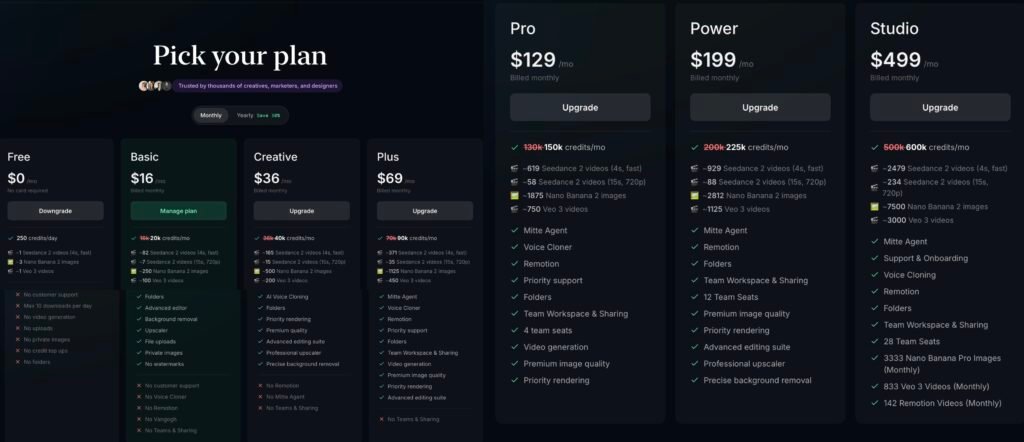
Mitte sells subscriptions on top of the free plan, with prices that change depending on which toggle you are viewing. Here is the monthly ladder, verified on the pricing page on June 12, 2026.
Switch the page to the yearly toggle and the same plans show lower monthly-equivalent prices, each billed as a single annual charge: Basic $10, Creative $25, Plus $49, Pro $83, Power $125, Studio $292.
The pricing page has three details worth checking before you subscribe.
Mitte’s two pricing surfaces do not agree, including the headline discount
Mitte shows its plans in two places that do not match. The public pricing page, reached from the top-nav Pricing link, carries a “Save 30%” yearly badge. The in-app page, under Settings then Plans, carries a “Save 50%” badge for the same plans and the same annual totals. We computed the real saving from the listed prices, and it runs from about 29 percent on Plus to 42 percent on Studio, near 35 percent on Basic. So the public page’s 30 percent is roughly right and the in-app 50 percent overstates it. The monthly-equivalent prices differ too: the public page shows Creative $25, Power $125, and Studio $292, while the in-app page shows $24, $124, and $291 for the identical annual totals. The price gap is a dollar and a rounding direction. The discount gap, 30 against 50 percent on the same plans, is the one to weigh, since only the lower figure matches what the prices actually save.
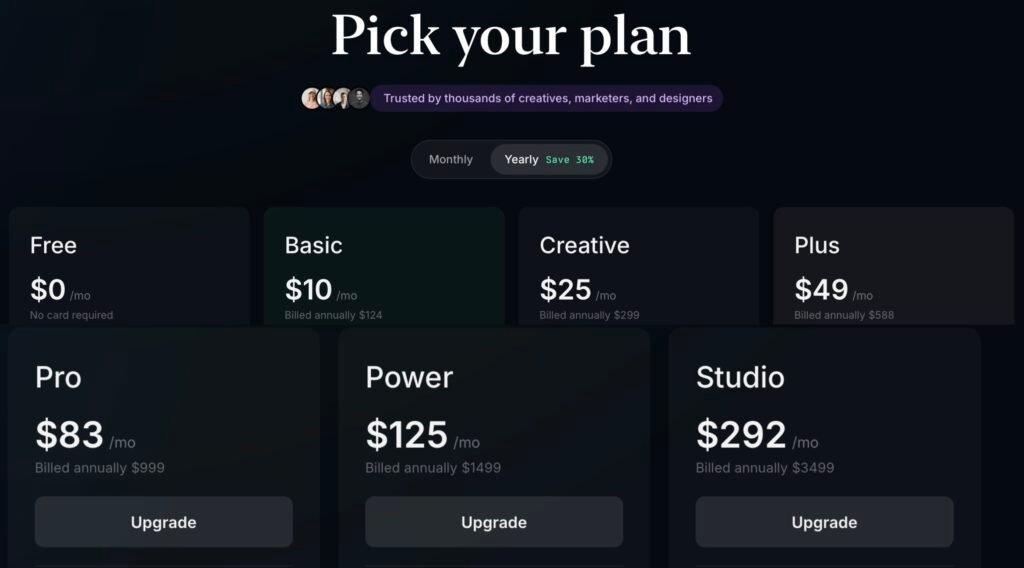
Mitte’s yearly pricing. The badge reads Save 30 percent; the savings we computed run about 29 to 42 percent depending on plan.
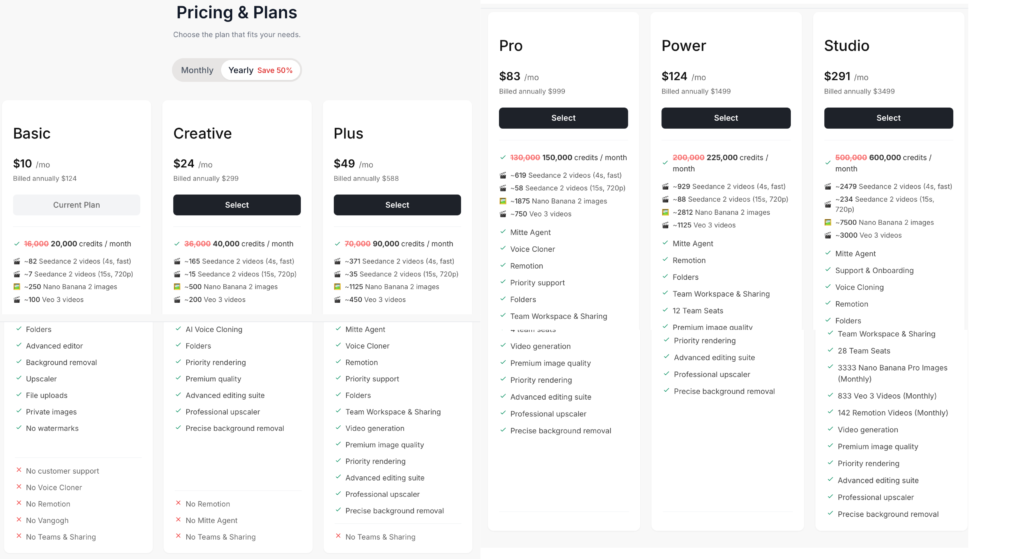
The credit counts are shown with a strikethrough
The Basic plan reads about 16,000 struck through, then 20,000. The framing is that you now get more credits than before. Whether the lower struck-through number was ever the real allowance is not something we could verify from the page.
Read the headline video counts carefully
The Basic plan advertises about 82 Seedance 2 videos. That number is for the cheapest variant: 4-second, fast. The same plan lists only about 7 Seedance 2 videos at 15 seconds and 720p, because a 15-second clip costs roughly ten times as much. The 82 figure is accurate. It is also the smallest, cheapest unit. Do not read “82 videos” as a general Seedance 2 allowance.
The prices only the panel shows
Mitte’s public pricing page lists plans and headline video counts. It does not list what any specific generation costs. It is the same split we covered in our Claude Fable 5 pricing breakdown: a published number that is not the price your plan actually charges.
Google did the sharper version of this with Gemini CLI, where a published quota of 1,000 requests per day was withdrawn in June 2026 and replaced by a credit meter whose baseline Google does not publish at all. The Gemini CLI shutdown removed the readable number outright, where Mitte at least still shows one in the panel.
Microsoft did a quieter version with MAI-Thinking-1, which it markets as cost-efficient while publishing no per-token price at all, so the cost claim cannot be checked.
Those numbers exist in one place: the generation panel, after you have picked a model, a tier, a duration, a resolution, and an audio setting. We walked the panel through Veo 3.1 and Seedance 2 on June 12 and 13, 2026, and wrote the numbers down. Treat everything below as displayed estimates from that session, not a stable price list. We charge-verified exactly two of them.
The spread inside one model is the headline. Veo 3.1 displayed 200 credits for a 4-second, 720p Lite clip and 4,800 for an 8-second, 4K Standard clip with audio, a 24x range under the same model name. Seedance 2 displayed 968 for a fast 4-second 720p clip with audio and 10,206 for a Standard 15-second 1080p clip with audio. That last number is more than half of the Basic plan’s 20,000 monthly credits, displayed for a single clip.
Audio is its own line item, and it is not consistent. On the Veo Standard and Fast tiers, switching audio on roughly doubled the displayed cost, for example 1,200 to 2,400 on a 6-second 1080p Standard clip. The Lite tier has no audio switch at all and displayed 200, and the Lite clips we generated arrived with an embedded stereo audio track anyway, which we confirmed by inspecting the downloaded files. Whether Lite audio matches Standard audio in quality is something we did not test, and the Lite tracks we received were mixed very quiet. On Seedance 2, our audio-on generation billed exactly the displayed 968, and the embedded track was close to silent.
Two smaller observations from the same walk. On Veo Standard, 720p and 1080p displayed the same price, with only 4K jumping higher, so picking 1080p over 720p cost nothing in our session. And the panel can display nonsense. With Lite selected at 8 seconds and 4K, it showed a cost of 1 credit. Generating from that state did not produce a one-credit 4K video. The server rejected it with an error saying the 4K option is not available for that resolution control, and no charge appeared. The displayed 1 was a broken label, not a price.
Put the marketing next to this. The Basic plan advertises about 82 Seedance 2 videos a month. Our cheapest Seedance 2 configuration, fast, 4 seconds, 720p, audio on, billed 968 credits, and at that rate 20,000 credits is about 20 videos, not 82. Some cheaper configuration presumably hits the 82 figure. The pricing page does not say which one, and the only place to find out is the panel.
Buying, upgrading, and refunds
The upgrade FAQ matters more than usual, and the safest place to learn the billing is the FAQ itself, which documents most of these corners.
Upgrades do not prorate
Mitte’s FAQ states that when you upgrade, your old plan is canceled and a new billing period starts immediately with the new plan’s full credits. There is no credit for the time left on the plan you were already paying for. If you upgrade from a yearly plan, the FAQ tells you to email [email protected] to get your unused months refunded so you do not pay twice.
The FAQ has a standing answer for a double-charge
It includes a question to the effect of “I was double-charged while upgrading, can I get a refund,” and the answer is yes, by email, with no processing fee. We did not test an upgrade, and we are not saying Mitte double-charged us. We are saying that Mitte’s own FAQ keeps a ready answer for a double-charge during upgrade, which tells you the scenario is common enough to document. If you are going to change plans, read that section first.
Refunds are narrow
Refunds are narrow, and Mitte’s own documents do not agree on the window. The pricing page and FAQ say five days. The Terms of Service section 8.1 says, word for word, “within seven (5) days,” with the number seven and a parenthetical five contradicting each other in the same sentence, while section 8.3 refers to a seven-day window. Whichever applies, a 15 percent service fee is deducted from every refund, credits already used are not refundable, and renewals are excluded. Before you rely on a refund, assume the shorter five-day window and confirm it in writing.
A free-plan overdraft follows you into a paid plan
Our free balance ended at -180 after the video test. When we subscribed to Basic, the plan did not open at its advertised 20,000 credits. It opened at 19,820. The 180-credit overdraft from the free plan was deducted from the paid allotment. The amount is small, about eighteen cents at the base rate. The behavior is worth knowing: upgrading does not erase an overdraft, it collects it.
One contradiction sits on the purchase side
Mitte offers credit top-up packs, and the copy on that page says “one-time purchase, no subscription required.” In our free-plan testing on June 12, the button to buy those packs was gated to subscribers only, so a free-plan user could not buy them despite the no-subscription line. On the paid plan the Add Credits page worked as described. If top-ups matter to your workflow, confirm whether you can buy them on the plan you are on.
We saw the reverse timing problem at another tool, where buying credits before subscribing changed what the buyer received.
A small note for completeness: the FAQ says priority support comes with the “Pro and Max” plans, but there is no Max plan in the current lineup, which reads like leftover copy from an older plan structure and was still live on June 13, 2026. Every other plan, including the $16 Basic we paid for, gets email support.
The trust boundary
For non-confidential creative work, the data terms are unlikely to be the deciding issue. For client or regulated material, they are, and they are stricter than the Enterprise framing implies.
- describes itself as an experimental AI platform
- reviews uploaded and generated content for safety and compliance
- processes data in the United States
- may retain data in backups and logs after deletion
- tells users not to upload sensitive, confidential, or personal material
Read that last line together with the first. The practical trust boundary is not whether Mitte can make good media. It is whether you should feed confidential or regulated material into a platform that calls itself experimental, reviews your content, processes it in the US, and tells you in writing not to upload sensitive data. The review part is not buried in legal text either. Mitte’s help FAQ states that its system checks all generated content and automatically terminates accounts that break platform rules, and that uploaded content passes through its safety systems (checked June 13, 2026). For a family-friendly consumer tool that is a defensible posture. It is also written confirmation that what you upload and generate is scanned.
The Terms of Service go further than the privacy policy, and the wording is worth reading before you upload client work. Section 3.2 grants Mitte a perpetual, irrevocable, worldwide, sublicensable license to use, copy, modify, and distribute anything you generate, for any purpose, and it names AI training and marketing among those purposes. Section 3.3 adds that your inputs and outputs may be used to train its models, and that by using Mitte you consent to that. Section 5.2 states it plainly: you have no expectation of privacy regarding your content. None of this is unusual for a free consumer AI tool. It is a problem only if you were planning to put paid client work or anything proprietary through it, which the terms themselves advise against.
For EU and enterprise buyers there are open questions rather than answers, and they are worth putting to the vendor directly. We did not find a public Data Processing Agreement or a subprocessor list on Mitte’s official pages. Without those, an EU or enterprise buyer cannot confirm the data-residency, lawful-basis, and subprocessor details that GDPR-governed procurement usually requires. The discount display and US processing also raise consumer and data-protection questions under EU rules, given that the vendor is a US company selling into the EU. We are not asserting that Mitte complies or fails to comply with any of these. We are flagging the questions a careful buyer should ask before uploading anything that matters. The Terms also cap Mitte’s total liability at the greater of the fees you paid in the prior three months or one hundred dollars, which is a normal startup clause but a relevant ceiling for any business weighing what happens if something goes wrong.
Mitte’s imprint also lists a single email, [email protected], as the contact for every kind of request, including legal, billing, refunds, account deletion, and disputes. There is no phone number or separate legal contact.
Upstream model risk: Sora 2
One model on Mitte’s roster has a clock on it, and the clock is OpenAI’s, not Mitte’s. OpenAI’s API deprecation page lists the Videos API and the sora-2 and sora-2-pro models for shutdown on September 24, 2026, with no replacement named, announced on March 24, 2026. We do not know how Mitte sources or routes Sora 2, so we are not saying Mitte’s Sora 2 will stop working. The point is narrow: if Mitte still lists Sora 2 when you read this, treat it as an upstream availability risk, and do not choose Mitte for Sora 2 alone. For contrast, Mitte’s GPT Image 2 is OpenAI’s current image model rather than a deprecated one, so the same concern does not apply there.
Mitte versus going direct
Mitte is a convenience layer, not the cheapest path to these models. Several of the models Mitte resells, including the Chinese video models, are available directly from their providers, so a high-volume creator who is willing to manage provider accounts should compare the direct per-model pricing against Mitte’s credit cost before committing. That is the normal trade-off for any aggregator, not a Mitte-specific flaw.
AI video pricing is rarely simple even when you go direct, as our comparison of Runway and Pika shows.
We are not putting a markup percentage on this, because Mitte does not disclose which model variant, tier, or resolution a given credit charge routes to, which makes a precise markup impossible to verify from the outside. That non-disclosure is itself the point: you can see what a generation costs in credits, once it settles in your usage log, but not whether you are paying a convenience premium or close to cost for the specific model behind it.
So the trade is plain. Mitte’s value is one account, one balance, and many models, with no provider setup. If one account and one balance save you enough setup time, the layer is worth it. If you generate enough that unit economics dominate, price the direct route for the specific models you use before you commit.
Who should use Mitte, and who should not
Who should use Mitte
Mitte is a good fit if your work is image-first and you want a strong image model without a separate subscription. It suits creators who want to sample and compare several models from one place, who work with non-confidential material, and who will run one cheap probe of each configuration and then budget from the usage log rather than the panel. If you mainly want to try things, the free plan alone is worth the time.
If you are still picking an image tool, our roundup of the strongest standalone AI image generators compares the options.
Who should skip it
Skip Mitte if you want heavy video generation for free, because one short clip can exceed a full day of free credits. Skip it if you are expecting flat, unlimited usage, since this is a metered system that can run your balance negative. And skip it, for now, if you handle confidential, regulated, or client data, or if your organization needs an SLA, a DPA, or a subprocessor list before you can upload assets. Mitte’s own terms point you away from sensitive material.
Who should wait
Wait if your real goal is the upper video tiers. We tested Veo 3.1 at Lite and Seedance 2 at fast on the $16 plan, and both billed exactly as displayed. We did not run the Standard, Pro, or 4K configurations, whose displayed costs ran as high as 10,206 credits for a single clip, and whose billed costs we therefore cannot confirm. Price the actual stack for the generations you want, probe each configuration once, and read the log before you batch. If Sora 2 is your reason for choosing Mitte, factor in its September 2026 upstream shutdown.
What we did not test
We did not run every model on Mitte. This review focuses on the credit meter, the public pricing page, and what a paying buyer is actually charged, so the generations are a sample, not a full catalog test.
We did run, as supporting checks: GPT Image 2 at three quality steps, plus several video flows (Seedance 2, Kling 3.0, Veo 3.1, LTX 2.3, Grok Video). These confirmed the same display-versus-charge pattern in more places. They are single runs per configuration, not a benchmark, and we do not rank one model against another from them.
We did not cover Video Avatar. That is a separate category on Mitte (Veed Fabric, Omnihuman 1.5, LTX 2-19b Avatar, Kling Avatar v2, Lipsync 2), and it carries a heavier trust and licensing question because it involves a face and a voice. We cover it in a separate piece.
FAQ
Is Mitte AI free?
Yes, Mitte has a free plan with no card required. It refreshes 250 credits per day, resetting at midnight UTC (verified June 12, 2026). That is enough to test image generation across several days, though one short video can spend more than a full day of credits in a single clip.
How do Mitte AI credits work?
Mitte uses one credit balance for all models, priced at 1,000 credits for one dollar. The cost per generation changes by model, tier, duration, resolution, and options, and the per-configuration prices appear only in the generation panel, not on the pricing page. The panel number is an estimate. In our eight billed tests, four configurations billed exactly as displayed and two billed higher every time, one by 6.2 times (verified June 12 to 13, 2026).
How many credits does a Mitte video cost?
It depends on the configuration, and the panel is only an estimate. Billed examples from our testing: a 6-second Hailuo 2.3 text-to-video clip billed 280 (displayed 45), the same clip as image-to-video billed 480 (displayed 480), a 4-second 720p Veo 3.1 Lite clip billed 200 (displayed 200), and a 4-second 720p Seedance 2 fast clip with audio billed 968 (displayed 968). Displayed prices we did not run reached 10,206 for one Standard Seedance 2 clip.
Does Mitte auto-charge your card when credits run out?
We found no auto-recharge or overage billing setting in our testing, so on the plans we used, running out of credits did not trigger a card charge. Extra credits are bought manually at $1 per 1,000 and never expire. On the free plan the balance can run negative instead of stopping, ours hit -180, and that overdraft was deducted from our paid plan when we upgraded (verified June 13, 2026).
Do Mitte credits roll over?
Monthly plan credits do not roll over. Mitte’s FAQ says they reset at the start of each billing month, and yearly plans get a fresh monthly allowance with unused credits resetting the same way. Manually purchased top-up credits are the exception: the same FAQ says they never expire (checked June 13, 2026).
Is Mitte good for AI image generation?
In our free-plan testing, yes. Nano Banana 2 produced strong, prompt-accurate images, with the panel showing 80 credits at both 1K and 2K. Note that this configuration billed 120 in our settled runs, not the 80 shown, so budget from the receipt. Image generation was the strongest part of the product and the clearest reason to try the free plan.
Is Mitte good for free AI video generation?
Less so. The accessible free video model, Hailuo 2.3, produced mediocre, audio-free results in our test, and one short clip can exceed the daily free credit allowance. Treat the free tier as image-first, and do not judge Mitte’s premium video ceiling by it.
What should I check before subscribing to Mitte?
Run one cheap probe of each model and configuration you plan to use, then read the usage log and the asset’s Cost field, because the panel number is an estimate that was wrong for two of our six configurations. Read the refund and upgrade FAQ, since upgrades do not prorate and refunds carry a 15 percent fee inside a 5-day window. Decide whether the privacy terms fit your material before uploading anything.
Does Mitte support Sora 2, Veo 3.1, and Seedance 2?
Mitte’s roster lists all three. On the $16 Basic plan we generated with Veo 3.1 at its Lite tier and Seedance 2 at its fast tier; both billed exactly their displayed price and produced watermark-free 720p files with embedded audio. We did not run Sora 2. OpenAI has scheduled the Sora 2 API for shutdown on September 24, 2026, so if Mitte still lists it, treat it as an upstream availability risk.
Is Mitte safe for confidential business assets?
Mitte’s own privacy policy advises against uploading sensitive, confidential, or personal material, describes the service as experimental, processes data in the US, and reviews uploaded content. Its help FAQ adds that its system checks all generated content and can terminate accounts that break platform rules. We did not find a public DPA or subprocessor list. For regulated or client data, hold until the vendor provides those terms.
the X follow-for-250-credits offer, which we could not confirm: our account already followed @mitte_ai, so we did not observe whether a new follow grants the credits.
Methodology and sources
This is a Tier B review based on hands-on testing of both the free plan and a paid subscription. On June 12, 2026 we tested a free Mitte account on desktop Safari: Nano Banana 2 images at 1K and 2K, the web search option on an image, a Hailuo 2.3 six-second video at standard quality, and an image-to-video continuity pass. The same day we paid $16 for one month of Basic and continued into the early hours of June 13: the same image and video configurations again, Hailuo 2.3 image-to-video with a first frame, two Veo 3.1 Lite clips at 4 seconds and 720p, one rejected Veo 3.1 Lite attempt at 8 seconds and 4K, and one Seedance 2 fast clip at 4 seconds and 720p with audio. The paid session ran from 20:41 to 00:22 Japan time, about three hours forty minutes of wall clock.
Every billed figure reconciles three ways: the pre-generation panel display, the balance before and after, and the usage log, all captured in timestamped screenshots. The paid period’s usage total of 2,248 credits equals the sum of the six paid charges (120, 280, 480, 200, 200, 968). The Basic plan’s opening balance of 19,820 equals 20,000 minus the free plan’s 180-credit overdraft. We also inspected two downloaded output files, one Veo 3.1 Lite clip and one Seedance 2 clip, at the container level to confirm the embedded audio tracks, the resolution, and the absence of watermarks, including a contrast-amplified check of the frame corners.
The pricing, FAQ, refund, upgrade, support, location, and privacy claims were checked against Mitte’s own pages on June 12 and 13, 2026, and are described as Mitte states them. The per-configuration panel prices quoted for Veo 3.1 and Seedance 2 are displayed estimates captured in those sessions; only the 200 and 968 figures are charge-verified. The Sora 2 shutdown date comes from OpenAI’s official API deprecation page. The single out-of-test signal, one creator’s per-generation cost drift, is labeled as such and was not reproduced by us. Volatile items, including prices, panel estimates, the model roster, and the Sora 2 listing, should be rechecked against the live pages, since all of them can change.
Mitte’s in-app FAQ, reached through Settings then Need help, was read while signed in on June 13, 2026.
The Terms of Service and privacy policy were read in full at https://mitte.ai/terms on June 13, 2026. Quoted section numbers refer to that version of the Terms, last updated February 25, 2026, and may change.
How we measured cost
This review separates two layers of evidence.
Core receipts: paid generations where we logged the displayed estimate before generating, then reconciled three independent numbers after the charge settled: the asset Cost field, the usage-log row, and the change in our credit balance. We treat a billed figure as confirmed only when at least two of the three agree. Every headline price here meets that bar.
Supporting runs: additional generations captured later in the usage log (image and video flows, plus the avatar category). They show the same pattern but are not all reconciled to the two-of-three standard yet. Where a supporting run shows a gap, we label it usage-log observed, pending confirmation. We do not present those as final prices, and we do not rank models from them.
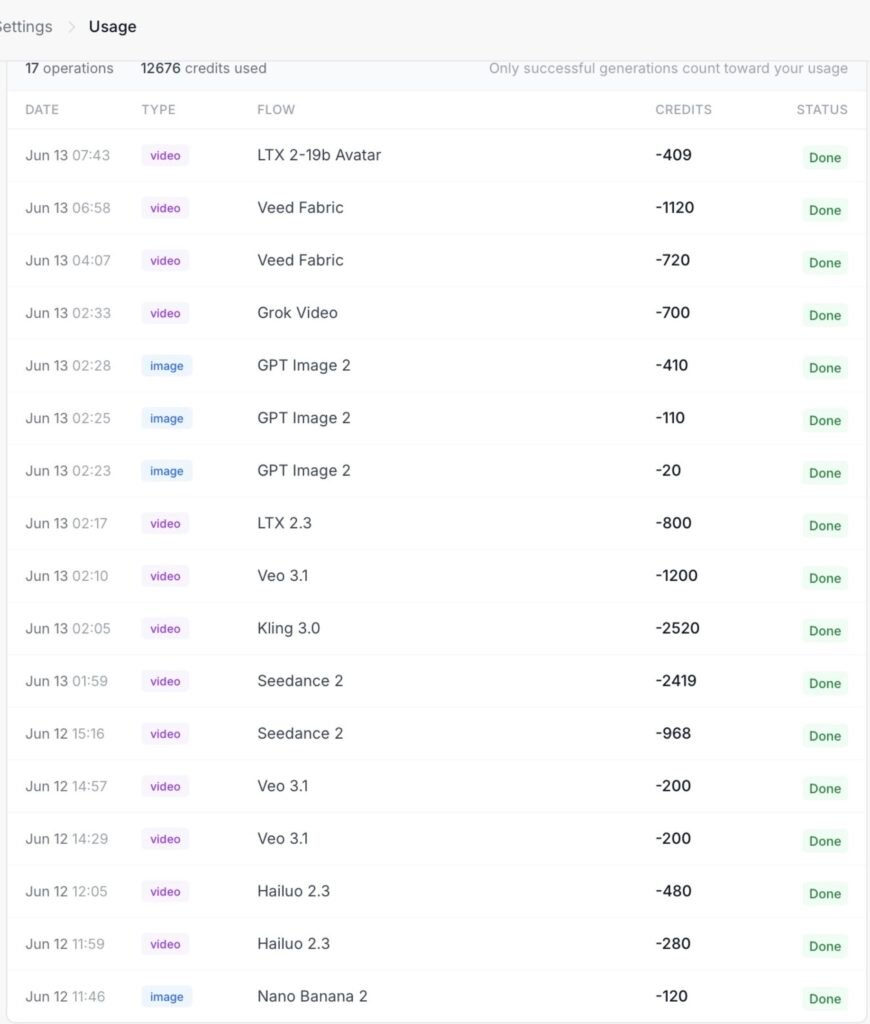
These supporting rows are usage-log readings, not benchmark results. Seedance 2 logged 2,419, Kling 3.0 logged 2,520, Veo 3.1 logged 1,200, and GPT Image 2 logged 20, 110, and 410 across three quality steps, each matching the number its panel showed. Two logged higher than the panel. LTX 2.3 showed 600 and logged 800, and Grok Video showed 500 and logged 700. We have not reconciled each to the two-of-three standard, so we treat the two gaps as a direction to verify, not a published price.
FSR verdict
The output is good enough that this should not become a billing takedown. The images were strong, the paid video clips from Veo 3.1 Lite and Seedance 2 were usable and watermark-free with audio in the file, the free plan is real for exploring, and one balance across many models is convenience some creators will pay for happily.
The caution is just as real, and it sits in the meter, not the output. The per-generation prices exist only inside the app. The number the panel shows is an estimate that was exact for four of our six configurations and wrong by up to 6.2 times for the other two, with the same wrong number on free and paid. The balance ran negative with no stop at zero, the overdraft followed us into the paid plan, upgrades bill without proration, and the privacy terms tell you in writing not to upload anything sensitive. None of that makes Mitte a bad product. It makes it a product you budget from receipts, not from the screen.
So the verdict splits. For an image-first or model-sampling creator who will probe each configuration once and read the usage log, Mitte is worth a paid month, and the free plan is worth it for anyone. For a production buyer who needs to quote per-asset costs in advance, or for anyone handling confidential or regulated material, hold. The prices you would be quoting are not published, and the meter is only sometimes the price.
FSR uses affiliate links only where a verdict is balanced and the cautions stay intact. If you subscribe to Mitte through our link, FSR may earn a commission (15 percent for the first three months) at no extra cost to you, and it changes nothing in this review. You can also go directly to mitte.ai.