Last updated: July 13, 2026
A post-mortem on OpenAI’s video app: the deadline developers cannot ignore, what can and can no longer be verified about the face and voice data people uploaded, and why the market OpenAI pointed nobody toward is wide open.
Last updated: June 14, 2026
Sora was OpenAI’s standalone AI video app and API. The app and website closed on April 26, 2026, and the Sora API shuts down on September 24, 2026. The cost of running it is the easy explanation for the shutdown. The harder one is what Sora exposed: a generative API retired with no successor, and a consumer app that took people’s face and voice data, then stopped. The consumer product is already gone, so there is nothing left to test by hand.
Claim status · verified June 14, 2026
Most of the obituaries reached for one number. Compute cost somewhere between one and fifteen million dollars a day, set against roughly $2.1 million in lifetime app revenue. Run the arithmetic and Sora looks like a money fire OpenAI finally stopped feeding.
That math is plausible enough. It also explains the wrong thing.
A burn rate is survivable when people keep coming back, which is why OpenAI runs ChatGPT at enormous cost. Sora never became that kind of habit. That explains why OpenAI was willing to let it go, but it says nothing about what the shutdown costs the people who used it. Two groups inherit that cost. Developers built against an API that now carries a shutdown date and, on OpenAI’s own page, a blank where the replacement model should be. Ordinary users handed a short-lived app their face and voice, and the pages that documented what happened to that data have come offline with the product. Those are the parts worth keeping: the code pointed at a dead API, and the most permanent identifier a person owns, fed into a tool that lasted seven months.
On this page
TL;DR
Where you stand
Where you stand
The timeline, corrected
A lot of write-ups get Sora’s birthday wrong, dating the launch to 2024 and calling it a fifteen-month, or even twenty-three-month, experiment. That is wrong, and the error matters, because a tool that bled out over fifteen months reads differently from one that came and went in seven.
February 2024 was a research preview, a web demo of the underlying model. The thing most people actually used, the standalone Sora 2 app with the cameo feature, launched on September 30, 2025. From public app to public obituary was under seven months.
| Date | Event |
|---|---|
| Feb 15, 2024 | Sora research preview (web demo of the model) |
| Sept 30, 2025 | Sora 2 standalone app launches |
| Oct 1, 2025 | Reality Defender reports bypassing the app’s anti-impersonation check within 24 hours (a vendor claim, picked up by TIME) |
| March 13, 2026 | Sora 1 removed in the US; Sora 2 becomes the default |
| March 24, 2026 | OpenAI announces the shutdown and notifies API developers |
| April 26, 2026 | App and website go dark (about one month after the announcement) |
| Sept 24, 2026 | Sora API shuts down (about six months after the announcement) |
If a source tells you Sora ran for a year and a half, it did not check the app’s actual launch date.
The verified finding: a deadline with a blank where the successor should be
For developers, this is the part that holds up under any scrutiny, because it comes straight from OpenAI’s own deprecation page.
Open that page and you find a long list of retired models, and almost every one carries a named replacement. DALL·E points to a current image model, gpt-image-2. The retired GPT-4 snapshots point to a GPT-5 successor. Even obscure 2024 embedding models point somewhere. Filling that column is routine practice.
Then you reach the Sora row. The Videos API, sora-2, sora-2-pro, and every snapshot share a shutdown date of September 24, 2026, and a recommended replacement of, literally, “—“.
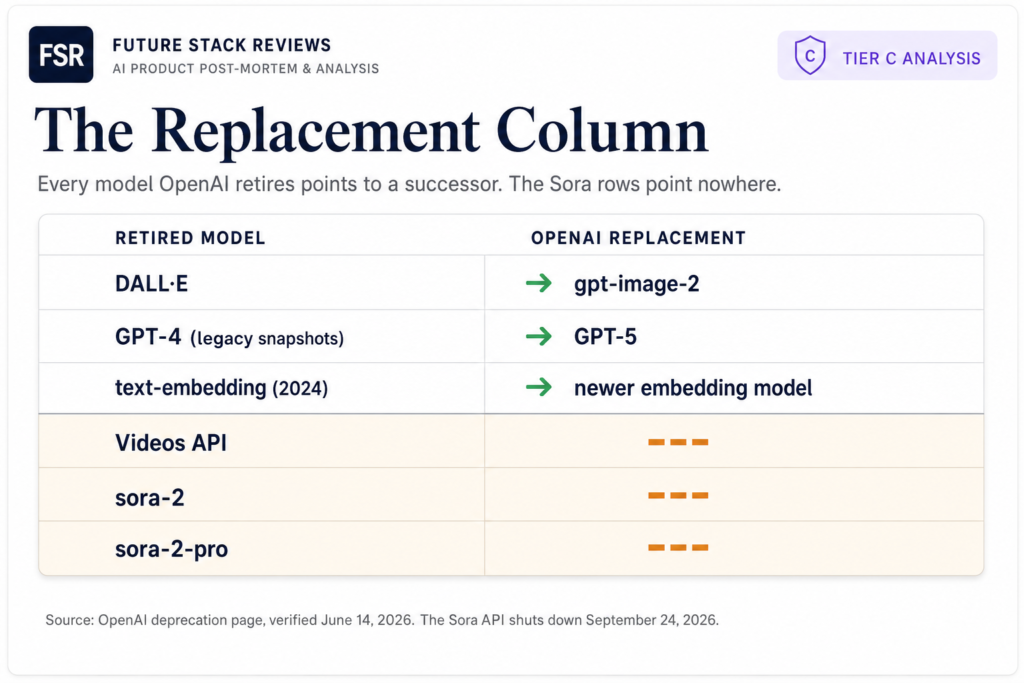
That blank is the finding. A removal date with nothing in the replacement column is a deadline, not a path. It tells developers the next step leads off OpenAI entirely.
The timing sharpens it. OpenAI announced the shutdown on March 24, 2026. The consumer app went dark about a month later. The API kept the standard six-month runway OpenAI gives generally available models. So consumers were cut off fast, developers were given time, and in both cases the destination stayed empty.
The only hint of a continuation path is a general line on the same page: developers may be able to provision dedicated capacity for continued access past a shutdown date by contacting sales. That is life support you pay for, and few teams will take it.
None of this is really about Sora. Anyone who built on a single vendor’s generative API just watched that API get a death date with a dash where the off-ramp should be. That is the standing cost of putting your core on infrastructure you do not control.
The open-source case is not exempt. TensorZero was fully self-hostable and still shut down, leaving its users facing a migration, because an archived, unmaintained tool stops getting security patches and provider updates even when you can still run it. Owning the code postpones the off-ramp; it does not remove it.
What happened to the face you uploaded, and why that is now hard to answer
The consumer app’s cameo feature asked you to record a short clip so Sora could capture your face and voice and place your likeness in generated videos. That capture is biometric data, and biometric data is unforgiving in one way: you can reset a password, but you cannot reset a face. Unlike a password, a biometric template cannot be reissued once it is exposed.
So the natural question for anyone who used it is simple. With the product gone, what happened to that data?
Before you delete anything
Deleting your OpenAI account to clear Sora data also removes your ChatGPT history and API access, because Sora, ChatGPT, and the API share one account.
The earlier reports of a permanent lockout are outdated. Under OpenAI’s current policy you can reuse the same email and phone after 30 days, so the real cost is the lost access, not a permanent ban. To request data deletion without removing the whole account, use OpenAI’s Privacy Portal.
And this is where it gets harder. The consumer help pages that documented how the cameo feature handled and retained face and voice data no longer resolve at their published locations. Whether moved or removed, the public record that would answer the question has thinned now that the product is gone. So I am not going to assert what OpenAI does or does not keep, in either direction. The honest position is that the documentation a user would need to check is no longer where it was.
What can still be verified sits in three places, and none of it is a hidden-faceprint scandal.
The account coupling is real. Deleting your OpenAI account removes your ChatGPT and API access along with everything else, because Sora, ChatGPT, and the API share one account. At launch, Sora’s terms went further, saying you could not reuse your email or phone afterward, and OpenAI acknowledged it was working on a way to delete a Sora account on its own. OpenAI’s current account policy has since softened the identifier part: you can reuse the same email after 30 days, and the same phone after 30 days, within a three-account limit. So the remedy is blunt rather than permanent. To clear everything, you may have to delete an account that also holds your ChatGPT history.
Training exposure is a consumer-versus-business split. OpenAI’s policy is that content from its consumer services can be used to improve its models unless you opt out, while business and API usage is excluded by default. For someone who uploaded a real person’s likeness through a consumer app, that distinction is a governance question, not a footnote.
Meta ran into the same opt-out-versus-training gap weeks later: in July 2026, Meta reversed an Instagram likeness feature in Muse Image, and the control it pointed users to governed content reuse, not model training.
The API drew a firmer line than the app. In the Videos API, uploads depicting human likeness were blocked by default and gated to eligible customers. The face-and-voice capture was a consumer-app feature, not something the API handed to every developer.
Taken together, the data story is quieter than the headlines and more structural. A product that encouraged people to hand over their most permanent identifier has shut down, taken its consumer documentation offline, and left an account-wide switch as the only clean way to force deletion. It is the same off-ramp problem in another form.
Why it died: the compute story is the easy part
The compute number was the one everyone could find, so it became the explanation. Estimates ran from a conservative million dollars a day in the Wall Street Journal’s account to roughly fifteen million in a Cantor Fitzgerald model, and that high figure was a theoretical ceiling built from a per-clip cost. OpenAI confirmed none of them. Treat every figure here as an outside estimate, not a disclosure.
The cost made Sora expensive to run. Weak repeat use made it hard to justify running. Reported retention figures point to a product people tried once and did not return to, with the often-quoted numbers landing far below anything that resembles a lasting consumer habit. I am deliberately not hanging this section on a single percentage, because the precise figure comes from third-party readings, not from OpenAI, and the directional point holds either way: a novelty nobody reopens cannot amortize its compute no matter how low that compute goes.
That reframes the robotics move too. OpenAI says the Sora team is shifting to world-simulation research for robotics, a theme it was already describing in February 2024, before the app existed. Treat it as a long-term research direction and a stated rationale, not the whole story. The compute did not vanish. It moved toward the things that retain users.
The fuller read is a combination, not a single villain. The bill was high and repeat use was weak, and OpenAI would rather point scarce compute at products people reopen. Most coverage picked the bill because it was the cleanest line to write.
The alternatives: the market is open, and mostly cheaper
For anyone migrating, the good news is that the destination column OpenAI left blank is crowded in the real world, and the prices come in below what Sora charged.
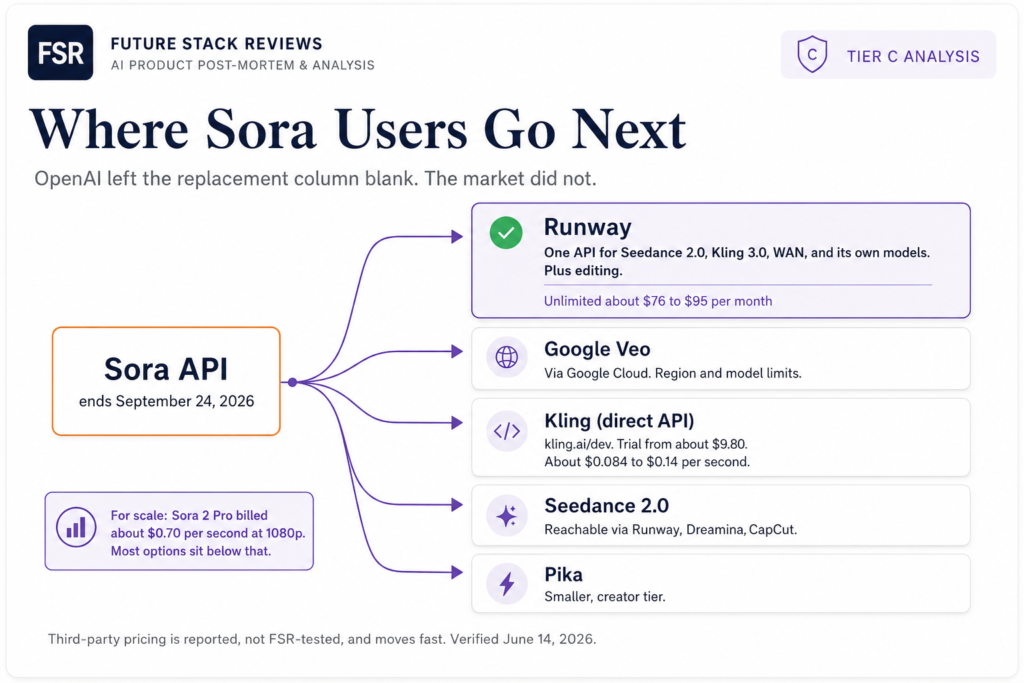
For scale: OpenAI billed Sora 2 Pro at about $0.70 per second for 1080p. Most of the options below sit well under that.
The most common piece of advice in the shutdown coverage, “switch to a cheaper Chinese model,” turned out to be more available than much of that coverage suggested. The gate that supposedly locked Western buyers out is mostly not there. Kuaishou’s Kling runs a public developer API with disclosed, prepaid pricing: trial packs under ten dollars, standard packs from a few hundred, and per-second rates around eight to fourteen cents for standard and pro generation, with 4K higher. ByteDance’s Seedance 2.0, after an earlier pause on its international rollout, is now reachable through Runway, Dreamina, and CapCut, and Runway added it to its own API in late May 2026, with a faster variant following in June.
Runway is worth singling out, because it has quietly become the most practical single destination for a Western team leaving Sora. It aggregates Seedance 2.0 and Seedance 2.0 Fast, Kling 3.0 and its siblings, WAN, and its own models behind one API, with editing tools layered on top. That is closer to a replacement platform than a replacement model.
Sora replacements, by operating surface
| Option | Western access | API | Reported cost | Note |
|---|---|---|---|---|
| Runway | Yes | Yes | Subscription; Unlimited around $76 to $95/mo | Aggregates Seedance 2.0 and 2.0 Fast, Kling 3.0, WAN, and its own models behind one API with editing. Strong one-stop destination. |
| Google Veo | Yes | Yes, via Google Cloud | Mid-tier | Region and model limits; tied to Google’s ecosystem. |
| Kling direct API | Yes | Yes (kling.ai/dev) | Trial packs from ~$9.80; ~$0.084 to $0.14/sec, 4K ~$0.42/sec | Disclosed prepaid pricing, concurrency limits, a contract with a Kuaishou entity. |
| Seedance 2.0 | Yes | Via Runway API and others | Among the lowest on paper | Reached through Runway, Dreamina, CapCut. Direct international rollout had an earlier pause. |
| Pika | Yes | Limited | Creator-tier | Smaller, more consumer-focused. |
For scale, OpenAI billed Sora 2 Pro at about $0.70 per second at 1080p. Third-party pricing here is reported or estimated, not confirmed by FSR hands-on testing, and moves fast. Verify current rates and terms before committing.
The real caveat is subtler than access or price, and it is what “a replacement model is not a replacement platform” actually means once you look closely. Going direct to Kling means prepaid units and concurrency limits, under a contract with a Kuaishou entity. Reaching Seedance through Runway means living inside Runway’s plans and moderation. Veo ties you to Google’s stack. None is a drop-in for the exact Sora surface you had, and for likeness-heavy workloads the regulatory questions below travel with you regardless of which you pick.
The off-ramp audit
This is the part worth keeping after the Sora news goes stale. Before a team uploads a face, trains a character, builds against a video API, or stores client work inside any AI video product, it should be able to answer these:
- Is there a model successor, or only a removal date?
- Can you export your assets, prompts, and generated library in usable form?
- Can you delete a likeness reference without deleting your entire account?
- Is training use opt-in, opt-out, or off by contract, and do consumer and business terms differ?
- What is deleted, on what timeline, and which exceptions apply?
- Is a DPA available, and are business terms offered in your region?
- If the product shut down tomorrow, would its documentation still be there to tell you what happened to your data?
Sora answered some of these and, in the end, took the answers to others offline. A buyer should ask them before the upload, not after the shutdown notice.
The regulatory read: EU and India
If your use of any of these tools involves uploading other people’s faces and voices, the shutdown is also a compliance prompt. This is risk framing, not legal advice, and nothing here is a finding of violation. Where it matters, run it past counsel.
The EU view
In the EU, face and voice prints are biometric data and fall under the special-category rules of the GDPR, which set a high bar for collection, lawful basis, and consent, and grant a right to erasure. When a company shuts down a service that processed special-category data, how that data is retained or deleted is exactly the kind of question a regulator can ask, and the answer being harder to find after the fact does not make the obligation go away. The EU AI Act adds a separate layer for AI-generated impersonations of real people, with transparency obligations for deepfake content that the Act is phasing in. Because the processing happened on US infrastructure, the cross-border transfer rules raise their own questions. None of this is a verdict. All of it is the reason an EU organization that touched Sora’s API should treat the migration as a procurement and compliance event, not only an engineering one.
India: lighter on the input, tougher on the output
India is one of the world’s largest creator and short-video markets, so a consumer AI video tool always draws attention there, and the regulatory fit runs opposite to the EU. Indian legal analyses of the Digital Personal Data Protection Act, 2023 note that, unlike the GDPR, it does not carve out biometric data such as face and voice as a special category. It treats them as ordinary personal data, with a right to correction and erasure once the stated purpose is complete or consent is withdrawn. On the input side, your faceprint gets a lighter baseline shield in India than in Europe.
The output side is where India moved hard. Reporting and legal commentary describe amendments to the IT intermediary rules, effective in early 2026, that define synthetically generated information, require AI-generated content to be prominently labelled and, where feasible, to carry provenance metadata, and shorten takedown timelines for flagged synthetic content after an authorized order. India has also acted in practice, with reports of a 2025 arrest over a doctored video of the Prime Minister and a stock-exchange warning about deepfake videos impersonating its chief executive. The result is the Indian version of the same gap: the state moves hard against whoever deepfakes a person, while the face that person handed over sits under ordinary personal-data rules.
FAQ
Is Sora really shut down?
Yes. OpenAI announced the shutdown on March 24, 2026. The consumer app and website went dark on April 26, 2026. The Sora API continues until September 24, 2026, then stops. OpenAI has not announced a successor product for either the app or the API.
Can I still use the Sora API, and is there a replacement?
The Sora API runs until September 24, 2026. OpenAI’s deprecation page lists the recommended replacement for the Videos API and every Sora 2 model as “—“, meaning no successor. Any migration is to a third-party platform, and OpenAI gives developers only a general option to negotiate dedicated capacity through sales.
What happened to the face and voice data I uploaded?
This is harder to answer than it should be. The consumer help pages that documented cameo data handling no longer resolve now that the product has shut down. What remains verifiable is that deleting your OpenAI account removes ChatGPT and API access, and that consumer content can be used for model training unless you opt out. For deletion now, use OpenAI’s Privacy Portal.
If I delete my account, can I reuse my email and phone?
Yes. OpenAI’s current policy lets you create a new account with the same email after 30 days, and reuse the same phone after 30 days, within a three-account-per-number limit. Sora’s launch terms said otherwise, but that stricter language has been superseded by the general policy.
Why did Sora really shut down?
A combination. The compute cost, estimated at one to fifteen million dollars a day and never disclosed by OpenAI, made it expensive. Reported retention figures suggest weak repeat use, which made it hard to justify. OpenAI says it is redirecting the team to world-simulation research for robotics, a real but long-standing theme.
What are the best alternatives, and are the Chinese models really off-limits for Western buyers?
No, they are reachable. Kling runs a public developer API with disclosed pricing, and Seedance 2.0 is available through Runway’s API, Dreamina, and CapCut. Runway is the strongest single destination because it aggregates Seedance, Kling, and others behind one API. Most options cost less than Sora 2 Pro’s roughly $0.70 per second at 1080p.
Is Sora safe for EU or enterprise use?
This is a regulatory question, not a verdict. Face and voice data are special-category biometric data under the GDPR, with strict consent and erasure rules, and the EU AI Act adds deepfake transparency obligations. Any organization moving likeness workflows to a new vendor should treat it as a compliance review.
Methodology and sources
This is a Tier C analysis. The product is discontinued, so there was no hands-on testing and none was possible. The work here is source verification, contradiction-checking, and synthesis, with a deliberate effort to separate what current primary documents confirm from what is now unverifiable.
What I treated as ground truth: OpenAI’s developer deprecation page and Videos API guide, OpenAI’s account-deletion and data-usage policies, and the developer documentation and changelogs for Runway and Kling. Each load-bearing claim about dates, the missing API successor, account deletion, training use, and third-party access was checked against these primary pages.
What I corrected from earlier drafts because the primary source said so: the claim that deletion permanently burns your email and phone (OpenAI’s current policy allows reuse of both after 30 days), and the claim that the Chinese models are gated or unavailable to Western buyers (Kling’s API pricing is public and Seedance is available through Runway’s API). I also removed any assertion about what OpenAI keeps or derives from cameo uploads, in either direction, because the consumer documentation that would support such a claim no longer resolves.
What I treated as reported, not confirmed: every financial and usage figure. OpenAI disclosed none of them. Revenue near $2.1 million comes from third-party app-data estimates. Compute figures of roughly one million (WSJ) to fifteen million (Cantor) dollars a day are outside estimates, and the higher one is a theoretical ceiling. Retention is treated directionally, not as a precise number. The Reality Defender bypass is a vendor claim reported by the press, not an independent audit.
What I did not verify: payload-level data handling, and the live state of third-party pricing, which moves quickly.
Verification date: June 14, 2026, against current primary documentation. Volatile items to recheck: alternative-tool pricing and availability, and any new OpenAI statement on a Sora successor or on cameo data handling.
FSR Verdict
Sora was sold as a creative revolution. As a consumer product it did not work, and the reported numbers say people came once and did not return. That is a failure, but it is not a scandal, and the lazy version of the privacy story, that OpenAI quietly hoarded everyone’s faceprint, is not something the available record supports in either direction.
The more durable lesson is plainer. OpenAI ended a product and an API and pointed nobody anywhere, leaving a dash in the column where a successor should be. It cut consumers off in a month and developers in six, and as the product wound down, even the documentation explaining what happened to the face and voice data people uploaded came offline with it. The expensive part was never only the compute. It was learning, after the fact, that a generative AI product can vanish and take your workflows and your ability to audit your own data with it.
This is not a story about OpenAI being uniquely careless. The market it ignored is open and cheaper, and migrating is mostly an engineering and governance job rather than a crisis. The real takeaway is procedural: AI buying now needs an off-ramp audit as standard. If you only ever played with Sora, you are fine. If you uploaded your likeness, use the Privacy Portal and know that the blunt remedy also costs you ChatGPT. If you built on the API, your deadline is September 24 and your map ends at the border. And if you are choosing what comes next, ask how it leaves before you ask how it looks.
Related from FSR
- Ahrefs Agent A: the sticker price that hid the real stack
- Grok Build CLI: when the product’s own loop is the failure
- Mitte AI: reading the credit meter nobody explains
- Runway: the one-API aggregator most Sora migrants land on
- Pika: the smaller, creator-tier corner of AI video