Last updated: July 29, 2026
Evidence boundary. This is a Tier B, hands-on review. Future Stack Reviews created one HeyGen free account in Japan and worked it across two sessions, on 28 and 30 July 2026. Three generations were submitted across two creation modes, and every file, cloud and sharing control the interface offered was tried. Findings describe that one account on those two dates. The account remained on the free plan throughout. No paid plan was entered. Vendor documentation is recorded as an official claim, not as verification of runtime behaviour.
HeyGen is a browser-based platform that generates presenter-style video from a script, using stock or custom avatars. Paid web plans issue a monthly credit allocation and draw against it at published rates. The free tier is the route the vendor offers for trying that before paying.
FSR opened one free account and worked it across two sessions, two days apart.
The free account exposed the workflow and left the two questions that decide a purchase open.
Those two are what a minute of equivalent paid production would cost, and what a delivered video file would contain. Neither is a gap in the session. Both are properties of what a free account can reach.
Read this if
- You are about to spend a free allowance and want to know what it buys
- Your decision turns on cost at volume rather than on how the avatar looks
- You need an output file to reach someone outside your account
- You are writing a procurement note and need the untested items named
Skip this if
- You want paid plan behaviour. This account never entered one.
- You want delivered file quality. No video file was obtained.
- You want a buy or do-not-buy recommendation
- You want API, LiveAvatar or team behaviour
At a glance
| Review depth | Tier B, hands-on. One free account. |
| Account and dates | One new free account, Japan. Two sessions, 28 and 30 July 2026. Still on the free plan at the end of both. |
| Generations submitted | Three, across two creation modes. Two completed. One returned an over-length error. |
| Retrieval controls tried | Six, once each, against the first completed asset |
| In scope | Signup, plan surfaces, meters, the script composer and the prompt agent, three generations, six retrieval controls, hosted playback, the terms as supplied |
| Out of scope | Any paid plan, delivered file specification, allowance reset, digital twin, voice cloning, API, connectors, support, any other account or region |
| Question | Can a free account close enough uncertainty to justify paying, or does it only teach the interface? |
| Answer | It closed the workflow question. It did not close paid cost or delivered file contents. |
In this briefing
Contents
Trial or plan
The search term most readers use says trial. The billing surface in the account said ‹Your Plan: Free›.
No captured surface showed an expiry notice, a countdown or a conversion prompt, and the upgrade control read as an upgrade rather than as a trial conversion. A one-day test cannot establish whether that state persists, and no expiry was waited out.
There is a second reason not to settle it here. HeyGen’s own materials describe the base tier as a plan while describing access to some premium features in trial terms. Whether a given capability sits inside the plan or inside a limited trial is a per-feature question, and this review does not answer it feature by feature.
Can free usage predict paid production cost
This is the question a buyer needs closed before paying, and the one a free account is least equipped to close.
Three observations bear on it. They are recorded separately because the account did not connect them.
What the account displayed about cost
| Free tier, in-app plan modal | $0. Three videos per month, videos up to one minute, access to Avatar IV and Video Agent. No credit figure appears anywhere in the column |
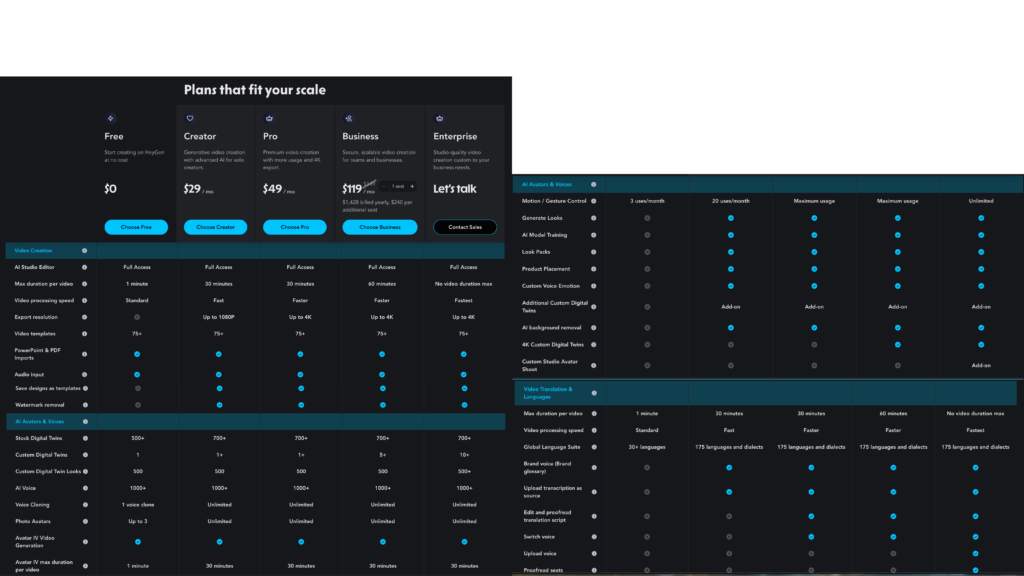
| Paid tiers, same modal | Creator $24 a month with $29 struck through, $288 billed yearly, 600 monthly credits. Pro $41 with $49 struck through, $488 billed yearly, 1,000 monthly credits. Both offer videos up to thirty minutes |
| Export and watermark | Creator lists 1080p export, Pro lists 4K export, and both list watermark removal. The Free column lists none of the three |
| Paid allowance, tooltip | ‹600 monthly credits›, described as usable for up to ‹200 minutes on Avatar III, 30 minutes on Avatar IV, 20 minutes of Video Agent, or 120 minutes of dubbing› |
| Creation surface rate | Presenter mode carried ‹0.3 credits per second›. Cinematic mode carried ‹60 credits› as a per-job figure |
| Composer, before submission | ‹No cost estimate and no length counter›, on an empty composer and after a long script was pasted |
| History, after the completed attempt | A row was written with a CREDITS column. The cell displayed ‹an em dash› |
One free account, 28 July 2026. Paid rates were read from a free account and were not exercised.
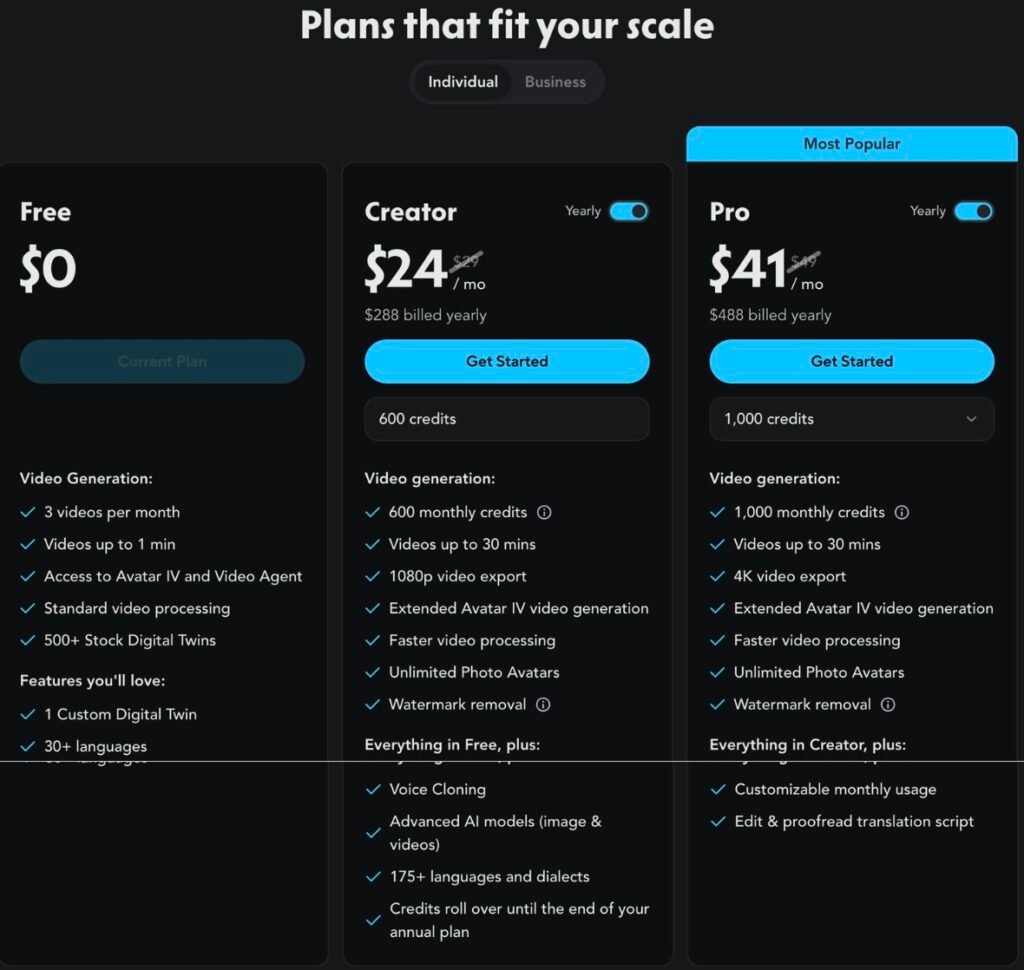
The Free column also lists access to Avatar IV and to the prompt agent. HeyGen’s own pricing page publishes a per-minute credit rate for both of those workflows. The Free column publishes no credit figure. Those are three readings from two of the vendor’s own surfaces, and this review sets them next to each other without drawing a line between them.
Two things follow, and they are different in kind.
The first is arithmetic. A per-minute rate can be derived from the tooltip. Any such figure remains a calculation from one displayed allowance, not an independently verified rate, and it is not a second source corroborating the first.
The second is a gap. The paid tiers are described in credits. The free tier is described in its own unit. Whether a conversion between the two is published on any surface a buyer can reach is ‹the result of a search whose scope has to be recorded›, not an observation, and it does not publish as a bare statement of absence.
HeyGen’s July 2026 product update describes upfront estimates for actions that consume Premium Credits. The post does not clearly define how that applies to free plan access. This review reports only what the authenticated free composer displayed.
The second session tested the same question on a different surface. The prompt agent accepted a job, ran it for close to twenty-nine minutes and delivered it, and at no point in that sequence did the account display a cost. HeyGen’s own pricing page publishes a per-minute credit rate for that workflow.
If the two tiers are counted in different units and no conversion is reachable, time spent free produces interface familiarity rather than a cost estimate.
Three generations, two modes
FSR submitted three generations from this free account. Two produced completed assets. One returned an over-length error in the interface. Whether that request entered a render queue was not determined.
The first two came from the script composer on 28 July. The third came from the prompt agent on 30 July, and it is the one that changes the picture.
The prompt agent ran on a free account
On 30 July FSR opened the home surface, pressed the control that inserts a sample prompt, and submitted what the vendor supplied. The prompt asked for a thirty-second video on a named subject, with a stated visual style, avatar type and music direction. FSR wrote none of it.
The job completed. The interface reported the elapsed generation time as 1714 seconds, close to twenty-nine minutes. The finished asset ran thirty-seven seconds, across six scenes, and the account created two artifacts from the one prompt: the video, and a separate object the interface labels a video plan.
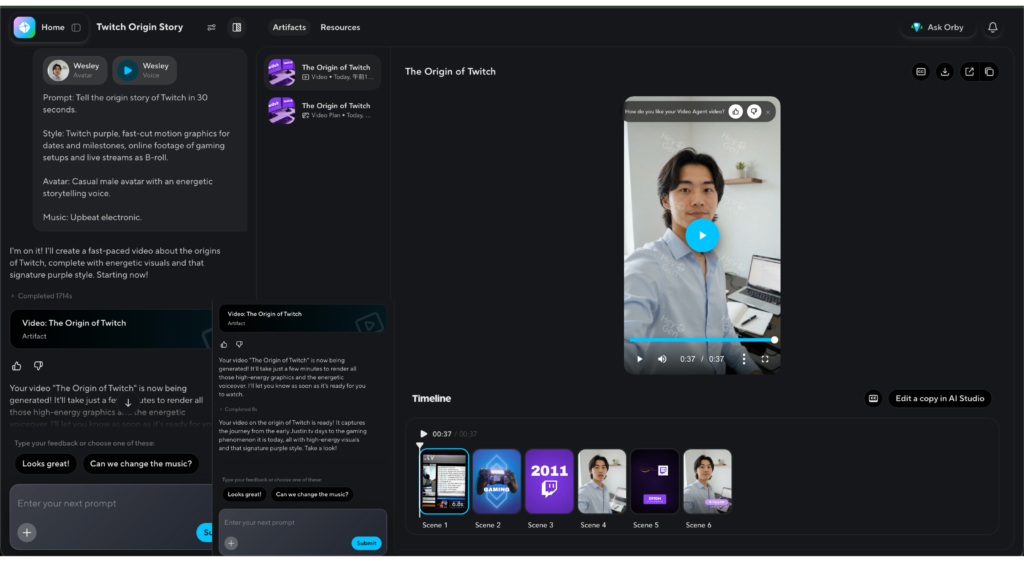
Those readings reconcile, which is worth saying in a review that spends a section on readings that do not. The timeline named six scenes, the export panel and the player both reported thirty-seven seconds, and playing the asset through showed six scene changes spanning about that length. Where these surfaces describe the same asset at the same grain, they agreed.
The download panel for that asset offered three tabs, for video, captions and audio. Both routes that would deliver the video file, direct download and save to cloud drive, carried the premium marker. FSR reports the markers as displayed and does not report a wall for this session, because the result of pressing them was not captured.
Two things are worth separating here rather than joining.
HeyGen’s published pricing lists the prompt agent workflow at a per-minute credit rate. This account has no published credit allocation. The account displayed no cost for the job, before submission or after completion. Those are three statements from three surfaces, and this review does not compute a figure from them.
The other is a ratio a buyer can use directly. Twenty-nine minutes of generation produced thirty-seven seconds of output, and the output stayed inside the account. On a plan counted in whole videos rather than minutes, that is what one unit of the allowance buys.
The two composer submissions, 28 July
| Reading | Completed | Over length |
| Displayed counters, before and after | ‹Unchanged› | ‹Unchanged› |
| History row created | ‹Yes, one row› | ‹No› |
| Project object created | ‹Yes› | ‹No› |
| Warning before submission | Not applicable | ‹None. Generate stayed active.› |
| Interface message | None recorded | ‹A duration-too-long error naming an upgrade, exact wording to be retyped from the capture› |
Two attempts, one free account, 28 July 2026. Both readings taken from the same surfaces minutes apart.
The composer accepted the over-length script for submission. The interface then displayed the message above. FSR did not inspect network or server logs and does not attribute the outcome to a particular system layer.
Whether the second attempt consumed any allowance is not determined. No counter relevant to the free video allowance was identified on the surfaces inspected, so no debit could be read either way. Not recorded is not the same as not consumed.
The length constraint applied after the script was written and the settings fixed, not before. On a metered plan that ordering decides whether a mistake costs a minute or an allowance, and the account gave no way to tell which one happened.
Can the asset leave the account
Six controls, one asset
| Control | Returns | Premium marker | Result |
| Video download | Video file | ‹Yes› | ‹Upgrade wall› |
| Save to cloud drive | Video file | ‹Yes› | ‹Upgrade wall› |
| Captions download | Subtitle file | ‹Yes› | ‹Upgrade wall› |
| Audio download | Audio file | ‹No› | ‹Upgrade wall› |
| Transcript download | Text file | ‹No› | ‹File delivered, a subtitle file of about 137 bytes› |
| Share page, anonymous viewer | Hosted playback | Not applicable | ‹Plays. No download control offered to the viewer.› |
One free account, one completed asset, 28 July 2026. Each control tried once.
No video file was obtained through the controls tested on this account. That does not establish that every HeyGen free account, workflow or entry point behaves the same way.
One control carrying no premium marker was gated when used. The marker did not predict the gate here. One counterexample establishes that for this account on this date. It does not establish that the markers are unreliable in general, and this review does not say so.
The one file that came back is worth reading carefully rather than treating as a win. The interface reported the asset at ‹about seven seconds›. The delivered subtitle file ended its final cue at ‹three seconds›, with the whole utterance inside a single cue. These are two different measurements of different things, and this review does not treat them as contradictory without a shared asset identifier and a stated measurement definition. What it does mean is that the subtitle file is not usable as delivered.
The second completed asset, from 30 July, was not put through the same six controls. Its download panel was opened and photographed. It offered video, captions and audio tabs, and both routes to the video file carried the premium marker. FSR did not capture the result of pressing either, so this session adds a marker observation and not a second gate observation.
FSR could inspect hosted playback but not a downloaded video file. Delivered resolution, delivered duration, framerate, watermark burn-in and audio encoding stay outside this test. A reader deciding on the strength of a preview is deciding on a rendition the platform controls end to end. That held on both assets, two days apart, on two creation modes.
One thing the preview did allow. Watched in the platform’s own player, on the prompt-agent asset, lip movement tracked the delivered speech without drift visible to this observer. That is one asset, one avatar, one voice and a script FSR did not write, judged by eye rather than measured, in the vendor’s player rather than in a file. It is not a comparison with any other product.
It is worth stating for a structural reason rather than as praise. The dimension a free account can assess is the one a buyer could mostly have guessed at. The dimension it cannot assess is the one that decides the invoice.
Values that differed across surfaces
Named surfaces in one account displayed different values on the same day. The evidence did not identify an authoritative one.
Same account, same day
| Maximum video length | Four readings, across the plan modal, the billing page, the creation surface and the rejection message. The billing page named ‹up to 5 minutes› as an upgrade benefit. The creation surface named ‹30 minutes› for presenter mode. The rejection message named no figure at all. Each reading belongs to a different scope, and none is stated as the free tier’s own ceiling |
| Duration of one asset | The export modal, the project card and the player agreed. The history row and the studio timeline each showed something different, and the subtitle cue a third thing. ‹Each value with its surface, to be transcribed from the captures› |
| Engine label on the same drafts | The editor and the project card named ‹different avatar generations for the same two drafts› |
| 4K availability | ‹Absent from the composer resolution list, present and gated in the export list, present and actionable in the upscale panel› |
One free account, 28 July 2026. Readings are preserved as displayed and are not reconciled.
A buyer planning against a maximum length has to choose a number the account does not settle. The verification cost falls on the buyer, across surfaces they would have to know to check. Recording the disagreement is the finding. Asserting a reason for it would be a second claim requiring evidence that does not exist here.
Free account against a structured paid test
What each route can settle
| Question | Free account | Structured paid test |
| Does the editor fit our workflow | Yes | Not needed |
| What does a minute of output debit | No | Yes |
| What does the delivered file contain | No | Yes |
| Do failed attempts debit | No | Yes |
| How does the allowance reset | No | Yes |
Based on what this one free account could and could not reach on 28 July 2026.
A buyer whose open questions sit in the lower four rows may require a structured paid test rather than more free usage.
Terms and output rights
HeyGen’s terms of service address free plan output in one section and paid plan output in another, and the two are drafted differently. The free plan section describes the licence granted over free output in restrictive terms and lists prohibited uses. The section covering paid plans is drafted the other way. The free plan section also reserves the ability to impose or change limits, including export capability.
This section reports what the document states as of the access date below. It reaches no legal conclusion, characterises no conduct as permitted or prohibited for any reader, and offers no advice. A reader whose decision depends on output rights should read the current terms and take their own advice.
Tested and untested
Reachable, not exercised
Digital twin creation, voice cloning, look generation, motion, upscaling, clipping, thumbnail capture, API usage, any connector, support responsiveness, and any repeat attempt on identical settings. No biometric material was submitted at any point.
Outside the free account
Delivered file specification, because no video file was obtained through the controls tested. This is a property of the plan rather than a gap in the session.
Not attempted, and why
The allowance reset basis, because this account is being upgraded before a reset could be observed. The reason is stated so a reader can weigh it rather than assume it was overlooked.
None of the above is a claim that HeyGen publishes no answer. No reproducible documentation search was run for these items. Untested and documented-as-absent are different statuses.
FAQ
Is the HeyGen free plan a trial that expires?
The billing surface labelled it a plan. No captured surface showed an expiry, a countdown or a conversion prompt on 28 July 2026. HeyGen separately describes access to some premium features in trial terms, so the answer is per feature rather than plan wide. No expiry was waited out.
Do you need a credit card to sign up?
In the signup path FSR used, HeyGen sent a magic link by email and ‹did not request a payment method› before the account opened. FSR did not verify whether a password could later be added, and did not test other entry points.
How many videos does the free plan include?
The plan modal displayed a figure for the free tier. What it counts, whether submissions, completed assets or stored objects, was not determined, and FSR identified no counter labelled for it on the surfaces inspected. Treat the figure as a label rather than a measured allowance.
Can you download the video on the free plan?
No video file was obtained through the six controls FSR tried on this account. One control returned a subtitle file whose final cue ended well short of the reported asset length. Other accounts, workflows and entry points were not tested.
How long can a free plan video be?
Named surfaces in the same account displayed different maximum lengths on the same day, and each belongs to a different scope. The rejection message named no figure. The evidence did not identify an authoritative value for the free tier’s own ceiling.
Does a rejected attempt use up part of the allowance?
Not determined. The rejected attempt produced no history row and no project object, and FSR identified no counter relevant to the free video allowance on the surfaces inspected before and after. No debit could be read either way. A structured paid test would settle it.
Does the free plan show credit cost before you generate?
HeyGen’s July 2026 update describes upfront estimates for actions consuming Premium Credits. The post does not clearly define how that applies to free access. On the authenticated free composer, FSR observed no cost estimate, on an empty composer and after pasting a long script.
Is the free plan enough to decide whether to pay?
It closed workflow questions in this test. It did not close paid cost or delivered file quality. A buyer whose decision rests on either may require a structured paid test rather than more free usage.
Trying it yourself
Open a free HeyGen accountFuture Stack Reviews earns nothing from this link. It carries no affiliate code and no tracking parameter. Plan terms change without notice; confirm what the free tier includes on HeyGen’s own pricing page before you sign up.
Methodology
This is a Tier B, hands-on review. FSR created one HeyGen free account and worked it across two sessions, submitting three generations across two creation modes and trying every file, cloud and sharing control the interface presented.
The interface changed between the two sessions. On 28 July the home surface presented a four-step setup card. On 30 July the same account presented a three-step card with different step labels, and one step present on the first date was absent on the second. FSR did not establish whether this was a product change, a state-dependent display, or something specific to this account or region. Anything this review says about the setup card describes 28 July.
Test conditions
| Account and dates | One free account created for this review. Session one 28 July 2026, session two 30 July 2026. The account was on the free plan at the end of both. |
| Elapsed and active | Session one: elapsed ‹four hours› between first and last capture, active time ‹approximately ninety minutes›, reconstructed from the session log and stated as an estimate rather than a measurement. Session two: one generation, with the platform’s own reported generation time recorded from the interface |
| Two timing figures, kept apart | The 1714 second figure in section 3 is the platform’s own display. The operator’s separate wall-clock impression of the same job was longer. This review publishes the displayed figure and does not merge the two |
| Prompt authorship | The 30 July prompt was inserted by the vendor’s own sample-prompt control. FSR did not write it and did not edit it before submitting |
| How the playback observation was made | Watched live in the browser with sound, by one observer, in the platform’s player. Judged by eye, not measured. The screen recording retained in the archive carries no audio track, so it preserves the picture but not the evidence for the synchronisation statement |
| How the scene count was checked | The archived screen recording of the second asset’s playback was analysed frame by frame for visual discontinuities. Six were found. This is a measurement of FSR’s own recording of the platform’s player, not of a delivered file, and the recording is not published |
| Region, browser, language | Japan. Desktop Chrome, one surface checked in a private window. Interface preference set to English; some surfaces rendered Japanese |
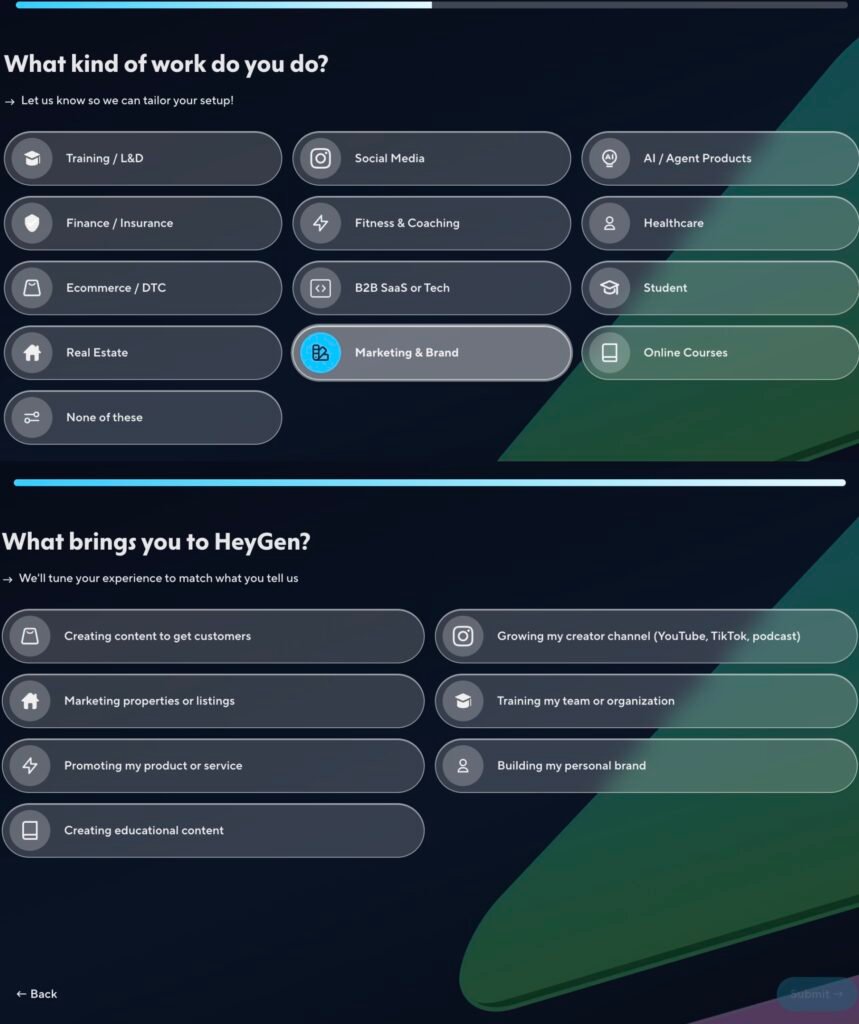
| Onboarding answers | ‹Both answers, from a capture showing the completed selection›. The home surface states it is personalised on these answers, which scopes every home surface observation |
| Surfaces searched for counters | ‹Named list, with date› |
| Account identifiability | The account email sits on this publication’s own domain, so the vendor could identify it as a review account. Queue time, failure rate and support behaviour are not assumed representative |
| Evidence handling | Runtime observations appear here only where the evidence ledger links them to a timestamped capture, a downloaded file or a contemporaneous session log. Those three are recorded separately and are not treated as one class. Captures are held in FSR’s archive and are not published, because they carry account identifiers |
| Demoted to context | Two-factor settings, personalisation state and mixed-language rendering were observed and recorded in the ledger. They did not bear on the purchase decision and are not treated as findings |
| Not carried forward | The previous version of this article was an audit target. None of its product, price or performance claims were carried forward |
Vendor documentation is recorded as an official claim, not as verification of runtime behaviour. Prices, plans, quotas, feature availability and terms are volatile, and were rechecked on the publication date.
Verdict
The free account exposed the workflow. It did not close what equivalent paid production would cost, and it did not close what a delivered video file would contain.
Those two gaps are structural rather than incidental. No paid plan was entered, so no debit was observable. No video file came back through the controls tried, so no file specification was inspectable.
Against that, a free account does not have to reproduce every paid feature to be worth an hour. A buyer who only needs to see the editor and hosted playback can get what they came for.
This review did not assess overall value, billing accuracy, output quality against competitors, or product intent. A buyer whose open questions are cost at volume or delivered file contents may require a structured paid test.
Related FSR briefings
Tier B briefings are hands-on tested. Tier C briefings are document-first, with no hands-on testing. Comparisons are not tiered.
TIER B-
Mitte AI Review: Strong Output, a Credit Meter That Is Only Sometimes Right, and a Price List That Is Not Public
The same meter problem on another product, taken further because the account was paid. Four configurations billed exactly what the panel displayed. Two billed more, every time.
-
Soundful Review 2026: The Audio Works. The License Is the Real Test.
Output you can judge in a minute, and rights you cannot judge from the vendor’s pages at all. The same split this briefing finds between what a free account shows and what it settles.
-
HeyGen Pricing and Credits: What the Official Pages Publish
The documented side of the same product. It reads HeyGen’s own pricing pages and works out what a buyer can calculate before signing up, and what stays open.
-
HeyGen vs Synthesia: You’re Probably Buying the Wrong One
For a reader who has decided a free account is not enough, and wants the field narrowed before paying for either.
Future Stack Reviews publishes structural audits of AI and SaaS products for technical buyers. This is a Tier B hands-on review of one free account, on one date, in one region, under one set of onboarding answers. No paid plan was entered. Vendor statements are recorded as official claims, not as verification of runtime behaviour. Pricing, plans, quotas and terms are volatile and should be confirmed against the vendor’s current surfaces before purchase.