Last updated: June 11, 2026
June 11, 2026 · Pricing and policies checked: June 11, 2026 · Review depth: Tier B
Zebracat is an AI video generator for marketers that turns text, links, and scripts into short videos. It routes generation to third-party models and meters everything in credits. This Future Stack Reviews audit did not test finished video quality. It tested the buying layer: credit packs, refunds, support answers, review incentives, pricing claims, and the documentation an enterprise buyer would need before uploading company content.
Zebracat’s pricing page makes one of the cleanest promises in AI video: “Didn’t download any video? Get a full refund within 7 days.”
We tested it from the strongest position a customer can hold. Our account showed zero videos created, zero downloads, and an empty usage history. The only money spent was $9.90 on a 340-credit pack.
Support refused the refund. Three times.
The reason given: the guarantee covers subscription plans, not credit packs. That limit appears nowhere near the promise on the pricing page. And Zebracat’s own documentation goes further than a limit. Its help-center refund article says refunds are not given once a subscription is made. Its Terms agree. One company, one product, a full-refund banner and a no-refunds policy, published at the same time.
That gap between what Zebracat advertises and what its transaction layer does is the subject of this review.
- Free account setup and the in-app UI
- A real $9.90 credit-pack purchase
- A refund request and a multi-reply support thread
- The pricing page, plan comparison table, credit packs, in-app credit menu, Terms, Privacy Policy, API page, and help center
- Finished video quality (we generated zero videos)
- Lip-sync accuracy and export reliability
- Prompt adherence and output consistency
- Payload-level network and data-handling analysis
Best for / not for
| Best for | Not for |
|---|---|
| Marketers making short-form 1080p social and ad videos | Buyers who need guaranteed 4K (advertised only on the $199 Unlimited Cat tier and up, untested by FSR) or broadcast-grade delivery |
| Teams that treat credits as a production budget they watch | Free-plan users buying one-time credit packs |
| People who test on the free tier before paying | Refund-sensitive buyers |
| Buyers who want multiple third-party models in one workflow | Buyers who read review badges as independent proof |
| Veo 3 Standard users who accept a wrapper’s economics | Enterprise teams needing public DPA and subprocessor docs |
Briefing Summary: June 2026
- Zebracat’s pricing page advertises a 7-day full refund if no video has been downloaded. Its help center and Terms say no refunds once a subscription is made. FSR’s zero-download refund request was refused three times.
- The $199 Unlimited Cat plan removes the video cap but keeps a finite pool of 3,600 generative AI credits per month. By our calculation, that is about 8 minutes of Veo 3, or about 30 minutes on the cheapest model.
- A free-plan account bought a $9.90 credit pack. The balance never appeared in the account UI. Zebracat’s credit-packs page says such credits work without changing your subscription; support first said they require an active paid subscription.
- Zebracat’s Reward Center pays platform credits for reviews on G2, Trustpilot, Capterra, Google, Product Hunt, and TrustRadius, with no disclosure requirement. Trustpilot and Google’s own policies prohibit incentivized reviews.
- The API page claims German hosting and full GDPR compliance. The public privacy policy does not document the AI model pipeline, and FSR could not locate a public DPA or subprocessor list.
- The one place a buyer might expect a discount, Veo 3, is mixed: Zebracat undercuts Veo 3 Standard but costs more than Veo 3 Fast, and Zebracat does not disclose which variant it runs.
Tier B review. Based on 60 to 90 minutes of hands-on testing on a free account plus primary-source verification of Zebracat’s pricing page, plan comparison table, credit packs, Terms, Privacy Policy, API page, and help center. FSR did not generate finished videos, so output quality is drawn from Zebracat’s own documentation and third-party reports, not firsthand.
TL;DR
Zebracat is a credit-metered front door to rented third-party video models. The video engine may be fine, but this review does not score it, because we made no finished videos. What we tested is the part around the purchase, and that part is not clean. The refund promise conflicts with the refund policy. “Unlimited” describes project count, not generation capacity. The review badges come from platforms where Zebracat pays credits for reviews. The privacy documentation stops where an enterprise buyer would start reading. Usable, but only if you treat every dollar in as spent for good.
Quick Start
- Start on the free tier. It costs nothing, but the limit is small: the in-app free plan shows one video and ten generative credits per month.
- Generate the exact type of video you plan to ship before paying anything.
- Do not buy credit packs while on the free plan until you can confirm where the balance appears and what can use it. The entitlement section below explains why.
- If you subscribe, assume the payment is final, whatever the pricing page promises.
- Watch the credit counter, not the video counter. Credits are the real meter.
- EU or enterprise buyer? Request a DPA and subprocessor list in writing before any company data touches the platform.
At a Glance
| Fact | Detail |
|---|---|
| Company | Zebracat AI UG, Merantix AI Campus, Berlin, Germany (HRB 233288 B). German governing law. |
| What it is | A credit-metered layer over third-party video models. FSR found no public evidence that Zebracat trains a video model of its own. |
| Models named | The pricing cards list VEO3, Kling 2.5 Pro, Seedance, PixVerse, and Sora2. The in-app credit menu lists more (Vidu, LTX, Alibaba Wan, MiniMax Hailuo). The roster shifts and differs by surface. |
| Free tier | Public pages advertise 5 free videos. The in-app free plan shows a limit of 1 video and 10 generative credits per month. 720p, 30-second cap, no credit card. |
| Paid plans | $39 / $99 / $199 per month. Annual billing: $19 / $49 / $99 per month. Enterprise from $599. |
| Export ceiling | 4K advertised on Unlimited Cat ($199) and Enterprise; the $39 and $99 tiers list no 4K. FSR verified 1080p on the free plan only and did not test the paid 4K output. |
| Refund stance | 7-day money-back advertised on the pricing page; help center and Terms state no refunds once subscribed. |
| Data documentation | Privacy policy covers website logs and contact forms. FSR did not locate a public DPA or subprocessor list. |
| Pricing verified | June 11, 2026. Zebracat’s pricing changes often; confirm on the live page before buying. |
Plan Comparison
| Cat Mode | Super Cat | Unlimited Cat | Enterprise | |
|---|---|---|---|---|
| Monthly price | $39 | $99 | $199 | $599+ |
| Annual price (per month) | $19 | $49 | $99 | Custom |
| Videos per month | 15 | 40 | Unlimited | Unlimited |
| Generative AI credits per month | 350 | 1,400 | 3,600 | Custom |
| Max video length | 2 min | 5 min | Up to 10 min | Up to 10 min |
| Free edits per video | 3 | 3 | 5 | Unlimited |
| Export resolution | 1080p (no 4K listed) | 1080p (no 4K listed) | Up to 4K (advertised) | Up to 4K (advertised) |
| Custom avatars | None | 5 / mo | 10 / mo | Unlimited |
| Voice cloning | Yes | Yes | Yes | Yes |
| Watermark removal | Yes | Yes | Yes | Yes |
| Commercial rights | Yes | Yes | Yes | Yes |
| Brand kits | 1 | 5 | Unlimited | Unlimited |
| Live support | AI chat | Standard | Priority | Priority |
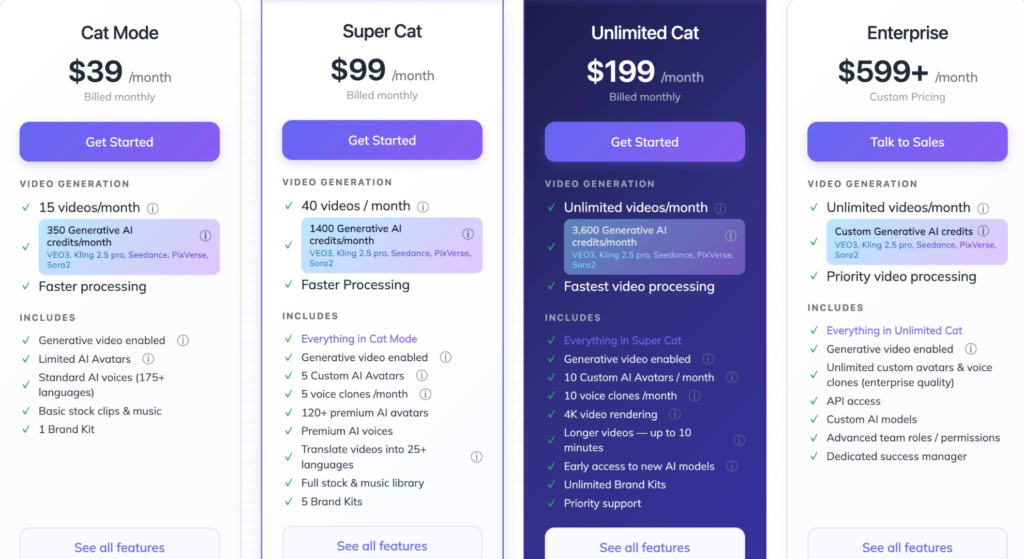
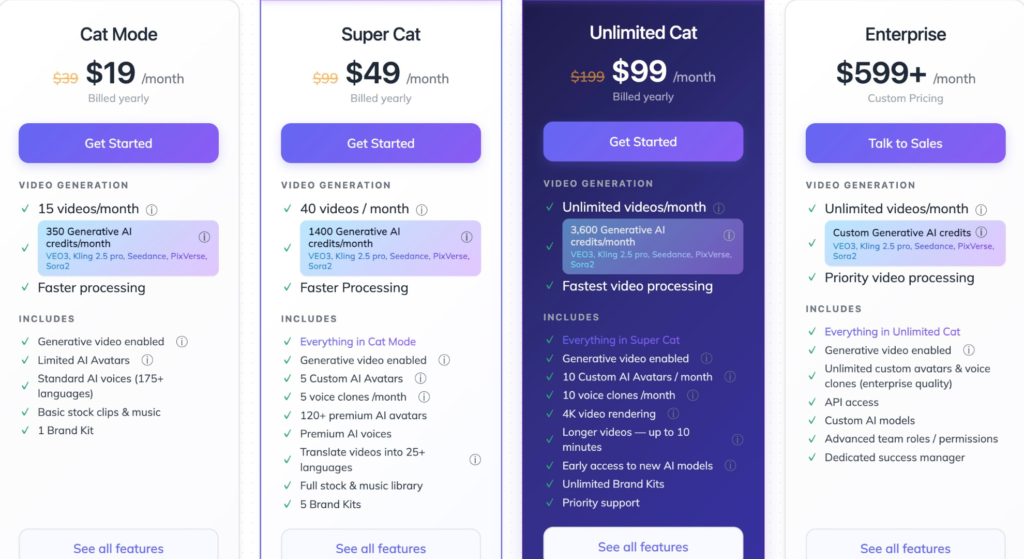
Three notes on this table. The annual toggle advertises 50% savings, and the card math supports roughly that figure. 4K rendering is listed only on the $199 Unlimited Cat tier and Enterprise; the $39 and $99 plans show no 4K. FSR tested the free plan (1080p) and did not verify the paid 4K output. And the cheapest paid tier’s “live support” is an AI chatbot, not a person. Prices verified June 11, 2026.
Deep Dive
The refund promise vs the refund policy
Three Zebracat surfaces talk about refunds, and they do not agree.
The pricing page, in the payment box, promises a 7-day money-back guarantee for buyers who have not downloaded a video. The help center’s refund article reduces that to nothing: “we do not offer refunds once a subscription to a paid plan is made.” The Terms of Service take the help center’s side: “No refunds will be provided for already paid subscription periods.” One company, one product, a full-refund banner above the buy button and a no-refunds line in the policy, published at the same time.
For fairness, Zebracat has a reason to be cautious. Every generation hits a third-party AI service that bills Zebracat per run, so open-ended refunds invite misuse. That is a real cost structure, and it explains why a strict policy might exist. It does not explain why a full-refund promise still sits above the buy button.
Then there is what happened when we asked.
FSR’s account was as clean as a refund case gets. Zero videos created. Zero downloads. An empty usage history. We had bought a 340-credit pack for $9.90 and used none of it. The exchange did not start as a refund request. It started with a simpler question: where does the purchased balance appear? Support’s first reply said the credits could not be used at all on our plan. They “don’t provide platform access on their own.”

So we requested the refund on that basis. The product we had paid for did not work on the plan we were on, we had downloaded nothing, and the pricing page offers money back for exactly that case.

The refund was declined three times. What makes the refusals worth recording is that, across them, support reversed its own first answer. The same credits that “don’t provide platform access on their own” were now “still available for you to use” on the free plan after all. Both positions cannot hold at once, and support stated both inside one ticket. The reason given for the refusal settled on a policy line: the refund policy “only applies to subscription plans.” Yet the credit-packs page sells packs as credits you add without changing your subscription, and a free-plan user completes the purchase with no warning that a plan is required.

This is not a legal claim. Whether any of it is enforceable in any jurisdiction is a question for lawyers, not reviewers, and FSR did not test whether the credits work on a paid plan. The buyer-level finding is what a buyer can see: a full-refund promise that did not function for a zero-download account, a binding policy that contradicts it in writing, and a support thread that could not hold one story about whether the purchase even worked. The amount in question is trivial. What it documents is not. Plan your spending as if every payment is final.
Zebracat’s pricing page advertises a full refund within 7 days if you have not downloaded a video. In FSR’s test, that promise did not hold. A zero-download account was refused a credit-pack refund three times, and Zebracat’s own help center and Terms state that no refunds are given once a subscription is made.
Do not buy credit packs on a free plan until you can confirm where the balance appears and what can use it. In our test the purchased balance never showed in the account, support contradicted Zebracat’s own credit-packs page on whether the credits worked, and the same charge appeared as two different amounts across the receipt and the in-app billing history. Verify on the live pages before spending. Checked June 11, 2026.
“Unlimited” and the credit maze
Zebracat meters paid plans twice. Each plan caps the number of videos per month, and each grants a pool of generative AI credits that model usage burns through, with each video also counting against the pool. Cat Mode gets 15 videos and 350 credits, Super Cat gets 40 videos and 1,400 credits, Unlimited Cat gets unlimited videos and 3,600 credits.
Read that last pairing again. The $199 plan is named Unlimited Cat, and the video count is unlimited. The credits are not.
How far 3,600 credits stretches depends entirely on the model, and the in-app credit menu makes that plain. Veo 3 costs 60 credits per 8-second clip. So 3,600 credits divided by 60 gives 60 clips, which is 480 seconds: about 8 minutes of Veo 3 per month. The cheapest model in the menu, MiniMax Hailuo 2.3 Fast, costs 10 credits per 5 seconds, which turns the same pool into about 30 minutes. Those are our calculations, not Zebracat’s claims. “Unlimited” describes how many projects you can open. It does not describe how much premium video you can generate.
The word gets stretched the same way elsewhere, and HeyGen’s “unlimited” plan carries its own asterisk.

Then there are the separately purchased credit packs. They come in four sizes: 150 credits for $4.90, 340 for $9.90, 1,200 for $29.90, and 1,800 for $49.90. All expire 60 days after purchase and, in Zebracat’s own words on the packs page, do not auto-renew or refresh. The per-credit rate does not simply improve with size either: the 1,200 pack works out cheaper per credit than the larger 1,800 pack. The plan credits do not last either. Zebracat’s FAQ states that unused in-plan credits do not carry forward to the next billing cycle and the count resets, with rollover only when you change plans. Between the monthly reset on plan credits and the 60-day expiry on packs, the whole credit system is use-it-or-lose-it. Budget accordingly. The subscription price is the entry fee, and the credit pool is the actual product.

Veo 3 economics: cheaper than Standard, pricier than Fast
The one place a buyer might expect Zebracat to be the cheap option is Veo 3, since buying premium models through a wrapper can sometimes beat going direct. We checked the current numbers. The answer is not simple, and the simple version that other reviews repeat is now wrong.
An 8-second Veo 3 clip costs about $1.50 to $1.75 in Zebracat credits, depending on which credit pack you buy.
Google’s direct rate has dropped since Veo 3 launched. As of June 11, 2026, Google’s published Gemini API pricing lists Veo 3 Standard at $0.40 per second and Veo 3 Fast at $0.10 per second for 720p and $0.12 per second for 1080p. That puts an 8-second clip at $3.20 on Standard, and at $0.80 to $0.96 on Fast.
So the comparison splits:
| 8-second Veo 3 clip | Cost | Vs Zebracat (~$1.50 to $1.75) |
|---|---|---|
| Zebracat credits | $1.50 to $1.75 | baseline |
| Google Veo 3 Standard, direct | $3.20 | Zebracat is cheaper |
| Google Veo 3 Fast, 1080p, direct | $0.96 | Direct is cheaper |
| Google Veo 3 Fast, 720p, direct | $0.80 | Direct is cheaper |
Zebracat undercuts Veo 3 Standard by a wide margin. It is more expensive than Veo 3 Fast. Since Zebracat exports at 1080p, the matched-resolution comparison a buyer would actually run is against Fast at 1080p, where going direct to Google is cheaper. The catch is that Zebracat does not disclose which Veo 3 variant it runs underneath. If it runs Standard, the credit price is a real discount on a higher-quality model. If it runs Fast, the credit price is a markup. A buyer cannot tell which, which is the honest finding here: the Veo 3 economics depend on a detail Zebracat does not publish. Treat any “cheaper than Google” claim about Zebracat as variant-specific, not a blanket fact. (Google’s rate verified June 11, 2026; recheck before publish, as model pricing moves often.)
For a wider price comparison, the Runway vs Pika breakdown covers the same kind of confusing AI video pricing.
The Reward Center: credits for reviews under its own badges
Zebracat’s site advertises more than 1,000 five-star reviews and shows rating badges of 4.8 on G2, 4.9 on Capterra, and 4.7 on Trustpilot.
Inside the product sits a Reward Center that pays platform credits for marketing activity. The in-app schedule: 3 credits for a social share, 5 for a review, 8 for a blog post, 10 for a video tutorial, 4 for answering a question. (A help-center article prices a review at 10 credits instead of 5, one more case of Zebracat’s surfaces disagreeing with each other.)

The review task asks for at least 50 words on G2, Trustpilot, Capterra, Google, Product Hunt, or TrustRadius. The instructions ask for honest feedback. The accompanying tip steers writers toward the features they love and how Zebracat helped their workflow. Nothing in the flow we observed requires disclosing that the review was rewarded.
The pattern extends past review sites. The Q&A task pays credits for answers on Quora, Reddit, and Skool that mention Zebracat naturally, with a tip that authentic-feeling answers get more visibility. The blog task pays for posts on your own site, Medium, or LinkedIn, with guidance to mention Zebracat early and link to it in natural wording, suggesting phrasing like a casual aside about the AI video tool used in a recent project. Only the social-share task requires a visible marker, the “made with zebracat.ai” tag.
The platform rules matter, so here they are against what Zebracat rewards. FSR checked each platform’s own policy in June 2026:
| Platform | Pays credits for a review here? | The platform’s own rule |
|---|---|---|
| Trustpilot | Yes | Prohibits incentivized reviews. No money, gifts, or other benefit in exchange for a review. |
| Yes | Prohibits reviews tied to a benefit such as money, freebies, or discounts. | |
| G2 | Yes | Permits incentives, but runs them through its own program and tags confirmed incentivized reviews as incentivized. |
| Capterra | Yes | Permits incentives only with disclosure. Vendors who incentivize reviews must use Capterra’s Incentivized Review Form, and a review found to be incentivized without disclosure is disabled or marked as paid. |
| Product Hunt | Yes | Prohibits incentivizing upvotes and any other artificial boosting of activity. Its guidelines do not separately address incentivized written reviews. |
| TrustRadius | Yes | Permits incentives with disclosure. Reviewers are prompted to disclose any incentive, the incentive cannot depend on sentiment, and incentivized reviews are labeled. |
Read the pattern. Two of these platforms ban incentivized reviews outright. The three that allow them all require the incentive to be disclosed or run through the platform’s own tracked program. In the Reward Center flow FSR observed, Zebracat asks for honest feedback but does not instruct the reviewer to disclose that credits were paid.
To be precise about what we are and are not saying: FSR has no evidence that any specific review of Zebracat was paid for or left undisclosed, and we are not calling any review fake. The documented facts are the reward schedule, the target platforms, the absence of a disclosure instruction in the flow we saw, and each platform’s own policy. What those badges are worth, given that machinery, is a judgment each buyer can make.
A pricing page that disagrees with itself
The current pricing page is mostly clean and consistent: clear cards, a feature comparison table, and a monthly-to-annual toggle that adds up. The seams show in two places.
First, the FAQ blurs the very distinction the rest of the pricing runs on. One question asks what happens to unused videos at the end of a billing cycle, and the answer is entirely about credits: unused credits do not carry forward, and the count resets. But videos are capped per plan and credits are a separate pool the plan also draws on, so the two are not the same meter. Zebracat’s own FAQ treats them as interchangeable, which is the same blur that lets a plan named Unlimited Cat sit on top of a finite credit budget.
Second, the page is not carefully proofed. The Voice Cloning screen calls the product “Zebract,” the comparison table offers “exclusive courses and tranings,” and the entitlement table and plan cards do not fully agree on what the cheapest tier includes. The comparison table marks voice cloning and ultra-realistic voices as included on Cat Mode, while the plan card’s voice description is narrower. If you are buying the $39 tier for a specific voice feature, get the entitlement confirmed in writing first.
The free tier and the credit trap
Zebracat’s public pages advertise five free videos. Inside the account, the free plan shows a different limit: one video and ten generative credits per month. Ten credits does not go far. A single Veo 3 clip costs 60 credits, so the free plan cannot generate even one.
Credit metering like this is common in AI video tools, and InVideo’s credit system has the same trap.
The account still offers a Buy AI Video Credits button, and a free-plan user can complete a purchase. We bought a 340-credit pack for $9.90. After the purchase, no credit balance appeared in the account UI. We could not see what we owned.
Then the explanations diverged. Zebracat’s own credit-packs page says these credits work “without changing your subscription” and do not affect your video limit. Support told us the opposite: the first reply said the credits require an active paid subscription and do not grant platform access on their own. Later replies in the same thread said the credits remained available on the free plan after all. The official page and the first support answer cannot both be right.
The billing records did not line up either. The email receipt said $9.90 for a credit pack. The in-app payment history showed $9.00, labeled as a subscription cycle.

The careful conclusion is not that free-plan credits are unusable. FSR cannot prove that, and support said both things. The product may allow some free-plan path that was not visible in the tested flow. That is exactly the problem for a buyer. The entitlement boundary is unclear at every level: the public free limit does not match the in-app one, the purchased balance is invisible, support contradicts Zebracat’s own packs page, and the billing surfaces disagree on the amount and the label. Until that changes, buying credits on a free account means paying for an entitlement you cannot see, may not be able to use, and, per the refund section above, will not get back.
The EU and enterprise documentation gap
On paper, Zebracat has a strong European story. It is a German company, Zebracat AI UG, registered in Berlin. Its API page states the service is “built and hosted in Germany” and “fully GDPR-compliant,” alongside a 99.9% uptime SLA and pay-as-you-go API pricing from $10. The privacy policy names a data protection officer, which is more than many small SaaS vendors manage.

Then the documentation stops.
The privacy policy’s introduction promises to explain the third-party components that process user data. The body covers two things: website server logs, kept for seven days, and contact-form messages. It does not name the third-party AI model providers. It does not describe what happens to the prompts, files, and voice samples users upload. It does not state where that processing occurs or how long user content is retained. FSR could not locate a public data processing agreement or a subprocessor list in the documents reviewed.
For a product whose entire function is sending user content through external AI models, that is the part of the privacy policy that matters, and it is the part that is missing.
The Terms add a detail enterprise buyers should weigh: liability is capped at the lesser of $100 or the fees paid in the prior 12 months. The same Terms assert GDPR compliance and list data-subject rights.
None of this means Zebracat is non-compliant, and we make no such claim. The company may handle data well internally. The point is procurement-level: an EU or enterprise buyer cannot answer basic due-diligence questions from the public documents. Which subprocessors touch the data, in which countries, retained for how long, under which agreement: all of it would need to be obtained in writing before deployment.
A note on output quality, which FSR did not test
FSR generated zero videos on Zebracat. Nothing in this review is a firsthand claim about output quality, lip-sync accuracy, or export reliability. We restate it here so it does not get lost: the findings above are about the buying layer, not the video engine.
What we can report is what Zebracat says about its own output. The help center includes troubleshooting articles on why faces in AI visuals can look distorted and why the AI voiceover may not sync. The vendor acknowledges both can happen.
Third-party buyers add more, with the weight third-party reports deserve. AppSumo lifetime-deal customers report a credit-model change after purchase (a 30-videos-per-month cap plus separate AI-scene credits that cut the deal’s value), face distortion, audio sync problems, and a workflow complaint: a generated video cannot be edited afterward without recreating it and spending credits again. FSR did not verify these reports independently.
The practical advice follows directly. The free tier exists, it costs nothing, and it lets you generate at least one short video. Generate the exact type you need before any money moves. Do not outsource that judgment to a reviewer, including this one.
Who Should Use Zebracat
Picking the wrong tier is a common and expensive mistake with these tools, as OpusClip buyers often find.
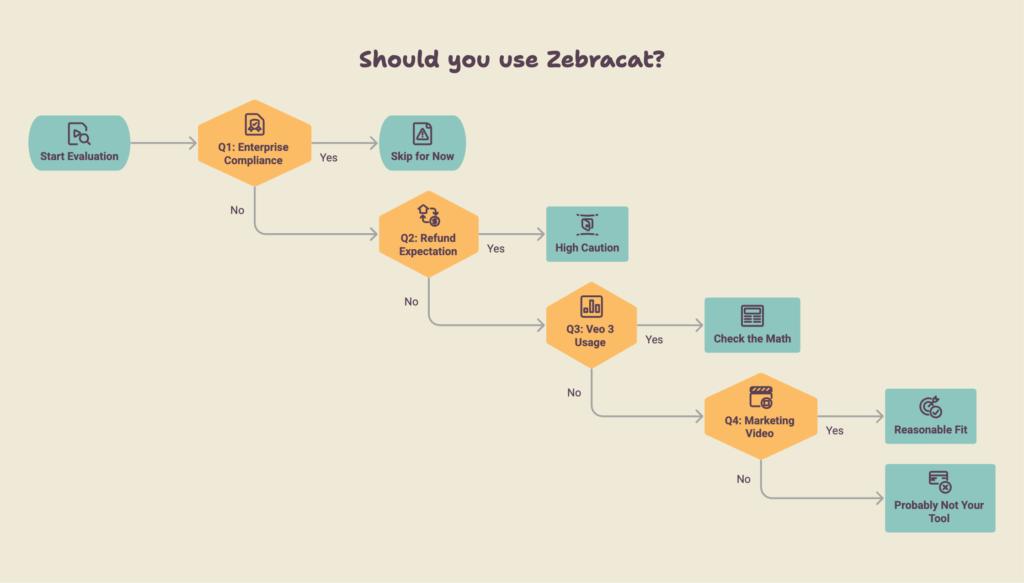
Use it if you produce short-form marketing or social videos, you can treat credits as a strict production budget, you mostly run the cheaper models or specifically want Veo 3 Standard through a wrapper, and 1080p output is acceptable.
If it holds up, sign up on Zebracat’s own site, and treat the first charge as final given the refund findings above.
Skip it if you expect refunds to work the way the pricing page reads, you need predictable premium-model economics at volume, you need 4K that FSR has verified (it is advertised only on the $199 tier and up, and FSR did not test it), or you want social proof you can take at face value.
Do diligence first if you are an EU or enterprise buyer. Get the DPA, the subprocessor list, the data-residency confirmation, and the retention terms in writing. The public documents do not contain them.
Reasonable fit. Test your exact use case on the free tier first, then decide.
Probably not your tool. The credit economics will work against you. Look elsewhere.
FAQ
Does Zebracat offer refunds?
Zebracat’s pricing page advertises a 7-day money-back guarantee with a full refund if no video has been downloaded. But its own help-center refund article states refunds are not offered once a subscription is made, and its Terms say no refunds for already paid subscription periods. The marketing promise and the binding policy conflict. Verified June 2026.
Is Zebracat’s Unlimited plan really unlimited?
On the $199 Unlimited Cat plan, video count is unlimited but generative AI credits are capped at 3,600 per month. Because Veo 3 costs 60 credits per 8 seconds, that pool equals about 8 minutes of Veo 3 monthly, or about 30 minutes on the cheapest model. “Unlimited” applies to video projects, not premium-model generation. Verified June 2026.
Does Zebracat pay users for reviews?
Yes. Zebracat’s Reward Center gives platform credits for reviews on G2, Trustpilot, Capterra, Google, Product Hunt, and TrustRadius, and for mentioning Zebracat on Quora, Reddit, and Skool. Trustpilot and Google prohibit incentivized reviews outright; Product Hunt prohibits incentivizing engagement; G2, Capterra, and TrustRadius permit incentives only when the incentive is disclosed or run through the platform’s own program. In the flow FSR observed, Zebracat does not instruct reviewers to disclose the credit. Verified June 2026.
What AI models does Zebracat use?
Zebracat routes generation to third-party models, and FSR found no public evidence it trains a video model of its own. Its pricing cards name VEO3, Kling 2.5 Pro, Seedance, PixVerse, and Sora2; the in-app credit menu lists more, including Vidu, LTX, Alibaba Wan, and MiniMax Hailuo. The roster varies by surface and over time. Verified June 2026.
Is Zebracat GDPR-compliant and safe for EU enterprise use?
Zebracat is a German company (Zebracat AI UG, Berlin) and its API page claims German hosting and full GDPR compliance. But its public privacy policy covers only website server logs and contact data. It does not disclose the third-party AI model providers, processing locations, retention, or transfer mechanisms. FSR did not locate a public DPA or subprocessor list. Verified June 2026.
How much does Zebracat really cost?
Zebracat’s plans are $39, $99, and $199 per month ($19, $49, and $99 billed annually), plus a $599+ Enterprise tier. The real cost driver is generative AI credits, not the subscription. Separately purchased credit packs run $4.90 to $49.90 and expire in 60 days, and in-plan credits reset every billing cycle rather than rolling over. Verified June 2026.
Can Zebracat free-plan users buy credits?
In FSR’s test, a free-plan account bought a credit pack, but the balance never appeared in the UI, and support contradicted Zebracat’s own credit-packs page on whether the credits worked without a subscription. The free plan itself shows a limit of one video and ten generative credits per month. Verified June 2026.
Is Zebracat cheaper than using Veo 3 directly?
It depends on the variant. An 8-second clip costs about $1.50 to $1.75 in Zebracat credits. Google’s direct rate is $0.40 per second for Veo 3 Standard ($3.20 for 8 seconds) but only $0.10 to $0.12 per second for Veo 3 Fast ($0.80 to $0.96). So Zebracat undercuts Standard but costs more than Fast, and it does not disclose which variant it runs. Verified June 2026.
Methodology & Sources
FSR ran a hands-on test of Zebracat on a free account in June 2026: account setup, a real $9.90 credit-pack purchase, a refund request, a multi-reply support exchange, and reads of the pricing page, plan comparison table, credit packs, in-app credit menu, Terms of Service, Privacy Policy, API page, and help center. Screenshots and receipts were archived for every firsthand claim, and the pricing, comparison table, and credit packs were re-verified in the live account on June 11, 2026. Google’s Veo 3 API rates were verified against Google’s published Gemini API pricing page on June 11, 2026. Trustpilot’s and Google’s review-incentive policies were checked against the platforms’ own guidelines in June 2026.
What this review is not based on: FSR generated no videos, performed no payload-level network analysis, and did not test the API. Output-quality statements come from Zebracat’s own documentation or from attributed third-party reports, never from FSR testing. Where sources conflict, Zebracat’s published pages and FSR’s firsthand receipts outweigh third-party commentary.
Zebracat’s pricing and model lineup change frequently, and so does Google’s. Confirm current numbers on the live pages before purchasing. If Zebracat aligns its refund pages, documents the AI pipeline, or changes the Reward Center, this review will be updated; the dates above mark the verified state.
FSR Verdict
Zebracat may work as a short-form video tool. This review does not score that, because we generated no finished videos. What we tested is the buying layer, and the buying layer is not clean. The refund promise on the pricing page did not apply to the thing we bought. “Unlimited” is bounded at 3,600 credits. The free plan advertises five videos but shows one in the app. The review badges sit on a program that pays credits for reviews on platforms whose own rules prohibit it. Support contradicted Zebracat’s own credit-packs page on what a buyer even owns. And the one place a buyer might expect a clear discount, Veo 3, turns out to depend on a model variant Zebracat does not disclose.
Buy it only if credits are a budget you control and you have tested your exact use case on the free tier. Treat every charge as final. If you need clean refunds, predictable premium-model costs, verified 4K output, independent social proof, or enterprise data documentation, Zebracat is not your tool yet.
Buyer-risk verdict: Caution. This is a buyer-experience assessment, not a video-quality score. FSR generated no finished videos in this test.
Notes and Disclosure
This review was researched and written by Future Stack Reviews. The account, purchase, support exchange, and document reads described above were performed by FSR in June 2026. No individual support agents, reviewers, or company staff are named, by policy.
Independence note: This review contains no affiliate links, and FSR earns no commission if you sign up for Zebracat. The findings are based on a paid credit-pack purchase and primary-source verification, as described in the methodology above.