Last updated: July 15, 2026
What Google’s June 18 shutdown actually changed, who wins, who loses, and the dependency almost every migration guide skipped.
On June 18, 2026, Google stopped serving Gemini CLI requests for free, Google AI Pro, and Google AI Ultra individual users, and pointed them to a new tool called Antigravity CLI. The code did not disappear. The repository is still Apache 2.0. What ended was the free consumer right to reach Google’s models through that code. That distinction is the whole story, and most coverage got it slightly wrong.
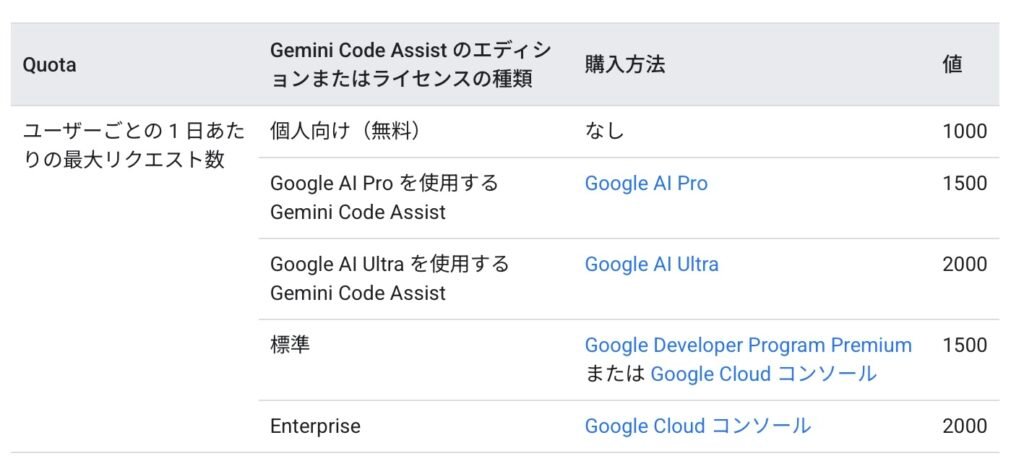
The number that frames it: Gemini CLI’s free individual tier was a documented 1,000 model requests per day. The replacement runs on a usage system Google does not publish a clean per-day figure for. You moved from a number you could read to a meter you cannot.
gemini on a free, Google AI Pro, or Google AI Ultra account, those calls were cut on June 18, 2026. Migration guides report they fail with no error, so audit your infrastructure for gemini invocations now. Enterprise licenses and paid API keys are not affected.TL;DR
Google is consolidating its developer AI tooling into one platform called Antigravity, and Gemini CLI is the casualty for individual users. If you ran the gemini command on a free, Pro, or Ultra account, it stopped working on June 18 with no grace period. Enterprise license holders and anyone using a paid API key are not affected.
Google describes the replacement, Antigravity CLI, as a Go-based successor with multi-agent features. FSR has not benchmarked its speed or feature parity. Its public repository ships documentation and a demo but no application source, and it bills through a credit system Google has not fully documented. The headline most outlets ran, that Google abandoned open source, is not accurate. The repository is intact and still licensed Apache 2.0. The accurate and more useful finding is that the open license never guaranteed continued access, because the part that made the tool useful, Google’s hosted backend and quota, was always Google’s to switch off.
The practical takeaway is not “move to Claude Code.” Claude Code is also a closed client on a single vendor’s backend. If the lesson you draw from this is that you want to own your tooling, the only structural answer is a provider-agnostic client paired with models you can host yourself.
If you have automation that calls gemini on a consumer tier, treat this as an incident, not a someday task. Search your CI configs, cron jobs, Git hooks, Dockerfiles, and deploy scripts for gemini invocations now. Those consumer-route calls were cut on June 18, and migration guides report they fail with no error: the command simply stops returning results.
What happened, in plain terms
At Google I/O on May 19, 2026, Google announced it was retiring the standalone Gemini CLI and the Gemini Code Assist IDE extensions and moving developers to Antigravity CLI, the terminal front end for its Antigravity 2.0 agent platform. Google’s own announcement set the date and the scope clearly.
The exact wording from Google’s blog: on June 18, 2026, Gemini CLI and Gemini Code Assist IDE extensions stop serving requests for Google AI Pro and Ultra, as well as those using it free through Gemini Code Assist for individuals. Gemini Code Assist for GitHub blocks new organization installations on the same date, with existing requests winding down over the following weeks. The cutoff was a hard stop. For affected accounts, the command simply stopped returning results.
Three facts get lost in the noise, and they change how you should read this.
First, the repository did not die. Gemini CLI shipped in 2025 as an Apache 2.0, TypeScript project, and the public repository is still there under the same license. Google’s product manager stated the project remains available to the community as an Apache 2.0 repository with no changes, and that Google will keep updating it for enterprise customers. So “Google killed an open-source tool” is the wrong frame. What changed is who can run it for free.
Second, the carve-out is real and large. Organizations with a Gemini Code Assist Standard or Enterprise license, or access through Google Cloud, keep using Gemini CLI unchanged. So does anyone authenticating with a paid Gemini or Gemini Enterprise Agent Platform API key. This was a consumer-tier shutdown, not a universal one. Enterprise customers even keep both tools.
Third, the cutoff took effect as scheduled. The date has passed, Google’s documentation now treats the consumer routes as ended, and developers reported the gemini command going dark on June 18. The authoritative basis for that is Google’s own stated cutoff and its live documentation, not social posts. Day-of reaction on X and GitHub is a visible sample, useful as sentiment but not an audited count.
One detail worth pinning down before the comparisons: the binary you install for the replacement is almost certainly invoked as agy. Google’s own Antigravity CLI repository contains an asset named agy-cli-demo.gif, and the migration guides that have circulated all use agy. The literal invocation string is not spelled out in the repository’s README, and the official docs page is a JavaScript application this review could not extract, so treat the exact command as strongly indicated rather than quoted from Google’s own text.
What changes operationally
For an individual on a free, Pro, or Ultra account, the change is not really about the word gemini versus agy. It is about what sits behind the command.
The old tool gave you a number you could plan against. Google’s quota page documents the per-day request caps for Gemini Code Assist and Gemini CLI: 1,000 requests per day for free individuals, 1,500 for Google AI Pro, and 2,000 for Google AI Ultra, with Standard and Enterprise at 1,500 and 2,000. The page also notes that in agent mode or in the CLI, one prompt can produce several model requests, so these caps are not one prompt each. Still, they are published numbers with a last-updated date. (Verified: Google’s official Gemini Code Assist quotas page, last updated April 27, 2026.)
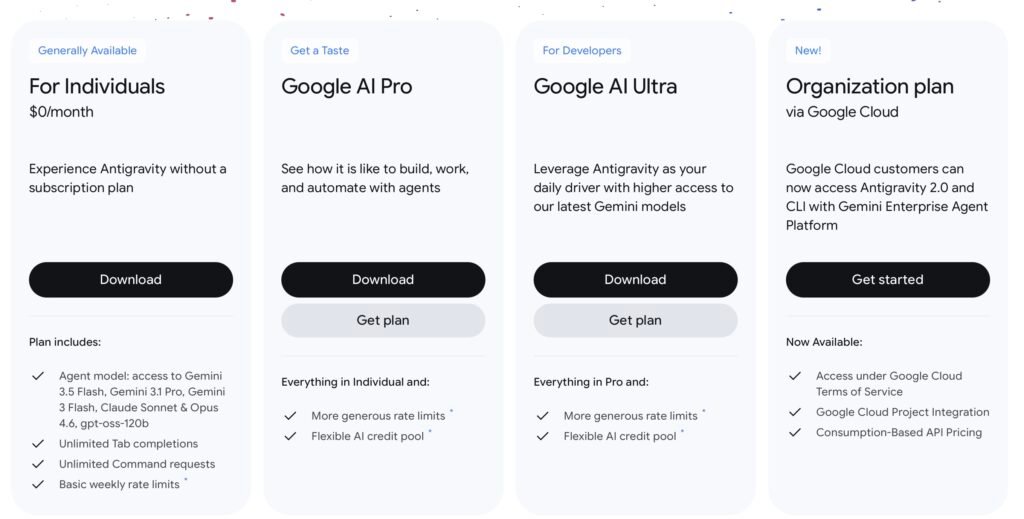
The new tool does not work that way. Google documents Antigravity as a two-tier usage system: a baseline quota plus purchasable AI credits, with credits deducted based on the model and the request complexity. Google AI Pro members get higher limits inside Antigravity and access to several models, including Gemini 3 Pro and Vertex Model Garden models such as Claude 4.5 Sonnet and gpt-oss-120b. What Google does not publish is the part you most need: the exact baseline quota, the refresh windows, or the formula that turns a request into a credit charge. (Verified that the model exists and that the numbers are not published: Google One support documentation.)
That gap is the operational story. Developers describe Antigravity’s consumption as an opaque “compute effort” or “work done” meter, report exhausting allowances inside short sessions, and report cooldowns measured in days. There are also reports of the interface showing full capacity moments before a single prompt triggers a multi-day lockout. These are community reports, not Google’s official figures, and FSR has not reproduced them. (Community: Google’s own developer forums and GitHub discussions. Unverified by FSR.)
It is the same kind of credit meter that is only sometimes accurate we have flagged on other tools.
If you ran Gemini CLI inside automation, the migration is not a clean find-and-replace. The two binaries have different configuration layouts, and several failure points are silent: a CI job keeps calling a dead command, an MCP configuration field fails without an error, an integration mode is missing at launch. None of these throw an error during the switch. They surface later, when they are more expensive to fix. (Source: Google’s parity caveat plus community migration reports.)
The honest read of that table: this is not a loss for everyone. A solo developer who uses the tool interactively and pays for a tier gets a manageable migration and the new platform features. The people who actually lose are those who built on the free tier’s predictability, those who automated against it, and the contributors who supplied the engineering that Google then closed off for individuals.
The blind spot: you rented the engine, not the license
Here is the part most coverage missed, and the reason this article exists.
The debate framed itself around open source. Did Google betray open source? Is the replacement open or closed? Those are the wrong questions, because the open license was never the thing you depended on.
FSR has watched the same gap open from the other direction, at launch rather than shutdown: Microsoft’s MAI-Thinking-1 arrived with headline benchmark claims while access itself stayed locked inside a gated preview, and OpenAI’s GPT-5.6 launch ran the same play, with public token prices on day one and no public access path.
Gemini CLI’s code was Apache 2.0 the entire time. You could read it, fork it, modify it. None of that helped on June 18, because the code is inert without Google’s backend: the hosted models, the authentication, the quota, the server-side harness. A permissive license on a client whose engine a vendor controls is open in name and rented in practice. The thing you actually depended on was the consumer entitlement to that backend, and an entitlement can be removed with a blog post. The terms of service for a free product change when the vendor decides they do.
Sometimes the expiry is printed on the label from day one: Leanstral 1.5, Mistral’s open-weight Lean 4 proof model, pairs downloadable Apache-2.0 weights with a free hosted endpoint that is already scheduled to retire, the same rental with a countdown attached.
This is not a Google-specific failing. It is a structural property of AI-era developer tools, and it deserves a name. A traditional open-source project survives a vendor’s exit because the community forks the code and keeps running. An AI CLI cannot, because forking the client does not give you the model weights, the inference capacity, the auth layer, or the quota the client was a thin wrapper around. You keep the steering wheel. You do not keep the engine.
It is the same split a low-code buyer hits when a platform lets them export the code but not the runtime it depends on.
Two corrections matter here, because getting them wrong is how this story turns into misinformation.
The quota cut you have read about is not Antigravity’s. A widely cited figure says a free tier was slashed roughly 92 percent, from 250 requests per day to 20. The traceable source for that number is a complaint on Google’s own developer forum about the Gemini API and Gemini Flash free tier, dated December 2025. It is real, and it shows Google’s broader pattern of launching generously and tightening later. But it has not been confirmed as Antigravity CLI’s free-tier number, and several third-party blogs appear to have applied it to Antigravity by assumption. The defensible statement is narrower and still damning: Gemini CLI gave individuals a published 1,000 requests per day, and Antigravity gives them a credit model whose baseline Google does not publish at all. The problem is not a number that got worse. The problem is a number that disappeared. (Verified: Google quota page and support page. Community: the 92 percent forum complaint, which concerns the Gemini API, not Antigravity.)
Antigravity is not a single-model cage. It is easy to assume the replacement traps you on Gemini. Google’s own documentation shows otherwise: inside Antigravity, paid users can reach Gemini 3 Pro and other Vertex Model Garden models, including Claude Sonnet and gpt-oss. The lock-in is not which model you run. It is that the plan, the quota, the authentication, the harness, and the credit accounting all stay under Google’s control no matter which model you pick. That is a sharper point than “you are stuck with Gemini,” and it is the one that holds up. (Verified: Google One support documentation.)
So what actually removes the dependency? Not switching vendors. The structural fix is decoupling the client from the backend. A client you can read and fork, like Aider or OpenCode, paired with model weights you can download and host, like Qwen, DeepSeek, or Llama, moves the dependency from “the vendor’s on/off switch” to “your own hardware and electricity.” That is the only configuration where forking the client is a real exit, because you also hold the engine. The cost of that exit is the part FSR measured separately: running a current open-weight coding model like GLM-5.2 or Kimi K2.7 Code needs roughly 640GB of GPU memory or more, which is the hardware floor most teams cannot clear. (Verified at the structural level by the licenses and weight availability below. Self-hosting performance and hardware requirements not tested here.)
This framing is not fringe. The European Union’s Open Source Strategy, part of its Technological Sovereignty Package, explicitly treats dependence on vendor-controlled software as a procurement and sovereignty risk, and promotes open source specifically to reduce single-vendor lock-in in public-sector technology. “You own the license but not the engine” maps directly onto a risk a major regulator already names. (Primary: EU digital strategy and Interoperable Europe sources. Exact procurement-guideline text still in development.)
Where the alternatives actually differ
Most migration guides point you at one replacement and move on. The useful comparison is not which tool is best. It is which tools decouple the client from the backend and which do not, because that is the property this whole episode was about.
| Tool | Client license | Backend | Real fork / self-host | Note |
|---|---|---|---|---|
| Antigravity CLI | No source or license in public repo (as of Jun 19) | Google account / GCP, multi-model | No (no client source published) | Credit meter not quantified by Google |
| Claude Code | All rights reserved (not open source) | Anthropic plan; Bedrock / Vertex paths | No (closed client, native binary) | The popular “switch to this” is also vendor-locked |
| OpenAI Codex CLI | Apache 2.0 | ChatGPT login or API key; --oss local | Partial (client open, hosted tier plan-limited) | Can run local OSS models via Ollama |
| Aider | Apache 2.0 | Provider-agnostic; local via Ollama | Yes (client open, any backend) | Deprecation risk shifts to your chosen provider |
| OpenCode | MIT | 75+ providers; local models | Yes (client open, any backend) | Optional managed tier exists separately |
| Continue | Apache 2.0 | Multi-provider | Code is open, but project is winding down | Acquired by Cursor; repo marked no longer maintained |
Read the color, not just the rows. The two tools the crowd recommends most, Antigravity CLI and Claude Code, sit in the same column you just left: a client you cannot fork, on a backend a single vendor controls. Codex CLI is a middle ground, open client with an escape hatch to local models. Aider and OpenCode are the only entries where forking the client is a genuine exit, because they were never tied to one backend in the first place. Continue looks like a safe open option until you notice it has been absorbed by Cursor and its repository is no longer maintained, which is its own version of this article’s lesson.
And TensorZero’s shutdown is that lesson in its cleanest form: a funded, widely adopted, fully self-hostable LLMOps stack whose repository is now archived and unmaintained, where the code survives and the maintained system around it does not.
If decoupling is what you want, the client is only half of it. The other half is a model you can hold. Several capable models ship downloadable weights you can self-host, which is what makes an open client meaningful: Qwen2.5-Coder and Mistral’s Devstral small model under Apache 2.0, DeepSeek’s R1 and V3 under MIT, and Meta’s Llama 4 under its community license. Licenses and terms vary by model and should be checked against each model card before commercial use.
A provider-agnostic client plus one of these models, served locally through Ollama or vLLM, decouples your inference cost from any vendor’s pricing tier and removes the on/off switch from someone else’s hands. The trade is real: you take on hardware, provisioning, and the gap between a frontier hosted model and a self-hosted one. FSR has not benchmarked that gap, and the hardware to run the largest models well is not trivial. But the lock-in math changes from “sunk subscription plus a proprietary harness” to “infrastructure you own.” (This paragraph is reasoning from the verified licenses and weight availability above, not a tested deployment.)
Who should switch, wait, or leave
Switch to Antigravity CLI if you are staying in Google’s ecosystem, you use the tool interactively rather than in heavy automation, and the multi-agent features are worth more to you than a predictable quota. For this profile the migration is short and low-friction. Run one real task through it this week and watch where your quota lands before you rely on it.
Wait, or rather act now but carefully, if you have unattended automation on a consumer tier. Your priority is not choosing a new tool. It is finding every gemini call in your infrastructure before more of them fail silently. Then decide.
Leave if you chose Gemini CLI because it was open and free, and that combination is what you valued. The replacement is neither for individuals. The honest alternatives are not Claude Code or Antigravity. Neither lets you fork the client (Claude Code’s repo is all rights reserved, and Antigravity’s public repo ships no source), and both run on a vendor’s backend. The alternatives are a provider-agnostic client and, if you want a true exit, a self-hosted open-weight model.
You are not affected if you hold a Gemini Code Assist Standard or Enterprise license, or you authenticate with a paid API key. Confirm which account tier each of your integrations actually uses before assuming you are safe, because the line runs between consumer and enterprise, not between products.
FAQ
Is Gemini CLI still open source after June 18, 2026? Yes. The Gemini CLI repository remains public and Apache 2.0 licensed, and Google says it will keep maintaining it for enterprise. What ended on June 18 was free consumer service access through Google AI Pro, Ultra, and the free individual tier, not the open-source status of the code itself. (Verified: GitHub repo, Google blog.)
Can I still use Gemini CLI at all? Yes, through a paid path. Gemini CLI keeps working for organizations on a Gemini Code Assist Standard or Enterprise license and for anyone authenticating with a paid Gemini or Gemini Enterprise Agent Platform API key. The shutdown only removed the free and consumer-subscription routes for individuals. (Verified: Google Developers Blog.)
What is the catch with Antigravity CLI’s pricing? Google documents a baseline quota plus purchasable AI credits, with credits deducted by model and request complexity, but does not publish the baseline numbers, refresh windows, or the credit formula. You moved from Gemini CLI’s documented 1,000 free requests per day to a meter you cannot read in advance. (Verified: Google quota and support pages.)
We have watched that gap before, where a $99 sticker hid an $827 bill.
Did Google really cut the free quota by 92 percent? That figure traces to a December 2025 complaint about the Gemini API and Gemini Flash free tier, not Antigravity CLI. It shows Google’s pattern of tightening free limits, but it has not been confirmed as Antigravity’s number. The verifiable change is that Gemini CLI’s published free quota was replaced by an unpublished credit model. (Community for the 92 percent claim; verified for the documented Gemini CLI quota.)
What are the best alternatives to Gemini CLI? For an open client you can fork, Aider (Apache 2.0) and OpenCode (MIT) are provider-agnostic and run local models. OpenAI Codex CLI is open with a local-model flag. Claude Code is a capable option but is a closed client on Anthropic’s backend, so it does not solve the lock-in this episode exposed. (Primary: project repositories and docs.)
Will my CI pipeline break? If it calls the gemini command on a free, Pro, or Ultra account, those calls were cut on June 18, and migration reports say they fail silently rather than throwing an error. Enterprise-licensed and paid-API-key automation is unaffected. Audit your CI configs, cron jobs, and scripts for gemini invocations and confirm each one’s account tier. (Verified scope; silent-failure behavior is from migration reports, not FSR-observed.)
Is Antigravity CLI safe for EU or enterprise procurement? That is a procurement question, not a yes or no. The EU’s Open Source Strategy treats vendor-controlled dependence as a sovereignty risk, and Antigravity’s auth, quota, and credit accounting are Google-controlled. FSR did not audit Antigravity’s data handling or terms, so enterprise buyers should review the relevant terms and data-processing documents directly. (Primary for the EU framing; FSR did not verify payload-level data handling.)
Methodology, sources, and what we did not verify
Tier C, no hands-on testing. This is a research post-mortem. FSR did not install, run, or benchmark Antigravity CLI, and did not reproduce the quota or lockout reports. Everything here is built from primary Google sources, the public GitHub repositories accessed on June 19, 2026, official EU policy pages, and a visible sample of developer reaction on X and GitHub. A Tier B follow-up is planned: install the replacement, confirm the binary name from a live install, run reproducible tasks, measure real quota consumption against the old tool, and reproduce the silent-failure cases.
How evidence is labeled. Verified means a primary or official source with a URL and date. Community means a forum, GitHub, or social post, treated as a signal, not a fact. Inference means reasoning from verified facts. Unverified means claimed somewhere but not confirmed. Where sources conflict, the conflict is preserved rather than smoothed.
- Antigravity’s exact free quota. Google does not publish it. The “20 requests per day” figure is community-reported and partly traceable to the Gemini API, not confirmed for Antigravity CLI. Do not state it as Google’s official Antigravity number.
- “Google abandoned open source.” Not accurate. The repository is intact and Apache 2.0. Use “removed free consumer access,” not “killed open source.”
- “Antigravity CLI is officially closed source.” Google has not published that statement. The verifiable fact is that the public repo contains no application source and no license file as of June 19, 2026.
- The binary name. Strongly indicated as
agyfrom Google’s repo asset and migration guides, but not quoted from Google’s own rendered docs. Confirm on a live install. - Version and star counts. Volatile and inconsistent across sources. Recheck against the live repository at publication.
- Whether Antigravity accepts third-party or local endpoints. Unconfirmed. Do not claim it only works with Google’s hosted models.
Primary sources. Google Developers Blog, “An important update: Transitioning Gemini CLI to Antigravity CLI” (May 19, 2026). Google Gemini Code Assist quotas page (last updated April 27, 2026; the free 1,000, Pro 1,500, and Ultra 2,000 daily caps were reconfirmed on the live page on June 19, 2026). Google One support documentation on Antigravity usage. The public google-gemini/gemini-cli and google-antigravity/antigravity-cli repositories. EU Open Source Strategy and Technological Sovereignty Package pages. Project repositories and docs for Aider, OpenCode, Codex CLI, Claude Code, and Continue. Developer reaction is a visible sample from X and GitHub discussion 27274, used as sentiment only.
Affiliate disclosure. FSR has no affiliate relationship with any tool named in this article and earns nothing from any link here. This piece points to no single replacement on purpose.
FSR verdict
Google did not kill an open-source tool. It demonstrated that an open-source license was never what its users depended on. The Apache 2.0 repository is intact, and it is also beside the point, because the part that made Gemini CLI useful, the hosted backend and a free quota you could read, was always Google’s to withdraw. On June 18 it withdrew it for individuals and replaced a published 1,000-requests-per-day number with a credit meter it does not quantify.
The lesson the migration guides keep getting wrong is the recommendation. Moving to Claude Code does not fix this, because Claude Code is also a closed client on a single vendor’s backend. The only configuration that removes the dependency is a client you can fork paired with a model you can host. Most teams will keep renting the engine, and that can be the right call. The editorial point is to make the rental explicit. What you are choosing is a landlord, not a house.
If you take one thing from this: when you pick an AI command-line tool, do not check the license and stop. Check who controls the model, the quota, the authentication, and the harness. That is the dependency. The license is the part that looks like ownership and is not.
This thesis is falsifiable. It weakens if Google open-sources the Antigravity client, restores a documented free quota, extends free Gemini CLI access for individuals, or publishes the credit formula and a usage dashboard that reconciles shown capacity with billed usage. If any of those happen, this verdict should be revisited.