Last updated: August 17, 2026
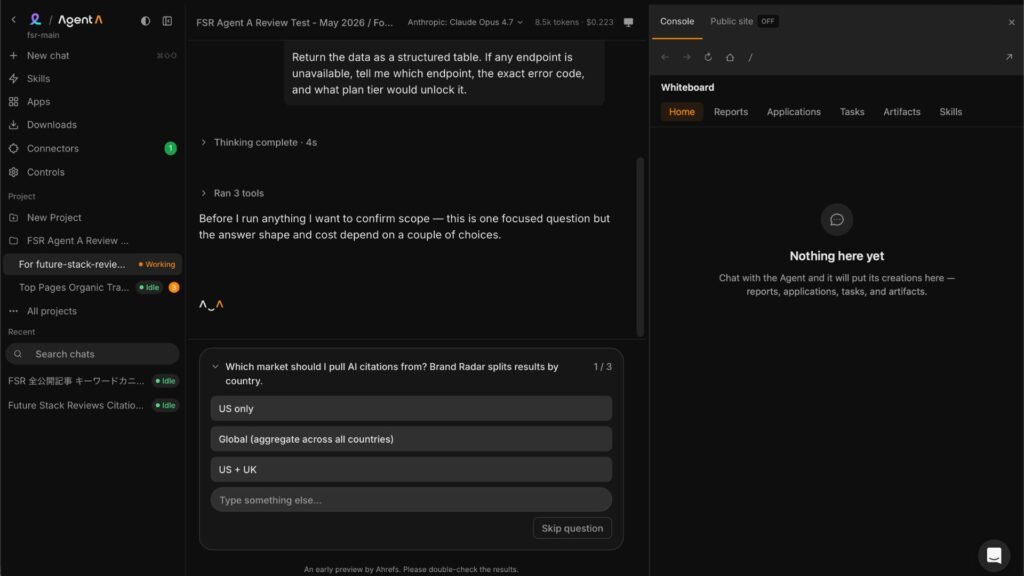
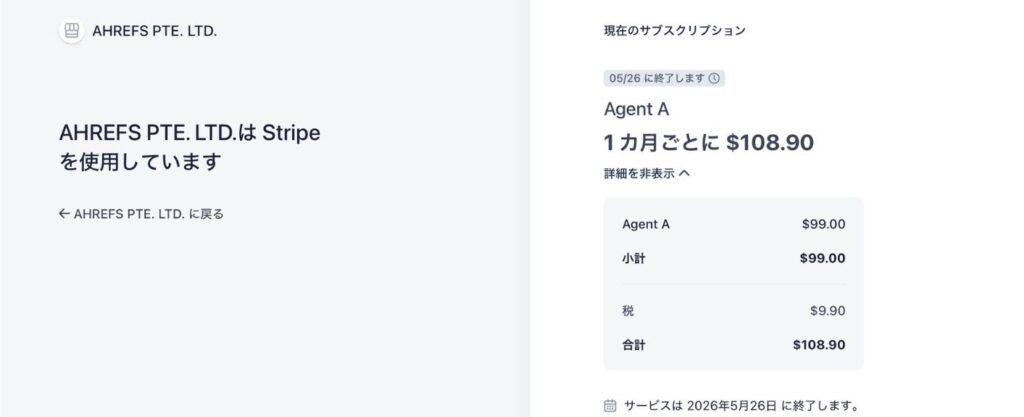
Ahrefs Agent A is a $99/month AI marketing agent built by the team behind Ahrefs, running on Letaido, their own workspace platform. The agent connects to Ahrefs data and over 650 AI models, but the entitlements required for AI citation tracking sit in a separate Ahrefs product called Brand Radar. Agent A does not include Brand Radar. The total monthly cost for AI citation work is $827, not $99.
I paid $99 to subscribe on April 26, 2026. Five days into active testing, my real monthly cost projection had climbed to $827. Four Brand Radar endpoints returned HTTP 403 Forbidden inside the agent’s own tool calls. The agent itself told me Grok was not in Ahrefs’ coverage list. Ahrefs’ own Brand Radar page lists Grok at $199 per index or inside the $699 all-platform bundle. Agent A had misreported its parent product.
That is not a bug to fix. That is the review.
Briefing Summary — May 2026
Tier B review · 30 days of paid access · 5 days of active testing · supplemented with primary-source research
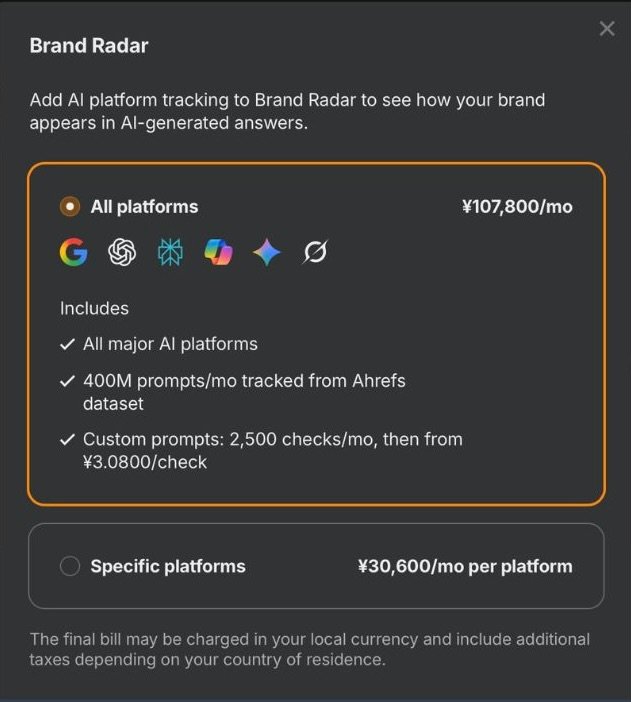
Ahrefs Agent A is a vertically priced AI agent. The base subscription is $99/month. The data layer most people came for sits behind a separate product called Brand Radar that starts at $199 per AI platform per month and reaches $699 for the all-platform bundle. The realistic monthly cost for a buyer who wants AI citation tracking across ChatGPT, Perplexity, Copilot, Gemini, Grok, and AI Mode lands at $827. That is the $99 Agent A plus a $29 Ahrefs Starter subscription plus the $699 Brand Radar bundle. This is not an official Ahrefs SKU. It is the configuration my intended workflow required. Pricing verified on May 17, 2026.
If you are an existing Ahrefs subscriber at the Lite tier or above and you already have Brand Radar in your stack, Agent A is the most coherent agent layer on top of an SEO data platform that exists right now. The synthesis is strong. The self-correction is unusually honest for an LLM product. The willingness to admit when the underlying workspace is wrong for the job is, as far as I can tell, unique.
If you are an SMB or solo operator looking at a $99 line item and assuming you bought “AI search visibility tracking,” close this tab. The agent itself will tell you, in writing, that what you actually need is Brand Radar. I have the transcript.
If you are sitting in the EU and operate in regulated verticals (healthcare, legal, financial services), you need to read section D3 before doing anything else. Letaido does not currently document European data residency, the platform appears to be operated by the same team that runs Ahrefs out of Singapore, and the EU AI Act Article 50 transparency rules take full effect on August 2, 2026. That is 77 days from publication.
TL;DR
The agent is good. The bill is bigger than advertised. Most people quoting $99 do not understand what they actually bought.
If you already pay Ahrefs $129/month or more and you want a conversational layer on top, Agent A earns its $99. If you are buying it to “track AI citations,” you bought the wrong product at the wrong price tier, and the agent itself will tell you so in the first session.
Skip it if your real question is “how do I show up in ChatGPT,” because that question costs $526 to $827 per month to answer with Ahrefs infrastructure, not $99.
Quick Start: 30-Second Decision
Already pay for Ahrefs Lite or above? Add Agent A. The synthesis layer is worth $99 if you write briefs, run site audits, or run keyword research more than twice a month.
Already pay for Brand Radar? Add Agent A. You are the buyer the product was designed for. The agent can talk to your Brand Radar data and turn AI citation reports into language a CMO will read.
Looking at Agent A as “the cheap AI SEO tool”? Stop. The agent itself will tell you, when asked, that the $99 tier gives you nothing on AI search visibility. Quoting directly from a Prompt 5 session on May 13, 2026: “Anyone whose primary 2025 question is ‘how do I show up in AI search.’ That’s Brand Radar territory. At $99 I will give you nothing here and you’ll feel cheated.”
The agent is being more honest about its own product than most reviewers.
That should tell you something about the reviewers.
Full Comparison: Pricing Stack and Five Competitors
This is the section the official Ahrefs product page does not write for you. Five vendors operate in the AI citation tracking category. Each priced and bundled differently. The Ahrefs offering is the only one that splits the agent and the tracking data into two separate paid products.
Agent A is the only product in the category where a $99 buyer can get blocked from the headline use case by the same company’s own paywall, inside the same chat window, with the agent itself saying “I cannot do this without a different subscription.”
That is structurally unusual. Worth understanding before you commit.
| Vendor | Entry price | Grok | Claude | Trial |
|---|---|---|---|---|
| Ahrefs Agent A + Brand Radar | $327–$827 | ✓ $199 / $699 bundle | ✓ Bundle only | None |
| Profound | $99–$399+ | ✓ | ✓ | Unconfirmed |
| Peec AI | $95–$459 | ✓ | Enterprise only | 7-day |
| OtterlyAI | $29–$489 | ✗ | ✗ | 14-day |
| Scrunch AI | $250–$500 | Conflicting docs | ✓ | 7-day |
| AthenaHQ | $295+ | ✓ | ✓ | None |
A few things become obvious from this matrix.
OtterlyAI is the only vendor under $30 at entry, and the price tells you exactly what you lose. No Grok. No Claude. A 14-day trial that mostly exists to show you what the bigger plans do.
AthenaHQ at $295 self-serve with both Grok and Claude is the strongest argument against buying the full $699 Brand Radar bundle. The Ahrefs stack only beats AthenaHQ if you also need Ahrefs data underneath, and even then the math depends on how much you actually use the SEO side.
Profound and Peec AI sit in the middle. Both list Grok at lower entry prices than Ahrefs Brand Radar single index. Peec AI’s Claude support is enterprise-gated, which weakens it for SMB buyers.
Scrunch AI’s Grok coverage shows up inconsistently across public pages and reviewer reports. I would call them before buying.
Side note: HubSpot is shipping an AEO Sensor for free as part of their marketing hub. Open-source GEO trackers like geocheckr and dualmark exist for $0 to $29. The whole category is two pricing layers away from being commoditized, and Ahrefs is positioned at the top of the layer that gets squeezed first.
Who Should and Shouldn’t Subscribe
Best for
Existing Ahrefs subscribers at the Lite tier or above who want a conversational interface on top of data they are already paying for. The synthesis surface is where Agent A earns its $99. You will write better content briefs faster, triage Site Audit findings more honestly, and ask follow-up questions you would not have typed into a static SEO dashboard.
Enterprise CMOs and VP-level marketing operators who need defensible board-level reporting on AI search visibility. The $827 stack is real money. It is also less than one analyst’s monthly billable rate. If your job involves explaining to a board why ChatGPT mentions matter, the all-platform Brand Radar bundle gives you the data structure you need.
Agencies already paying $700/month or more for SEO infrastructure across multiple client accounts. The economics work because the agent reduces analyst hours, not because $99 is cheap.
Not for
SMB founders with under $200/month in total marketing software budget. The agent will be honest with you in the first session about what it cannot do. Believe it. Cancel before day 14.
Brands whose primary 2026 question is “how do I show up in AI search,” because the answer at the $99 tier is “you cannot find out from Agent A alone.” The agent itself flagged this category as roughly 40% of the people currently shopping for an AI SEO agent. They are the people most likely to feel cheated. Do not be that buyer.
EU operators in regulated verticals. Article 50 enforcement is 77 days away. Letaido does not currently publish a regional data residency policy that I could verify on May 17, 2026. That is not a refusal to comply. It is a gap. Do your own check before signing.
Anyone who wants to track Claude citations as a primary use case at the lowest price. AthenaHQ at $295 is the cheaper and structurally cleaner path. Ahrefs Brand Radar Claude support requires the $699 all-platform bundle to function as advertised.
Solo bloggers writing fewer than four briefs per month. The agent’s strongest feature is reducing repetitive analytical work. If you do not have repetitive analytical work, you are paying $99 for a chat interface that has cheaper substitutes.
Deep Dive: The Stochastic Illusion
The most expensive misunderstanding in AI search optimization is that AI citations behave like Google rankings. They do not.
Google rankings are mostly deterministic. Same query, same crawler, same index, similar result set. You can A/B test changes against rank tracking and read the signal within two weeks if your data set is large enough. Most professional SEO workflows are built on this assumption. They have been built on it for two decades.([The structural reason “optimized” doesn’t equal “ranked” is its own rabbit hole I’ve written separately.] )”
LLM citations are probabilistic. Same query, same model, same time of day, and you can get three different cited URLs in three different sessions. The retrieval set is sampled. The reranker is stochastic. The grounding step is non-deterministic at temperature settings above zero, which is where most production LLM products operate.
This matters because every tool in the AI citation tracking category, including Ahrefs Brand Radar, samples a fixed set of prompts at a fixed cadence and aggregates the result. That is the only thing they can do. But the sampling rate is not high enough to give you statistical confidence on a single prompt over a single week.
Three peer-reviewed papers shaped how I read the Brand Radar data Agent A surfaced.
Zhang Kai and colleagues, in “From Citation Selection to Citation Absorption” (2026), ran an analysis of 602 prompts producing 21,143 citations across 18,151 pages. Their finding is the most cited piece of GEO research in the last twelve months. High-influence pages were longer, more structured, more semantically aligned with the prompt, and richer in extractable evidence. That last word matters. Evidence. Definitions. Numerical facts. Comparisons. Procedural steps. The pages that get cited do the analytical work that an LLM would otherwise have to do.
Ma and colleagues (2025), in “When Content is Goliath and Algorithm is David,” analyzed 10,000 websites and found that generative engines prefer content with higher predictability for underlying LLMs. Predictability. Not novelty. Not freshness. Not authority in the traditional SEO sense. The model wants content it can reliably summarize.
Venkit and colleagues (2024), in “The False Promise of Factual and Verifiable Source-Cited Responses,” ran a 21-participant study against four major LLM products and found frequent hallucination and inaccurate citation. The retrieval and grounding pipelines are not trustworthy yet. Every tool in the AI citation tracking category is measuring an output stream that is itself unreliable.
I asked Agent A to pull a 30-day report on which of my pages ChatGPT had cited. Four endpoints returned HTTP 403 Forbidden. The agent did not have Brand Radar entitlements on my workspace. It also told me, when I pushed back, that even with Brand Radar access the underlying cited_pages endpoint does not have a true “last 30 days” filter. It aggregates latest snapshot cumulative cited-response counts and you have to compute deltas yourself.
That is the stochastic illusion. You buy a $699 product expecting weekly trend lines and you get cumulative counts you have to differential-process yourself. Most buyers will not know that until they have already paid.
Agent A told me this in the first session. That is one of the strongest cases I can make for paying $99 to talk to it. The agent is honest about the limits of Ahrefs’ own data layer in a way that the Ahrefs website is not.
The shape of the problem is not specific to SEO data. Fujitsu announced its PHOTON architecture at up to 475× output tokens per GPU, while the paper behind that headline defines the measured quantity as throughput divided by per-sample cache memory, and publishes no batch size, concurrency, precision, or GPU count. The figure reconstructs exactly from the paper’s own tables. It still cannot size a single server.
Deep Dive: The Vertical Pricing Stack
The $99 sticker is not the price. The $99 sticker is the entry point to a four-product vertical stack: Agent A (the workspace), Ahrefs (the data), Brand Radar (the AI citation entitlement), and optional API access (the volume layer).
I tested all four layers across five days of active use. The pricing math is unambiguous.
If you want what most people think they bought when they read “Agent A,” you need three of these four layers. The math lands at $526 for the typical mid-market buyer (one Brand Radar index for ChatGPT, one for Copilot) and $827 for the buyer who needs the all-platform bundle including Grok.
The 395% premium over native Claude Pro is real. Claude Pro costs $20/month for the same Claude Opus 4.7 model that runs underneath Agent A. You are paying $99 to get the agent layer, the Ahrefs tool integrations, and a $50 monthly AI credit allocation that covers most reasonable usage.
The model underneath has since moved on. Anthropic shipped Claude Opus 4.8 in May 2026 as the direct successor to 4.7, at the same $5 / $25 token pricing. Our Claude Opus 4.8 review covers what changed and where the newer model is a worse autonomous operator.
In my five days of active testing, I consumed $4.91 in AI credits across six substantive analysis prompts. That left $43.01 of my $47.88 starting balance. The credits are not the binding constraint. The data entitlements are.
Bergemann and colleagues (2025), in “Menu Pricing of Large Language Models,” found that optimal pricing of LLM products depends on token allocation across tasks and user heterogeneity, with higher markups for more intensive users. Ahrefs has implemented this almost perfectly. The agent is priced low to acquire the user. The data layer is priced high to capture the heavy user. The vertical stack is a textbook example of price discrimination across a multi-product bundle.
This is not a criticism. It is the dominant pricing model in mature B2B SaaS. The criticism is that the product page does not name it.
This is not unique to SEO software. Mureka runs the same playbook in AI music: a $27 plan up front, with a per-action Gold meter doing the real billing. It runs in AI media too, where Mitte’s credit meter showed one price on the generate button and sometimes billed another.
It runs in AI coding too: in our MiniMax M2.7 test, the “17x cheaper per token” headline said nothing about what a task actually bills, and the editor’s own cost meter ran about double the real provider charge.
The free end of the market hides cost the same way, just in different units. A self-hosted AI tool can read as $0 while the real bill is hardware, storage, and maintenance, which is exactly the gap I measured in my Odysseus review.
Orchestration is one more unit on that list. A managed multi-model API can show clean sticker prices, then bill the tokens its router spends behind each request, a charge you audit after a run but cannot forecast before one. Sakana Fugu’s orchestration tax is that same hidden cost, one layer down from the SEO stack.
Three institutional reviews flagged this same structural pattern.
“The Ekamoira blog, in their February 23, 2026 analysis, wrote that Ahrefs ‘follows a layered model that significantly increases the total cost beyond what many marketers initially expect.’ Rankability, on January 8, 2026, concluded that Brand Radar ‘is not yet the complete solution many hoped for.’ EWR Digital, on February 2, 2026, reported that ‘The lack of native tracking for Claude and Grok is a significant omission, especially at this price point.’ This last point conflicts with current public Brand Radar documentation, which now lists both. Coverage existed as of May 17, 2026 when I verified it directly. The documentation appears to have expanded in the three months between EWR Digital’s review and this one. The market is moving faster than the reviews citing it.”
Agent A defended this pricing structure when I asked it to explain. Its answer was that “$129 gets you in the door; ~$725/mo is what unlocks the agent’s full surface area.” The agent’s pricing recall was off by $30 (current entry is $99, not $129), and the $725 figure is a constructed full-surface estimate the agent assembled from Ahrefs Standard $249 plus Brand Radar $200 plus a $275 API allocation. There is no official Ahrefs SKU at $725. The agent built the number to make a point.
I am quoting the agent’s wrong number to make a different point. In one prompt the agent described its entry price as $129. The current Ahrefs Agent A page and Help documentation list $99. The recall was off by $30. That is not fatal. It is diagnostic.
The first misreport I caught was Grok coverage. The second was its own entry price. Both came out of the same product, in sessions five days apart. Neither is a deal-breaker. Both are exactly why buyer-facing pricing claims from the agent need verification against the source pages before you build a procurement decision on them. Use the agent for synthesis. Verify the numbers yourself.
Side note: another AI agent I reviewed recently has the exact same pattern. Manus AI calls its own bad numbers “hallucinations” right in the output.
Deep Dive: The Singapore Question
Letaido and Ahrefs are operated by the same team. This is documented in four independent sources that I verified on May 17, 2026.
First, the Letaido homepage states “Built by the team behind Ahrefs.”
Second, the Letaido homepage carries an official quote from Dmytro Gerasymenko, Founder and CEO of Ahrefs: “We moved to Letaido ourselves. When we adopted it internally, the shift wasn’t technical. Teams started small, automating routine tasks, then pushed further to automate entire workflows. We built a full CRM in two days.”
Third, the Agent A chat interface itself displays a disclaimer at the top of every session: “An early preview by Ahrefs. Please double-check the results.”
Fourth, the Letaido Privacy Policy at letaido.com/legal/privacy-policy (last updated April 16, 2026) opens with: “This Privacy Policy applies to the Processing of information by Ahrefs Group (‘Ahrefs’, ‘we’, ‘us’, or ‘our’) in connection with the provision of Letaido.” The California section names Ahrefs Pte Ltd as the responsible legal entity. The corporate address on the privacy page is 16 Raffles Quay #33-03 Hong Leong Building, Singapore 048581.
Four sources, one conclusion. Letaido is not a third-party platform that Ahrefs happens to use. Letaido is Ahrefs’ own workspace product, marketed under a separate brand, operated by a Singapore-headquartered Ahrefs legal entity. Buyers should understand this before they make data residency assumptions.
This matters for EU operators. The EU AI Act Article 50, which takes full effect on August 2, 2026, requires that natural persons interacting with an AI system “be informed that they are interacting with an AI system, unless this is obvious from the circumstances and the context of use.” Agent A’s chat header shows the underlying model name (Anthropic Claude Opus 4.7) and a verification disclaimer. A regulator could plausibly accept that combination as meeting the “obvious from circumstances” exemption. They could also reject it. I am not a lawyer. The point is that 77 days from publication, this question becomes enforceable, and Ahrefs has not yet published a clear EU compliance statement.
Letaido does publish a privacy policy. I missed it on my first pass and want to correct that here. The policy lives at letaido.com/legal/privacy-policy, was last updated April 16, 2026, and applies to “the Processing of information by Ahrefs Group” in connection with Letaido Services. It names VeraSafe Ireland Ltd. as EU Representative under GDPR Article 27. It discloses that “Personal Data collected is transferred to and stored in the United States” where the services operate. It identifies WorkOS as the encryption layer for data in transit. It explicitly acknowledges that user information may be shared with Third Party Services, including “large language models, integration partners and open-source software.”
The privacy issue for EU regulated buyers is therefore not that the policy is missing. It is what the policy says.
US data storage as the default. Cross-border transfers governed by Standard Contractual Clauses (2021/914/EU) and EU-US Data Privacy Framework reliance. A controller entity (Ahrefs Pte Ltd) headquartered in Singapore. Personal data flowing through US infrastructure into large language model providers as part of normal product operation.
None of this is unusual for a SaaS product. Most US-and-Asia-headquartered AI workspaces operate the same way. The question for a regulated EU operator (healthcare, legal, financial services, public sector) is whether that posture clears the bar your specific regulator has set. For some industries it will. For others it will not. The 77-day Article 50 enforcement countdown is the right deadline to make that decision against.
If you are a regulated EU buyer (healthcare, legal, financial services, public sector), three vendors merit a serious look before Ahrefs Agent A:
Mistral, headquartered in Paris, with explicit EU data residency options and a French government contract pipeline.
Aleph Alpha, headquartered in Heidelberg, building sovereign AI infrastructure for German enterprise and public sector clients.
Black Forest Labs, while focused on image generation, illustrates that EU-headquartered foundation model providers are emerging quickly and with stronger regulatory posture than their American competitors.
None of these three currently offer an integrated SEO data layer comparable to Brand Radar. The data layer is the structural advantage Ahrefs has. The compliance layer is the structural advantage the EU vendors have. Choose which advantage matters more for your specific risk profile.
In practice, this means EU buyers should not assume that “Ahrefs is a known SEO brand, therefore Agent A is safe to deploy.” Brand recognition is not regulatory compliance. The 77-day countdown is the data point that should drive your decision.
Deep Dive: Where This Market Goes
The AI citation tracking category will not exist in its current form by 2030.
I am not predicting that AI citations will stop mattering. The opposite. They will matter so much that the platforms themselves will absorb the tracking function and offer it as a native publisher dashboard, exactly the way Google Search Console replaced an entire generation of third-party rank trackers in 2006.
There is precedent. In the desktop SEO rank tracker boom of 2005 to 2010, tools like WebCEO and Advanced Web Ranking were category leaders. They charged $200 to $500 per month for what is now a free tab inside Google Search Console. The category did not collapse from competition. It collapsed because Google itself shipped the dashboard.
OpenAI, Anthropic, and Perplexity will ship Publisher Consoles. Some version of this already exists in private beta at all three companies. When the consoles ship publicly, they will offer first-party citation data, free, with publisher verification. The third-party tracking category will compress to two surfaces: aggregation across multiple LLM platforms (where third parties retain value for one or two years), and analytical synthesis on top of the raw data (where Agent A-style products retain value longer).
Samet (2026), in “A GEO-First Framework,” proposed a metric called “Share of Model” as the replacement for Share of Voice in the LLM era. The framework assumes that brands track their narrative inclusion within the AI retrieval set, and that this inclusion catalyzes downstream high-intent branded searches. The metric is good. The data source for it will not be Brand Radar in five years. It will be a free OpenAI Publisher Console or its equivalent.
This is what Ben Thompson at Stratechery has called aggregation economics. The foundation model providers control the compute and the index. Aggregators that sit on top of multiple model APIs face permanent margin pressure as the providers expose more data downstream for free. Ahrefs Brand Radar at $699 per month is a transitional product. It is well-built. It is also priced for a market that will not exist at this price point in 36 months.
The buyer question becomes: do you need the data this month, or can you wait?
If you need the data this month, Brand Radar is the most mature offering in the category and Agent A is the best synthesis layer on top of it. Pay the $827 and capture the value while the category exists.
If you can wait, watch for the OpenAI Publisher Console announcement (rumored in late 2026), the equivalent Anthropic announcement (likely 2027), and the Perplexity native publisher dashboard (already partially launched). The free version of this category is coming. Most buyers will be better served waiting.
Agencies and consultancies should not wait. They need a defensible analytical product to sell to clients today, and Brand Radar is the most defensible product in the category. The same is not true for direct brand buyers. A brand can afford to track AI citations imprecisely for 18 months. An agency cannot.
Frequently Asked Questions
What does Ahrefs Agent A actually cost?
The Agent A subscription is $99 per month for one workspace, billed by Letaido. The realistic total for a buyer who wants AI citation tracking lands between $327 (Agent A plus Ahrefs Starter plus one Brand Radar index) and $827 (Agent A plus Starter plus the all-platform Brand Radar bundle). The $99 price tag does not include AI citation tracking data. Pricing verified May 17, 2026.
Does Ahrefs Agent A track AI citations?
Not at the $99 tier. AI citation tracking requires Ahrefs Brand Radar, which is a separate add-on starting at $199 per AI platform per month. The all-platform bundle including ChatGPT, Perplexity, Copilot, Gemini, Grok, and AI Mode costs $699 per month. Agent A can talk to Brand Radar data if you have both subscriptions. It cannot generate that data on its own.
Is Ahrefs Agent A worth it without Brand Radar?
Yes, if you are already paying for Ahrefs Lite or above and use it for content workflows, keyword research, or site audits. Agent A’s synthesis layer reduces repetitive analytical work on data you already have. It is not worth it as a standalone product for buyers whose primary goal is AI search visibility tracking, since that function requires Brand Radar regardless of the agent.
How does Ahrefs Agent A compare to AthenaHQ or Profound?
AthenaHQ covers Claude and Grok on a $295 self-serve plan. Profound starts at $99 with broader AI platform coverage but less integration with traditional SEO data. The Ahrefs stack is the only option that combines an SEO data platform, an AI agent layer, and AI citation tracking under one vendor. The integration is the differentiator. The price ceiling is the cost.
Does Ahrefs Agent A comply with the EU AI Act?
Partially. The chat interface displays the underlying model name (Anthropic Claude Opus 4.7) and a verification disclaimer, which could meet Article 50 transparency requirements under the obvious-from-circumstances exemption when enforcement begins August 2, 2026. Letaido does publish a privacy policy (Ahrefs Group, last updated April 16, 2026) with EU Representative and Standard Contractual Clauses for cross-border transfers, but personal data is stored in the United States. EU regulated industry buyers should verify whether this posture meets their specific regulator’s standard.
FSR Verdict
Three weeks before this review, I asked Agent A to analyze why Future Stack Reviews has 17 ChatGPT citations but zero organic Google traffic on a six-week-old domain. I assumed the answer was that I had built the site for LLMs. I had a thesis. I wanted the agent to confirm it.
The agent disagreed.
It returned three hypotheses, weighted them, and assigned 55% confidence to a different explanation. The site is in a Google sandbox period while ChatGPT’s retrieval has already ingested it. ChatGPT does not have a sandbox. Google does. The agent ran the citation data, noticed that all eight US-scope ChatGPT citations had been acquired in the prior three months while Google AI Overview impressions remained at zero, and reframed the question.
After thinking about it for two days, the agent was right. The site is too new to be optimized for anything. ChatGPT just got there first.
That observation is the strongest case I can make for paying $99 per month to talk to Agent A. It is also why I will not keep paying.
The agent is good. Better than I expected. Sharp enough to catch me defending a weak hypothesis, honest enough to admit when Ahrefs’ own workspace is the wrong tool for a job, calibrated enough to assign 55% confidence instead of pretending to know more than it does. In five days of testing it caught two of its own misreports (Grok coverage, current entry pricing), corrected itself on a US-versus-GB query default, refused to invent data when four Brand Radar endpoints returned 403, and recommended SimilarWeb and Semrush Market Explorer as alternatives when the Ahrefs workspace could not deliver what I asked for.
That last move is what most reviewers will not believe. An Ahrefs-owned agent, running on an Ahrefs-owned workspace, recommended Ahrefs’ direct competitors when those competitors were better suited to the task. The agent did not protect the brand. The agent protected the answer.
This is also why I am not renewing.
The agent is smart enough to expose the problem with Agent A. The agent is gated behind a pricing stack that adds $228 to $728 per month to do what the product page implies the agent can do at $99. The agent itself will tell you this in the first session, in writing, if you ask. Most buyers will not ask. Most buyers will see “$99 AI agent from Ahrefs” and assume the SEO citation tracking is included. It is not.
Agent A is good enough to reveal the problem with Agent A.
I cannot decide if that is a feature or a bug. The agent disclosed its own limits more honestly than the product page does. That should make me more trusting of Ahrefs. It also means the company is selling a product whose own AI tells you, on day one, that you probably bought the wrong tier.
If you are existing Ahrefs and want a synthesis layer, this is the best one in the category. Sign up.
If you are new to Ahrefs and primarily want AI citation tracking, the agent itself will tell you that $99 is the wrong price and you need Brand Radar. Listen to the agent. Decide whether $827 is worth it before you start the $99 trial, not after.
The agent is honest about Agent A.
Whether that honesty is enough to overcome the price stack it is honest about, that’s your call.
Takashi Fujino is the founder of Future Stack Reviews and the Representative Director of 合同会社 Future Stack (Osaka, Japan).
FSR classifies every briefing under one of three evidence tiers. Tier A and Tier B are tested hands-on inside a paid account. Tier C is document-first and involves no hands-on testing. Every briefing carries a pricing verification date.
This is a Tier B review, based on 30 days of paid Agent A access (subscribed April 26, 2026) and 5 days of active testing (May 13–17, 2026), supplemented with primary-source research.