Last updated: July 31, 2026
Current status
This briefing is a record of Claude Fable 5’s launch week, published 12 June 2026. The dates, plan terms and deadlines below describe the offer as it stood then. They have been superseded several times since, and none of them is current.
For the terms in force now, read Claude Fable 5 From July 20, 2026: What Happens on Each Paid Plan, which sets out what each plan and seat type receives.
What has not changed is the finding this briefing was written about. Anthropic publishes a per-token rate and no conversion between that rate and the limits a subscription is sold in. FSR’s July 20 briefing, working from the current plan documentation, reached the same conclusion independently.
The two notices below are retained as history. Neither describes current terms. Status marker added 31 July 2026.
UPDATE · July 3, 2026: Access was restored on July 1, 2026, and the free-through-June-22 offer described below no longer applies. On Pro, Max, Team, and premium Enterprise seats, Fable 5 is now included for up to 50% of weekly usage limits through July 7, then moves to usage credits. FSR tested the restored model’s usage and credit boundary hands-on.
Claude Fable 5 is currently unavailable. On June 12, 2026, Anthropic said the US government issued an export control directive, citing national security, ordering it to suspend access to Fable 5 and Mythos 5 for any foreign national, inside or outside the United States. Because Anthropic cannot selectively block foreign nationals in real time, it disabled both models for every customer worldwide. All other Anthropic models remain available.
Anthropic says it is complying with the directive but disputes it, describes it as a likely misunderstanding, and is working to restore access. The pricing, timeline, and guidance below describe Fable 5 as it was offered at launch. Whether it returns, and on what terms, is now uncertain.
Source: Anthropic’s official statement, June 12, 2026. This is a developing situation. Confirm current availability before acting on the details below.
FSR covers the suspension itself, the contested legal basis, and what it means for buyers relying on US-hosted frontier models in a separate briefing on the Claude Fable 5 suspension.

Claude Fable 5 is Anthropic’s first publicly available Mythos-class model, a tier the company places above its Opus line. It launched on June 9, 2026 at $10 per million input tokens and $50 per million output tokens: double standard Claude Opus 4.8, and the same rate as Opus 4.8 Fast Mode. It is Anthropic’s most capable widely available model. On paid subscriptions it is included free through June 22, then shifts to metered usage credits.
The published token rate is the easy part. Anthropic states it plainly: $10 in, $50 out. That is double standard Opus 4.8 ($5 and $25), and the same rate Anthropic charges to run Opus 4.8 in fast mode. What Anthropic does not publish is the number a subscriber actually needs.
Your Pro, Max, or Team plan measures usage in five-hour session windows. Fable 5 is priced per token. Anthropic provides no conversion between the two. You can read the official documentation end to end and still not know how much Fable 5 your plan includes during the free window, or what it will cost you once that window closes on June 22.
You find out by spending.
FSR’s take in one line: use the free window to measure your own Fable 5 token burn, and treat any post-June-22 cost you cannot measure as an estimate.
This is a research briefing, not a hands-on review. FSR has not run Claude Fable 5 or measured its token consumption directly. Every factual claim below is drawn from Anthropic’s own documentation. Launch-week pricing and plan packaging are moving quickly. Verify live pricing before buying usage credits or planning production usage. Figures current as of June 12, 2026.
TL;DR
- Claude Fable 5 launched June 9, 2026. API model ID
claude-fable-5. List price $10 per million input tokens and $50 per million output: double standard Opus 4.8 ($5/$25), and the same rate as Opus 4.8 Fast Mode. - It is free on Pro, Max, Team, and seat-based Enterprise plans through June 22, 2026. Free means no extra charge, not unlimited: during the window Fable 5 draws from your existing plan usage limits. On June 23 it leaves plan inclusion and runs on opt-in usage credits billed at API rates, charged separately.
- Anthropic intends to fold Fable 5 back into standard plans once capacity allows. No date is committed.
- The seam: the unit price is public, but Anthropic publishes no conversion between session-based plan limits and per-token pricing. A subscriber cannot calculate from official docs how much Fable 5 their plan includes, or forecast their monthly cost, without observing usage or buying credits.
- If you want to evaluate Fable 5, do it during the free window and watch your own token usage so you leave with a real cost estimate for June 23.
The verified facts
| Item | Detail |
|---|---|
| Released | June 9, 2026 |
| API model ID | claude-fable-5 |
| List price | $10 / M input, $50 / M output |
| Versus standard Opus 4.8 | Standard Opus 4.8 is $5 / $25. Fable 5 is double that |
| Versus Opus 4.8 Fast Mode | Opus 4.8 Fast Mode is also $10 / $50 (about 2.5x speed). Fable 5 matches it on price |
| Prompt caching | 90% off cached input (about $1 / M cached reads) |
| Batch pricing | $5 / $25 per M (50% off) |
| Context window / max output | 1M tokens / 128k tokens |
| Subscription free window | June 9 through June 22, 2026 (Pro, Max, Team, seat-based Enterprise). Draws from existing plan limits, not a separate allowance |
| After June 23 | Opt-in usage credits at API rates, billed separately on top of your plan. No automatic billing |
| Safety fallback | Certain flagged queries (cybersecurity, biology, and some model-development tasks) are routed to Opus 4.8, with a notice. Rerouted requests are not charged at Fable rates |
| Data retention | 30-day retention required to run the safety classifiers, not used for training. Zero Data Retention not available for Fable 5 |
| Mythos 5 | Same underlying model, cyber safeguards lifted, restricted to Project Glasswing partners |
The metering gap, explained
Anthropic runs two meters, and Fable 5 crosses from one to the other on June 23.
The first meter is your plan. On Pro, Max, and Team, included usage is governed by session limits that reset every five hours. Anthropic describes the limit in exactly those terms. It does not attach a token number to a session. There is no published figure for how many tokens, messages, or Fable 5 responses a single session window holds.
The second meter is usage credits. When you exhaust your plan’s session usage, credits let you keep working, and that overage is billed at standard API rates. For Fable 5 that is $10 per million input and $50 per million output. Credits are opt-in and prepaid, with a monthly spend cap you can set, and they appear on your bill as a separate charge from your subscription. Finer per-user or per-organization spend controls are not offered on the consumer plans.
One point worth stating plainly, because the word “free” invites the wrong assumption. During the June 9 to June 22 window, Fable 5 is not a separate or unlimited bucket. It draws from your existing plan usage limits, and by widely repeated accounts it depletes them faster than other models. Free here means no extra charge through June 22, not unlimited use.
Through June 22, Fable 5 sits inside the first meter. On June 23, it moves to the second. Nowhere in the official documentation does Anthropic bridge the two.
You will see a figure repeated across launch coverage that a Fable 5 session burns plan capacity about twice as fast as Opus. Read that carefully. It is a relative rate derived from the 2x token price, not an official allowance and not a token count. It tells you Fable depletes your plan faster than Opus. It does not tell you how much Fable you have, because the plan’s capacity was never published in tokens to begin with.
This is not hidden pricing. The unit price is public and specific. What is missing is the one number a subscriber needs to plan around: the conversion between the unit their plan is sold in and the unit Fable 5 is priced in. Anthropic’s own pricing page makes the gap concrete. In the plan comparison table, Fable 5 appears on Pro and Max only as a label, marked “Promo,” with no token figure attached anywhere in the table. The table tells you which models a plan includes, not how much of each. As of June 12, 2026, there is no official Anthropic conversion from session capacity to tokens, and no per-plan Fable 5 token allowance.
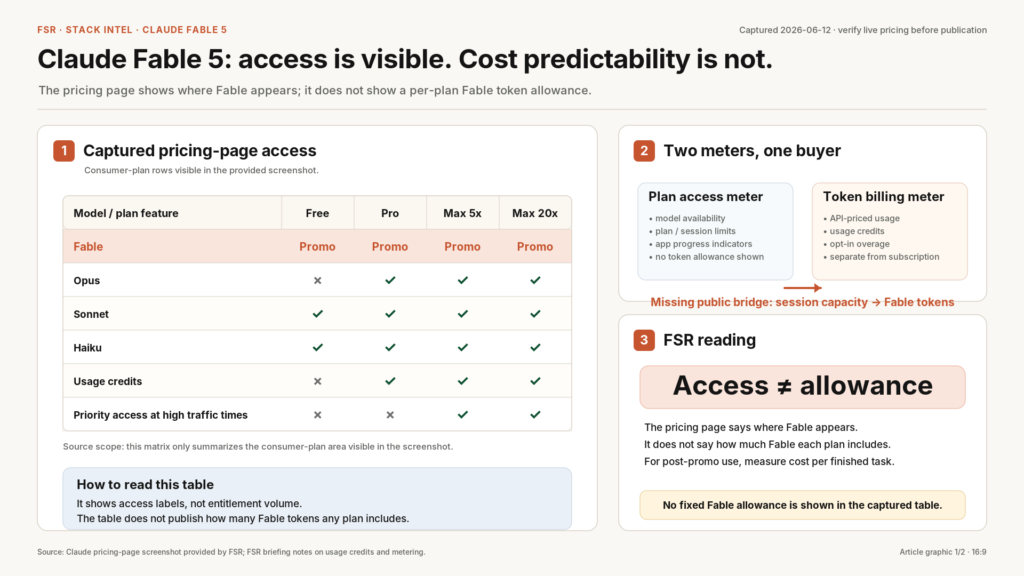
The effect is visible in the wild already. In public posts reviewed in the days after launch, a visible but non-exhaustive sample, several developers reported that a single complex Fable 5 workflow consumed an entire five-hour session. We are not treating those reports as measurements, and we have not reproduced them. What they show is the shape of the problem: people are discovering their Fable 5 entitlement by burning a session and watching the meter, not by reading a number in the docs. Measurable after you spend is not the same as predictable before you spend. That gap is the finding.
What this actually changes
For paid Claude subscribers, Fable 5 moves the frontier model from plan entitlement into cost management.
For most subscription users, the practical promise of Pro, Max, or Team has been predictable access inside a fixed monthly fee. Fable 5 bends that promise. After a two-week promotional window, the most capable model the company sells moves to consumption billing inside the subscription: a flat fee for your plan, plus metered credits on top for Fable specifically.
Anthropic frames this as a capacity decision rather than a permanent pricing tier, and says it will restore standard inclusion when it can. Taken at face value, that is reasonable, and the change may well be temporary. The structural signal is still worth naming. The budgeting discipline that used to belong to API teams, watching token spend, setting caps, costing each task, is now arriving at the prosumer subscription layer. If you run Fable 5 seriously past June 22, you are doing AI cost management, whether you planned to or not. OpenAI’s GPT-5.6 preview runs the same play from the API side, publishing a clean per-token price while the access, throughput, and account terms that decide real cost stay unpublished. Anthropic ran a related play weeks later with Claude Sonnet 5, which holds Sonnet 4.6’s per-token price while a new tokenizer turns the same text into more tokens, so a flat sticker can still mean a higher cost per task.
Claude Science shows the same seam on another Anthropic surface: the pricing page marks it “included” on paid plans, but it draws from the same five-hour session limits, shared with Claude Code and Cowork, and can spin up external compute with no spend ceiling.The Opus 4.8 fallback
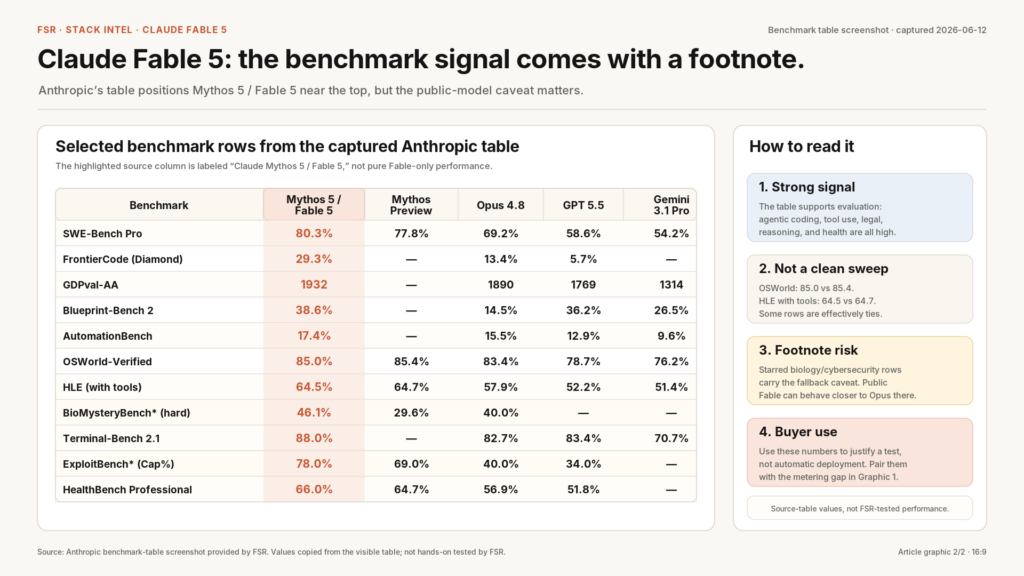
Fable 5 ships with safety classifiers. When a query trips one of them, in areas like cybersecurity, biology, and certain model-development tasks, Anthropic routes it to Opus 4.8 instead and notifies you. By Anthropic’s own data this triggers in under 5% of sessions, and the company says the classifiers are tuned conservatively and sometimes catch harmless requests. The current list of affected areas and the exact handoff behavior are documented in Anthropic’s fallback help article.
Three practical points for buyers.
First, the fallback does not overcharge you. Anthropic states you are not charged Fable prices for rerouted requests; the rerouted portion is billed at Opus rates, which are lower. The tradeoff is capability, not cost: on a flagged query you asked for Fable 5 and, after an on-screen model-switch notice, received an Opus 4.8 response. For a multi-step agent run that mixes both models, that also makes your cost harder to attribute after the fact, which compounds the forecasting problem above.
Second, this automatic switching applies on Anthropic’s consumer Claude surfaces. In the API, the behavior is not the same: Anthropic says API customers configure fallback handling themselves rather than getting an automatic switch. If you are building on the API, do not assume a flagged Fable request silently lands on Opus.
Third, the conservative tuning has a real edge case. Developers doing legitimate security or biology-adjacent work have reported being routed to Opus mid-task, losing the model they came for partway through a session. If your work lives near those classifiers, factor in that some of your Fable 5 usage may not be Fable 5 at all.
There is a sharper version of this buried in Anthropic’s own benchmark table. The scores it publishes are the higher of Mythos 5 and Fable 5, and a methodology note states that on the cybersecurity, biology, and health benchmarks, Fable 5 lands closer to Opus 4.8 because its safeguards reroute those queries. Read plainly: on several of the domains where Anthropic shows Fable’s largest lead, the public model you pay $10/$50 for performs near the model that costs half. Anthropic discloses this in a footnote. It belongs in a buyer’s decision, not buried under a benchmark table.
Act now, or wait
| Best for | Not for |
|---|---|
| Long-horizon coding and agentic tasks where Opus or Sonnet fail | Routine chat, summaries, and low-stakes drafting |
| Teams willing to track cost per finished task | Buyers who need predictable flat-rate usage |
| Temporary evaluation before June 22 | Organizations bound to Zero Data Retention |
| Users comparing Fable against Opus on real workloads | Anyone treating “2x usage” as an official allowance |
Evaluate it now, before June 22, if model capability is your bottleneck: large-codebase work, long-horizon agentic tasks, document-heavy analysis. This is the only confirmed no-extra-cost evaluation window in Anthropic’s current public docs. Run your real workloads, not toy prompts, and watch your token usage so you leave the window with a concrete cost estimate for June 23.
Wait, or start cheaper, if Sonnet or Opus already serves your work. For routine chat, summarization, short coding help, and low-stakes drafting, start below Fable 5 and reserve it for tasks that fail on cheaper models. After June 22 it bills on top of your subscription through opt-in credits, and the right metric is cost per completed task, not cost per prompt.
If your work touches cybersecurity, biology, or chemistry, expect occasional fallbacks to Opus 4.8 mid-session. That is a workflow consideration before you commit a deadline to Fable.
If you are evaluating for an enterprise: Fable 5 and Mythos 5 are designated Covered Models that require 30-day data retention, and Zero Data Retention is not available for them. On the Claude API, a request from a ZDR-configured organization returns a 400 invalid_request_error until retention is enabled. For most consumer-plan users this changes nothing, since Free, Pro, and Max already retain inputs and outputs under standard policies. The constraint bites organizations on ZDR: to use Fable 5 they enable 30-day retention per workspace in Claude Console (Settings > Workspaces > Privacy controls), which keeps their other workspaces on ZDR, and if their policy requires ZDR, Anthropic points them to Opus 4.8 instead. On Bedrock, Vertex AI, and Microsoft Foundry, each platform sets its own retention. EU and regulated buyers should put these terms in front of their data-governance people before standardizing on Fable. FSR did not assess compliance with any specific regime.
FAQ
Is Claude Fable 5 free? Through June 22, 2026 it is included at no extra cost on Pro, Max, Team, and seat-based Enterprise plans. Free means no extra charge, not unlimited: it draws from your existing plan usage limits. On June 23 it leaves plan inclusion, and continued use requires opt-in usage credits billed at API rates.
Does Fable 5 count against my regular usage limits during the free window? Yes. During the promotion it is not a separate or unlimited allowance. It draws from your existing plan usage limits, and by widely repeated accounts it depletes them faster than other models. There is nothing separate to activate, and no published token allowance for it.
How much does Claude Fable 5 cost? On the Claude API, $10 per million input tokens and $50 per million output tokens. That is double standard Claude Opus 4.8 ($5 and $25), and the same rate as Opus 4.8 Fast Mode. On subscription plans after June 22, the same API rates apply through usage credits.
Will I be charged automatically after June 22? No. Continued use of Fable 5 requires usage credits, which you have to enable and fund, and which bill separately at standard API rates. If you do not turn credits on, Fable 5 simply stops being available on your plan rather than generating a surprise charge.
Why can’t I tell how much Fable 5 my plan includes? Because plan usage is measured in five-hour session windows, not tokens, and usage credits are billed per token. Anthropic publishes no conversion between session-based plan limits and the per-token price, so the included amount cannot be expressed as a token figure.
Is Claude Fable 5 actually double the price of Opus 4.8? It is double standard Opus 4.8 ($5/$25). It is not more expensive than every Opus configuration: Opus 4.8 Fast Mode runs at the same $10/$50. At that rate you are choosing Fable 5’s capability over Fast Mode’s speed, not paying a unique premium.
Does the fallback to Opus 4.8 cost more? No. Anthropic says rerouted requests are not charged at Fable prices; the Opus-served portion is billed at Opus rates, which are lower. The tradeoff is capability rather than cost: on a flagged query you receive an Opus 4.8 response, with a notice, instead of Fable 5.
Does the automatic fallback happen in the API? The automatic switch-with-notice behavior applies on Anthropic’s consumer Claude surfaces. In the API, Anthropic says customers configure fallback handling themselves, so the same automatic switch should not be assumed.
Can I use Claude Fable 5 with Zero Data Retention? No. Fable 5 requires 30-day retention to run its safety classifiers, and Zero Data Retention is not available for it. On the API, requests from a ZDR-configured organization return a 400 invalid_request_error until retention is enabled. Organizations on ZDR must enable retention in the relevant environment to use it; for workloads that require ZDR, Anthropic directs you to Claude Opus 4.8.
What is the difference between Fable 5 and Mythos 5? They share the same underlying model. Fable 5 adds safeguards that route some cybersecurity, biology, and model-development queries to Opus 4.8. Mythos 5 has the cyber safeguards lifted and is restricted to Project Glasswing partners. Fable 5 is the version available to the public.
How FSR checked this
Public Tier: C (research briefing). FSR did not run Claude Fable 5. We did not measure its token consumption or test the safeguard fallback directly.
Primary sources: Anthropic’s Claude Fable 5 and Mythos 5 announcement, the Claude Fable 5 product page, Anthropic’s live pricing page, the Mythos-class data-retention support article, the usage-credits help article, the Opus 4.8 model page, and the Opus 4.8 announcement (which states fast mode pricing of $10/$50). Pricing for both models including Opus Fast Mode, the June 22 to June 23 timeline, the usage-credit mechanic, the safety fallback and its billing, the mandatory retention, the 1M context window and 128k output, and the absence of a plan-to-token conversion all rest on Anthropic’s own pages.
Labeled as inference, not fact: that no session-to-token conversion exists. This is an absence claim from the official docs FSR reviewed across pricing, promo, usage-limit, and usage-credit pages as of June 12, 2026, not a statement Anthropic makes. The “2x usage” figure circulating in coverage is a relative rate derived from the 2x token price, not an official metering rule.
Drawn from a non-exhaustive public sample: the reports that a single complex workflow consumed a full session. These are user signal, not measurement, and FSR has not reproduced them.
Tier B follow-up (committed): during the free window, before June 22, FSR will run real workloads and record token consumption, and capture whether the dashboard shows a cost estimate before a user continues on Fable credits. That follow-up will attach concrete numbers to the June 23 transition.
Recheck schedule: pricing and availability rechecked by June 20, 2026, and again on June 23, 2026, after the plan-inclusion change.
Disclosure: FSR uses Claude, an Anthropic model, as an editorial tool, including in producing this briefing, and this article assesses an Anthropic product. Every factual claim is based on Anthropic’s published documentation. Readers should weight that relationship as they see fit.
FSR verdict
Fable 5 is the strongest model Anthropic has put in front of the public. Its $10/$50 rate is not a unique premium, since Opus 4.8 Fast Mode costs the same, but it is the top of the public rate card, and you are paying it for capability.
The open question is not whether Fable 5 is good. It is that Anthropic meters your plan in five-hour sessions and bills Fable 5 in tokens, and publishes no bridge between them. Until it does, treat any answer to “what will this cost me” as an estimate, not a quote.
If you intend to rely on Fable 5 past June 22, the move this week is simple. Measure your own token burn now, while it is free.