Last updated: June 23, 2026
TensorZero was an open-source LLMOps stack that unified five functions in one system: an LLM gateway, observability, evaluation, optimization, and experimentation. In June 2026 the team stopped maintaining it and archived the GitHub repository to read-only. The code is still there. What you lose is not a provider gateway, which is now easy to replace, but the maintained loop that turned your production traces and feedback into better prompts, evals, and model choices.
Verdict: do not adopt upstream TensorZero for new work. If you already run it, preserve your inference data, evaluation history, and experiment state before you touch the gateway.
Briefing summary: June 2026
TensorZero did not disappear. Active maintenance did.
The team archived its GitHub repository to read-only in June 2026, and the official site now says the project remains on GitHub but is no longer maintained. The company had raised $7.3 million and passed 11,000 GitHub stars, and it wound down with most of that money unspent. This brief covers what happened, who it affects, and why the loss that matters is the maintained learning loop, not the gateway.
On this page
TL;DR verdict
- What happened. TensorZero wound down. The GitHub repo is archived and read-only, and the site says it is no longer maintained. This was a voluntary, orderly shutdown, not an insolvency.
- Who it hits. Anyone running TensorZero in production, anyone who was about to adopt it, and anyone treating GitHub stars plus a funding round as a continuity guarantee.
- The real loss. Not the gateway. Routing and fallback are being commoditized by cloud platforms and OpenAI-compatible APIs. What has no clean replacement is the integrated loop that connected traces, feedback, evals, and optimization.
- If you use it. Urgency depends on how deep you went. Protect your historical inference data and experiment history first, not the gateway.
- If you were about to adopt it. Stop. Choose something maintained.
What happened
The public facts are simple. TensorZero’s site now says it remains on GitHub but is no longer maintained. The main repository is a public archive under Apache 2.0, with more than 11,000 stars and more than 900 forks at the time checked. On Hacker News, co-founder and CEO Gabriel Bianconi wrote that the team had decided to wind down the project; the repo would stay available under Apache 2.0 but would not be actively maintained by the team.
This was not the usual startup death. Bianconi said the company had raised $7.3 million in 2024, spent less than half of it, carried no debt, and was returning the rest to investors. The round was announced in August 2025, led by FirstMark with Bessemer, Bedrock, DRW, Coalition, and angels. Those facts remove the easy explanation. This was not a repo abandoned because nobody cared. It had funding, adoption, and serious engineering, and it still wound down.
His own reason is the sharper one. He said an open-source company has to find product-market fit twice, first for the open-source project and then for a commercial product, and the AI market moves fast enough that one wrong step leaves you behind.
One correction matters, because it is easy to get wrong. The open-source platform was free, with no paid features. But the company was building a commercial layer on the same stack, an automated AI engineer it called Autopilot, which shipped inside the product. So the accurate read is not “there was no commercial product.” It is that the open-source project earned real adoption while the commercial layer around it did not become a business that could carry the company. That gap is what this shutdown exposes.
There is one more detail worth keeping. TensorZero’s README claims it powered roughly 1% of global LLM API spend. Asked about it, Bianconi said the figure was a best-effort estimate that might be outdated. A founder softening his own headline number on the way out is not how rug pulls work. Capital returned, no debt, a transparent post, a self-corrected claim. That clean exit is what makes the buyer lesson harder to wave away: doing it right did not keep the project alive.
Verified key facts
| Fact | Detail | Source |
|---|---|---|
| Status | Wound down, archived to read-only | GitHub, official site |
| Maintenance | No longer maintained by the team | Official site |
| License | Apache 2.0 (code stays public) | GitHub |
| Funding | $7.3M seed, raised 2024, announced Aug 2025 | Company PR |
| Capital | Spent less than half, no debt, rest returned | Founder (HN) |
| GitHub | 11,000+ stars, 900+ forks (snapshot) | GitHub |
| OSS platform | Free, no paid features | README |
| Commercial layer | “Autopilot” automated AI engineer, shipped in-product | README, release notes |
| Built in | Rust | GitHub |
| Usage / customer claims | “~1% of LLM API spend,” large-enterprise use (company claims, not independently verified; the enterprise figure appears inconsistently as Fortune 10 / Fortune 50; CEO calls the 1% a best-effort estimate) | README, HN, founder site |
The real loss is not the gateway
A gateway routes calls. A loop remembers what worked.
TensorZero’s README lists five connected functions. The gateway gave one interface to every provider. Observability stored inferences and feedback in your database. Evaluation benchmarked prompts, models, and workflows. Optimization used production metrics and human feedback to improve prompts, models, and inference strategies. Experimentation ran A/B tests, routing, and fallbacks. The pitch was that these compound: evaluations feed optimization, optimization feeds experiments, experiments feed back into the data.
The shallow layer is being commoditized. Routing, fallback, caching, and provider abstraction now ship inside cloud platforms and OpenAI-compatible APIs. Amazon Bedrock has Intelligent Prompt Routing, though AWS’s own documentation says it cannot adjust routing based on application-specific performance data and may not suit specialized use cases. Azure AI Foundry has a model router that picks an underlying model per request. Cloudflare’s AI Gateway documents caching, rate limiting, dynamic routing, analytics, and logging across many providers. If TensorZero was only your gateway, the replacement category is obvious.
The same commoditization has a flip side. Sakana now sells that routing layer as the product itself, a managed multi-model API that hides which model ran behind each request. Sakana Fugu is an orchestration hedge, not sovereign AI, and it shows how thin the gateway is once a vendor charges for it directly.
What does not commoditize is the loop. If you used TensorZero as the connective tissue between traces, feedback, evals, and optimization, the hard part is not routing. It is state. Which prompts won, under which traffic, against which evaluator, on which model version, measured by which feedback signal, stored in which schema. That accumulated state was the asset. Re-pointing an endpoint does not move it. The cloud routers do not rebuild it, because a router that cannot see your business outcome cannot optimize against it.
So the first question for a current user is not which gateway to switch to. It is what state you accumulated inside TensorZero, and how you preserve it before you change the request path.
What replaces which layer
Conceptual mapping, not a buying guide. Named tools are examples of the category, not endorsements, and carry no verified pricing or feature claims here. The verified, priced comparison is the Tier B follow-up. The column that matters most is the last one.
| TensorZero function | Replacement category | Examples in the category | What carries over | What does NOT carry over |
|---|---|---|---|---|
| Gateway | Standalone gateway or cloud router | LiteLLM, Cloudflare AI Gateway, Bedrock router, Azure Foundry router | Endpoints, keys, model mappings, retries, fallback policy | The tie-in to your eval and feedback loop |
| Observability | LLM tracing / observability | Langfuse, OpenTelemetry-based tooling | New trace capture, re-instrumented dashboards | Historical traces in TensorZero’s schema unless exported first |
| Evaluation | Eval and LLM-judge tooling | Braintrust and other eval tools | New evaluation runs | Past eval datasets and results unless exported first |
| Experimentation | Feature-flag / experimentation | Flag platforms, in-house experiment frameworks | New experiments | Past experiment assignments and history unless exported first |
| Optimization | Provider fine-tuning + optimization libraries | Provider fine-tuning, DSPy | New optimization runs | The integrated metric-to-feedback-to-optimize loop as one system |
| The whole loop | No single replacement | Assembled from the rows above | Individual functions, separately | The compounding loop itself |
Who this affects
The risk is proportional to how much state you stored in TensorZero.
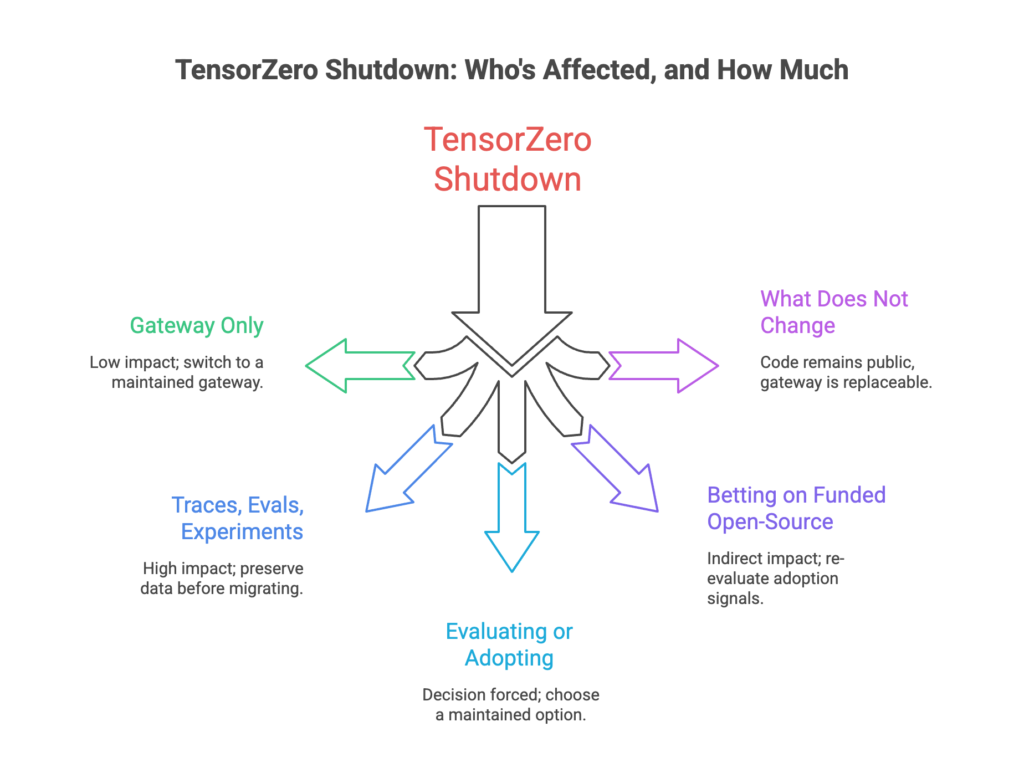
If you ran it only as a gateway, the blast radius is small. If you ran traces, evals, and experiments through it, the dependency is deep, and it is not a swapped endpoint. Teams that were evaluating TensorZero have the simplest call: a read-only repo with no upstream maintainer is not a foundation for new work, however good the code is. And anyone who underwrote this on adoption signals, a strong round, top-of-GitHub stars, real enterprise users, should note that none of it guaranteed continuity.
The safer posture toward any fast-moving AI tool is the one we applied to DeepSeek, a weapon to rent, not a vendor to marry.
The blind spots most coverage misses
Most write-ups will land on “popular open-source project shuts down, RIP.” That skips the parts that actually matter to a buyer.
Archived is not the same as unmaintained. The repo is read-only. You cannot open an issue or merge a fix upstream. Apache 2.0 lets you fork, but a fork of a frozen project is a cold start with no maintainer behind it. “The code is still on GitHub” is true and close to useless as reassurance.
The same gap showed up with Gemini CLI, where the repository stayed open but the access did not; an open-source badge says nothing about whether the thing you relied on still runs.
A clean, well-funded, widely-adopted project still died. This should unsettle buyers more than a messy flameout. A flameout is easy to write off as someone else’s mismanagement. TensorZero was funded, adopted, well-built, and honestly wound down, and it still could not clear the second hurdle. Funding is not continuity. Adoption is not continuity. Even deep resources do not change that, as OpenAI’s shutdown of Sora showed: it ended the product and named no successor at all.
Forkability is not maintained continuity. More than 900 forks exist. A high fork count is not a maintenance plan. A fork is a starting point for private maintenance, not a maintained successor: no foundation has adopted the project, and forking a frozen codebase means you inherit security response, provider-compatibility updates, and release discipline yourself. The existence of a fork changes your migration triage. It does not restore the upstream.
TensorZero sat across five budgets buyers often split. Gateway, observability, evaluation, experimentation, and optimization are frequently bought, or built, separately. A single vendor unifying all five is elegant, and also exposed: each function has well-funded point tools and cloud features pulling at it. The lesson is not that LLMOps is fake. It is that the unified-suite wedge was narrower than the adoption numbers suggested.
What to do now
Your move depends entirely on how deeply you wired TensorZero in. Pricing, per-tool compliance, and a hands-on migration test are the Tier B follow-up. This is the triage.
Were about to adopt it
Don’t. Choose a maintained option. For the gateway alone that includes LiteLLM, Cloudflare’s AI Gateway, or your cloud’s native router. The full, verified comparison is the next article.
Use it only as a gateway
The swap is bounded: re-point endpoints, remap model names and provider parameters, move keys and fallback policy, update monitoring. This is the cheap layer.
Went deep (traces, evals, experiments)
Freeze first. Before you touch anything, snapshot the running version and configuration, the database and schema, the inference records, the feedback labels, the evaluation datasets and results, the prompt variants, the experiment assignments and history, the optimization recipes, the dashboards, and the provider keys. Then build a measured bridge, and seriously consider a private fork while you do. A rushed gateway swap fixes the visible risk and strands the history that made the tool worth running.
Should you still run it
Keep running it, for now, if
- You have a deep production dependency that would be costly to unwind quickly
- You can own maintenance through a private fork
- Your provider set and use cases are stable in the near term
- You are buying time to migrate, not betting on a revival
Do not run it if
- You are starting something new
- You need ongoing security patches or provider-API updates
- You cannot take on the maintenance yourself
- You are relying on upstream support or a roadmap
Data, terms, and the EU angle
TensorZero’s pitch included keeping data in your own infrastructure by self-hosting. Once the gateway is unmaintained, that control carries a new cost: no security patches, and no updates when a provider changes its API. This is not hypothetical.Owning the code is not the same as owning a maintained system, which is the same gap Base44 buyers run into: you keep the exported code, not the runtime. During active development the gateway shipped at least one fix for a high-risk security vulnerability (advisory GHSA-824w-x939-6cmc). With the project archived, a future vulnerability of that kind has no upstream fix. For an EU or regulated team, an unpatched component in the request path is a question a security review will raise, not a settled answer. The full compliance read, including which replacement tools are self-hostable in practice and how each handles data, belongs in the Tier B teardown, where it can be checked against each vendor’s own documentation rather than asserted.
What FSR checked, and what it didn’t
This is a Tier C brief, built on primary sources read directly: the Hacker News wind-down thread, the archived GitHub repository and its README and release notes, the official site notice, TensorZero’s seed-round announcement, and the public routing, failover, and caching documentation from AWS, Microsoft, Cloudflare, and major model providers.
FSR did not run TensorZero, and did not test any migration. No hands-on numbers are reported here.
The Tier B follow-up will cover what desk research cannot: a sandbox breakage test pointing an archived TensorZero client at live providers to see how an unmaintained gateway fails over time, verified current pricing for each replacement, and each managed gateway’s real data-handling posture before any compliance claim is made. Several widely-repeated claims in this space, that managed gateways log prompts by default, that one gateway is far faster than another, that one had a supply-chain incident, are not stated here as fact because they have not yet been verified against primary sources. They belong in the teardown, checked, not in a breaking brief.
FAQ
What happened to TensorZero?
TensorZero wound down in June 2026. After raising $7.3M and passing 11,000 GitHub stars with a popular Rust-based LLMOps stack, the founders cited the difficulty of finding product-market fit for both an open-source project and a commercial product. They stopped active maintenance, archived the repository to read-only, and returned the remaining capital to investors.
Is TensorZero still maintained or safe to build on?
No. The repository is archived and read-only, and the official site states the project is no longer maintained. The Apache 2.0 license keeps the code available to fork and self-host, but there are no provider-API updates, security patches, or support. New projects should not build on it.
Can I still use the code?
Yes, technically. The repository is archived and read-only but remains public under Apache 2.0, so you can clone, run, and fork it. What you do not get is upstream maintenance: no security patches, no provider-API updates, and no support from the original team. Running it now means owning that maintenance yourself.
Is there a maintained fork?
The Apache 2.0 license lets anyone fork and maintain the code, and forks exist. As of mid-2026, no foundation had adopted the project and no fork had reached the adoption or release cadence of the original. Treat any fork as a private-maintenance option to evaluate, not as a guaranteed successor.
What should current TensorZero users do first?
Freeze state before changing anything, especially if you used more than routing. Snapshot the running version, configuration, database schema, inference records, feedback labels, evaluation datasets, prompt variants, experiment history, and optimization recipes. A rushed gateway swap can strand the historical data and experiment continuity that made the tool valuable.
What are the alternatives to TensorZero?
There is no single one-to-one replacement, because TensorZero unified five functions. The gateway maps to options like LiteLLM, Cloudflare AI Gateway, or cloud-native routers. Observability maps to tools like Langfuse. Evaluation maps to tools like Braintrust. The integrated optimization and experimentation loop is the part with no clean equivalent. A verified, priced comparison is the next article.
Did TensorZero fail because LLMOps is a dead category?
No. The category is active, with funded point tools and cloud features across observability, evaluation, and routing. The shutdown points to a narrower lesson: unifying five LLMOps functions in one open-source suite was harder to sustain as a business than the adoption suggested, because each function competes with well-funded alternatives.
Is self-hosting still safer for regulated teams?
Self-hosting keeps data in your own infrastructure, which is a real benefit. But it is not safe by default once a component is unmaintained, because security fixes and provider updates stop. For regulated teams, an unpatched element in the request path is a documented risk to manage, not an automatic compliance win. Maintenance status matters as much as where the data sits.
FSR verdict
TensorZero is over as a maintained product, and it was wound down with more integrity than most shutdowns show. That is exactly why the lesson lands: doing it right did not keep it alive.
If you are choosing TensorZero today, the decision is closed. If you run it, your timeline is set by how deep you went, and your first job is to protect your inference data and experiment history, not to rip out a gateway you can replace. And if you are picking your next stack, the durable question is no longer which suite has the most features. It is which layer stays defensible once the cloud and the providers absorb the commodity parts. TensorZero’s answer was the learning loop. That answer was directionally right. What it could not prove was whether enough buyers would pay one vendor for the whole loop before the surrounding stack absorbed the pieces.
Sources
Primary sources, accessed June 21, 2026:
- Hacker News, founder’s wind-down comment: https://news.ycombinator.com/item?id=48518120
- Hacker News, submission thread: https://news.ycombinator.com/item?id=48516504
- GitHub repository (archived, read-only, Apache 2.0, README, star and fork counts): https://github.com/tensorzero/tensorzero
- GitHub release notes (Autopilot “Sessions” page removed; fix for high-risk gateway vulnerability GHSA-824w-x939-6cmc, referenced in the notes): https://github.com/tensorzero/tensorzero/releases
- Official site, “no longer maintained” notice: https://www.tensorzero.com/
- Seed-round announcement (August 18, 2025) on the TensorZero blog: https://www.tensorzero.com/blog/
- AWS Bedrock Intelligent Prompt Routing, considerations and limitations (it “can’t adjust routing decisions or responses based on application-specific performance data”): https://docs.aws.amazon.com/bedrock/latest/userguide/prompt-routing.html and https://aws.amazon.com/bedrock/intelligent-prompt-routing/
- Microsoft Azure AI Foundry model router and Cloudflare AI Gateway: official product documentation (exact URLs to be added before publish if cited inline)
Company claims about usage share and customers (“~1% of global LLM API spend,” and large-enterprise use stated as Fortune 10 or Fortune 50 in different places) appear in TensorZero’s own materials and are not independently verified. The CEO has described the ~1% figure as a best-effort estimate that may be outdated. Star and fork counts and any fork’s status are point-in-time snapshots and should be rechecked before publication.