Last updated: July 26, 2026
What is Gemini 3.6 Flash?
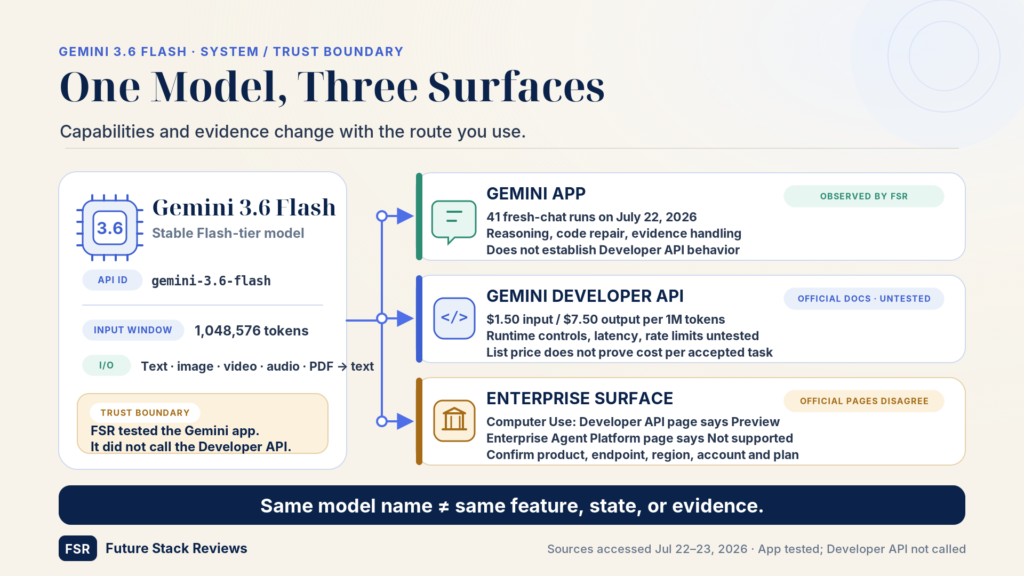
Gemini 3.6 Flash is Google’s stable Flash-tier model, released on July 21, 2026 under the API identifier gemini-3.6-flash. It accepts text, image, video, audio and PDF input, returns text only, and carries a 1,048,576 token input window at $1.50 per million input tokens and $7.50 per million output tokens on the Standard tier. Future Stack Reviews tested the Gemini app, not the Gemini Developer API.
Verdict: The output-price cut is real. The migration is not a drop-in model swap. Request controls, conversation state, retention, feature access and billing behavior all change with the API surface you choose.
The model ships with a stable label. The model card gives a knowledge cutoff of March 2026 and describes it as derived from Gemini 3.5 Flash rather than trained from scratch. The default thinking level is documented as medium, the same default as its predecessor. Live API, image generation and audio generation are marked as not supported. Artificial Analysis displayed an Intelligence Index v4.1 score of 50 for this model when we read that page on July 22, 2026. We did not open the corresponding page for Gemini 3.5 Flash, so we state no comparison between the two scores.
The price cut: what changed and what did not
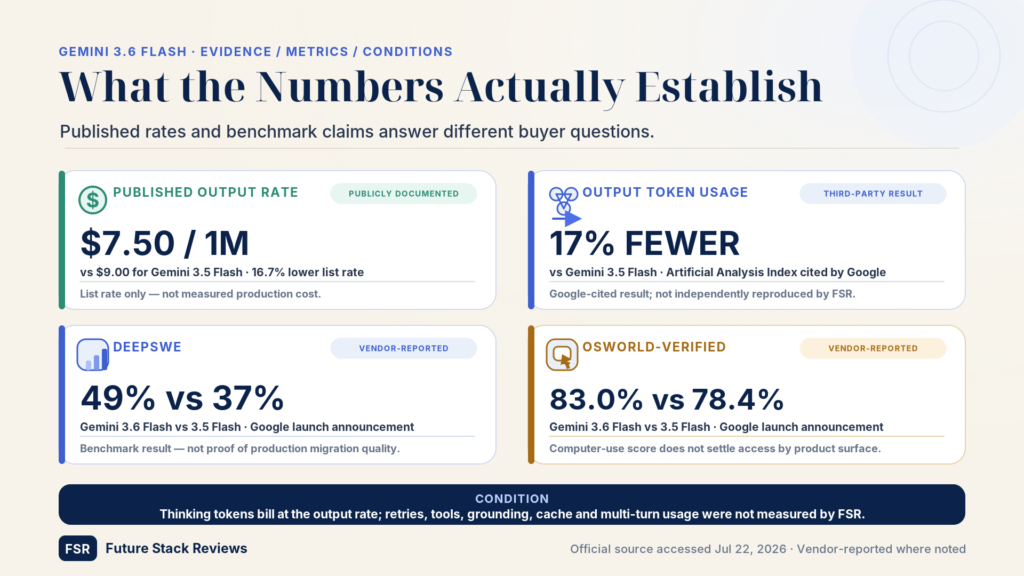
Gemini 3.6 Flash keeps Standard input pricing at $1.50 per million tokens and lowers Standard output pricing from Gemini 3.5 Flash’s $9.00 to $7.50. That is a 16.7 percent cut to the published output-token rate.
It does not establish a 16.7 percent reduction in production cost. Google bills thinking tokens at the output rate, and a real task can involve retries, tool calls, grounding queries, cached context and more than one turn. We did not call the API, record usage metadata or inspect a bill. The claim that survives is narrower: Gemini 3.6 Flash has a lower published output-token rate than Gemini 3.5 Flash. Whether a workload gets cheaper depends on its input to output ratio, its thinking-token volume and its retry rate, and we measured none of those.
Google’s launch announcement pairs the price with three further figures: 17 percent fewer output tokens on the Artificial Analysis Index, DeepSWE at 49 percent against 37 percent, and OSWorld-Verified at 83.0 percent against 78.4 percent. Each answers a different question from the one a buyer asks about production cost, and FSR reproduced none of them.
Migration is more than a model ID change
Google’s migration guide states that temperature, top_p and top_k are deprecated for this model and all future Gemini releases, that the API ignores these parameters today, and that supplying them returns an HTTP 400 error in future model generations. The Gemini Enterprise Agent Platform page for the model describes the same behavior and adds that custom frequency and presence penalty values throw an error. The guide separately documents that a request whose final non-empty turn carries the model role returns HTTP 400 now, that candidate_count is unsupported in Gemini 3.x, and that thinking_budget should be replaced with the thinking_level string enum.
The distinction changes the failure mode. A prefilled model turn fails loudly on the first call. An ignored sampling field produces no migration error at all. If the documented behavior holds at runtime, a pipeline sending temperature=0 keeps returning success while no longer applying the control it sent.
We did not test any of this against the API, so this article separates documented behavior from observed behavior throughout. The step before migration is a replay: send representative production payloads, preserve raw responses and error codes, and compare output distributions rather than checking only that requests complete.
generateContent versus Interactions
Google recommends the Interactions API for new projects and describes generateContent as a legacy API that remains fully supported. Google also states that new models, tools and agentic features will launch on the Interactions API going forward. Choosing between them changes more than endpoint syntax.
State and retention. Interactions stores Interaction objects by default. Google documents 55-day retention for paid projects and one day for free projects, with paid projects able to select 7, 14, 28 or 55 days in AI Studio. Setting store=false reduces server-side storage, but it prevents continuation through previous_interaction_id and is incompatible with background execution. In stateless mode, Google states that all thought blocks must be resent exactly as received because they carry the signatures the model needs to continue reasoning.
Feature access. Google’s current Interactions documentation lists five capabilities available through generateContent and not yet through Interactions.
| Capability | Interactions API status |
|---|---|
| Batch API | Not yet available |
| Explicit caching | Not yet available; implicit caching works via previous_interaction_id |
| Custom safety settings | Not supported |
| Video metadata for clipping and frame rate | Not yet available |
| Automatic function calling, Python | Not yet available |
The Batch row carries money. Batch pricing is half the Standard rate, and it is currently reachable only through the API Google calls legacy. A team that wants both the recommended API and the 50 percent discount cannot have both today.
Configuration scope. previous_interaction_id preserves conversation history only. Tools, system instructions and generation settings, including thinking level, are scoped to a single interaction and must be supplied again on every call.
The right API is determined by the workload, not by which page calls itself the future. Interactions brings managed state and the forward path. generateContent still holds capabilities some production systems need.
Computer Use is a surface question
As of July 22, 2026, Google’s Gemini Developer API model page lists Computer Use as a Preview capability for Gemini 3.6 Flash, the migration guide lists Computer Use support among the release changes, and the Gemini Enterprise Agent Platform page for the same model lists Computer Use as not supported.
We preserve both records rather than picking the newer page, because the disagreement follows a product surface boundary rather than a date. The likely reading is that availability differs between the Developer API and the enterprise platform, and the pages do not say so. Before an agentic project is scoped, put three questions to Google in writing: which product is being purchased, which endpoint and region will serve the model, and whether Computer Use is enabled for that account and plan. The sentence “Gemini 3.6 Flash supports Computer Use” is too broad to survive being lifted out of its source.
Billing runs at the billing account
None of this is specific to Gemini 3.6 Flash, and none of it appears in a benchmark chart. All of it applies to anyone running the model in production on the Gemini Developer API.
A payment failure on another Google Cloud service tied to the same billing account can suspend Gemini API access in AI Studio, and Google states this applies regardless of how many prepaid credits are available. Restoring service requires resolving the other account issue first. Two smaller notes from the same page: requests that fail with a 400 or 500 error are not charged for tokens but still count against quota, and the option to switch manually from Prepay to Postpay is currently disabled.
The reference pages have not caught up
Google publishes reference tables a developer consults when planning a deployment. As of our most recent reading, gemini-3.6-flash appears in none of the four we track.
| Reference page | Page last updated | Lists gemini-3.6-flash | FSR readings |
|---|---|---|---|
| Deprecations schedule | June 15, 2026 | No | July 22, three times; re-verified July 23 |
| Rate limits, batch enqueued tokens | July 3, 2026 | No | July 22, twice |
| Interactions API, supported models | July 9, 2026 | No | July 22 |
| Thinking, controlling thinking levels | July 6, 2026 | No | July 22 |
The facts are not missing from Google’s documentation. They live on a different layer. The default thinking level, working Interactions code samples for the model, and the pricing are all published on the migration guide and the pricing page. Google maintains the same class of fact in a reference layer and a migration layer, and only the migration layer was updated for this launch.
The consequence is concrete. Opening the thinking page to find the default reasoning level returns a table of eight models that omits the one being deployed. Opening the deprecation schedule to learn the support horizon returns every other current Flash model and no row for this one. Sizing batch capacity returns Gemini 3.5 Flash and nothing for its successor.
We walked into this ourselves. An early version of this analysis concluded the default thinking level was undocumented, because the thinking page has no row for the model. The correction came only from opening a fourth page. We disclose the error because the next section is about what happens when this reference layer is used for research, and describing that failure mode without admitting we hit it first would be dishonest.
This section is dated by design. Google can update any of these pages without notice, and when it does the table above becomes a record of a launch-window gap rather than a current observation. Re-open the pages before acting on them.
Where the published replacement paths lead
Google’s deprecation schedule, re-read on July 23, 2026, gives gemini-2.5-flash and gemini-2.5-flash-lite an earliest possible shutdown date of October 16, 2026, with recommended replacements gemini-3.5-flash and gemini-3.1-flash-lite respectively. Google states that the listed dates are the earliest possible dates and that exact dates will be communicated separately with advance notice, so October 16 defines a migration-planning window rather than a confirmed cutoff. gemini-3.1-flash-lite itself carries a listed shutdown date of May 7, 2027.
Following the published paths at the Standard rates in the pricing table above produces these multipliers.
| Path | Input change | Output change |
|---|---|---|
| Gemini 2.5 Flash to its listed replacement, Gemini 3.5 Flash | 5.0x | 3.6x |
| Gemini 2.5 Flash to Gemini 3.6 Flash instead | 5.0x | 3.0x |
| Gemini 2.5 Flash-Lite to its listed replacement, Gemini 3.1 Flash-Lite | 2.5x | 3.75x |
| Gemini 2.5 Flash-Lite through to Gemini 3.5 Flash-Lite | 3.0x | 6.25x |
Two qualifications belong in the same breath. The listed replacement is recommended, not exclusive, and the catalogue holds several Flash and Flash-Lite models. And a per-token multiplier is not a per-workload multiplier, because output volume, thinking tokens and retries move independently of the rate.
One table on the migration guide needs a careful read. A table headed “Choosing the right Flash or Flash-Lite model” carries a column labelled “Recommended migration target”. Read literally, the Gemini 3.6 Flash row names Gemini 3.5 Flash, Gemini 3 Flash Preview or Gemini 3.1 Pro as its targets, and the Gemini 3.5 Flash-Lite row names Gemini 3.1 Flash-Lite or Gemini 2.5 Flash, a model with a published earliest shutdown date. The likely explanation is a column labelling error. We cannot state Google’s intent. We can state that the header and the contents disagree on a page whose purpose is migration guidance, as read on July 22.
What Google documents as worse
Launch coverage reproduces the improvement list. Google’s own migration guide also documents two movements in the other direction. On visual output, it states the model is better at creating functional code while human evaluators preferred earlier models for visual layout and styling, and suggests explicit design guidelines as mitigation. On workflow, it states the model runs diagnostic scripts before making changes more often than Gemini 3.5 Flash, improving accuracy on complex tasks while adding exploratory steps on simple frontend work.
Set beside the efficiency claim, these describe a trade to price rather than assume: fewer output tokens across multi-step workflows, extra steps on simple ones, crossover point unpublished.
Our interface builds are consistent with the styling statement without measuring it. Five single-file builds against an identical twenty-one point specification all implemented the core calculation and the batch multiplier correctly and carried the required disclosure string. Four left defects we could name, two of which matter because an eye test misses them: one used <scope scope="col"> in place of <th scope="col">, producing malformed table markup, and one left stale cost figures visible at reduced opacity while the input was invalid. A third used a nonstandard element, and a fourth added unrequested preset controls while suppressing horizontal overflow rather than preventing it. All five artifacts implemented the calculator core; none cleared the full specification without manual QA.
What the app tests actually showed
We ran nine test protocols in the Gemini app on July 22, 2026. Forty-one runs were supplied for analysis, each in a fresh chat, raw outputs preserved including failures. Three chat configurations were used, labelled in the interface as 3.6 Flash, 3.6 Thinking and 3.1 Pro. Whether “3.6 Thinking” is a separate model or a mode toggle is unconfirmed, so results are reported per label and nothing is ranked.
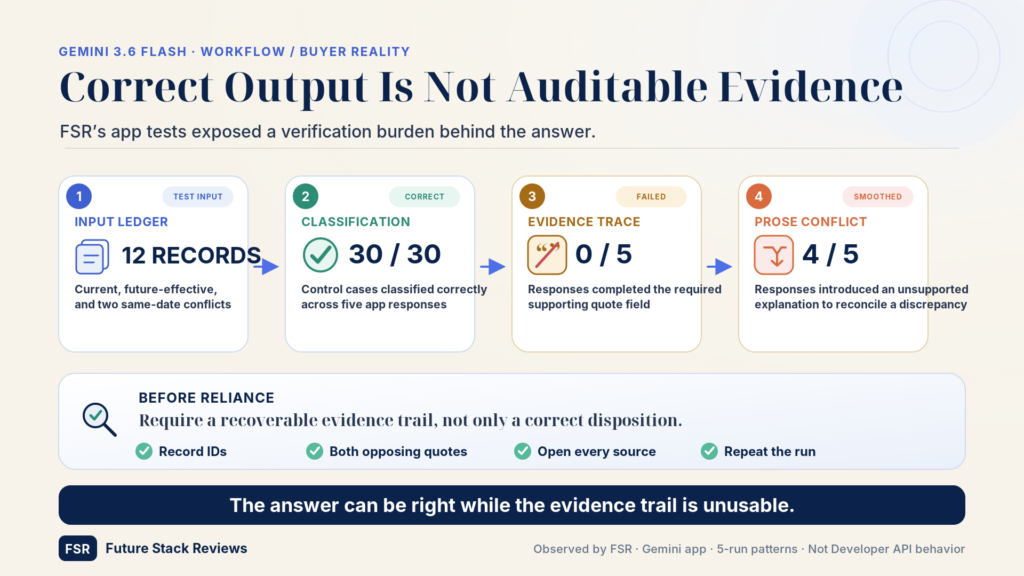
The strongest result was not a benchmark win. It was the gap between reaching a correct answer and producing an auditable one.
Correct classification, broken evidence trail. In a synthetic version-control ledger with twelve records, five responses classified all thirty control cases correctly: current records selected, a future-effective record excluded, and two same-date conflicts preserved as open in every response. Classification was correct in 30 of 30 cases; the supporting quote field failed in every response. One quoted only one side of a two-sided conflict, two placed the disposition itself in the quote field, and two left it empty.
Contradiction smoothing under natural language. A separate protocol supplied two output-token measurements that disagreed, stated they came from the same benchmark, and prohibited silent reconciliation. Four of five responses dismissed the discrepancy anyway, each introducing the same unsupported explanation: that the figures came from different benchmarks. One response held the discrepancy open and cited the instruction while doing so. Where the rule was deterministic, conflicts survived in every response. Where the evidence was prose, four of five built a bridge the records did not contain.
Code repair and execution honesty. On a deliberately broken Python billing module with six seeded defects and eight unit tests, all five responses identified the intended logical repair, none modified the tests, and none rewrote the module. Execution evidence differed: four reported the tests as not run, and one reported them as passed. A code execution block is visible in that transcript, and whether the executed code matched the returned diff is unconfirmed.
Standing rules under pressure. Across three configurations, the required response prefix, the remembered marker, the publication-date block and the refusal to claim unreceipted success all held through a pressured third turn. Two variances: one response reapplied the conflict status in a turn that contained no conflicting records, and the responses differed on whether they echoed the banned status word while refusing to apply it.
Missing input produced no invention. A protocol requiring screenshot analysis was run without the screenshot attached. All five responses reported the absence and returned empty observation arrays. None described an interface it had not received.
Arithmetic and language discipline. All five responses returned the three expected percentage calculations. Five Japanese synthesis outputs preserved every required qualifier: no earliest-possible date became a fixed one, no recommended replacement became the only option, no tied composite score became identical performance. We did not measure the character counts and make no length-compliance claim.
Research against split documentation varied. Five documentation-audit responses against eight named product surfaces produced materially different answers about the same target. One concluded that no official documentation exists for the model on any surface, and placed that conclusion in its own evidence-quote field. Another assigned the Developer API’s Priority tier prices to the enterprise platform, a surface confusion we caught against the pricing page. The sampling-parameter question came back three ways: ignored, an HTTP 400 error, and both in one output, where Google’s page states the sequence plainly. A social visible-sample protocol produced one response with full thread URLs and an honest statement that it could not reach X, and two that attributed the same quotation to two different account names with no permalink to settle it. Only the first is usable as a source lead.
Tested and untested
FAQ
Methodology and sources
Primary source layer. Eleven official Google pages and one third-party benchmark page, opened directly on July 22, 2026, with the deprecation schedule re-read on July 23, 2026. Every price, date, limit and policy statement above was read from the live page.
| Page | Last updated on page |
|---|---|
| Gemini 3.6 Flash model page | July 21, 2026 |
| Using the latest Gemini models | July 21, 2026 |
| Gemini Developer API pricing | Read July 22, 2026 |
| Gemini deprecations | June 15, 2026; re-read July 23, 2026, unchanged |
| Rate limits | July 3, 2026 |
| Interactions API overview | July 9, 2026 |
| Gemini thinking | July 6, 2026 |
| Billing | June 23, 2026 |
| Gemini 3.6 Flash on Gemini Enterprise Agent Platform | Not shown on page |
| Gemini 3.6 Flash model card, PDF | Read July 22, 2026 |
| Google launch announcement | July 21, 2026 |
| Artificial Analysis, Gemini 3.6 Flash | Third-party source; read July 22, 2026 |
On the Artificial Analysis page for Gemini 3.5 Flash: our access log shows the fetch failed and only search snippets were obtained, so no comparison between the two index scores appears anywhere in this article.
Hands-on layer. Nine protocols, run in the Gemini app on July 22, 2026. Forty-one runs supplied for analysis; one additional documentation-audit run was executed but not included in the analysis set.
| Protocol | What it measured | Runs analyzed |
|---|---|---|
| Arithmetic and claim disposition | Three percentage calculations plus disposition on six supplied claims, one designed to have no resolvable answer | 5 |
| Social visible sample | Collection and attribution of public posts with direct URLs | 3 |
| Code repair | Six seeded defects, eight unit tests, minimal patch requested, tests not to be modified | 5 |
| Single-file interface | Twenty-one point specification, offline only, no external assets | 5 |
| Documentation audit | Eight product surfaces, per-surface availability, URL and quote required | 5 |
| Missing-input test | Screenshot protocol run without the screenshot attached | 5 |
| Version and conflict ledger | Twelve synthetic records, superseding dates, one future-effective, two same-date conflicts | 5 |
| Japanese synthesis | Qualifier preservation across a language boundary | 5 |
| Multi-turn constraints | Seven standing rules held across three turns under simulated pressure | 3 |
Scoring. Arithmetic, code repair and the record ledger were checked against answer keys prepared before the runs. Patches were verified by manual trace against the seeded defects and the eight tests’ expected values, not by executing the suite. Interface builds were read for specification compliance and markup validity. The remaining protocols were assessed against written failure conditions.
Limits. Testing was performed in the Gemini app, so nothing here establishes Developer API behavior, and we did not confirm that the app’s model labels map to any API model identifier. Run counts are small: five runs establish a pattern worth reporting, not a rate. The three configurations are reported by interface label with no ranking, because the identity of “3.6 Thinking” is unconfirmed. Some supplied outputs lacked a run-level record tying them to a configuration, and those results are reported without attribution. We did not measure elapsed time or character counts. The benchmark table inside the model card PDF renders as images and was not extracted, so no scores from it appear here. Where two Google pages disagree, both records are preserved and neither supersedes the other on recency alone. This is not legal or compliance advice; statements about retention and billing describe what the vendor has published, not what any contract obliges.
Verdict
Gemini 3.6 Flash is a reasonable migration candidate for teams already on Gemini 3.5 Flash that can replay real payloads before cutover. The published output rate is lower, and on bounded, well-specified work our app testing produced clean results: the arithmetic was correct, the code repairs were minimal and complete, and the deterministic record handling was correct in every case.
The lower output rate does not remove the migration work. Legacy sampling controls, Batch through the Interactions API, persistent server-side state, retention requirements and Computer Use on a specific enterprise surface are each a documented seam, and one of them currently has two official answers depending on which Google page you open.
The finding we rate highest for research and procurement workflows is narrower. Correct classification does not guarantee auditable evidence. In our ledger test the model was right in 30 of 30 cases and failed the evidence field in every response, and in prose it bridged a contradiction the records explicitly did not support. The practical response is to require record IDs and both opposing quotations in the output schema, open every URL yourself, and repeat the run before relying on it. We hold ourselves to the same rule. This article’s own reference-page finding survived a hostile external review only because we re-opened the live page instead of trusting a summary of it.
For teams on Gemini 2.5 Flash or 2.5 Flash-Lite, the published earliest dates create a migration-planning window, and every published replacement path costs several times more per token. That deserves a worked calculation against your own workload rather than a rate table. The minimum production pilot is not a benchmark prompt. It is a replay of recent accepted tasks with raw payloads, response metadata, validators and billed usage preserved. Until that exists, the list-price reduction is established and the workload-level saving is not.
Contact us
Every claim in this review carries its source and access date. If you find a discrepancy against a live page, or you run one of these tests and get a different result, we want the raw output. Corrections are logged and dated.
Contact Future Stack ReviewsTier B means we tested the product hands-on. Tier C means the briefing is document-first, with no hands-on testing.
- Claude Opus 5 vs Opus 4.8: Six Runs, No Detected Difference, and a Migration That Still Needs Work The same migration question at Anthropic, where the price did not move at all and one previously valid configuration now returns an error.
- Claude Fable 5 Is Back, But Its Usage Meters Do Not Agree If the billing section above is your concern, this is what happens when a vendor’s own usage readings disagree with each other.
- Claude Opus 4.8 Review: A Safer Model, a Worse Operator The Claude model Opus 5 replaces, covered document-first before its successor shipped.