Last updated: July 23, 2026
An AI coding tool, running the Fable 5 model, generated a single landing-page file, then ran its own security review over that file. The security pass returned advisory notes and changed zero lines of code. That result was a map of a boundary. The page had almost nothing to attack, because everything that gets attacked in production had not been built yet.
Verdict in one line: A clean AI security review of a static file is a scope record, not a safety result. Zero fixes here meant the page had nothing to attack.
BEST FOR
Teams deciding whether an AI builder’s self-review can stand in for a security control, and what evidence to keep when it runs. | NOT FOR
Readers who want a model benchmark, a build tutorial, or a ruling on whether the tool is safe. This is one generation examined closely. It makes no general safety claim. |
What actually happened
The setup was deliberately ordinary. Using Claude Code with the Ultracode setting and the Fable 5 model selected, the tool generated a Japanese B2B landing page for a fictional SaaS. The output was a single file: index.html, 1,459 lines, one readable and unminified document with no separate scripts or styles. FSR then had the same tool review its own output twice, once as a specification and quality audit and once as a security review, and recorded what each pass did.
The numbers below come from the session’s own machine records, the workflow metadata and per-agent transcripts, read after the fact. They are firsthand observations of this one run and do not generalize to the product.
The security review changed nothing, and said why
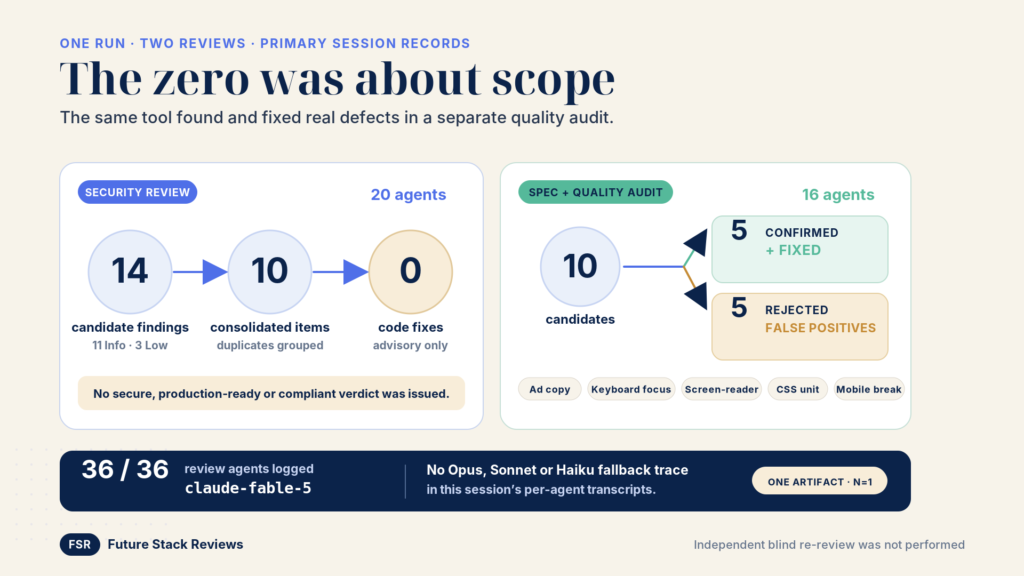
The security pass ran as a workflow of 20 agents: an inventory pass, five category reviewers, and 14 verification agents that re-checked each candidate. It produced 14 findings, all rated Info (11) or Low (3), which it consolidated into 10 items. It applied zero code fixes. The review reported and advised; it did not change the file.
The reason sat in the review’s own conclusion rather than in any missing effort. The page ships a lead form that goes nowhere: submission is stopped in the browser, the form declares no action or method, and the meta content-security-policy sets form-action 'none'. In the review’s words, “the moment you attach a real endpoint, you are adding the entire server-side security surface (validation, rate limiting, bot control, storage, logging) from zero; nothing in this file provides it.” The honeypot and the consent gate are client-side JavaScript, which the review noted “will not stop a bot that POSTs directly to your future endpoint.” Clickjacking and transport protections such as frame-ancestors and HSTS “cannot exist inside this file” because a page cannot set them for itself. The on-page privacy claims, that nothing is sent or stored, were marked accurate for the demo build only, and flagged to become false the moment the form is wired up.
Read together, those notes record how little there was to test. A static file has no server to misconfigure and no stored data or live session to compromise. The review was explicit that it issued no “secure, production-ready, or compliant” verdict and that “absence of a finding here is not evidence of safety.”
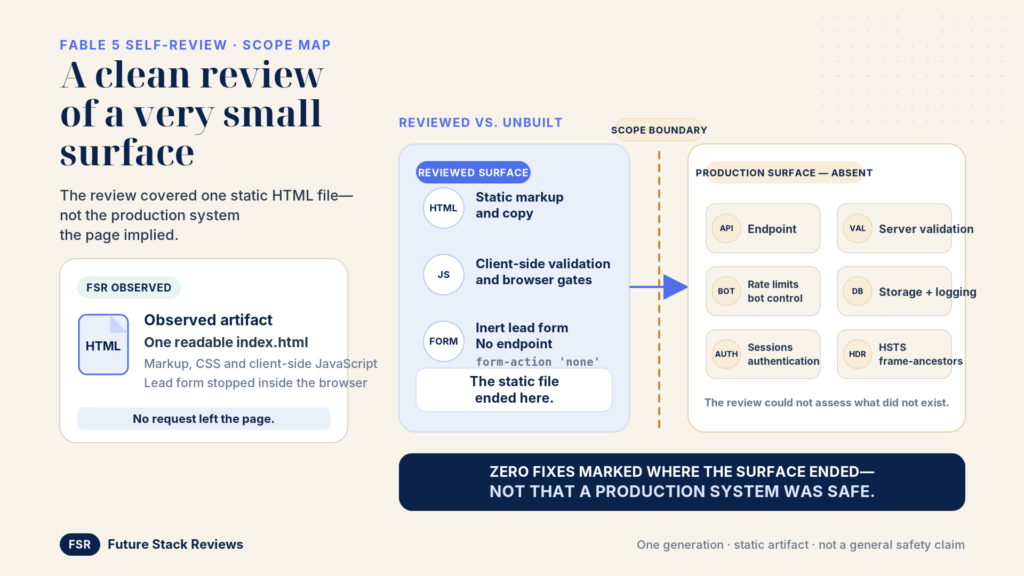
The tool can find things, so the zero was about scope
A skeptical buyer should ask whether the security pass returned nothing because the tool cannot find problems. The other review in the same session answers that. The specification and quality audit, a 16-agent workflow, raised 10 findings, confirmed 5 through its verification agents, and rejected the other 5 as false positives. The five it kept were real and it fixed them: a real product name used in ad copy where the brief forbade named brands, a mobile call-to-action bar that stayed keyboard-reachable while hidden, validation errors that a screen reader would not announce, a unit typo in a font size, and a hard-coded line break that broke awkwardly at phone width. FSR confirmed each of those fixes in the current file.
So the same tool, on the same artifact, in the same session, did find and repair genuine issues, and did throw out half of its own candidates as noise. The security pass returned zero fixes because the artifact had no attackable surface. The run establishes a scope distinction: the reviewer works, but a static file gives it almost nothing to work on.
Which model actually ran
A review is only as attributable as the model behind it, and interface labels do not settle that. Anthropic documents three ways the model can differ from the one shown: subagents can run on cheaper models, a workflow can route a stage elsewhere or set a model through the CLAUDE_CODE_SUBAGENT_MODEL variable, and a safeguard can reroute a flagged request to Opus 4.8 with the answer “labeled with the model that answered” (sub-agents, workflows, model switching).
For this run the records close that gap. Across all 36 review agents, the model field in the transcripts reads claude-fable-5 and nothing else, with no trace of a fallback to Opus, Sonnet, or Haiku. That is a strong, checkable answer for this one session, and it is exactly the kind of answer a buyer should demand rather than assume. It does not generalize: the next generation could route differently, and only its own logs would show it.

What a clean review authorizes
Treat a clean AI review as a scope record. Anthropic’s own guidance points the same way: automated security reviews “should complement, not replace, your existing security practices and manual code reviews” (automated security reviews). The output worth keeping from the run above is the record of what the review looked at, what it could not reach, and why.
The same gap can open one layer earlier, inside the review output itself. In an FSR ledger test on Google’s Gemini app, five responses classified all thirty control cases correctly and every one of them returned a defective supporting-quote field, so correct dispositions arrived without the evidence behind them. A record kept from that output would carry field six and lose field four.
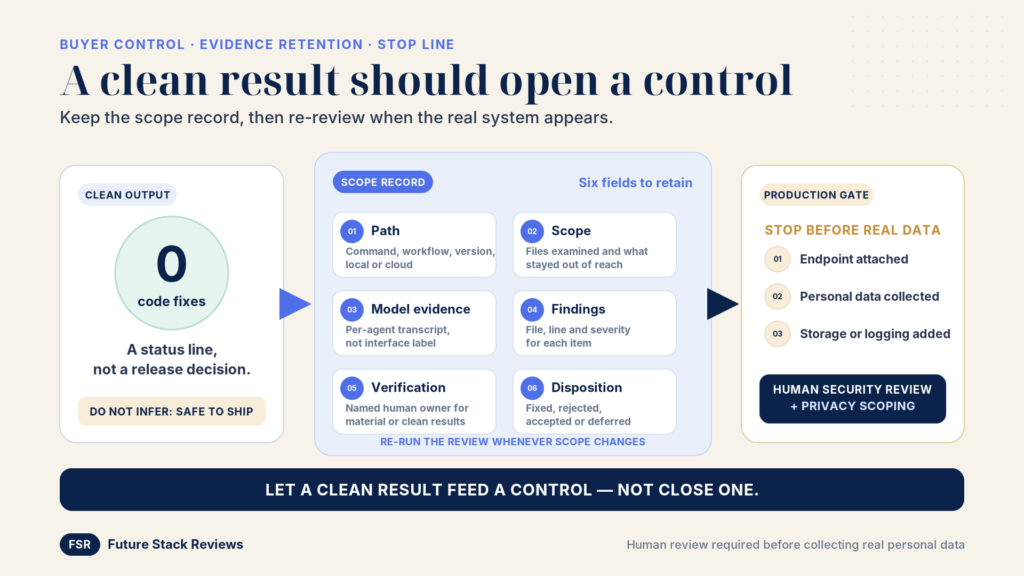
Where the review told the buyer to stop
The security pass also drew a stop-line. The form is built to collect other people’s personal data, the names and email addresses of prospects. As shipped it sends and stores nothing, but its intended use is lead capture, and the review escalated on that point: before any real deployment that collects this data, a first-pass static review is not enough, and a qualified human security review plus privacy-compliance scoping is required. In Japan that means at minimum the Act on the Protection of Personal Information, covering consent text, purpose specification, retention, and processor handling. That boundary comes from the review’s own output. It is not a legal opinion, and a team collecting real data should take its own advice.
What stays uncertain
This is one generation, and the article says so plainly. The findings describe a single output; regenerating from the same prompt could produce different code and different findings. The clean security result belongs to a static file, and it says nothing about the backend a real product would need, which is precisely the surface the review flagged as absent. An independent second review, run in a fresh session with no build context, was not performed, so the question of whether a blind pass would reproduce these results is open. The model attribution holds for this run’s logs and does not forecast the next one. And the product details cited here are dated: research-preview features and entitlement windows change, so re-read the linked sources before relying on one.
FAQ
Methodology and disclosure
This is a hands-on review of one generation. FSR had an AI builder produce the artifact and run its own two reviews, then read the session’s primary records, the workflow metadata, the per-agent transcripts, and the current file, to establish the counts, the model attribution, and the file identity. Those observations are firsthand and scoped to this session. The product facts about Fable 5, Ultracode, the review surfaces, and data retention are official Anthropic claims read on their pages on 2026-07-19 JST, not independent measurements of runtime behavior. FSR discloses that it uses an AI system to write about an AI system’s self-review; that the sample is one generation with non-determinism stated; that an independent blind re-review was not run; and that no payment, health, or government-identifier data was present in the artifact. No credential, key, or token appeared in the artifact or the records, and none is reproduced here.
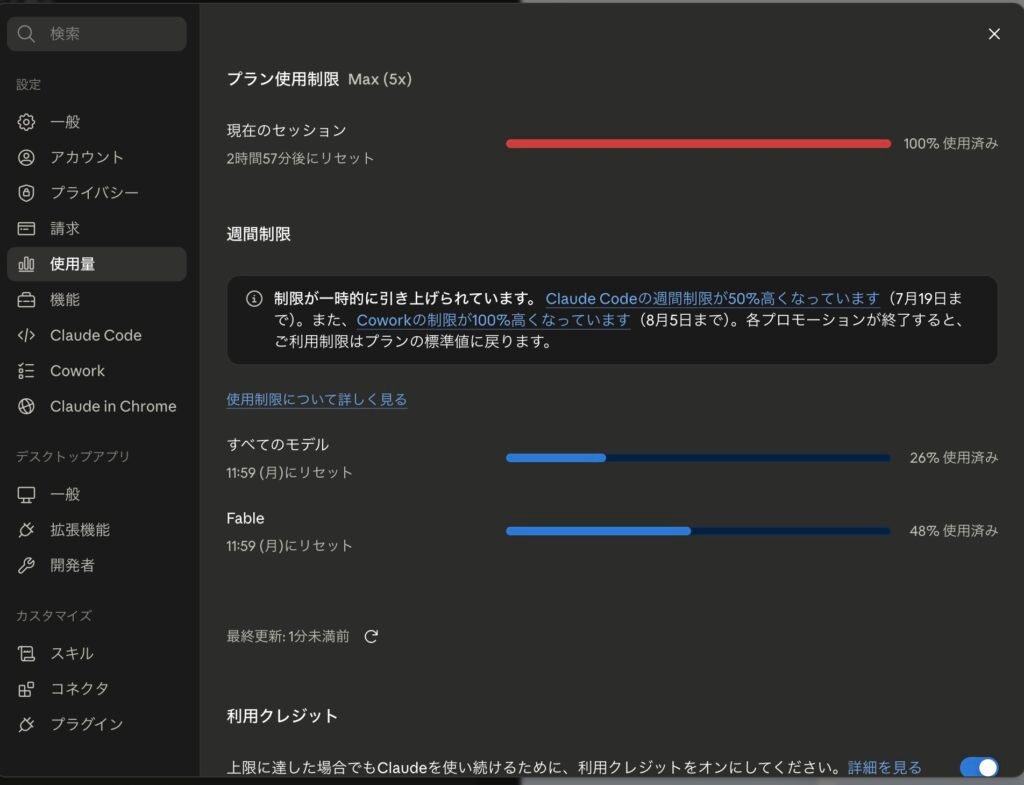
Note on cost. The run used a Max (5x) consumer plan, and on the build day the session reached its cap; the token budget below is what two multi-agent reviews on one file cost in practice.
Verdict
For a buyer, the useful question is not whether this tool reviews well. On the evidence it can: it found and fixed five real defects on this file and discarded five of its own false positives. The question is what a clean result licenses, and the answer here is narrow. A security pass that changes zero lines on a static file marks where the surface ends. Everything a real product exposes, the endpoint, the storage, the sessions, the transport, was still unbuilt, and the review said so and escalated to human review before any real data is collected. The buyer action follows: keep the scope record, treat the boundary as a procurement fact, and let a clean result feed a control instead of closing one.
Sources (official primary unless noted; all accessed 2026-07-19 JST)
- Claude Fable 5: https://www.anthropic.com/claude/fable
- Automated security reviews in Claude Code: https://support.claude.com/en/articles/11932705-automated-security-reviews-in-claude-code
- Orchestrate subagents with dynamic workflows (Ultracode, agent caps): https://code.claude.com/docs/en/workflows
- Create custom subagents (model routing): https://code.claude.com/docs/en/sub-agents
- Why Claude switched models (Fable 5 fallback): https://support.claude.com/en/articles/15363606-why-claude-switched-models-in-your-conversation-with-fable-5
- API and data retention (Covered Models): https://platform.claude.com/docs/en/manage-claude/api-and-data-retention
- Plans and Pricing: https://claude.com/pricing
- Firsthand records (not public): FSR session workflow metadata, per-agent transcripts, and the artifact
index.html(SHA-256ec59af12…), read 2026-07-19 JST.