Last updated: July 31, 2026
Current status
This is a dated hands-on record. FSR tested one Max 5x account on 2 July 2026, and every reading below is what that account showed on that day. Those observations stand as recorded.
The plan terms described alongside them do not. This review was written while Fable 5 was included through 7 July, and it states that Pro, Max and Team all move to usage credits after that date. That is no longer correct. The 7 July boundary did not hold, and from 20 July Anthropic split the plans: Max and eligible premium seats keep Fable 5 included, while Pro and standard seats run on usage credits. Read the 7 July dates, the plan table, the decision table and the FAQ below as a record of the terms in force on 2 July, not as current guidance.
For the terms in force now, read Claude Fable 5 From July 20, 2026: What Happens on Each Paid Plan, which sets out what each plan and seat type receives.
What has not changed is the finding this review was written about. Claude Code and the API report tokens, the Claude app reports a percentage, and no official page converts one into the other or into a dollar figure. FSR’s later briefings, working from Anthropic’s current documentation, reached the same conclusion.
Status marker added 31 July 2026. The hands-on session itself is unchanged and has not been re-run.
Claude Fable 5 is Anthropic’s model for its most demanding reasoning and long-horizon agentic work. Anthropic suspended access on June 12 to comply with United States export controls, then restored it on July 1 after those controls were lifted. This review does not test whether Fable 5 is capable. It audits the restoration as a buyer problem: where Fable 5 usage shows up, in what unit, and whether you can turn that into a budget.
Fable 5 is available again, but it did not return as a normal included model. It came back as a capped, separately metered entitlement, and its usage reads in a different unit depending on which Claude surface you look at.
Anthropic’s model for its most demanding reasoning and agentic coding, restored on July 1 across Claude Platform, Claude.ai, Claude Code, and Claude Cowork after an export-control suspension.
Developer and technical teams that can run measured, high-value work in Claude Code or the API, log which model answered, and use the included window as a cost test.
Buyers who need predictable per-task cost, standard Enterprise seats without credits enabled, workloads that require zero data retention, or teams that need confirmed cloud-platform parity.
On the API, Anthropic lists Fable 5 at $10 per million input tokens and $50 per million output tokens, against $5 and $25 for Opus 4.8. On subscription, Fable is included up to 50% of weekly limits through July 7, then moves to usage credits. Confirm current figures on the pricing page before purchase.
How the app’s percentage meter converts to tokens or dollars, what Fable costs once it crosses into credits after July 7, and whether Fable 5 is live in the cloud catalogs today.
Fable 5 usage is visible again, but not uniformly legible. Claude Code and the API show tokens, the Claude app shows percentages, and nothing on screen converts either into a dollar figure until you cross into paid credits.
Next step
Verify the live terms before you budget for Fable 5.
Anthropic’s pricing, plan access, and usage-credit rules can change independently. Check the current official pages before enabling credits or assigning production work.
The clearest way to see the problem is to put the three surfaces side by side. These are readings from FSR’s Max 5x account on July 2.
| Surface | Unit shown | What FSR observed | What remains unknown |
|---|---|---|---|
| Claude app | Percentage | Weekly Fable at 5% | Token and dollar equivalent |
| Claude Code | Tokens | Fable at 95.2k tokens | Whether that is the billed count |
| Usage credits | Dollars | $0.00 used | Cost behavior after the limit |
On this review
- What changed after Fable 5 returned
- What FSR tested
- Finding 1: Fable now has its own meter
- Finding 2: Claude Code shows a different unit
- Finding 3: The surfaces do not translate
- Finding 4: The credit boundary is visible but uncrossed
- Finding 5: Safety routing can contaminate evaluation
- Pricing and entitlement reality
- Data retention and the trust boundary
- Who should test it, who should wait
- What FSR tested and did not test
- FAQ
- Methodology
- FSR Verdict
- What FSR could not verify
- Sources
What changed after Fable 5 returned
The restoration changed the buyer question from access to measurement. Anthropic’s redeployment post says Fable 5 became available again on July 1 across Claude Platform, Claude.ai, Claude Code, and Claude Cowork, after the June 30 removal of the export controls that forced the June 12 suspension. FSR tracked the roughly 72-hour first run before Anthropic pulled it, where the real risk was access dependency, not the model itself.
The access is not open-ended. For Pro, Max, Team, and premium Enterprise seats, Anthropic says Fable 5 is included for up to 50% of weekly usage limits through July 7, after which it moves to usage credits. Standard Enterprise seats are treated differently, which is covered in the pricing section below.
| Plan or seat | Fable 5 through July 7 | After July 7 |
|---|---|---|
| Pro, Max, Team | Included, up to 50% of weekly usage limits | Usage credits |
| Premium Enterprise seats | Included, drawn from each seat’s usage at no extra cost | Usage credits |
| Standard Enterprise seats | No included allowance; access only through usage credits | Usage credits |
Two less visible changes matter more for teams than the headline return. The first is safety routing: Anthropic redeployed Fable 5 with a stronger classifier, says blocked requests are sent to Opus 4.8 with a notification, and says the classifier may flag benign coding and debugging more often while it is tuned. The second is cloud timing, and it is the one place Anthropic’s own pages do not line up.
Cloud availability, unresolved. Anthropic’s current pricing page lists Fable 5 on AWS, Google Cloud, and Microsoft Foundry with full billing detail. Its June 30 restoration post said access to those clouds would be re-enabled as quickly as possible, without a date. Neither page gives a dated confirmation that Fable 5 is selectable in each cloud catalog today. Teams on those platforms should check the catalog directly before relying on it.
What FSR tested
FSR ran a structured session on one Max 5x account on July 2, focused on a single question: where does restored Fable 5 usage show up, and in what unit? The session covered a document-heavy task in the Claude app with usage readings before and after, a read-only repository audit in Claude Code with the model-level token view, a clean-tree check to confirm the audit changed nothing, a second app usage reading after the Code work, and a look at the usage credits panel and its spend controls.
FSR did not exhaust the Fable allowance, did not trigger the transition into paid credits, did not test Enterprise seats, did not test cloud-platform access, did not pull an API or Console billing receipt, and did not run any exploit or jailbreak tests. Every reading below is from this one account on this one day, so treat the specific percentages as illustrative of behavior on this plan, not as fixed values for every plan.
Finding 1: Fable now has its own meter
In the Claude app, Fable 5 is no longer an invisible option folded into a general limit. It has a dedicated weekly meter. During a document-heavy editorial task, FSR watched the weekly Fable meter move from 0% to 4%, the weekly all-models meter move from 2% to 4%, and usage credits stay at $0.00. The current-session meter moved further in the same run.
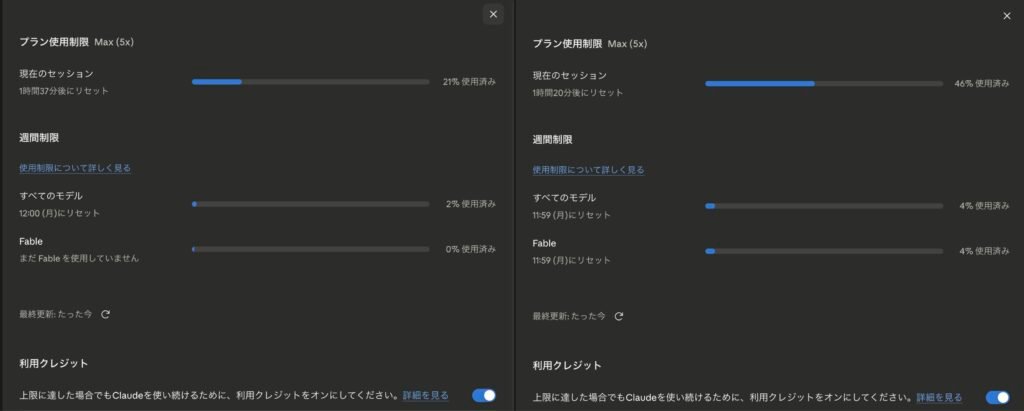
That is a real improvement over having no per-model signal at all. The limit of the finding is the unit. The meter is a percentage. There is no token count next to it and no dollar figure, and FSR did not find an official way to convert that percentage into either.
What FSR can say: on this account, one Fable task moved the weekly Fable meter from 0% to 4% while credits stayed at zero. What FSR cannot say: how many tokens that 4% represents, what it would cost, or whether the same task moves the meter the same amount on another plan.
Finding 2: Claude Code shows a different unit
Claude Code exposes a unit the Claude app does not: model-level tokens. Fable 5 was selectable there, with an interface warning that it uses your allowance faster than Opus 4.8. After a read-only repository audit, the model tab reported Fable 5 at 95.2k tokens for the session, split into 51.1k input and 44.1k output, with Fable accounting for a minority share of that session’s total.
This is more granular than the app. A developer working in Claude Code can see model-level token usage as they go. The boundary is what those numbers are. The model tab shows usage, not a billing receipt, and FSR did not confirm that this figure is the exact count a subscription or invoice would charge against.

Finding 3: The surfaces do not translate
The mismatch appears when the same account shows tokens in one product and percentages in another. After the Code-side work, FSR read Fable at 95.2k tokens in Claude Code, weekly Fable at 5% in the Claude app, and $0.00 in usage credits, at roughly the same time.
Those three numbers are not a conversion. FSR did not, and could not from a single observation, derive that 95.2k tokens equals 5% of a Max 5x allowance, or attach a dollar value to either. The app percentage and the Code token count are two measurement grammars for the same underlying usage, and nothing on screen bridges them.
One documented detail widens the gap. Anthropic’s model documentation says adaptive thinking is always on for Fable 5 and cannot be disabled. Reasoning happens whether or not it shows in the answer, so the visible output and the work the model did can diverge. FSR did not verify how those thinking tokens are counted against the app’s percentage meter, so this is a reason the percentage is hard to read, not a measured rate.
Google’s Flash line runs the same design with one difference that matters for measurement. Gemini 3.6 Flash has thinking on by default at a documented medium level and bills those tokens at the output rate, and Google states that pricing is based on the full thought tokens the model generates even though the API returns only summaries. The difference is where the count lands. Google exposes it in a usage field rather than folding it into a percentage, so the invisible work is at least countable on that side.
The safe claim is narrower than the headline: FSR observed both units, but not an official conversion between them. This is a Claude app problem, not an everywhere problem. Claude Code and the API show tokens, so this review does not claim Anthropic hides token counts across its products.
The one receipt that would settle this. A single post-limit Fable run captured end to end: the app percentage before and after, the Claude Code or API token count for the same work, the usage-credit charge it produced, and the matching change in the usage dashboard. FSR did not cross that boundary in this session, so it does not have that receipt yet. In public, neither does Anthropic.
Finding 4: The credit boundary is visible but uncrossed
Usage credits are the mechanism that keeps Fable 5 working after the included window, and the controls for them are present in the app. FSR saw the credits toggle enabled, $0.00 used, a configurable monthly spending cap, an auto-charge control, and a button to buy credits. Anthropic’s help documentation describes how the system works: credits activate after you reach your plan’s usage limits, they are billed at standard API rates and charged separately from the subscription, and there is a notification and a confirmation before you switch over to them.
So the boundary is real, it has spend controls, and it does not appear to charge silently. What FSR did not do is cross it. The observed Fable work stayed inside the included allowance at $0.00 credit usage, so the actual transition into paid credits was not triggered here.
Still unverified: whether the pre-charge confirmation shows a specific dollar estimate before you cross, what real subscription workloads cost once Fable moves to credits after July 7, and how a request rerouted to Opus 4.8 is billed. FSR did not test any of these and does not state them as facts.
Finding 5: Safety routing can contaminate evaluation
Fallback can turn a Fable test into a mixed-model test. Anthropic says the redeployed classifier blocks the reported cyber technique at a high rate, can flag benign coding and debugging more often while it is being tuned, and routes blocked Fable requests to Opus 4.8, a model FSR judged safer but a worse operator, with a notification to the user.
For anyone evaluating Fable 5, that creates a subtle trap. A task you believe you ran on Fable can, in part, be answered by Opus 4.8 after a block, unless you log it. FSR observed no fallback in its single benign read-only audit and did not run any tests designed to trigger the classifier. This review does not reproduce or describe any blocked technique. The practical point for a developer is simple: if you are measuring Fable’s output quality or cost, watch for the fallback notification and keep model attribution per request.
Pricing and entitlement reality
On the API, the headline is a clean doubling, confirmed against Anthropic’s pricing page.
| Model | Input per million tokens | Output per million tokens | Batch input | Batch output |
|---|---|---|---|---|
| Claude Fable 5 | $10 | $50 | $5 | $25 |
| Claude Opus 4.8 | $5 | $25 | $2.50 | $12.50 |
One number is easy to misread, so it is worth getting right. Anthropic’s pricing page says the newer tokenizer used by Fable 5 produces approximately 30% more tokens for the same text than older models. That looks like it should widen the gap with Opus 4.8, but it does not, because Opus 4.8 uses the same newer tokenizer. Against Opus 4.8, the token count is a wash and the difference is the 2x rate. Multiplying the 2x price by the 30% to call Fable 2.6 times Opus overstates it for anyone comparing to Opus 4.8. Against an older model such as Sonnet 4.6, a Fable run does pay both the higher rate and the higher token count. The same per-token-versus-per-task gap runs through Claude Sonnet 5, where cheaper per token is not always cheaper per task.
The offsets are real and documented. Batch processing runs Fable at $5 input and $25 output, half the standard rate. Prompt caching charges a cache read at a tenth of the input price. Teams that reuse a large context or can process asynchronously can pull the effective rate down. For work that needs United States-only inference, the pricing page lists a 1.1x multiplier, and partner cloud regional endpoints carry a 10% premium over global routing.
FSR’s earlier read of Fable 5’s plan pricing made the same point: Anthropic publishes a token price, not what a plan includes. Restoration moved that gap rather than closing it. On subscription, the entitlement rather than the sticker price is what bites. Fable is included up to 50% of weekly limits through July 7, then credits. Standard Enterprise seats have no included Fable allowance at all and need credits enabled to use it, while premium seats are included through the window. A procurement team that assumed uniform access across every Enterprise seat could find part of its staff locked out.
Here the number FSR could not find matters more than the ones it could. The per-token rate and the tokenizer overhead are documented. What is not documented is how a subscription percentage meter converts to tokens or dollars, or any official statement that Fable draws down a subscription allowance at a fixed multiple. Claude Code’s warning that Fable uses your allowance faster than Opus 4.8 is a direction, not a rate.
Data retention and the trust boundary
Fable 5 arrives with a fixed data posture that some buyers will not be able to accept. Anthropic’s model documentation designates Fable 5 and Mythos 5 as Covered Models with 30-day data retention and no zero data retention option, and says this remains current after restoration.
The work most likely to justify Fable 5, such as large codebase changes, sensitive research, and long-horizon agents, is also the work most likely to trip retention and legal review. For an organization that previously relied on a zero data retention agreement, the Covered Model status removes a control it may have been counting on. That is a procurement question to raise before deployment, not a verdict. FSR did not verify payload-level data handling, and nothing here is a compliance ruling. Teams in regulated settings should route this through legal and security review, and should confirm the current retention and residency terms directly, because those policies change.
Who should test it, who should wait
- You need top-tier reasoning or agentic coding and can use the included window.
- You can instrument each run and record which model actually answered.
- Your work lives mostly in Claude Code or the API, where token usage is visible.
- You need predictable per-task cost before committing budget.
- You are on a standard Enterprise seat without credits enabled.
- You need cloud-platform parity, zero data retention, or settled post-July-7 pricing.
The useful way to compare Fable 5 against Opus 4.8 or Sonnet here is not a benchmark score. It is whether you can measure and govern the run.
| Decision axis | What to check for Fable 5 |
|---|---|
| Unit visibility | Tokens in Claude Code and the API; only percentages in the Claude app |
| Fallback attribution | Blocked requests route to Opus 4.8 with a notification; log which model answered |
| Credit boundary | Included through July 7, then usage credits at standard API rates, with a confirmation before switching |
| Data retention | 30-day retention, no zero data retention, Covered Model |
| Cloud parity | Listed on AWS, Google Cloud, and Foundry on the pricing page, but restoration timing unconfirmed; check the catalog |
What FSR tested and did not test
Tested on a Max 5x account, July 2, 2026: Fable 5 appearing in the app usage context with a dedicated weekly meter; a document-heavy app task moving the session, all-models, and Fable meters; usage credits reading $0.00 during that included-window work; Fable 5 selectable in Claude Code with its faster-usage warning; a Claude Code model tab showing Fable at 95.2k tokens split 51.1k input and 44.1k output; a clean working tree after the read-only audit; a later app reading of weekly Fable at 5% with credits at $0.00; and the credits panel with its spend and purchase controls.
Not tested: the exact conversion between Code tokens and app percentages; what 100% of the Fable meter represents; whether Fable usage always counts against both the all-models and Fable meters; behavior on Pro, Max 20x, Team, or Enterprise plans; standard versus premium Enterprise seat behavior in practice; post-July-7 credit billing; cap exhaustion and the cost-preview at that moment; how a rerouted request is billed; Fable 5 availability on AWS Bedrock, Google Cloud, or Microsoft Foundry as of today; current retention and residency terms beyond the model documentation; an API or Console billing receipt; and any cyber or jailbreak reproduction.
FAQ
What is the Claude Fable 5 usage limit on a subscription?
Anthropic says that through July 7, 2026, Pro, Max, Team, and premium Enterprise seats can use Fable 5 for up to 50% of their weekly usage limits. After July 7, Fable 5 moves to usage credits billed at standard API rates. Standard Enterprise seats have no included allowance and need credits enabled.
What happens to Claude Fable 5 after July 7?
According to Anthropic’s redeployment post, once the included window ends on July 7, Fable 5 remains available through usage credits rather than plan inclusion. Usage credits are billed separately at standard API rates. FSR did not test post-July-7 billing, so the exact charge for real subscription workloads remains unverified here.
How much does the Claude Fable 5 API cost?
Anthropic’s pricing page lists Fable 5 at $10 per million input tokens and $50 per million output tokens, twice the listed rate of Opus 4.8 at $5 and $25. Batch processing halves those rates and prompt caching cuts cache reads to a tenth of the input price. Confirm current figures on the pricing page.
Is the 30% tokenizer increase the same as a subscription usage multiplier?
No. Anthropic’s pricing page says the newer tokenizer, used by Fable 5 and several other models including Opus 4.8, produces about 30% more tokens for the same text. That affects token counts on the API. It is not a statement about how fast Fable draws down a subscription percentage allowance, which Anthropic does not publish.
Does Fable 5 fall back to Opus 4.8?
Anthropic says a redeployed safety classifier can block certain requests and route them to Opus 4.8, with a notification to the user, and that it may flag benign coding and debugging more often while tuning. FSR observed no fallback in one benign read-only audit and did not run any exploit tests.
Does the Claude app show Fable 5 token usage?
Not directly. On the account FSR tested, the Claude app showed Fable 5 usage as a weekly percentage meter, not a token count. Claude Code showed model-level tokens for a session. FSR did not find an official way to convert the app’s percentage into tokens or dollars for an individual plan.
Does Claude Code usage count toward usage credits?
Yes. Anthropic’s usage-credits help page says Claude Code usage counts toward the same plan limits as other Claude conversations. Once those limits are reached, work continues on usage credits billed at standard API rates, so a heavy Claude Code session moves you toward the credit boundary like any other use.
Does Claude Fable 5 support zero data retention?
No. Anthropic’s model documentation designates Fable 5 and Mythos 5 as Covered Models with 30-day data retention and no zero data retention option. For buyers who rely on ZDR agreements, this is a change worth raising in procurement and legal review before deploying Fable 5 on sensitive data.
What should teams log before enabling usage credits?
Record a baseline before switching. Capture the weekly Fable and all-models percentages before and after a representative task, the Claude Code token count for the same work, the usage-credits reading, and which model answered each request. That gives you your own conversion evidence, since Anthropic does not publish one.
Methodology
FSR tested restored Fable 5 access on one Max 5x account on July 2, 2026. The session covered the Claude app usage panel before and after a document-heavy task, a Claude Code read-only repository audit, the Claude Code model-level token view, a clean working-tree check, a second app usage reading after the Code work, and the usage credits panel. Screenshots were captured for each step and stored in FSR’s evidence archive; the raw credits view holds account-private data and is not published.
The limits are deliberate and stated. This is a single account on a single day. FSR did not exhaust the Fable allowance, did not cross into paid credits, did not test other plans or Enterprise seats, did not test cloud platforms, did not pull a billing receipt, and did not run exploit tests. Facts attributed to Anthropic come from its pricing page, model documentation, help center, and redeployment post, each of which can change and should be rechecked before you rely on it.
The behind-the-scenes of this review, including the cost calculation the market gets wrong and what changed after we published, is in our Substack field notes.
FSR Verdict
Fable 5’s restored access is useful, but it is not procurement-complete. The strongest reason to test it now is not that it is a free premium model for a week. It is to learn how your real work registers across Claude’s token, percentage, and credit surfaces before you commit budget to it.
Claude Code and the API will show you tokens. The Claude app will show you a percentage. Neither will tell you, on its own, what a given run costs, and Anthropic’s public documentation does not bridge that gap for individual plans. Add the always-on reasoning, the fixed 30-day retention with no zero data retention option, the standard Enterprise seats that need credits to work at all, and the fallback that can quietly move a request to Opus 4.8, and the current window is best used for measurement, not procurement closure. Treat it as a chance to build your own conversion evidence, not as proof that Fable 5 is now operationally normal.
What FSR could not verify
This section is the honest boundary of the review. Each item below was sought and either not found in official sources or not tested by FSR, and none of it is stated as fact anywhere above.
The exact post-July-7 billing for subscription Fable workloads. Any official conversion from an individual plan’s percentage meter to tokens or dollars. Any official statement that Fable draws down a subscription allowance at a fixed multiple. The billing rate for a request rerouted to Opus 4.8. Whether the cost-preview at the credit boundary shows a specific dollar estimate. Fable 5’s live availability in the AWS Bedrock, Google Cloud, and Microsoft Foundry catalogs as of today. Cross-plan meter behavior beyond this Max 5x account. Each of these stays open, and this review will be updated if Anthropic publishes the mapping or if FSR tests them directly.
Sources
Primary sources accessed July 2, 2026. Prices and cloud availability are volatile and should be rechecked on publish day.
| Source | What it supports here | Type |
|---|---|---|
| Redeploying Claude Fable 5 | Restoration date and surfaces, the 50% included window through July 7, the move to usage credits after, the standard versus premium Enterprise seat split, the Opus 4.8 fallback, and pending cloud re-enablement | Anthropic primary |
| Claude Platform pricing | Fable 5 and Opus 4.8 API rates, batch and prompt-caching discounts, the newer tokenizer’s roughly 30% token increase, and the US and regional pricing multipliers | Anthropic primary, recheck on publish day |
| Introducing Claude Fable 5 and Mythos 5 | 30-day retention, no zero data retention, Covered Model status, always-on adaptive thinking, and refusal and fallback-credit behavior | Anthropic primary |
| Manage usage credits for paid Claude plans | How usage credits activate, standard API-rate billing, spending controls, the confirmation shown before switching, and Claude Code counting toward the same limits | Anthropic primary |
| FSR hands-on session, Max 5x account | The app usage meters before and after, the Claude Code model tab at 95.2k tokens, the clean working tree, and the credits panel at $0.00 | FSR hands-on |
| AWS Bedrock, Google Cloud, and Microsoft Foundry model catalogs | Whether Fable 5 is selectable in each cloud after the suspension | Pending, check each provider’s catalog |
Stay with the review desk
Choose a channel to keep reading.
Share this review