Last updated: August 14, 2026
Anthropic canceled the September 1 price increase. Claude Sonnet 5 stays at $2 per million input tokens and $10 per million output tokens, now as standard pricing rather than an introductory rate.
Nothing about the rate moved on August 10. It has been $2 and $10 since the June 30 launch. What moved is the calendar: the step up to $3 and $15 that this article was built around will not happen.
| Announced | August 10, 2026, as an edit appended to Anthropic’s Claude Sonnet 5 launch post, and reflected on the Claude Platform pricing page. |
| Rate today | $2 in / $10 out per million tokens, one third below Sonnet 4.6 at $3 / $15. |
| What changed | The scheduled September 1, 2026 move to $3 / $15 will not occur. The introductory label is gone; the numbers behind it are not. |
| Revised here | The migration table, the pricing section and its comparison table, the migration checklist, the methodology recheck rule, and the verdict. |
| Withdrawn here | The cost per task comparison against Opus 4.8, and the chart carrying it. |
| Not re-opened here | The tokenizer behavior, the three API request changes, and the Priority Tier exclusion. Those sections keep their July 1, 2026 access date and were not re-read for this update. |
This is a vendor change, not an FSR correction. The July version described the schedule Anthropic had published at the time.
The cost per task figure is a separate matter. Artificial Analysis stated that its measurement used the $3 / $15 rate. That rate is no longer in effect. FSR removed the comparison rather than rescaling it, because a rescaled number would be an FSR calculation wearing a third-party label. It returns only if the source publishes a figure on the current rate.
Sources: Anthropic, 10 August 2026 edit · Claude Platform Docs, accessed 14 August 2026
Claude Sonnet 5 is Anthropic’s new Sonnet-class model for agentic coding, tool use, and professional work, released June 30, 2026. For a team already on Sonnet 4.6, the decision is not whether it is stronger. It is whether the move changes your cost per task, token counts, request behavior, output budgets, and service-tier assumptions.
FSR verdict: a credible upgrade candidate, but not a blind production swap.
This is a Tier C, document-first review. FSR analyzed Anthropic’s official materials and clearly labeled third-party analysis, and did not run Sonnet 5 hands-on.
The per-token price is the same as Sonnet 4.6 and lower than Opus. A new tokenizer turns the same text into about 30% more tokens, and one independent lab already measured a higher cost per task than Opus 4.8. Treat this as a migration-cost decision, not a discount.
What happened
Anthropic shipped Sonnet 5 on June 30, 2026 and calls it a drop-in upgrade from Sonnet 4.6. The same docs disclose a new tokenizer, three request-breaking API changes, and a service-tier exclusion.
Who should care
Teams running Sonnet 4.6 in production, anyone budgeting API spend from token counts, developers using manual thinking budgets or custom sampling, and orgs relying on Priority Tier capacity.
Who can ignore this
Casual Claude.ai chat users. Most of these changes sit below the app. You were moved to Sonnet 5 automatically and will mostly notice stronger answers, not billing mechanics.
When it is safe to move
After you re-count tokens and resize max_tokens on a real 4.6 workload, and after you confirm your code sets no manual thinking budget and no non-default sampling.
When to hold
If production depends on manual thinking budgets, non-default temperature or top_p or top_k, or Priority Tier capacity commitments. Those paths break or do not carry over.
Evidence status
Pricing, tokenizer, API changes, and specs are confirmed from Anthropic official pages. The cost-per-task figure is third-party. Launch-week complaints are unverified signal. FSR did not run Sonnet 5.
Bottom line: a strong upgrade candidate, not a blind production swap. Read the full migration audit below.
- The migration in one table
- The pricing story is not the sticker price
- The tokenizer is the hidden migration variable
- Drop-in upgrade is not drop-in operations
- Priority Tier is a procurement seam
- Where Sonnet 5 actually sits
- Who should move and who should wait
- Migration checklist
- FAQ
- Sources and methodology
- FSR verdict
| Released | June 30, 2026 |
|---|---|
| API model ID | claude-sonnet-5 |
| Price | $2 in / $10 out per million tokens through Aug 31, 2026, then $3 in / $15 out from Sep 1, 2026 |
| Context / output | 1M context (default and maximum); 128k max output on the synchronous API |
| New tokenizer | About 30% more tokens for the same text than Sonnet 4.6 |
| Breaking API changes | Manual extended thinking and non-default temperature / top_p / top_k return 400; adaptive thinking on by default |
| Priority Tier | Not available on Sonnet 5 |
| FSR depth | Tier C, document-first, no hands-on testing |
The migration in one table
A model can be a real upgrade and still cost you a day of engineering to adopt safely. Here is the whole migration in one view, before the detail.
| Layer | What changes on Sonnet 5 | Buyer impact | Action before migrating |
|---|---|---|---|
| Price window | $2 / $10 intro through Aug 31, then $3 / $15, the same per-token rate as 4.6 | The discount expires; the durable price is flat, not lower | Model spend at the September rate, not the launch rate |
| Tokenizer | Same text produces about 30% more tokens | Old token counts and budgets understate the new cost | Re-run token counting on real prompts |
| Output budget | Adaptive thinking is on by default and shares the max_tokens cap with the response | Outputs tuned near a 4.6 limit can truncate | Resize max_tokens; decide whether thinking stays on |
| API validation | Manual thinking and non-default sampling return 400 | Wrappers and SDK defaults can start failing | Remove manual thinking budgets and non-default temperature, top_p, top_k |
| Entitlement | Priority Tier is not available | 4.6 capacity assumptions do not carry over | Check any Priority Tier dependency |
| Region and cost | US-only inference adds a 1.1x multiplier on all token categories | Regulated routing raises the effective bill by 10% | Confirm whether region policy forces US-only routing |
The pricing story is not the sticker price
At launch, Sonnet 5 runs at introductory API pricing of $2 per million input tokens and $10 per million output tokens, through August 31, 2026. From September 1 it moves to standard pricing of $3 and $15.
That standard rate is the same per-token price as Sonnet 4.6, and it sits below Opus 4.8 at $5 and $25.
So the launch discount is temporary, and the durable price is flat against the model it replaces. Most launch coverage quotes the $2 and $10 and compares them to Opus. That framing skips both the September step-up and the token change sitting behind it.
| Model and window | Input | Output | Note |
|---|---|---|---|
| Sonnet 5, intro (to Aug 31, 2026) | $2 | $10 | Set to be roughly cost-neutral vs 4.6 during launch |
| Sonnet 5, standard (from Sep 1, 2026) | $3 | $15 | Same per-token rate as Sonnet 4.6 |
| Sonnet 4.6 | $3 | $15 | Previous tokenizer, fewer tokens for the same text |
| Opus 4.8 (reference) | $5 | $25 | Higher-capability model |
Per-token rate is not per-task cost. The tokenizer change below is not reflected in these numbers.
Anthropic frames the introductory pricing as being set so the move from 4.6 is roughly cost-neutral during launch. That wording matters, because a discount described as cost-neutral is offsetting something. What it offsets is the new tokenizer.
The tokenizer is the hidden migration variable
Sonnet 5 ships a new tokenizer. Anthropic’s pricing documentation states that Sonnet 5, along with Opus 4.7 and later, produces approximately 30% more tokens for the same text, while Sonnet 4.6 and earlier use the previous tokenizer. The launch note adds that the exact multiplier ranges from about 1.0 to 1.35 times depending on content type, and hits code, structured data, and non-English text hardest.
Hold that number precisely. About 30% is the increase in token count for the same text. It is not a claim that every workload costs 30% more, and it is content-dependent.
Three consequences follow, and Anthropic lists them. Token counts for the same text go up, so estimates built on 4.6 counts understate Sonnet 5, and Anthropic tells developers to re-run token counting rather than reuse old numbers. The 1M context window holds less actual text than it did on 4.6, because each token now covers less text on average. Output budgets can truncate, since an max_tokens value tuned for 4.6 may cut off equivalent output.
This is where the cheaper framing breaks. Artificial Analysis, an independent evaluation group that worked with Anthropic to test Sonnet 5 before release, reported that at standard pricing the model costs about $2.29 per task on its Intelligence Index, roughly twice Sonnet 4.6 and about 15% more than Opus 4.8, driven entirely by higher token usage. That is a third-party measurement in one harness, not an FSR result and not a universal figure. It points at the same action the official docs already require: compare cost per completed task, not price per token.
One number needs separating from another. Anthropic’s roughly 30% is the tokenizer effect on the same text. Artificial Analysis reported a larger figure, about 40% more output tokens per task, but that was measured at maximum effort and reflects the extra reasoning turns Sonnet 5 takes, not the tokenizer alone. Do not merge the two. Fable 5 uses the same newer tokenizer, and FSR’s hands-on test of the restored Fable 5 found the per-token-versus-per-task gap shows up in its subscription usage meters too.
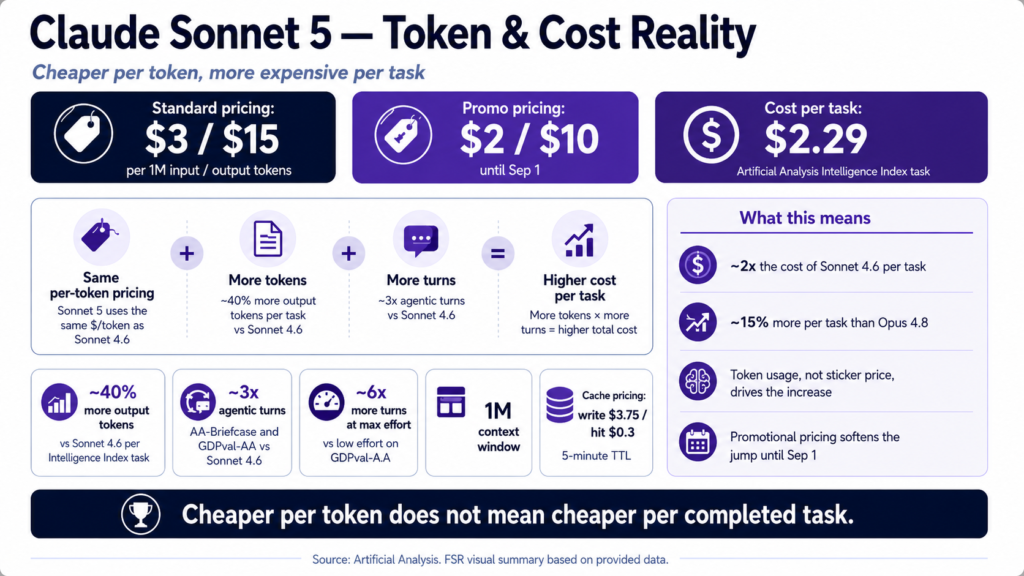
The standard price returns to 4.6 levels while the same text now maps to more tokens, and default thinking can add output tokens on top. The honest comparison is cost per completed task at the September rate, measured on a representative workload, not the launch-price sticker.
Drop-in upgrade is not drop-in operations
Anthropic calls Sonnet 5 a drop-in upgrade. The migration documentation, on the same page, lists behavior changes that can break an existing Sonnet 4.6 integration. Both statements are true at once, and FSR keeps them both rather than averaging them into minor.
- Manual extended thinking is removed. A request that sets
thinking: {type: "enabled", budget_tokens: N}now returns a 400 error. It was already deprecated on 4.6. - Non-default sampling parameters are rejected. Setting
temperature,top_p, ortop_kto a non-default value returns a 400 error. Remove them and steer behavior through the system prompt instead. - Adaptive thinking is on by default. On 4.6, a request without a thinking field ran without thinking. On Sonnet 5 the same request thinks by default, and because
max_tokenscaps thinking plus response text together, an output budget tuned for 4.6 can now truncate.
These are not preference changes. They affect request validation, wrapper defaults, deterministic pipelines, internal agent harnesses, and any output-budget logic. A plain chat integration that already omits manual thinking and custom sampling may need only a model ID change and a token recount. A production agent with tuned request parameters needs migration work.
Two of these three changes have a direct parallel at Google. Google documents temperature, top_p and top_k as deprecated for Gemini 3.6 Flash and states that the API ignores them today, with an HTTP 400 error arriving in future model generations. Anthropic rejects the request. Google accepts it and drops the value. Google also runs thinking on by default at a documented medium level and bills those tokens at the output rate, so the same design decision that creates a truncation risk here creates a billing line there. We traced how the same two changes land on the Google side in our Gemini 3.6 Flash review.
Priority Tier is a procurement seam
Sonnet 5 carries the same tools and platform features as 4.6 with one exception: Priority Tier is not available on it.
That is an entitlement gap, not a capability gap. Priority Tier is a capacity assumption, not a model feature. It matters to a specific reader, an enterprise team whose 4.6 deployment leans on Priority Tier for committed throughput, latency expectations, or overload handling. That team cannot assume Sonnet 5 inherits its 4.6 service posture.
For a team on Standard Tier or ordinary API capacity, this likely changes nothing. For a team that planned capacity around Priority Tier, it is a procurement question to settle before migrating, not a detail to discover from an incident.
Where Sonnet 5 actually sits
One misread should be removed before any comparison: Sonnet 5 is not Anthropic’s highest-capability model, and Anthropic does not present it as one.
Anthropic’s own system card states that Sonnet 5 does not advance its capability frontier, and its internal AI research-and-development rule-out results place Sonnet 5 below Claude Opus 4.7 on most tasks and further below Claude Mythos 5. The Claude Platform model overview still routes buyers toward Opus 4.8 for the hardest Opus-tier reasoning and toward Fable 5 for the highest available capability.
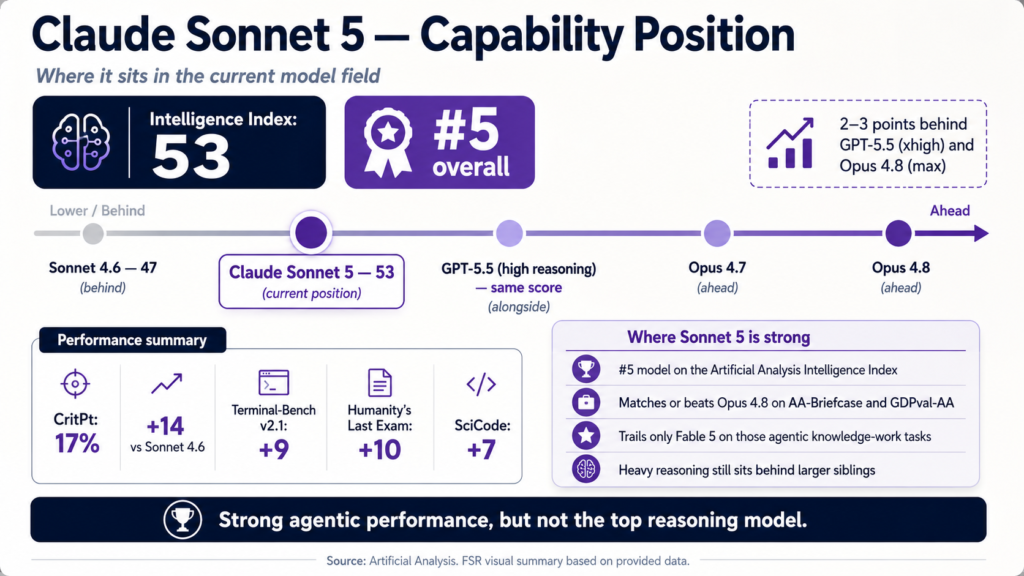
The independent read is consistent, with one nuance. Artificial Analysis places Sonnet 5 at number five on its Intelligence Index, matching GPT-5.5 at high reasoning while trailing Opus 4.7 and 4.8, and reports that on some agentic knowledge-work tasks Sonnet 5 sits just ahead of Opus 4.8 while remaining behind on heavy reasoning. The buyer takeaway is a routing rule, not a ranking. If a task needs the strongest reasoning, Sonnet 5 is not that model. Its argument is cost-adjacent agentic capability, once the migration math is settled.
In the limited launch-window sample FSR reviewed, cost was the clearest social signal, with several developer posts sharing token-count screenshots after switching from 4.6. These are signals, not measurements. FSR did not reproduce them. They do not prove cost inflation on any specific workload, but they support the same step the official docs already require: re-count before scaling.
Sidebar: region and residency is a pricing modifier
Anthropic’s pricing documentation states that requesting US-only inference through inference_geo: "us" applies a 1.1x multiplier on all token categories for Sonnet 4.6 and later, so a US-routed workload effectively pays 10% more per token. Global routing is the default and uses standard pricing. This is a pricing and procurement point, not a compliance verdict. FSR is not claiming Sonnet 5 is compliant or non-compliant for any jurisdiction. If region routing is part of your policy, it belongs in the cost model.
Sidebar: self-checking is not automatic productivity
Anthropic’s launch highlights that Sonnet 5 checks its own work and finishes tasks earlier models abandoned. Independent software-engineering research on agentic coding assistants is mixed on whether self-checking and tool use reliably raise expert throughput on real work, and some controlled studies show experienced developers running slower. This is not a Sonnet 5-specific finding. It is a reason to measure workflow outcomes rather than trust the framing.
In a separate hands-on case, FSR had Fable 5 security-review its own generated code and it changed nothing; that clean self-review proved scope, not safety.
Who should move and who should wait
| Buyer | Recommendation |
|---|---|
| Casual Claude.ai user | Nothing to do. The migration risks sit below the app. |
| Developer using the API casually | Try it, but watch token counts and resize max_tokens. |
| Team running 4.6 in production | Do not swap blindly. Re-baseline token counts, cost, sampling, thinking behavior, and output truncation on a real workload. |
| Team using manual thinking budgets | Migration work required. That path returns 400 on Sonnet 5. |
| Team setting non-default temperature, top_p, or top_k | Migration work required. Those settings return 400 when non-default. |
| Enterprise with Priority Tier commitments | Hold until capacity and service-tier assumptions are checked. |
| Team comparing against Opus 4.8 | Compare cost per completed task, not token price. In third-party testing, Sonnet 5 was not the cheaper option per task. |
| EU or regulated buyer | Do not treat this article as legal guidance. Confirm data residency and region pricing directly. |
Migration checklist
If you are moving a real 4.6 workload, the work is short but not zero.
Re-run token counting on Sonnet 5 for your actual prompts, since counts from 4.6 no longer apply. Resize max_tokens so it covers thinking plus response, and confirm your longest outputs still fit. Remove any thinking: {type: "enabled"} manual budget and any non-default temperature, top_p, or top_k, or expect 400s. Decide whether adaptive thinking should stay on, be disabled, or be controlled through the effort parameter, based on your latency and cost targets. Check whether anything you run depends on Priority Tier, and whether region policy forces US-only routing. Then compare cost per completed task against 4.6 at the September rate, not the launch discount.
FAQ
Is Claude Sonnet 5 cheaper than Sonnet 4.6?
Only during launch. Sonnet 5 runs at $2 in and $10 out per million tokens through August 31, 2026, then moves to $3 and $15, the same per-token rate as 4.6. Because a new tokenizer produces about 30% more tokens for the same text, per-task cost can rise after launch even though the per-token rate is unchanged.
Does Sonnet 5 break my existing Sonnet 4.6 code?
It can. Manual extended thinking and non-default temperature, top_p, or top_k now return 400 errors, and adaptive thinking is on by default, which can push output past an max_tokens limit tuned for 4.6. Simple chat calls may only need a model ID swap and a token recount. Tuned production agents need real migration work.
Why does the new tokenizer matter for cost?
Sonnet 5 uses a new tokenizer that turns the same input text into roughly 30% more tokens than 4.6, ranging about 1.0 to 1.35 times by content type. It raises measured token counts, shrinks how much text fits in the 1M window, and can truncate outputs. Anthropic advises re-running token counting rather than reusing 4.6 numbers.
Is Sonnet 5 better than Opus 4.8?
No, and Anthropic does not claim so. Its system card states Sonnet 5 does not advance the capability frontier and places it below Opus and Mythos class models on most evaluations. Anthropic routes buyers to Opus 4.8 for the hardest reasoning. Sonnet 5 targets cost-adjacent agentic work, not top-end capability.
Can I still use manual thinking budgets or custom sampling?
No. On Sonnet 5, a manual thinking budget returns a 400 error, and setting temperature, top_p, or top_k to a non-default value also returns a 400 error. Remove those parameters and steer behavior through the system prompt, and use adaptive thinking with the effort parameter instead of a manual budget.
Is Priority Tier available on Sonnet 5?
No. Sonnet 5 carries the same platform features as 4.6 except Priority Tier, which is excluded. Teams on Standard Tier are unlikely to notice. Teams that planned committed capacity, latency, or overload handling around Priority Tier should confirm the impact before migrating.
What should teams measure before migrating?
Re-count tokens on real prompts, resize max_tokens for thinking plus response, remove unsupported parameters, decide on adaptive thinking, check Priority Tier and region-routing exposure, then compare cost per completed task against 4.6 at the September standard rate rather than the launch discount.
Did FSR test Claude Sonnet 5?
No. This is a Tier C, document-first analysis. FSR did not run Sonnet 5, make API calls, compare outputs, or measure billing firsthand. It analyzes Anthropic’s official launch materials, pricing and migration docs, model docs, and system card, plus clearly labeled third-party analysis.
Sources and methodology
This is a Tier C, document-first review. FSR did not run Sonnet 5 hands-on, make API calls, or measure billing. Claims are separated by source class.
Primary, from Anthropic, checked July 1, 2026: pricing, tokenizer, availability, model ID, and the introductory-to-standard price change (Introducing Claude Sonnet 5, and Claude Platform pricing docs); the three behavior changes, context and output limits, and Priority Tier exclusion (What’s new in Claude Sonnet 5); the US-only inference 1.1x multiplier (Claude Platform pricing docs); and the capability-frontier positioning (Claude Sonnet 5 System Card).
Third-party, attributed and not treated as FSR fact: cost per task, output-token increase at max effort, and Intelligence Index placement (Artificial Analysis).
Signal, not measurement: launch-window developer posts on token and billing surprise, treated as directional only and not reproduced by FSR.
Not used as fact: any competitor pricing or benchmark beyond the sources above, and any legal or compliance conclusion.
Volatile facts here, especially pricing, carry a recheck before publication and again on or after August 29, 2026, ahead of the September price change.
FSR verdict
Claude Sonnet 5 is a strong upgrade candidate, not an automatic production migration. The launch price understates the operating picture: the standard rate returns to Sonnet 4.6 levels after August 31, the new tokenizer raises token counts for the same text, adaptive thinking is on by default, manual thinking budgets and non-default sampling now return 400 errors, and Priority Tier is unavailable. Independent testing already put the cost per task above Opus 4.8, driven by token usage rather than the rate card.
The correct move is a controlled migration test on an equivalent 4.6 workload, not a blanket swap. Re-count tokens, resize output budgets, strip unsupported parameters, decide how much thinking you want, check Priority Tier and region exposure, and compare cost per completed task at the September rate. Teams that pass those checks get a credible default for agentic and everyday work. Teams that skip them will be misled by the launch price.