Last updated: July 26, 2026
Claude Fable 5 is Anthropic’s public Mythos-class model. Since July 20, 2026 it has remained inside Max, Team premium seats and legacy seat-based Enterprise premium seats, capped at 50% of the same weekly usage pool every other model draws from. Pro plans and standard seats keep access to the model but no longer receive included usage. Anthropic publishes no token equivalent and no burn-rate multiplier for that percentage.
Verdict: Max kept included access. Pro kept the model and lost the included usage.
What each plan actually gets
Two things are being confused in most coverage of this change: model access and funding. Anthropic’s plan article states that Fable 5 is available on all paid plans. What changed on July 20 is who pays for the usage.
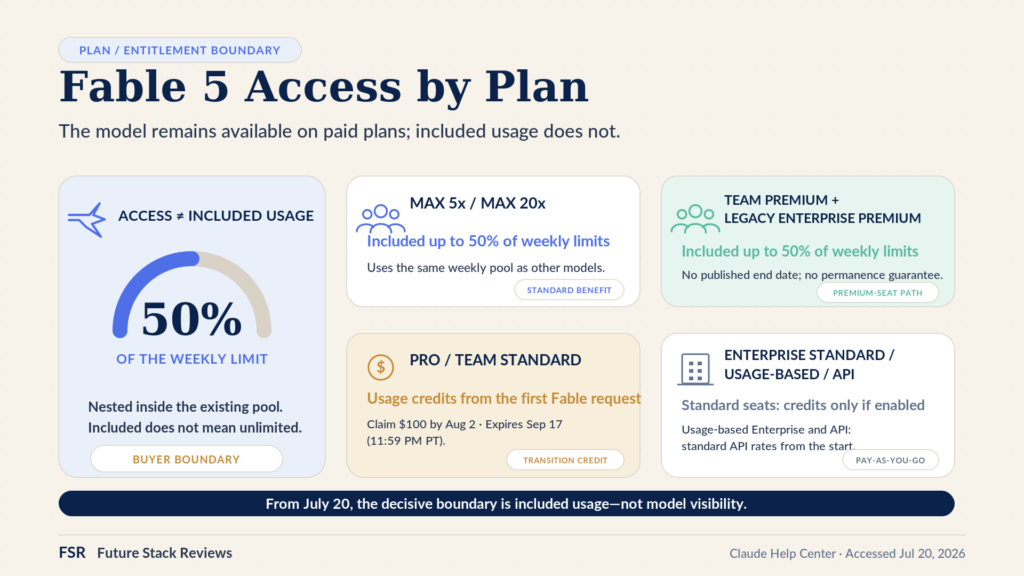
| Plan or seat | Can select Fable 5 | Included usage | Included ceiling | Paid route |
|---|---|---|---|---|
| Max 5x, Max 20x | Yes | Yes | Up to 50% of weekly limits | Usage credits |
| Team premium seats | Yes | Yes | Up to 50% of weekly limits | Usage credits |
| Legacy seat-based Enterprise premium seats | Yes | Yes | Up to 50% of weekly limits | Usage credits |
| Pro | Yes | No | None | Usage credits from the first request |
| Team standard seats | Yes | No | None | Usage credits from the first request |
| Legacy seat-based Enterprise standard seats | Only if the organization has enabled usage credits | No | None | Usage credits from the first request |
| Usage-based Enterprise | Yes | Not applicable | Not applicable | Standard API rates |
| Claude API | Yes | Not applicable | Not applicable | Standard API rates |
Source: Anthropic Help Center, “Claude Fable 5 on your plan,” read July 20, 2026 (JST). Status: OFFICIAL CLAIM.
The Enterprise standard seat row carries the sharpest consequence. Anthropic’s June 30 redeployment post put it plainly: where an organization has not enabled usage credits, standard seat users do not have access to Fable 5. For an administrator that is not a billing preference. It is an access switch.
The ceiling inside the pool
“Up to 50% of your weekly usage limits” reads like added headroom. Anthropic answers the question directly in its own FAQ, and the answer starts with the word “No.” Use of other models draws from the same limits, and total usage can never exceed the weekly limit.
The structure is nested:
The separate Fable progress bar in usage settings is what makes this easy to misread. Two meters do not mean two budgets. One tracks total plan consumption. The other tracks how much of that shared budget Fable 5 is permitted to take.
Anthropic adds that Fable 5 uses those limits faster than other Claude models, and publishes no multiplier for it.
None of this makes the entitlement worthless. Eligible premium plans avoid per-token billing entirely until they reach either the Fable ceiling or the plan’s overall weekly limit, and for a subscriber whose Fable work is intermittent that boundary may never arrive. The value is real. It is bounded, and the boundary is not calculable from public documents.
One structural note for anyone reading the Max plan page instead. That page, updated the same week, describes two weekly limits, one across all models and another for Sonnet models only, plus the five-hour session limit. It does not mention the Fable entitlement.
What Anthropic does not disclose
This belongs near the top rather than buried in a footnote, because it determines whether the allowance can be budgeted at all. After reading the plan article, the Max article, the usage credits article, the platform pricing and deprecation pages, the fallback article and the Claude Code model configuration documentation, the following are not published:
- The token or compute quantity behind any weekly percentage, on any plan.
- The multiplier behind “uses them faster.” No figure appears anywhere.
- Whether the percentage meter counts raw tokens, weighted tokens, compute units, model cost, or another internal measure.
- Meter rounding and update latency.
- How usage accrued during the promotional window was treated at the switch.
- Which meter is debited when a safety fallback occurs partway through a response.
- How the Fable ceiling interacts with the temporary Claude Code weekly limit increase running to August 19.
Some outlets have converted the tokenizer note on Anthropic’s pricing page into a subscription consumption rate. That conversion is not supported. Future Stack Reviews examined those counters directly in a separate hands-on briefing, where the Fable meter and the all-model meter did not reconcile. No published formula links tokenization to the subscription meter, and the newer tokenizer is shared with Opus 4.8 and Sonnet 5 rather than unique to Fable 5.
The practical consequence is narrow and worth stating precisely. A buyer can establish access and list price from public documentation. A buyer cannot calculate the effective included workload.
Which route fits your account
There is also a route that costs nothing to consider. Opus 4.8 lists at half Fable 5’s per-token rate and remains inside every plan’s usage limits. Anthropic’s own Claude Code documentation notes that Fable 5 is not the default model on any account type, and that it suits work larger than a single sitting. Reserving it for that work, rather than leaving it selected, is the cheapest form of limit management available.
Sonnet 5 sits lower again, though cheaper per token does not always mean cheaper per task.
What counts as that work is a separate question, and one we tested when Fable 5 built and then security-reviewed its own code.
Where separate billing begins
There are three distinct routes to metered billing. Collapsing them into one warning is what produces unexpected invoices.
One: continuing on Fable past the included ceiling. Anthropic documents two options at that point. Switch to another Claude model and continue within any remaining plan capacity, or enable usage credits and continue on Fable 5 at standard API rates. Switching models is not unconditional: the account must still have room under its session and weekly limits. Usage credits are billed separately from the subscription and appear as additional charges. They require activation in Settings, a payment method, a prepaid balance, and a spending configuration, with a monthly cap and optional auto-reload, subject to a $2,000 daily redemption limit. Anthropic states that a notification and a confirmation appear when a plan limit is reached, so the crossing is signposted rather than silent.
No Fable-specific allowance can be purchased. Anthropic documents no add-on that raises the 50% share by itself. Moving from Max 5x to Max 20x enlarges the overall weekly pool, which enlarges the same 50% share as a side effect, but it does not change the entitlement.
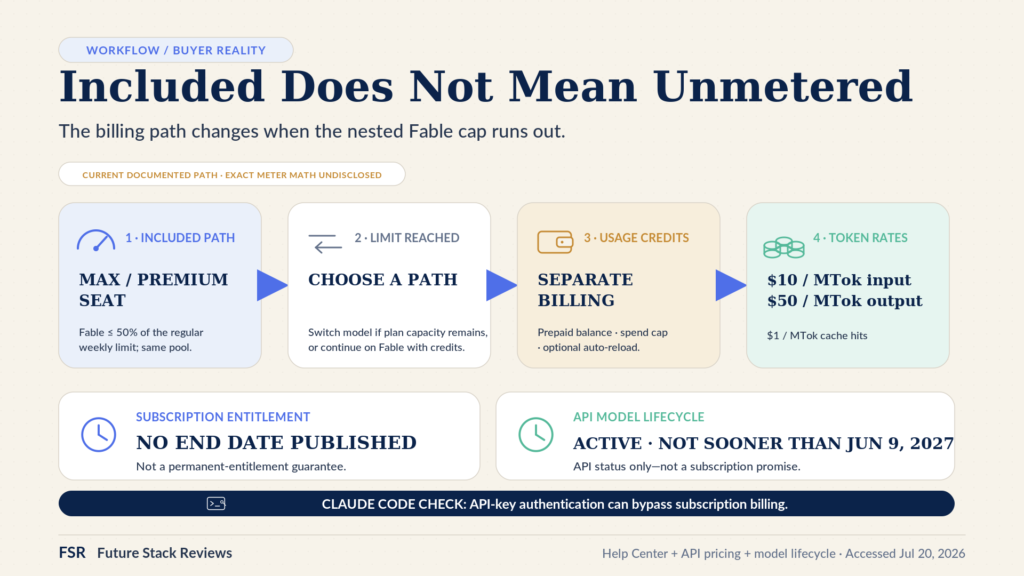
Two: how the client authenticated. Anthropic’s Claude Code documentation states that how you signed in determines how usage is metered. A terminal session running on an API key rather than a subscription login is billed to that API account, regardless of what the subscription would have covered. The usage credits toggle in the Claude app can read off while charges accumulate through a separate Console account. For anyone using the CLI, the question is not only which plan the account holds. It is which identity the session is using.
Three: the API and usage-based Enterprise. Both are metered from the first token, with no included allowance to exhaust.
When Fable is not the model that answered
Fable 5 runs automated safety checks on every request. Anthropic names four areas expected to reroute to a non-Mythos model: offensive cybersecurity work, most biology, chemistry and life sciences queries, attempts to extract the model’s summarized thinking, and a narrow set of frontier model development tasks. The checks read everything the model reads, including memory, connector content, web search results and attached files, so a block can be triggered by material the user did not type.
Three separate things happen when that fires, and they should not be merged:
That distinction matters because Anthropic has acknowledged, in its June 30 redeployment post, that the classifier built after the export control episode flags benign requests more often during routine coding and debugging. More false positives means more midstream reroutes. Whether that shows up as a bill or as faster consumption depends entirely on which route the account is on.
Two operational notes. Automatic switching can be turned off in Settings under Capabilities, which pauses a flagged request instead of rerouting it. And the fallback target is an Opus model rather than a fixed version: the apps documentation names Opus 4.8, while Claude Code documentation notes Opus 4.7 on the Claude apps gateway. Inspect the response label rather than assuming.
The credit and its two deadlines
For Pro subscribers and Team standard seats, this is the whole of Anthropic’s transition offer.
Three rows change behaviour. Expiry is fixed at September 17 rather than sixty days from the claim, so waiting until August 2 shortens the runway instead of extending it. Team credits are granted per purchased seat rather than per assigned seat, which decouples the amount from active headcount. And claiming enables usage credits and may require a card on file, so accepting the credit changes the account’s billing posture before a single token is spent.
The Claude Code enforcement gap
At 07:35 UTC on July 20, roughly 35 minutes after the cutover boundary, Anthropic opened an incident stating that some Claude Code users on Max plans were incorrectly prompted to use usage credits to access Fable 5, which is included in their plan, and advising affected users to restart Claude Code. At 19:35 JST the incident remained in Monitoring, scoped to Claude Code, with claude.ai listed as operational.
This does not invalidate the Max entitlement. It exposes a narrower risk: a documented benefit can fail at the enforcement layer while the contract behind it is correct.
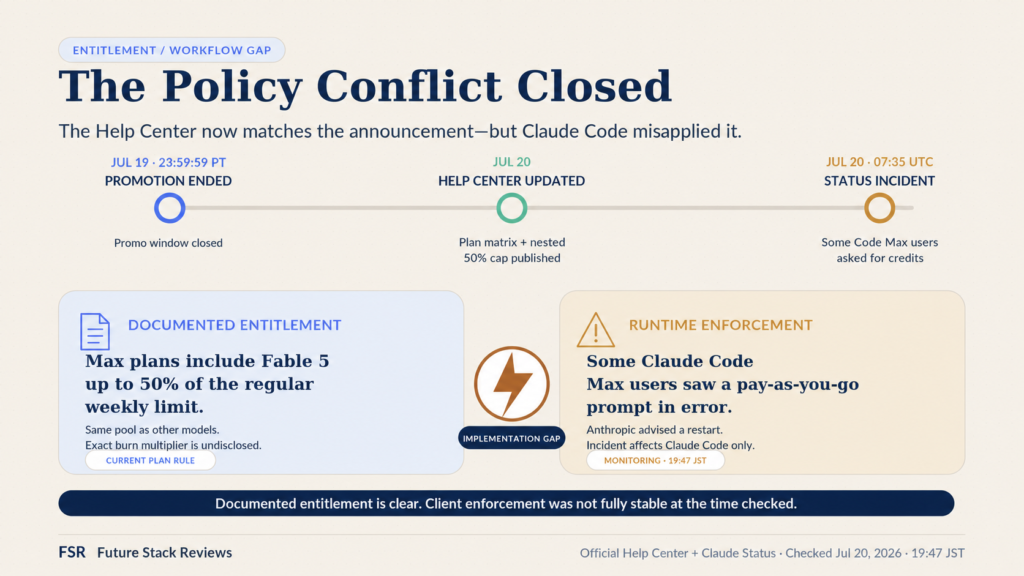
A similar entitlement symptom appeared three days earlier. On July 17 Anthropic logged an incident in which users could not select Fable 5 across Claude.ai, Claude Code and other surfaces, reported applying a fix for what it described as an erroneous requirement for usage credits on Fable 5, and closed it noting the model was available again without usage credits, as expected. Anthropic has not published a root cause for either incident, so these are matching symptoms rather than a confirmed identical defect.
For anyone seeing a credits prompt this week, three checks come before payment:
- Confirm the account is on a plan that includes Fable 5.
- Confirm Claude Code is authenticated through the subscription rather than an API key.
- Check whether the official incident is still open.
Retention, ZDR and BAA
Fable 5 is designated a Covered Model. Prompts and outputs on covered models are retained for thirty days to support Anthropic’s safety work, on every platform where the models are offered, under a policy effective June 9, 2026.
Consumer plans sit outside that change. Anthropic states that Free, Pro and Max across web, desktop and mobile, including Claude Code, are unaffected, because inputs and outputs are already retained on those surfaces. Describing this as consumer Max losing zero data retention misreads the scope.
For commercial configurations the constraint is structural rather than negotiable:
This is a procurement constraint, not a compliance verdict. The capability and the data configuration are sold as a pair, and an organization that has standardised on zero data retention has already excluded Fable 5 without evaluating it. Regulated buyers should route this to legal and security review before any model comparison.
FAQ
Methodology and source scope
This is a Tier C briefing. Tier C means document-first research published before hands-on testing. Future Stack Reviews carried out no testing of Claude Fable 5 for this article. No account was measured, no usage was reproduced, no billing was observed, and no screenshot is presented as evidence of behaviour.
Sources were opened and read on July 20, 2026 (JST). Live service status was locked at 19:35 JST. The sources were:
- Anthropic Help Center: “Claude Fable 5 on your plan”; “Claude Fable 5 one-time free credits promotion”; “What is the Max plan?”; “Manage usage credits for paid Claude plans”; “Why Claude switched models in your conversation with Fable 5”; “Data retention practices for Covered Models”; “Covered Models under a Business Associate Agreement (BAA)”; “Models, usage, and limits in Claude Code”; “Use the Claude Agent SDK with your Claude plan”; the Claude Code and Cowork limit promotion articles
- Anthropic Platform documentation: pricing; model deprecations
- Claude Code documentation: model configuration
- Anthropic news: “Redeploying Claude Fable 5”
- Claude status page, current incidents and the July 17 record
Anthropic’s plan documentation is treated throughout as an official vendor claim rather than independently verified behaviour. It establishes what Anthropic says the terms are. It does not establish how any account was billed.
Where a figure is not published, this briefing says so rather than estimating it. No token counts, consumption multipliers or usage projections appear anywhere above, because Anthropic has published none.
One correction is worth recording for readers who saw earlier coverage elsewhere. Anthropic announced in May that from June 15, 2026 Agent SDK and claude -p usage would move outside subscription usage limits and onto a monthly credit. That change was paused on June 15. Agent SDK, claude -p and third-party app usage still draw from subscription usage limits, and the announced monthly credit is not available. The original text remains on the same help page as preserved reference material and is no longer in effect.
Anthropic’s official posts on X were identified but not opened for this briefing and are not cited. All prices, limits, promotional dates and incident states are volatile and were accurate as read.
Verdict
July 20 removed the countdown for Max and premium seats. That is worth something concrete: no claim to file, no metered billing until a limit is reached, and no date on the calendar to plan around. For a subscriber whose Fable 5 work is intermittent, the arrangement is simply better than the one it replaced.
It did not make Fable 5 unmetered. The allowance is a ceiling inside a shared weekly pool, the burn rate against that pool is undisclosed, and continuing past the ceiling moves the same model onto standard API rates at twice the per-token cost of Opus 4.8. The only honest position on duration is that no end date is published and no guarantee exists. The same allowance has already carried a different published end date once.
For Pro, the calculation is now explicit rather than subsidised. The credit is a claim with a fixed expiry, and after September 17 the question becomes whether Fable 5 output is worth $10 and $50 per million tokens when Opus 4.8 sits at half that and stays inside the plan.
The part worth watching is not the pricing. The policy ambiguity of last week has closed. What replaced it is an enforcement gap: a documented entitlement that the client failed to honour, twice in four days, with no root cause published for either occurrence. That gap costs operational time even when the contract is correct.
Tier B means we tested the product hands-on. Tier C means the briefing is document-first, with no hands-on testing.
- Claude Fable 5 Is Back, But Its Usage Meters Do Not Agree A hands-on reading of the two meters described above, where the Fable counter and the all-model counter did not reconcile.
- Fable 5 Built a Landing Page, Then Security-Reviewed Its Own Code. Zero Fixes. Here’s What “Clean” Actually Meant. What the work large enough to justify the Fable ceiling looks like in practice, and what its own security review returned.
- Claude Opus 5 vs Opus 4.8: Six Runs, No Detected Difference, and a Migration That Still Needs Work Opus 5 shipped four days after this briefing at the same $5 and $25 rates as Opus 4.8, which changes the half-price route described above.
- Claude Opus 4.8 Review: A Safer Model, a Worse Operator The model this briefing points to as the half-price route, and where its operating behaviour diverges from its safety record.