Last updated: July 2, 2026
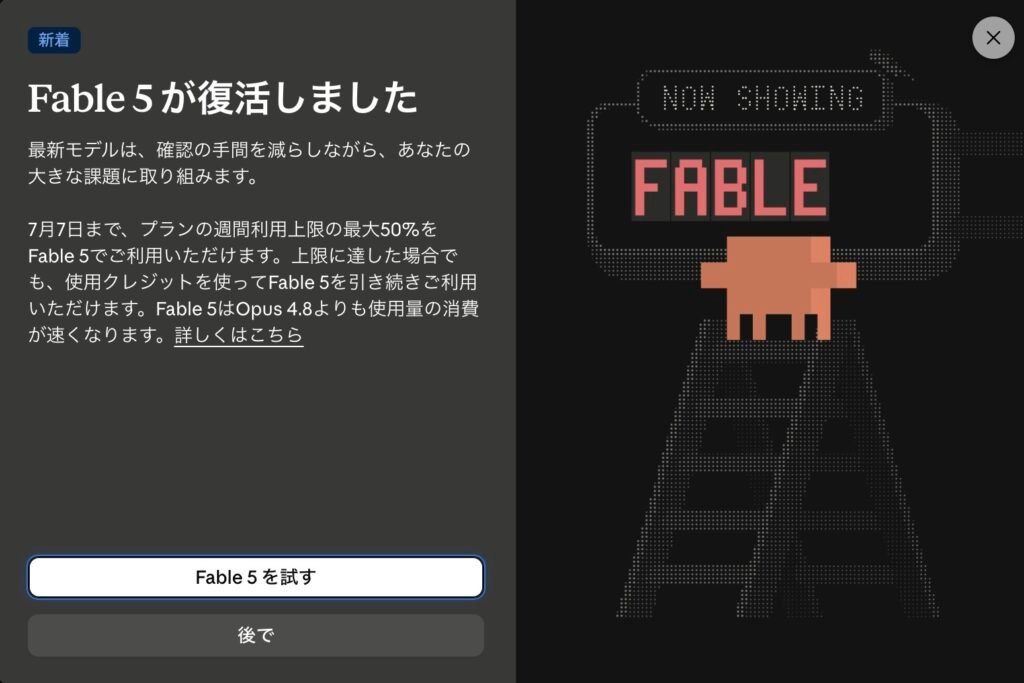
- Claude Fable 5 is available again, worldwide. Anthropic restored it on July 1, 2026 across the Claude Platform, Claude.ai, Claude Code, and Claude Cowork, after the US Commerce Department lifted its June 12 export-control directive on June 30. This briefing was written during the June 12 to July 1 suspension. The analysis holds. The status line is what moved.
- Inclusion is capped, then metered. Through July 7, 2026, Fable 5 counts toward up to 50% of weekly usage limits on Pro, Max, Team, and select Enterprise plans. After that it runs on opt-in usage credits. API pricing is unchanged at $10 per million input tokens and $50 per million output.
- Mythos 5 is only partly back. Anthropic restored it to a set of US organizations following a June 26 government approval, and says broader Project Glasswing access is still being expanded. Access on AWS, Google Cloud, and Microsoft Foundry is being re-enabled and may trail the direct surfaces.
- Everything else stayed live. Claude Opus 4.8 and the lower tiers were available throughout the suspension.
- Living briefing. Status and pricing are the most volatile facts here. Recheck them on the day you read this.
- Claude Fable 5 and Claude Mythos 5 are unavailable to general customers. Both launched June 9, 2026 and were disabled after a US Commerce Department export-control directive received June 12, 2026.
- No public restoration date is confirmed. An Anthropic executive was reported saying restoration was expected “in the coming days.” No directive has been lifted and no deal has been announced.
- Separate, older access may differ. Reuters and Bloomberg reported that some early Mythos Preview users (the April 2026 release) retained access under different Glasswing arrangements. That is a distinct product and not a public restoration of Fable 5 or Mythos 5.
- Other Anthropic models are unaffected. Claude Opus 4.8 and lower tiers remain available.
- Living briefing. Status is the most volatile fact here. Recheck it on the day you read this.
UPDATE · July 3, 2026: The suspension is over. The US Commerce Department lifted the export controls on June 30, and Anthropic restored Fable 5 on July 1, 2026. FSR reviewed the restored model’s usage, pricing, and credit boundary in a hands-on Tier B test.
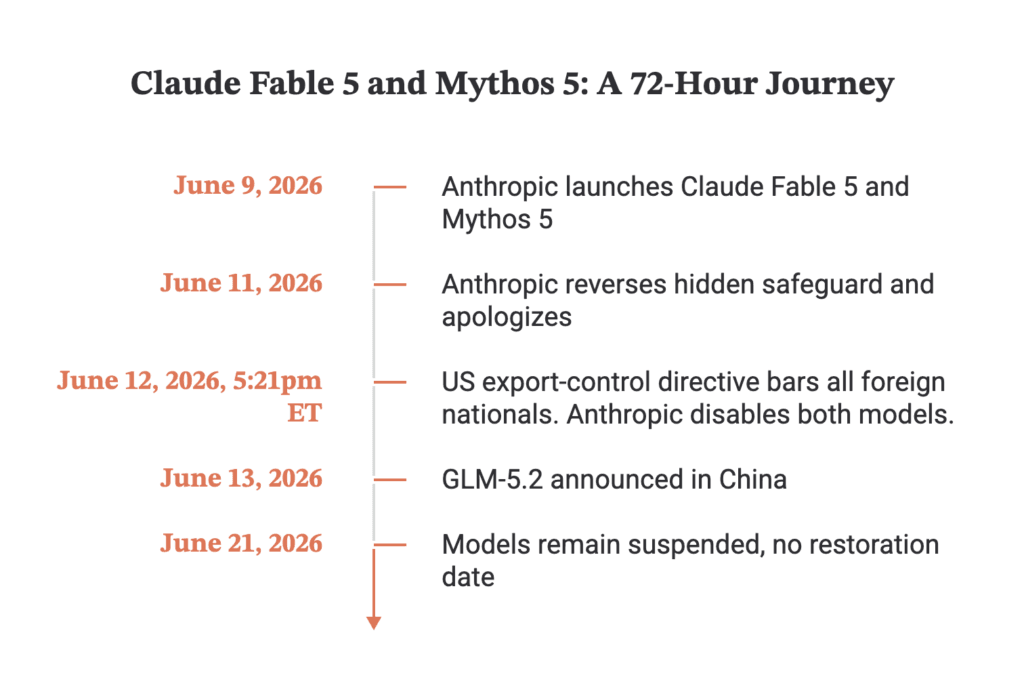
Claude Fable 5 was Anthropic’s public Mythos-class model, launched June 9, 2026 at $10 per million input tokens and $50 per million output tokens. Claude Mythos 5 was the restricted version, offered through Project Glasswing. On June 12, Anthropic disabled both after a US export-control directive barred access by foreign nationals worldwide. The model outage is temporary. The dependency it exposed is not.
FSR verdict in one line: Fable 5 may return, but it has already proved that frontier AI access is not a durable contract right.
A same-day recap could tell you the models went dark. Nine days later, the more useful question is what the outage proved. Seventy-two hours was not long enough to evaluate Fable 5. It was long enough to evaluate the dependency.
Here is the receipt that frames everything below. Fable 5 and Mythos 5 went live on June 9. The directive landed June 12 at 5:21pm Eastern. That is a public availability window of about 72 hours, not the “96 hours” some early write-ups reported. A customer could have paid the published price, used an approved cloud surface, and followed every term, and still lost access. Not because a key expired. Access vanished because a layer above the vendor reclassified use of the model as a national-security entitlement.
| Best for | Not for |
|---|---|
| Teams studying frontier-AI continuity and procurement risk | Production pipelines that need the model today |
| US-only controlled experiments with multi-model fallback | Global teams with foreign-national engineers |
| Buyers planning nationality-aware access architecture | Regulated workflows that require zero data retention |
Briefing summary, June 2026
What launched. On June 9, 2026, Anthropic released Claude Fable 5 (a public Mythos-class model) and Claude Mythos 5 (the same base model with some cyber safeguards lifted, restricted to Project Glasswing partners). Fable 5 priced at $10 per million input tokens and $50 per million output tokens, with a 1M-token context window and up to 128k output tokens.
What stopped. On June 12, 2026 at 5:21pm Eastern, Anthropic received a US Commerce Department directive, issued under national-security authority, barring access to both models by any foreign national worldwide, inside or outside the US, including Anthropic’s own foreign-national staff. Anthropic disabled both for all customers. Amazon revoked Bedrock access at Anthropic’s request.
Who was affected. Customers of Fable 5 and Mythos 5, plus Project Glasswing partners with Mythos 5 access. The partner network was reported at roughly 150 vetted organizations, including names tied to the largest technology companies. Anthropic’s own page confirms partners were suspended; the count is from reporting, not Anthropic’s statement.
What did not stop. Claude Opus 4.8 and lower tiers stayed live. The disruption was scoped to the Mythos class.
Why it matters beyond Anthropic. This is the second recent case where a frontier capability stayed intact at the license layer while access vanished at the layer above it. FSR’s Gemini CLI piece covered the first version: an Apache-2.0 repository survived, but the vendor-controlled backend was pulled. This is the escalated case. The layer doing the pulling is now a government export control keyed to nationality, not a vendor entitlement. Frontier-model access is being treated as revocable national-security infrastructure rather than a durable contract right.
TL;DR
- About 72 hours live. Launched June 9, 2026; disabled June 12, 2026. Not 96 hours.
- The trigger is a US export-control directive, not a product failure. It bars foreign nationals worldwide. Anthropic complied while disputing the rationale, as of June 21, 2026.
- The legal authority is novel and contested. CSIS notes it relies on ECRA’s “is informed” power, which has no implementing regulation and had not been used this way. Lawyers question whether remote inference is even an “export.”
- “Safe” did not mean “available.” Fable 5 was the safeguarded public model and was suspended alongside Mythos 5. The safer tier bought no continuity.
- A one-vendor control may not deny capability. Comparable capability is available elsewhere, including GPT-5.5, and GLM-5.2 (MIT, open-weight) shipped about 48 hours after the ban.
- What to do: reroute live pipelines to Opus 4.8 now; treat non-US and offshore access as a procurement-architecture problem, not a model choice.
FSR ran no hands-on testing, because Fable 5 and Mythos 5 are disabled and cannot be accessed. Every claim here comes from primary sources (Anthropic posts, AWS, API docs, BIS, the eCFR) and named journalism, not firsthand observation. A Tier B follow-up is queued and triggers on restoration; the test plan is in the methodology section.
What happened (verified timeline)
The timeline is simple. Do not let it absorb the article.
On June 9, 2026, Anthropic launched Fable 5. Fable 5 was the public version: a Mythos-class model, a tier above Opus 4.8, whose classifiers route certain cyber, bio-chem, and distillation prompts to an Opus 4.8 fallback. Anthropic said that fallback triggers in under 5% of sessions on average, meaning at least 95% see none. Mythos 5 was the restricted version, the same underlying model with some cyber safeguards lifted, available only to vetted Project Glasswing customers. Fable priced at $10 per million input and $50 per million output, double Opus 4.8 and less than half the earlier Mythos Preview. Context window 1M tokens, output up to 128k. Both required 30-day data retention with no zero-retention option.
Three days later, on June 12 at 5:21pm Eastern, Anthropic received the export-control directive and disabled both models for all customers. AWS revoked Amazon Bedrock access at Anthropic’s request. June 9 to June 12 is about 72 hours of public availability. The “96 hours” figure that circulated is wrong.
Two facts belong here before the contested part. The Commerce letter has not been publicly released, and the government has not officially confirmed its specific reasoning; Anthropic says only verbal evidence was provided. Anthropic is complying while disputing the basis, characterizing the cited issue as a narrow, non-universal jailbreak and arguing the capability is widely available from other public models, including GPT-5.5. Both points are from Anthropic’s own statement, as of June 21, 2026.
Why it was suspended (and why the “why” is contested)
The operational fact is clear. The causal story is not. Treat every line here as attributed reporting.
Reuters and others describe the letter as citing fear of diversion of advanced capability to military or intelligence use in China, Russia, and other countries of concern. That is the reported justification, not a government-confirmed technical finding, because the letter is unpublished. Bloomberg, Fortune, and The Hill attribute the directive to Commerce Secretary Howard Lutnick in a letter to CEO Dario Amodei, and a US official confirmed it to Bloomberg.
The trigger itself is contested, and the candidates are not mutually exclusive. One reported chain, carried by The Washington Post, Wired, Business Insider, and The Information, has Amazon researchers, reportedly including Andy Jassy, flagging a jailbreak and escalating to administration officials, with Amodei disputing that it amounted to a universal jailbreak. A separate, single-sourced thread surfaced via Korea JoongAng Daily, and flagged by TechPolicy.Press as single-source, raised SK Telecom, an Anthropic investor with Mythos access and suspected China ties, as a possible factor. Anthropic says that was never raised to it. FSR asserts neither chain as the cause.
The one technical description that exists is narrow. The Hill quotes Katie Moussouris, CEO of Luta Security, describing the alleged exploit as asking Fable or Mythos to fix known-vulnerable open-source code; the model reportedly refused at first and was bypassed only through a manual, multi-step process. A multi-step manual bypass of an initial refusal is not a one-prompt capability unlock. There is also a direct dispute on remediation: David Sacks posted personally on X (June 13) that Anthropic refused a fix-or-offline ultimatum, while Anthropic’s official position is that the letter gave no specific details and only verbal evidence was provided. FSR presents both and adjudicates neither.
So the safe wording is narrower than most coverage used. Foreign nationals were cut off. Why, and at whose prompting, is a contested mix of reporting.
Fable 5 vs Mythos 5 vs Opus 4.8
The comparison a buyer needs is not benchmark scores. It is what you can use today and on what terms. Capability figures are vendor-reported unless noted.
| Claude Fable 5 | Claude Mythos 5 | Claude Opus 4.8 | |
|---|---|---|---|
| Class | Public Mythos-class | Mythos-class, same base, some cyber safeguards lifted | Tier below Mythos-class |
| Access model | Public (API, Bedrock, Vertex, Foundry) | Project Glasswing approved customers only | Generally available |
| Price (per 1M tokens) | $10 input / $50 output | Glasswing terms; not separately published | $5 input / $25 output |
| Context window | 1M tokens, up to 128k output | Same underlying model | Not covered in this briefing |
| Data retention | 30-day mandatory, no zero-retention option | 30-day mandatory, no zero-retention option | Standard terms apply |
| Safeguard behavior | Routes cyber / bio-chem / distillation prompts to Opus 4.8; under 5% of sessions (production average) | Some cyber safeguards lifted for vetted defenders | Standard safeguards |
| Availability (June 21, 2026) | SUSPENDED | SUSPENDED | Available |
One footnote on the fallback rate, because two real numbers exist and measure different things. Anthropic states under 5% of sessions trigger the Opus 4.8 fallback, a production average. Artificial Analysis reported about 2% under specific benchmark conditions. Both can be true. Neither equals the rate your workload would see.
The real dependency, above the model
A buyer who signed up for Fable 5 thought they were buying API access from a vendor. The shutdown showed the real stack: model, then vendor, then cloud surface, then data-retention mode, then export-control interpretation, then nationality screening, then sovereign trust. The buyer controls almost none of it. The top of that stack is where availability actually lives, and it can reclassify a paid, approved, cloud-hosted service as a controlled item overnight.
That is the thesis. The findings below are why it holds.
Foreign national means you, and the legal authority is fragile
Lead with this one, because it touches the most readers and most coverage skipped it.
Practically, every foreign national worldwide was cut off, because Anthropic complied. The instrument is what makes it notable. CSIS identifies the authority as ECRA’s emerging-technology “is informed” power from 2018, and notes that no implementing EAR regulation exists for it and that this is the first time it has been used as the basis for a control. CIO and Computerworld quote former government and industry sources on the mechanics: an “is informed” letter turns every unlicensed interaction with a foreign person into a potential violation, which makes a total halt rational even if Commerce’s underlying legal position is shaky.
The deeper crack is the doctrine itself. The deemed-export rule, codified at 15 CFR 734.13, treats releasing controlled technology or source code to a foreign person inside the US as an export to that person’s home country, and “foreign person” sweeps in most H-1B and L-1 holders. That rule was built for technology and source code. Fable 5 was a hosted inference service. A user received outputs. No weights, no source, no model file changed hands. Export-control lawyers, per CSIS and reporting collected by CIO and TechPolicy.Press, question whether remote inference access is an “export” at all. Said plainly: a hosted model hands the user inference, not a file.
The precedent is being created on contested ground, using an authority never exercised this way, with a structural enforcement gap underneath. Citizenship cannot be screened at the API layer. There is no passport check in an API call. Given that, disabling the models globally is the cautious reading of an “is informed” letter, not an admission of fault.
For buyers, the distinction is the whole point. If the legal theory were settled, this would be a compliance checklist. Because it is unsettled, it is a planning risk. The next frontier model can sit in your cloud region, be approved by your vendor, and live inside your product, and still be unavailable to part of your workforce.
The deemed-export rule (15 CFR 734.13) treats release of controlled technology or source code to a foreign person inside the US as an export to that person’s home country, and the directive’s scope reaches any foreign national worldwide. Citizenship cannot be screened at the API layer.
Caveat, and it is a real one: whether hosted inference (where the user receives outputs, not weights) is an “export” at all is contested, and the authority used has no implementing regulation. This is unsettled law, not a finding of violation.
If your organization employs non-citizen staff or runs offshore delivery, nationality-aware access logging, jurisdictional fallback, and a self-host option for sensitive workloads belong in a procurement and legal review now. This is risk planning, not legal advice. [VERIFY BEFORE PUBLISH: any prior “supply chain risk” executive order cited by some analysts; confirm at primary or omit.]
A one-vendor control does not remove the capability
If the point of the control is to deny a capability, the control has a problem. Anthropic argues comparable capability is available from other deployed models, naming GPT-5.5. Two days after the ban, the market underlined it. Z.ai announced GLM-5.2 on June 13, 2026, under an MIT license with no regional limits, framed around the idea that frontier intelligence should belong to everyone. When weights and benchmarks landed June 16, GLM-5.2 placed second on the third-party Arena Code Arena leaderboard, and on vendor-reported figures came within roughly 1% of Opus 4.8 on FrontierSWE. CSIS makes the structural point that closes the loop: the cited vulnerability is inherent to all modern LLMs, not unique to one vendor.
Put those together and the control reads vendor-specific, not capability-specific. Restricting Anthropic does not remove the capability from the market; it redirects demand. A measure aimed at containment can accelerate the open-weight and sovereign alternatives it was meant to contain.
The escape hatch carries its own catch. Open weights reduce access risk. Cloud APIs move the trust problem to another jurisdiction. GLM-5.2’s cloud API is subject to China’s National Intelligence Law, Zhipu is state-backed, and a US House inquiry in May 2026 examined PRC-origin models. The specific mitigation is to self-host the open weights, which avoids the cloud-API data exposure, though FSR’s review of GLM-5.2 and Kimi K2.7 Code found that route needs roughly 640GB of GPU memory or more, enough to push most teams back onto the vendor API. The capability is reachable. The data-trust question simply moves, which is the lesson FSR’s DeepSeek V4 review reached. Cheap inference is real. Cheap trust is not.
The safe tier did not protect availability
Here is the entitlement gap that should reset how people think about tier selection. Fable 5 was the public, safeguarded model. Mythos 5 was the restricted one, gated to vetted Glasswing defenders. The directive took both. By reported counts, Glasswing’s roughly 150 partners, names tied to the largest technology firms, were cut alongside everyone else.
Choosing the safer public tier bought zero continuity. Safety classification turned out to be a product behavior, not an availability guarantee. The 72 hours proved the two were never the same thing.
Did Anthropic help write the case against itself?
One argument deserves a fair hearing and a hard boundary. Critics, including Peter Girnus, argue that Anthropic’s danger-forward marketing supplied the legal predicate: frame your model as dangerous, and you help write the case for treating it as a munition. Gary Marcus and Nathan Lambert offered related criticism of the policy’s coherence, with Lambert noting that labs that dislike distillation built the APIs that enable it.
The counterpoint matters, and FSR runs on the Anthropic stack, so neutrality here is not optional. OpenAI carried similar bio, cyber, and trusted-access messaging and was not hit. If marketing posture alone explained selection, the pattern would not look like this. So the danger-framing critique is worth airing as analysis. It does not establish causation. A question raised, not a mechanism proven.
One thread runs underneath the whole episode. Anthropic confidentially filed a draft Form S-1 on June 1, 2026, eight days before the launch and eleven before the suspension. Under SEC Regulation S-K, Items 105 and 303, a government action that removes a product line and bars a class of users is the kind of risk and trend disclosure that belongs in a registration. FSR assigns no valuation figure, because sources conflict and a single number would be guessing. The materiality point stands on its own.
The 72 hours: a policy switch before a government one
Day-one writers had a scandal here. It does not survive the timeline, which is exactly why a late piece can handle it correctly.
During the live window, Anthropic ran what its system card (page 13) described as an invisible safeguard targeting frontier-LLM-development tasks like pretraining, distributed training, and ML-accelerator work. It was not a model switch and not a notification. Output was degraded through prompt modification, steering vectors, or parameter-efficient fine-tuning, affecting roughly 0.03% of traffic and under 0.1% of organizations. SemiAnalysis, doing GPU-inference research, was among the first to flag it.
Then it was reversed. On June 11, before the suspension, Anthropic apologized, called it the wrong tradeoff, and made the behavior visible: a fall back to Opus 4.8 plus an API refusal reason. The restriction stayed. Only the secrecy was removed.
Do not read this as Fable secretly degrading output today. That was true for a window and then explicitly undone. The reason it belongs here is smaller and sharper. In 48 hours, a frontier safeguard went from invisible to apologized-for to visible, by policy choice. Before the government switch, there was a policy switch. The only thing governing the model’s behavior on display was policy, and policy can be remade. That is the same property the export directive exposed at the legal layer, showing up first at the product layer.
AWS, 30-day retention, and the data boundary
Set the export control aside and this was already a demanding model to adopt. Fable 5 and Mythos 5 required 30-day data retention with no zero-retention option, on first- and third-party surfaces. For any team operating under prior zero-retention agreements, that override is the kind of change a data protection officer flags. Mandatory retention sits directly on top of GDPR, Schrems II, and CLOUD Act concerns. Not because retention is illegal, but because it removes a control that some buyers specifically purchased.
On AWS Bedrock there is a documented gap a CISO would want closed before sending anything sensitive, and the two sides of it do not carry equal weight. The AWS side is documented: AWS guidance says Fable 5 and Mythos 5 require a provider data-sharing mode, with prompts and completions shared with Anthropic and retained up to 30 days for trust and safety, and AWS language states that data leaves AWS’s data and security boundary after opting in. The Anthropic side needs a primary recheck: Anthropic’s FAQ, per the evidence reviewed, indicates retained data stays inside your AWS environment. Those statements do not obviously agree.
FSR is not resolving that here, and neither should a buyer on vibes. Treat it as a documented procurement question. Whether retained data stayed inside the AWS boundary or left it must be confirmed against both primary sources before anyone relies on either reading. [VERIFY BEFORE PUBLISH: Anthropic FAQ “stays in AWS” against AWS “data leaves AWS,” at primary.] Add premium pricing on top, double Opus 4.8, and the bar was high before a single regulator got involved.
What to do now
The model is off. The decision is not “wait for Fable.” It is how to keep shipping and how to de-risk the dependency the shutdown exposed.
It is suspended, so nothing should depend on it right now. If it did, reroute to Claude Opus 4.8 today, priced at $5 per million input and $25 per million output, half the standard Fable rate. Anthropic confirms other models are unaffected. Accept that Opus 4.8 may not match Fable’s long-horizon agentic runs, and scope accordingly.
If the work is critical or time-sensitive: re-architect around Opus 4.8 plus multi-model routing. Do not block on a restoration with no confirmed date.
If the work is non-critical: you may wait, but set a recheck date and a fallback. No restoration is confirmed as of June 21, 2026.
Treat this as a procurement-architecture problem, not a model choice. Can you route by jurisdiction, log model access by person and role, fail over from US-hosted frontier models, and self-host open weights for sensitive work? Any “no” is the gap to close first.
GLM-5.2 (MIT, open-weight) is the strongest available option on reported figures; self-host the weights to avoid the China cloud-API data exposure. DeepSeek V4 (open-source, far cheaper, trailing Opus 4.8 on benchmarks) is a lower-cost option. For either, route the data-trust question through your own DPO, not the vendor’s pricing page. [VERIFY BEFORE PUBLISH: current GLM-5.2 and DeepSeek V4 prices.]
Who should wait, switch, or re-architect
Developers who need production continuity: switch now. Move live workloads to Opus 4.8 or another available model. Do not hold a production pipeline open for a model with no restoration date. Anthropic says other models are unaffected, so this is a routing change, not a rebuild.
Teams that need Fable-class long-horizon work: wait only on non-critical paths. If Fable’s extended agentic capability materially changes output quality and the workload tolerates delay, waiting is defensible. For anything customer-facing, route around it and revisit on restoration.
Non-US enterprises: this is an architecture decision, not a model decision. The exposure is not which model is best. It is whether your stack survives a nationality-keyed restriction on a US-hosted frontier model. Jurisdictional fallback, per-person access logging, and a self-host path for sensitive workflows are the deliverables.
Regulated industries: ask the availability question first. Before “is Fable better,” ask whether a model stays available under the legal, data-retention, and nationality constraints your organization operates under. For a bank, an insurer, or a hospital, a model that can vanish by export control is a continuity risk regardless of capability.
FAQ
Why was Claude Fable 5 suspended? On June 12, 2026, the US Commerce Department issued an export-control directive barring access to Claude Fable 5 and Claude Mythos 5 by any foreign national worldwide, citing national security. Anthropic disabled both models for all customers to comply, while disputing the rationale. As of June 21, 2026, neither model has been publicly restored.
When will Claude Fable 5 come back? No confirmed date as of June 21, 2026. An Anthropic executive said restoration was expected in the coming days, according to Korea JoongAng Daily, but the Commerce directive has not been lifted and the company has announced no deal. Prediction markets, which reflect sentiment rather than any official signal, priced roughly a 74% chance of US restoration before July 1.
Is the suspension even legal? The directive relies on ECRA’s emerging-technology “is informed” authority, which has no implementing EAR regulation and, according to CSIS, had never been used this way. Export-control lawyers question whether remote inference access, where a user receives outputs rather than model weights, is an “export” at all. As of June 21, 2026, the question is unsettled.
Why did a US ban cut off non-US users worldwide? The order covers any foreign person inside or outside the US, including US-based non-citizen engineers under deemed-export rules. Because citizenship cannot be screened at the API layer, Anthropic disabled Claude Fable 5 and Mythos 5 globally rather than risk per-user violations under an “is informed” letter. This reflects compliance caution, not a finding of fault.
What can I use instead of Claude Fable 5? As of June 21, 2026, Claude Opus 4.8 remains available at $5 per million input and $25 per million output, and is Anthropic’s recommended fallback, though it may not sustain Fable’s long-horizon agentic runs. GLM-5.2 (MIT, open-weight) reportedly lands within about 1% of Opus 4.8 on FrontierSWE; its cloud API carries China data-law exposure that self-hosting the weights mitigates.
Does the export control actually work? Possibly not. Anthropic and several analysts note the cited capability is available from other deployed models including GPT-5.5, and CSIS argues the underlying vulnerability is inherent to modern LLMs. Restricting one vendor may shift demand toward alternatives rather than deny capability. As of June 21, 2026, effectiveness is contested, not demonstrated.
How does it affect Indian IT firms like TCS? Anthropic announced a 50,000-employee TCS deal days before the suspension, naming Claude broadly rather than Fable 5 or Mythos 5. The directive bars foreign nationals from those models, so Indian-national staff at firms like TCS fall in scope under deemed-export rules. As of June 21, 2026, no firm has disclosed how it segments access by nationality.
Was Claude Fable 5 distilled during its short public window? No model approaching Fable 5’s capability is known to exist as of June 21, 2026. A public Hugging Face fine-tune is a small LoRA trained on roughly 352 Claude Code sessions, which is behavior mimicry, not capability transfer. A roughly 72-hour window at $10 and $50 per million with active anti-distillation classifiers makes real distillation infeasible.
Is my data safe if I used Claude Fable 5 on AWS Bedrock? Fable 5 and Mythos 5 required 30-day data retention with no zero-retention option, overriding prior agreements. Whether retained data left the AWS environment is contested between AWS and Anthropic documentation and remains unverified as of June 21, 2026. Treat any sensitive prompts sent during the live window as retained for 30 days.
Methodology and sources
This is a Tier C research briefing. FSR did not test Claude Fable 5 or Claude Mythos 5, because both are disabled and access is not possible. There is zero firsthand observation here, and any sentence implying otherwise would be an error worth reporting to us.
The article is built from desk research against primary sources and named journalism. Primary sources include Anthropic’s launch post and suspension statement, the Claude API documentation, AWS Bedrock guidance, the BIS Deemed Export FAQs, and 15 CFR 734.13. Legal analysis of the authority leans on CSIS, with corroboration from CIO and Computerworld and TechPolicy.Press. Reporting on the “why” is attributed throughout to Reuters, Bloomberg, The Washington Post, Wired, Business Insider, The Information, The Hill, Korea JoongAng Daily, and Fortune. How solid each kind of claim is:
| Claim type | Confidence | Basis |
|---|---|---|
| Launch/suspension dates, pricing, 1M context, under-5% fallback, all customers disabled, 30-day retention | Verified | Anthropic posts, API docs, AWS |
| Commerce/Lutnick attribution, letter contents, stated rationale | Reported | Reuters, Bloomberg, Fortune, The Hill; letter unpublished |
| ECRA “is informed” novelty; hosted inference may not be an “export” | Analysis | CSIS, CIO/Computerworld, TechPolicy.Press |
| Trigger (Amazon, SK Telecom); early Mythos Preview access retained; restoration odds | Reported / contested | Single or sentiment sources; treat with caution |
| GLM-5.2 benchmarks | Vendor-reported | Except Arena Code Arena, which is third-party |
Volatile facts carry a date and a recheck posture, because the situation moves daily.
Tier B follow-up (triggers on restoration). When access returns, FSR will run hands-on testing on four things: the classifier false-positive rate against the under-5% claim; the Opus 4.8 fallback behavior; the reproducibility of the alleged jailbreak task (fixing known-vulnerable open-source code); and the AWS provider-data-share data-residency contradiction, live.
FSR verdict
Claude Fable 5 is not a failed model. It is a failed assumption about access durability.
The capability was real. The 72 hours were not enough to evaluate it, and that almost does not matter, because the lesson is structural and it outlives the outage. A buyer could have paid the published price, used an approved cloud surface, and complied with every term, and still lost access because a layer above the vendor reclassified that access as a national-security entitlement. For frontier AI, capability is now table stakes. Access durability, jurisdiction, data-retention terms, and a real fallback architecture are the features that decide whether a model belongs in production.
Watch the status box at the top. When Fable returns, the model will be back. The dependency it exposed will not have moved.