Last updated: July 26, 2026
Future Stack Reviews has not tested, purchased, operated, or measured any X Square Robot product or model. This briefing reads public documents only. Where a claim comes from the company, it is labelled as such. Where Future Stack Reviews could not open a source, that is stated rather than filled in.
X Square Robot (自变量机器人) is a Chinese embodied-AI company that builds the foundation models controlling robots, alongside the robots themselves. Its models carry the “WALL” name. That single name now covers an open-weight research release, a published research model, an announced commercial flagship, and whatever software actually ran in the homes the company describes.
The short version: treat WALL as four separate artifacts with four different evidence levels, not as one product story.
- April 2026: the company announced WALL-B, described on its own timeline as the first embodied foundation model built on a World Unified Model architecture.
- May 2026: it open-sourced Wall-OSS-0.5 and released a world model called WALL-WM.
- June 2026: it reported four consecutive funding rounds closed and a valuation above RMB 20 billion.
- Coverage has largely merged these into one announcement.
- Robotics and ML engineers who want an Apache-2.0 vision-language-action codebase and downloadable weights.
- Analysts tracking where capital and capability are moving in Chinese embodied AI.
- Competitors calibrating against the open portion of this stack.
- Anyone about to repeat a performance number in print.
- Consumers looking for a home robot to buy. There is no published price and no order path.
- Teams wanting a hosted API or SaaS. This is a model plus hardware stack, not a service.
- Buyers who need independently verified performance figures.
- Procurement functions needing EU or US compliance documentation.
- Settled here: which WALL artifacts you can actually download today, and what the published code licence covers.
- Settled here: what the company’s own timeline claims, in its own wording rather than the headline version.
- Not settled here: whether the architecture is novel, or whether the performance figures hold up.
- Not settled here: what happened inside the homes, and what terms any model weights are licensed under.
| Company | X Square Robot / 自变量机器人 / X2Robot |
| Founded | December 2023, per the company’s own About page |
| What it sells | Embodied foundation models and wheeled dual-arm robot platforms |
| Publicly downloadable | Training and inference code, plus four WALL-OSS checkpoints |
| Code licence | Apache License 2.0 on the wall-x repository |
| Not publicly downloadable | WALL-B, WALL-A, and any WALL-WM specific checkpoint |
| Stated valuation | Above RMB 20 billion as of June 2026, company-stated. This is yuan, not yen. |
| Independent testing located | None |
| Evidence basis | Official site, official code repository, one sponsored trade article |
What the company actually announced
The company’s own About page carries a dated timeline. Read in sequence, it describes a fast release cadence rather than a single launch.
October 2024: WALL-A, described as the largest-parameter general manipulation model in the GreatWall series. September 2025: WALL-OSS open-sourced together with its training code. April 2026: WALL-B, plus a Series B round with Xiaomi investing. May 2026: Wall-OSS-0.5 open-sourced, WALL-WM released as an event-level world model, and a domestic push for robots residing in real homes. June 2026: an open-sourced whole-body data collection and training system called XR Zero-G0, a cross-modal action tokenizer called X-Tokenizer, and four consecutive funding rounds reported as closed.
One wording detail carries weight for anyone quoting the launch. The About timeline describes WALL-B as the world’s first embodied foundation model equipped with a World Unified Model architecture. The company’s own homepage title compresses this into the world’s first World Unified Model. English coverage has generally inherited the shorter version.
Those are different claims. The first says a model was built on an architecture. The second says the architecture category itself is new and this is the first instance. Future Stack Reviews has not attempted a prior-art review and does not assert that either claim is false. What can be said is that the narrower formulation is the one that appears in the company’s structured timeline, and that the broader formulation is the one circulating.
| Timeline dates and event descriptions | Company statement, on the official site |
| “World’s first” in either formulation | Company statement, not independently reviewed |
| Wording gap between timeline and homepage title | Directly observed on both pages |
The WALL identity map
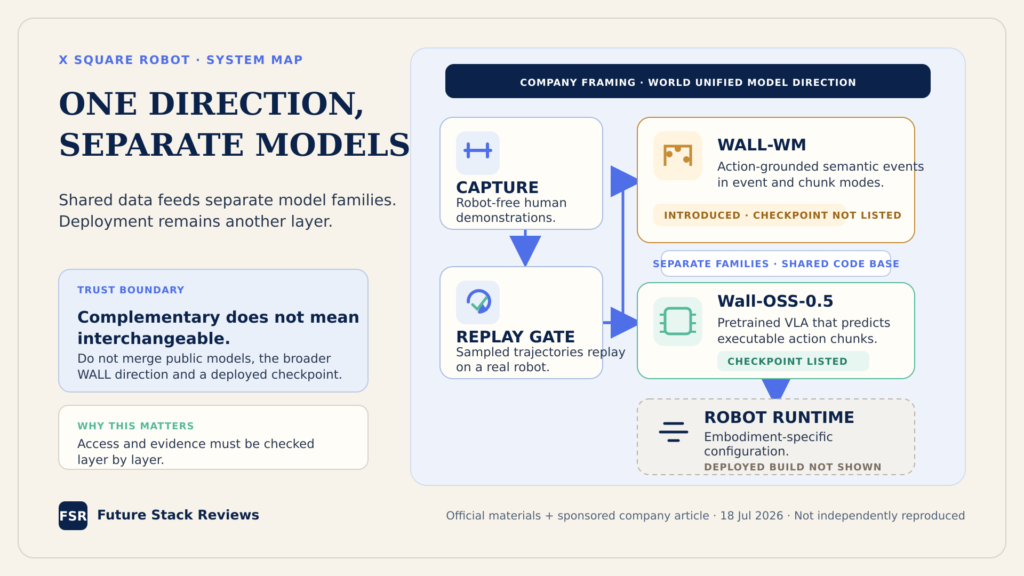
The most common error in coverage of this company is treating everything named WALL as one artifact. The company’s own materials do not support that. A sponsored trade article authored by the company describes its world model and its action model as complementary but independent model families that share a code base. The pattern is not unique to robotics. It appears at ByteDance too, where a single brand name spans several different products with different terms behind it.
Separating them changes what a reader can conclude.
| Name | What it is | Public paper | Public checkpoint located | Verb used on the official timeline |
|---|---|---|---|---|
| WALL-A | Earlier GreatWall-series manipulation model | Not located | No | Neither released nor open-sourced |
| WALL-OSS | End-to-end embodied foundation model | Yes | Yes, two variants | Open-sourced |
| Wall-OSS-0.5 | Deployment-ready vision-language-action model | Yes | Yes | Open-sourced |
| WALL-WM | Event-level world model | Yes | Not located in the repository model list | Released |
| WALL-B | Commercial flagship on the WUM architecture | Not located | No | Released |
| Wall-X | The shared training and inference code repository | Not applicable | Code only | Open-sourced |
| XR Zero-G0 | Whole-body data collection and training system | Not located | Not assessed | Open-sourced |
Compiled from the company’s About timeline, its research pages, and the model list published in its public code repository, all read on July 18, 2026. “Not located” means Future Stack Reviews did not find it in the sources it opened, which is not the same as establishing that it does not exist.
The distinction between the two verbs on that last column is the company’s own. Its Chinese timeline applies 开源, meaning open-sourced, to WALL-OSS, Wall-OSS-0.5, and XR Zero-G0. It applies 发布, meaning released or announced, to WALL-WM and WALL-B. That is a consistent internal distinction, not an accident of translation.
There is a live conflict here that this briefing does not resolve. Company communications elsewhere have described WALL-WM as open-sourced. The timeline verb and the published artifact list point the other way. Both readings remain on the record until someone matches a WALL-WM specific checkpoint, configuration, and licence to the paper.
Where the open-source boundary sits
This is the section most likely to change a working decision, so it is worth being exact about what was checked.
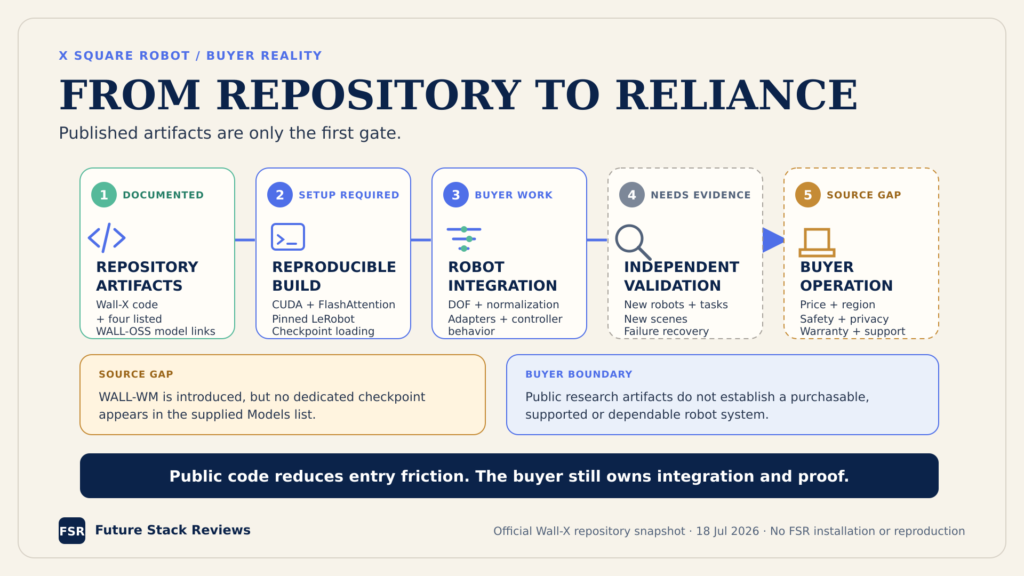
The wall-x repository contains a LICENSE file holding the full text of the Apache License 2.0, and its setup.py declares the matching classifier. Both were read directly. An earlier repository issue had flagged that setup.py declared a BSD licence without specifying the variant while no LICENSE file existed. That inconsistency has since been resolved in favour of Apache 2.0.
So the code position is clean. The weights position is not established by it.
| Training and inference code | Published, Apache License 2.0 |
| WALL-OSS checkpoints | Four listed and linked from the repository |
| Weight licence terms | Must be read per model card. Not established by the code licence. |
| Training data | No manifest located |
| WALL-WM checkpoint | Not in the published model list |
| Controller, firmware, deployed build | Not located |
| Tagged releases | None published on the repository |
A paper and an open licence on a shared repository do not by themselves make a model reachable. Google’s command line tool landed in the same position, open source and still not obtainable.
Two practical notes follow from this.
First, an Apache-2.0 code licence tells a legal reviewer nothing about the weights. Model weights are distributed separately with their own terms, and the question of which licence actually attaches to the weights has caught commercial users out before, so each model card has to be read before any plan is built on it.
Second, the repository loads its model through a class named for a Qwen2.5 vision-language mixture-of-experts architecture. A class name is a strong hint about lineage. It is not proof of which base weights training started from, and it does not settle whether any upstream licence terms carry through. That question needs the model cards and the training report, not the code.
On operating cost, the repository install path expects CUDA 12.x, flash-attn, and a Linux environment, and its default training configuration uses a sharded multi-GPU trainer. That describes training. The repository does not publish a minimum inference GPU, memory figure, or latency target, so anyone budgeting for deployment is currently estimating rather than reading.
What the performance evidence measures
Almost every capability figure in circulation originates with the company. That is not disqualifying. It does set a ceiling on what a reader can conclude, and it shifts the burden onto the checks a vendor-run benchmark has to pass.
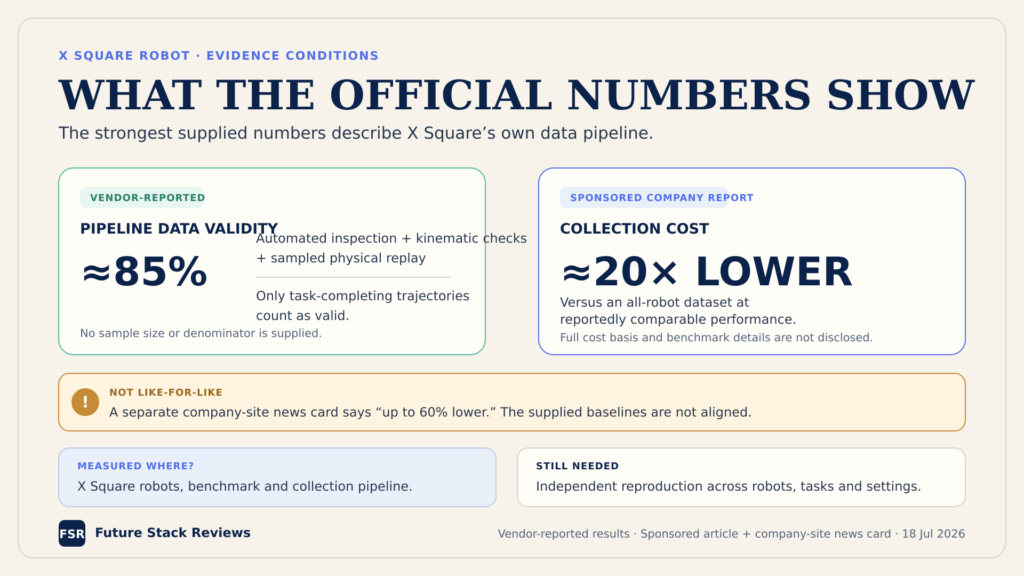
The strongest-looking western reference point illustrates the problem. A detailed technical article about this stack appeared in a well-known engineering publication in July 2026. It carries a sponsored designation and lists X Square Robot as its author. It is company material on a media platform, and it cannot serve as third-party validation of anything it contains. To its credit, the piece states plainly that its results were measured on the company’s own robots and its own benchmark, and that broader independent testing is still to come.
The figures that article does supply describe the company’s data pipeline rather than robot performance. It reports a data validity rate of roughly 85 percent, reached through automated inspection, kinematic checks, and physical replay of sampled trajectories, and a collection cost roughly twenty times lower than an all-robot dataset it describes as comparable. Neither figure carries a sample size or a disclosed cost basis. A news item on the company’s own site puts the cost reduction at up to 60 percent, which is a different baseline again.
Three specific cautions apply to any number quoted from this stack.
Task Progress is not success rate. Reporting indicates that the world model paper’s real-robot evaluation covers a small number of task suites and scores them on a progress metric that credits partial completion. A model that reaches most of the way through a task scores on that metric. Converting such a figure into a completion rate or a success rate changes what was measured. Future Stack Reviews has not opened that paper and reports this as an outstanding item rather than a finding.
The substitution is not confined to robotics. Fujitsu announced its PHOTON architecture as delivering up to 475× output tokens per GPU, while the paper it links defines the measured quantity as throughput divided by per-sample cache memory.A benchmark name is circulating that could not be located. Secondary coverage refers to a real-robot benchmark by name in connection with these results. Future Stack Reviews did not find that name in the company’s research pages or its public repository, whose evaluation scripts reference LIBERO, a public benchmark, instead. Whether the circulating name is an internal evaluation set, a public benchmark, or a reporting error is unresolved. It should not be repeated as an established benchmark until someone produces its specification.
The paper reportedly discloses its own limits. Reporting indicates that the world model paper acknowledges an advantage from alignment between pretraining and the evaluation platform, and an asymmetry in tuning resources against the systems it compares with. If accurate, that is a candid disclosure by the authors, and it also means the comparison is not like-for-like. This too remains unverified here.
What “in real homes” is documented to mean
The company’s May 2026 timeline entry says it took the lead domestically in advancing robots residing in real homes. It gives no household count, no unit count, no duration, and no model version.
Independent reporting fills in a more specific and more modest picture, and it does not match the version that has circulated in English.
Reports describe a paired service in which a human cleaner works alongside a robot with an attendant present, running through a domestic services platform since around March 2026, at a price of roughly 148 to 149 yuan for a three-hour booking depending on which outlet is read. The May 25 date appears to attach to a separate resident-home programme rather than to the first appearance of a robot in a home. At least one financial outlet has framed the May activity as an experimental phase rather than a general rollout.
Future Stack Reviews has not opened those reports and cannot confirm their contents. They are recorded here because they conflict materially with the simpler story, and because a reader deciding how seriously to take this deployment needs to know that the conflict exists.
This is a recurring failure in AI reporting rather than an isolated slip. Meta’s image model produced the same shape of error, with a feature removal reported as a shutdown.
A robot being physically present in a home establishes presence. It does not establish that the robot operated autonomously, that the machine was purchasable, or that the system running on it was the announced flagship model. Each of those needs its own evidence, and none of the four has been demonstrated to Future Stack Reviews.
One further point deserves care because it is where analysis most easily overreaches. The company has been consistent and public that data quality, not model size, is what it treats as the binding constraint, and it has built data collection systems around that view. Reporting also indicates the home service supports data collection and model iteration alongside delivering the service itself. It is tempting to compress this into a claim that the home programme exists only to harvest household data. That compression is not supported. What can be said is that data acquisition is a documented objective of the company’s strategy and a reported function of the home service, and that the service also delivers cleaning that customers pay for.
Company, funding, and legal entity
The June 2026 timeline entry states that four consecutive rounds, labelled B, B+, B++, and C, were completed and fully settled, with valuation passing RMB 20 billion. That is the company’s own statement and it is specific enough to be useful.
It also resolves an apparent conflict. Reporting from April 2026 put valuation above RMB 10 billion. Reporting from late June put it above RMB 20 billion. Those are not contradictory figures. They are consistent with three additional rounds closing in between.
The About page lists investors including ByteDance, Alibaba Cloud, Meituan, China Mobile, Xiaomi, Lightspeed China, Legend Capital, Longzhu Capital, and Sequoia China. Separate reporting indicates that vehicles connected to SAIC also participated. A claim has circulated that this is the only Chinese embodied-AI company backed by all four of the major consumer internet firms. The four names do appear on the company’s own investor list. The word “only” requires a systematic search for counterexamples that has not been performed here, and the general claim also flattens the difference between a brand name and the specific fund or entity that actually invested.
Three cautions for anyone working with these numbers.
The currency is yuan. RMB 20 billion is not JPY 20 billion, and the two differ by more than an order of magnitude.
The official timeline itself contains inconsistencies. A Pre-A++ round appears against two different dates, and several entries sit out of chronological order. Anyone totalling the rounds from this page should expect to find double counting.
The corporate entity has history. The site footer names a Shenzhen company, and reporting indicates that an earlier registered entity in Jinan was relocated and renamed. Registry records reportedly show that as a single continuous entity rather than two companies. This is a normal corporate event and should not be presented as misrepresentation. It does mean that anyone contracting, licensing, or conducting diligence needs to establish which entity holds the IP, which operates the site, which received each round, and which would sign.
Who should engage and who should skip
Worth your time if you are a robotics or ML engineer evaluating open vision-language-action stacks. There is a genuine Apache-2.0 codebase with published checkpoints, a public benchmark integration, and papers to read. The cost of evaluating it is your own compute and time.
Worth your time if you track Chinese AI capital formation. The funding sequence and the investor list are documented on the company’s own site and are unusually explicit.
Skip for now if you want a robot you can buy. There is no published price, no configuration list, and no order path. Acquisition runs through enquiry.
Embodied AI is not alone in this. Reinforcement learning environments are another category that has not become one product, and at least one frontier model has shipped with published pricing but no route to access.
Skip for now if you need a hosted API. This is not a service product.
Skip for now if your decision requires independently verified performance. No third-party evaluation was located, and the most authoritative-looking western write-up is sponsored company material.
Skip for now if you are in European or American procurement. No product-level privacy documentation, data processing agreement, subprocessor list, or conformity marking was located. A general website privacy policy does not describe how a home robot handles household video, audio, and action logs, and those are different documents answering different questions.
FAQ
Can I buy an X Square Robot machine today?
The company website lists product pages for its wheeled dual-arm platforms and a procurement enquiry page, but publishes no price, no configuration options, and no order path. Acquisition appears to run through direct enquiry. No public pricing, export terms, or non-China distribution information was located.
Is WALL-B open source?
No WALL-B checkpoint appears in the company’s public code repository model list as of July 18, 2026. The official Chinese timeline describes WALL-B as released, and reserves the term open-sourced for WALL-OSS, Wall-OSS-0.5, and XR Zero-G0.
What licence covers the published code?
The wall-x repository carries an Apache License 2.0 file, and its setup.py declares the matching classifier. That covers the code in that repository. It does not establish the licence terms of any model weights, dataset, or deployed component, each of which must be checked separately.
Did robots move into homes on May 25, 2026?
The official timeline places a domestic push for robots residing in homes in May 2026 without giving numbers. Reporting describes an earlier paired human and robot cleaning service running from around March, with the May date attached to a separate resident-home programme.
Does the sponsored engineering article count as independent verification?
No. It carries a sponsored designation and lists X Square Robot as its author, making it company material published on a media platform. The article itself states that its results were measured on the company’s own robots and benchmark.
What benchmark are the headline results measured on?
A benchmark name circulates in secondary coverage that could not be located in the company’s official research pages or public repository, whose evaluation scripts reference LIBERO instead. Whether it is an internal evaluation set, a public benchmark, or a reporting error is unresolved.
What hardware do I need to run the open models?
The repository install path requires CUDA 12.x, flash-attn, and a Linux environment, and its default training configuration uses a sharded multi-GPU trainer. The repository does not state a minimum inference GPU or memory figure, so single-GPU inference feasibility is unestablished.
Methodology and evidence boundary
This is a Tier C briefing, the same format applied to an open-weight model in an earlier piece. Future Stack Reviews did not test, purchase, operate, or measure any product or model described here, and nothing in this piece should be read as a hands-on assessment.
Opened directly on July 18, 2026: the company’s homepage and About page, its public code repository including the licence file, the package configuration declaring the licence classifier, the repository issue concerning earlier licence ambiguity, and the sponsored trade article including its metadata and author attribution.
Not opened, and therefore reported rather than verified: the world model and deployment-ready model papers, the individual product specification pages, the individual model cards and their licence metadata, the news reports describing the home service and its pricing, the corporate registry records, and the funding coverage naming additional investors.
On corroboration. Several outlets carrying the same claim is not independent confirmation when those outlets are reproducing one press release. The same applies to research tools: multiple AI systems returning the same answer usually means they read the same source, not that the claim was checked twice. Nothing in this briefing is treated as corroborated on the basis of repetition alone.
Volatile items. Valuation, funding round structure, licence terms on individual model cards, published checkpoints, and deployment scale all change quickly. Every one of them should be rechecked against the primary source before being relied upon.
Not covered here. Architecture novelty, benchmark validity, autonomy levels in the home programme, household data handling, and regulatory position in any jurisdiction. Each requires evidence this briefing does not have, and none is answered by the sources that were read.
Conditional verdict
Three questions get three separate answers, because merging them is how this story gets misreported.
Is the technical approach novel? Unresolved. The architecture claims are coherent and specific, and the company has published papers and code that make them checkable in principle. No prior-art review or independent architectural assessment was located, and the strongest technical write-up in English is sponsored company material. The claim deserves examination rather than either endorsement or dismissal.
Is the work reproducible? Partly. A real Apache-2.0 codebase and multiple published checkpoints exist, which is more than several better-known competitors offer. Training data, the world model checkpoint, weight licence terms, and the deployed configuration are outside that boundary. Reproduction of the published research models is plausible. Reproduction of the headline results is not currently possible from public artifacts.
Is it ready for a buyer outside China? No, and not close. There is no price, no order path, no product-level data documentation, and no independent performance evidence. For a developer wanting open weights to experiment with, the answer changes completely, and that developer is the reader this company currently serves.
The useful question about X Square Robot is not whether it built the world’s first anything. It is which model a given claim refers to, and whether that model is one you can download, one you can only read about, or one you can neither obtain nor inspect. Those three categories all exist inside the same product name, and most coverage does not separate them.
Future Stack Reviews publishes structural audits of AI and software products. This briefing is document-first research, not a hands-on review, and not legal, financial, procurement, or compliance advice. Company statements are identified as such and are not endorsed. Figures denominated in RMB refer to Chinese yuan.
Last updated July 18, 2026. Sources read on July 18, 2026.