Last updated: July 18, 2026
ByteDance AI is not a single product. It is a set of access layers: Doubao, Dola, Volcengine Seed, BytePlus ModelArk, third-party gateways, Seedance and Seedream, and Seed-OSS. Each layer can change the model, the seller, the jurisdiction, the data policy, the commercial rights, and the real cost.
FSR verdict: evaluate ByteDance AI by access layer, not by brand.
This is a Tier C, document-first audit. It maps the separate doors into ByteDance AI, shows where a buyer is most likely to mistake one for another, and marks what FSR could and could not confirm. FSR did not run hands-on tests of Dola, Doubao, Seed 2.1, Volcano Engine, BytePlus ModelArk, Seedance, Trae, or gateway access. Pricing, availability, model provenance, and terms move quickly and should be rechecked before any procurement decision.
Key facts, verified and not
| Fact | Status |
|---|---|
| Public Tier | Tier C, document-first |
| FSR hands-on testing | None |
| Dola operator | SPRING (SG) PTE. LTD., a ByteDance Singapore subsidiary |
| Dola model stack | Not verified. Terms disclose third-party LLMs; the privacy policy names Gemini as an example |
| Dola commercial-use boundary | Private, non-commercial language in the terms |
| BytePlus availability | Country and version variation. The United States was not found in the country list FSR extracted |
| Seed pricing | China yuan list and gateway signals only. First-party international price not verified |
| Seed-OSS | Apache-2.0 open-weight route. Self-hosting shifts, but does not erase, the infrastructure burden |
The access-layer trap
The usual question, “Can I use ByteDance AI?”, is too broad to be useful. The better question is narrower: which door are you entering?
A developer can touch ByteDance AI through a phone app, a China cloud console, an international ModelArk listing, a reseller gateway, or a downloaded open-weight model. Those are not the same purchase. The product surface, the model identity, the billing entity, the jurisdiction, and the data-use policy can all change before the first token is generated.
This is where the brand becomes the wrong unit of analysis. The common buying mistake is to treat a Dola test, a yuan price, and a gateway signup as if they describe one stack with one governance boundary. A team installs the consumer app, likes the output, then signs an API contract believing it evaluated the same thing. Or it quotes a launch price from Chinese coverage and budgets against a number it cannot actually procure at.
The same mistake travels beyond model APIs. X Square Robot’s four different WALL artifacts sit under one product name in embodied AI, and only one of the four has weights a buyer can download.
Three corrections set up the rest of this audit. Doubao is not Dola. Dola is not automatically Seed. And gateway access to a Seed model is not first-party enterprise procurement. Hold those apart, and the decision gets clearer.
The access layers buyers must not collapse
There is no single object you can point at and call “ByteDance AI.” There are entry points, and the entry point decides almost everything that follows. The table below is the spine of this audit. Read it as a map of doors, not as a feature comparison.
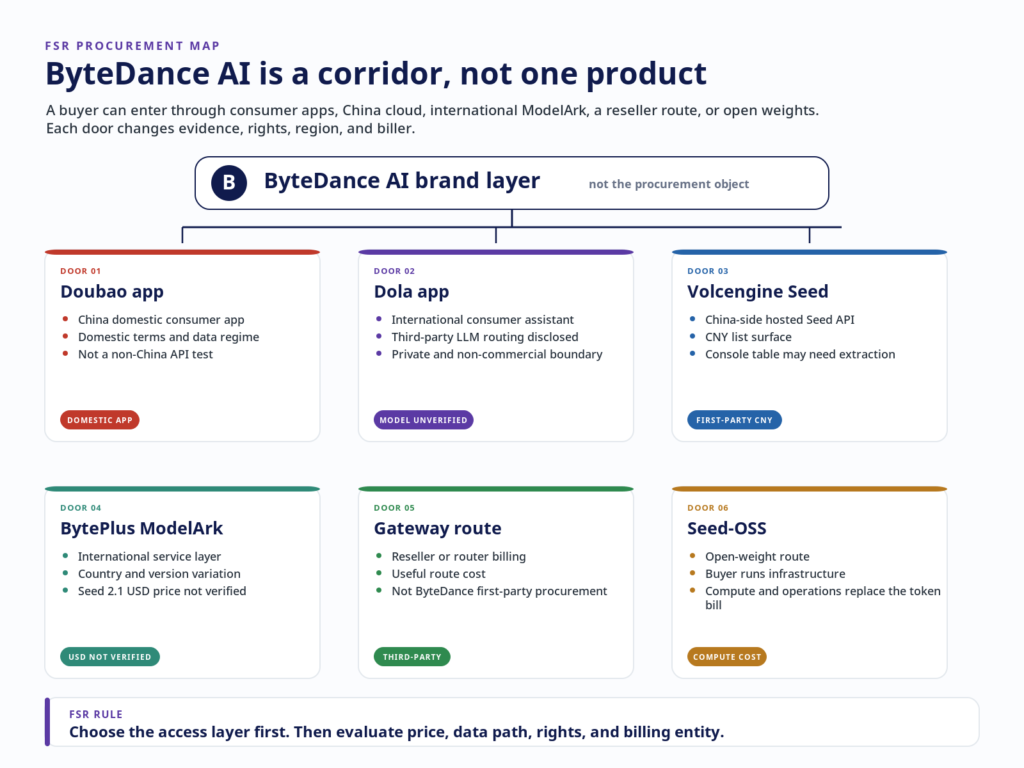
| Access layer | What you are actually evaluating | Who bills you | Main buyer risk |
|---|---|---|---|
| China Doubao app | The domestic consumer assistant | A ByteDance domestic affiliate | Domestic-market terms, a China data regime, mismatch for a non-China buyer |
| International Dola app | The overseas consumer assistant, formerly Cici | SPRING (SG) PTE. LTD. | Model provenance is unclear, third-party LLM routing, private and non-commercial terms |
| Volcengine Seed API | China-side hosted Seed model access | Volcano Engine (ByteDance cloud) | Yuan pricing, real-name access friction, an unclear inference data path |
| BytePlus ModelArk | The international model-service layer | BytePlus (ByteDance) | Country and version variation, model-specific governance not confirmed |
| Third-party gateways | Resold, routed access to Seed-style models | A reseller, not ByteDance | Gateway terms, markup, logging, and routing, not first-party procurement |
| Seed-OSS | An open-weight model you run yourself | You, on your own hardware | Hardware cost, operations burden, capability gap versus the hosted model |
The Seedance video and Seedream image models sit next to these and are reached through the apps or the API. They carry their own commercial-rights and content-provenance questions, which is one more reason the consumer surfaces and the model surfaces should not be folded into a single verdict.
The point is not that ByteDance is hiding anything. It is that a buyer who compares price, performance, privacy, or procurement risk before separating these doors is comparing the wrong things.
Dola is not a Seed test
Dola is where the mistake becomes most expensive. It is the product many non-China users can actually install, and it is clearly part of the ByteDance ecosystem. That does not make it a clean test of ByteDance’s hosted Seed models.
Here is what the current official documents support. Dola’s terms state that the service is provided by SPRING (SG) PTE. LTD., and that its bots may be powered by proprietary technology and by third-party large language models. The same terms describe the service as being for private and non-commercial use. Dola’s privacy policy indicates that chatbot interactions may share user content and automatically collected information with the developers of integrated AI tools, and it names Gemini, from Google, as an example of such a model.
Here is what those documents do not support. They do not state that the consumer Dola app runs on ByteDance’s Seed 2.x family. They do not name OpenAI as a current provider. The OpenAI link belongs to history: early reporting from the 2023 Cici period described the app relying on OpenAI technology through Azure, and that access was later suspended over distillation concerns. A Chinese-language analysis from late 2025 went further and described Dola as calling GPT and Gemini rather than the in-house model. The current privacy policy, by contrast, names only Gemini. So the sources themselves disagree.
FSR keeps that disagreement open rather than resolving it, because resolving it is not required to act. The safe buyer conclusion is narrower. Dola is risky to use as a proxy for Seed. Its terms disclose third-party LLM routing, its privacy policy names Gemini as an example, and neither document shows that the consumer app runs on Seed. A buyer who likes Dola’s output has not necessarily evaluated Seed, and a buyer who rejects Dola’s privacy posture has not necessarily evaluated every Seed access path either. FSR will not write that Dola runs on Seed, that Dola is powered by Gemini, or that Dola currently uses OpenAI. Its model provenance is unverified, and a buyer should assume a third-party or mixed backbone until ByteDance publishes a clear technical statement.
Price: three meters, not one
The Seed pricing story is attractive, and it has to be split into three evidence layers before it can be used.
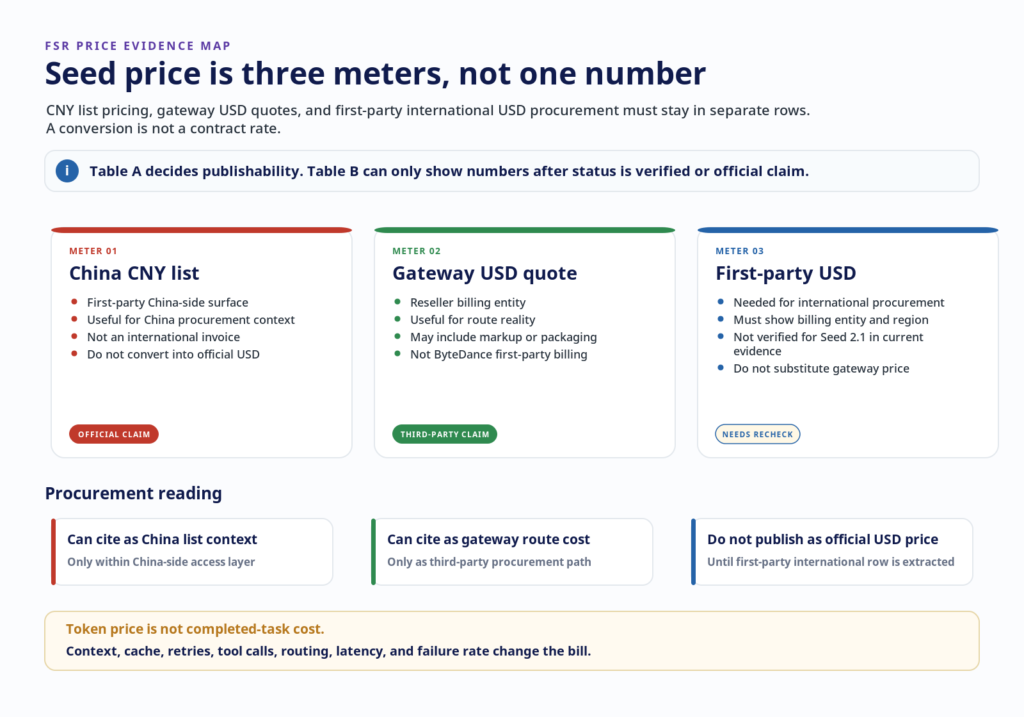
First, there is China-side yuan pricing, reported from Volcano Engine and Chinese-language source-ledger work, which puts Seed 2.1 Pro near 6 yuan per million input tokens and 30 yuan per million output tokens, with a Turbo tier at roughly half that. FSR notes that the first-party pricing surface returned a loading state and appears to sit behind a console login, so the full official table was not extracted. Second, there are gateway prices, where resellers expose Seed-style models through their own billing and quote a spread in dollars that depends on the gateway. Third, there is the first-party international procurement price a non-China buyer would actually pay under contract, which FSR could not verify from public sources for Seed 2.1.
Those are not the same number. A yuan list price does not become an international invoice by being converted into dollars. A gateway quote does not become a ByteDance first-party contract. And a per-token price does not predict the cost of a completed task. Agent loops, retries, long-context bloat, tool calls, cache assumptions, failed generations, and routing overhead can erase much of the apparent discount.
The headline price matters. It just should not be treated as a contract rate, an international invoice, or a reliable estimate of what a completed task will cost. This is why a blunt “Seed is cheaper than OpenAI” does not hold up. DeepSeek’s current official API pricing also sits below several Seed 2.1 figures in the research pack, so Seed should not be described as the universal cheapest Chinese frontier-adjacent option. Chinese tech media also report a wide gap between Doubao’s daily compute cost and its daily revenue, which is one more reason to treat the current price as a moving target rather than a fixture.
Availability: app access is not API access
App availability and API availability are different questions, and the brand blurs them.
On the app side, reported availability, drawn from app-store metadata and source-ledger research rather than an official Dola country matrix, shows the international Dola app in markets such as Japan, the United Kingdom, and several countries across Latin America, Southeast Asia, the Middle East, and Europe, and absent from the United States, Canada, Australia, and mainland China. FSR did not find an official regional availability matrix on Dola’s own site or legal pages, so this should be read as a signal, not as a confirmed official list. The China Doubao app is a separate product aimed at the domestic market, and neither app tells you who can call the hosted Seed model.
On the API side, the picture is thinner. The BytePlus international availability page lists country coverage that, in the version FSR extracted, included Japan, the UK, Canada, and Australia, while the United States was not found in that extracted list. BytePlus also notes that available versions can vary by region and that the final service depends on what is provided at the point of access. Third-party gateways do expose Seed-style models to a wider set of developers, which is why “you can reach a Seed model from outside China” is true in a limited sense. A gateway is a reseller, not ByteDance first-party procurement.
So the access question has to be asked per door, not per brand. FSR will not claim that Seed 2.1 is reachable worldwide, that US buyers can officially obtain it through BytePlus or Volcano Engine, that Dola app availability proves API availability, or that gateway availability proves a model is acceptable for enterprise procurement. The doors carry different country lists, different billing entities, and different evidence quality. The older framing of a total US lockout was wrong precisely because it treated the brand as one wall.
Governance: the packet procurement needs
A regulated buyer does not need another privacy slogan. It needs the exact packet for the access layer it is buying: a data-processing agreement, a subprocessor list, retention terms, the training-use position, the inference region, the billing entity, audit rights, and a clear statement of whether any ByteDance entity in China can access the data.
Dola’s public documents answer part of that question for the consumer app. They disclose SPRING (SG) PTE. LTD. as the provider, third-party LLM sharing, a model-training use that a user can opt out of, and storage on servers in Malaysia, Singapore, and the United States, with sharing across the corporate group. That is useful, and it is not enough to clear an enterprise production data path.
For BytePlus and ModelArk, FSR located general legal pages, including a data-processing addendum and a sub-processor list. The correct caution here is not that these pages are missing. It is that FSR did not verify whether they resolve the ModelArk and Seed-specific questions a buyer must ask: how inference data is handled, the retention schedule, a no-training commitment for this model path, region isolation, the subprocessor set for the hosted model, and whether a ByteDance China entity can reach the data. The domestic Doubao policy reads differently again, with Chinese-language review indicating that data from domestic operations is stored within China and, currently, not transferred overseas, alongside the broad national-security and law-enforcement carve-outs that are standard in such policies. The same brand therefore presents two different data regimes, one domestic and one international.
China’s National Intelligence Law belongs here only as a risk lens. The primary text obliges organizations and citizens to support state intelligence work, and it is not written with an explicit territorial limit. Whether and how it would reach a Singapore subsidiary or the Volcano Engine platform is contested, and legal opinions differ. FSR will not write that ByteDance breaches the GDPR or the EU AI Act, that all API data is processed in China, that calling the API from outside China definitely keeps data out of Chinese jurisdiction, or that the Singapore entity is exempt from Chinese legal exposure. None of those is established by the evidence. Until the access-layer packet is available, the verdict is simple. Low-risk experiments may be reasonable. Production use with regulated or confidential data should wait.
Seed-OSS: the sovereignty exit with a hardware bill
One route changes the data question at its root, and it deserves a section rather than a footnote.
Seed-OSS is an open-weight ByteDance model released under the Apache-2.0 license, a 36-billion-parameter dense model with a large native context window, available to download and run. Because the weights run inside a buyer’s own environment, self-hosting can reduce the hosted-API data-path risk: the prompts and outputs do not have to leave infrastructure the buyer controls. For a team whose hard requirement is that data never touch a third party’s cloud, this is the only route in the ByteDance stack that can even attempt to satisfy it.
The catch is the hardware bill. Running the model at full precision points to roughly 72 gigabytes of GPU memory, in the territory of a single high-end data-center card, and even an aggressively quantized version lands near 18 to 24 gigabytes, which still means at least one top-tier GPU. Add deployment, security, maintenance, latency, and capability tradeoffs, and the option stops being realistic for many small teams. A team that cannot meet that floor falls straight back into the hosted-API, gateway, and ModelArk questions this audit has already raised, with the data path back in play.
So Seed-OSS is not a magic escape hatch. It is the sovereignty path with an infrastructure bill. FSR will not claim that it is equivalent to the hosted Seed 2.1 Pro, that it solves every governance risk, that self-hosting is the universal answer, or that its commercial rights extend beyond the actual license language. It can reduce the hosted-API data-path risk, but only for a buyer that can actually self-host.
How it compares, by buyer axis
A model-versus-model leaderboard is the wrong tool here, partly because FSR ran no benchmarks and partly because the decision is not about a single score. The useful comparison is on buyer-decision axes: model-identity certainty, first-party procurement clarity, pricing-evidence quality, governance and DPA clarity, data residency, tool and agent suitability, price per completed task, open-weight availability, and enterprise-review friction.
On those axes, the alternatives have specific shapes. DeepSeek’s published API pricing comes in below Seed on the current rate cards, which removes the “cheapest Chinese option” line from Seed’s column. Developer commentary tends to reach for DeepSeek when the priority is cost and reasoning, for Qwen when the priority is tool-call reliability and ecosystem breadth, for Kimi when the priority is long-context reading, and for Seed when the workflow already sits inside ByteDance’s product surface. That is a fit map, not a ranking.
Two cautions keep this honest. Vendor benchmark claims, including the launch framing that Seed 2.1 outperforms a named Western model, are vendor positioning until independent testing confirms them, and FSR has not confirmed them. And the choice of a Chinese frontier-adjacent model is rarely lost on raw capability. It is lost on procurement clarity: model identity, billing entity, residency, and the missing access-layer documents. Seed’s weak spot in this comparison is not intelligence. It is the evidence a reviewer needs in order to sign off.
Who should act, and how
The verdict splits by buyer, because the right move genuinely differs.
| Buyer | Default move | Non-negotiables before you commit |
|---|---|---|
| Cost-sensitive developer, low-risk workload | Consider for sandbox and non-sensitive work | Pin the exact model ID, gateway or provider, terms, price, and logging. Compare against DeepSeek and Qwen on completed-task cost, not token price |
| Regulated or enterprise buyer | Do not put it in a production data path yet | Obtain the DPA, subprocessor list, retention schedule, no-training commitment, inference region, billing entity, and audit rights for the exact access layer. Gateway access is not enough |
| Content creator using Dola or Seedance | Treat the consumer surfaces as consumer tools | Do not assume generated images, video, or voice are commercially cleared. Confirm the exact local terms or a paid business agreement first |
The shape of the answer is what matters. The correct verdict is not “blocked, so irrelevant,” and it is not “cheap, so use it.” The operational verdict is narrower: choose the access layer first, then price the model, the data path, and the rights attached to that layer. For most buyers that resolves to one of three moves. Sandbox it on non-sensitive work, wait until the access-layer packet exists, or reject it for this use. Pick the move that matches the door, not the brand.
FAQ
What FSR checked, and did not
This is a document-first audit. Sources include official product and legal pages, app-store metadata, source-ledger research, Chinese-language source review, visible social and search signals, and third-party pricing trackers. FSR did not perform hands-on testing of any product named here. Volatile items include pricing, availability, model IDs, regional access, terms, DPA and subprocessor coverage, data residency, and the identity of the model behind Dola. Each should be rechecked before a procurement decision.
- The exact Seed 2.1 international model IDs available to a non-China buyer
- Official first-party US access to the hosted Seed API
- Paid-account creation and the invoicing entity for Japan, UK, and EU buyers
- A first-party international price for Seed
- The model that currently powers the consumer Dola app
- Commercial-output rights for Dola, by country
- The commercial and IP boundary for Seedance outputs
- Whether the BytePlus and ModelArk legal pages cover the Seed-specific inference data path, retention, no-training, region isolation, subprocessors, and China-entity access
- Price per completed task on real workloads
- Independent English long-context, coding, and tool-use performance
FSR verdict
ByteDance AI is not irrelevant because some apps are blocked, and it is not automatically attractive because a Seed price looks low. The older framing, that a US reader is locked out of the entire thing, was wrong, because it treated a brand as a single wall when it is really a corridor of separate doors.
The right buyer question is narrower and more operational. Which door are you entering, and what changes when you do? The model behind the answer changes. The company that bills you changes. The jurisdiction your data sits in changes. Whether you may sell what you make changes. A buyer who answers those four questions per door will make a good decision. A buyer who compares “ByteDance AI” against “OpenAI” as if each were one thing has already made a mistake the price tag cannot fix.