Last updated: August 6, 2026
Built from vendor pages and reporting opened on 6 and 7 August 2026. No plan was purchased, no API request was sent, no feature was tested. Everything below describes what documents say, not what the products do.
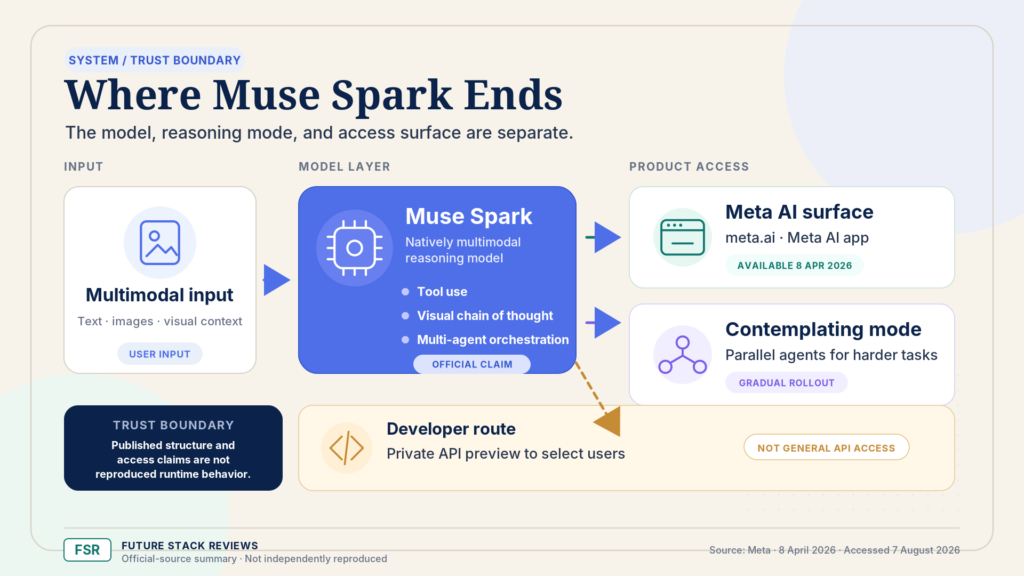
Meta AI is not one product you can buy. Meta sells a personal subscription called Meta One, a metered developer API, and a free assistant embedded across Facebook, Instagram, WhatsApp, and Messenger. Each has a different buyer, a different billing counterparty, and a different rule about who may use your data. The first decision is not whether Meta AI is worth paying for. It is which of the three you actually mean.
Verdict in one line: an individual can evaluate Meta One at the onboarding screen, a business cannot buy it at all, and a developer’s real choice is a data boundary rather than a token price.
What happened
- 8 April 2026: Meta shipped Muse Spark, a closed-weight model family replacing Llama at the frontier
- 27 May 2026: Meta announced Meta One, its first paid consumer AI subscription
- 9 July 2026: the Meta Model API opened in public preview
- 5 August 2026: Muse Spark 1.2 arrived with two separately priced model IDs and a coding agent
Who this concerns
- Individuals deciding whether to subscribe to Meta One
- Developers choosing between the two Muse Spark 1.2 model IDs
- Teams that assumed a consumer AI subscription could be standardized across the group
- Anyone comparing Meta against ChatGPT, Claude, or Gemini on an equivalent basis
Who this does not concern
- Readers who want model quality, benchmark, or latency results
- Buyers who need a confirmed price in their own currency and market today
- Anyone seeking a compliance, privacy, or contractual determination
- Readers looking for a verdict on whether Meta AI is a good assistant
What a document-first briefing can and cannot settle
Can settle: which products exist, which account types may purchase each one, what Meta publishes about data use and eligibility, and where the public record stops.
Cannot settle: what any specific account is offered, whether prices match in your market, how the products behave at runtime, or what the operative terms say where we could not retrieve them.
On this briefing
Contents
The three things Meta sells
A search for Meta AI pricing now returns several correct answers, because Meta charges for several different things.
Three routes, three buyers, three billers
| Route | Who may buy | Billed by | Data used to train Meta models |
|---|---|---|---|
| Free assistant | Anyone with an eligible account | No charge | Meta says interactions are used to improve its AI |
| Meta One Plus / Premium | Personal accounts only. Business accounts excluded | Apple App Store or Google Play | Not addressed in the plan pages reviewed |
| Meta Model API | Developers, subject to preview availability | Meta, metered per token | Depends on which of two model IDs you call |
Compiled from Meta Help Center pages and Meta AI blog posts opened 6 and 7 August 2026. Meta also documents business and creator subscription plans that this briefing does not cover.
These are not three price points on one product. They are three products with different eligibility rules, and moving between them is not an upgrade path. A personal Meta One subscriber who later needs the same capability for a company cannot convert the plan, because the business account was never eligible to hold it.
That distinction is the whole argument of this briefing. Everything below is its consequences.
Sources: Meta Help Center, About Meta One plans, opened 7 August 2026 · Meta Help Center, About Meta One Premium plans, opened 7 August 2026 · Meta AI, Introducing Muse Spark 1.1, 9 July 2026
The consumer plan you cannot compare
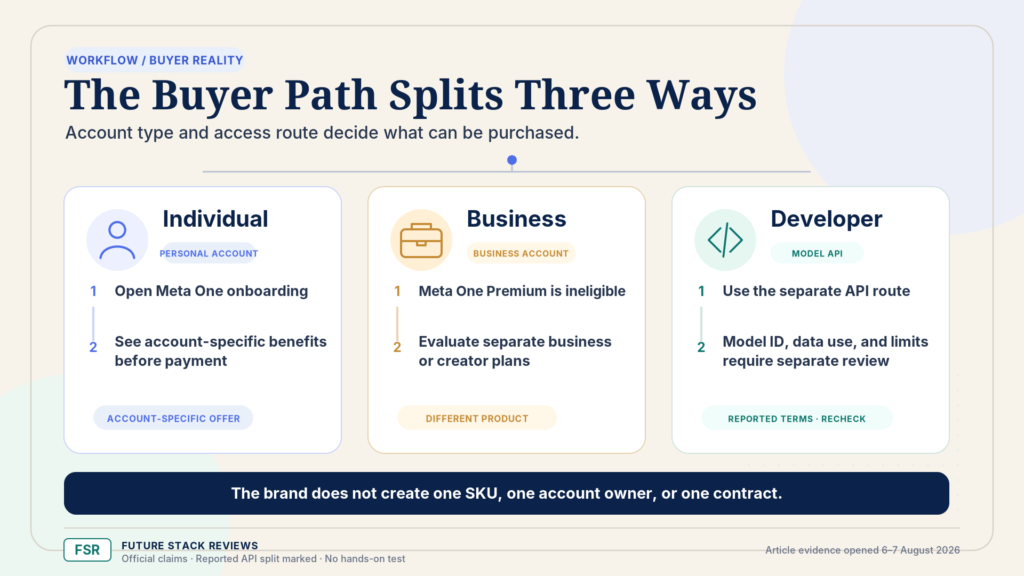
Meta One Premium is a personal subscription. Meta’s Help Center states that “Business accounts such as Facebook Pages or Instagram professional business accounts aren’t eligible” to subscribe. It sells through supported Meta technologies on iPhone and Android, bills through the Apple App Store or Google Play, and renews on the anniversary of the purchase date until canceled.
The plan pages describe benefits in relative terms. Plus gives more monthly AI usage allowance. Premium gives expanded allowance, along with Thinking mode for more detailed answers, which is limited to the Meta AI app and meta.ai rather than every Meta surface. No page we opened attaches a number to either allowance.
Meta then adds two qualifications. Included subscriptions and benefits may vary based on location, account type, and which Meta apps you use. And “Available benefits will be shown to you during onboarding before you subscribe.”
That second sentence matters, and it corrects a reading we published earlier. A buyer is not paying blind. Meta discloses the package. It discloses it inside the mobile onboarding flow, to that account, at the moment of purchase.
The consequence is narrower than deception and more awkward than transparency. Disclosure that happens per account, in an app, at checkout cannot be compared. You cannot line Meta One up against ChatGPT Plus or Claude Pro from a browser, because one side publishes a plan page and the other resolves the plan at the till. You cannot ask what a colleague in another country would receive. You cannot cite it in a procurement document. What you can do is open the flow with the account that will own the plan, stop short of payment, and record what you are shown.
For an individual that is a reasonable procedure. For a team it is not a procedure at all, because the product a team would need to buy is a different product.
Sources: Meta Help Center, About Meta One Premium plans, opened 7 August 2026 · Meta Help Center, About Meta One plans, opened 7 August 2026
The cheapest API tier is not a discount
The developer route publishes its prices, which makes it easier to analyze and easier to misread.
Muse Spark 1.2 ships as two model IDs. The naming suggests a tier. The gap between them does not behave like one.
Muse Spark 1.2, two model IDs
| muse-spark-1.2 | muse-spark-1.2-contributor | Gap | |
|---|---|---|---|
| Input per 1M tokens | $1.25 | $0.10 | 12.5× cheaper |
| Cached input per 1M | $0.15 | $0.002 | 75× cheaper |
| Output per 1M tokens | $4.25 | $0.20 | 21.25× cheaper |
| Requests per minute, per team | 3,000 | 60 | 50× lower |
| Your prompts and completions | Not used to train Meta models | Used to train Meta models | Different product |
Prices and rate limits reported by independent technical coverage and gateway documentation on 5 and 6 August 2026. Future Stack Reviews did not open Meta’s own pricing and rate-limit documentation for this briefing, and did not send API requests. Treat every figure here as reported rather than measured.
Two of these rows move in opposite directions, which is what makes the pair interesting.
The price rows all favor Contributor, by margins large enough to change which vendor wins a cost comparison outright. The rate limit row reverses that. A team on Contributor is capped at sixty requests per minute against three thousand on Standard, according to the technical write-ups published at launch. Coverage of this release has led with the discount. We have not found a general-audience article that leads with the throughput ceiling.
Underneath both sits the actual decision. Vercel’s gateway page for the Contributor model states plainly that “Your inputs and outputs are used to train and improve Meta’s AI models.” Meta’s Standard SKU carries the opposite treatment.
So the choice presented as cheap against expensive is really a choice about three things at once: what you pay, how fast you may call, and whether your prompts leave your control. For a developer testing ideas on public data, Contributor may be an unusually good deal. For anyone holding client code, proprietary documents, or material under a confidentiality obligation, Standard is the baseline and the Contributor price should not enter the comparison at all.
One caution on scope. We read secondary technical coverage and gateway catalog pages, not Meta’s own pricing and rate-limit documentation, which we were unable to open in this pass. Those pages are where these numbers should be confirmed before anyone budgets against them. A short pricing label also settles less than it appears to. “Not used to improve our products” answers one question about data. It does not answer retention, subprocessing, deletion, or contractual questions, and those documents remain unread here.
Sources: Simon Willison, 5 August 2026 · DataNorth, 5 August 2026 · Vorp Labs, release record, 5 August 2026 · Vercel AI Gateway, model page, opened 6 August 2026 · Reuters, 5 August 2026
What the country search returned
Meta’s plan pages say benefits vary by location. We went looking for the table that would tell a reader what their location produces.
We searched Meta-controlled domains: the Help Center across both its subscriptions and artificial intelligence sections, ai.meta.com, research.meta.ai, developer.meta.com, transparency.meta.com, and about.fb.com. Queries combined the product names Meta One, Meta One Plus, Meta One Premium, and Meta Model API with terms for availability, countries, regions, and eligibility. Dates and scope are recorded in the methodology below.
We did not find a public matrix of plan by country by feature, for either the consumer tiers or the API.
What exists instead is a sequence of partial statements. Press coverage of the May announcement named Singapore, Guatemala, and Bolivia as the initial AI-tier test markets. Meta’s Muse Spark 1.1 launch post announced the API preview without naming regions. The Muse Code post described the API as having expanded global access, again without a list.
This is a narrower finding than it may look, so we want to bound it precisely. Meta does resolve eligibility, per account, in onboarding. What is missing is the public, comparable version. An individual can learn their own answer. Nobody can learn the general answer, which means nobody can plan across accounts, markets, or a fleet of users in advance.
Absence of a list in the pages we opened is also not proof that no list exists. It may sit behind a developer console login, inside a sales conversation, or on a page our queries did not reach. We are reporting a scoped negative result, not a fact about Meta’s internal documentation.
Sources: Meta AI, Introducing Muse Spark 1.1, 9 July 2026 · Meta AI Research, Introducing Muse Code and Muse Spark 1.2, 5 August 2026 · CNBC, 27 May 2026
What this briefing did not settle
This is a document-first briefing, and several of its findings concern what is absent rather than what is present. That makes the boundary worth stating exactly.
We did not subscribe to Meta One, open its onboarding flow, or see a price in any currency. We sent no API requests to Meta or to any gateway. We measured nothing: no quality, no latency, no output. We did not verify eligibility from any specific country.
Five questions stayed open after this pass.
Meta’s own API pricing and rate-limit documentation was not retrieved, so every figure in section 03 rests on secondary sources. Meta’s AI Terms of Service, referenced from its AI Disclosures page, was located but not read, which leaves the commercial-use rights in assistant output unresolved. Whether the two Muse Spark model IDs and the consumer assistant run the same deployment is not established; they share a model name, and nothing we read establishes more than that. Meta’s data-handling documentation describes more than one path for AI conversations, and we did not map them completely. And Meta One’s numerical AI allowances appear nowhere in the pages we opened.
Any of those could change a section above. We would rather publish the gaps than a tidier briefing than the evidence supports.
Sources: Meta Transparency Center, AI Disclosures, opened 6 August 2026 · Meta Help Center, Start a chat with Meta AI, opened 6 August 2026
FAQ
Is Meta AI free or paid?
Both. A free assistant runs across Meta’s apps and meta.ai. Since May 2026 Meta has also sold paid personal tiers called Meta One Plus and Meta One Premium, which add AI usage allowance and Thinking mode. Availability depends on your account and location.
Can a business account subscribe to Meta One Premium?
No. Meta’s Help Center states that business accounts, including Facebook Pages and Instagram professional business accounts, are not eligible for Meta One Premium. Meta documents separate business and creator subscription plans, which this briefing does not cover.
Are Meta One benefits shown before you pay?
Yes. Meta states that available benefits are shown during onboarding before you subscribe. That disclosure is account-specific and happens inside the mobile flow, so it lets you check your own offer but not compare packages across accounts or markets from the open web.
What is muse-spark-1.2-contributor?
A second model ID for the same Muse Spark 1.2 release, reported at $0.10 input and $0.20 output per million tokens against $1.25 and $4.25 on the standard ID. Its inputs and outputs are used to train Meta’s models, and its per-team request rate is reported as far lower.
Is the Meta Model API the same as the Meta AI assistant?
No. The API is a metered developer service opened in public preview on 9 July 2026. The assistant is a consumer product. Both reference the Muse Spark family, but a shared model name does not establish a shared deployment, system configuration, or tool stack.
Can Meta AI output be used commercially?
Unresolved in this briefing. The operative document is Meta’s AI Terms of Service, referenced from Meta’s AI Disclosures page. We located the reference and did not retrieve the text. Any answer that does not quote the clause and its URL is a guess.
Methodology
This is a Tier C briefing. Tier C means document-first: vendor pages and reporting, with no purchase, no test, and no measurement. Tier B and Tier A briefings at Future Stack Reviews carry hands-on evidence. This one does not.
Claim statuses used. A vendor page establishes an official claim, meaning what the vendor currently publishes. It does not independently establish runtime behavior, billing outcome, or implementation. A third-party catalog or news report establishes a third-party claim. A recorded negative search establishes only that the queries and domains listed returned nothing.
Pages opened. Meta’s AI blog posts for Muse Spark, 8 April 2026, and Muse Spark 1.1, 9 July 2026, were read in full on 6 August 2026. Meta Help Center pages for About Meta One plans, About Meta One Premium plans, and Start a chat with Meta AI were read on 6 and 7 August 2026. Meta’s AI Disclosures page was read on 6 August 2026. Gateway catalog pages at Vercel AI Gateway, LLM Gateway, EmpirioLabs, and Merge Gateway were read on 6 August 2026. Reuters coverage of the Muse Code launch was read on 6 August 2026.
Pages not retrieved. Meta’s Model API pricing and rate-limit documentation at developer.meta.com could not be opened in this pass, so all figures in section 03 rest on secondary technical coverage. Meta’s AI Terms of Service was referenced but not retrieved.
Search scope for the negative finding in section 04. Domains searched: meta.com Help Center, both subscriptions and artificial intelligence sections; ai.meta.com; research.meta.ai; developer.meta.com; transparency.meta.com; about.fb.com. Query patterns combined Meta One, Meta One Plus, Meta One Premium, Meta AI subscription, and Meta Model API with availability, country, region, eligibility, and pricing terms. No public plan-by-country-by-feature matrix was located.
Two errors this briefing corrects in its own earlier research
We publish these because a briefing that audits vendors on evidence discipline should show its own.
The first draft of this research concluded that the Meta AI assistant could not be purchased. That came from a search that never included the term Meta One, because we did not yet know the product name. An absence claim is only as strong as the scope that produced it, and a scope missing the right product name proves nothing.
The second draft concluded that a Meta One buyer discovers the package only after paying. Meta’s Help Center states the opposite: available benefits are shown during onboarding before subscription. That sentence sits on a page we had already quoted from. We read one line and treated it as the page.
Both are the same mistake at different scales. Both are recorded here rather than silently patched.
Verdict by buyer type
If you are an individual
Check the onboarding screen before you pay
Meta One can be evaluated properly, just not from a browser. Open the subscription flow on the device and account that will own the plan, stop before payment, and record the price, the currency, the included AI allowance, the eligible surfaces, and the renewal terms. That is a reversible personal check and it costs nothing.
If you are buying for a team
This plan is not sold to you
The personal plan is not available to business accounts, and treating it as a workaround fails at the account level rather than at the price. Meta documents separate business and creator plans. Those are the products to evaluate, and this briefing does not cover them.
If you are a developer
Choose the data boundary, then the price
The Contributor model ID is reported at roughly a twelfth of the input price and a twentieth of the output price, and its prompts and completions are used to train Meta’s models. Its per-team request rate is reported as fiftyfold lower. Price it against other providers that permit equivalent use of your data, not against providers that do not.
The common thread
“Meta AI” names a brand rather than a purchase, which is why it will not slot into a stack the way a vendor product does. There is no single object to evaluate, no single account that holds it, and no single set of terms that governs it. Before asking whether Meta AI is worth paying for, work out which of the three you are actually talking about.
Corrections and commissioned audits
Contact us
If Meta has published a plan-by-country matrix we did not find, or if your onboarding screen shows something different from what we describe, send it. We will update this briefing with a dated, attributed correction. We also build entitlement and pricing maps like this one on commission, for buyers who need the seams named before they sign.
[email protected]Corrections are logged and dated. We do not quietly edit published claims.
Tier C briefing. Document-first research, no hands-on testing. Prices, plan names, availability, rate limits, and terms change without notice and vary by country and account. Verify current terms on the vendor’s own pages before purchasing. This briefing is not legal, financial, or compliance advice.
Future Stack Reviews has no commercial relationship with Meta Platforms and received no compensation for this briefing.
Last updated 7 August 2026. Sources opened 6 and 7 August 2026. Next scheduled recheck: 21 September 2026, or immediately on any Meta One or Meta Model API announcement.