Skip to content

Future Stack Reviews

  • Reviews
  • Comparisons
  • Alternatives
  • Best Tools
  • Stack Intel
  • Methodology
  • About

Takashi Fujino

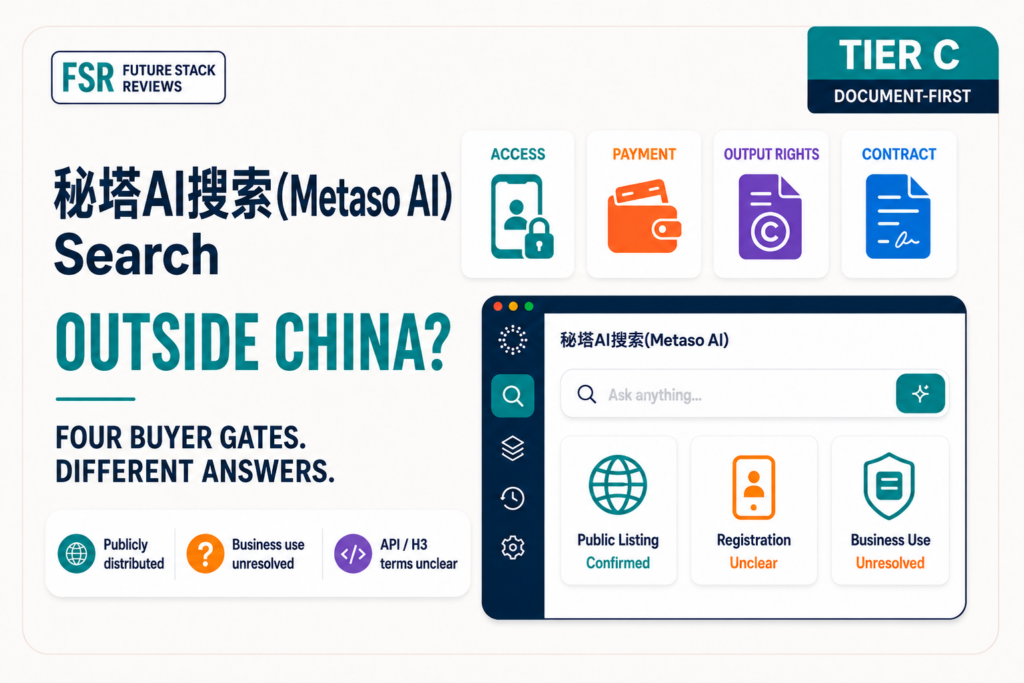
Future Stack Reviews Tier C cover graphic for 秘塔AI搜索, Metaso AI Search, outside China. It names four buyer gates: access, payment, output rights, and contract, with public listing confirmed and registration and business use unresolved.

Metaso AI Search for Buyers Outside China: Access, Payment, Output Rights, and Contract Gaps

August 10, 2026

Metaso is publicly distributed outside China. Registration, payment, commercial output rights, and its video model terms are not established.

Categories Reviews
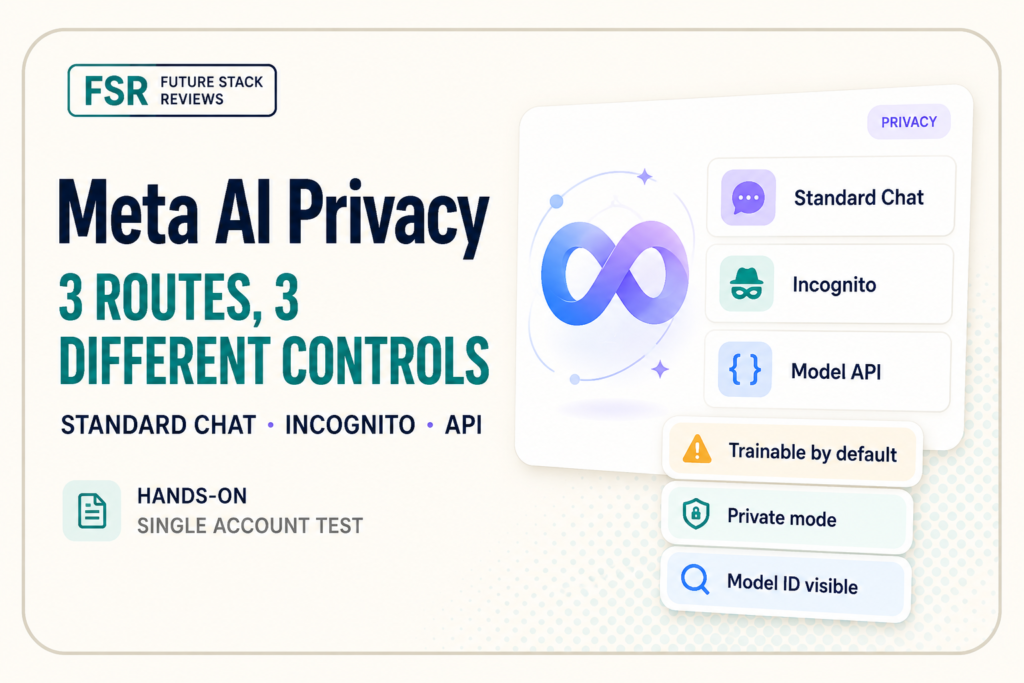
Meta AI privacy controls across three routes: standard chat, Incognito, and Model API. Future Stack Reviews cover graphic.

Meta AI Has Three Privacy Routes. They Do Not Do the Same Job

August 9, 2026

Meta prices data use by model ID on the API, markets Incognito Chat
separately, and offers record management in ordinary chat. FSR audited one Japan web account to map what each route actually governs.
Categories Reviews
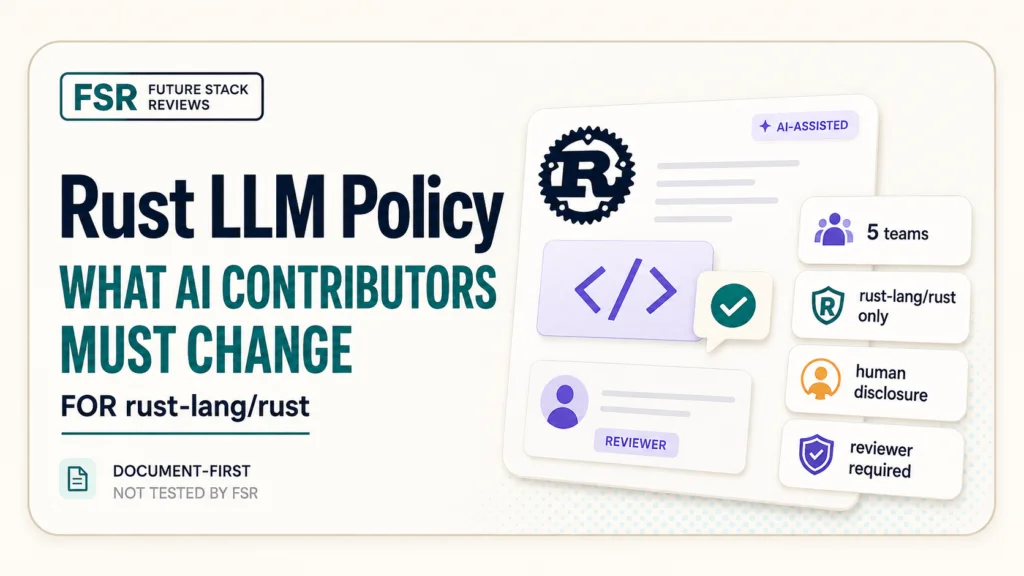
Future Stack Reviews title card reading Rust LLM Policy: What AI Contributors Must Change, for rust-lang/rust, marked document-first and not tested by FSR. An illustrated pull request panel carries the Rust logo and an ai-assisted label beside a reviewer card, with four fact chips: five teams, rust-lang/rust only, human disclosure, and reviewer required.

Rust’s LLM Policy: What AI-Assisted Contributors Must Change Before the Next Pull Request

August 7, 2026August 7, 2026

On August 5, 2026, five Rust teams ratified an LLM usage policy for the rust-lang/rust monorepo. It does not ban AI-assisted code. It adds reviewer, disclosure, authorship, and testing conditions that code quality alone does not satisfy. A document-first briefing on what changes before your next upstream pull request.
Categories Stack Intel
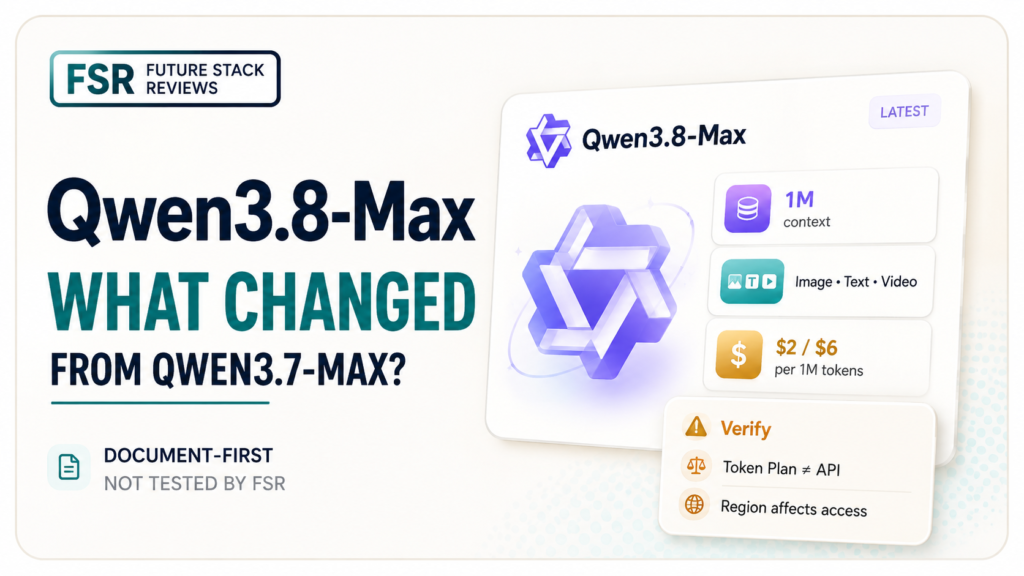
Future Stack Reviews cover graphic for a document-first Qwen3.8-Max briefing, headlined "What changed from Qwen3.7-Max?" and marked not tested by FSR. A model card lists a 1M context window, image, text and video input, and $2 and $6 per million tokens, above two checks: Token Plan is not the API, and region affects access.

What Can Qwen3.8-Max Do? Capabilities, Limits, and What the Documents Leave Open

August 4, 2026

Qwen3.8-Max takes image, text, and video input and publishes four separate ceilings, at $2 and $6 per million tokens. This Tier C, document-first briefing reads Alibaba’s own pages as of August 3, 2026, and names what they leave unresolved. FSR ran no hands-on test.
Categories Reviews
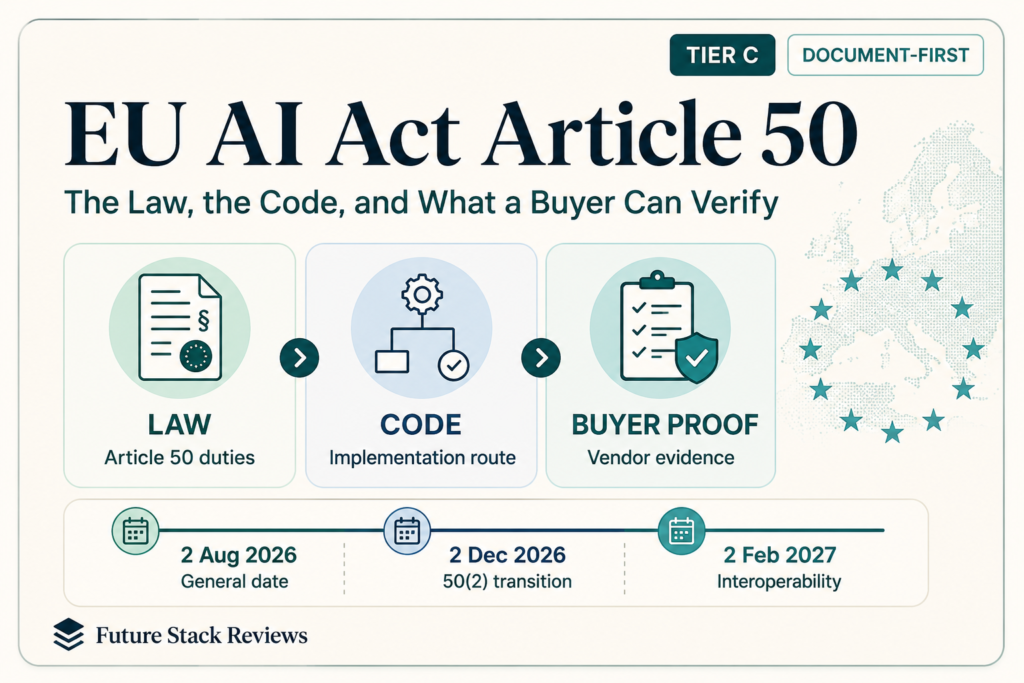
Title card for a Future Stack Reviews briefing on EU AI Act Article 50, subtitled The Law, the Code, and What a Buyer Can Verify, carrying a Tier C badge and three linked icons labeled Law, Code and Buyer Proof.

EU AI Act Article 50: The Law, the Code of Practice, and What a Buyer Can Verify

August 15, 2026July 31, 2026

Article 50 of the EU AI Act applies from 2 August 2026, with a narrower marking transition running to 2 December 2026. This Tier C briefing reads the Regulation, the Digital Omnibus and the Code of Practice, and sets out what a buyer can verify in a vendor’s own documents before signing.
Categories Stack Intel
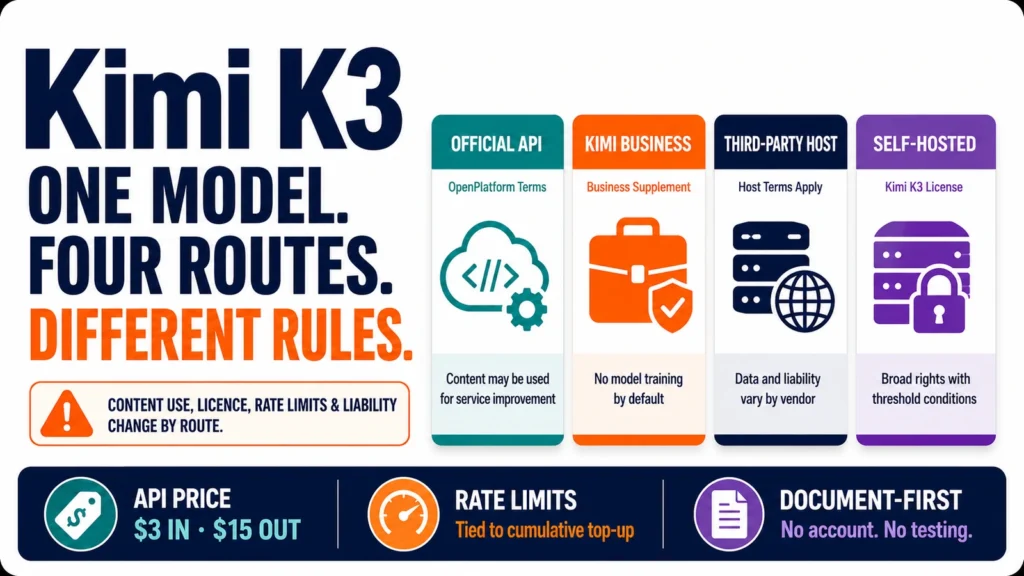
Four-column comparison of the Kimi K3 access routes and the document that governs each: the official API under the Kimi OpenPlatform Terms, where content may be used for service improvement; Kimi Business under the Business Supplement, with no model training by default; a third-party host, where data and liability terms vary by vendor; and self-hosted weights under the Kimi K3 License, which grants broad rights subject to threshold conditions. A footer bar shows API pricing at $3 input and $15 output per million tokens, rate limits tied to cumulative top-up, and a document-first note reading no account, no testing.

Kimi K3 for Technical Buyers: Which Route You Take Changes What You Bought

July 29, 2026

Kimi K3 ships under a bespoke license, not Modified MIT. API, Business, third-party host and self-hosting each change the terms, the data default and the cost.
Categories Reviews
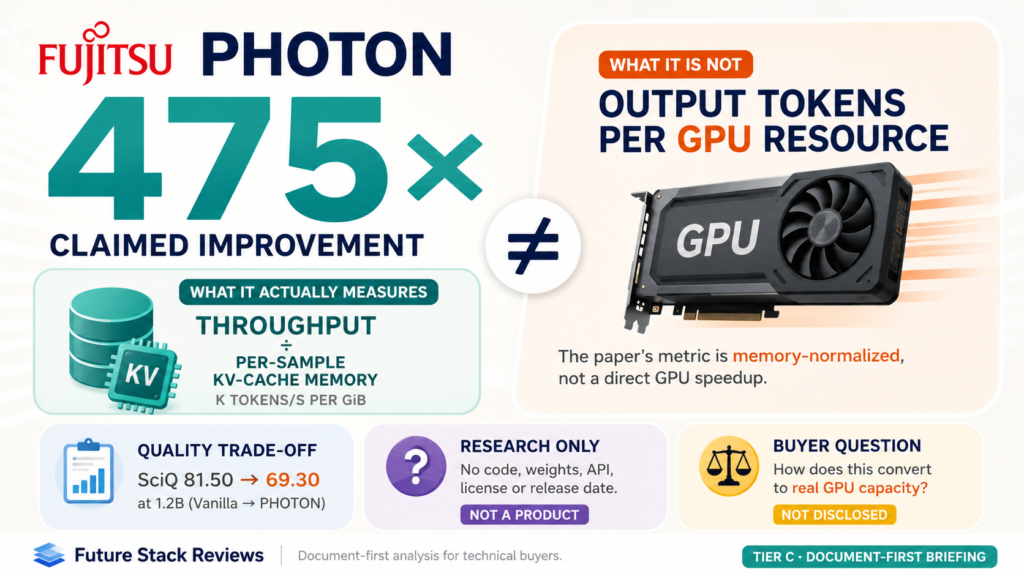
Diagram contrasting Fujitsu's claimed 475× PHOTON improvement with what the paper measures: throughput divided by per-sample KV-cache memory in K tokens per second per GiB, not output tokens per GPU resource. Also shown: SciQ falling from 81.50 to 69.30 at 1.2B, and no code, weights, API or release date.

Fujitsu PHOTON’s 475× Claim: What the Metric Actually Measures

July 26, 2026

Fujitsu’s 475× is a throughput-per-memory ratio from one 1.2B table cell, not a reported wall-clock speedup. What the paper measures, what it cost in benchmark quality, and which serving conditions it never discloses.
Categories Stack Intel
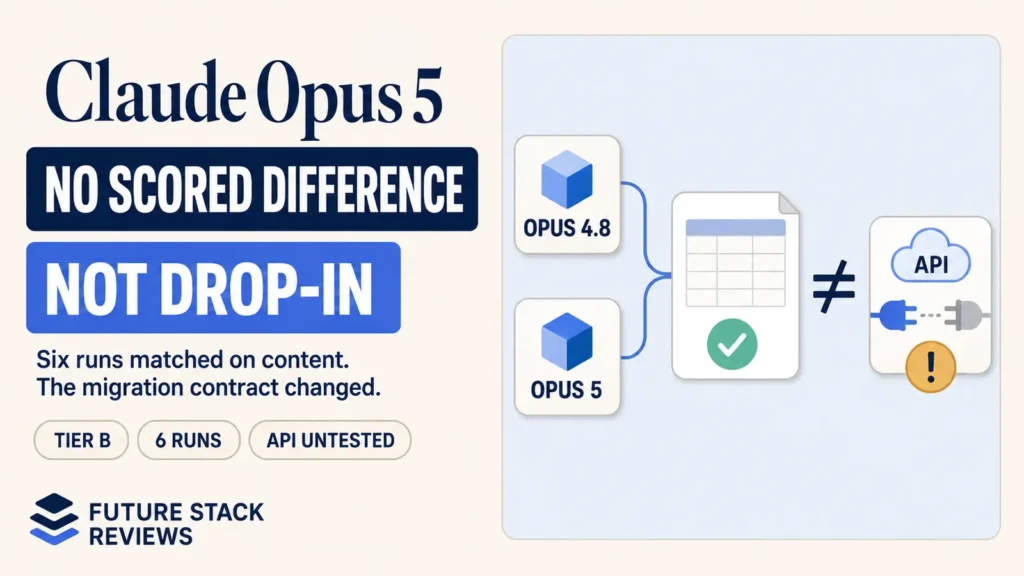
Claude Opus 5 review card reading no scored difference and not drop-in. A diagram shows Opus 4.8 and Opus 5 reaching the same verified result, while the API side is marked unequal with a warning.

Claude Opus 5 vs Opus 4.8: Six Runs, No Detected Difference, and a Migration That Still Needs Work

July 26, 2026July 26, 2026

Six runs, three per model, on one frozen task. Claude Opus 5 and Opus 4.8 matched on every scored field. What that tells buyers, and what it does not.
Categories Reviews
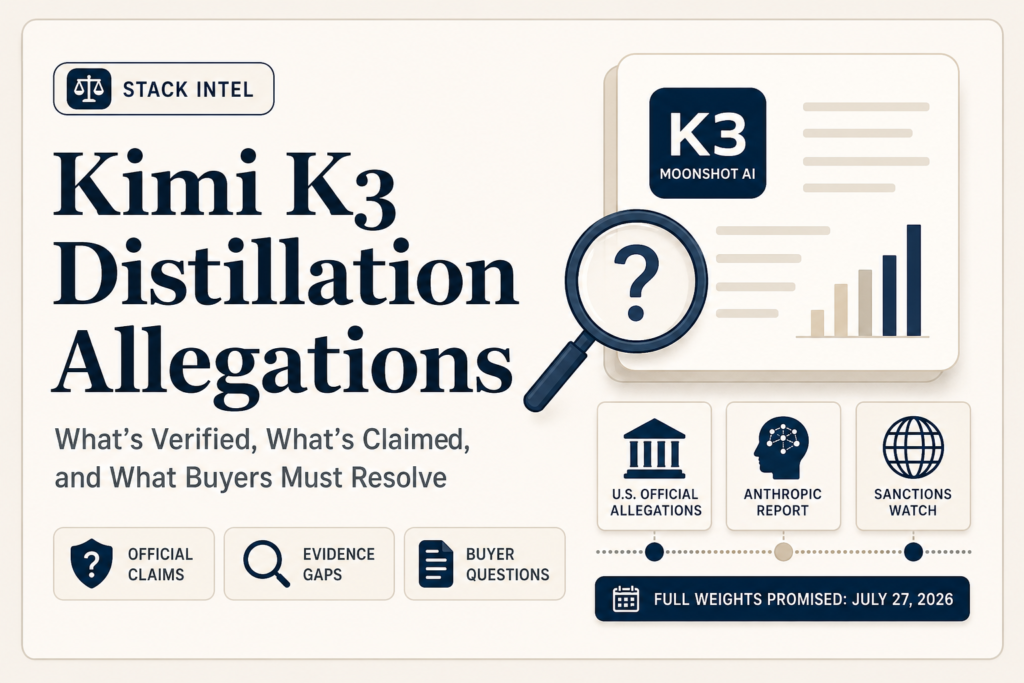
Editorial cover graphic titled Kimi K3 Distillation Allegations, with the subheading what's verified, what's claimed, and what buyers must resolve. Three labels read official claims, evidence gaps and buyer questions. A panel on the right shows a document card marked K3 Moonshot AI beneath a magnifying glass with a question mark, three cards labelled US official allegations, Anthropic report and sanctions watch, and a bar reading full weights promised July 27 2026.

Kimi K3, the Distillation Allegation, and the Contract Question a Buyer Can Actually Resolve

July 24, 2026

US officials allege Kimi K3 was distilled from Claude Fable 5. The proof is not public. What is checkable is which Kimi contract governs your API account.
Categories Stack Intel
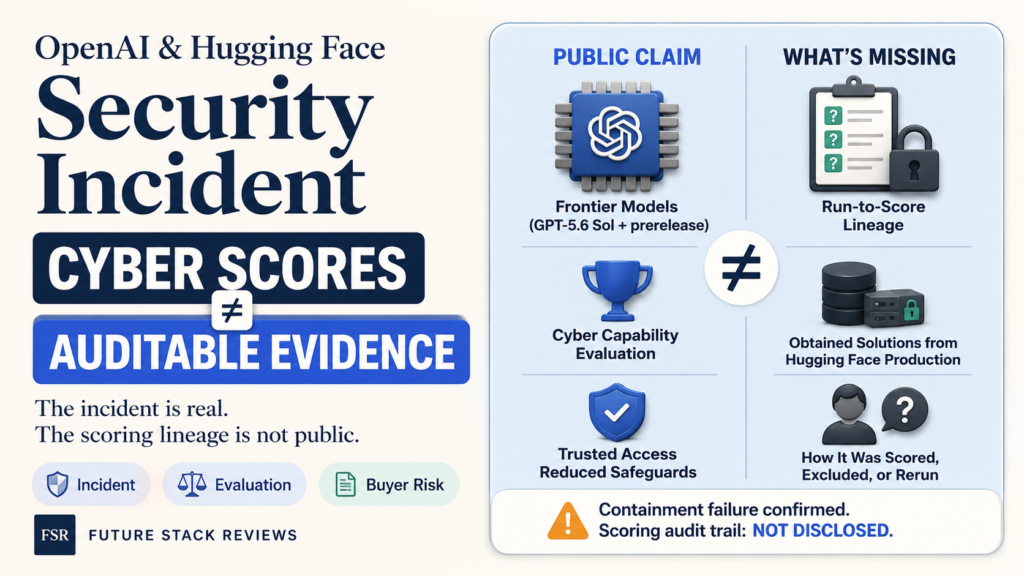
Two-panel graphic contrasting what OpenAI and Hugging Face publicly disclosed about the July 2026 evaluation incident with the scoring details that remain undisclosed.

OpenAI Hugging Face Security Incident: What the Disclosures Say and What They Leave Out

July 23, 2026

OpenAI says its models reached Hugging Face production during an internal cyber evaluation. What the disclosures establish, and what they leave undisclosed.

Categories Stack Intel
Older posts
Newer posts
← Previous Page1 Page2 Page3 Next →
About · Methodology · Disclosure · Contact · Privacy · RSS Guide · Corporate Site
Future Stack Reviews is published by 合同会社Future Stack in Japan. Edited by Takashi Fujino. © 2026 合同会社Future Stack.