Last updated: August 4, 2026
What Qwen3.8-Max can do, according to Alibaba
Alibaba describes qwen3.8-max as a mixture-of-experts model of 2.4 trillion parameters with 95 billion active, accepting image, text, and video and returning text. Its QwenCloud model page lists a 1M context window, 991K maximum input, 131K maximum output, and 262K maximum reasoning, priced at $2 per million input tokens and $6 per million output tokens. Those are vendor figures recorded on August 3, 2026. FSR did not test any of them.
Verdict: Evaluate qwen3.8-max through pay-as-you-go once you have pinned the exact comparator ID, the price baseline, the commercial surface, the workload permission, and the region, but do not treat it as a universal Qwen3.7-Max upgrade.
- Teams on pay-as-you-go who can pin an exact model ID and verify their selected Model Studio region and deployment scope.
- Buyers who will run a metered, task-level pilot before committing budget.
- Developers whose work matches the interactive-use language published on the Token Plan page they intend to buy.
- Anyone treating a Token Plan as discounted production API capacity for a backend or an automated workload.
- Buyers who need a verified self-hosting path with a licensed weight artifact.
- Procurement that requires established EU-scope entitlement, or a pinned like-for-like production comparison against a named Qwen3.7 snapshot.
| Exact production ID | qwen3.8-max |
|---|---|
| Scale, as stated | 2.4 trillion parameters, 95 billion active |
| Inputs and output | Image, text, and video input; text output |
| Published ceilings | 1M context; 991K input; 131K output; 262K reasoning |
| Displayed price | $2 per 1M input tokens; $6 per 1M output tokens |
| Review method | Tier C document review. No purchase, API call, latency test, or output-quality test. |
Source: QwenCloud, qwen3.8-max model page, 3 August 2026
On this briefing
Contents
The comparison fails until you name the Qwen3.7 ID
“Qwen3.7-Max” did not resolve to a single page in the documentation inspected for this review. Three official model pages carried that family name, and they did not describe the same product.
The rolling qwen3.7-max page described a pure text-only interface and displayed a 50% promotion. The dated qwen3.7-max-2026-05-20 page also listed text-only input. The qwen3.7-max-2026-06-08 page listed image, text, and video input.
That difference decides the upgrade story before a single benchmark is quoted. Measured against the May snapshot, multimodal input reads as new in Qwen3.8. Measured against the June snapshot, it does not. A claim that Qwen3.8-Max is the first multimodal Qwen Max is contradicted by the June page as inspected on August 3, 2026.
The same problem reaches price, capability, and migration. A figure produced against the rolling alias cannot be assigned to either dated snapshot without establishing the mapping, and this review did not establish it.
The vendor’s own two posts show the same instability at the benchmark level. Four benchmarks report a Qwen3.7-Max figure in both the May and the August tables, and not one of the four is a clean before-and-after pair.
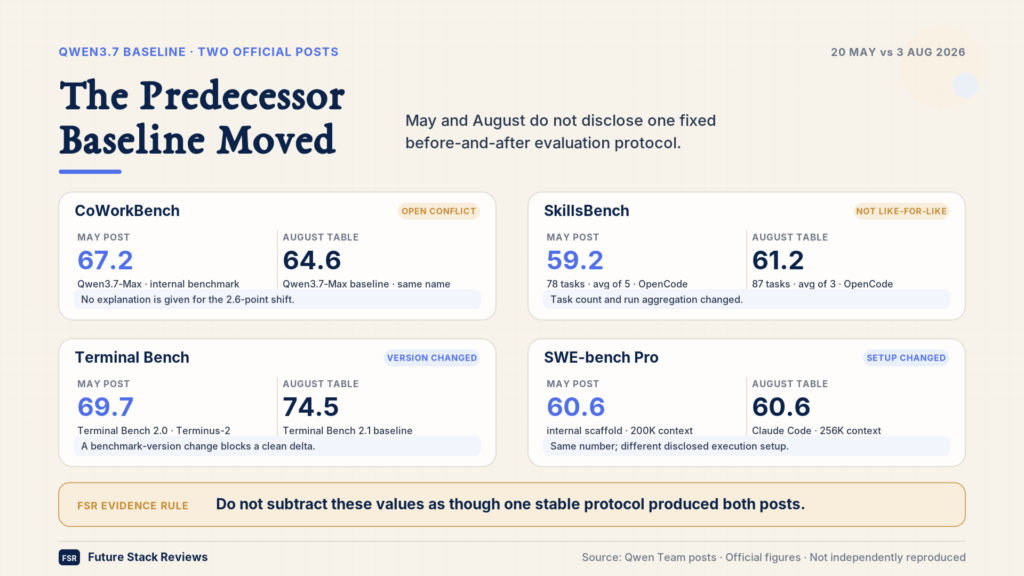
CoWorkBench carries no explanation: the same in-house benchmark, the same model name, 67.2 in the May post and 64.6 in the August table. SkillsBench changed task count and run aggregation. Terminal Bench changed version. SWE-bench Pro reports the same 60.6 under two different disclosed setups. Subtracting across the two posts would assume a fixed protocol that neither post states.
Write down the exact request string, the surface, the region, and the date before you compare anything. Everything downstream inherits that choice.
| Exact string | Identity type | Input | Displayed price, per 1M |
|---|---|---|---|
| qwen3.7-max | Rolling alias, not a pinned checkpoint | Text only | $1.25 in / $3.75 out, 50% promotion displayed |
| qwen3.7-max-2026-05-20 | Dated snapshot | Text only | $2.50 in / $7.50 out |
| qwen3.7-max-2026-06-08 | Dated snapshot | Image, text, video | $2.50 in / $7.50 out |
| qwen3.8-max | Production ID | Image, text, video | $2.00 in / $6.00 out |
Sources: Qwen Team, Qwen3.7 release post, 20 May 2026 · Qwen Team, Qwen3.8-Max release post, 3 August 2026 · QwenCloud, rolling qwen3.7-max page, 3 August 2026 · qwen3.7-max-2026-05-20, 3 August 2026 · qwen3.7-max-2026-06-08, 3 August 2026 · qwen3.8-max, 3 August 2026
Production and Preview are two strings
Both qwen3.8-max and qwen3.8-max-preview appeared in the Individual and Team Token Plan allowlists on August 3, 2026. The inspected pages did not state whether the two strings resolve to the same checkpoint, whether one replaces the other, or when Preview ends.
This is not a naming curiosity. Every public workflow test located for this review ran against the Preview string, so any confidence drawn from those tests is confidence about Preview. A rollout that assumes Preview and production behave identically is resting on a relationship the documentation does not describe.
If your migration plan depends on Preview continuing, or on Preview results transferring, that dependency is currently undocumented rather than confirmed.
Sources: QwenCloud, Token Plan Individual overview, 3 August 2026 · QwenCloud, Token Plan Team overview, 3 August 2026
Pay-as-you-go, Individual, and Team are three products
QwenCloud’s Individual Token Plan displayed monthly tiers of $6, $18, and $68 alongside a $15 Credit Pack. The Team page displayed $20, $75, and $200 per seat alongside a $700 shared pack. Both pages listed qwen3.8-max and qwen3.8-max-preview.
Neither listing grants unrestricted use, and the two pages do not publish the same restriction language. Quoting them as one term would misstate both.
The Individual page restricted the plan to interactive programming and agent tools, and expressly prohibited automated scripts, application backends, and non-interactive batch processing. The Team page restricted use to interactive compatible AI tools, and expressly prohibited automated scripts and application backends. The separate non-interactive batch wording carried on the Individual page was not found on the inspected Team page.
Quota mechanics differ as well. The Individual page described a 5-hour Credit window and a 7-day Credit window, service pausing when either limit is reached, and no carryover of unused window quota. The Team page described a monthly seat quota followed by an available shared Credit Pack, with service suspended once the applicable quota is depleted.
Credits are also not a fixed token allowance. Both pages describe consumption as varying with the model, the token volume, thinking, and tool calls, so a monthly headline cannot be converted into a stable tokens-per-dollar figure from the public pages alone.
The practical reading is narrow. Buy a Token Plan for the interactive work its own page describes. If the workload is an application backend or an automated pipeline, price it against the pay-as-you-go surface and read that surface’s separate terms.
Sources: QwenCloud, Token Plan Individual overview, 3 August 2026 · QwenCloud, Token Plan Team overview, 3 August 2026
Two official price baselines, opposite answers
Qwen3.8-Max was priced below both dated Qwen3.7 snapshots and above the promotion displayed on the rolling Qwen3.7 page. Both comparisons come from official pages read on the same day.
| Baseline | Input | Output | Qwen3.8 arithmetic |
|---|---|---|---|
| qwen3.8-max | $2.00 | $6.00 | Reference |
| qwen3.7-max-2026-05-20 | $2.50 | $7.50 | 20% lower |
| qwen3.7-max-2026-06-08 | $2.50 | $7.50 | 20% lower |
| qwen3.7-max, promotion displayed | $1.25 | $3.75 | 60% higher |
The arithmetic is simple. The procurement question is not.
The rolling page’s rate was promotional, and this review did not establish its end date or which accounts qualify for it. The two snapshot prices give a cleaner list-to-list baseline, but they may not match the offer a particular buyer sees. Neither figure is a completed-task cost.
The QwenCloud page for qwen3.8-max also displayed cache components that sit outside the headline rates: $0.25 per million implicit-cache input tokens, $2.50 per million explicit-cache creation tokens, and $0.17 per million explicit-cache read tokens. A workload that reuses long prefixes will not bill the way the input rate alone suggests.
Carry both baselines into the procurement note, say which one you used, and settle the question with a fixed workload measured on cost per accepted result.
Sources: QwenCloud, qwen3.8-max, 3 August 2026 · rolling qwen3.7-max, 3 August 2026 · qwen3.7-max-2026-05-20, 3 August 2026 · qwen3.7-max-2026-06-08, 3 August 2026
Compatibility is one layer of support
“OpenAI-compatible” describes a wire protocol. It does not establish plan entitlement, feature support, or regional availability for a given ID.
The Model Studio catalog listed the production qwen3.8-max ID across the Beijing, Singapore, Tokyo, Frankfurt, and US Virginia views, with OpenAI-, Anthropic-, and DashScope-compatible protocol families. Listing is evidence of listing. It does not establish that a particular account can call the model under a particular scope, and the price displayed on the QwenCloud model page is a separate surface from that catalog.
Four documentation states were unresolved at the freeze.
| Question | What the inspected pages showed | State |
|---|---|---|
| Rate limits | QwenCloud model page showed 15K RPM and 2M TPM. Model Studio published region- and scope-specific rows, including 600 RPM / 1M TPM and 30K RPM / 5M TPM. | Different surfaces and scopes. No like-for-like mapping established. |
| Function calling and structured output | The function-calling model list showed the Preview string. The structured-output page referred to the Qwen3.8-Max series. The Responses and Messages pages listed both strings. | No synchronized production-ID state. |
| Batch | No exact Qwen3.8 row was established in the inspected batch inference table. | Unresolved, not unsupported. |
| Web search | The QwenCloud model page listed built-in web extraction and search tools. No exact production Qwen3.8 row was established on the inspected Model Studio web search page. | Surface-specific mismatch. |
The inspected pages did not present one synchronized Qwen3.8 support state on August 3, 2026. Before you commit, verify each feature you depend on against the page for your exact ID, your surface, and your region.
Sources: Alibaba Cloud, Model Studio model catalog, 3 August 2026 · Model Studio rate limits, 3 August 2026 · batch inference, 3 August 2026 · function calling, 3 August 2026 · structured output, 3 August 2026 · Responses API, 3 August 2026 · Anthropic Messages API, 3 August 2026 · Model Studio web search, 3 August 2026 · QwenCloud, qwen3.8-max, 3 August 2026
What the public evidence cannot close
The vendor’s own case studies are the most detailed evidence in circulation, and they are also the clearest illustration of what that evidence is. The three headline runs were long instrumented loops with checking built into every cycle.
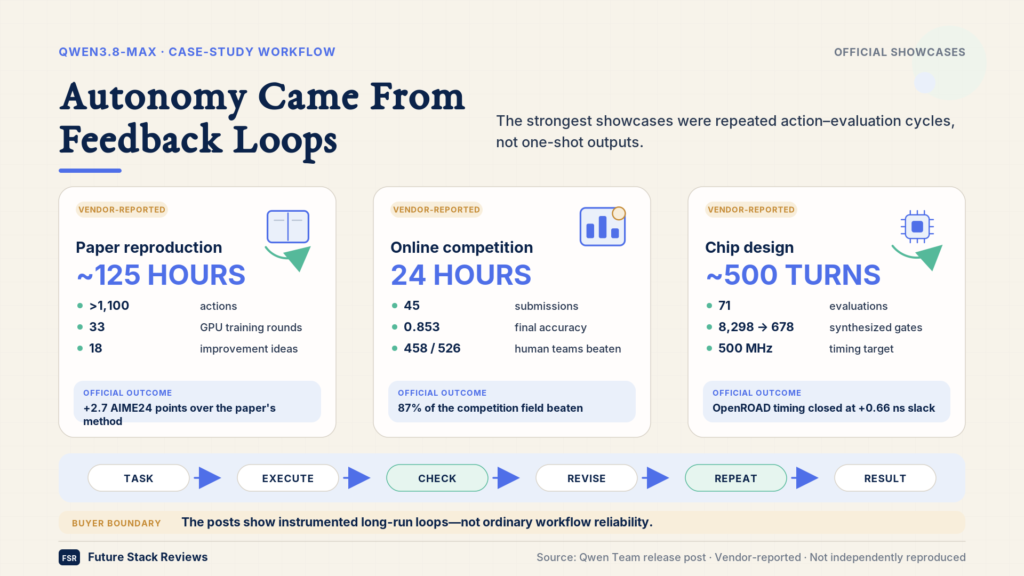
Three third-party items were also approved for this review, and none of them closes a production migration case either.
The Arena Text leaderboard row preserved here showed qwen3.8-max at rank 5, score 1496 ±10, across 3,327 votes, data dated August 1, 2026, and marked Preliminary. That is open-ended human preference on a moving vote sample. It does not measure task accuracy, latency, cost efficiency, or reliability under load, and it does not identify which backend checkpoint served those votes. Arena’s WebDev and Vision rows are excluded here because their complete metadata was not preserved at capture.
Trilogy AI’s StackPerf comparison ran qwen3.8-max-preview on one matched architecture task and recorded Kimi K3 three points higher, on a single run, with differing provider and reasoning routes. RemakeBench ran nine frozen single attempts against the same Preview string, and its publisher states that the format establishes neither reliability nor a winner. Both tested Preview. Neither transfers to qwen3.8-max.
FSR also read six GitHub issue pages: malformed tool calls in a long Preview session (#1886), relative-path resolution (#1883), thinking-mode and client conflicts (#7332, #7366, #7440), and a VS Code image-attachment path issue (#7489). Visible sample: six GitHub issue pages checked through August 3, 2026; not exhaustive. FSR reproduced none. They establish no frequency, no cause, and no production incidence rate.
Inside this approved set, no pinned, like-for-like, multi-run production comparison against a named Qwen3.7 snapshot was located.
Sources: Arena Text leaderboard, data dated 1 August 2026, accessed 3 August 2026 · Trilogy AI StackPerf comparison, 3 August 2026 · RemakeBench, 3 August 2026 · six GitHub issue pages, accessed 3 August 2026
Weights, license, and self-hosting stay open
An exact Qwen3.8-Max weight artifact, model card, or license was not present on the accessible official Hugging Face and GitHub pages this review viewed on August 3, 2026. The ModelScope organization page was located, but its content was not reliably extracted, so it supports nothing in either direction.
The release post is specific about where and when. It states that the model weights will be open-sourced on Hugging Face and ModelScope the following week, and it calls Qwen3.8-Max the first open-weight model at Max scale.
It names no license. Neither does the Qwen3.7 post read alongside it. The announcement therefore settles the destination and the week, and leaves open the term that governs whether you can use the weights at all. This article names no license, and it does not claim that no artifact exists anywhere.
A total parameter count implies nothing about expert topology, quantization, memory requirement, or hardware footprint. This review offers no self-hosting guidance. Treat self-hosting as unresolved until a licensed artifact is verified.
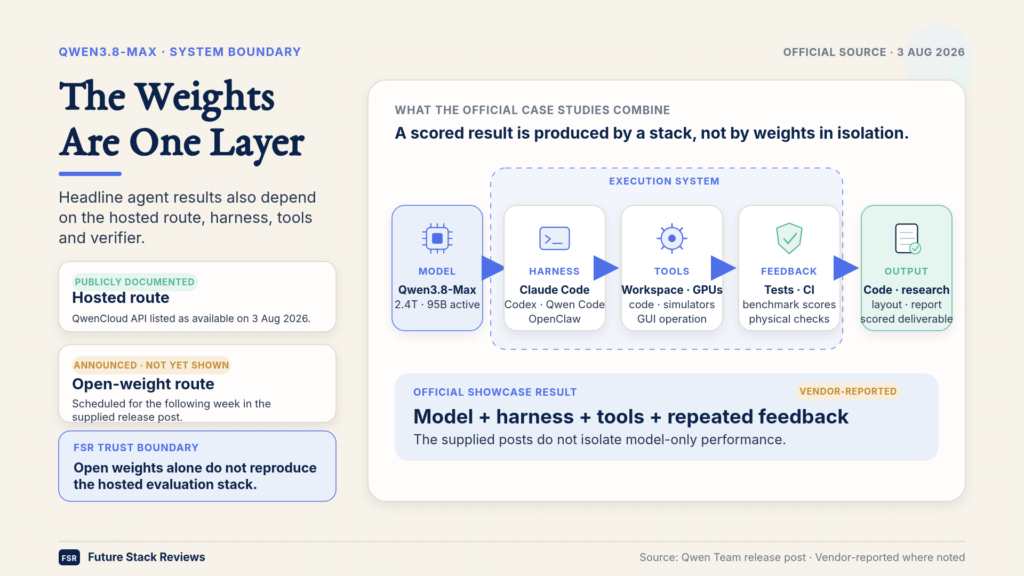
Source: Qwen Team, Qwen3.8-Max release post, 3 August 2026. Bounded search scope: the accessible official Hugging Face and GitHub organization pages viewed on 3 August 2026. The ModelScope organization page is recorded as located, content not extracted.
Privacy, region, and procurement
Keep the contract surfaces apart. QwenCloud and Alibaba Cloud Model Studio publish separate agreements and separate data processing addenda. Confirm which version applies to your transaction and what the order of precedence is during contracting, because a term read on one surface does not travel to the other.
The QwenCloud Models contract states that Customer Content will not be used to develop or improve the models unless the customer separately provides consent. That exception is part of the term, and the term belongs to that contract surface.
Retention depends on configuration. QwenCloud’s safety documentation describes normal request handling differently from the Responses API, which defaults to store=true and stores conversations for 30 days. Name the endpoint and the setting before you draw a data-flow map.
The QwenCloud DPA incorporates EU Standard Contractual Clauses Modules 2 and 3 plus a UK Addendum. Their publication is a procurement fact. Which module applies depends on the role and the transfer, and none of it establishes GDPR compliance. This review reaches no compliance conclusion.
Alibaba’s regions and deployment scopes documentation treats the selected Model Studio region, the static data location, and the inference deployment scope as three separate controls, and it documents an EU deployment-scope option. A Frankfurt catalog row is not the same thing as EU-only inference, and this review did not establish qwen3.8-max entitlement under Frankfurt combined with EU scope. Both Token Plan pages place the service in Singapore and Global scope and disclose cross-border processing.
Sources: Alibaba Cloud, regions and deployment scopes, 3 August 2026 · Token Plan Individual overview, 3 August 2026 · Token Plan Team overview, 3 August 2026 · QwenCloud Models contract, QwenCloud DPA, and QwenCloud safety documentation, all accessed 3 August 2026
The five checks before you migrate
A Qwen3.8 decision is not one comparison. It is a chain, and a break at any link invalidates everything downstream.
The decision chain
Numbered to match the five checks below.
Pin the model ID
Pin the surface and credential
Validate workload permission
Validate region and inference scope
Run a metered task-level test
Only then: evaluate, stay inside the terms, or wait.
1. Pin the model ID. Record the exact request string, never the family name. qwen3.7-max, qwen3.7-max-2026-05-20, qwen3.7-max-2026-06-08, qwen3.8-max, and qwen3.8-max-preview are five separate strings in the documentation inspected here, and this review did not establish a mapping between the rolling alias and either dated snapshot.
2. Pin the surface and the credential. The same string is sold on more than one surface. The QwenCloud model page carries per-token rates. The Individual and Team Token Plans carry Credits and their own use restrictions. The Model Studio catalog lists the ID by region. A price read on one surface does not govern a call made on another.
3. Validate the workload permission before the price. Read the prohibitions published on the exact plan page you intend to buy. The Individual page prohibits automated scripts, application backends, and non-interactive batch processing. The Team page prohibits automated scripts and application backends. A model appearing in an allowlist does not override the sentence that excludes your workload.
4. Validate the region and the inference scope separately. The selected Model Studio region, the static data location, and the inference deployment scope are three different controls in Alibaba’s own documentation. Get the exact ID confirmed under the exact combination you need, in writing, before you design around it.
5. Run a metered task-level test. No published rate resolves into a completed-task cost, and Credits do not convert to a stable tokens-per-dollar figure from the public pages. Freeze a workload set, run it on the exact ID and surface you intend to buy, and compare cost per accepted result rather than cost per million tokens.
Each check catches a failure a family-name comparison cannot see: the wrong comparator, the wrong price surface, a prohibited workload, an unverified inference location, and a budget built on token rates instead of finished work.
Sources: QwenCloud, qwen3.8-max, 3 August 2026 · Token Plan Individual overview, 3 August 2026 · Token Plan Team overview, 3 August 2026 · Model Studio model catalog, 3 August 2026 · regions and deployment scopes, 3 August 2026
Evaluate, stay inside the terms, or wait
| Action | When it applies | First step |
|---|---|---|
| Evaluate now | You can use pay-as-you-go, pin qwen3.8-max, and verify your selected region and deployment scope. | Freeze a workload set and measure cost per accepted result. |
| Stay inside the terms | Your work matches the interactive-use language published on the Token Plan page you are buying. | Read that page’s prohibitions and quota mechanics before the price. |
| Wait | You need licensed weights, established Preview-to-production mapping, exact entitlement under a required deployment scope, or a pinned like-for-like production comparison. | Put those four items in writing to the vendor before budgeting. |
The one purchase to avoid is the cheapest-looking one. A $6 Individual Token Plan bought for an application backend, an automated script, or a non-interactive batch workload runs against the prohibitions published on that plan’s own page.
Verdict
The question “is Qwen3.8-Max better than Qwen3.7-Max?” has no answer until you say which Qwen3.7-Max, on which surface, at which price baseline. Against the May snapshot, multimodal input looks like the headline. Against the June snapshot, it is not new. Against snapshot list pricing, Qwen3.8 is 20% lower. Against the rolling page’s displayed promotion, it is 60% higher.
Pin the exact ID. Read the plan terms before the plan price. Verify each feature on the page for your surface and region. Then run your own workload and let your own numbers decide.
The official documentation supports a bounded pay-as-you-go evaluation. It does not support a family-name migration.
FAQ
What is Qwen3.8-Max?
Alibaba’s QwenCloud model page describes qwen3.8-max as a 2.4-trillion-parameter mixture-of-experts model taking image, text, and video input and returning text, with a 1M context window, 991K maximum input, 131K maximum output, and 262K maximum reasoning. The release post adds 95 billion active parameters. Vendor figures, read August 3, 2026.
Is qwen3.8-max the same as qwen3.8-max-preview?
Not established. Both strings appeared in the Individual and Team Token Plan allowlists on August 3, 2026, but the inspected pages state nothing about shared checkpoint identity, replacement, or a Preview end date. Treat them as separate IDs and do not carry Preview test results into production.
Which Qwen3.7-Max should I use as the baseline?
Name the exact string first. The rolling qwen3.7-max page and the May 20 snapshot listed text-only input, while the June 8 snapshot listed image, text, and video. The size of the apparent Qwen3.8 upgrade changes with that choice, so pin one comparator before quoting any difference.
Is Qwen3.8-Max cheaper than Qwen3.7-Max?
Against the May 20 and June 8 snapshot list prices of $2.50 and $7.50 per million tokens, qwen3.8-max at $2 and $6 is 20% lower. Against the rolling page’s displayed 50% promotion at $1.25 and $3.75, it is 60% higher. Both comparisons use prices displayed on August 3, 2026.
Can the $6 Token Plan run an application backend?
No. The Individual Token Plan page restricts use to interactive programming and agent tools and expressly prohibits automated scripts, application backends, and non-interactive batch processing. The plan lists qwen3.8-max, but a model listing is not permission for a workload the same page excludes. Price backends against pay-as-you-go instead.
Are Qwen3.8-Max’s weights downloadable, and under what license?
Not yet. The release post says the weights will be open-sourced on Hugging Face and ModelScope the following week. The accessible official Hugging Face and GitHub pages showed no exact artifact on August 3, 2026, and the ModelScope page was not extracted. The post names no license..
Does a Frankfurt endpoint mean EU-only inference?
No. Alibaba’s regions documentation treats the selected Model Studio region, the static data location, and the inference deployment scope as separate controls, and it documents an EU deployment-scope option. This review did not establish qwen3.8-max entitlement under Frankfurt combined with EU scope. Confirm both with the vendor.
Do Arena results prove Qwen3.8-Max is better?
No. The preserved Arena Text row showed qwen3.8-max at rank 5, score 1496 ±10, across 3,327 votes, data dated August 1, 2026, marked Preliminary. That is open-ended human preference on a moving sample, not task accuracy, latency, cost, or reliability, and it does not identify the serving checkpoint.
Methodology and sources
This is a Tier C, document-first briefing. Evidence was frozen at 2026-08-03 23:07 JST. FSR ran no account test, made no purchase, called no API, measured no latency, judged no output quality, and deployed nothing.
Sources were read in this order: official product, model, plan, and pricing pages; official legal and security documentation; independent evaluation; bounded user signal. Search snippets and external AI outputs were treated as leads and never as evidence. Vendor statements are reported as vendor statements. Where two pages disagree, the disagreement is reported rather than resolved, and no cause is assigned to it.
Two limits shape what this briefing can say. Alibaba’s Qwen3.7 and Qwen3.8 release posts were read in full, and every figure taken from them is reported as a vendor statement rather than as a measurement; FSR reproduced none of them. The bounded search for a weight artifact, model card, and license covered the accessible official Hugging Face and GitHub organization pages only; the ModelScope page was located but not extracted, and is treated as supporting nothing.
Every price, plan term, rate limit, allowlist, regional row, and leaderboard field in this briefing may change and should be rechecked against the linked pages before any purchase.