Last updated: August 7, 2026
Document-first briefing. The subject is a governance document, so there is no product to run and no account to open. Coding-tool behavior described here was read from each vendor’s own documentation on August 6, 2026 and was not reproduced by FSR. Factual claims are sourced beneath each section. FSR interpretations are labeled as such.
An LLM usage policy is a project rule governing how large language models may be used in contributions. On August 5, 2026, five Rust teams ratified one for the rust-lang/rust monorepo. It permits private AI assistance and admits a narrow class of LLM-created code under a named experiment, subject to reviewer agreement, disclosure, human authorship of specific artifacts, and a higher testing bar.
Rust has not banned AI-assisted contribution. It has added conditions that code quality alone does not satisfy, and the conditions are split across documents that carry different authority.
What happened
- August 5, 2026. Jynn Nelson announced on the Inside Rust blog that five teams had ratified an LLM usage policy, authored by Nelson, for contributions to
rust-lang/rust. The same post states it is not an official Rust stance on LLMs and does not apply everywhere in the project. - The same day. A pull request adding an LLM policy section to
CONTRIBUTING.mdand two checkboxes to the repository’s pull request template was merged. - Two months earlier. The crates.io team had already adopted a different policy for its own repositories, under which disclosure is appreciated but not required.
Who this affects
- Anyone opening a pull request containing LLM-generated code on
rust-lang/rust - People who review or moderate pull requests on that repository
- People who find issues using an LLM and report them there
- People who write issues or comments there that directly quote an LLM
Who it does not affect
- Everyone outside the four groups above. The announcement states so directly.
- Teams working only in private repositories
- Contributors to other
rust-langrepositories, which are outside this policy’s scope - Readers seeking a legal conclusion on AI-generated code ownership. None is offered here.
At a glance
| Item | Detail | Authority |
|---|---|---|
| Ratified | August 5, 2026 | Announcement |
| Ratifying teams | compiler, libs, types, rustdoc, bootstrap, and their subteams | Canonical policy |
| Scope | The rust-lang/rust monorepo only | Canonical policy |
| Excluded | Other rust-lang repositories; submodules, subtrees, and crates.io dependencies; non-ratifying teams such as lang and edition | Canonical policy |
| LLM-created code | Conditionally allowed under a named experiment: pre-arranged, non-critical, high-quality, well-tested, well-reviewed, disclosed | Canonical policy |
| Reviewer requirement | A reviewer must have agreed in advance to review an LLM-created PR, and must be the reviewer assigned to it | Canonical policy |
| Human-authored only | Doc-comments, // SAFETY comments, diagnostic wording, soundness-critical code, commit messages, PR descriptions, comments, and the disclosure itself | Policy and guidance |
| Volume limit | Merging of new LLM-created PRs stops if they exceed half of PRs merged in a six-week window, minimum ten-day cooldown | Canonical policy |
| Automation status | The policy strongly suggests automating the volume limit. It does not state that automation exists. | Canonical policy |
| Evidence date | All sources opened August 6, 2026. Vendor defaults not reproduced. | FSR |
Contents
On this briefing
What the policy covers
The policy applies to the rust-lang/rust monorepo and, within it, to the teams that ratified it: compiler, libs, types, rustdoc, bootstrap, and their subteams. Its appendix names what sits outside. Other repositories in the rust-lang organization are out of scope. So are submodules, subtrees, and crates.io dependencies. So are teams that did not ratify it, with lang and edition given as examples. The appendix also excludes specific artifacts, including T-lang tracking issues and proposals, language documentation, the style guide, and the names of compiler lints. Diagnostic messages remain covered even where lint names are not.
The announcement explains why the policy exists in operational terms. It identifies a shortage of review capacity that easier code generation makes worse, reports 1,281 open pull requests on the repository at the time of writing, and describes mechanical copy-pasting between a reviewer and a model as wasted effort for both. On the signal problem it is blunt: “Polished PRs no longer indicate effort”.
Anyone summarizing this as a Rust-wide ban on AI-generated code is wrong on three counts at once. It is one repository, five teams, and a conditional permission rather than a prohibition. The appendix settles all three in about a minute of reading.
Sources: Inside Rust Blog, 5 August 2026 · Rust Forge, LLM usage policy, Appendix: Scope, retrieved 6 August 2026
Four surfaces, one canonical
Four public documents describe these rules. They do not carry equal weight, and the difference changes what a given sentence obligates.
Authority map
| Inside Rust announcement | Rationale and summary. Explains the reasoning. Not a rule. |
| Rust Forge, LLM usage policy | Canonical. The moderation policy. Bans, conditional allowances, experiment conditions, volume limit, scope. |
| rustc-dev-guide | Subordinate guidance, containing mandatory wording. Two pages: one for authors, one for reviewers. |
| Pull request template | The implemented interface. Records whether an LLM was used. |
The dev-guide states the ordering itself. Its landing page describes the section as a list of guidelines and a summary of the moderation policy, says it is not the policy, and adds: “If the two conflict, Forge is canonical.”
That ordering is not an academic point. The two surfaces express different standards on the same question, which is the subject of section five.
Sources: Rust Compiler Development Guide, Working with LLMs, retrieved 6 August 2026 · Rust Forge, LLM usage policy, retrieved 6 August 2026 · GitHub, rust-lang/rust pull request 155424, merged 5 August 2026
What changes before the next PR
For a team already using coding agents, the following is what the published documents require. Each row states whether the requirement is canonical policy or subordinate guidance.
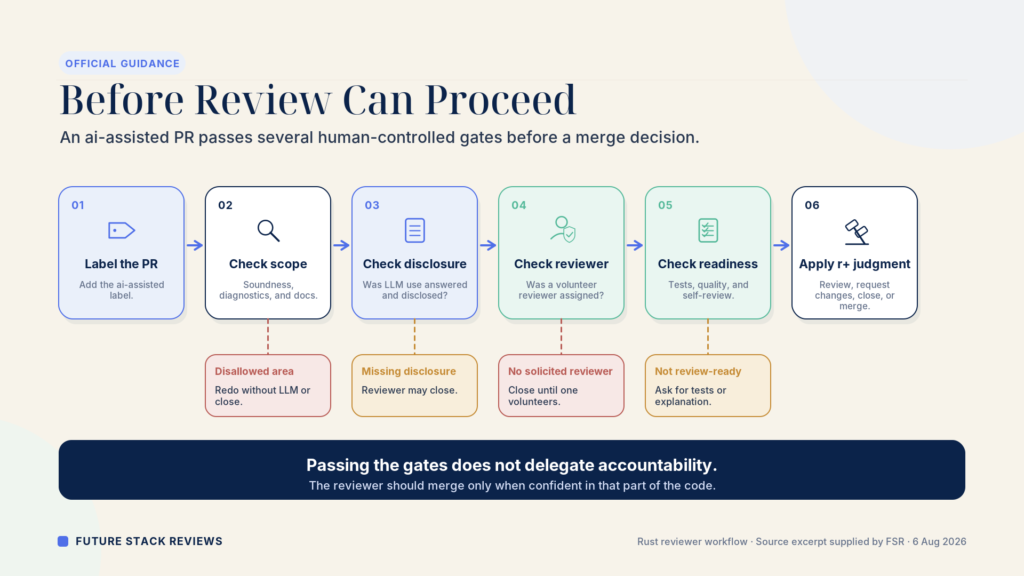
Contributor workflow
| Stage | Required action | Authority |
|---|---|---|
| Before coding | Find a reviewer who volunteers to review your PR. Without a contact, ask in the #llm-mentoring Zulip channel, stating your experience, the problem, and how you expect to test. | Guidance (recommended) |
| Before opening the PR | A reviewer must have communicated ahead of time that they will review an LLM-created PR, and must be the reviewer assigned to it. New contributors cannot use an LLM unless they first talk with that reviewer. | Canonical |
| Issue selection | Do not use an LLM on E-easy issues. Ask before starting an E-mentor issue. | Guidance |
| While working | Write doc-comments, // SAFETY comments, diagnostic wording, and soundness-critical code yourself. An LLM may review that work but may not write it from scratch. | Guidance |
| Commit preparation | Commit messages must be authored by you. | Guidance |
| PR preparation | Write the PR description, comments, and the disclosure yourself. The disclosure states the extent and purpose of your LLM use. An LLM may privately review a disclosure you wrote; it may not draft or rewrite it. | Policy and guidance |
| Template | Check one of the two LLM boxes. Do not delete the question. | Implementation |
| Review and merge | Supply tests. Untested LLM PRs will not be merged, and there is no exception for tests being difficult. Merging can also be paused by the aggregate volume limit. | Policy and guidance |
Authority column reflects which document states the requirement. Where the two differ, the canonical policy controls.
Sources: Rust Compiler Development Guide, Writing LLM-created code, retrieved 6 August 2026 · Rust Forge, LLM usage policy, Experiment section, retrieved 6 August 2026 · GitHub, rust-lang/rust pull request 155424, merged 5 August 2026
Quality is required and does not erase origin
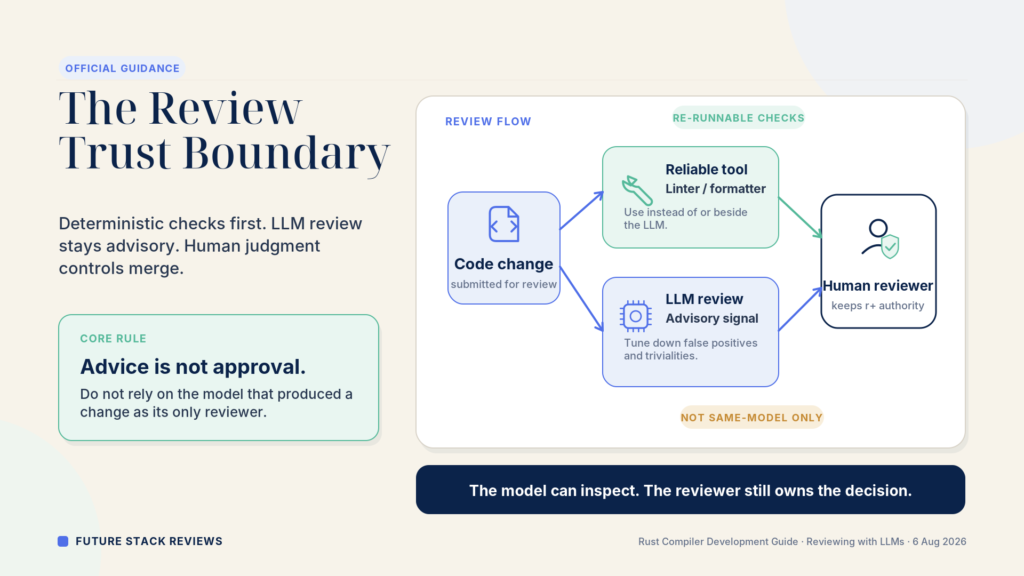
Some coverage frames this policy as a shift from judging output to judging process. That framing does not survive contact with the text.
The experiment admits LLM-created code changes only when they are pre-arranged, non-critical, high-quality, well-tested, and well-reviewed. Both author and reviewer are expected to understand the code. The policy sets a higher testing expectation for LLM-created PRs than for human-created ones, on the stated reasoning that models make tests cheaper to produce, and the guidance adds that untested LLM PRs will not be merged. Technical quality is a hard requirement.
What the policy adds is a second axis that quality does not move. The appendix defines the phrase originally created by an LLM as text generated by an LLM and possibly edited afterward by a human, then states: “No amount of editing can change how it was originally created”. The policy also records that it draws no distinction between output from a chat interface and output from editor auto-completion.
The result is an admission test with several independent parts. Is the code technically acceptable and tested? Does the contributor understand it well enough to defend it? Was a reviewer secured? Was the LLM involvement disclosed in the required form? A patch can clear the first two and fail the rest.
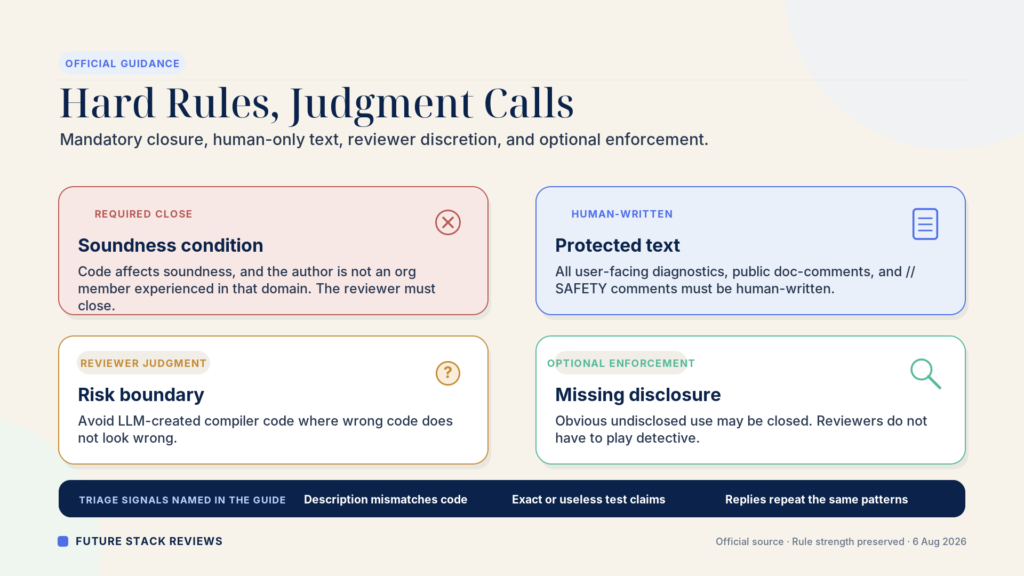
On the reviewer side, the guidance names three currently banned areas. All user-facing diagnostics must be human-written. All public doc-comments and all // SAFETY comments must be human-written. For code that affects soundness, if the author is not an organization member who is experienced in the domain, the reviewer is required to close the pull request.
The guidance is candid that the soundness boundary is imprecise. It notes the phrase is both broader and narrower than it sounds, since almost all of the compiler bears on soundness while much of rust-lang/rust is not the compiler, listing library, bootstrap, compiletest, rustdoc, and CI. Where a reviewer is uncertain, it suggests withholding LLM-generated code from “parts of the compiler where wrong code does not look wrong”, and then states that the decision is the reviewer’s judgment.
Sources: Rust Forge, LLM usage policy, Rules and Appendix, retrieved 6 August 2026 · Rust Compiler Development Guide, Reviewing with LLMs, retrieved 6 August 2026 · Rust Compiler Development Guide, Writing LLM-created code, retrieved 6 August 2026
Where the floor and the workflow diverge
The canonical policy sets an admissibility floor. The subordinate guidance describes the workflow that keeps a contributor from doing work that gets discarded. On three questions these two produce different answers, and the difference is where engineering time is lost.
Reviewer timing. The canonical requirement attaches to the pull request: a reviewer must have agreed in advance to review an LLM-created PR, and must be the one assigned. Nothing in the canonical text requires that agreement before code is written, with one exception the policy states explicitly, that new contributors cannot use an LLM unless they first talk with that reviewer. The guidance takes a stricter line for everyone, telling authors to find a volunteer reviewer before anything else. A contributor who follows only the floor may write a patch and then discover that no reviewer will take it.
Disclosure. The canonical requirement is that LLM use be disclosed. The merged template implements that as a two-option checkbox. The guidance defines what an adequate disclosure contains: the extent and purpose of the use, written by the contributor, describing whether the model implemented an idea, proposed one, reviewed the patch, or performed some narrower task. The guidance states plainly that model identity is not the information wanted.
Testing. The canonical requirement is well-tested code with an explicitly higher bar for LLM-created PRs. The guidance converts that into an operational rule, stating that untested LLM PRs will not be merged and that the author is expected to verify the tests fail before the change and pass after it.
Reading only the canonical policy produces a defensible legal position and an unreliable workflow. Reading only the guidance produces a workable habit and an inaccurate account of what is actually mandatory. Teams writing an internal contribution checklist need both, and need to record which is which, because the canonical document controls if the two ever conflict.
The separation described in this section is FSR’s reading of the two documents. Neither document characterizes itself as a floor.
Sources: Rust Forge, LLM usage policy, Experiment section, retrieved 6 August 2026 · Rust Compiler Development Guide, Writing LLM-created code, retrieved 6 August 2026 · GitHub, rust-lang/rust pull request 155424, merged 5 August 2026
Tool attribution and the disclosure
The guidance lists two examples of inadequate disclosure. One is a generated-with product line. The other is a co-author trailer naming a model. Neither string is false. Neither states what the model did.
That intersects with what coding tools currently document as their defaults.
Documented behavior, read 6 August 2026
| Product | Documented default | Configurability as documented | Evidence status |
|---|---|---|---|
| Claude Code | An attribution setting with separate commit and pr keys. Default commit attribution is a co-author trailer naming the session’s active model. Default PR attribution is a generated-with product line. | Documented as customizable; an empty string on either key hides that attribution. | Official claim. Not reproduced by FSR. |
| Qwen Code | general.gitCoAuthor.commit and general.gitCoAuthor.pr, both documented as defaulting to true. The commit setting also attaches a per-file AI-attribution git note. | Documented as boolean settings; disabling the commit setting skips both behaviors. | Official claim. Not reproduced by FSR. |
| GitHub Copilot CLI | No attribution default is documented on the page reviewed. When /pr create generates a title and description, the documentation states Copilot follows a repository pull request template if one exists. | Not addressed on the page reviewed. | Official claim. Whether it answers Rust’s LLM question is untested. |
Vendor documentation retrieved 6 August 2026. Setting names and defaults change between releases. Verify against current documentation before acting on this table.
The Claude Code documentation gives the default pull request attribution as 🤖 Generated with Claude Code, which renders as the same line the guidance lists as inadequate. Its documentation also states that the model name in the commit trailer reflects the session’s active model, so the specific model named in the guidance example will age out while the shape of the string does not. Qwen Code documents its commit setting as adding a “Add a Co-authored-by trailer to git commit messages” behavior, defaulting to on. The GitHub Copilot CLI documentation states that “Copilot follows it when generating the pull request title and description” where the referent is a repository pull request template, which is the surface now holding Rust’s LLM question.
Three limits on what this table supports.
The policy governs contributors. Nothing here establishes that any product is noncompliant with anything, and a default that omits extent and purpose is not a defect in a feature that was never designed to carry them.
Disabling generic attribution removes an inadequate string. It does not produce the disclosure the guidance asks for. That remains a per-pull-request piece of human writing, and no configuration change substitutes for it.
FSR did not install, run, or configure any of these tools. Every statement in the table is what the vendor’s documentation said on the date shown.
Sources: Claude Code Docs, Attribution settings, retrieved 6 August 2026 · Qwen Code Docs, Configuration, retrieved 6 August 2026 · GitHub Docs, Managing pull requests with the /pr command, retrieved 6 August 2026 · Rust Compiler Development Guide, Writing LLM-created code, retrieved 6 August 2026
The aggregate volume limit
The policy includes a mechanism it calls a circuit breaker. If more than half of the pull requests merged in a six-week window are LLM-created, merging of new LLM-created PRs is disallowed until the share falls back below fifty percent, with a minimum cooldown of ten days. The policy states the six-week window aligns with the release cycle and that the cooldown period aligns with the Final Comment Period process, with the stated purpose of avoiding rapid switching between allowed and disallowed.
This creates two planning problems for a team that contributes regularly.
It operates on aggregate volume rather than on any individual submission, so a compliant, tested, pre-arranged pull request can wait on the merge behavior of contributions it has no relationship to. And the policy strongly suggests that the mechanism be automated, which is a recommendation rather than a statement that automation exists. The policy page does not identify where a current ratio is published, so a team planning around the threshold cannot check proximity to it from that document.
Sources: Rust Forge, LLM usage policy, Circuit breaker, retrieved 6 August 2026
One organization, two disclosure rules
Two months before the monorepo policy was ratified, the crates.io team adopted a different one. A pull request merged on June 5, 2026 brought the CPython developer guide’s AI tools policy into crates.io as docs/AI-TOOLS.md, with one Python-specific sentence removed, linked from CONTRIBUTING.md and AGENTS.md. That policy places responsibility for content on the submitter and requires contributors to be able to explain their changes. On disclosure it lands differently from the monorepo policy: appreciated, but not required.
The pull request discussion records that this was argued rather than assumed. Reviewers pressed for mandatory disclosure on two grounds, accounting for contribution origin and review practicalities, and proposed a lightweight trailer as the minimum form. Others argued that mandating disclosure carries its own costs, citing published findings that disclosure can reduce trust, the risk of false accusations once readers are primed to look, and the enforcement burden a mandatory rule creates. The proposal merged without a disclosure requirement.
One line from that discussion bears on the previous section. Arguing against a mandatory trailer, the author noted that “getting that tooling to reliably add trailers is a whole separate problem”.
Later in the thread, a contributor asked what would happen if the monorepo policy were proposed project-wide, observing that adopting it would mean withdrawing things crates.io currently permits. The response was that the monorepo policy is scoped to one repository and that extending it would require an RFC with buy-in from all teams.
Both policies keep human responsibility and permit AI assistance. They differ on whether disclosure is mandatory. For a team contributing across the organization, the operational conclusion is that the unit of AI-governance compliance is the repository, not the tool and not the parent organization.
Sources: GitHub, rust-lang/crates.io pull request 13726, merged 5 June 2026
What the documents do not establish
- Whether the volume limit is implemented in automation today. The policy recommends automating it and does not state that it is automated.
- Where the current share of LLM-created merged pull requests is published, if anywhere.
- Whether the pull request template validates the quality of an explanation. The template records that an LLM was used; the adequacy standard sits in the guidance.
- Whether GitHub Copilot CLI, or any tool, correctly completes Rust’s template question. FSR ran no test.
- Whether tools other than the two named here document comparable attribution defaults. FSR checked three products.
- Whether a project-wide policy will eventually supersede this one. That governance track is separate and unresolved.
Sources: Rust Forge, LLM usage policy, retrieved 6 August 2026 · GitHub, rust-lang/rust pull request 155424, merged 5 August 2026
FAQ
Did Rust ban AI-generated code?
No. LLM-created code is conditionally allowed under a named experiment when it is pre-arranged with a reviewer, non-critical, high-quality, well-tested, well-reviewed, and disclosed. Separate categories are banned outright, including LLM-created documentation, compiler diagnostics, and comments posted from a personal account.
Which teams and repositories are covered?
The rust-lang/rust monorepo, and within it the compiler, libs, types, rustdoc, and bootstrap teams plus their subteams. Other repositories in the organization, submodules, subtrees, crates.io dependencies, and non-ratifying teams such as lang and edition are outside its scope.
Must I find a reviewer before writing code?
The canonical requirement is that a reviewer has agreed in advance to review an LLM-created PR and is the one assigned to it. New contributors cannot use an LLM until they have talked with that reviewer. The dev-guide goes further and tells all authors to find a reviewer before anything else.
What must be written by a human?
Public doc-comments, all SAFETY comments, user-facing diagnostic wording, soundness-critical code, commit messages, the pull request description, GitHub comments, and the LLM disclosure. An LLM may privately review a disclosure you wrote but may not draft or rewrite it.
Is a tool-generated co-author line enough?
The guidance lists a model co-author trailer and a generated-with product line among its inadequate examples, and states that model identity is not the information wanted. What it asks for is the extent and purpose of the use, written by you. Removing the string does not create that account.
Does editor autocomplete count?
The policy states it makes no distinction between output from a chat interface and output from editor auto-completion, and adds that in most cases such output is trivial. Trivial changes sit in the conditionally allowed category, and everything in that category requires disclosure that an LLM was used.
What triggers the circuit breaker?
More than half of pull requests merged in a six-week window being LLM-created. Merging of new LLM-created PRs then stops until the share returns below fifty percent, with a minimum ten-day cooldown. The window aligns with the release cycle and the cooldown with the FCP process.
Does crates.io use the same policy?
No. The crates.io team adopted the CPython developer guide’s AI tools policy in June 2026, under which disclosure is appreciated but not required. Both policies place responsibility on the submitter and require contributors to explain their changes. They differ on whether disclosure is mandatory.
Sources: Rust Forge, LLM usage policy, retrieved 6 August 2026 · Rust Compiler Development Guide, Writing LLM-created code, retrieved 6 August 2026 · Rust Compiler Development Guide, Reviewing with LLMs, retrieved 6 August 2026 · GitHub, rust-lang/crates.io pull request 13726, merged 5 June 2026
Methodology
This is a Tier C briefing: document-first, with no hands-on testing. The subject is a governance document, so no product was run and no account was opened.
Every source cited was opened and read directly on August 6, 2026. Publication dates are shown where a document displays one; otherwise the retrieval date is recorded. The LLM usage policy on Rust Forge is canonical. The two rustc-dev-guide pages are subordinate guidance containing mandatory wording, and the guide states that Forge controls where the two conflict. Each source caption identifies which layer a requirement comes from.
Coding-tool behavior was read from each vendor’s own current documentation on August 6, 2026. FSR did not install, run, or configure any of these tools and did not observe their output. Those statements are official vendor claims, they are date-locked, and the defaults are configurable and subject to change between releases. The Rust documents name one product in their disclosure examples; the second product was identified by FSR from vendor documentation, not from any Rust source.
FSR used AI assistance for source discovery, extraction, and adversarial review of this argument. Every cited source was then opened and read before any claim was written, and one research output was discarded in full after asserting the existence of a policy section that does not exist. A human accepted editorial responsibility for the final text. Given that this briefing examines automated attribution, disclosing FSR’s own process is a requirement rather than a courtesy.
Commercial relationships: FSR holds paid subscriptions to Claude Code, Qwen Code, and GitHub Copilot, and used them in its own work. FSR has no affiliate arrangement or sponsorship with any named vendor, and this article contains no affiliate links. No named vendor was contacted before publication.
Corrections are published with a dated note rather than applied silently.
Full source list: Inside Rust Blog, 5 August 2026 · Rust Forge, LLM usage policy · rustc-dev-guide, Working with LLMs · rustc-dev-guide, Writing LLM-created code · rustc-dev-guide, Reviewing with LLMs · GitHub, rust-lang/rust PR 155424 · GitHub, rust-lang/crates.io PR 13726 · Claude Code Docs, Settings · Qwen Code Docs, Configuration · GitHub Docs, Copilot CLI pull requests
Verdict
Keep the tool. Change the workflow, and write the checklist against the canonical policy while following the guidance.
Rust has not made AI-assisted contribution impossible. A disciplined contributor can comply using the tools they already have, provided the team secures a reviewer before the pull request exists, keeps commit messages, pull request prose, documentation, diagnostics, and the disclosure in human hands, understands the patch well enough to defend it, and supplies tests. Nothing in the policy stops that.
What changes is where the failure modes sit. Technical quality remains mandatory and now sits alongside conditions it cannot satisfy: an agreed reviewer, an accurate account of what the model did, and a category boundary that a reviewer decides. A team that treats generic tool attribution as the upstream project’s required disclosure has satisfied a checkbox and not the standard behind it.
The practical instruction is narrow. Treat upstream AI policy as repository configuration rather than as a tool-wide permission, write a per-repository contribution checklist that marks which rules are canonical, and check the policy again before each material submission. The rules differ between rust-lang/rust and crates.io today, and a project-wide reconciliation has been raised without being settled.
Contact us
Questions, corrections, or a policy we should read next?
Future Stack Reviews publishes structural audits of AI and SaaS products for technical buyers, separating what a vendor states from what the documents and interfaces actually establish. If your team contributes upstream with coding agents and you want a briefing on a specific repository’s rules, tell us which repository.
Corrections are welcome and are published with a date. If any statement here does not match the source it cites, send the sentence and the source, and we will check it.
Related FSR briefings
Best Tools and Alternatives are comparison formats. Tier B briefings are hands-on tested. Tier C briefings are document-first.
-
Best Tools
Best AI Coding Assistant 2026: 42% of Code Is Now AI-Generated. Here’s What Nobody Tells You About the Other 58%
Why an aggregate cap on LLM-created pull requests is not a hypothetical constraint.
-
Tier B
Claude Code Review: 5 Costly Mistakes Every Developer Makes
Hands-on testing of the tool whose default attribution appears in this briefing.
-
Tier B
Fable 5 Built a Landing Page, Then Security-Reviewed Its Own Code. Zero Fixes. Here’s What “Clean” Actually Meant.
What happens when the model that wrote the code is also the one reviewing it.
-
Alternatives
7 GitHub Copilot Alternatives That Won’t Waste Your Money (2026)
Pricing and access for the tool whose CLI is documented to follow a repository’s pull request template.
-
Tier C
EU AI Act Article 50: The Law, the Code of Practice, and What a Buyer Can Verify
Disclosure obligations in a different register: statute rather than a repository policy.
-
Tier C
OpenAI Hugging Face Security Incident: What the Disclosures Say and What They Leave Out
The same reading applied to an incident record: what the disclosures state, and what they leave open.
Future Stack Reviews publishes structural audits of AI and SaaS products for technical buyers. This briefing is Tier C: document-first, with no hands-on testing. It describes what published documents state, and does not constitute legal advice or a compliance assessment. Coding-tool defaults were read from vendor documentation on the date shown and are configurable and subject to change.
Last updated: August 7, 2026. Published by 合同会社Future Stack.