Last updated: August 11, 2026
Public pages only. Future Stack Reviews held no paid account, ran no test, took no measurement, and viewed no invoice or logged-in screen. Statements about a vendor describe page content on the access date. Reasoning, recommendations, and the classification scheme are FSR’s own.
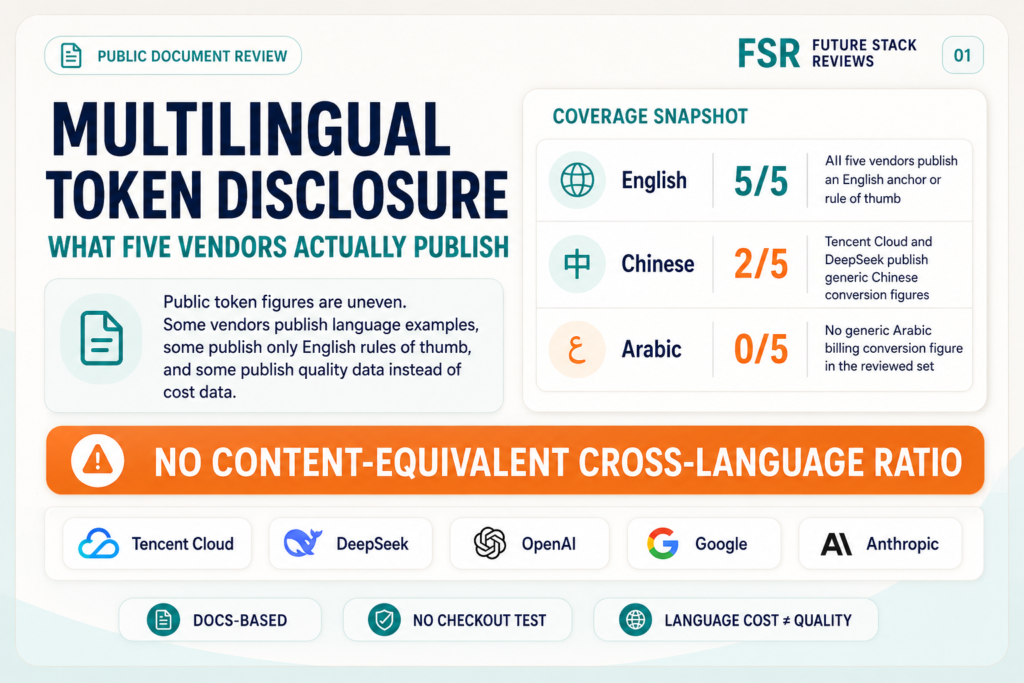
AI token cost by language is the change in billable token volume when the same content is written in a different language. Nine public pages from five vendors were read on 11 August 2026. All five publish a token figure for English, and four of those figures sit within a narrow band. Two publish a figure for Chinese. None publishes one for Arabic, and no page in the set supplies a figure that compares two languages against equivalent content.
Verdict in one line: the published figures converge on English and fragment past it, so count your own text against the exact model before you commit.
Before you read on
What was found
The published record has three tiers. English is covered by all five vendors with figures that broadly agree. Chinese is covered by two. Arabic is covered by none. No page bridges any two languages against equivalent content.
Who this touches
Anyone billed per token who works outside English. Teams shipping into a non-English market. Finance staff reconciling a token invoice against a rate card that did not change.
Who this does not touch
Buyers on flat per-seat plans with no token meter. English-only workloads. Teams already counting production traffic by language against the deployed model, whose telemetry beats every figure below.
What a document review separates
Can separate: which languages a page names, what its figure measures, whether two figures share a denominator.
Cannot separate: what any language actually costs, and what appears behind a login.
At a glance
| Review date | 11 August 2026 |
| Vendors | Tencent Cloud, Anthropic, OpenAI, Google, DeepSeek |
| Pages in the reviewed set | 9 |
| Vendors publishing an English token figure | 5 of 5 |
| Vendors publishing a Chinese token figure | 2 of 5 |
| Vendors publishing an Arabic token figure | 0 of 5 |
| Pages giving a content-equivalent cross-language ratio | 0 of 9 |
| Counting published with no account required | OpenAI, DeepSeek |
| FSR measurement | None |
| Logged-in surfaces | Out of scope, not reported as empty |
| Affiliate relationship | None with any vendor named |
Contents
On this briefing
Where the five vendors agree
Read the five side by side and the first thing that stands out is how closely they agree, as long as the language is English.
Anthropic’s pricing page states that one token is approximately four characters or 0.75 words in English. OpenAI’s help center lists its numbers under the heading “Helpful rules of thumb for English”, starting with four characters and three quarters of a word. Google’s token documentation gives “a token is equivalent to about 4 characters”, then adds 100 tokens for roughly 60 to 80 English words. Tencent Cloud’s billing page puts English at about 0.75 words per token. DeepSeek states 0.3 tokens per English character, which works out near three and a half characters per token.
Five vendors, five separate documents, and one language covered by all of them in figures that sit within a narrow band.
Chinese has a smaller version of the same agreement. Tencent gives about 1.8 Chinese characters per token. DeepSeek gives about 0.6 tokens per Chinese character, which is roughly 1.7 characters per token. Two vendors, two figures, close together.
Arabic has none. Across the nine pages, no vendor publishes a characters-per-token or words-per-token figure for Arabic. The two Arabic numbers in the set measure something else. OpenAI’s 2024 announcement counts one sample sentence under two tokenizer generations. Anthropic’s multilingual page scores Arabic against an English performance baseline.
The published record therefore has three tiers. A buyer working in English can sanity-check an estimate against five vendors. A buyer working in Chinese can do it against two. A buyer working in Arabic has nothing published to check against.
Sources: Anthropic, accessed 11 August 2026 · OpenAI, accessed 11 August 2026 · Google, updated 30 July 2026 · Tencent Cloud, 11 August 2026 · DeepSeek, accessed 11 August 2026
What each page publishes
The table records what each figure measures rather than how detailed it looks. Denominators matter more than decimal places, because two figures in different denominators cannot be divided into each other.
| Vendor and page | What the figure measures | Denominator | Languages named |
|---|---|---|---|
| Tencent Cloud, TokenHub billing methods | Token estimate for text models | Chinese in characters, English in words | Chinese, English |
| DeepSeek, Token & Token Usage | Character-to-token ratio | Characters for both | Chinese, English |
| Anthropic, Pricing | Rule of thumb, plus a note that the count varies by language and content type | English characters and words | English |
| OpenAI, help center token article | Rules of thumb labeled for English, plus two counting tools | English characters and words | English |
| Google, understand and count tokens | Character anchor, English word range, and multimodal token rates | Characters, English words, seconds, pixels | English |
| Google, Gemini API pricing | Prices per unit, plus modality-to-token conversions for selected models | Seconds, pixels, images, songs, requests | None |
| Anthropic, Token counting | Token change between tokenizer generations for identical text | Percentage against earlier models | None |
| Anthropic, Multilingual support | Benchmark score relative to English | Percent of English performance | English baseline plus 14 |
| OpenAI, GPT-4o announcement | Token counts for one displayed sentence, before and after a tokenizer change | Tokens per fixed sentence | 20, including Arabic and Chinese |
Covers the nine pages read on 11 August 2026. Pages not read are outside this table and no result is claimed for them.
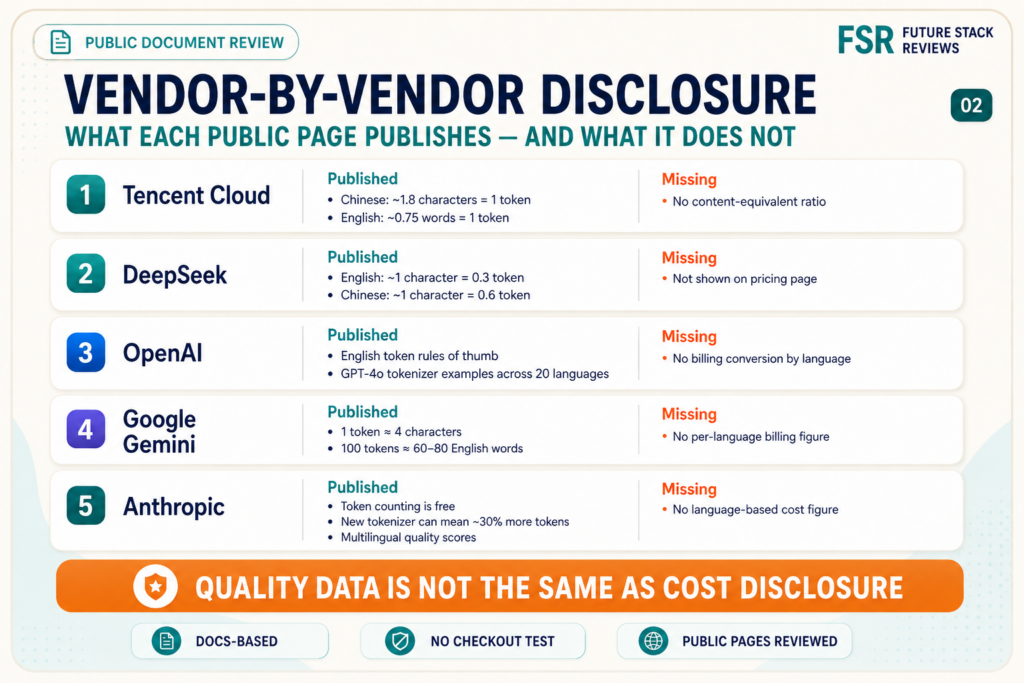
Two figures carry the most weight for a non-English buyer, and both come from Chinese vendors. Tencent’s billing page states “中文约 1.8 字符 ≈ 1 Token,英文约 0.75 单词 ≈ 1 Token”, which FSR renders as roughly 1.8 Chinese characters per token and roughly 0.75 English words per token. DeepSeek’s token page states “1 English character ≈ 0.3 token. 1 Chinese character ≈ 0.6 token.”
Sources: Tencent Cloud, 11 August 2026 · DeepSeek, accessed 11 August 2026 · Google pricing, accessed 11 August 2026 · Anthropic, accessed 11 August 2026 · OpenAI, 13 May 2024
Agreement is not comparison
Two vendors publishing the same kind of figure for the same language is useful. It is not the calculation a multilingual buyer needs, and the gap between the two is where budgets go wrong.
Start with Chinese. Tencent’s 1.8 characters per token and DeepSeek’s 1.7 sit close enough to place side by side. Neither tells a buyer what a document costs in Chinese against the same document in English, because characters are not units of content. An English sentence and its Chinese translation contain very different character counts, and neither page supplies the bridge between them.
Tencent’s own line makes the problem visible in a single sentence. Chinese is expressed in characters and English in words. Converting one into the other requires a words-to-characters ratio for equivalent content, and the page does not give one.
The English agreement has the opposite shape. Four vendors converge because they are all describing the same language, so the figures line up and say nothing about any other.
DeepSeek states the remaining limit on its own page: conversion ratios vary by model, and the number that counts is the one returned in the usage results. The underlying methodological point is not new. Peer-reviewed work since 2023 has held that cross-language cost comparison requires content-equivalent text rather than raw character counts, and this briefing does not add to that literature.
Sources: Tencent Cloud, 11 August 2026 · DeepSeek, accessed 11 August 2026 · Petrov et al., 2023
Precise about audio, approximate about text
Google’s Gemini Developer API pricing page shows how exact a vendor can be about token counts when the input is not text.
Audio on a text-to-speech model counts at 25 tokens per second. Video output on one model is calculated at 5,792 tokens per second at 720p. An output image at 1,024 by 1,024 pixels consumes 1,120 tokens, and image input on another model is fixed at 560 tokens per image. Google’s token documentation adds 258 tokens for an image at or below 384 pixels in both dimensions, 263 tokens per second of video, and 32 tokens per second of audio for the models it covers.
Text is priced on that same page, per million tokens, alongside everything else. What no Google page in this set supplies is a text-to-token conversion for any named language other than the English figures already quoted.
The practical difference is worth stating plainly. A team budgeting an audio workload can convert duration into tokens from published numbers before signing anything. A team budgeting an Arabic text workload has no published conversion to work from.
Sources: Google pricing, accessed 11 August 2026 · Google tokens, updated 30 July 2026
When a tokenizer change moves the bill
Language is not the only variable that moves token volume while the rate card holds still.
Anthropic’s pricing page states that Claude 4.7 and later models use a newer tokenizer, and that “this tokenizer produces approximately 30% more tokens for the same text”. The page qualifies the figure by content and workload shape and notes that Sonnet 4.6 and earlier models use the previous tokenizer. The token counting documentation repeats the number, adds that usage and billing reflect the newer counts, and tells developers to recount rather than reuse older measurements.
The same pricing page lists a second set of numbers that differ between generations. Tool use adds a fixed system prompt to every request: 497 to 589 tokens on Opus 4.6, and 675 to 804 on Opus 4.7. The page reports the counts per model without attributing the difference to a single cause.
Migration is therefore a budget event in its own right. A workload moved between generations without recounting can consume more billable tokens on identical input while the published rate per million stays where it was.
Length thresholds behave differently across the set. Anthropic’s long context section states that a 900,000-token request is billed at the same per-token rate as a 9,000-token request on current models. Google prices some models in bands: Gemini 3.1 Pro Preview lists $2.00 per million input tokens for prompts at or below 200,000 tokens and $4.00 above that line, and Gemini 2.5 Pro carries the same threshold. Tencent’s billing page notes that some models use segmented pricing by input length. Where a band exists, the number of tokens a given source produces decides which side of it a request lands on.
Sources: Anthropic pricing, accessed 11 August 2026 · Anthropic token counting, accessed 11 August 2026 · Google, accessed 11 August 2026 · Tencent Cloud, 11 August 2026
The unit on the invoice
A price table denominated in tokens does not guarantee an invoice denominated in tokens.
Anthropic’s pricing page documents this for two routes. Claude Platform on AWS bills through AWS Marketplace in Claude Consumption Units: token usage is rated in USD at standard rates, discounts are applied, the result converts to CCUs at one cent each, and the AWS bill shows a single CCU line item. Claude in Microsoft Foundry follows the same structure through the Azure Marketplace. The page states that 100 CCU represents one US dollar of fees.
Google’s pricing page runs several units at once. Text and multimodal input bill per million tokens. Veo video bills per second of output. Imagen bills per image. Lyria bills per song. Search grounding bills per thousand requests. Context cache storage bills per million tokens per hour. The page does not address whether language affects any of them.
Tencent’s billing page does address it, three times over. The language estimate covers text models and not vision models. The voice section states that the language model token estimate does not apply there. The video section says the same, and adds that some model families bill per second or per credit per second rather than per token.
Compare quotes on the route you will buy on. The unit used to calculate a charge and the unit printed on an invoice can differ, and only one vendor in this set tells a reader where its language estimate stops applying.
Sources: Anthropic, accessed 11 August 2026 · Google, accessed 11 August 2026 · Tencent Cloud, 11 August 2026
Arabic in the reviewed set
No characters-per-token or words-per-token figure for Arabic appeared in the nine pages. Chinese conversion estimates appear on two of them, both from vendors whose documentation is published in Chinese alongside English.
Two Arabic numbers do sit in the set, and neither answers a budgeting question. OpenAI’s 2024 announcement carries a table of 20 languages with two counts on each row, and the Arabic row reads “Arabic 2.0x fewer tokens (from 53 to 26)”. Those counts describe one sample sentence under an earlier tokenizer and under the one introduced with that model, and the English row on the same table shows 27 and 24. The comparison runs within each row rather than down the column. Anthropic’s multilingual page places Arabic at 97.2 percent of its English performance baseline on Claude Sonnet 4.5 and 92.5 percent on Claude Haiku 4.5, which is a capability score.
For an Arabic workload, that leaves counting as the first route to a number. Two vendors publish counting that needs no account: OpenAI offers an interactive tokenizer and the open-source tiktoken library, and DeepSeek offers a downloadable tokenizer package. On the pages reviewed, Anthropic and Google document counting through an API endpoint.
FSR records the placement and stops there. Explaining why a vendor names one language rather than another would need evidence this review does not hold.
Sources: OpenAI, 13 May 2024 · OpenAI help center, accessed 11 August 2026 · Anthropic, accessed 11 August 2026 · DeepSeek, accessed 11 August 2026
How to build the budget instead
Four of the five vendors document a counting route, and two of them tell readers in plain words to use it rather than a rule of thumb. The steps below are FSR’s, built from what those pages establish.
Fix the purchase first: exact model ID or snapshot, API route, region or inference geography, and pricing tier. Each of these appears in at least one reviewed page as something that changes either the count or the rate.
Assemble a real sample of the workload rather than sample prose. Anthropic’s pricing page shows why: the tool system prompt alone adds several hundred tokens per request, before any of your own content is counted.
Build semantically aligned versions in every deployment language, then count the same request against each target model’s current tokenizer or counting interface. Apply input, output, cache write, cache read, and any regional or fast-mode modifier separately rather than as one blended rate.
Recount before any model migration. Anthropic’s published 30 percent figure is the clearest documented case in this set of a count moving while a rate did not.
Three questions belong in the procurement record, because the reviewed pages answer them only in part. Which tokenizer applies to the contracted model. Whether that tokenizer can change without a rate card change, and what notice applies. Which usage field or converted unit controls the invoice on the route being bought.
Sources: OpenAI, accessed 11 August 2026 · DeepSeek, accessed 11 August 2026 · Anthropic, accessed 11 August 2026 · Google, updated 30 July 2026
Limits of this review
FSR measured nothing and publishes no multiplier for any language pair. How many tokens Arabic or Chinese consumes relative to English has been studied in peer-reviewed work since 2023, including research finding that parallel text can differ substantially in tokenized length, with consequences for cost, latency, and context capacity.
Nine pages at five vendors were read. OpenAI’s developer API pricing page, its consumer and business plan pages, DeepSeek’s pricing page, terms of service, rate limit documentation, and vendors not named were not part of this set, and no result is claimed for them. Logged-in checkout, console screens, enterprise order forms, and negotiated contracts sit outside what a document review can reach and are excluded rather than reported as empty.
The figures quoted here are vendor statements. FSR did not independently validate any of them, and each vendor page attaches its own qualifiers. A fixed ratio per language is not a stable object either: DeepSeek states that ratios vary by model, and Anthropic qualifies its 30 percent figure by content and workload shape.
Sources: DeepSeek, accessed 11 August 2026 · Anthropic, accessed 11 August 2026 · Petrov et al., 2023
FAQ
Does Arabic cost more than English?
This review read documents rather than running tokenizers, so it does not answer that. Peer-reviewed work since 2023 has measured cross-language token disparity. None of the nine pages publishes an Arabic conversion rule, so the first usable Arabic number has to come from counting your own text.
If four vendors agree on the English figure, is it reliable?
Reliable as a rough English anchor, and useless for anything else. Every one of those figures describes English, so their agreement carries no information about a second language. Anthropic and DeepSeek both state on the page that the count varies by language, model, or content type.
Can characters per token predict my invoice?
Not on its own. A generic ratio leaves out system prompts, tool definitions, structured data, output length, cache behavior, and retries. DeepSeek’s page states the ratio varies by model and points to the returned usage figure. OpenAI’s help center gives the same advice.
Does a tokenizer change count as a price change?
The rate and the count are separate variables. Anthropic’s pricing page states that Claude 4.7 and later models use a newer tokenizer producing about 30 percent more tokens for the same text, with the exact increase depending on content and workload. This review did not examine notice terms.
Do I need an account to count tokens?
Not for every vendor. OpenAI publishes an interactive tokenizer and the open-source tiktoken library, and DeepSeek publishes a downloadable tokenizer package. On the pages reviewed, Anthropic and Google document counting through an API endpoint.
Is this a vendor failure?
Nothing reviewed here supports that reading. Two vendors publish conversions naming two languages, several state plainly that counts vary by language or model, and four document a counting route. What the record shows is a shared English anchor and no shared anchor past it.
Methodology
Tier C declaration. No paid account. No purchase. No invoice, dashboard, console, or checkout screen. No product test. No token measurement. Statements about a vendor describe page content on the access date. Reasoning, buyer recommendations, and the classification scheme are FSR’s own.
Pages read, with dates. Tencent Cloud TokenHub billing methods, page last updated 11 August 2026. Anthropic pricing, token counting, and multilingual support, no page dates visible, accessed 11 August 2026. OpenAI GPT-4o announcement, page dated 13 May 2024. OpenAI help center token article, page states it was updated 13 days before access. Google Gemini Developer API pricing, accessed 11 August 2026. Google token documentation, page last updated 30 July 2026. DeepSeek Token and Token Usage, no page date visible, accessed 11 August 2026.
Classification. Pages were sorted by which languages each figure names and which denominator it uses. The scheme was written for this review after the source set was assembled, and it is stated here so a reader can apply it to a different set.
Pages located but excluded. DeepSeek’s Models and Pricing page was retrieved during preparation. A later independent attempt to open the same address returned a different page in the same documentation set, so this briefing builds no claim on it. OpenAI’s business and enterprise plan pricing was reviewed during preparation and is excluded because a stable public address for the version read was not recorded.
Out of scope, declared rather than reported as empty. Logged-in checkout, console screens, enterprise order forms, individual quotations, negotiated contracts, terms of service, rate limit documentation, and OpenAI’s developer API pricing page.
Vendors not reviewed. Other vendors publish language-related token guidance and were not part of this set. Their absence from the table is a scope boundary rather than a result.
Translation. The Tencent Cloud page is published in Chinese, and the English rendering of the quoted line is FSR’s own. Figures read in a localized version of any page were checked against the English version of the same page.
Prior research. Cross-language token disparity and its cost consequences have been established in peer-reviewed literature since 2023. This briefing does not restate those measurements as its own findings.
Deliberately excluded. No measurement, no multiplier for any language pair, no consumer subscription cap analysis, and no characterization of any vendor’s disclosure practice as a compliance matter.
Affiliate posture. FSR holds no affiliate relationship with any vendor named and received no compensation connected to this briefing.
Sources: Tencent Cloud, 11 August 2026 · Anthropic pricing · Anthropic token counting · Anthropic multilingual · OpenAI, 13 May 2024 · OpenAI help center · Google pricing · Google tokens, 30 July 2026 · DeepSeek tokens
Verdict
Do not pick a vendor from a published language conversion rule. Across nine pages read on 11 August 2026, all five vendors publish a token figure for English, and four of those figures land in the same narrow range. Two publish a figure for Chinese that also broadly agrees. Nobody publishes one for Arabic, and no page in the set connects any two languages through equivalent content, which is the calculation a multilingual budget actually needs. Google’s pricing page will convert a second of audio into tokens exactly, and offers nothing equivalent for a paragraph of text in any language. Use the published figures to find where your uncertainty sits, then count a real sample of your own workload against the exact model, route, and tier you intend to buy, and count it again before any migration.
Sources: all nine pages listed under Methodology, read 11 August 2026.
Related FSR briefings
Tier B briefings are hands-on tested inside a paid account. Tier C briefings are document-first, with no hands-on testing.
-
Tier B
Meta AI Has Three Privacy Routes. They Do Not Do the Same JobThree routes through one product that do not do the same job, tested inside the account rather than read off the page.
-
Tier C
Metaso AI Search for Buyers Outside China: Access, Payment, Output Rights, and Contract GapsWhat changes when you buy from outside a vendor’s home market, including how payment and output rights are documented.
-
Tier C
Zendesk AI Pricing in 2026: Two Billing Models, One Unpublished Rate CardOne vendor running two billing models at once, with the rate card that decides the bill left unpublished.
-
Tier C
Runway Pricing 2026: Credits, Seats, and Where Runway’s Documents Contradict Each OtherThe same reading method turned on a single vendor, where the credit and seat documents disagree with each other.
-
Tier C
OpusClip Credits: Why 3,600 Shared Credits Cost $174 or $348An identical credit allowance carrying two different prices, which is the packaging version of the unit problem above.
-
Tier C
Claude Sonnet 5 Explained: Cheaper Per Token, Not Per TaskA lower price per token that does not become a lower price per task, for readers who found the rate-versus-count split useful.
Contact us
Need this run against your own vendor shortlist?
FSR produces a paid multilingual token cost dossier: your named vendors and models, the pricing and token pages for each, what every published figure measures, the questions your contract needs to answer, and a counting protocol matched to your workload. Send the vendor shortlist, the deployment languages, and the billing route. Scope and price are quoted before any work starts.
Corrections and additional vendor pages are welcome at no charge and are logged with attribution.
[email protected]A document-first record of published vendor pages on the date stated. Not a product review, a measurement study, a cost forecast, or legal advice. Pricing and documentation change without notice, and any figure quoted here should be re-checked against the vendor page before a purchasing decision. Future Stack Reviews holds no affiliate relationship with any vendor named. Published by 合同会社Future Stack, Osaka, Japan.
Last updated: 11 August 2026.