Last updated: August 11, 2026
FSR reviewed public documentation and did not observe a live billing ledger, a checkout screen, or an account entitlement state. Every figure below describes what a named page displayed on the date it was opened. Where two published pages disagree, both appear here and the conflict is left open. This briefing describes web purchases; the iOS listing offers in-app purchases whose management terms were not reviewed.
OpusClip bills by credit. One credit covers one minute of imported source video for standard processing in the web app. API jobs, posts published to X, thumbnail generation, and Agent Opus video generation each deduct under separate published rules, and the company sells a second product, Agent Opus, priced in the same credit unit. A plan comparison built on credit count alone will misprice several of those paths.
Verdict in one sentence
OpusClip’s annual Pro plan lists the lowest price per credit in the company’s published lineup, and the published pages do not establish that those credits carry the same product rights as the Agent Opus plan sold at twice the annual price.
What this briefing found
Opusclip Inc. runs two pricing pages. The OpusClip page lists an annual Pro plan at $174 with 3,600 credits. The Agent Opus page lists an annual Pro plan at $348 with 3,600 credits. Both cards are headed Pro and both show $29 per month before the annual toggle.
The two cards do not bundle the same product. Agent Opus Pro lists generation features that the OpusClip Pro card does not, including access to top video models, background music generation, a brand brief slot, a custom avatar slot, and a voice clone slot. FSR did not locate a published statement mapping which of those an OpusClip Pro subscription unlocks.
The price difference is therefore an observation about purchase paths. It is not proof of a cheaper route to the same product.
Read this if
- You are choosing between monthly and annual OpusClip Pro
- You use, or expect to use, both OpusClip and Agent Opus
- Your monthly volume is uncertain and you are weighing a prepaid year
- You are sizing an API budget for short jobs
- You may cancel mid-term while holding unused credits
Skip this if
- You stay on the free plan and accept the watermark
- You want a judgment on clip quality, which this briefing does not give
- You bought through the App Store, since management terms differ and were not reviewed
- You hold a signed Business agreement, which may govern your account instead
On this briefing
Contents
What one credit buys, by action
Source-video duration predicts the standard web-processing charge and nothing else. The help center gives a 30-minute import costing 30 credits, and adds two rounding rules that run in opposite directions. A video under one minute rounds up to a full credit, so a 20-second test costs the same as a 60-second one. A video with a partial minute above one rounds down, so 4.5 minutes bills as four.
Four other published rules sit outside that formula.
Each row comes from a separate official document. Whether these deductions combine additively inside one workflow was not observed in a billing ledger.
The API rule changes the shape of the cost curve for short jobs. A one-minute video submitted through the browser deducts one credit under the standard rule. The same file submitted as an API project meets a ten-credit floor. A developer batching short clips should budget against the minimum, the monthly cap, and any publishing or thumbnail calls, rather than multiplying source minutes by one.
Sources: OpusClip Help Center, 10 August 2026 · OpusClip API Reference, 10 August 2026 · OpusClip OpenAPI specification, 11 August 2026 · OpusClip Pricing, 10 August 2026
The price gap, and what it does not prove
Opusclip Inc. publishes pricing in two places. The OpusClip page at opus.pro/pricing lists Pro at $29 monthly, and $174 billed annually with 3,600 credits granted upfront. The Agent Opus page at opus.pro/agent/pricing lists Pro at $29 monthly, and $348 billed annually with 3,600 credits. The Agent Opus annual toggle leaves the displayed monthly rate at $29, which is twelve months at the monthly price.
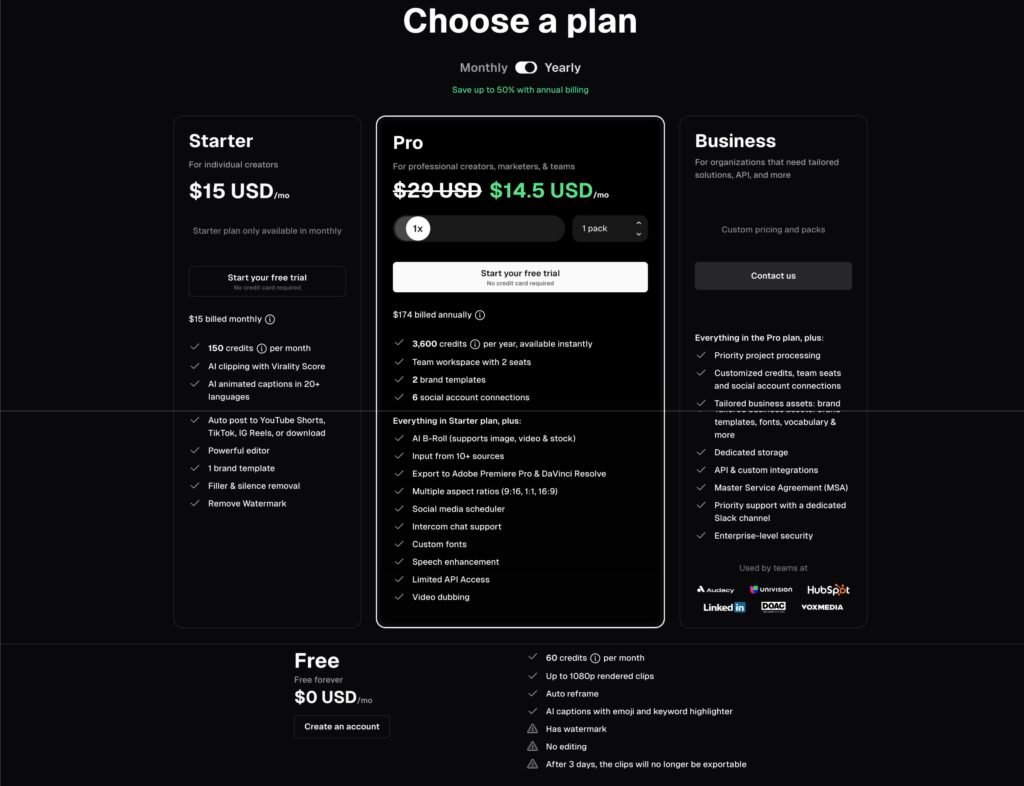
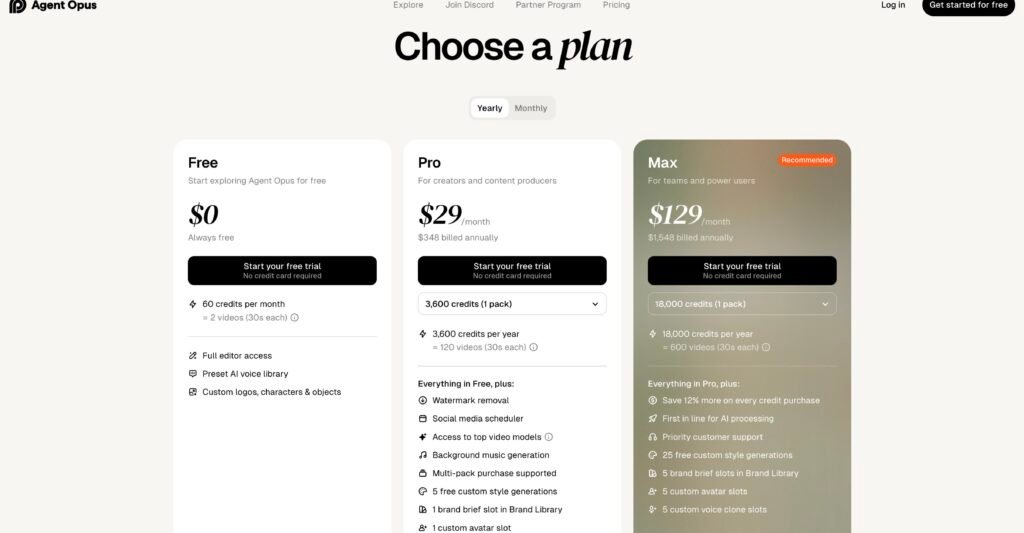
Dividing the listed prices by the listed credit counts gives roughly $0.048 per credit through OpusClip annual and roughly $0.097 through Agent Opus annual. Those are FSR calculations on displayed figures, not rates the vendor publishes.
Credits do cross the product line in at least one direction. The OpusClip credit page lists a Max plan at 1,500 credits per month, states that the plan is available only through Agent Opus, and states that its credits can be used on OpusClip. So a plan absent from the OpusClip pricing page can be purchased elsewhere and spent inside OpusClip.
What the published pages do not establish is whether the two Pro plans confer the same product rights. The Agent Opus Pro card lists watermark removal, a social media scheduler, access to top video models, background music generation, multi-pack purchase, five free custom style generations, one brand brief slot, one custom avatar slot, and one custom voice clone slot. The OpusClip Pro card lists a different set built around clipping: a two-seat team workspace, two brand templates, six social account connections, AI B-Roll, export to Premiere Pro and DaVinci Resolve, three aspect ratios, and limited API access. FSR did not locate a published entitlement map showing which Agent Opus features, if any, an OpusClip Pro subscription unlocks.
Treat the difference as a purchase-path observation. A buyer cannot determine from the two pages whether $174 and $348 buy the same thing at different prices, or two different things that happen to include the same credit count.
Sources: OpusClip Pricing, 10 August 2026 · Agent Opus Pricing, 11 August 2026 · OpusClip Help Center, 10 August 2026
When the annual grant is actually cheaper
Twelve monthly Pro payments come to $348 and deliver 300 credits a month. The annual plan costs $174 and delivers all 3,600 at once. On headline arithmetic the annual route halves the acquisition cost, which is why most coverage stops there.
The saving depends on consumption, and a monthly buyer is not obliged to buy twelve months. Paying $29 only in the months work arrives, the break-even sits at six packs: 6 × $29 = $174. Above roughly 1,800 credits of annual demand, an average of more than 150 credits a month, the annual plan costs less than buying monthly packs as needed. Below that, six or fewer monthly packs cost the same or less.
Expiry pulls in the opposite direction for each. Annual credits are valid for twelve months, so the annual buyer can front-load or back-load a year with no monthly ceiling. Monthly credits expire after 60 days, which the help center describes as one month of rollover, so a monthly buyer cannot bank three quiet months and spend them in one busy one. The annual plan buys flexibility inside the year. The monthly plan buys the option to stop.
The figure that matters for either is not the price of a purchased credit. It is the price of a credit actually consumed inside the workflow before it expires.
Sources: OpusClip Pricing, 10 August 2026 · OpusClip Help Center, 10 August 2026 · OpusClip Help Center, 10 August 2026
What happens to credits when you cancel
Two help center pages answer the same question differently. “How Do Credits Work?” states that on cancellation, remaining credits expire at their original expiration date, even where that date falls after the billing cycle ends. “Where did my minutes go?” states that on cancellation, remaining credits expire at the end of the current billing cycle. Both pages were open in one browser session two minutes apart on 10 August 2026.
The two rules can produce different dates for the same balance, and the size of the gap depends on how old the credit batch is when cancellation happens. A monthly subscriber holding a rolled-over batch with weeks of its 60-day life remaining is looking at two published answers with no stated order of precedence.
The Terms of Service, effective 17 November 2025, does not resolve it in the sections that govern money. FSR read Fees and Payments, Paid Services, Billing, Payment Method, Recurring Billing, Auto-Renewal, and Free Trials without locating a credit expiry provision, and has not run a full-text search of the whole agreement. The same document states that any payment terms presented during signup for Paid Services are deemed part of the agreement, and that additional policies are incorporated by reference. The governing rule may therefore sit in a checkout disclosure rather than in either help page, and FSR has not captured that screen.
The exit path carries its own conditions. The plans page states that an account holding more than 30 minutes of credits cannot downgrade to Free and directs the user to cancel instead, and that a Pro Yearly account must cancel and resubscribe rather than move directly to Starter. Its cancellation notice reads that after three days, projects will no longer be accessible. Whether that count starts at the cancellation request or at the end of the paid term is not stated, and this briefing does not assume either.
Sources: OpusClip Help Center, 10 August 2026 · OpusClip Help Center, 10 August 2026 · OpusClip Help Center, 10 August 2026 · Opusclip Inc. Terms of Service, effective 17 November 2025, read 10 August 2026
Storage capacity is not project retention
The pricing comparison table gives Pro 100GB of fixed storage and no MP4 export limit. The help center page on saving projects states that Pro projects expire 30 days after creation, that expired projects are removed from the dashboard and cannot be recovered, and that Pro users keep projects past 30 days by saving them to cloud storage manually or by enabling auto-save. Capacity and default retention are separate entitlements, and the pricing table does not disclose the 30-day default or the save condition attached to it.
The Starter column carries a numeric mismatch inside the same table. Its media storage row reads “Expires after 29 days” while its export row reads “30-day limit.” The help center gives 30 days for Starter projects. Whether the three statements describe the same object is not stated anywhere FSR read.
Plan changes move data at different speeds in each direction. Downgrading to Free or Starter immediately removes saved projects from cloud storage and immediately removes uploaded assets, with clips that used them showing as missing media. Upgrading to Pro restores previously uploaded assets automatically, while projects from earlier plans are not automatically saved and must be re-saved one at a time.
One more retention detail affects anyone still deciding. Exports produced during the 7-day Pro trial carry the OpusClip watermark, and trial users cannot reprocess a video to recover credits when results disappoint. Watermark-free export is one of the clearest paid differences at the $15 Starter tier, and the trial does not expose it.
Sources: OpusClip Help Center, 10 August 2026 · OpusClip Help Center, 10 August 2026 · OpusClip Pricing, 10 August 2026 · OpusClip Help Center, 11 August 2026
Plan labels and API entitlement
The OpusClip pricing page sells Free, Starter, Pro, and Business. The API reference states that API access is available on Pro (Beta), Max, and Business plans. Two of those labels have no counterpart on the pricing card a buyer clicks, and both carry consequences.
Max is the plan sold through Agent Opus whose credits the OpusClip credit page says can be used on OpusClip, and it appears in the API access list. Pro (Beta) is the label attached to the API limits: 15 hours or 900 credits of API usage per calendar month per workspace, four concurrent projects, and a 403 response at the cap rather than a 429, so agent frameworks stop instead of retrying. Access resumes on the first day of the next month UTC, and the web app stays usable while the API is capped.
A subscriber on the OpusClip Pro card, which advertises “Limited API Access,” cannot confirm from the pricing page whether the Pro (Beta) limits describe their account. For a single monthly Pro pack with no added credits, the 300-credit plan balance would run out before the 900-credit API cap became relevant. On Max, or with additional packs or an annual balance, the cap can bind first.
Sources: OpusClip Pricing, 10 August 2026 · OpusClip API Reference, 11 August 2026 · OpusClip API Reference, 10 August 2026 · OpusClip Help Center, 10 August 2026
What this briefing does not cover
Three areas sit outside a credit-economics briefing and are being handled separately. The first is data handling: the help center states that for individual, non-enterprise users the company may use their data to improve its AI models, and that it does not do so for enterprise customers, and the privacy policy documents an opt-out from AI research and model development for individuals in the EU and EEA. The second is security assurance, where the trust center publishes a subprocessor list and gates the SOC 2 report behind a request. The third is API tooling beyond billing, including where the SDKs named on the API page are distributed. Buyers who need any of those settled should raise them directly with the vendor before signing.
Sources: OpusClip Help Center, 10 August 2026 · OpusClip Privacy Policy, effective 17 November 2025, read 10 August 2026 · OpusClip Trust Center, 11 August 2026
FAQ
Are OpusClip and Agent Opus credits shared?
In at least one direction, yes. The OpusClip credit page states that the Max plan is available only through Agent Opus and that its credits can be used on OpusClip. FSR did not locate a published statement that shared credits also carry shared plan features across the two products.
Why do 3,600 credits cost $174 on one page and $348 on another?
Both pages sell a plan called Pro at $29 monthly, and both list 3,600 annual credits. The OpusClip annual toggle drops the rate to $14.50 monthly; the Agent Opus annual toggle does not. The two cards also bundle different product features, so the credit count is not the whole comparison.
Does one OpusClip credit always equal one minute?
No. One credit per minute of imported source video describes standard web-app processing. Publishing a clip to X costs one credit, an API project meets a ten-credit minimum, and an API thumbnail job costs seven credits per successful call under the current documentation.
How much does a short API job cost?
At least ten credits. The API reference states a 10-credit minimum per project, described as roughly ten minutes of clip time, and states that web-app submissions are not subject to it. A one-minute file therefore costs one credit in the browser and ten through the API.
Do OpusClip credits expire?
Yes. The help center states that credits on a monthly plan expire after 60 days, giving one month of rollover, and that annual credits are granted upfront and remain valid for twelve months. FSR did not locate any published route to refund unused credits.
What happens to credits after cancellation?
Two help pages give different answers. One says remaining credits keep their original expiration date even when it falls after the billing cycle. The other says they expire at the end of the current billing cycle. The Terms sections governing fees do not settle which applies.
Do Pro projects expire after 30 days?
By default, yes. The help center states that Pro projects expire 30 days after creation and are then removed and unrecoverable, unless saved to cloud storage manually or covered by auto-save. The pricing table lists 100GB of fixed storage and does not mention the default.
Does the free trial remove the watermark?
No. The trial exclusions page states that videos exported during the 7-day Pro trial include the OpusClip watermark. The same page states trial users cannot reprocess a video to recover credits, so the period with the least protection is also the evaluation period.
Methodology
This is a document-first pricing audit. No account was purchased, no video was processed, no checkout screen was captured, and no billing ledger was observed. Pages were opened between 10 and 11 August 2026, and the two cancellation pages in section four were opened in one session two minutes apart so the comparison is not an artifact of an update between visits. Sources are the two pricing pages, the homepage, the Terms of Service, the Privacy Policy, nine help center articles, the API reference and its OpenAPI file, and the trust center. Per-credit figures are FSR arithmetic on displayed prices and are labeled as such at the point of use.
Four things stay unresolved: which document governs credit expiry after cancellation, whether an OpusClip Pro subscription unlocks Agent Opus product features, what a multi-action workflow deducts in practice, and how App Store purchases are managed.
Verdict
Buy OpusClip annual Pro when clipping in the web app is the workload, annual demand runs above roughly 1,800 credits, and the OpusClip feature set is the one you need. Turn on auto-save before treating 100GB as persistent project storage, because the default is 30 days.
Stay monthly when volume is uncertain or when the ability to stop matters more than the unit price. Six monthly packs cost the same $174, and below that threshold the prepaid year buys credits that may expire unspent.
Do not buy OpusClip Pro as a cheaper substitute for Agent Opus Pro on the strength of the matching credit count. Confirm in an account, or in writing from the vendor, which Agent Opus models and features an OpusClip subscription actually unlocks. The published pages do not answer it.
For API work, budget against the ten-credit project minimum rather than the per-minute rule, and confirm which plan label your account carries before planning around the 900-credit monthly cap. For procurement, ask which document governs credit expiry on cancellation, request the checkout terms in writing, and obtain a data processing agreement and the model-training position for the exact account type you intend to buy.
FSR will revisit this briefing when the entitlement question is answered or the published figures change.
Working through a purchase decision
Tell us what you need settled
Editorial and corrections: [email protected]
Related briefings
Tier B briefings are hands-on tested inside a paid account. Tier C briefings are document-first, with no hands-on testing.
TIER B HeyGen Creator Plan Credit Audit: What 439 Credits Revealed
A counted record of where credits went inside one paid account, which is the measurement a document-first briefing cannot make.
TIER B Zebracat Review: What Happens If You Buy Credits Before You Subscribe
Tested from inside an account: the order in which you buy changes what the same credits are worth.
TIER C HeyGen Pricing and Credits: What the Official Pages Publish
The same method applied to another AI video vendor, for readers comparing how two companies publish their credit rules.
TIER C InVideo AI Review 2026: What the Credit Balance Does Not Tell You
Another displayed balance that stops short of describing what the plan behind it actually permits.
TIER C Pika Pricing 2026: Standard vs Pro for Commercial Use
Where commercial use rights sit on an AI video plan ladder, and what a free tier does not license.
TIER C Hostinger renewal pricing: the term discount does not come back
What a term discount is worth at renewal, which is the question behind every prepaid annual plan.
Future Stack Reviews is an independent publication operated by 合同会社Future Stack, Osaka, Japan. It is not affiliated with, endorsed by, or compensated by Opusclip Inc. No affiliate link appears in this briefing.
Product names and trademarks belong to their respective owners. This briefing describes publicly published documentation and does not offer legal, tax, or compliance advice.