Last updated: August 12, 2026
Future Stack Reviews holds no ElevenLabs account and ran no generations for this briefing. Every figure comes from an ElevenLabs page opened on 12 August 2026, linked under the section it supports. Where a number is our arithmetic, the sentence says so.
ElevenLabs pricing covers six self-serve plans, from $0 to $990 per month, all metered in credits. The website and the API price the same models at different rates, and ElevenLabs says so in its Pay As You Go documentation. What no page states is the size of that difference. Working it out from the two published tables gives a spread from no difference at all on sound effects to roughly sixteen times on transcription.
Verdict in one sentence: pick the surface your production will actually run on before you pick the plan, because the same subscription is worth a very different amount depending on the answer.
What happened
ElevenLabs publishes two capacity tables for the same subscription. The ElevenCreative page states a monthly credit quota and a credit cost for each product. The ElevenAPI page states, for each plan, how much of a given product that plan buys at API rates.
Both tables answer the same question: what does this plan buy if you spend all of it on one product. Running the comparison across six products shows the two answers agreeing exactly on sound effects, diverging by about a tenth on music and dubbing, by about half on voice changer, by 1.8 times on text to speech, and by 16 times on transcription. That range is not published anywhere.
This affects you if
- Transcription is a meaningful share of your volume
- You are deciding between building an integration and using the web app
- You are sizing a plan from minute counts you found in a review
- You will prepay a Pay As You Go balance
- You expect to change plans while holding a balance
This does not affect you if
- You already run everything through the API and budget from its rate card
- Your work is sound effects only, where the two tables agree
- Your monthly volume sits far below the plan quota
- You hold an Enterprise agreement with negotiated rates
Key facts
| Monthly list price | Free $0 · Starter $6 · Creator $22 · Pro $99 · Scale $299 · Business $990 |
| Annual equivalent per month | Starter $5 · Creator $18.33 · Pro $82.50 · Scale $249.17 · Business $825 |
| Monthly credits | 10k · 30k · 121k · 600k · 1.8M · 6M |
| First month promotion | Creator shows $11 for month one; $22 is the recurring price |
| Commercial use | Starter is the first tier listing a commercial license |
| Website credit costs | TTS 1 per character · STT 330 per minute · Music 900 per minute · Voice changer and isolator 1,000 per minute · Sound effects 200 per generation |
| API rates | Multilingual v2/v3 $0.10 per 1,000 characters · Flash/Turbo $0.05 · Scribe v2 $0.22 per hour |
| Rollover | Up to two months of unused subscription credits, while the plan stays active |
| Prepaid top-ups | Non-refundable, expire 12 months after purchase |
| Evidence base | Public ElevenLabs pages and legal documents, opened 12 August 2026 |
List prices for logged-out monthly billing. Enterprise terms are negotiated and are not covered here.
On this briefing
Contents
Two capacity tables, one plan
The ElevenCreative pricing page gives each plan a monthly credit quota and lists what each product costs in credits. Creator gets 121,000 credits a month, text to speech costs one credit per character on the standard multilingual models, and transcription costs 330 credits per minute.
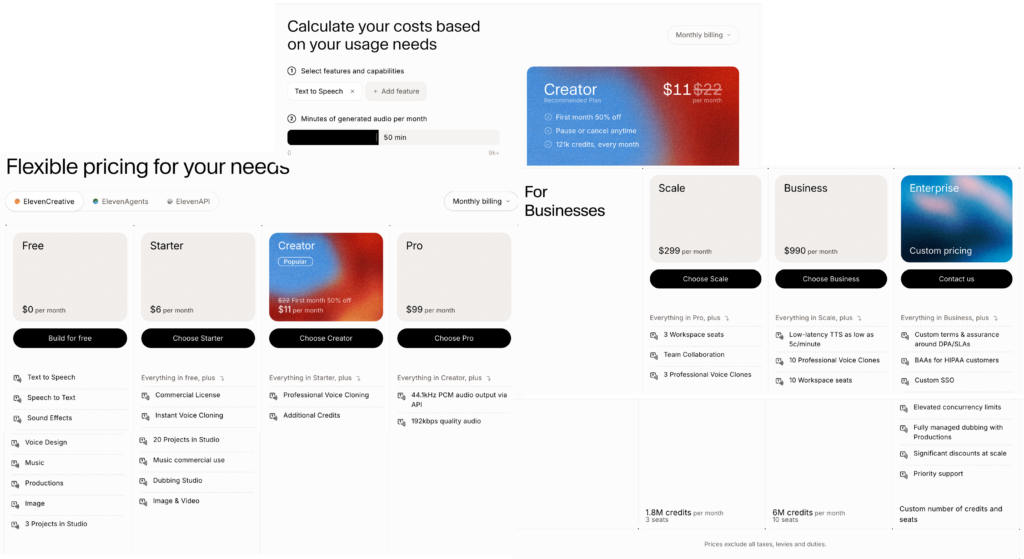
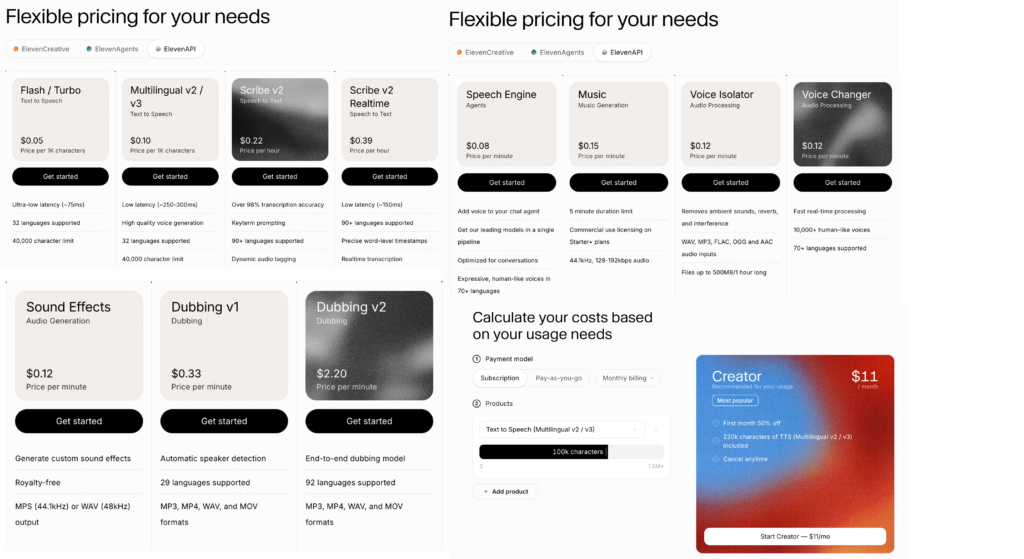
The ElevenAPI page describes the same six plans, at the same six prices, using a different unit. It prices each model in dollars, then shows how much of that model each plan includes. For Creator it shows 220,000 characters of Multilingual text to speech and 100 hours of Scribe v2 transcription.
Neither page is wrong. They are answering the same question through different meters, and ElevenLabs states in its Pay As You Go documentation that API usage carries lower rates than UI usage. The rates on both pages are published. The relationship between them is not.
Sources: ElevenLabs, ElevenCreative pricing and credit FAQ, accessed 12 August 2026 · ElevenLabs, ElevenAPI model pricing, accessed 12 August 2026 · ElevenLabs, Pay As You Go documentation, accessed 12 August 2026
The spread, product by product
Both tables answer the same hypothetical: spend the entire plan on one product, and how much do you get. Applying that assumption on both sides makes the comparison clean, because the assumption cancels out.
Here is the Creator plan at $22, across every product where both pages publish a figure.
| Product | Website capacity from 121,000 credits | API capacity shown for Creator | API divided by website |
|---|---|---|---|
| Sound effects | 605 generations | 605 generations | 1.00x |
| Music | 134 minutes | 147 minutes | 1.09x |
| Dubbing v1, no watermark | 40 minutes | 44 minutes | 1.09x |
| Voice changer or isolator | 121 minutes | 183 minutes | 1.51x |
| Text to speech, Multilingual | 121,000 characters | 220,000 characters | 1.82x |
| Speech to text, Scribe v2 | 6.1 hours | 100 hours | 16.36x |
Website column is our arithmetic: 121,000 credits divided by the credit cost published for each product. API column is read directly from the ElevenAPI table. Ratios are ours. Flash and Turbo are excluded because their discount is stated to apply to API usage only, which makes the two sides non-comparable.
Sound effects is the control case. The two pages produce the identical figure, 605 generations, which shows the difference is not an artifact of the method.
From there the gap widens unevenly. Music and dubbing move by about nine percent. Voice changer moves by half. Text to speech moves by 1.8 times. Transcription moves by more than sixteen.
A team that budgets transcription from the credit table and then builds on the API will find its plan stretches far further than expected. A team that does the reverse will run out.
Sources: ElevenLabs, ElevenCreative credit costs, accessed 12 August 2026 · ElevenLabs, ElevenAPI included quantities by plan, accessed 12 August 2026
Why every API figure equals the plan price
The API table is not a second allowance sitting on top of the credit quota. Multiply any included quantity by its own published rate and the answer is the plan price.
| Product | Creator quantity | Published rate | Product |
|---|---|---|---|
| Text to speech, Multilingual | 220,000 characters | $0.10 per 1,000 | $22.00 |
| Speech to text, Scribe v2 | 100 hours | $0.22 per hour | $22.00 |
| Voice changer or isolator | 183 minutes | $0.12 per minute | $21.96 |
| Music | 147 minutes | $0.15 per minute | $22.05 |
| Dubbing v1, no watermark | 44 minutes | $0.50 per minute | $22.00 |
Arithmetic ours, from quantities and rates published on the ElevenAPI page. The pattern holds on the other paid tiers: Starter $6, Pro $99, Scale $299, Business $990.
This is the strongest reading of what the API page is doing, and it is worth stating plainly because it defeats a tempting misreading. The page is showing what your monthly fee is worth if you direct all of it at one product through the API. It is not promising that a Creator account holds 121,000 credits and 220,000 characters and 100 transcription hours as separate balances.
The finding survives that reading. If the API column is plan value at API rates, and the credit column is plan value at website rates, then the ratio between them is the price difference between the two channels. That is precisely the number a buyer needs and precisely the number neither page prints.
Source: ElevenLabs, ElevenAPI model pricing table, accessed 12 August 2026
What the spread proves and what it does not
It proves a difference in published capacity between two official surfaces for the same subscription. Both figures are current, both are the vendor’s own, and the assumption behind them is identical.
It does not prove that a bill will come in sixteen times higher. Nothing here was measured inside an account. The published tables describe capacity, and an invoice describes charges, and this briefing did not join the two.
The API does expose some per-request billing metadata. ElevenLabs documents a character-cost response header alongside request-id and x-trace-id, described as generation metadata including character costs. That header is a character count. The documentation does not define it as a dollar amount or as a credit debit, and the workspace usage endpoint reports credits grouped into time buckets rather than per request. So the pieces exist at different levels of aggregation, and no documented key joins a single request to a credit movement or an invoice line.
Closing that gap needs a paid account, a controlled run, and an invoice. That is a different piece of work, and until it is done, the honest position is that the published tables disagree by a knowable amount and the billing behavior behind them is untested.
Sources: ElevenLabs, API reference introduction, Tracking generation costs, accessed 12 August 2026 · ElevenLabs, Usage analytics documentation, accessed 12 August 2026
Agents runs on a third meter
The ElevenAgents page adds a complication that neither of the other two carries. Creator there shows 275 included call minutes, additional minutes at $0.08, and burst pricing at $0.160, which is double.
Those base call minutes sit outside the shared credit pool. The page separates them from credits, prices the LLM component as a deduction from ElevenLabs credits, and treats telephony as billed separately at cost.
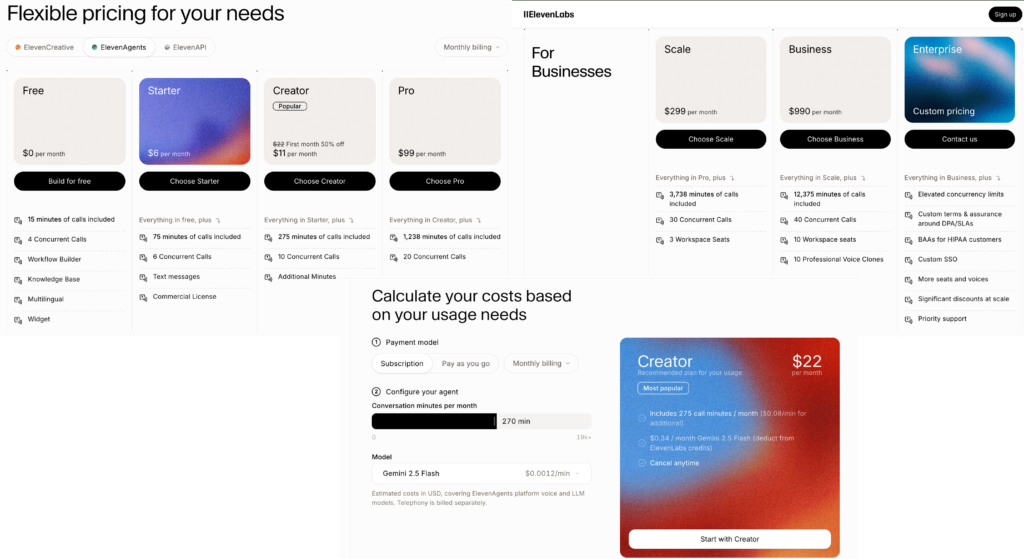
The result is that an agent deployment carries three cost layers rather than one: hosting minutes on their own meter, model usage against the credit pool, and carrier charges outside both. A team budgeting agents from the minute count alone will be short.
Source: ElevenLabs, ElevenAgents pricing and cost calculator, accessed 12 August 2026
What happens to a balance you do not spend
Three balances follow three different rules, and mixing them up is expensive.
| Balance | Reset | Rollover | Refund | On plan change |
|---|---|---|---|---|
| Subscription credits | Monthly | Up to two months while the plan is active | Documented 14-day window if no quota was used | Forfeited on downgrade or cancellation |
| Prepaid top-ups | None | No monthly cap | Non-refundable per the Terms | Dollar value held, credit count reconverted |
| Legacy overage billing | Postpaid | Not applicable | Not applicable | Closed to new self-serve accounts |
Sources: ElevenLabs, Billing documentation, accessed 12 August 2026 · ElevenLabs, Pay As You Go documentation, accessed 12 August 2026
The prepaid row carries the most risk. Section 6(b) of the Terms describes prepaid credits as a limited, revocable, prepaid right to access services, and states they are not money, not a deposit, and not stored value. They expire twelve months after purchase, with no obligation on ElevenLabs to warn you first. Because the balance is held as a dollar figure and converted at the current plan’s rate, a downgrade lowers the credit count on screen while the dollar value stays put.
Refund language differs by document and by region rather than contradicting itself outright. The billing documentation describes a fourteen day window where no quota was used. The non-EEA Terms say all sales are final with refunds at ElevenLabs’ discretion. The EEA Terms grant a statutory fourteen day withdrawal right with a model form attached. Which applies depends on where you are.
Sources: ElevenLabs, Terms of Service (non-EEA), 31 March 2026, Sections 3, 6(b), 6(e) · ElevenLabs, Terms of Service (EEA), 31 March 2026, Sections 6(b), 7
What you can and cannot decide from this
Decidable from this briefing
- Which published table to size your plan from
- Whether a transcription workload justifies an integration
- Which figures in a third-party review are stale or off-surface
- Whether a top-up fits inside your project timeline
- What to ask ElevenLabs in writing before signing annual
Not decidable from this briefing
- What a job actually debits inside a live account
- Whether the published ratios survive contact with an invoice
- The order in which quota, prepaid funds, and overage are consumed
- Voice quality, latency, or output suitability, none of which were tested
- How any tax treatment applies to your entity
Four questions close the right column, and one paid Creator month answers all of them: record the starting balances, send fixed input through the API and through the web app, export the request log and the usage CSV, then compare both against the invoice.
Source: scope statement of this briefing. No ElevenLabs account was used.
A note for buyers in Japan
Japan falls outside the EEA, Switzerland, and the UK, so Japanese buyers are on the non-EEA Terms. Section 6(g) states that where the services are subject to Japanese consumption tax under the reverse charge mechanism, the customer self-assesses, reports, and remits the tax directly, and that ElevenLabs will not charge or remit JCT for those services. Whether that applies to a given purchase depends on the buyer’s own circumstances. Confirm it against an actual invoice with your tax adviser before treating the position as settled.
Source: ElevenLabs, Terms of Service (non-EEA), 31 March 2026, Sections 6(d) and 6(g)
FAQ
How much does ElevenLabs cost per month?
Self-serve plans are Free at $0, Starter $6, Creator $22, Pro $99, Scale $299, and Business $990 per month. Annual billing works out to ten monthly payments, so Creator is $18.33 a month equivalent. Enterprise is quoted separately.
How do ElevenLabs credits work?
Each plan includes a monthly credit quota shared across every ElevenCreative product. Text to speech costs one credit per character on the standard multilingual models. Transcription costs 330 credits per minute, music 900, voice changer and isolator 1,000, and sound effects 200 per generation.
How many minutes is 121,000 ElevenLabs credits?
On the website, 121,000 credits is roughly 121 minutes of multilingual speech, or about 6.1 hours of transcription, or 605 sound effect generations. The exact figure depends on which product you spend them on, since the credit cost per product differs.
Is the ElevenLabs API cheaper than the web app?
ElevenLabs states that API usage carries lower rates than UI usage. Comparing the two published capacity tables for the Creator plan gives no difference on sound effects, about 1.8 times more text to speech through the API, and about 16 times more transcription.
Why does Creator show 121,000 credits on one page and 220,000 characters on another?
They are two capacity views of the same $22, priced on different meters. Multiplying 220,000 characters by the published API rate of $0.10 per 1,000 returns exactly $22. The two are not separate allowances that stack.
Can you see the cost of a single ElevenLabs API request?
Partly. ElevenLabs documents a character-cost response header with request-id and x-trace-id on raw text to speech responses. It is a character count rather than a dollar or credit figure, and the usage endpoint reports credits in time buckets, so no documented key joins a request to an invoice line.
Do ElevenLabs credits roll over?
Unused subscription credits roll over for up to two months, so a balance can reach three times the monthly quota, provided the subscription stays active and you do not downgrade or cancel. Rollover does not apply to the Free plan.
Do pay-as-you-go top-ups expire, and can you get a refund?
The Terms state that prepaid credits expire twelve months after purchase, that ElevenLabs has no obligation to give notice before expiry, and that purchases are non-refundable except where law requires otherwise, including on account suspension or termination.
What happens to a prepaid balance when you change plans?
The balance is stored as a dollar value and converted to credits at your current plan’s rate. Changing plans keeps the dollar value and changes the credit count, so a downgrade shows fewer credits without you having spent any.
METHODOLOGY
This is a document-first briefing. Future Stack Reviews holds no ElevenLabs account, ran no generations, and inspected no invoice, checkout, or usage ledger.
Every figure comes from a page opened on 12 August 2026: the three pricing tabs, the billing and Pay As You Go documentation, the usage analytics page, the API reference introduction, and the Terms of Service for both the EEA and non-EEA regions dated 31 March 2026. Links sit under the section each supports.
The website capacity column is arithmetic, dividing the plan quota by each product’s published credit cost. The ratios are ours. Both columns assume the whole plan is spent on one product, which is why they compare cleanly.
Absence statements are bounded to the pages listed above. Pricing on this vendor moved during 2026, so recheck before purchase. Our full evidence and tier rules are set out in the Future Stack Reviews methodology.
VERDICT
Choose the production surface before the plan. On sound effects the choice is free. On transcription it changes what $22 buys by more than an order of magnitude, and neither pricing page tells you that.
For a single-surface team, budget from the table that matches the surface and start with a capped first cycle. For a mixed workflow, or before an annual commitment or a meaningful top-up, run one paid month and reconcile it against an invoice. The capacity tables are good enough to size a plan and not good enough to close a finance review.
Related FSR briefings
Where this pattern shows up elsewhere
Tier B briefings are hands-on tested inside a paid account. Tier C briefings are document-first, with no hands-on testing.
-
TIER B
HeyGen Creator Plan Credit Audit: What 439 Credits Revealed
The test this briefing could not run. 439 credits spent inside a paid account, reconciled row by row against the billing history.
-
TIER B
Ahrefs Agent A Review: $99. The Real Bill Was $827. The Agent Didn’t Know.
What the distance between a published price and a real monthly bill looks like when someone pays it and counts.
-
TIER C
OpusClip Credits: Why 3,600 Shared Credits Cost $174 or $348
The same credit count on two of one company’s own pricing pages, at twice the price on one of them.
-
TIER C
Runway Pricing 2026: Credits, Seats, and Where Runway’s Documents Contradict Each Other
Web and developer rate cards that disagree, including on the ElevenLabs model Runway resells through both.
-
TIER C
Zendesk AI Pricing in 2026: Two Billing Models, One Unpublished Rate Card
Two billing models running at once, with the per-tier prices held back from every public page.
-
TIER C
InVideo AI Review 2026: What the Credit Balance Does Not Tell You
A displayed balance that stops short of describing what the plan behind it actually permits.
Procurement support
Need this checked against a real invoice?
Future Stack Reviews prepares procurement dossiers on request. A dossier contains the source pack behind a briefing, the questions to put to the vendor in writing, and the contract clauses a reviewer should read before signing. Scope and fee are agreed before any work starts, and a dossier can conclude against a purchase.
Contact usTell us the plan under review, the surfaces you expect to use, and your entity’s jurisdiction.
Future Stack Reviews is an independent publication operated by 合同会社Future Stack, Osaka, Japan. This briefing is not legal, tax, or financial advice. Vendor pricing and terms change without notice, so verify against the live pages before purchasing. No compensation was received from ElevenLabs or any competitor. See our methodology and disclosure policy.
Last verified: 12 August 2026.