Last updated: June 17, 2026
The instrumental BGM is usable. What you are allowed to do with it after you cancel is the part Soundful’s own pages cannot answer.
Tested on a free Standard account, June 16, 2026 · Scope: hands-on generation and download, an ffmpeg measurement of one downloaded file, and a full read of Soundful’s pricing, license, FAQ, and Terms pages. Not a paid-plan, stem, checkout, or cancellation test.
Soundful is a template-driven AI generator for instrumental background music. You pick a genre and style, set BPM and key, name the track, and it renders a finished instrumental in about twelve seconds. There is no text-prompt songwriting and no vocals in the flow we tested. The audio is fine. The buyer risk sits one layer down, in what rights survive cancellation, and that is decided across three sets of Soundful pages that do not name the same things the same way.
FSR verdict, in one sentence: Soundful is worth using if you need fast instrumental BGM and you confirm, in writing, which license your plan grants; it is not a tool to build monetized or client work on until you can answer what survives cancellation.
Best for
- Creators who need clean instrumental BGM for video, podcast, or stream, fast, where speed beats fine control
- LoFi, ambient, and atmospheric beds
- Buyers whose use stays on a license that survives cancellation, confirmed before paying
Not for
- Vocals, songwriting, or full fidelity in vocal-driven or aggressive genres
- Real editing: timeline, instrument control, or stem mixing inside the app
- Anyone who assumes a paid plan means they own the music, or who plans to release to Spotify or Apple Music without buying copyright
What FSR measured
| What FSR did | What happened | Evidence |
|---|---|---|
| Generated one LoFi preview on a free account | Finished instrumental in 12.05 seconds | Observed |
| Generated one Phonk preview | 12.66 seconds | Observed |
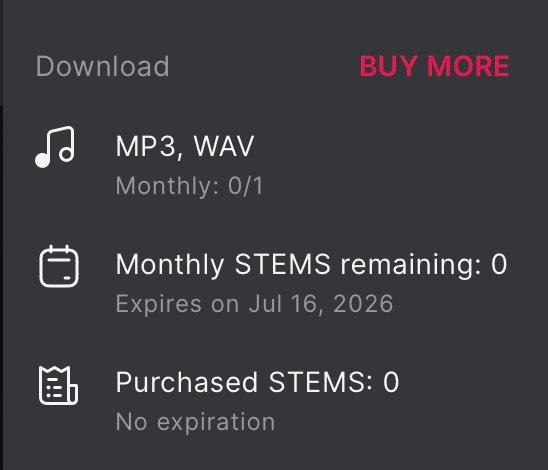
| Downloaded the single track the free plan allows | Async render, delivered by email, counter moved 1/1 to 0/1 | Observed |
| Measured the downloaded master with ffmpeg | 320 kbps CBR MP3, 44.1 kHz stereo, 4:23, -16.07 LUFS, +0.02 dBTP | Measured |
| Raised tempo from 100 to 130 BPM | Runtime dropped from 2:33 to 1:57, the exact 100:130 ratio | Observed; same-composition reading is inference |
| Read the in-app plan screen, license page, FAQ, and Terms side by side | Three naming systems; cancellation rights stated only in the FAQ | Verified across Soundful’s own pages |
What FSR did not prove: any paid plan, stem export, the Business and Enterprise tiers, the checkout flow, the cancellation flow, the copyright-purchase process, Content ID behavior, the payload of any request, and long-term use. Single free account, one machine, on the dates noted. Soundful’s pages change, so re-confirm pricing and license details before you rely on them.
Soundful is not a rights product you can read off the plan cards. The audio you can judge in a minute. What you are licensed to do with it, and what happens when you stop paying, lives in a different set of pages, and those pages do not agree with each other.
The receipt
Two things happened in the test, and the second one is the review.
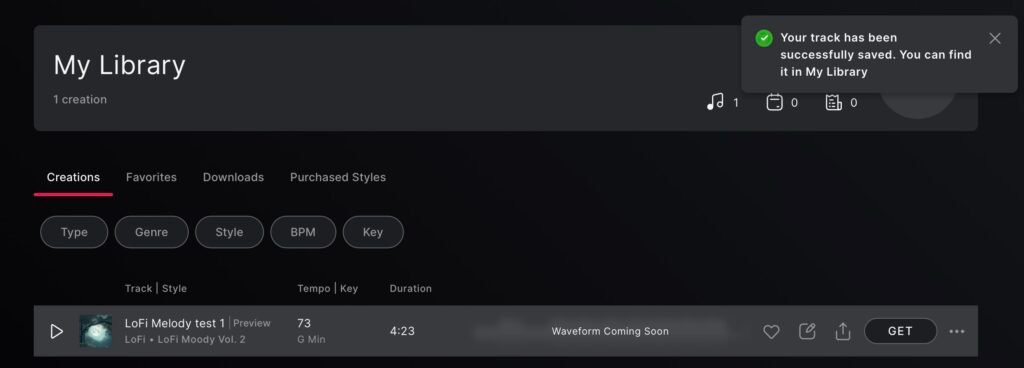
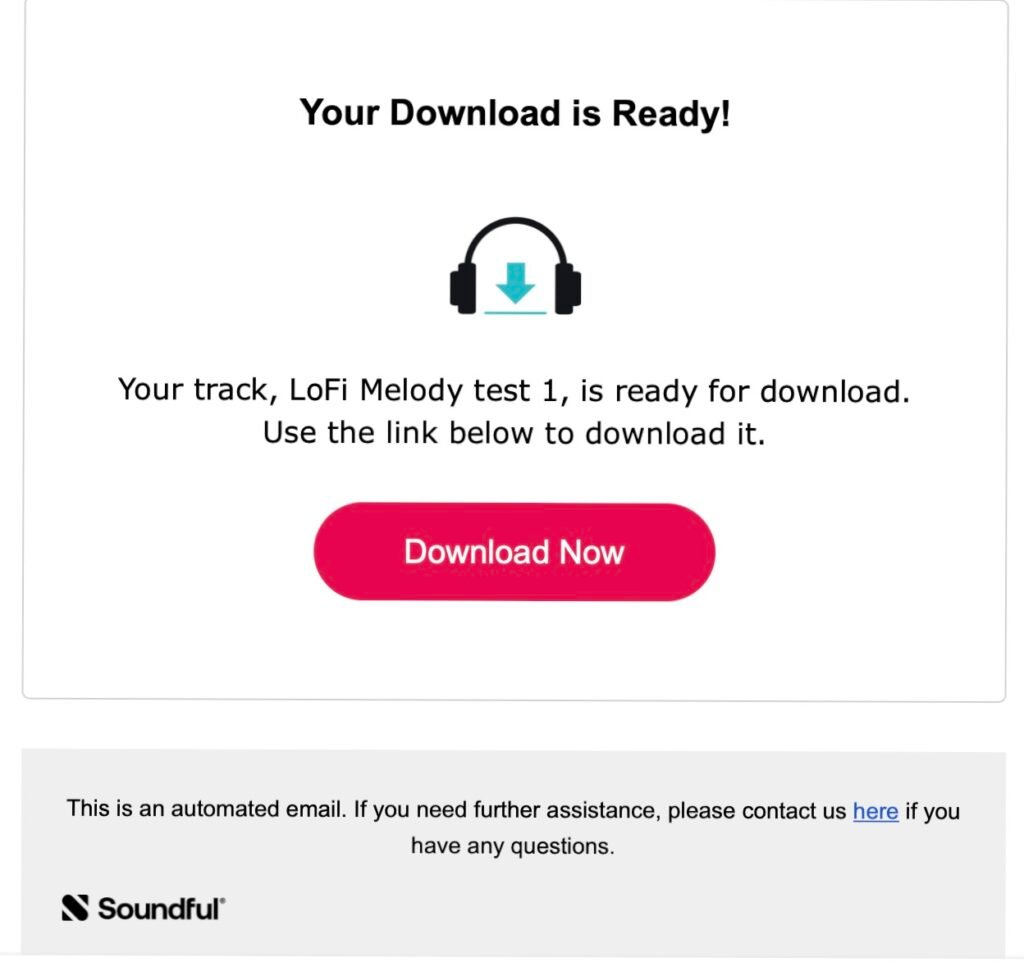
The first was easy. On the free Standard plan, FSR opened the create screen, chose the LoFi Moody Vol. 2 style at 73 BPM in G minor, and hit Create Preview. A finished instrumental came back in 12.05 seconds. FSR saved it, exported it, and the download counter moved from 1 of 1 to 0 of 1. The render did not save instantly; it arrived as an email from [email protected] with a file named in the form [track]_mix.mp3. Measured later, the file was a clean 320 kbps master. As a piece of background music, there was nothing wrong with it.
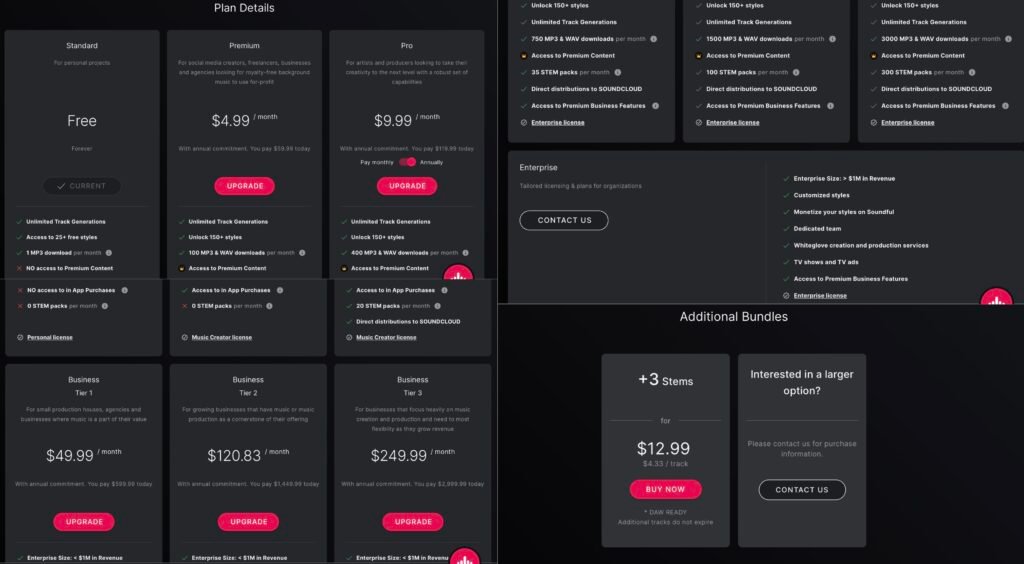
The second was the problem. FSR went to confirm what could be done with that track after cancelling, and the answer split into three. The in-app screen calls the paid plans Premium and Pro. The public pricing page calls them Plus and Pro. The FAQ describes the licenses under two more names, Content Creator and Music Creator Plus, and only the FAQ says that one of them ends your monetization rights when you cancel. The plan you pay for never carries the label that decides that. That is not a small gap, and it is where the rest of this review lives.
The license you pay for is not the one that sets your cancellation rights
Start with what Soundful’s FAQ says, because the wording is the point. Soundful describes two paid creator licenses that behave in opposite ways after you cancel. The Content Creator license is non-exclusive and perpetual: the FAQ says music you download while subscribed can be used on your content forever. The Music Creator Plus license is exclusive while the subscription is active, but it does not survive cancellation; monetization rights end when the subscription ends, and to keep monetizing you buy the track’s copyright, which the FAQ prices from $50 per track.
That split, on its own, is a coherent design. An exclusive license that ends with payment, sitting next to a cheaper non-exclusive license that persists, is fine if a buyer can see which one they are getting before they pay. The trouble is that they cannot, because three things do not line up.
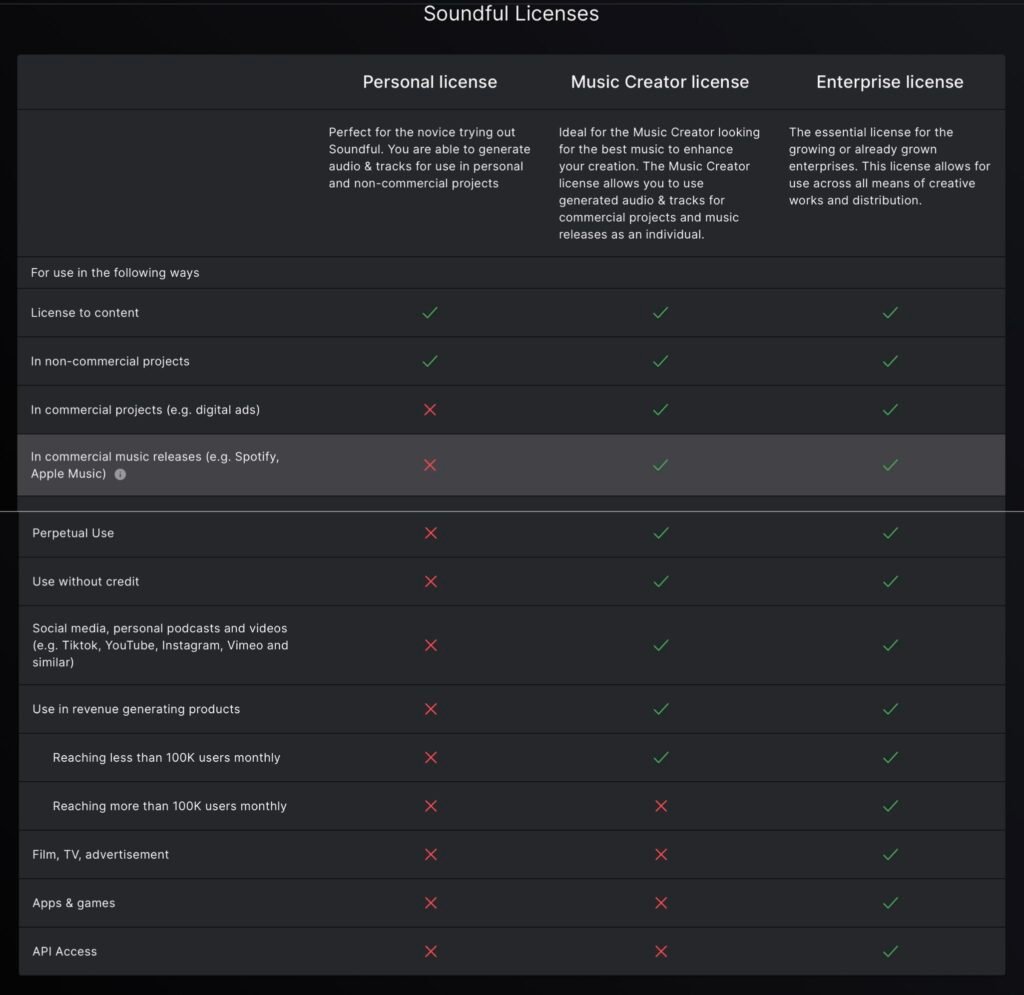
The plan names and the license names do not line up. The in-app plan screen FSR tested sells paid plans called Premium and Pro. The license page names its licenses differently: Personal, Music Creator, and Enterprise. The FAQ uses a third set, Content Creator and Music Creator Plus. So the thing you buy (a plan called Premium or Pro), the license it is said to grant (Music Creator), and the license the FAQ attaches cancellation rules to (Content Creator or Music Creator Plus) are named in three different systems, with no single page that maps them to each other.
The pages disagree on whether the paid license is perpetual. On the in-app plan screen, both Premium and Pro link to a license labeled simply “Music Creator license.” Neither says perpetual or non-perpetual. The license page does answer it: it marks the Music Creator license as Perpetual Use. The FAQ, separately, … calls it non-perpetual. So one official page calls the paid license perpetual, and another, using a name one word apart, calls it non-perpetual.
The numbers do not match either. In the app, Premium includes 100 downloads a month and zero stems; Pro includes 400 downloads and 20 stems. In the FAQ, Content Creator lists 100 downloads and one stem pack, and Music Creator Plus lists 300 downloads and ten stem packs. You might guess Premium maps to Content Creator on the download count, but Pro’s 400 downloads match neither FAQ figure.
Here is the whole conflict in one view.
| Where you see it | Name shown | Downloads / stems per month | Post-cancellation rights | Evidence |
|---|---|---|---|---|
| In-app plan screen | Premium plan, “Music Creator license” | 100 / 0 | not stated on the plan card | Observed by FSR |
| In-app plan screen | Pro plan, “Music Creator license” | 400 / 20 | not stated on the plan card | Observed by FSR |
| License page | Music Creator license | applies to the paid plans | Perpetual Use marked yes | Official |
| FAQ | Content Creator license | 100 / 1 | perpetual, usable after cancellation | Official |
| FAQ | Music Creator Plus license | 300 / 10 | monetization ends unless copyright bought | Official |
Look at the post-cancellation column. The license page says the Music Creator license is perpetual. The FAQ says Music Creator Plus monetization ends on cancellation. Those two names are one word apart, and the in-app plan card, the screen where you actually pay, uses neither cancellation word. The plan you buy does not carry the label that decides your rights after you stop paying, and the pages that do carry a label do not agree. That is the gap a buyer cannot close from the pages alone.
There is a structural point underneath the naming mess. The rules that decide what you can do with a track, and what happens when you cancel, sit in FAQ and help-center text, not in a binding contract. FSR read Soundful’s Terms and Conditions, last updated January 1, 2024, and they govern use of the website. FSR did not find plan-specific music-output rights there: nothing that defines downloads, post-cancellation monetization, or the Content Creator versus Music Creator Plus split. FAQ and help text are, in most places, not a contract document. The same Terms page also names its venue inconsistently, with California governing law but venue in “Orange County, Delaware,” which reads as a contract-maintenance signal rather than the article’s point.
This is a shape FSR keeps finding. In the Zebracat review, the pricing page, the terms, and support gave three different answers on refunds. In the Mitte AI review, “one-time purchase” and “subscribers only” described the same product. Soundful’s version is the license map: the surface that sells the plan and the surface that defines the rights are not the same surface, and they do not reconcile.
None of this is a legal conclusion. Under EU consumer rules, for example, a restrictive term can be perfectly lawful when it is clearly disclosed and accepted before purchase, so the question here is clarity and where the terms live, not legality. And the confusion is not unique to AI music. Survey work on digital goods has shown for years that buyers read “buy” and “own” as conferring more than a revocable license actually grants, which is the gap Soundful’s “royalty-free” framing can widen. Royalty-free is a usage permission, not ownership. Soundful’s own FAQ confirms the master license stays with Soundful unless you buy the copyright.
To be fair to Soundful, note what FSR did not test. FSR tested on a free account, did not go through checkout, did not subscribe, did not cancel, and did not see what license text appears at the point of payment or in a paid download’s paperwork. It is possible the checkout flow states the mapping cleanly. Until that is confirmed, the safe reading is that the public pages, as they stand, do not.
What you actually control: four parameters, and tempo is a time-stretch
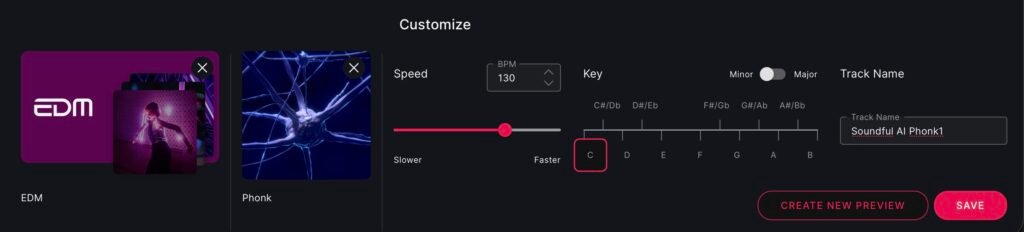
Soundful gives you control before generation, not over the composition after it. In the create flow you set genre, style, BPM, and key, and you name the track. After a track exists, the “Edit track” panel is the same four-parameter screen: tempo, key, style, and name. FSR found no timeline, no instrument-level mute or solo, and no stem editing inside the app. Stems exist, but as a paid export, a bundle of MIDI, pre-master, master, and an Ableton project file meant to open in a separate digital audio workstation. That is a handoff to a real DAW, not editing inside Soundful.
One behavior is worth flagging as a strong inference rather than proven fact. When FSR changed a Phonk preview from 100 BPM to 130 BPM with Apply Changes, the runtime dropped from 2:33 to 1:57, which is exactly the 100-to-130 ratio. That points to the tempo control re-rendering the same composition at a new speed rather than writing a new arrangement. FSR did not inspect the engine, so this is not stated as fact, but the runtime math is hard to read another way. A new arrangement, by contrast, comes from the separate Create New Preview button, which warns it will replace your current preview.
The takeaway for a producer is short. If you want to shape a track after it is made, swap instruments, restructure sections, or mix stems in the browser, Soundful is not built for that. If you want a finished bed to drop into a video, it is.
The audio is genre-dependent, and one file shows the ceiling
Soundful’s quality is not uniform. It tracks how well a genre fits the product’s strength, which is clean instrumental atmosphere.
LoFi fit it well. FSR generated the LoFi Moody Vol. 2 style at 73 BPM in G minor. It was calming, with an ambient water texture, and the downloaded master held up. Measured with ffmpeg, the file was a 320 kbps constant-bitrate MP3 at 44.1 kHz, stereo, 4 minutes 23 seconds, about 10 MB, with an integrated loudness of -16.07 LUFS and a loudness range of 7.0 LU. That is a usable, broadcast-adjacent level for background music.
The one caveat in the file is headroom. It measured a sample peak at 0.0 dBFS and a true peak of +0.02 dBTP, which is essentially no safety margin and a marginal inter-sample overshoot. For an ordinary YouTube or podcast upload that is unlikely to be a problem. If you plan to re-encode the file or push it through another platform’s loudness normalization, pull the ceiling down first.
Phonk showed the boundary. The genre sits under Soundful’s EDM category, and the result was recognizable but not aggressive. The 130 BPM version had more energy, but as noted above it was the same composition sped up, and because the output is instrumental with no vocal chops, it landed closer to EDM-flavored background music than to a full Phonk track. That is a fair test of the limit, not a knock on the tool. Soundful is built for instrumental beds, and a genre that depends on vocal chops and hard structure falls outside its range.
These are first-person impressions of specific tracks, and the measurements come from one downloaded file. FSR is not generalizing from a single LoFi master to every output. The pattern, strong on atmospheric work and weaker where a genre needs vocals or hard structure, matched what the product is designed to do.
One detail from onboarding. When you sign up, Soundful asks whether you are a singer-songwriter or a rapper, among other creator types. Nothing FSR generated produced or supported vocals. If you arrive as a vocalist expecting to build songs around your voice, the tool you land in does not do that, at least not in the flow FSR saw.
The real comparison is download-perpetual versus publish-perpetual
This is directional. FSR did not run the same paid tests across every competitor, and competitor prices shift, so this is not a price-by-price table. For the Soundful buyer the comparison reduces to one axis: what happens to your rights when you stop paying. On that axis the category splits into two camps, and most tools tell you which camp they are in. That is the context that makes Soundful’s gap visible, because Soundful does not.
| Tool | What survives cancellation | Pick it if | Evidence |
|---|---|---|---|
| Soundraw | Download-perpetual: keep the license to use downloaded music forever after you cancel. DSP release needs the Artist plan plus modification; Content ID registration prohibited | You want downloaded BGM you keep | Official pages, directional |
| Boomy | Download-perpetual on Creator and Pro for songs you download; Boomy owns copyright by default; buyout about $19 | You want simple song downloads you can monetize | Official, directional |
| Suno | Paid output keeps commercial rights on songs created while subscribed; no copyright-vesting guarantee | You want vocal songs from a prompt | Official, directional |
| Epidemic Sound | Publish-perpetual: content published while subscribed stays cleared forever, but new use after cancellation is not licensed | You want a large cleared library | Official, directional |
| Beatoven | Project-sync perpetual; standalone distribution to streaming platforms is not allowed; Fairly Trained | You sync music into your own video or podcast | Official, directional |
| Udio | Downloads disabled after the Universal Music Group settlement; moving to a licensed walled garden | Hold; terms are mid-transition | Official, directional |
Two readings come out of that table. First, the correction to a claim you will see online, that Soundful is the only tool where cancelling puts your existing use at risk. It is not. Publish-perpetual is a normal, disclosed model, and Epidemic Sound, one of the largest royalty-free libraries, runs on it. Soundful’s actual problem is not that it has a post-cancellation limit; it is that you cannot tell, from its own pages, which camp a given Soundful plan belongs to.
Second, terms can change underneath you. Udio’s shift after the Universal Music Group settlement, disabling downloads and moving to a licensed service, is the rented-execution risk FSR flagged in the Manus AI review: you are renting access on terms the vendor can revise after you have built on them. For Soundful that is one more reason to keep your own copy of anything you license, and to know whether your copy stays licensed.
For a head-to-head on pricing and on vocal-capable generation, see FSR’s AI BGM comparison hub and the Mureka review.
The sticker is $4.99. The bill can include $50 per track.
The monthly numbers are the easy part. On the account FSR tested, Premium is $4.99 a month billed annually, charged as $59.99 up front, and annual-only in the in-app view. Pro is $9.99 a month on the annual plan, charged as $119.99 up front, or $14.99 month to month. The three Business tiers run $49.99, $120.83, and $249.99 a month, billed annually at $599.99, $1,449.99, and $2,999.99, and they are marked for organizations under $1M in revenue. Enterprise is custom, for revenue above $1M.
The harder cost is the one the price slider does not show. The license page says the Music Creator license covers commercial music release on Spotify and Apple Music. But by default, per the FAQ, Soundful keeps the master license to the tracks you download. To actually own a track, to register it, sell it standalone, or run it through Content ID, you buy the copyright, which the FAQ prices from $50 per track. That purchase is not a one-click upgrade: the documented process runs through an email to Soundful support, an individual assignee rather than a business, and a contract, with bundle pricing for five or fifteen tracks. Soundful also sells stem bundles on the side, three stems for $12.99, about $4.33 a track, marked as not expiring. Direct distribution to SoundCloud is included from the Pro tier.
The sticker-versus-bill gap is a pattern FSR keeps finding in AI tooling. In the Agent A review a $99 sticker concealed a realistic $327 to $827 stack once the necessary parts were added. Here the sticker is $4.99 and the real bill, for anything you intend to own or release, is the subscription plus a per-track copyright purchase, plus the rights uncertainty above. For casual background music that math is fine. For monetized or client work, price the copyright step in from the start.
Download means request a render and wait for an email
Downloading is asynchronous, which is worth knowing before you plan around it. After choosing to export, the interface said the render could take up to ten minutes. FSR’s took roughly one to two minutes, and the finished file arrived two ways: by email from Soundful’s support address, with a name in the form [track]_mix.mp3, and in the My Library section of the app. On the free Standard plan, the monthly download counter moved from 1 of 1 to 0 of 1 after that single export, with the allowance resetting on the next monthly date.
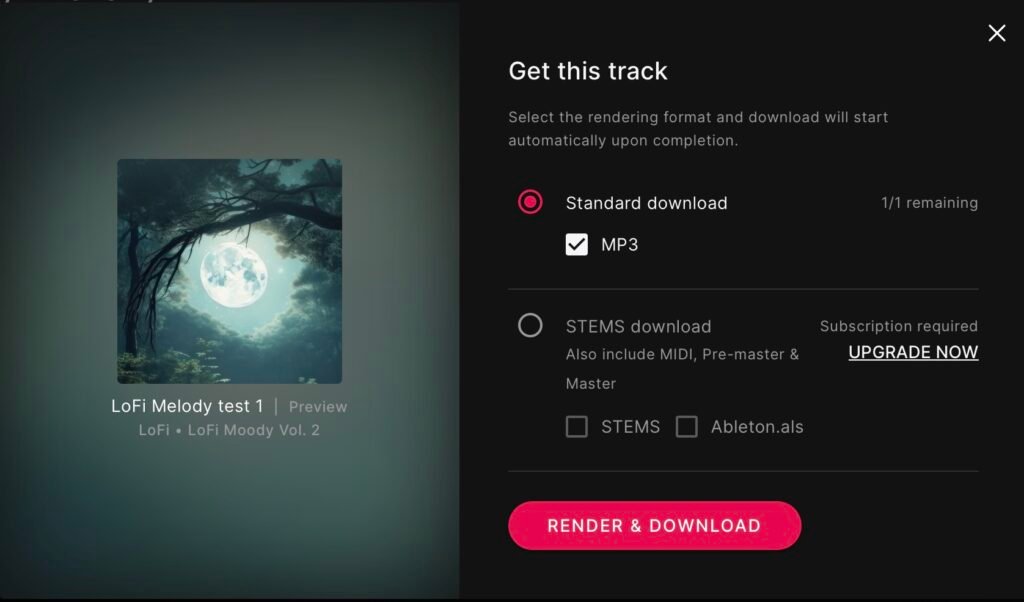
It works, and the file is real. Just know that “download” here means “request a render and wait for an email,” not an instant save.
At a glance
Each line is written to stand on its own, with the evidence type marked so a careful reader, or an answer engine, can see what FSR measured versus what the pages state versus what is inferred.
| Fact | Detail | Evidence |
|---|---|---|
| What it is | Template/style-based AI generator for instrumental BGM | Observed by FSR |
| Text-prompt songwriting | Not present in the tested flow | Observed by FSR |
| Vocals | Not present in the tested flow | Observed by FSR |
| Generation speed | About 12 seconds per preview (Phonk 12.66s, LoFi 12.05s) | Measured by FSR |
| In-app editing | BPM, key, style, track name only | Observed by FSR |
| Stems | Paid export to an external DAW, not in-app editing | Observed by FSR |
| Free plan (Standard) | $0, 1 MP3 download/month, 0 stems, Personal (non-commercial) license | Observed by FSR; in-app |
| Premium | $4.99/mo billed annually ($59.99/yr), 100 MP3 and WAV/mo, 0 stems, Music Creator license | Official; in-app, recheck |
| Pro | $9.99/mo annually ($119.99/yr) or $14.99/mo monthly, 400 downloads/mo, 20 stems, SoundCloud distribution, Music Creator license | Official; in-app, recheck |
| Business tiers | $49.99 / $120.83 / $249.99 per month; 750 / 1,500 / 3,000 downloads; Enterprise license; stated for under $1M revenue | Official; in-app, recheck |
| Copyright purchase | From $50/track per the FAQ, by email plus a contract, individual only | Official, verified; recheck |
| Cancellation rights | Content Creator perpetual; Music Creator Plus monetization ends unless copyright bought; plan-to-license mapping unstated | Official, verified; mapping needs manual check |
| Binding Terms | Last updated January 1, 2024; no plan-specific music-output rights found | Verified, interpretive |
| Refund | 7-day window, void once any premium feature is used | Official |
| AI training claim | Not trained on copyrighted music, per a 2024 Soundful blog post, not independently audited | Official claim only |
| Affiliate networks | FlexOffers and Rakuten, no official affiliate page on soundful.com; commission rate not stated | Third-party, needs manual check |
A note on the free plan, because Soundful’s pages disagree. The in-app plan card shows one MP3 download per month for the free Standard plan, which matched FSR’s account. A block in Soundful’s pricing-page FAQ still describes a “Standard Plan” with ten downloads per month and one stem pack. FSR could not reconcile those from the public pages; read the in-app figure as current and treat the FAQ number as stale until Soundful corrects it.
Use, skip, or wait
Use it if you need clean royalty-free instrumental BGM for video, podcast, or stream, speed matters more than fine control, your need is mostly LoFi or ambient, and your use stays on a license that survives cancellation, which you have confirmed in writing before paying.
Skip it if you want vocals or a songwriting tool, you need real editing inside the app, or you assume a paid plan means you own the music. By default you do not.
Wait if you plan to monetize, release to streaming platforms, or deliver tracks in client work and your plans are not settled. Confirm the per-track copyright cost and process, confirm what survives cancellation on your specific plan, and reread Soundful’s license pages, which shift and currently contradict each other.
A specific word on agencies and businesses, because it is the highest-risk case. If you put Soundful music into client deliverables, you need to know whether the rights transfer to the client, whether the client or the agency must hold the active subscription, and what happens to the client’s published work after either of you cancels. Soundful’s public pages do not answer those cleanly. Until they do, treat client and broadcast use as something to clear in writing or to route through a tool with explicit transfer terms or a copyright purchase.
Decision tree
- Want a private background track for a low-risk internal edit? → Use it. Speed and the low entry price are the value.
- Need it for monetized YouTube or a podcast you will keep live? → Use it only after you confirm, in writing, which license your plan grants and whether the upload stays monetized after cancellation.
- Need Spotify or Apple Music release, a standalone music sale, or a client transfer? → Do not treat the plan card as enough. Confirm whether copyright purchase is required, from $50 per track, before the track becomes part of paid work.
- Want vocals, full genre fidelity, or in-app editing? → Skip. Wrong tool category.
FAQ
Is Soundful royalty-free, and do I own the music? Soundful’s paid plans grant a royalty-free license to use generated tracks, but per its FAQ the master license stays with Soundful by default. You do not own the music unless you separately buy the copyright, which the FAQ prices from $50 per track. Royalty-free here means a usage permission, not ownership.
Can I use Soundful music on YouTube? For background music on monetized videos, the paid plans are intended for commercial use. The free Standard plan grants a Personal, non-commercial license and requires crediting Soundful. The unresolved question is what happens to videos that stay live after you cancel, which depends on a license mapping Soundful’s pages do not state clearly. Confirm before relying on it.
Can I upload Soundful tracks to Spotify or Apple Music? Not on the standard licenses. Per Soundful’s FAQ, distributing to streaming platforms requires buying the track’s copyright, which starts at $50 per track and runs through a manual email-and-contract process. Direct distribution to SoundCloud is included from the Pro tier, which is separate from Spotify or Apple Music release.
What happens to my Soundful tracks if I cancel? Soundful’s FAQ gives two answers by license type. A Content Creator license is described as perpetual, usable after cancellation. A Music Creator Plus license ends monetization when the subscription ends unless you buy the track’s copyright. The catch is that Soundful’s pages do not map those licenses cleanly to the plans you pick, so confirm your plan’s terms in writing first.
Does Soundful generate vocals or full songs? No, not in the flow FSR tested. Soundful is an instrumental background-music generator. You select genre, style, BPM, and key, and it renders an instrumental in about twelve seconds. There is no text-to-song prompting and no vocal generation, which makes it a different category from tools like Suno or Udio.
How much does Soundful cost? On the account FSR tested in June 2026, Premium is $4.99 a month billed annually ($59.99 up front), and Pro is $9.99 a month annually ($119.99 up front) or $14.99 month to month. Business tiers run $49.99 to $249.99 a month. Owning a track costs extra, from $50 per copyright. Recheck current pricing before you buy.
Is Soundful safe for EU or enterprise use? For this review, the immediate enterprise issue is contract clarity: post-cancellation rights live in FAQ text rather than binding Terms, and procurement teams will want that pinned down in writing. EU buyers should still review Soundful’s privacy, data-processing, and procurement terms separately, which fall outside this hands-on test.
Methodology and sources
Testbed. One free Standard account on my.soundful.com, in Safari on macOS, June 16, 2026. FSR generated and downloaded instrumental tracks, recorded generation times and the download flow, and hit the free-tier limit. The one downloaded LoFi master was measured with ffmpeg for bitrate, sample rate, duration, integrated loudness, loudness range, and true peak.
What FSR read. Soundful’s in-app plan screen, public pricing page, public license page, FAQ, and Terms and Conditions, cross-checked against Soundful’s help-center articles. Where Soundful’s own pages disagree, FSR preserved the disagreement rather than resolving it, because the disagreement is the finding. Competitor rights facts come from each tool’s official license, terms, or help pages, read on June 16, 2026, and are used directionally, not as a price comparison.
What was not tested. Any paid plan; stem export; the Business and Enterprise tiers; the checkout flow; the cancellation flow; the copyright-purchase process; Content ID behavior; the payload of any request; and long-term use. The training-data claim is an official statement, not an audited fact.
Source hierarchy. Highest weight: FSR’s hands-on observation and Soundful’s primary pages (in-app screen, pricing, license, FAQ, Terms). Directional: competitor official pages. Lowest: outside signals. On those, in the visible sample FSR checked, roughly 25 posts and pages across about 24 months, FSR did not find verified reports of users losing the right to use tracks they made after cancelling Soundful; that sample is not exhaustive. FSR also saw one public complaint about a refund dispute, which is a separate billing matter and a single account’s claim, not something FSR can verify or generalize.
Validity window. This review is tied to pages read on June 16, 2026, on one free account. Pricing, download limits, and license terms are volatile; re-confirm within 48 hours of any decision. If Soundful changes its pages so the plan-to-license naming reconciles, the license finding should be updated with a dated line.
Masking. No account credentials, payment details, or personal data are reproduced.
FSR verdict
| Audio quality (BGM use) | Solid |
| Speed and ease | Strong |
| Editing and control | Limited |
| Genre range | Narrow (instrumental only) |
| License clarity | Weak |
| Best for | Royalty-free instrumental BGM |
Soundful does the narrow thing it is built for. It makes clean instrumental background music quickly, the one file FSR measured was technically sound, and the entry price is low. For a LoFi bed under a video or a podcast, it earns its place.
This review spends most of its length on licensing because that is where a buyer actually gets hurt, and it is the part ordinary reviews skip. The audio you can judge in a minute. What you cannot judge from Soundful’s pages is what you will be allowed to do with that audio after you stop paying, because the plan names, the license names, and the download numbers do not line up across the in-app screen, the license page, and the FAQ, and the binding Terms cover none of it.
That is not a scam and it is not unique to Soundful. It is a documentation problem with real commercial consequences, the same surface-versus-substance split FSR found in Zebracat and Mitte. Buy Soundful for what it is, a fast instrumental BGM generator, and stay on a license that survives cancellation, or buy the copyright for anything you monetize. Read the license, not the pricing page, and get the mapping in writing before you build paid work on top of it.
Author note: This review reflects hands-on testing of Soundful’s free tier and a documentary read of its public pages on June 16, 2026. It is not legal advice. FSR is not a law firm; questions about copyright, ownership, and contract enforceability should go to a qualified professional. FSR does not state legal conclusions about Soundful’s terms; it reports what the pages say, where they conflict, and what a buyer should confirm.