Last updated: August 19, 2026
Future Stack Reviews read public documentation. We did not buy a subscription, run a session, or inspect an invoice for this briefing.
This establishes what each vendor sells and on what terms. It does not establish which product writes better code, works faster, or fails less often. Every page cited was opened on 19 August 2026, and each section carries its own sources.
A GitHub Copilot alternative has to replace a workflow surface, not just generate code. Copilot covers inline completion, IDE chat, a terminal CLI, cloud agents, and pull request review. Most products marketed as alternatives replace one or two of those. Price only becomes comparable after you know which surface a product actually takes over, and which cost moves with it.
Verdict in one line: Keep Copilot when GitHub-native completion and pull request workflow are the job, and switch only when another product replaces your primary surface with a cost or control advantage its own documents make explicit.
- Developers comparing paid plans after GitHub’s June 2026 billing change
- Engineering leads choosing one standard tool for a team
- Procurement checking usage limits, data routing, and governance before a pilot
- Anyone deciding whether bring-your-own-key changes the bill
- A measured code quality ranking. Nothing here was run
- Latency or benchmark comparison
- Buyers holding a negotiated Order Form, which can modify all of this
- Anyone who needs a compliance determination rather than the documents behind one
What each alternative actually replaces
Start here. A cheaper product that does not cover your primary surface is not cheaper.
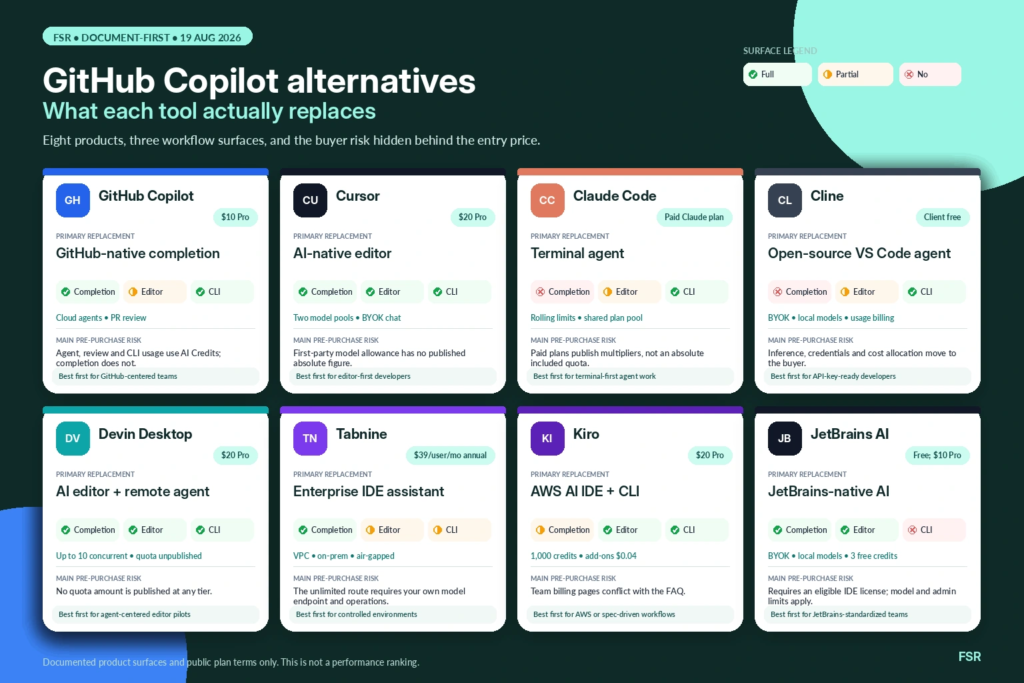
| Product | Inline completion | Editor | Terminal agent | Entry price | Main pre-purchase risk |
|---|---|---|---|---|---|
| GitHub Copilot | Yes, and not metered | Extension, keeps your IDE | Copilot CLI | $10 / user / mo | Agent usage is metered separately, and part of the allowance is variable |
| Cursor | Yes, on Cursor’s own models | Replaces the editor | CLI available | $20 / mo | First-party model allowance is not published as a figure |
| Claude Code | No | IDE extension, not a fork | Primary surface | Bundled with a paid Claude plan | No absolute usage figure published for included plans |
| Cline | No | VS Code extension | CLI available | Client free, inference billed | Provider credentials and cost allocation move to you |
| Devin Desktop | Tab completion, unlimited on all plans | Replaces the editor | Devin CLI | $20 / mo | No quota figure published at any tier |
| Tabnine | Yes | IDE plugin, keeps your IDE | Tabnine CLI on the higher plan | $39 / user / mo, annual | The unlimited route requires model infrastructure you supply |
| Kiro | Not published as a separate entitlement | Own IDE | Kiro CLI | $20 / user / mo | Team billing pages conflict with the FAQ |
| JetBrains AI | Yes, on JetBrains models by default | Runs inside JetBrains IDEs | Junie and Claude Agent in-IDE | Free tier, then $10 / mo | Requires an eligible IDE license underneath |
Surfaces and prices are taken from each vendor’s own pages. This table records what is sold, not how well any of it works.
Three rows deserve emphasis before you read further.
Copilot keeps inline completion outside its credit meter on every paid plan, which makes it the cheapest documented route to paid GitHub-native completion. Claude Code and Cline do not replace inline completion at all; they are terminal agents. And Devin Desktop and Cursor replace the editor itself, which is a switching cost that no price column captures.
Sources: GitHub, Copilot plans · Cursor, Pricing · Anthropic, Plans and pricing · Cline, Pricing · Devin, Plans and pricing · Tabnine, Plans and pricing · Kiro, Pricing · JetBrains, AI plans and pricing · all read 19 August 2026
| What changed on 1 June 2026 | GitHub replaced Copilot premium requests with GitHub AI Credits at one cent each. Fallback to a cheaper model on exhaustion was removed |
| What did not change | Code completions and next edit suggestions consume no credits on any Copilot plan |
| Cheapest paid completion route | Copilot Pro at $10 per user per month |
| Publish an absolute usage figure | Kiro in credits, JetBrains AI in credits, GitHub in dollars, Cursor for third-party models only |
| Publish no usage figure | Devin Desktop. Anthropic publishes multipliers instead |
| Audit logs on an individual plan | Copilot Pro+ only. No Anthropic individual tier includes them |
| SSO, SCIM, usage metrics, IP indemnity | Organization plans only, at every vendor we checked |
| Owner, name, or lifecycle change since May 2026 | Four of the eight products covered here |
| Independent performance measurement located | None, for seven of the eight, under the search rules in the Methodology |
| Last checked | 19 August 2026, from Japan. Confirm every figure on the vendor page before you buy |
What changed on 1 June 2026
GitHub replaced premium request units with GitHub AI Credits for monthly individual subscribers. Credits cost one cent each and are consumed on token usage, including input, output, and cached tokens, at the published rate for whichever model handles the request. Base plan prices did not move.
The change removed fallback, added an Actions charge to code review, and treated annual subscribers differently from monthly ones.
Fallback is the one most likely to reach your workflow first. Under premium requests, a user who exhausted the allowance could drop to a lower-cost model and keep working. GitHub’s announcement states that fallback experiences are no longer available and that usage is governed by available credits and administrator budget controls instead.
Copilot code review now consumes GitHub Actions minutes in addition to AI Credits, billed at the same per-minute rate as other Actions workflows. That is a second meter attached to a single feature.
Annual Pro and Pro+ subscribers stayed on premium request pricing until their term expires. GitHub’s announcement states that model multipliers increased on 1 June for annual plan subscribers only, and that at expiration those accounts move to Copilot Free with the option to upgrade to a paid monthly plan.
Code completions and next edit suggestions remain outside the AI Credit meter on every plan. Chat, agent mode, code review, Copilot CLI, and cloud agents are inside it.
Sources: GitHub Blog, 27 April 2026 · GitHub, Copilot plans, read 19 August 2026
The five cost layers behind the headline price
Calling every charge a meter hides the difference that decides a budget. Variable inference cost may sit with the tool vendor, with the model provider, or with your own infrastructure, and a seat fee is none of those.
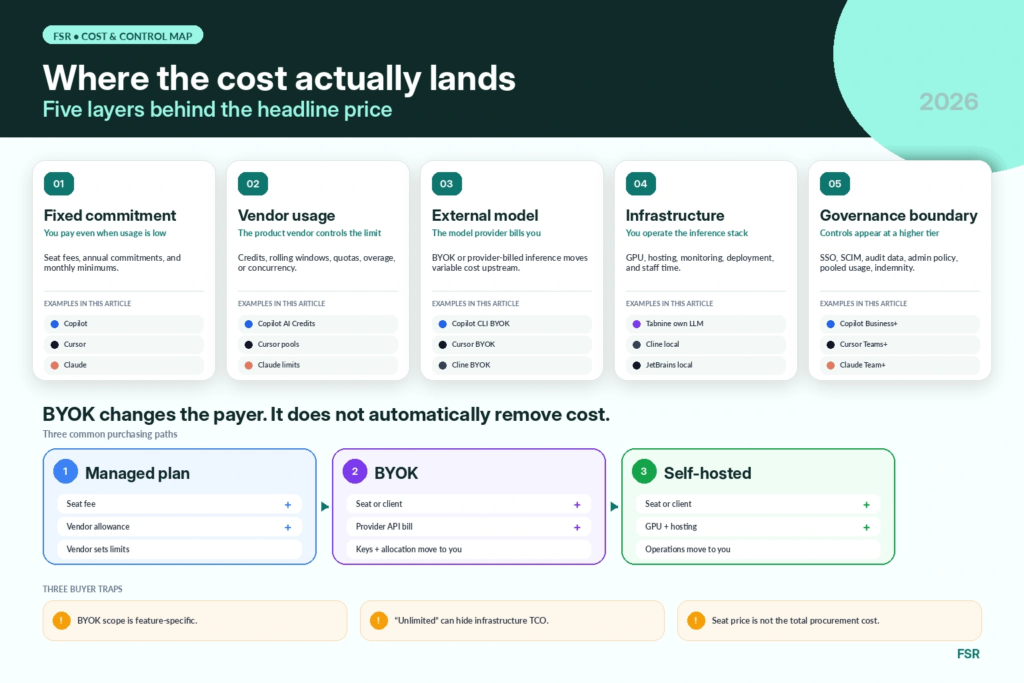
| Layer | Who is billed | Examples in this briefing |
|---|---|---|
| Fixed commitment | You, whether or not anyone opens the tool | Tabnine seats, Devin Teams minimum, JetBrains IDE license under the AI subscription |
| Vendor usage charge | The tool vendor | GitHub AI Credits, Kiro credits, JetBrains AI Credits, Cursor pools, Claude rolling limits, Devin quota |
| External model charge | Anthropic, OpenAI, Google, or another provider, directly | Any bring-your-own-key route, and Cline’s usage-billed inference |
| Infrastructure cost | You | Tabnine on-premises or customer endpoint, local models in JetBrains or Cline |
| Governance boundary | The plan tier where controls become purchasable | SSO, SCIM, usage analytics, IP indemnity, central billing, audit data |
A buyer can leave one layer without eliminating the others. Cline removes a mandatory client fee and leaves the external model charge. Tabnine removes its own usage charge when you supply an endpoint, keeps the seat fee, and transfers inference operations to you. JetBrains supports third-party and local models for several features without an AI subscription, and still requires an eligible IDE license underneath.
Sources: as cited in each vendor section below. This taxonomy is our construction, applied to the entitlements those pages publish.
Bring-your-own-key, feature by feature
Bring-your-own-key is the most common recommendation in this category and the least specific. It is not a product-wide entitlement anywhere we looked. It applies to named features, and the named features differ.
Cursor’s help documentation states that a custom API key applies to chat models, and that Tab completion continues to use Cursor’s built-in models. Two further statements on the same page belong in any procurement review. Cursor’s zero data retention policy does not apply to requests made with your own key, and data handling follows the policy of the provider you selected. And every request still passes through Cursor’s servers for final prompt construction, so the key is transmitted to Cursor’s backend on each request. Cursor states the key is not stored after the request completes.
JetBrains separates two settings sections, and the distinction decides what your key can do. Models configured under Third-party AI providers do not power next edit suggestions or code completion; those rely on JetBrains models by default. Completion can be moved to a model of your choice, but only by configuring an OpenAI-compatible provider under a separate AI Completion section, and only if that model supports fill-in-the-middle or edit prediction. JetBrains states that general-purpose chat models typically do not provide those capabilities.
Do not ask whether a product supports bring-your-own-key. Ask which features use the key, which server receives the request, which features fall back to vendor models, what happens to data retention, and whether an administrator can disable the route.
Three further constraints apply on the JetBrains path. Models from a third-party provider are assigned to features automatically, and the documentation states that features an assigned model does not support become unavailable. Local models cannot invoke tools from configured MCP servers. The default context window for local models is 64,000 tokens, adjustable in settings. Where an organization manages AI centrally, an administrator can set the provider and control whether you may connect a third-party key at all.
Cline routes inference to whichever provider you point it at, including Anthropic, OpenAI, Google, OpenRouter, AWS Bedrock, Google Vertex, Groq, Cerebras, DeepSeek, Ollama, and LM Studio. Its pricing page describes model inference purchased at cost or through your own key, and its FAQ also refers to a Cline-provided inference option, which means the open-source client is not exclusively a bring-your-own-key product.
Tabnine’s route is different in kind. Its pricing footnote describes usage as unlimited when the customer supplies an on-premises model or a cloud endpoint, and charges provider cost plus a 5 percent handling fee only for Tabnine-provided model access. That removes Tabnine’s usage charge. It does not remove the seat fee, the model, the hardware, or the operations.
Sources: Cursor Help, Use your own API key · JetBrains, Use third-party and local models, modified 28 July 2026 · Cline, Pricing · Tabnine, Plans and pricing · all read 19 August 2026. GitHub also documents customer-supplied and local model routes for Copilot CLI; we did not open that page for this revision and have not described its scope here.
GitHub Copilot, the baseline
An alternatives guide without the incumbent’s price table asks you to compare against something you cannot see.
| Plan | Price | Monthly credits | Composition and notes |
|---|---|---|---|
| Free | $0 | Not included | 2,000 completions and 50 agent mode uses per month |
| Pro | $10 / user / mo | $15 | $10 base plus $5 flex. Unlimited completion and next edit |
| Pro+ | $39 / user / mo | $70 | $39 base plus $31 flex. Adds premium models including Opus, and audit logs |
| Max | $100 / user / mo | $200 | $100 base plus $100 flex. Priority access to new models |
| Business | $19 / user / mo | $19 | $30 promotional for June, July, and August 2026. Pooled across the organization |
| Enterprise | $39 / user / mo | $39 | $70 promotional for June, July, and August 2026 |
One AI credit is one cent. Individual figures read from the plans page. Business and Enterprise figures from GitHub’s April announcement.
The flex allotment is the part to read twice. GitHub’s footnote states that flex allotments are not fixed and may change. On Pro that is one third of the monthly allowance. On Max it is half. The base portion matches the subscription fee and is described as fixed.
Governance on the individual plans is partial rather than absent, and the distinction matters if you are deciding whether to buy a Business seat. Audit logs appear at Pro+. Enterprise-grade security, IP indemnity, user management on github.com, usage metrics, SAML SSO authentication, and pooled usage are marked not included across all four individual tiers, so a single developer can buy an audit trail but not an identity or administration layer.
Training defaults differ by tier as well. GitHub’s FAQ states that from 24 April it may use interaction data from Free, Pro, and Pro+ subscribers to train and improve AI models, with opt-out available in account settings. The FAQ text names Free, Pro, and Pro+ and does not name Max.
One footnote sits directly under the words unlimited code completion and is easy to skip: response times vary by usage, and requests may be subject to rate limiting.
Sources: GitHub, Copilot plans, read 19 August 2026 · GitHub Blog, 27 April 2026
Cursor
Cursor replaces the editor, not only the assistant. That is the switching cost no price column shows, and it is the reason a $20 Cursor plan and a $10 Copilot plan are not the same purchase.
Pricing runs on two separate monthly pools. Other Models covers third-party frontier models at the provider’s API price. Cursor Models covers the first-party lineup, currently Composer 2.5 and the Grok versions Cursor ships as its own.
| Plan | Price | Other Models pool | Cursor Models pool |
|---|---|---|---|
| Hobby | Free | Not stated | Limited agent requests |
| Pro | $20 / mo | $20 | No figure published |
| Pro+ | $60 / mo | $70 | Stated as 3x Pro agent limits |
| Ultra | $200 / mo | $400 | Stated as 20x Pro agent limits |
| Teams Standard | $40 / user / mo | Not published as a dollar value | Not published |
| Teams Premium | $120 / user / mo | Not published | Stated as 5x Standard agent limits |
| Enterprise | Custom | Set by Order Form | Pooled across the account |
Cursor also sells a Start plan in India at 649 rupees, tax inclusive, carrying the Cursor Models pool only.
The multipliers measure something the pages do not name. Pro+ is described as three times Pro’s agent limits while its published third-party allowance moves three and a half times. Ultra’s stated twenty times matches its $400 allowance exactly. Neither page states which pool the multiplier applies to.
On Teams and Enterprise, third-party model requests carry a Cursor Token Rate of $0.25 per million tokens on top of the model’s own API price. The documentation states this applies to included usage, on-demand usage, and bring-your-own-key usage. First-party Cursor models are exempt. Individual plans and Teams plans therefore have different bring-your-own-key economics, and a buyer moving from one to the other should re-read this line.
Regional data residency is a paid option, adding a 10 percent uplift on model pricing for eligible models.
Cursor’s subprocessor list is more specific than most in this category. Code embeddings for indexing are stored with Turbopuffer in the United States. Web search runs through Exa in the United States. Inference providers listed include Fireworks, OpenAI, Anthropic, Google Gemini, Databricks, Baseten, Together, and SpaceXAI. Primary infrastructure is AWS, described as mainly the United States region with some latency-critical services in Europe and Singapore.
Sources: Cursor Docs, Models and Pricing · Cursor, Pricing · Cursor Trust Center, Subprocessors · all read 19 August 2026
Claude Code
Claude Code is a terminal agent bundled with paid Claude plans. It does not replace inline completion, and treating it as a Copilot substitute on price alone compares two different jobs.
Anthropic publishes no absolute quantity for the included-usage plans. Limits reset on a rolling five-hour session window, paid plans add weekly limits on top, and activity across web, desktop, mobile, and Claude Code draws from one pool. Anthropic states there is no fixed message count, that price and plans are subject to change at its discretion, and that it may limit usage in other ways such as weekly and monthly caps or model and feature usage.
| Plan | Displayed to us, tax included | Tax-exclusive equivalent | Claude Code |
|---|---|---|---|
| Free | $0 | $0 | Not included |
| Pro, annual | $220 billed up front, shown as $18 per month | $200 per year | Included |
| Pro, monthly | $22 per month | $20 per month | Included |
| Max | From $110 per month | From $100 per month | Included. 5x or 20x more usage than Pro |
| Team Standard seat | $22 annual, $27.50 monthly | $20 annual, $25 monthly | Team plan card lists Claude Code and Cowork |
| Team Premium seat | $110 annual, $137.50 monthly | $100 annual, $125 monthly | 5x more usage than standard seats |
| Enterprise | $22 per seat plus usage at API rates | $20 per seat | Usage cost scales with model and task |
The page we opened carried a footer reading that prices include 10 percent Japanese consumption tax. The tax-exclusive column divides the amount actually billed by 1.1 and is our arithmetic, not a figure Anthropic published. The $18 figure is the annual price presented as a monthly equivalent, so the tax-exclusive equivalent is $200 divided by twelve, or $16.67. We did not observe this page outside Japan. Team is described as for teams of 2 to 150.
The structural point sits in the last row. Individual and Team plans express usage as a multiplier of another plan. Enterprise expresses it as a seat price plus usage at published API rates. Enterprise is the only Anthropic tier where a buyer can price a known token volume before signing, and it gets there by removing the included allowance rather than by publishing one.
Governance is absent across every Anthropic individual tier, including audit logs. The comparison table marks single sign-on, central billing, admin controls for connectors, enterprise desktop deployment, role-based access, SCIM, audit logs, usage analytics, and the Compliance API as unavailable on Free, Pro, Max 5x, and Max 20x. All of them appear on Team or Enterprise. This is a sharper cut than GitHub’s, where audit logs are reachable at Pro+.
API rates appear on the same page: Fable 5 at $10 input and $50 output per million tokens, Opus 5 at $5 and $25, Sonnet 5 at $2 and $10, Haiku 4.5 at $1 and $5. Three platform charges sit alongside them: managed agents at $0.08 per session hour of active runtime, web search at $10 per thousand searches, and code execution with 50 free hours daily per organization then $0.05 per hour per container. Workloads that must run in the United States are available at 1.1 times pricing for input and output tokens.
One item is unresolved. The API tab carries the same consumption tax footer as the subscription cards, but the API figures are round numbers matching what is widely published as the list price, which they would not be if 10 percent tax were included. We did not observe this page from outside Japan and are recording the conflict rather than resolving it.
Sources: Anthropic, Plans and pricing, observed 19 August 2026 · Anthropic, Usage limit best practices, 3 June 2026 · Anthropic, Claude Code overview
Devin Desktop
The product sold as Windsurf is now Devin Desktop. Cognition’s pricing page carries the Devin name, the comparison table names the editor Devin Desktop, and windsurf.com resolves to devin.ai.
| Plan | Price | Allowance structure | Concurrent sessions |
|---|---|---|---|
| Free | $0 | Limited usage. Devin Review and DeepWiki included | Not available |
| Pro | $20 / mo | Daily and weekly quota. No figure published | Up to 10 |
| Max | $200 / mo | Weekly quota only, no daily cap. No figure published | Up to 10 |
| Teams | $80 / mo minimum | Full seat $40 with Pro-equivalent quota. Flex seat free, shared credits only | Unlimited |
| Enterprise | Contact sales | Not published | Unlimited |
The $80 Teams figure is a monthly minimum, not a base fee added to every seat. Devin’s billing documentation publishes the arithmetic: zero full seats costs $80 with $80 in credits included, one full seat costs $80 with $40 in credits, two full seats costs $80 with no credits included, and from two seats upward the monthly total is the seat count times $40. Ten full seats cost $400 per month. The pricing page phrasing, an $80 monthly figure plus $40 per seat, reads as $480 for ten seats if taken literally, and the billing documentation is where the difference is resolved.
Flex seats are free and unlimited in number. They draw entirely from the team’s shared on-demand credit pool and do not include Devin Desktop access.
The gap between Pro at $20 and Max at $200 does not appear on the public comparison table. Every row we checked holds the same value on both, including the concurrent session limit of ten. The billing documentation describes the actual difference: Pro and Teams full seats carry a daily and a weekly allowance, with the daily allowance set at more than one seventh of the weekly, while Max carries a weekly allowance only with no daily cap. Neither allowance is quantified anywhere we found. A buyer choosing between a $20 plan and a $200 plan is choosing between two structural descriptions with no number attached to either.
Two mechanics run in the buyer’s favor here. On-demand credits roll over month to month, and Devin states that purchased credits never expire. And the degradation path is written down: if credits run out, Automations stop running and Devin Review switches to its non-AI diff viewer.
Legacy plan holders should note that Core plan users were migrated to the Free plan, and that on-demand credits carry the same dollar value as the ACUs they replaced.
Sources: Devin, Plans and pricing · Devin Docs, Billing, self-serve plans · both read 19 August 2026
Tabnine
A banner across the top of Tabnine’s pricing page states that Tabnine has been acquired by Tricentis. We are recording the fact and not forecasting its effect.
Tabnine publishes two paid plans and no free or individual tier on that page. Code Assistant is $39 per user per month and Agentic Platform is $59 per user per month, both on annual subscription. Headless agents for CI and CD are an optional add-on priced separately. The Enterprise Context Engine is a separate product at custom pricing.
The footnote is the reason Tabnine belongs in a cost comparison at all.
“Unlimited usage when using your own LLM on-prem or your LLM end point on cloud.”
Tabnine plans and pricing page, read 19 August 2026. The same footnote adds that Tabnine-provided LLM access is charged at actual provider prices plus a 5 percent handling fee.
That sentence describes Tabnine’s own usage charge. It does not make the model, the hardware, the deployment, the support, or the staff time free. Tabnine describes itself as a fully private, organization-aware AI coding agent designed to run entirely within your environment, offers SaaS, VPC, on-premises, and fully air-gapped deployment, and publishes a System and Hardware Requirements section in its documentation. We located that section and did not extract it, so no hardware specification appears in this briefing. Open it before you model the cost of the unlimited route.
The Enterprise Context Engine is positioned as agent-agnostic and is described as working with Cursor, GitHub Copilot, and Claude Code as well as Tabnine’s own agents. Its published outcome figures, including up to a twofold improvement in agent accuracy and up to an 80 percent reduction in token consumption, carry a footnote stating they come from internal benchmarks and customer environments. Those are vendor measurements.
Tabnine states that it meets GDPR, SOC 2, ISO 27001, and other standards, and lists IP indemnification on both paid plans subject to terms and conditions. Those terms were not on the pricing page. We are reporting what Tabnine states and are not making a compliance determination.
Sources: Tabnine, Plans and pricing · Tabnine, Enterprise Context Engine pricing · Tabnine Docs, Overview · all read 19 August 2026
Kiro
Kiro is AWS’s successor to Amazon Q Developer, and the transition has published dates. New Q Developer signups were blocked on 15 May 2026. End of support for the Q Developer IDE plugins and paid subscriptions is 30 April 2027. Opus 4.6 was removed from Q Developer Pro on 29 May 2026. AWS states that Q Developer in the Management Console and first-party AWS experiences are not impacted, so this is an end of life for the IDE product rather than for the name.
| Plan | Price | Credits | Add-on credits |
|---|---|---|---|
| Free | $0 | 50 | Not available |
| Pro | $20 / user / mo | 1,000 | $0.04 each |
| Pro+ | $40 / user / mo | 2,000 | $0.04 each |
| Pro Max | $100 / user / mo | 5,000 | $0.04 each |
| Power | $200 / user / mo | 10,000 | $0.04 each |
GovCloud pricing is approximately 20 percent higher and has no free tier. Japanese Consumption Tax applies to Japanese billing addresses.
Kiro discloses more about its meter than anything else in this set. It publishes the credit count for every tier, states that credits are metered to two decimal places, and publishes a model multiplier: a task consuming a given number of credits under Auto costs 1.3 times that under Sonnet 4.6. That per-model ratio is the only one we found published by any vendor here.
Two mechanics run in opposite directions. Included credits do not roll over and reset at the start of each billing month. Purchased add-on credits do roll over and expire twelve months from the date of purchase.
Upgrade and downgrade are asymmetric, with one exception. A first upgrade from Free to a paid tier is charged prorated and grants the full credit allowance immediately. An upgrade between paid tiers mid-month triggers a retroactive charge for the whole month based on the price difference, with the month’s usage recalculated under the new tier. A downgrade takes effect the following month, and the current month is billed at the higher rate.
One conflict on Kiro’s own pages should not be resolved by an outside reader. The pricing page invites teams to contact sales for centralized billing, SSO, usage analytics, and enterprise security controls. The FAQ on the same page states that subscriptions and usage limits are calculated per individual user, that each developer needs their own subscription, and that team billing and management features are coming soon. A fifty-person rollout could be fifty individual subscriptions or an enterprise arrangement, and the public pages do not settle which.
Two further items belong in a procurement note. AWS states that once a customer upgrades to a Kiro subscription they cannot return to a Q Developer Pro subscription. And Kiro states that use through third-party automation harnesses that route requests outside its native interfaces is not permitted, naming an example tool.
The tier count itself is disputed between AWS properties. The Kiro pricing page shows four paid tiers plus Free. The AWS Amazon Q Developer FAQ, read the same day, describes Kiro as providing three subscription tiers and omits Pro Max.
Sources: Kiro, Pricing · AWS DevOps Blog, 30 April 2026 · AWS, Amazon Q Developer FAQs · all read 19 August 2026
JetBrains AI
JetBrains ties its meter to its price. One AI Credit equals one US dollar charged in your local currency, and the credits in a plan correspond to its subscription price, with what the documentation calls a small bonus on the Ultimate tier.
| Tier | Individual | Credits per 30 days | Organization |
|---|---|---|---|
| AI Free | Free | 3 | Available. No top-ups |
| AI Pro | $10 | 10 | $20 for 20 credits |
| AI Ultimate | $30 | 35 | $60 for 70 credits |
| AI Enterprise | Organizations only | Described as the maximum number of credits | Part of JetBrains IDE Services |
A JetBrains AI subscription sits on top of an IDE license. The purchase page carried a banner stating that AI licenses for organizations will soon become credits.
JetBrains is the only vendor here that publishes an approximate conversion from its unit to actual work. One credit gives roughly ten code generation requests in chat, forty in the editor, twenty-five code explanations, two hundred and eighty documentation writes, or one hundred and forty commit messages. The documentation calls it a rough approximation, and it is more than anyone else offers.
Two mechanics are easy to miss. The quota resets every thirty days from the date you first used the license rather than on a calendar month, which will not line up with a monthly budget cycle. Top-up credits stay valid for twelve months.
The free tier carries three cloud credits, and its usefulness depends on conditions the credit count does not show. The feature table marks Junie, Claude Agent, Codex, bring-your-own-key for OpenAI and Anthropic, and local models via Ollama and LM Studio as available on AI Free, and the page states that connecting your own API keys requires no JetBrains AI subscription. Eligibility and model support vary by IDE, by model capability, and by administrator policy. Next edit suggestions are marked unavailable on AI Free, and AI Free is not available in Android Studio or in the Community Editions of PyCharm and IntelliJ IDEA. Completion routed to your own model requires the separate AI Completion configuration described in section 04.
Data defaults are stronger than most of this set. Data excluded from training, zero data retention, and content exclusion with .aiignore are marked available on all four tiers, including the free one. On-premises LLMs, organization-wide key management through Azure OpenAI, Amazon Bedrock, or Google Vertex, single sign-on with SCIM, and AI audit logs are Enterprise only.
Territory restrictions apply. The documentation states that AI Free and AI Ultimate are available only in serviceable territories, with the exception of Mainland China for now, and that top-up credits are currently unavailable there. The AI Pro tier bundled free with the All Products Pack or dotUltimate cannot be activated if the IDE license comes through a License Server, which is how many large organizations distribute licenses.
Sources: JetBrains, AI plans and pricing · JetBrains, AI plans and usage, modified 22 July 2026 · JetBrains, Use third-party and local models, modified 28 July 2026. The AI Free feature rows come from a dynamic pricing matrix; we read it once and recommend confirming the row you depend on.
Cline
Cline separates the client from the model access. The client is open source under Apache 2.0 and free for individual developers. Model access is a separate decision, and the pricing page describes inference purchased at cost or through your own key, with the FAQ also referring to a Cline-provided inference option.
The open-source tier includes the VS Code extension, the CLI, a client-side architecture, the MCP marketplace, multi-root workspaces, and community support. Supported providers include Anthropic, OpenAI, Google, OpenRouter, AWS Bedrock, Google Vertex, Groq, Cerebras, DeepSeek, Ollama, LM Studio, and any OpenAI-compatible endpoint.
The Enterprise tier is custom priced and carries the organizational layer: single sign-on, SLA, dedicated support, centralized billing, role-based access control, the ability to restrict which inference providers a team may use, a team management dashboard, and authentication logs.
One item on that Enterprise list is not administrative. The JetBrains extension appears under Enterprise on the pricing page, and the repository states that the JetBrains plugins are not being open-sourced. Whether the JetBrains client is reachable outside an Enterprise agreement is not settled by the two pages we read, and a JetBrains shop should confirm it directly before planning around the free tier.
At the time we read it, the repository showed 66,400 stars, 7,100 forks, 341 contributors, and 373 releases.
For a buyer, the trade is legible. There is no client seat fee at the open-source tier, and the external model charge, the provider credentials, and the cost allocation move to you. An organization that prohibits developers from holding their own provider credentials cannot use that tier regardless of its price, and the Enterprise agreement is where central billing and provider restriction become available.
Sources: Cline, Pricing · cline/cline on GitHub · both read 19 August 2026. Cline’s documentation describes additional model-access routes that we did not extract for this revision.
Products outside these seven
The seven were selected on one rule: each is a paid or commercially supported product that replaces at least one Copilot surface and publishes a plan structure a buyer can read before purchase. That rule excludes several products a competent buyer would still consider, and naming them is more useful than pretending the list is exhaustive.
OpenAI Codex is bundled into ChatGPT subscriptions rather than sold as a standalone plan, which puts its entitlement inside a product this briefing does not cover. Gemini Code Assist changed its individual surface during 2026 and needs its own current check. Continue changed corporate ownership during the period covered here. Augment Code, Tabby, Aider, Kilo Code, and OpenCode all occupy the open-source or bring-your-own-key position that Cline represents in this comparison.
Any of them may be the right answer for a specific buyer. None of them changes the structure of the comparison above, which is why the seven were kept rather than expanded.
Selection rule and exclusions are ours. We did not open current pricing pages for the excluded products and are not describing their terms here.
What public documents cannot establish
Public plan pages establish what a vendor sells. They do not establish which agent completes your repository tasks with fewer errors or less review work.
We searched for independent measurements of these products published in 2026, applying three inclusion rules: the publisher has no commercial interest in the result, the method is described in enough detail to reproduce, and the measurement is of the product rather than of an underlying model. Under those rules we did not locate a qualifying measurement for seven of the eight products. The search scope and queries are in the Methodology.
The public evidence reviewed here does not support a cross-product performance ranking. This briefing records documented entitlements and control surfaces instead.
Task success, code correctness, latency, review burden, and actual monthly consumption are pilot questions. Section 19 sets out what to measure.
Numbers do circulate, and three groups are worth separating.
Vendor capability claims are usable if the scope travels with them. A published context window belongs to a named model, sometimes to a named plan, and rarely to a named region. Copied out of that scope it stops being a fact.
Vendor benchmarks usually do not survive a methodology check. GitHub has published a result on SWE-bench Verified for agent mode with a named model. The harness is named. The task count, the run date, and the competing configuration are not on the page we read, which is why the figure does not appear in this briefing.
Figures with no method trail are the group most likely to reach you through a comparison article. Several we traced ended at marketing pages attributing them to studies with no linked paper, no named authors, and no data.
One distinction is collapsed often enough to be worth stating. A model’s score on a public benchmark is not a product’s performance. The product wraps the model in context assembly, tool policy, retry behavior, and a sandbox. Two products calling the same model do not behave the same way.
What the documents do establish about capability is narrower. Kiro publishes model availability by plan with regions and credit multipliers. Cursor publishes default and maximum context per model. Claude Code documents a one million token window for named models. JetBrains publishes model context windows in its supported models table. Devin’s published long-context values appear in a pricing threshold table rather than as an agent session specification, and we are not treating those as equivalent.
Sources: Kiro Docs, Models · Cursor Docs · JetBrains, Supported LLMs · Devin Docs, Models · all read 19 August 2026
Nine checks before you switch
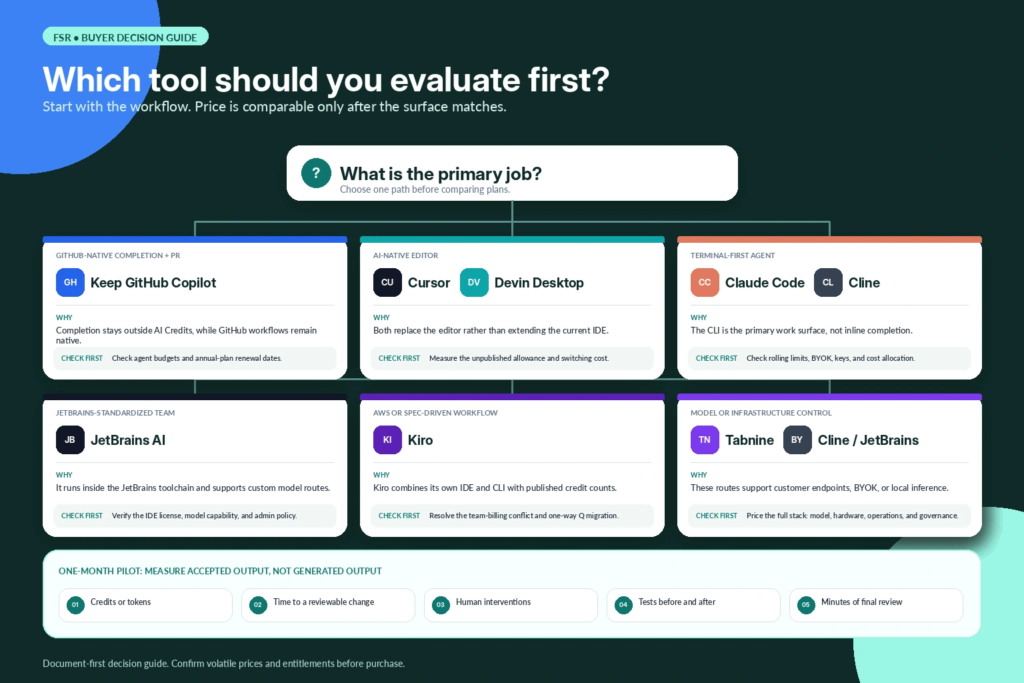
- Which surface does this replace? A terminal agent does not replace inline completion, and an editor replacement carries a switching cost no price column shows.
- Is any part of the allowance variable? One third of Copilot Pro’s credits and half of Max’s is a flex allotment GitHub states may change.
- Is there a second meter? Copilot code review consumes GitHub Actions minutes alongside AI Credits.
- Which features accept your own key? Cursor applies it to chat models and keeps Tab completion on its own. JetBrains needs a separate AI Completion configuration with a fill-in-the-middle or edit-prediction model.
- What happens to data handling under your own key? Cursor states its zero data retention policy does not apply, and that requests still pass through its backend.
- Does the vendor still charge on your key? Cursor’s $0.25 per million token rate applies to bring-your-own-key usage on Teams and Enterprise.
- What does the unlimited route require? Tabnine’s unlimited usage applies when you supply the model endpoint, and it publishes hardware requirements separately.
- What are the upgrade and downgrade mechanics? On Kiro a paid-tier upgrade is charged retroactively for the whole month while a downgrade takes effect the following month at the higher rate.
- At which tier does governance start? Copilot reaches audit logs at Pro+; SSO, SCIM, usage metrics, and IP indemnity are organization plans only. No Anthropic individual tier includes audit logs at all.
Sources: every item is drawn from a page cited in the vendor sections above and listed in the Methodology.
Fifty developers, the real cost stack
Seat cost is the first line, not the total. The third column identifies the variable cost the first two exclude.
| Product and plan | Monthly seat cost | Excluded from that figure |
|---|---|---|
| Cline open source | $0 | The entire inference bill, fifty sets of provider credentials, and central billing |
| Copilot Business | $950 | Usage past $19 in pooled credits per user, and Actions minutes for code review |
| Claude Team Standard | $1,000 annual, $1,250 monthly | Our arithmetic from a tax-inclusive display. Team caps at 150 seats |
| Kiro Pro | $1,000 | Add-on credits at $0.04. Whether this is fifty individual subscriptions or an enterprise arrangement is unresolved on Kiro’s pages |
| JetBrains AI Pro, organization | $1,000 | IDE licenses, purchased separately. Top-ups past 20 credits per user per 30 days |
| Copilot Enterprise | $1,950 | Usage past $39 in pooled credits per user, and Actions minutes |
| Tabnine Code Assistant | $1,950 | Annual commitment. Provider cost plus 5 percent, or your own model infrastructure |
| Devin Teams, 50 full seats | $2,000 | On-demand credits past quota. Flex seats are free and draw from the same pool |
| Cursor Teams Standard | $2,000 | Third-party model usage, plus $0.25 per million tokens including on your own key |
| Tabnine Agentic Platform | $2,950 | As above, plus headless agents priced separately |
| JetBrains AI Ultimate, organization | $3,000 | IDE licenses separately. Top-ups past 70 credits per user per 30 days |
| Cursor Teams Premium | $6,000 | The same token rate applies |
Seat count times published seat price, computed by us. Not a total cost of ownership estimate. Claude figures derive from a display that included 10 percent Japanese consumption tax.
Sources: seat prices as cited in each vendor section above, all read 19 August 2026.
Who should keep Copilot
Some buyers should not switch.
Keep Copilot if inline completion is the job. Code completions and next edit suggestions consume no credits on any paid plan, which makes Copilot Pro at $10 the cheapest documented route to paid completion in this set. If your daily value comes from fewer keystrokes rather than from an agent editing ten files, the June metering change touches a part of the product you rarely reach.
Keep Copilot if your work runs through GitHub itself. Issues, pull requests, Actions, cloud agents, and Spaces are native integrations. Evaluate each one you actually depend on against the alternative you are considering, because the alternatives in this briefing integrate with GitHub rather than living inside it.
Keep Copilot if it is already covered by an existing agreement. Where Copilot seats come through an enterprise contract, adding Cursor Teams at $40 per user or Tabnine at $39 per user creates a new line item. What Copilot costs you under that contract is a question only your contract answers.
Keep Copilot if you need governance and already hold Business or Enterprise seats. IP indemnity, SAML SSO, user management, usage metrics, content exclusion, and pooled credits sit there. Individual tiers across this entire briefing do not carry them, with the single exception of audit logs at Copilot Pro+.
Reconsider if you hold an annual Pro or Pro+ plan. Model multipliers increased for annual subscribers on 1 June, and at expiry the plan moves to Copilot Free rather than renewing. That decision has a date on it, and the date is your renewal date.
Sources: GitHub, Copilot plans · GitHub Blog, 27 April 2026 · both read 19 August 2026
Continuity and contract checks
Four of the eight products in this briefing had a documented owner, name, or lifecycle event between 15 May and 14 August 2026, and a fifth changed its billing model.
Amazon Q Developer entered end of support for its IDE plugins and paid subscriptions, with new signups blocked on 15 May 2026 and support ending 30 April 2027. Windsurf became Devin Desktop. Tabnine was acquired by Tricentis. Anysphere, the company behind Cursor, changed ownership. GitHub Copilot replaced premium requests with AI Credits on 1 June.
These events do not establish a category-wide instability rate. We did not measure a base rate, did not pre-define the population, and there are products outside these eight with events in the same window.
They do justify two checks before a multi-year commitment. Confirm who owns the product, what it is called, and what its billing model is on the day you sign. And read what the agreement says about change of control, because a subprocessor list, a data retention setting, and a rate card can all move under a new owner within a notice period.
Sources: AWS DevOps Blog, 30 April 2026 · Devin, Plans and pricing · Tabnine, Plans and pricing · GitHub Blog, 27 April 2026 · all read 19 August 2026
What a one-month pilot must measure
A pilot must measure accepted output, not generated output. Generated volume tells you the tool ran. Accepted volume tells you what you bought.
The same repository snapshot. The same written task specification. A clean environment per run. The same permitted tool set. The same reviewer.
Credits or tokens consumed. Wall clock time to a reviewable change. Human interventions per task. Tests passing before and after. Changes reverted. Minutes spent on final review. Suggestions accepted as a share of suggestions shown.
Open the usage or spending dashboard at the start of the billing cycle and save a capture. On products that publish no quantity, this is the only place the denominator exists, and it exists only after you have paid.
One month at the entry tier of two products costs less than a wrong annual commitment to one.
This protocol is our construction and is not derived from a published methodology. It is offered as a way to produce comparable numbers, not as a validated benchmark.
FAQ
Which alternatives actually replace inline completion?
Cursor, Tabnine, JetBrains AI, and Devin Desktop all provide a completion layer. Claude Code and Cline are terminal agents and do not. Kiro does not publish completion as a separate entitlement. If completion is your primary use, that narrows the list before price does.
What changed for GitHub Copilot on 1 June 2026?
Premium requests became GitHub AI Credits at one cent each, consumed on token usage. Base prices did not change. Fallback to a cheaper model on exhaustion was removed, and code review now also consumes GitHub Actions minutes. Code completions and next edit suggestions remain outside the meter.
What is a GitHub Copilot flex allotment?
It is the variable part of your monthly credits, on top of a fixed base matching your subscription fee. Pro is $10 base plus $5 flex. Max is $100 base plus $100 flex. GitHub’s footnote states that flex allotments are not fixed and may change over time.
Does bringing your own API key avoid vendor charges?
It depends on the feature and the plan. On Cursor Teams and Enterprise, a $0.25 per million token rate still applies to your own key on third-party models, and Tab completion stays on Cursor’s models. On JetBrains, completion needs a separate configuration. In every case you also pay your model provider.
Which plans include SSO, audit logs, and IP indemnity?
Organization plans, with one exception. Copilot Pro+ includes audit logs on an individual seat. Every other control we checked, including SSO, SCIM, user management, usage metrics, and IP indemnity, requires a Business, Team, or Enterprise plan. No Anthropic individual tier includes audit logs.
Which options support local or customer-managed models?
Tabnine documents SaaS, VPC, on-premises, and air-gapped deployment on both paid plans. JetBrains supports Ollama and LM Studio on all tiers and on-premises LLMs on Enterprise. Cline routes to any OpenAI-compatible endpoint including local runtimes. Each moves inference cost and operations to you.
What does a Devin Teams plan cost for ten developers?
$400 per month for ten full seats. The $80 figure is a monthly minimum, not a base fee. Devin’s billing documentation states that from two full seats upward the monthly total is the seat count times $40, and that below two seats the remainder of the $80 is charged as prepaid on-demand credits.
What happened to Amazon Q Developer and Windsurf?
Q Developer’s IDE plugins and paid subscriptions reach end of support on 30 April 2027, with new signups blocked since 15 May 2026 and Kiro as the successor. AWS states the upgrade to Kiro cannot be reversed. Windsurf is now sold as Devin Desktop, and windsurf.com resolves to devin.ai.
How should a fifty-developer team compare cost?
Start with seat cost, then add the variable layer each plan excludes: usage past the included allowance, provider API charges under your own key, infrastructure for self-hosted models, and any separate license the tool sits on. Section 16 lists the excluded item for each plan.
Which product writes the best code?
The public evidence we reviewed does not support that ranking. Under the inclusion rules in our Methodology, we did not locate an independent measurement with a described method for seven of the eight products. Run the pilot protocol in section 19 on your own repository instead.
Methodology and corrections
This is a Tier C briefing. No account was purchased, no session was run, no invoice was inspected, no checkout was completed, and no product was tested.
Pages opened, 19 August 2026, from Japan. GitHub Copilot plans and the GitHub billing announcement. Cursor models and pricing documentation, the pricing page, the subprocessor list, and the bring-your-own-key help article. The Anthropic pricing page across its individual, team and enterprise, and API tabs, the usage limit article, and the Claude Code overview. Devin’s pricing page and self-serve billing documentation. Tabnine’s pricing page, Enterprise Context Engine pricing page, and documentation overview. Kiro’s pricing page, the AWS end of support announcement, and the Amazon Q Developer FAQ. JetBrains AI pricing, the plans and usage documentation, and the third-party and local models documentation. Cline’s pricing page and repository.
Independent measurement search. We searched for 2026 measurements of these eight products under three inclusion rules: no commercial interest in the result, a method described in enough detail to reproduce, and a measurement of the product rather than of an underlying model. We searched vendor domains, arXiv, and general web search for each product name paired with the terms benchmark, evaluation, study, and measurement. We did not locate a qualifying measurement for seven of the eight. This is a statement about what we found under those rules on that date, not a claim that none exists.
Not reviewed. Authenticated dashboards, checkout flows, invoices, Order Forms, negotiated agreements, support correspondence, Tabnine’s system and hardware requirements pages, GitHub’s Copilot CLI model configuration documentation, and Cline’s full model-access documentation. Where those surfaces would change a figure, we have said so in the section rather than estimating.
Conflicts preserved rather than resolved. The Kiro pricing page shows four paid tiers while the AWS Amazon Q Developer FAQ describes three. The same Kiro pricing page invites teams to contact sales while its FAQ states team billing is coming soon. The Anthropic API tab carries a consumption tax footer while its figures are round numbers matching widely published list prices. Devin’s public comparison table shows identical values for Pro and Max on every row we checked while its billing documentation describes a structural difference. Cline’s pricing page lists the JetBrains extension under Enterprise while its repository states the JetBrains plugins are not open-sourced, which does not settle commercial availability.
Prices and tax display. Every page was read from one location on one day. The Anthropic pages displayed prices with 10 percent Japanese consumption tax included; the tax-exclusive column in that table divides the amount actually billed by 1.1 and is our arithmetic. GitHub, Cursor, and Kiro displayed dollars, and JetBrains displayed yen with tax shown separately. Display convention differs by vendor, which matters when two of these tables are compared side by side.
Corrections in this revision. An earlier draft stated that ten Devin Teams seats cost $480 per month; the correct figure is $400. It stated that no individual tier at any vendor includes governance; Copilot Pro+ includes audit logs. It stated that bring-your-own-key cannot power JetBrains completion; a separate AI Completion configuration can, given a model with fill-in-the-middle or edit-prediction support. It derived a Claude tax-exclusive figure incorrectly from a monthly-equivalent display. And it described Cline as offering only a free client and an enterprise contract, which understated its model-access options. Corrections on this site are published with a numbered log.
If a figure here does not match your screen, send the capture and the date.
Verdict
Choose the workflow first, then price the usage, data, and governance layers attached to it.
For a developer whose daily value is inline completion, Copilot Pro at $10 is the cheapest documented route in this set, and the June change did not meter that surface. Moving to a terminal agent is a different job, not a cheaper version of the same one.
For a developer who wants an agent-centered editor, Cursor and Devin Desktop are the two products that replace the editor rather than extending it. Both publish a price and neither publishes the first-party allowance that price buys, so a measured month is the only way to know what you have.
For a team, seat cost is the first line and governance is the deciding one. Audit logs are reachable at Copilot Pro+; identity, administration, usage visibility, and indemnity are not reachable on any individual plan at any vendor here. That is the boundary a rollout actually crosses.
For a buyer who must control the model or the infrastructure, Tabnine and the self-hosted routes in JetBrains and Cline are the documented options, and each converts a vendor charge into an operations cost you own.
For a ranking of code quality, this document does not provide one, and the public evidence reviewed here does not support one. Run a month on your own repository and read the dashboard.
This briefing covers eight products at list price. Your decision involves a specific plan, a specific region, a specific seat count, and a contract. FSR does that work as a paid engagement.
- An entitlement audit of the specific plans on your shortlist, at your seat count and billing region
- Every point where a vendor’s pricing page and its billing documentation disagree
- What the plan does not include, and what the public documents cannot answer at all
- The questions to put to the vendor in writing before you sign
- A pilot design that produces comparable numbers across two products
Asking costs nothing.
Tell us what you are comparing and when you need to decide. We will tell you whether there is work worth doing and what it would cost. If there is not, we will say so.
Scope. Engagements are document and evidence work. They are not legal, tax, or procurement advice.
Tier B briefings are hands-on tested inside a paid account. Tier C briefings are document-first, with no hands-on testing.
Hands-on inside a paid agent platform where the output was visible and the bill was not. The seam described in section 03, tested rather than read.
The two-pool structure summarized in section 06, read against Cursor’s contract terms and its four levels of public disclosure.
Which credential bills a session, underneath the plan prices in section 07. A paid plan covers Claude Code only while the session is authenticated with it.
What each Claude plan controls, and where the individual tiers stop. The governance boundary named in section 17, read plan by plan.
The same gap at model level: a published token price with no published plan allowance.
Future Stack Reviews is an independent publication operated by 合同会社Future Stack, Osaka, Japan. This is a Tier C briefing: document-first, with no hands-on testing, and it makes no assessment of code quality, speed, or reliability. It is not legal, tax, or procurement advice, and it states no conclusion about any party’s compliance with any law, regulation, or license agreement. Pricing, plan entitlements, model availability, and included allowances in this category change frequently and often without advance notice. Verify every figure against the linked source before acting on it. Corrections are published with a numbered log. Last checked against GitHub, Cursor, Anthropic, Devin, Tabnine, Kiro, JetBrains, and Cline documentation on 19 August 2026.