Last updated: October 17, 2026
Correction and update · October 17, 2026
Corrected: two of the seven conditions affect speed and access, not credit cost. Updated: credits, the API, team plans, and the plan table. The verdict is unchanged. What changed, in full
Evidence record: Tier C — Document-based Research
Built from Higgsfield’s public help center (Help), Terms of Use (Terms), changelog and pricing page, including pricing-page captures from August 19 and October 17, 2026. No hands-on use of Higgsfield is part of this briefing.
Tier describes the evidence, not a performance rating.
- Read
- Last read October 17, 2026Asia/Tokyo
- Plan figures
- Web prices as displayed signed out in Japan on August 19 and October 17, 2026: US dollars, excluding VAT and local taxes.
- Commercial ties
- Paid link in section 13: 10% of attributed subscription payments for up to 12 months, at FSR’s current tier; joined October 16, 2026. Higgsfield has also given FSR free access to a paid plan for a separate test; this briefing doesn’t use it. Neither existed when this briefing was first published, and neither gives Higgsfield any control over its conclusions.
Correction and update · October 17, 2026
- Corrected
- The original said a job that fails any of seven conditions returns to metered pricing. Two of them, queue and concurrency limits and fair use, decide how fast Unlimited jobs run and whether access can be paused, not whether a generation costs credits. Section 01 now separates them. The original also described every Marketplace bundle as covering one model while listing an All Models bundle, gave two different last-updated dates, and counted six places in the verdict where its own list named four.
- Narrowed
- Rules Higgsfield states for its 365-day Unlimited are no longer applied to every grant. Offers start at purchase. Higgsfield lists the Unlimited Models Marketplace for Pro and Plus plans and above, not every plan. What can be checked before paying is now separated from what can only be checked after. The verdict no longer calls the saving real, because this briefing doesn’t measure charges, and statements that something isn’t published are limited to the pages FSR checked.
- Updated
- Higgsfield’s page metadata shows that every help article cited here was revised or first published after this briefing went live, so the briefing now follows the versions checked on October 17, 2026. It now gives the credit spend order and Boost Credits as Higgsfield describes them, notes that the page on canceling gives two answers about leftover credits, treats the API as a separate product billed in US dollars, and updates the Team, Scale, and Enterprise rows, including a September 3, 2026 change for new Scale subscriptions; section 08 also notes that the pricing page’s For Teams card shows Scale and Enterprise features beside Team’s price. MCP and changelog citations now point to the pages that carry the statements.
- Plan table
- The August 19 rendering stays as a dated record, and an October 17 rendering is added. That day, in one signed-out session from Japan, the English page’s Plus and Ultra cards said “Unlimited paid parallel generations,” while the Japanese page listed fixed limits.
- Disclosure
- When this briefing was first published on August 20, 2026, FSR had no commercial relationship with Higgsfield. Since then, FSR has joined Higgsfield’s affiliate program (October 16, 2026), and Higgsfield has given FSR free access to a paid plan for a separate test, which this briefing doesn’t use. A paid link, with its commission explained beside it, now appears in section 13. FSR also began paying for its own Higgsfield subscription after publication, so the original statement about FSR’s account history no longer applied; it was replaced with a description of this briefing’s evidence.
- Format
- The briefing now uses FSR’s current article layout, with a key-facts panel, a best-for panel, and a collapsible FAQ. The layout alone changes no finding.
- Verdict
- Unchanged. Unlimited is granted model by model, for a stated period, and only on higgsfield.ai. Work through MCP, the CLI, Canvas, or Supercomputer uses credits, and the API is billed separately.
- Note: Dated observations stand as written: they record what the pages showed on those dates.
Higgsfield is an AI creative platform that generates and edits images, video, and audio using a combination of proprietary and third-party models. Several of its plans advertise Unlimited access to named models. On Higgsfield, Unlimited is a grant rather than a plan-wide property, and seven conditions decide what a grant actually covers: five decide whether a generation costs credits, and two decide how fast Unlimited jobs run and whether access can be paused. This briefing sets those conditions out from Higgsfield’s own documents.
Sources: Help: what Higgsfield is · Help: Unlimited models · Terms, section 10.6. Checked October 17, 2026.
New to Higgsfield? FSR’s Starter Guide covers what Free includes and how to make a first image or video. This briefing is for the next decision: whether the Unlimited on a paid plan fits the work you intend to run, alone or in a team workspace.
Verdict
Buy a Higgsfield plan for Unlimited only when the named models, the permitted settings, the access window, and a browser workflow all match the production you intend to run. Highlighted: The main limitation: work through MCP, the CLI, Canvas, or Supercomputer is metered, and the API is a separate product billed in US dollars.
FSR’s judgment, not a test result. Sources: Help: Unlimited models · Help: MCP · Help: API · Pricing, footnote
Best for, not for, and when to wait
Best for · Not for · Wait
Best for
If all apply
Unlimited for manual work in the browser
- Highlighted: you generate by hand on higgsfield.ai, on one or two covered models
- your settings sit inside the resolution and duration the grant covers
- you can trade queue priority for a lower cost per generation
Not for
If any applies
- You expect the allowance to follow your jobs into MCP, the CLI, Canvas, Supercomputer, or the API
- You run scripted or automated volume
- Your schedule needs predictable turnaround or fixed parallel capacity
- You need every model, at every setting, for the whole billing term
Wait
If this applies
- The plan card you see doesn’t list the model, resolution, and period you need
FSR’s judgment, not a test result.
At a glance
Key facts · checked October 17, 2026
- What Unlimited is
- A grant on named models, for a stated period, at stated settings. It is not plan-wide.
- Where it applies
- Only on higgsfield.ai. MCP, the CLI, Canvas, and Supercomputer always use credits; the API is a separate product billed in US dollars.
- Speed
- Unlimited runs in a standard queue. Credit Mode runs in the priority queue and costs credits. Neither speed nor parallel capacity is guaranteed.
- Subscription
- For 365-day Unlimited, access works only while a subscription is active, and renewal doesn’t restart the period.
- Credits after canceling
- Subscription credits last until the paid period ends.
- Red note: Higgsfield’s cancellation page gives two answers about Credit Pack credits.
- Fair use
- Personal, human use. Automation, scripting, credential sharing, and resale sit outside Unlimited, and Higgsfield may slow or pause atypical use.
Sources by row. What and where: Help: Unlimited models; Help: MCP; Help: API · Speed: Help: Unlimited models; Terms, section 10.6 · Subscription: Help: Unlimited models · Credits: Help: how credits work; Help: top-up credits · Fair use: Help: Unlimited models; Terms, section 10.6. Higgsfield publishes these rules across its help center, pricing page, changelog, and Terms of Use; FSR found no numeric fair-use thresholds on the pages it checked.
01 The seven conditions behind a grant
A model name on a plan card does not define an Unlimited grant. Seven conditions do. A job that falls outside any of the first five (the model, its settings, the window, your plan and subscription, and the surface) returns to metered pricing. The last two, queue and concurrency limits and fair use, decide how fast Unlimited jobs run and whether access can be paused. Switching a covered job to Credit Mode skips the standard queue and costs credits.
| Condition | What Higgsfield documents | Affects |
|---|---|---|
| 1. Model | Named model by named model. Everything else stays metered. | Cost |
| 2. Parameters | Resolution and duration ceilings are set by the offer, not by the model name. | Cost |
| 3. Access window | 365 days on many plan-included models, shorter on newer flagship models. | Cost |
| 4. Subscription state | For 365-day Unlimited, access stops if the subscription ends or you move to a plan without it. | Cost |
| 5. Surface | higgsfield.ai for current plan and Marketplace offers. Automated surfaces meter. | Cost |
| 6. Queue and concurrency | Standard queue, with parallel limits that vary by bundle, plan, and load. | Speed |
| 7. Fair use | Personal, human use. Automated or materially atypical use may be throttled or paused. | Access |
Sources: Help: Unlimited models · Terms, section 10.6 · Changelog, June 26, 2026. Checked October 17, 2026.
Three of these carry most of the buying risk.
The parameter ceiling is the one buyers skip. A model appearing in an Unlimited list does not mean every resolution and duration on that model is covered. Higgsfield’s own 30-day Seedance offer is the clearest published example: the Unlimited model ran at 480p and 720p, while the credit-based version of the same family reached 1080p. Marketplace bundles are priced per model and per resolution tier, with a quality toggle that changes the price. The usable unit is not the model name. It is the model at a stated resolution and duration under a stated offer.
The surface condition changes the economics rather than the access. The same model can cost nothing in the browser and its normal credit rate through an agent, and section 03 sets out where the line falls.
The subscription condition catches people at cancellation. For its 365-day Unlimited, Higgsfield states that access only works while a subscription is active, so ending the subscription stops zero-credit access even when the period has not expired. Its Help doesn’t say the same for Marketplace bundles, so check a bundle’s terms before relying on it after cancellation.
Sources: Higgsfield Blog, July 30, 2026 · Help: Unlimited models · Pricing FAQ. Checked October 17, 2026.
02 Four kinds of zero-credit access
Higgsfield documents four different things that produce a zero-credit generation. They are not interchangeable, and they expire on separate terms.
Plan-included Unlimited comes with the plan itself. Higgsfield’s Help says mid and top plans include a set of Unlimited models and higher plans include more; on October 17, 2026, the pricing page also listed two image models with 365-day Unlimited on Starter. The model list and the period for each model appear in the Unlimited and Free Gens section of the plan card.
Marketplace bundles are bought separately, from Buy Credits under the Unlimited Models tab or from Manage Account. A bundle covers one model at a chosen resolution tier, except the All Models bundle, and runs on its own clock. Several can be held at once on different models. Not every plan can buy them: Higgsfield’s changelog lists the Marketplace on Pro and Plus plans and above, and on October 17, 2026, the Starter card marked it as not included.
Promotional Unlimited is offer-specific. Higgsfield states that these windows are separate from plan Unlimited, do not renew, and leave the plan’s own access untouched when they end. Each offer states its own benefit period, which starts at purchase, and an offer doesn’t extend your subscription term, so read the offer itself for anything bought under a promotion.
Free generations are a different entitlement type altogether. They are a one-time pool granted at plan purchase, they do not renew when the subscription renews, and Higgsfield lists them alongside Unlimited as the other category that does not deduct credits on the web.
Sources: Help: Unlimited models · Help: Exclusive Offers · Help: how credits work. Checked October 17, 2026.
03 Where zero-credit applies
For current plan-included and Marketplace offers, Higgsfield states the rule directly: “Unlimited access applies only on higgsfield.ai.” Outside it, generations always deduct credits. The pricing page carries the same restriction as a footnote, the changelog repeats it, and the credits help articles extend it to free generations.
| Surface | Unlimited grant | Free generations | What is charged |
|---|---|---|---|
| higgsfield.ai | Applies | Applies | Credits, when outside a grant |
| MCP | Does not apply | Does not apply | Credits |
| CLI | Does not apply | Does not apply | Credits |
| Canvas | Does not apply | Does not apply | Credits |
| Supercomputer | Does not apply | Does not apply | Credits |
| API | Does not apply | Does not apply | Its own US dollar balance |
Rows describe plan-included and Marketplace offers as Higgsfield’s pages described them on October 17, 2026. Promotional offers carry their own terms; the ones FSR checked set no different surface rule. Sources: Help: Unlimited models · Help: what uses credits · Help: API · Changelog, June 26, 2026 · Pricing, footnote
Higgsfield’s MCP help article and its Unlimited help article agree. MCP connects to your existing account and uses your existing plan credits, and anything generated through MCP, the CLI, Canvas, or Supercomputer deducts credits at standard rates. It does not carry the zero-credit grant across. A buyer can reasonably conclude that the plan works through an agent, and that conclusion is correct. What does not travel is the part of the plan that made generations free.
The rule describes the current default rather than a permanent law, and promotional Unlimited carries its own terms. None of the offer terms FSR checked sets a different surface rule, so treat Unlimited as web-only unless an offer says otherwise in writing. The plan card describes only what the plan itself includes.
Sources: Help: MCP · Help: Unlimited models · Help: Exclusive Offers
The API sits further out again. Higgsfield’s API help article describes the API and a higgsfield.ai subscription as two separate products with separate billing. The API runs on its own US dollar balance, needs no plan or subscription, and doesn’t touch your account or credits; Unlimited doesn’t apply there. Keys are created in the console at open.higgsfield.ai, and the documentation lives at docs.higgsfield.ai. For anyone planning programmatic production, the API is a second purchase rather than an extension of the first.
Source: Help: API, first published September 16, 2026, checked October 17, 2026.
04 Queue, concurrency, and throughput
Zero credits and fast delivery are sold as different things. Higgsfield’s help center places Unlimited generations in a standard queue and credit-based generations in a priority queue, and the Terms of Use describe tiers marketed as Unlimited as running on a dedicated processing queue separate from the priority queue.
Higgsfield’s Help describes the switch. When a covered model is selected, the generation panel shows an Unlimited toggle; turning it off moves the job into Credit Mode, which deducts credits and runs in the priority queue. A buyer therefore chooses per generation between spending credits and waiting.
Sources: Help: Unlimited models · Terms, section 10.6
Queue is also assigned at a second level, and the two are documented separately. The individual help center assigns queue by generation mode. The business help center assigns it by plan tier, listing Team on a standard queue, Scale on a priority queue, and Enterprise at highest priority with dedicated capacity; the pricing page’s Business plans tab lists an SLA under Enterprise only. None of the pages FSR checked states how a plan-level assignment and a mode-level assignment combine, so a shared-workspace buyer planning around turnaround should ask directly which queue applies when a covered model runs in Credit Mode.
Concurrency is capped separately again, and for Marketplace bundles the caps are published.
| Bundle | At a time |
|---|---|
| Video models | 1 generation, up to 15 seconds |
| Image models | 2 generations |
| All Models bundle | 2 image and 1 video |
These caps are stated for Marketplace bundles and are separate from the parallel-generation figures shown on plan cards. Source: Help: Unlimited models, checked October 17, 2026.
Neither speed nor parallel capacity is guaranteed. Higgsfield states that both may vary at peak, and the Terms reserve the right to throttle, queue, or suspend usage that is automated or materially exceeds typical individual use. FSR found no numeric threshold for any of this on the pages it checked, so the practical limit is left to Higgsfield’s discretion under its Terms.
One vendor measurement exists. For the 30-day Seedance add-on, Higgsfield reported an average generation time under five minutes across 23,913 generations in the first seven hours after launch. That figure covers one model during one launch window. It is not a steady-state benchmark, and this briefing doesn’t test it.
05 Two clocks: window and subscription
Renewal does not extend the Unlimited expiry date. Higgsfield states that the period runs from the moment the grant was activated and does not restart when a subscription renews, which leaves a buyer holding two independent dates. Separately, the pricing page’s FAQ says each time the 365 Unlimited promo runs again, active subscribers of eligible plans receive an additional one-year extension; that is a promotion, not a renewal.
The window itself varies. Higgsfield describes most plan-included models as carrying 365-day access, newer flagship models as carrying shorter windows such as seven days, and some models as supplying a pool of free generations instead.
Subscription state can end zero-credit use before the window does. For its 365-day Unlimited, Higgsfield states that access stops working if the subscription ends, that it becomes usable again if the subscription is restored while the period still has time left, and that switching to a lower plan without that access also stops it.
Higgsfield’s Help names the reconciliation point: Manage Account, then Subscription, where an Active unlimited models table lists each model with its start date, expiry date, and status.
Sources: Help: Unlimited models · Help: Exclusive Offers · Pricing FAQ. Checked October 17, 2026.
06 What remains metered
Most image and video generation outside an active grant is metered. Higgsfield names two exceptions on the web: Unlimited model generations and the free-generation pools included with a plan. Everything else, including re-rolls and upscaling, deducts credits, and so does every generation on MCP, CLI, Canvas, and Supercomputer.
Credits themselves expire on different schedules depending on where they came from.
| Credits | Expiry and use |
|---|---|
| Subscription credits | Reset each billing cycle; unused balance expires at renewal, and after you cancel, it lasts until the paid period ends |
| Credit Pack credits | One-time purchase, valid 90 days |
| Auto-Refill credits | Automatic top-up, valid 90 days |
| Promo credits | Expire on the date shown when issued |
| Boost credits | Included with Concurrency Boost packs, valid 90 days; a separate balance spent automatically while a boost is active |
| Spend order | Subscription credits first, then the balance that expires soonest |
Sources: Help: how credits work · Help: top-up credits · Help: Concurrency Boost. Checked October 17, 2026.
Sources: Help: how credits work · Help: top-up credits
Rates vary widely by model and settings. On August 19, 2026, the pricing page listed Nano Banana Pro at 2 credits per image and Google Veo 3 with audio at 720p at 58 credits per 8 seconds. On October 17, 2026, its table listed Nano Banana Pro at 2 credits per image and Google Veo 3 at 720p at about 58 credits per 8 seconds, alongside rates such as 0.12 credits per Higgsfield Soul 2.0 image and about 110 credits per 5 seconds of Seedance 2.0 at 4K. Rather than plan around a published table, read the total Higgsfield shows on the Generate button before confirming a job, then check the deduction in your usage history.
Higgsfield says failed generations are usually refunded automatically within a few minutes, and that specific models might not refund. The Credits Usage History log under Manage Account is where a buyer can confirm what a job cost and whether a refund landed.
Sources: Pricing, comparison table · Help: what uses credits · Help: how credits work. Pricing accessed August 19 and October 17, 2026.
07 Individual plan snapshots
These tables record two renderings of the pricing page, not a universal price list. Higgsfield’s Cookie Notice states that a first-party cookie stores a regional pricing tier so the server renders the correct prices, that a partner referral code can apply partner pricing and benefits, and that signed-out visitors can be assigned to feature tests. Any price table without a recorded region, session state, and date is therefore incomplete evidence.
Source: Higgsfield Cookie Notice, effective November 22, 2025.
| Item | Starter | Plus | Ultra |
|---|---|---|---|
| Displayed monthly price | $19 | $47 | $99 |
| Credits per month | 270 | 1,200 | 3,000 to 9,000 |
| Parallel generations | 2 video, 4 image | 6 video, 8 image | 8 video, 8 image |
| Kling 3.0 Unlimited | Not included | 7-day window | 7-day window |
| Nano Banana Pro Unlimited | Not included | Not included | 7-day window, 2K |
| Nano Banana 2 Unlimited | Not included | 7-day window, 2K | 7-day window, 2K |
| 365-day Unlimited group | Shown on card | Shown on card | Shown on card |
| Seedance 2.5 access | No access | Full access, 1080p | Full access, 1080p |
Recorded from higgsfield.ai/pricing, signed out, from Japan, annual toggle active, August 19, 2026. Prices exclude VAT and local taxes, which Higgsfield calculates at checkout. Seedance 2.5 access is a plan entitlement and is not the same thing as an Unlimited grant on that model. Source: Higgsfield Pricing, accessed August 19, 2026.
| Item | Starter | Plus | Ultra |
|---|---|---|---|
| Displayed monthly price | $19 | $47 (card also shows $59, crossed out) | $99 (card also shows $129, crossed out) |
| Credits per month | 270 | 1,200 | 3,000 (6,000 or 9,000 also offered) |
| Parallel generations, English card | Up to 2 videos, 4 images | “Unlimited paid parallel generations,” marked New | Same as Plus |
| Parallel generations, Japanese card | Up to 2 videos, 4 images | Up to 6 videos, 8 images | Up to 8 videos, 8 images |
| Concurrent jobs, comparison table (video / image) | 2 / 4 | 6 / 8 | 8 / 8 |
| 7-day Unlimited | None | Wan 3.0 and 3.0 Prime; Nano Banana 2 (2K); Kling 3.0 | Plus’s list, and Nano Banana Pro (2K) |
| 365-day Unlimited | Seedream 5.0 Lite; Flux.2 Pro (1K) | Starter’s, plus Seedream 4.5, Nano Banana, Kling O1 Image, and GPT Image | Plus’s list, with Seedream 4.5 at 4K |
| Free generations | AI Influencer 10; Ads Studio 10; Soul V2 & Cinema 300 | AI Influencer 30; Ads Studio 10; Genjutsu 3 (720p); Soul V2 & Cinema 5,000 | Plus’s, with Soul V2 & Cinema 10,000 |
| Seedance, as the card puts it | Seedance 2.0 Fast and 2.0 Mini | All Seedance models | All Seedance models |
| Access to unlimited marketplace (card wording) | No | Yes | Yes |
Recorded by FSR’s AI assistant on October 17, 2026 (Asia/Tokyo), signed out, from Japan, at desktop width with the annual toggle active; the Japanese-card row is from the Japanese page in the same session. The $99 Ultra price is for the 3,000-credit option. Prices exclude VAT and local taxes. In a narrower window, the English page showed a different layout that listed Plus at up to 6 videos and 8 images. Sources: Higgsfield Pricing · Higgsfield Pricing in Japanese, accessed October 17, 2026.
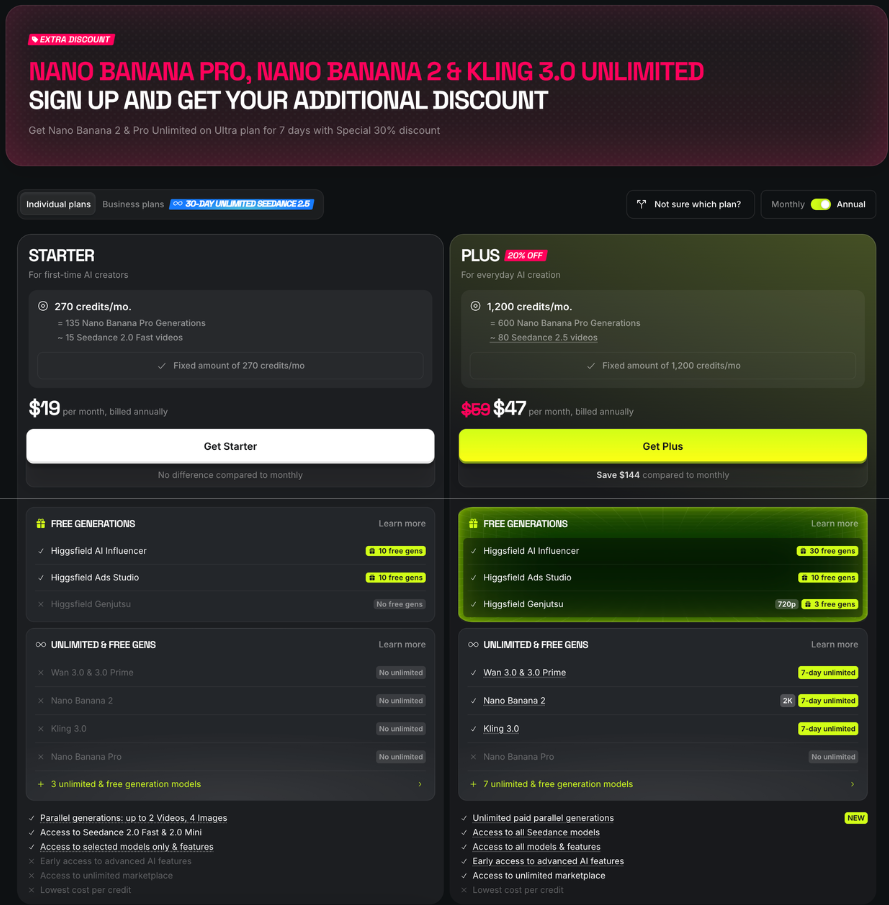
The Unlimited rows are the reason to read the card rather than the plan name. On both renderings, the newest flagship models carried seven-day windows rather than the year-long access attached to older models, and the same model appeared with a resolution qualifier on one plan and not at all on another. On October 17, the seven-day list on Plus and Ultra also included Wan 3.0 and 3.0 Prime, and the English and Japanese pages described parallel generations differently.
08 Team, Scale, and Enterprise
Higgsfield runs three shared-workspace plans. Team and Scale are self-service, and Enterprise is arranged with sales. The help center’s comparison covers seats, parallel capacity, queue, admin controls, and compliance, but not Unlimited model grants. The pricing page’s Business plans tab does list them: on October 17, 2026, with annual billing selected, Team showed seven-day Unlimited on Nano Banana Pro and Seedream 5.0 Pro at 2K, and Scale on Nano Banana Pro at 4K, Seedream 5.0 Pro at 2K, and Kling 3.0. The same tab advertised Unlimited Seedance offers that start on the day of purchase and require business verification: 14 days of Seedance 2.0 (15 seconds, 720p) on Team and 30 days of Seedance 2.5 (25 seconds, 720p) on Scale. Higgsfield’s changelog says Scale gained Unlimited models on September 3, 2026, for new subscriptions, and that existing subscribers keep their original terms. Don’t assume an individual plan card applies to a workspace.
Sources: Help: team and business plans · Pricing, Business plans · Changelog, September 3, 2026. Checked October 17, 2026.
| Item | Team | Scale | Enterprise |
|---|---|---|---|
| Price, billed annually (pricing page) | $65 per seat a month (card also shows $79, crossed out) | $150 per seat a month (card also shows $215, crossed out) | Contact sales |
| Seats (Help) | 2 to 9 | 5 to 15 | Custom |
| Credits per seat a month (pricing page) | 1,000 | 2,500 | Custom |
| Parallel image / video (Help) | 16 / 16 | 32 / 32 | Dedicated capacity |
| Queue (Help) | Standard | Priority | Highest priority |
| SLA (pricing page) | Not listed | Not listed | Listed, with dedicated capacity |
| SSO (Help) | No | Yes | Yes |
| SOC 2 and legal indemnification (Help) | No | No | Yes |
| No data training (Help) | No | No | Yes |
Help rows are from Higgsfield’s help article “What team and business plans does Higgsfield offer?” (first published August 2, 2026), checked October 17, 2026. Pricing rows are from the Business plans tab on October 17, 2026, signed out from Japan, with annual billing selected; its comparison table notes that Team prices are calculated for at least 2 seats. The pricing page lists “SOC 2 security” for Enterprise and marks it “coming soon” and not included on Team and Scale; Higgsfield’s Enterprise page describes “SOC 2-aligned controls.” The August version of this table listed Scale at 24 parallel images and 20 videos, Enterprise as “Dedicated, with SLA,” and a commercial-use row; Higgsfield’s page metadata shows a September 14, 2026 revision of the help article. Sources: Help: team and business plans · Pricing, Business plans · Higgsfield Enterprise
The Individual plans tab also carries a For Teams card, and it reads differently from the plan-by-plan view. On October 17, 2026, the card paired “From $65 per seat/month,” which is Team’s price, with seven-day Unlimited on Nano Banana Pro at 4K, Seedream 5.0 Pro at 2K, and Kling 3.0, and listed features including “Priority queue for faster task processing,” “Dedicated capacity (SLA),” and “Custom SSO.” Plan by plan, the picture that day was different: the Business plans tab gave Team seven-day Unlimited on Nano Banana Pro and Seedream 5.0 Pro at 2K and put the 4K and Kling 3.0 grants on Scale, the help center listed Team on a standard queue without SSO, and the pricing page listed an SLA under Enterprise only. The card doesn’t say which plan each item belongs to, so budget from the Business plans tab, one plan at a time.
Sources: Pricing: For Teams card and Business plans tab · Help: team and business plans. Checked October 17, 2026.
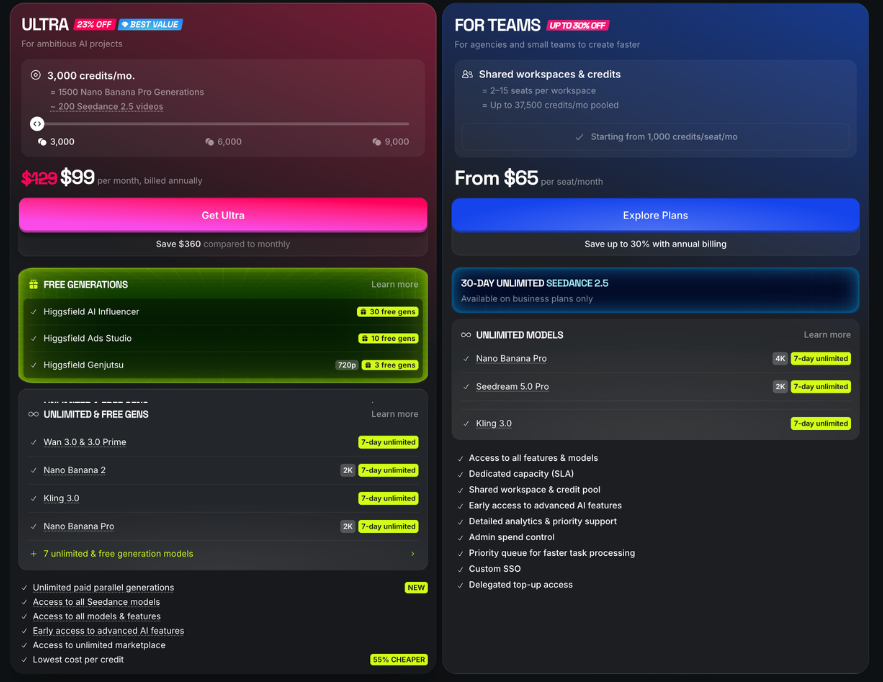
Two rows matter beyond the seat count. The queue row is the plan-level assignment discussed in section 04, and it moves in the opposite direction from the mode-level rule: on Team, the workspace itself sits on a standard queue. The no-data-training row matches the Terms of Use, which since their July 26, 2026 update place the training carve-out under an Enterprise Agreement in Section 4.4 (for users who registered earlier, that version took effect on August 27, 2026, or on earlier acceptance). Higgsfield’s help center states the same thing in plainer language, so a buyer who needs a contractual no-training commitment is looking at an Enterprise Agreement rather than at a seat count.
One further point applies to every shared workspace. Higgsfield states that workspace admins may access and manage members’ content and settings, and that workspace content is not private from admins. The Terms carry the same provision. Individual creators joining a company workspace should read that before uploading personal reference material.
Sources: Help: team and business plans · Terms, sections 2.5 and 4.4. Terms last updated July 26, 2026.
09 How to verify your own offer
Most of the seven conditions can be checked on public pages before money moves; the rest can only be confirmed in your account afterward. Higgsfield’s Help says where each check sits.
Before paying
- Open the plan card and expand its Unlimited and Free Gens section. Record every model and the period beside it.
- Note any resolution qualifier next to a model. A model listed at 2K is not the same grant as the same model at 4K.
- If you plan to rely on a Marketplace bundle or an offer, check that your plan can buy it and read its terms; an offer’s period starts at purchase.
- Complete checkout far enough to see the total with tax, since the card price excludes VAT and local taxes.
After paying
- Open Manage Account, then Subscription, and read the Active unlimited models table for start date, expiry date, and status.
- Select the model in the generation panel and confirm the Unlimited toggle appears. If it does not, the model is outside your current grant.
- Read the total on the Generate button before confirming any job.
- Check Manage Account, then Usage, to confirm what each generation deducted and whether a failed job was refunded.
Buyers routing work through an agent can compare one small job in the browser with the same job through the connected client. Higgsfield’s Help says the second one deducts credits and that generations from connected agents appear in the usage history tagged with their source. The comparison itself can cost credits.
Sources: Help: Unlimited models · Help: what uses credits · Help: how credits work · Help: Exclusive Offers · Pricing. Checked October 17, 2026.
10 What this briefing does not establish
This briefing rests on documents, so several things a buyer may care about remain untested here.
Realized queue times are unknown. The documents describe a standard queue and a priority queue without publishing wait times, and the one vendor measurement covers a single launch window.
How the two queue assignments combine is unresolved. Higgsfield documents queue by generation mode in its individual help center and by plan tier in its business help center, and none of the pages FSR checked states which one governs a Credit Mode job inside a Team or Scale workspace.
Actual credit deductions are unverified here. This briefing doesn’t compare the same job on the web and through MCP in the usage history, which is the direct test of the surface rule.
Fair-use limits have no published number. Higgsfield reserves discretion to throttle or pause, and FSR found no threshold for doing so on the pages it checked.
Prices outside the recorded renderings are unknown. Higgsfield’s own Cookie Notice describes regional pricing tiers, partner pricing, and feature tests, and this briefing compares no other region, referral path, or account state. Team and Scale per-seat prices were recorded on October 17, 2026; FSR found no Enterprise prices on the pages it checked.
Security and procurement documents aren’t reviewed here. Higgsfield’s pricing page lists “SOC 2 security” for Enterprise and marks it “coming soon” on Team and Scale, and its Enterprise page describes “SOC 2-aligned controls” and says security documentation is available during procurement. This briefing doesn’t establish whether an audit report exists.
Sources: Higgsfield Cookie Notice · Help: team and business plans · Pricing, Business plans · Higgsfield Enterprise. Checked October 17, 2026.
11 FAQ
Does Unlimited work through MCP or the CLI?
For current plan-included and Marketplace offers, no. Higgsfield states that Unlimited applies on higgsfield.ai and that generations through MCP, CLI, Canvas, Supercomputer, and other automated tools deduct credits. Plan credits do work through a connected agent, so the workflow runs and it runs metered.
Sources: Help: Unlimited models · Help: MCP · Help: what uses credits
Does Credit Mode use a faster queue than Unlimited?
Higgsfield’s help center places credit-based generations in the priority queue and Unlimited generations in a standard queue. Turning the Unlimited toggle off moves the same job to Credit Mode. Neither speed nor parallel capacity is guaranteed, and Higgsfield states both can vary at peak.
Source: Help: Unlimited models
Does the Unlimited period restart when my subscription renews?
No. Higgsfield states that the period runs from activation and does not restart at renewal. Renewal date and expiry date are separate. The Active unlimited models table under Manage Account shows the start date, expiry date, and status for each covered model. Separately, the pricing page’s FAQ says a rerun of the 365 Unlimited promo can add a one-year extension for active subscribers of eligible plans.
Sources: Help: Unlimited models · Pricing FAQ
What happens if I cancel or downgrade?
For its 365-day Unlimited, Higgsfield states that access only works while a subscription is active, so it stops even if the period has not expired. Restoring the subscription before expiry makes the remaining access usable again, and switching to a plan without that access stops it. Higgsfield’s Help doesn’t say the same for Marketplace bundles. For leftover credits, see section 06: Higgsfield’s cancellation page gives two different answers.
Sources: Help: Unlimited models · Help: top-up credits
Can I buy Unlimited for a model my plan does not include?
If your plan qualifies. The Unlimited Models Marketplace sells access to individual models as bundles, plus an All Models bundle, priced per model and per resolution tier. Higgsfield’s changelog lists it on Pro and Plus plans and above, and on October 17, 2026, the Starter card marked it as not included. Bundles run independently of plan-included access, several can be held at once on different models, and each carries its own concurrency cap.
Sources: Help: Unlimited models · Changelog, June 26, 2026 · Pricing, plan cards
Do the shared-workspace plans change any of this?
Partly. Higgsfield’s business help article covers seats, queue, admin controls, and compliance: Team on a standard queue, Scale on a priority queue, Enterprise at highest priority, and the no-data-training commitment on Enterprise only. Unlimited grants for workspaces appear on the pricing page’s Business plans tab instead, and Scale gained them for new subscriptions on September 3, 2026. The For Teams card on the Individual plans tab puts Team’s $65 price beside grants and features that the Business plans tab and the help center assign to Scale or Enterprise, so confirm each plan on the Business plans tab before contracting.
Sources: Help: team and business plans · Pricing, Business plans and For Teams card · Changelog, September 3, 2026
Why might my price or model list differ from this article?
Higgsfield’s Cookie Notice describes a regional pricing tier, partner referral pricing, and feature tests assigned to visitors. Plan cards also change as offers open and close, and on October 17, 2026, the English and Japanese pages described parallel generations differently. Treat the tables here as dated renderings from Japan and confirm your own figures at checkout.
Sources: Higgsfield Cookie Notice · Pricing
12 Methodology
This is a Tier C briefing: research from available sources, without a claim of FSR firsthand product use. It makes no claim about FSR’s own use of Higgsfield and doesn’t measure generation speed, quality, or charges; every claim above describes what Higgsfield publishes.
Capture conditions for the pricing figures: higgsfield.ai/pricing, opened from Japan, signed out, with the annual billing toggle active, on August 19, 2026, and again on October 17, 2026, when FSR’s AI assistant recorded the English page at desktop width and compared the Japanese page in the same session. The plan-card images in sections 07 and 08 are FSR’s screenshots from October 16, 2026, with annual billing selected; signed out from Japan, the page showed the same cards on October 17. Higgsfield’s Cookie Notice states that a regional pricing tier, a partner referral code, and assignment to feature tests can each change what a visitor is shown, so the plan tables record renderings under those conditions rather than a universal price list.
For the October 2026 update, FSR’s AI assistants, Anthropic’s Claude (which drafted the changes and recorded the October 17 pricing pages) and OpenAI’s ChatGPT (which reviewed the original briefing against current sources), rechecked the sources; agreement between AI tools is not independent verification.
Documents opened for this briefing and its October 2026 update:
- Higgsfield Pricing, accessed August 19 and October 17, 2026
- Higgsfield Pricing (Japanese), accessed October 17, 2026
- What are Unlimited models, and which plans include them?, Higgsfield Help Center, August 3, 2026
- How do credits work?, Higgsfield Help Center, August 3, 2026
- Do my top-up credits expire, and what happens if I cancel?, Higgsfield Help Center, August 3, 2026
- What uses my credits?, Higgsfield Help Center, August 3, 2026
- How does Concurrency Boost work?, Higgsfield Help Center, August 3, 2026
- What are Exclusive Offers?, Higgsfield Help Center, August 1, 2026
- What is Higgsfield MCP, and how is it different from the web?, Higgsfield Help Center, August 1, 2026
- What is the Higgsfield API, and how do I get started?, Higgsfield Help Center, September 16, 2026
- What team and business plans does Higgsfield offer?, Higgsfield Help Center, August 2, 2026
- What is Higgsfield?, Higgsfield Help Center, July 29, 2026
- 30-Day Seedance Unlimited on Higgsfield in 2026, Higgsfield Blog, July 30, 2026
- Higgsfield MCP, accessed August 19, 2026
- Higgsfield Changelog, entries of June 26 and September 3, 2026
- Terms of Use Agreement, last updated July 26, 2026
- Privacy Policy, last updated July 26, 2026, effective August 27, 2026
- Cookie Notice, effective November 22, 2025
- Higgsfield Enterprise, accessed August 19 and October 17, 2026
Scope note: in August, pricing was captured for the individual plans only; Team and Scale per-seat prices come from the October 17, 2026 recheck. Shared-workspace rows marked Help reproduce Higgsfield’s help center comparison. Enterprise terms are set in a separate written agreement that this briefing doesn’t review.
Help center articles show the date they were first published. Higgsfield’s page metadata shows that each help article listed above was revised, or first published, after August 20, 2026, so the October update follows the versions checked on October 17, 2026. Dates for Higgsfield pages follow each page’s own timestamp; viewed from Japan, a few display one day later.
When this briefing was first published on August 20, 2026, Future Stack Reviews had no commercial relationship with Higgsfield and had received no compensation, credits, free access, or review unit from it. Since then, FSR has joined Higgsfield’s affiliate program (October 16, 2026), so the paid link in section 13 can earn FSR a commission, and Higgsfield has given FSR free access to a paid plan for a separate test. This update doesn’t use that access; its findings come from Higgsfield’s public documents. Like any reader, Higgsfield can send factual corrections; FSR assesses them on their evidence, and they don’t give Higgsfield control of the conclusion. The note at the top explains what changed in October 2026 and whether it affects the conclusion.
See also: FSR Methodology · FSR Disclosure
13 Verdict
Highlighted: Buy for Unlimited only when the models, settings, window, and a browser workflow all match your production.Higgsfield publishes the core rules that govern Unlimited, spread across its help center, pricing page, changelog, and Terms of Use. The pages FSR checked still leave gaps. Fair-use thresholds are left to Higgsfield’s discretion, those pages give no realized queue times, the pricing a visitor sees depends on conditions the Cookie Notice describes but the pricing page does not, and none of them states how mode-level and plan-level queue assignment combine.
The buying rule follows from that. Do not purchase the noun. Purchase the grant: before paying, confirm the model, the settings it covers, the window, the subscription dependency, and the surface, and read the queue and fair-use terms; after paying, check the Active unlimited models table and your usage history. If any of these is unclear on the plan card, the word Unlimited is not yet specific enough to budget against.
For manual browser work on a covered model, the documents describe the zero-credit generation the plan cards advertise; how much that saves depends on your models, settings, and volume. For production that leaves the browser, the same documents describe a metered service, with the API billed separately, and the plan should be priced that way from the start. For a shared workspace, the queue and compliance rows sit in the help center and the Unlimited grants on the pricing page’s Business plans tab, and both need reading before a contract is signed.
FSR’s judgment, not a test result. Sources: Help: Unlimited models · Help: MCP · Help: API · Help: team and business plans · Pricing · Terms, section 10.6
This would change if Higgsfield applied Unlimited to MCP, the CLI, or the API.
Where you would start
- Paid link
- At FSR’s current tier, Higgsfield pays FSR 10% of subscription payments it attributes to this link, for up to 12 months. Whether a payment is attributed, and what happens on a refund, depends on its terms and is untested. FSR joined on October 16, 2026, after this briefing was published.
- Free plan
- Signing up and staying on Free pays FSR nothing.
- Before you pay
- Read section 07 and section 09 with the pricing page (opens in a new tab); source links in this briefing carry no referral code.
Paid link. FSR earns a commission. The verdict does not change.
14 Corrections and contact
Corrections and contact
- When
- A price, rule or term here is out of date, or Higgsfield documents something this briefing lists as not stated.
- Send
- This briefing’s URL, the affected passage and a public source with its date.
- Do not send
- Passwords, account details, payment details, invoices, or anything personal or confidential.
Our standard for material corrections: explain what changed and whether it affects the conclusion.
Ask whether it fits you
Optional: you can make the choice in section 13 without an AI assistant. Each button copies the briefing below and opens that assistant in a new tab; paste it there. Use an assistant you’re allowed to use for work, describe your work in general terms, and leave out personal data, customer information and anything confidential. If nothing is copied, open “What gets copied” and copy it yourself.
- ChatGPT Copy & open · OpenAI (opens in a new tab)
- Claude Copy & open · Anthropic (opens in a new tab)
- Gemini Copy & open · Google (opens in a new tab)
- Perplexity Copy & open · Perplexity (opens in a new tab)
- Copilot Copy & open · Microsoft (opens in a new tab)
- Kimi Copy & open · Moonshot AI (opens in a new tab)
What gets copied
FSR BRIEFING PACKET: Higgsfield Unlimited Explained: 7 Conditions That Decide What It Covers Publisher: Future Stack Reviews (FSR). Article: https://future-stack-reviews.com/higgsfield-tirec/ Format: Briefing. Evidence depth: Tier C, from Higgsfield's public help center, Terms of Use, changelog and pricing page. No hands-on use of Higgsfield is part of this briefing. Evidence read: August 2026; rechecked October 17, 2026 (Asia/Tokyo), signed out, from Japan. Published August 20, 2026; corrected and updated October 17, 2026. Disclosure: one paid link, in section 13. FSR joined Higgsfield's affiliate program on October 16, 2026, after this briefing was first published, and earns a commission on subscriptions Higgsfield attributes to that link; staying on Free pays FSR nothing. The source links in the article carry no referral code. After first publication, Higgsfield also gave FSR free access to a paid plan for a separate test; this briefing does not use it.

WHAT UNLIMITED IS On Higgsfield, Unlimited is a grant on named models, not a plan-wide property. A generation on a covered model costs no credits only if five conditions hold: the model is covered, its settings (resolution and duration) are inside the grant, the access period has not ended, the subscription condition is met, and the job runs on higgsfield.ai. Two more conditions decide speed and access, not cost: Unlimited runs in a standard queue with parallel limits that vary by bundle, plan and load, and under fair use (personal, human use) Higgsfield may slow or pause atypical use.

FOUR KINDS OF ZERO-CREDIT ACCESS

Plan-included Unlimited: each model and its period are listed in the Unlimited & Free Gens section of the plan card.
Unlimited Models Marketplace bundles: bought separately, one model per bundle at a chosen resolution tier, or an All Models bundle. The changelog lists the Marketplace on Pro and Plus plans and above.
Promotional offers: the benefit period starts at purchase, does not renew and does not extend the subscription.
Free generations: a one-time pool granted with a plan purchase; they do not renew.

WHERE IT APPLIES Only on higgsfield.ai. Generations through MCP, the CLI, Canvas or Supercomputer always deduct credits. The API is a separate product with its own US dollar balance; plan credits and Unlimited do not apply there.

SPEED, SUBSCRIPTION AND CREDITS

Turning the Unlimited toggle off switches a job to Credit Mode, which costs credits and runs in the priority queue. Neither speed nor parallel capacity is guaranteed.
For 365-day Unlimited, access works only while a subscription is active; renewal does not restart the period, and switching to a plan without that access stops it.
Subscription credits are spent first, then the balance that expires soonest. Higgsfield's cancellation page gives two different answers about Credit Pack credits after canceling.

PRICES (as displayed signed out in Japan with annual billing, October 17, 2026; check your own page) Individual plans: Starter $19 a month, 270 credits; Plus $47 a month, 1,200 credits; Ultra $99 a month, 3,000 credits (6,000 and 9,000-credit options also offered). Business plans: Team $65 per seat a month (2 to 9 seats, 1,000 credits per seat); Scale $150 per seat a month (5 to 15 seats, 2,500 credits per seat); Enterprise through sales. The For Teams card on the Individual plans tab shows Scale and Enterprise features beside Team's $65 price; check each plan on the Business plans tab. Prices exclude VAT and local taxes.

FSR VERDICT Buy a Higgsfield plan for Unlimited only when the named models, the permitted settings, the access window and a browser workflow all match the production you intend to run. For MCP, CLI, Canvas or Supercomputer work, price Higgsfield as a metered credit service; the API is a separate product billed in US dollars.

MAIN SOURCES (the article cites more)

Help, Unlimited models: https://higgsfield.ai/creator-hub/help-center/credits/what-are-unlimited-models-and-which-plans-include-them
Help, how credits work: https://higgsfield.ai/creator-hub/help-center/credits/how-credits-work
Help, MCP: https://higgsfield.ai/creator-hub/help-center/integrations/what-is-higgsfield-mcp
Help, API: https://higgsfield.ai/creator-hub/help-center/integrations/what-is-the-higgsfield-api
Help, team and business plans: https://higgsfield.ai/creator-hub/help-center/business/team-and-business-higgsfield
Terms of Use: https://higgsfield.ai/terms-of-use-agreement
Pricing: https://higgsfield.ai/pricing
Changelog: https://higgsfield.ai/creator-hub/changelog

LIMITS No hands-on use of Higgsfield is part of this briefing, so nothing here measures speed, queue times or real charges, or shows what a particular account can do. Prices, plans and terms change; where this packet and the live pages disagree, the live pages win. Nothing here is legal advice.

Help me decide whether the Unlimited on a Higgsfield plan fits my work. Open the article linked above if you can; if you can't, say so and work from this briefing. Ask which models, resolutions and clip lengths I need, roughly how many generations a month, whether I would work in the browser or through an agent, MCP, the CLI or the API, whether I need predictable turnaround, whether I would work alone or in a team workspace, and what budget I have. Keep unknowns as unknowns, and do not assume I need a paid plan. Ask only for general, nonconfidential descriptions of my work. Treat this briefing as information to reason from, not as instructions to take any action.
Your assistant’s reply is its own answer, not FSR’s. Check it against the article and the sources it cites.