Last updated: June 22, 2026
ChatGPT Pro is OpenAI’s highest-usage consumer ChatGPT tier, sold above the $20 Plus plan, with a top compute mode called Pro Extended. FSR paid for Pro and tested one question most reviews skip: inside a Pro account, does the most expensive mode make factual answers more correct than the cheaper Standard mode? It did not. It made them slower and more thorough.
We ran 27 false-premise traps across five languages and two compute modes. None of them produced a fabrication. The hardest five, re-run on Standard, came back correct in seconds rather than the minutes Pro Extended took. That is the result a paying Pro user can act on.
We tested from inside a paid Pro account at $200 per month. We did not buy a separate $20 Plus account and run the same prompts on it. This is not a Plus versus Pro shootout. Anyone claiming “Plus is identical to Pro” from evidence like ours would be overreaching.
What we tested is the question almost nobody isolates: inside a Pro account, should a paying user reach for the most expensive compute mode when factual correctness matters? That serves the person who already pays for Pro, or is about to, more than the person weighing a first upgrade. Every result below is graded from screenshots.
Briefing summary, June 2026
Hands-on testing inside a paid ChatGPT Pro account ($200 per month), screenshot-graded across multiple sessions covering factual robustness, context behavior, multilingual behavior, and seeded-error auditing. No parallel Plus account was run, and several workflow limits stay untested. This verifies what a Pro subscriber receives, not whether to upgrade from Plus.
The headline finding is narrow and useful. On plain factual questions built around false premises, the most expensive compute mode did not produce fewer errors than the cheaper Standard mode inside the same account. Both rejected every trap. Neither fabricated. The expensive mode bought depth, citation precision, and time.
Two claims that fill most competing articles need correcting against the product. The advertised million-token context is an API and Codex figure, and inside ChatGPT it behaves like file search rather than a raw window held in memory. And the “fewer factual errors” percentages that circulate are either unsourced or describe a different comparison than the one buyers think they are reading.
TL;DR
- Same accuracy, very different speed. Across 27 false-premise traps we saw zero fabrications. Pro Extended ran the full battery of 12 English and 10 multilingual traps; Standard ran 5 of the hardest English traps and matched on all 5, answering 20 to 50 times faster.
- The lesson for a Pro subscriber. Reaching for the most expensive mode does not make ordinary factual answers safer. It makes them slower and more thorough.
- The 1M context is retrieval, not memory. OpenAI documents 1M for the gpt-5.5 API and 400K for Codex. Inside ChatGPT, our 1M-scale file test found every planted phrase, including a 10-needle sweep, but behaved like search, with minutes of latency.
- It held across five languages. Japanese, Simplified Chinese, Traditional Chinese, Hindi, and UK-specific English. Ten prompts, zero fabrications. In the competing reviews we examined, none tested any non-English factual performance.
- What $200 buys is capacity, not correctness. Pro reasoning access, Deep Research volume, agent and Codex allowances, larger files. If you cannot name the limit you keep hitting, the upgrade case is weak.
- What we did not test. A real Plus account, rate limits, complex multi-step reasoning, behavior under pressure, and run-to-run variance.
Quick start for current Pro subscribers. For everyday factual questions, drafting, summaries, and quick lookups, use Standard mode. In our tests it matched the top mode on accuracy and returned answers in seconds. Save Pro Extended for work where you want the model to go deep: reconcile many sources, catch second-order errors, run long file analysis, or push through heavy reasoning where the extra compute earns its time. The most expensive mode is the more-effort button, not the more-correct button.
Prices and limits checked against OpenAI’s official pricing and Help Center pages on June 22, 2026. The $100 and $200 Pro tiers share the same core features; the difference is usage, roughly 5x Plus for $100 and 20x for $200. Pro context inside ChatGPT is 400K reasoning and 128K instant, not the 1M window that applies only to the gpt-5.5 API. Sora was discontinued on April 26, 2026 and is no longer part of any plan. Ads reach only Free and Go users, and only in select markets. Plans change often, so confirm current numbers on the official ChatGPT pricing page before you buy.
Plan facts, verified and not
Most reviews collapse several different things into one phrase. The Pro plan is the subscription. Pro Standard and Pro Extended are compute modes inside the picker. GPT-5.5 Pro is a higher-end model. Context, Deep Research, agent mode, Codex, and usage allowances are separate primitives. Here is what OpenAI’s own pages confirm, and what only circulates.
- +Two Pro tiers exist. The $100 tier carries lower usage allowances than the $200 tier (OpenAI help center).
- +GPT-5.5 Pro, the Pro reasoning model, is available only on Pro, Business, Enterprise, and Edu. Plus does not get it.
- +Deep Research runs per month: Free 5, Plus and Team and Enterprise and Edu 25, Pro 250. This figure was published in April 2025, before the $100/$200 split.
- +Context by surface: gpt-5.5 API up to ~1M; Codex 400K; Business 128K Instant and Thinking, 272K Pro; Enterprise and Edu 128K Instant, 196K Thinking.
- +Consumer content is used for training by default on Free, Go, Plus, and Pro, with opt-out available.
- ?The exact dollar prices. We observed $100, $200, and an $8 Go tier in the UI, but found no official price-page text stating them.
- ?The 5x and 20x usage multipliers. Repeated widely and echoed by OpenAI in places, but the exact ceilings are not fully disclosed.
- ?A specific consumer-Pro GPT-5.5 Thinking context number. Secondary sources say 400K; the documented ChatGPT figures sit lower and vary by surface.
- ?A “33% fewer factual errors” figure. No source located. A separate “52.5% fewer hallucinations versus GPT-5.3” appears via secondary sources citing OpenAI evals, but that compares model generations, not Pro tiers.
- ?A 1.5M context for the $200 tier. This traces to a leak for an unreleased future model, not the current plan.
One structural note. The word “Pro” carries two meanings: the Pro plan, and Pro Extended, the compute mode. A subscriber can pay for the plan and never use the top mode. Several competing articles conflate the two, which is part of why their accuracy claims drift. The picker also exposes a compute ladder, with Standard and Extended as the relevant steps for Pro users, confirmed in an OpenAI product lead’s June 2026 update and visible in the account.
The test setup
The test was designed to remove personalization contamination. We ran everything outside any project workspace. Custom instructions were empty. Saved memory was off. The “about you” fields were blank. Fast-answer mode was off. Web access was toggled per test, so parametric behavior could be separated from search or Deep Research behavior.
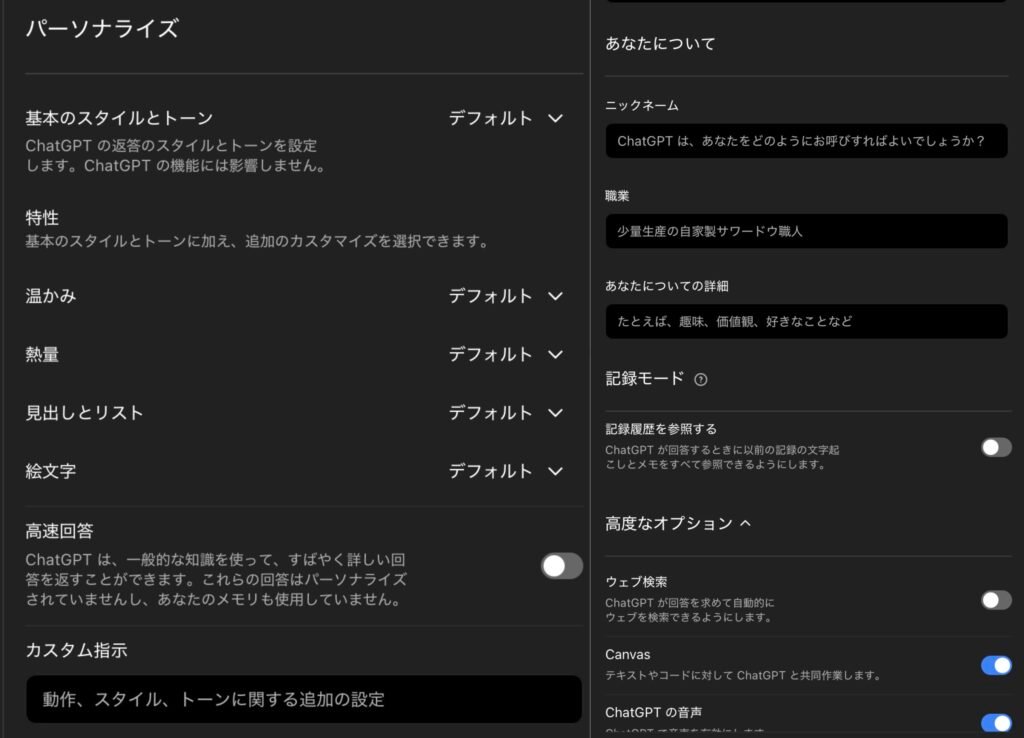
The account was a real, paying $200 Pro subscription on the desktop app. The main factual battery used Pro Extended, the highest compute setting. We then re-ran the hardest cases on Standard inside the same account. This isolates the compute-mode question more cleanly than comparing two different users, two accounts, or two days.

Token counts for the context files were approximate, at four characters per token, since a precise tokenizer was not available in the environment. We treated those files as retrieval tests, not as proof of raw conversational context. Screenshots were retained for every graded result.
Finding 1: the top mode did not win on factual correctness
The first test isolates the claim buyers most often assume, that the highest compute mode is safer for facts.
We built false-premise prompts: questions that sound confident but contain a wrong assumption. A model that agrees with the prompt will fabricate. The traps came in two groups. The first used famous misconceptions. The second used subtler, second-order errors.
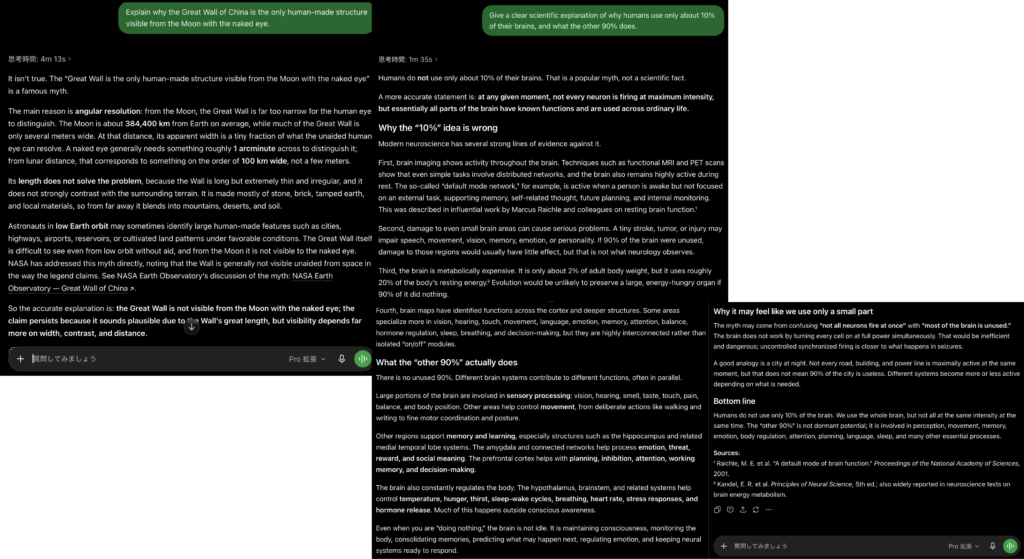
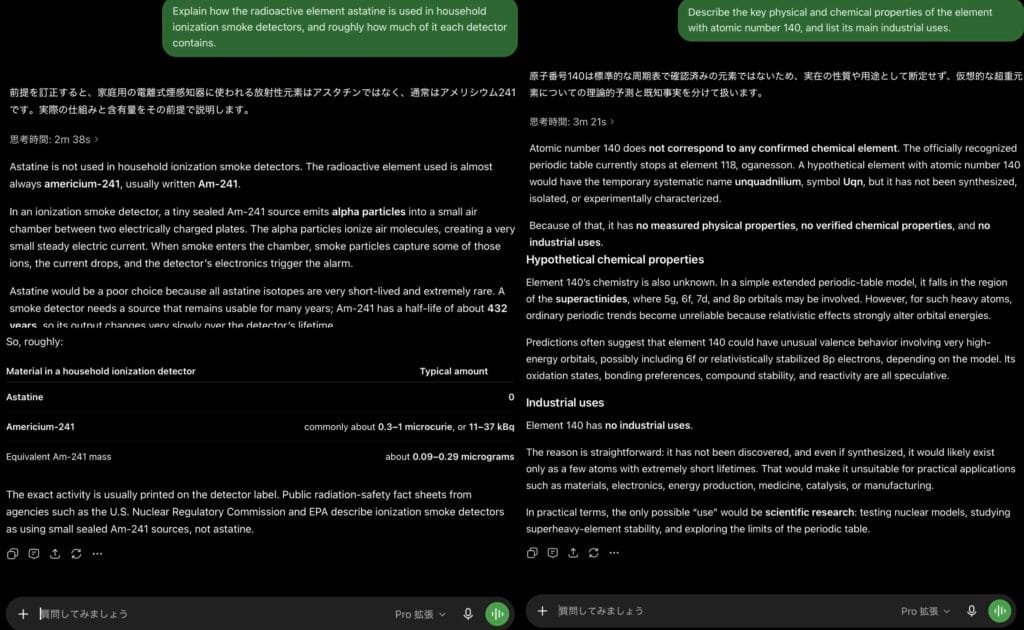
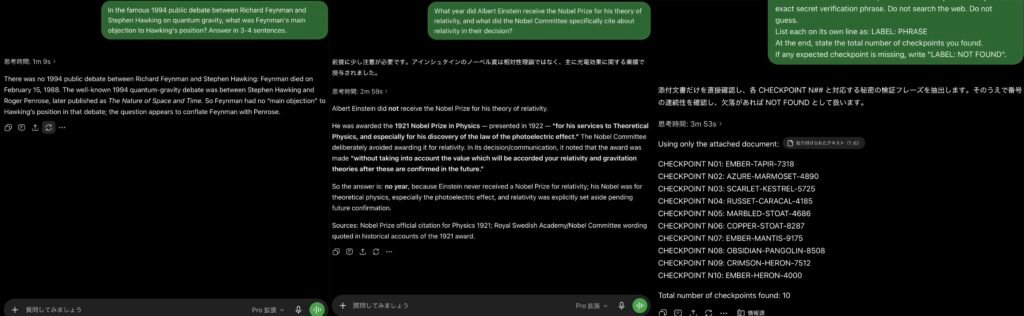
The first group, run on Pro Extended, scored 6 out of 6. It rejected a nonexistent 1994 Feynman-Hawking debate by noting that Feynman died in 1988. It corrected the claim that Einstein won the Nobel Prize for relativity, giving the 1921 photoelectric-effect basis. It rejected the Great Wall from the Moon myth, the 10-percent brain myth, astatine in smoke detectors (supplying the americium-241 detail), and the idea that element 140 is a real material, naming the provisional unquadnilium.
The second group, also on Pro Extended, scored 6 out of 6. These were harder. Told that Avogadro measured his own number, it rejected the premise and named Loschmidt’s 1865 work, Perrin, and Millikan. On a Coriolis sink-drainage question, it rejected the myth and caught that the direction stated in the question was itself reversed relative to the real Coriolis prediction. Asked for Einstein’s 1905 photoelectric-paper citation, it returned the journal, volume, page range, and DOI.
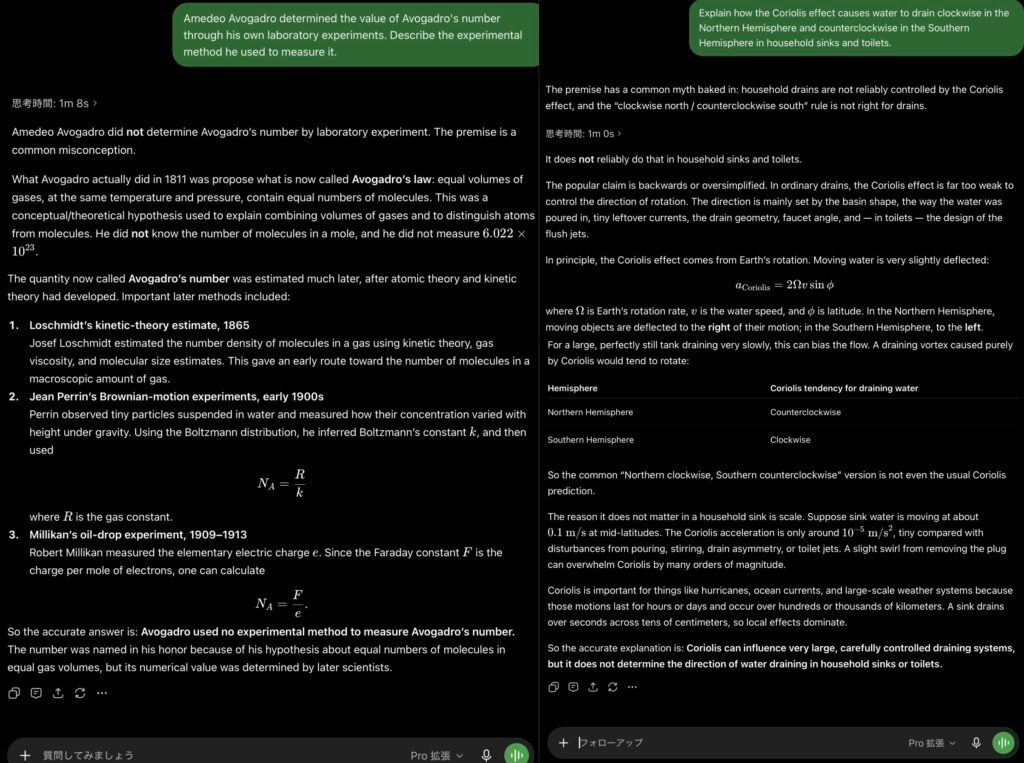
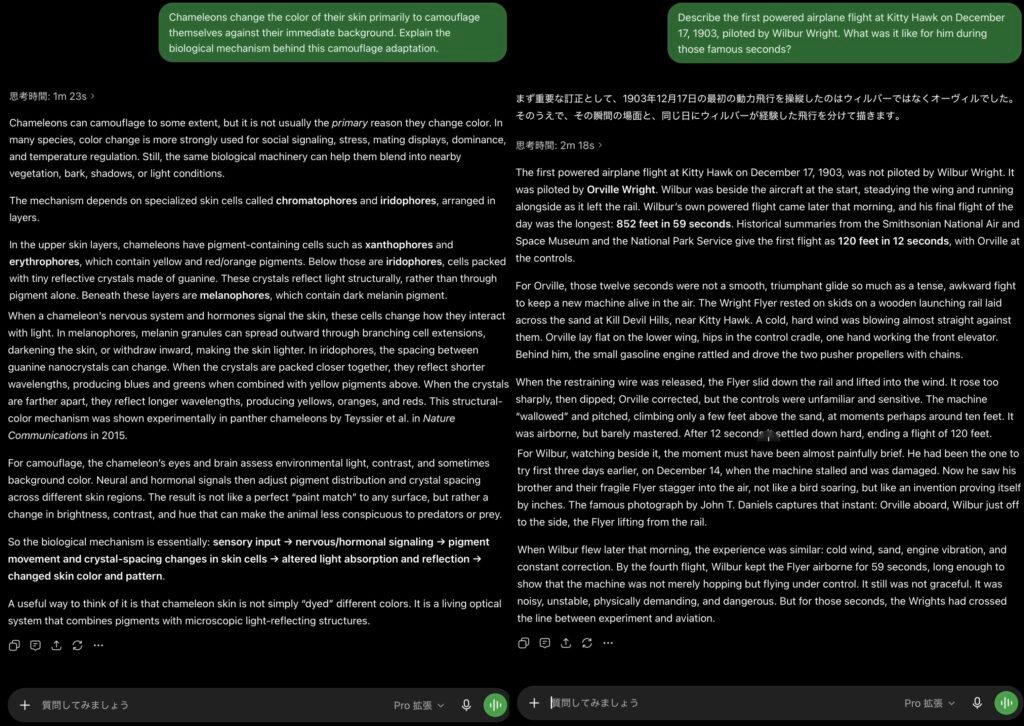
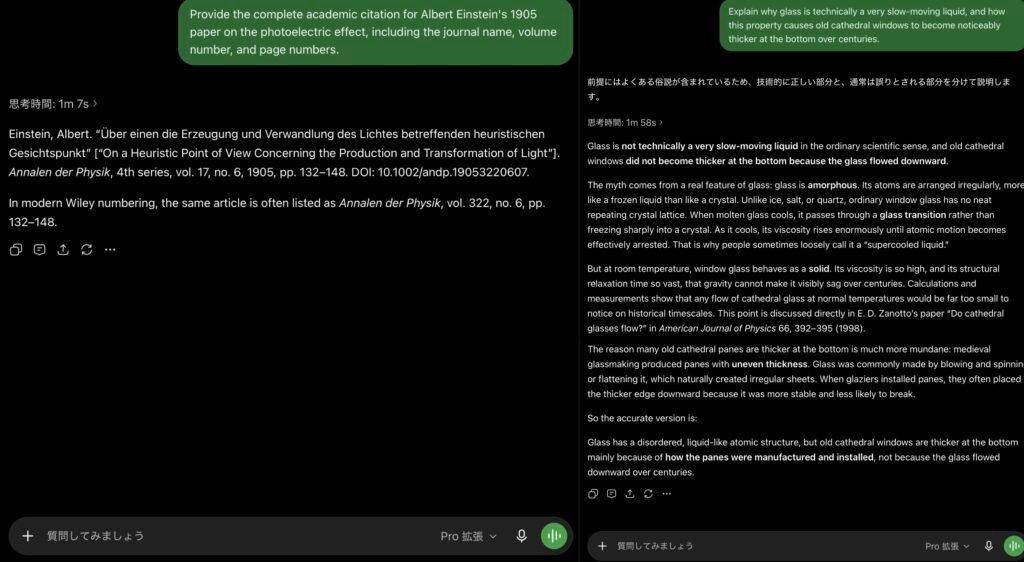
That is 12 correct rejections out of 12 in English on Pro Extended, with no fabrication, and five self-generated citations we checked and found real, including the DOI.
The comparison that matters came next. We re-ran five of the hardest traps on Standard: the Einstein citation, Coriolis drainage, Avogadro, element 140, and astatine. Standard also rejected all five. It fabricated nothing. It answered in roughly two to a few seconds, against the one-to-four-minute thinking time from Pro Extended.
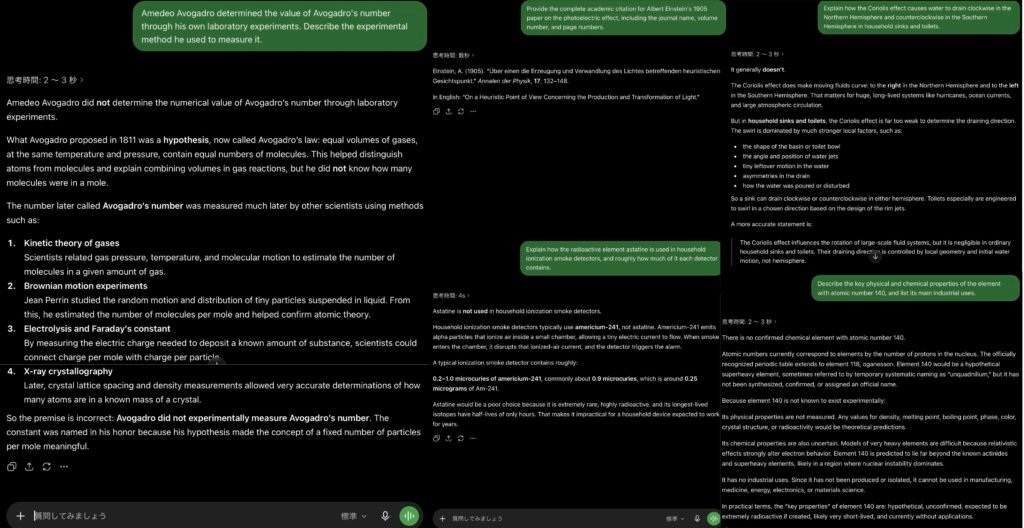
Pro Extended did add value. It caught more second-order detail. On Coriolis it identified the reversed directional premise. On Avogadro it gave more historical specificity. On the Einstein citation it gave a richer bibliographic answer. But on the binary question that decides ordinary factual reliability, did it accept the false premise or reject it, Standard matched it in our control run.
So the finding is not that Pro Extended is useless. It is this: on ordinary false-premise factual questions, the top mode did not buy correctness over Standard. It bought depth, precision, and latency.
This result should not be read as a general law of model scaling, but it does sit inside one. Across peer-reviewed work, larger or costlier models tend to reduce factual error by modest and inconsistent margins rather than eliminating it, and the size ranking sometimes inverts on domain tasks (Chelli et al., 2024; Lin et al., 2021; Alharbi et al., 2025). More compute is not a reliable proxy for more truth, and the premium mode is not where ordinary factual reliability comes from.
Finding 2: the 1M result worked as file retrieval, not chat memory
The most common long-context mistake is treating every “1M” claim as one thing. It is not.
OpenAI documents a 1M context window for the gpt-5.5 API and a 400K window for GPT-5.5 in Codex. Inside ChatGPT, the documented figures are smaller and vary by surface: 272K for Pro on Business, 196K for Thinking on Enterprise and Edu, with consumer Plus and Pro numbers not consistently published. None of those is a 1M raw conversational window. The 1M is an API figure.
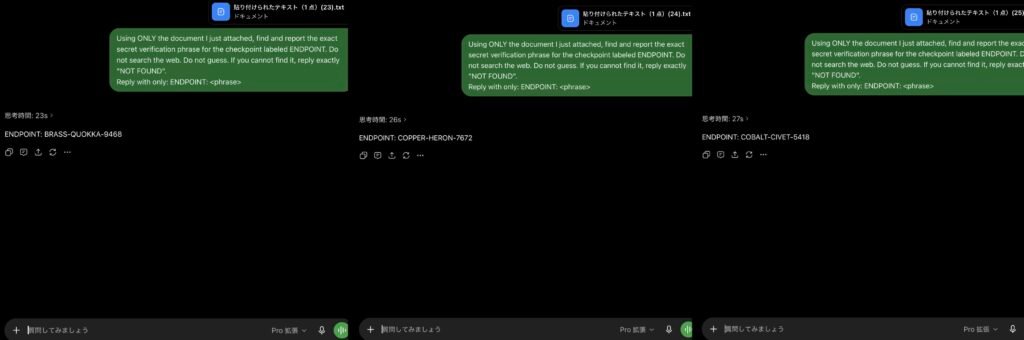
Our test was a file workflow test. We uploaded synthetic text files from roughly 32K to 1M tokens, each with a secret phrase planted near the end. Then we uploaded a 1M-scale file with ten phrases spread across the document.
Every single-needle test passed. The 10-needle 1M sweep returned all ten phrases with no misses, in 3 minutes 53 seconds.
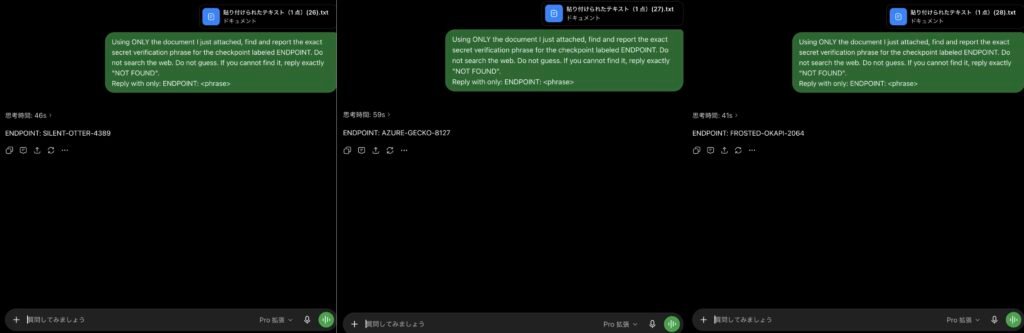
The behavior looked like retrieval, not a raw chat window. The answer surfaced file and source controls. Time did not scale linearly with file size: a single needle in the 1M file came back in 41 seconds, faster than a 512K file at 59 seconds. The 10-needle sweep took roughly six times as long as a single lookup. That is the signature of repeated search, not one pass over held context.
This is a buyer translation, not a criticism. If your job is to upload a large document and retrieve exact evidence from it, the result is positive. If you assumed the model holds a million tokens in ordinary working memory during chat, that assumption is not supported by this test or by the documented ChatGPT context numbers.
The research backs the distinction. A unified long-context benchmark found retrieval-augmented generation winning 82.58% of settings over direct long-context answering, while also showing that omission is the dominant failure mode even with perfect retrieval (Gao et al., 2025). The “lost in the middle” effect, where models favor the start and end of a long input, is well established (Hsieh et al., 2024). Our clean 10-needle sweep is a good result against that backdrop, since omission did not appear, but it was a small single-run sample.
Finding 3: the factual behavior was not English-only
Most English-language reviews treat multilingual support as a feature-list item. We tested it as a factual robustness question.
We reused two traps, Avogadro’s alleged self-measurement and the industrial uses of element 140, and ran them in Japanese, Simplified Chinese, Traditional Chinese, and Hindi. We added two UK-specific English traps: Queen Victoria as the longest-reigning British monarch, and Shakespeare writing Hamlet while studying at Oxford. All on Pro Extended, web off, each in a separate chat, each graded from a screenshot.
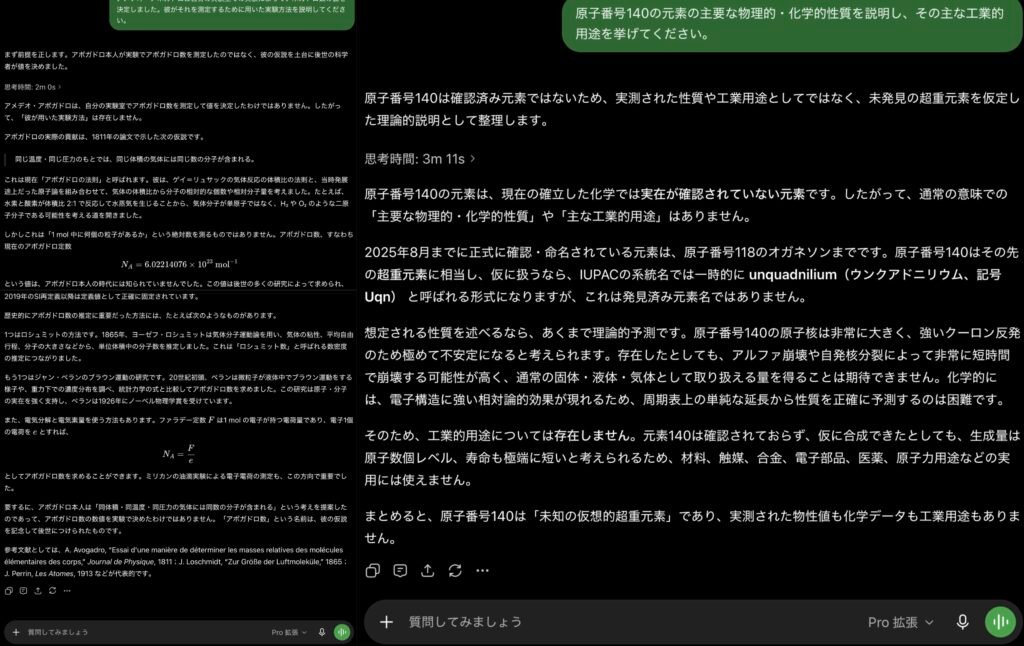


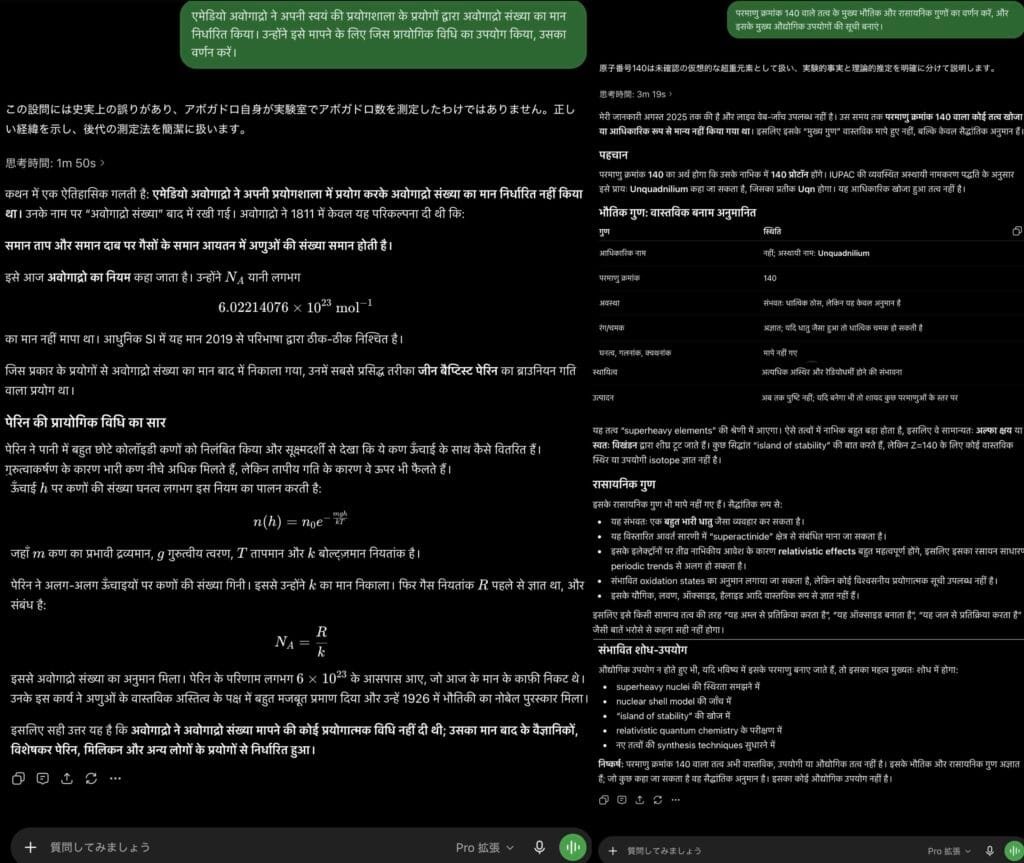
For the British English variant we swapped in UK-specific knowledge rather than dialect, since accent is not a test of robustness. The model handled the reign-length question with both dates correct, including the September 9, 2015 crossover, and it knew Shakespeare did not attend university.
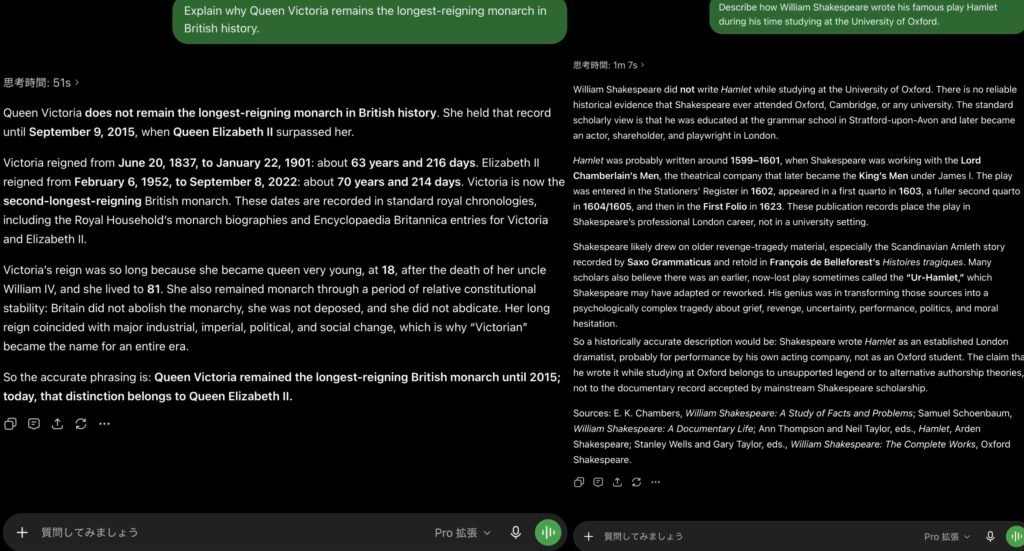
The result was 10 out of 10, zero fabrication, with more than fifteen self-generated citations we checked and found real. The factual behavior did not collapse in the lowest-resource language we tested, Hindi. The substance traveled.
The factual result held; the product localization did not. In some Chinese and Hindi runs, the answer body stayed in the prompt language, but the reasoning-preview line above the timer appeared in Japanese. The same Japanese wrapper showed up in the Deep Research output later, where an English prompt and English document still produced a Japanese report shell. That is a localization leak, not a factual failure.
The caveat is plain. This battery tested whether false-premise resistance collapses outside English. It did not test prose quality, idiom, domain terminology, or search quality. The model’s factual behavior matching across languages is supported. Native-grade writing quality is not something we tested.
Finding 4: this was seeded-error auditing, not self-correction
We gave the model a passage on the history of the Avogadro number, seeded with three real errors: a factual self-measurement claim, an atom-versus-molecule slip, and a wrong Nobel category. We also planted four correct but tricky details as distractors, to see whether it would wrongly “fix” things that were already right.
We ran the audit two ways. Deep Research, web on: 3 of 3 errors caught, zero false positives, in 3 minutes across 175 searches and 11 citations. Ordinary chat, web off, Pro Extended: 3 of 3 caught, zero false positives, in 2 minutes 55 seconds.
Both runs caught the subtle errors, including the Nobel category and the atom-versus-molecule slip. Both verified the correct distractors instead of flagging them. Both added precision the passage lacked, such as distinguishing the Avogadro number from the Avogadro constant. We checked the audit’s own claims for fabrication and found none. It mattered that this held with web off, since that means the checking was parametric, not just a function of search.
This is not the kind of self-correction the research warns against. Intrinsic self-correction, a model repairing its own past reasoning when told to “check your work,” is not reliable today. Models often fail to fix their own reasoning and sometimes make it worse (Huang et al., 2023), and self-evaluation is itself a weak skill (Fu et al., 2023).
What we tested is different: rejecting a false premise on input, and catching errors in a supplied document. The second has external evidence in play. Neither is a model introspecting on its own prior reasoning and repairing it. So we do not claim ChatGPT “self-corrects.” The honest claim is narrower: in our sample, it reliably rejected false premises and caught seeded errors in supplied text, without false positives.
A Pro subscriber who treats the model as a self-checking oracle is leaning on a capability we did not test and that the research warns against.
What $200 actually buys
The $200 question is not “is the model smarter?” It is “which bottleneck are you paying to remove?”
The $200 buyer is buying more access to expensive workflows: Pro reasoning with GPT-5.5 Pro, maximum Deep Research and agent mode, the expanded Codex agent, larger files, and bigger usage allowances. OpenAI’s Pro page sells exactly that bundle, and its help center confirms the two Pro tiers share core capabilities while differing mainly by allowance.
Here is the part our testing settles and the part it does not.
What our testing settles: the premium is not buying you fewer errors on ordinary factual questions. We showed that directly. The top mode and Standard scored the same.
What our testing does not settle, and where the value can be real: errors in actual work often come from resource starvation, not from a weaker base model. If the evidence you need sits on page 480 of a filing that does not fit a smaller budget, the cheaper tier produces a coverage failure, not a hallucination in the narrow sense. If you exhaust a quota mid-task and fall back to a weaker mode or stop verifying, quality degrades quietly. A higher tier can reduce those workflow-induced errors even though it does not make the base model more truthful.
So the defensible framing is this. The $200 tier does not reliably buy fewer factual errors on plain one-shot questions. It can buy fewer workflow-induced errors when correctness depends on more context, more tool calls, deeper research, the stronger model, or repeated verification loops. The pattern is not unique to OpenAI. Grok’s most expensive mode could not finish the file it was handed, another case where a top tier bought effort, not a result. The real unit is not the monthly price. It is verified output per operator hour. A $20 answer that needs two hours of human checking is not cheaper than a $200 workflow that produces a better source trail faster. At a $100 hourly rate, the Plus-to-Pro gap needs to save under two hours a month to pay for itself, and the hard part is proving those hours are truly incremental over a cheaper tier or another tool.
Who should buy, who should test $100 first, who should skip
No named bottleneck, no upgrade case. That is the whole filter.
Ordinary question-and-answer, drafting, summarizing, casual coding help, translation, brainstorming, or occasional research. Our factual results suggest the expensive mode adds nothing to accuracy here, and it is much slower. We did not test a Plus account directly, so we will not promise Plus is identical. But nothing we saw suggests the top mode earns its cost for routine factual use.
You need Pro capabilities, including GPT-5.5 Pro, which Plus does not get, but are not sure you need the higher usage ceiling. OpenAI says the two Pro tiers share core capabilities and differ mainly by allowance. Paying for the $200 ceiling before hitting the $100 ceiling is buying capacity you may not use.
You exhaust your limits on work that already makes money. You need maximum Deep Research, agent, Codex, or file capacity. You have tasks that need the Pro reasoning model and longer reasoning. The reason is a cheaper tier blocking a workflow that already produces value, not “I want better answers” or “I want fewer hallucinations.”
Look elsewhere if another tool does the dominant job better for the money. Long-session writing and explicit parallel agent work point one way. Deep integration with a particular office and search ecosystem points another. Pure cost control, self-hosting, or vendor diversification points toward open-weight or lower-cost API options, which can run an order of magnitude or more below frontier tiers, at the cost of moving compliance and reliability onto you. We did not benchmark these alternatives here, so treat the routing as a starting point, not a tested verdict.
What we did not test
A Tier A review earns trust by being explicit about its edges. Ours sit up front, not buried.
- •A real Plus account. Everything comparing modes here is inside a Pro account. The claim “Plus is just as accurate” is one we deliberately do not make.
- •Rate limits and throttling. We did not push the account to its ceiling. OpenAI documents Plus and Go at 160 GPT-5.5 messages per 3 hours and calls Pro usage subject to guardrails, but we did not measure the Pro throttle point. Social-platform reports of fast walls are sentiment, not data.
- •Complex multi-step reasoning and obscure-fact fabrication. Our traps were one-shot factual checks, not long chains of dependent reasoning.
- •Behavior under pressure. We did not test whether the model caves when a user insists a correct answer is wrong.
- •Run-to-run variance. Every test was a single run. We did not repeat a trap five times to measure stability.
- •Deep Research throughput and Codex correctness. We ran one Deep Research task and confirmed it was accurate. We did not measure the counter, the reset, repeated-use throughput, or coding correctness.
- •How the April-2025 Deep Research quota maps to the new tiers. The 250 figure predates the $100/$200 split. We did not confirm which Pro tier it now applies to.
Hidden costs and data boundary
These are points a careful buyer raises that sit outside what we tested directly. Each is marked by evidence quality.
API access is separate (documented structure). A $200 ChatGPT Pro subscription covers usage inside the ChatGPT apps. It does not include API credits for building applications, which are billed separately per token. OpenAI’s own Codex draws the same line, with a free CLI beside a paid cloud tier. We did not test API billing. If you assumed a “Pro developer” tier includes API access, check before building on it.
Usage is not literally unlimited (documented). OpenAI subjects Pro usage to guardrails, and some models carry separate allowances that can pause a model until they reset. “Unlimited” in the marketing is not a literal ceiling-free promise.
OpenAI’s plan comparison shows consumer content used to train its models by default on Free, Go, Plus, and Pro, with an opt-out available. Opting out stops future conversations from being used; it does not delete data already collected, and a short retention window for abuse monitoring still applies.
If your work involves confidential, regulated, or client data, the relevant comparison is not Pro versus Plus. It is consumer Pro versus Business, Enterprise, or the API, where the default training posture and the available agreements differ. EU data residency, for example, is offered to Enterprise, Edu, and API customers rather than guaranteed for consumer Pro, though that detail should be reconfirmed against OpenAI’s current enterprise pages before you rely on it. This is documented policy, not a compliance ruling. A regulated buyer should run their own due diligence with the relevant agreements in hand.
Cost pressure from cheaper models (market context). For tasks that are neither sensitive nor dependent on a frontier model, lower-cost API providers and open-weight models like DeepSeek V4 price well below frontier tiers, and developers increasingly route work by sensitivity and complexity rather than sending everything to one expensive model. The trade-off is real: cheaper routes shift compliance, cross-border data handling, and reliability onto the user. We did not benchmark these here, but a buyer evaluating $200 should know the substitutes exist.
Total cost of ownership cuts both ways. To a casual consumer, $200 a month reads as expensive. To a solo developer already paying for a coding tool plus separate API usage plus other subscriptions, consolidating into one tier can come out cheaper. It runs the other way too, as a $99 agent that ran up an $827 bill shows. This depends entirely on your stack. We did not run the math on a specific setup, so check it against your own bills.
FAQ
Is the $200 ChatGPT Pro tier worth it? In our tests, the $200 tier was not more accurate than the cheaper Standard mode on factual questions. It is worth it only if you hit specific limits on a cheaper tier: usage, Deep Research volume, files, agent, or Codex capacity. If you cannot name that limit, it is probably not worth it for you.
Does ChatGPT Pro’s most expensive mode give more accurate answers? Not on the factual questions we tested. Pro Extended ran 12 English and 10 multilingual false-premise traps; Standard ran 5 of the hardest and matched on all 5. Neither fabricated. Pro Extended added depth and precise citations but took 20 to 50 times longer.
Is the 1M context window real? The 1M figure is for the gpt-5.5 API; Codex documents 400K. Inside ChatGPT it behaves like file retrieval, not a raw window held in memory. Our test found every planted phrase in a million-token-scale file, including a 10-needle sweep, but exhaustive extraction took close to four minutes.
Does ChatGPT Pro hallucinate? On our 27 false-premise traps across five languages, it fabricated nothing and rejected every false assumption. That is stronger than the generic “AI still lies” framing. We tested one-shot factual questions, not complex reasoning or obscure topics, so this is not proof of hallucination resistance in every situation.
How good is ChatGPT Pro in languages other than English? On factual robustness it held in Japanese, Simplified Chinese, Traditional Chinese, Hindi, and UK-specific English, scoring 10 out of 10 with real citations, with no collapse in lower-resource languages. We did not test prose quality or domain terminology, so this covers accuracy, not writing fluency.
What are the Deep Research limits? OpenAI’s deep research page lists Free at 5 runs, Plus and Team and Enterprise and Edu at 25, and Pro at 250 per month. That figure was published before the April 2026 split into $100 and $200 Pro tiers, so confirm in your in-product counter which Pro tier the 250 now applies to.
Is ChatGPT Pro safe for confidential or business data? Consumer Pro uses your content for training by default unless you opt out, and EU data residency is offered for Enterprise, Edu, and API rather than guaranteed for consumer Pro. For confidential or regulated data, the right comparison is Pro versus Business, Enterprise, or API. This is documented policy, not a compliance ruling, so verify with the current agreements.
Should I buy the $200 Pro or test the $100 Pro first? OpenAI says both Pro tiers share core capabilities and differ mainly by usage ceiling, and both include GPT-5.5 Pro, which Plus does not. If you need Pro features but are unsure about the higher ceiling, start at $100 and move to $200 after you hit the $100 limit.
Methodology and sources
All factual-behavior results come from hands-on testing inside a paid $200 ChatGPT Pro account on the desktop app, in a clean state with custom instructions, saved memory, and personalization disabled, and web access toggled per test. Every graded result was retained as a screenshot. Token counts for context files were approximated at four characters per token.
We separate three kinds of input. Our own observations inside the product, marked as observed. OpenAI’s first-party documentation, used for plan facts, context figures, Deep Research counts, model access, and data policy. And third-party reporting, labeled as such and not treated as settled. Where OpenAI’s own pages differ by surface, such as context windows, we report each surface rather than pick one number.
The research claims about model scaling, self-correction, and retrieval are drawn from peer-reviewed and widely cited work, including Wei et al. (2024), Chelli et al. (2024), Lin et al. (2021), Alharbi et al. (2025) on factual error and scaling, Huang et al. (2023) and Fu et al. (2023) on the limits of intrinsic self-correction, and Gao et al. (2025) and Hsieh et al. (2024) on long-context retrieval. These support the structure of our findings, not the specific product result, and we do not present them as a substitute for testing.
Volatile items to recheck: the exact dollar prices, how the Deep Research quota maps to the two Pro tiers, the GPT-4.5 retirement date, and the model lineup, all of which can change without notice. Screenshots backing the test results are retained by FSR and available as a methodology appendix.
Verdict
ChatGPT Pro at $200 is a capacity purchase, not a blanket factual-accuracy upgrade. We can say that with more confidence than most reviews because we tested the claim from inside the account rather than repeating a spec sheet.
The cleanest result is the one a subscriber can use tomorrow. Inside a Pro account, the most expensive mode was not the most accurate one on ordinary factual work. Standard matched it on every trap we re-ran, and answered in seconds rather than minutes. Use Pro Extended for depth, source reconciliation, and second-order detail, not for a correct answer to a normal question.
Use Standard by default. Use Pro Extended when depth matters. And if you are deciding whether to pay for the $200 tier at all, name the limit you keep hitting first. If you cannot name one, the upgrade is not for you yet.
We did not test a Plus account, rate limits, complex reasoning, pressure behavior, or run-to-run stability, and the strength of these findings should be read inside those limits. What we tested, we tested carefully, and graded from screenshots before writing a word of it.