Last updated: August 12, 2026
Document-first research. Future Stack Reviews did not open a CallRail account, place a call, or view a checkout screen or invoice. Everything below describes what CallRail’s own pages said on 11 August 2026.
Voice Assist is CallRail’s AI phone agent. It answers inbound calls and texts, screens who is on the line, and can book an appointment without a person joining the call. On 28 July 2026, CallRail announced that it could be bought without a call tracking subscription and run on a business’s existing number.
The short version: use $95 per month as the documented baseline. CallRail’s own product site also displays $75, but the page that shows the lower number does not publish the usage terms needed to budget from it.
Evidence snapshot, 11 August 2026
| Question | Confirmed on CallRail pages | Unresolved |
|---|---|---|
| Base price | Main pricing page: starts at $95 per month | Product site also displays $75. Billing term, promotion status, and renewal rate are not stated on either page. |
| Included usage | Main pricing page footnote: $1 per call after 50 calls over 15 seconds | The product site publishes no included quantity and no overage rate beside its own price. |
| Call tracking required | 28 July announcement: not required for the standalone product | Automated retrieval of the same pricing page returned footnote variants that name an additional $55 charge. Cause unresolved. |
| Countries | Product FAQ: United States, for the standalone product | Whether the same limit applies when Voice Assist is bought as a CallRail add-on. |
| Renewal and taxes | Nothing located in accessible public text | Requires a written quote or an order summary. No checkout was opened for this briefing. |
What happened
On 28 July 2026 CallRail began selling Voice Assist without a call tracking subscription. Its public pricing and legal pages carry dates spread across twelve months, and they do not all describe the same commercial arrangement.
Who this concerns
- Anyone budgeting an AI phone answering service this quarter
- Existing CallRail customers weighing the add-on against the standalone product
- Procurement and legal reviewers who must read the AI terms before deployment
Who can skip this
- Businesses that do not take inbound calls
- Readers who want a performance test of the AI voice. This briefing does not contain one.
- Anyone who already has a signed CallRail order form, which supersedes every page cited here
What this can and cannot settle
Can settle: which figures and terms CallRail published, on which page, on 11 August 2026.
Cannot settle: your checkout total, the renewal rate, whether $75 expires, or how the agent performs on a live call.
Contents
On this briefing
What CallRail announced on 28 July
CallRail issued an announcement from Atlanta on 28 July 2026 stating that Voice Assist was now available to every business, with or without its call tracking product. The announcement describes the prior arrangement directly: Until now, Voice Assist has been offered only alongside CallRail’s call tracking.
Three changes are named in it. Voice Assist can be deployed on a business’s existing phone number without a call tracking subscription. It now replies to inbound texts. And it carries shared conversation memory, so a contact who calls in the morning and texts in the afternoon is treated as the same person.
The consequential change is commercial rather than technical. Voice Assist moved from a line item inside a call tracking account to a product a business can buy on its own. That matters to a buyer for a reason that has nothing to do with the software: the pages, prices, and contracts that describe a product do not all get revised on the day its commercial arrangement changes.
CallRail’s own numbers in that announcement are worth reading as vendor claims rather than measurements. The company states that businesses using Voice Assist see 44% more answered calls on average, and that its data shows 28% of business calls going unanswered. Those are CallRail’s figures, published by CallRail, and the announcement gives no sample size or method. They are useful as a description of the problem CallRail is selling against, and not as a benchmark.
Source: CallRail, 28 July 2026
The price states CallRail publishes
CallRail publishes Voice Assist pricing on two of its own sites, and on 11 August 2026 the two did not present the same commercial picture.
CallRail’s main pricing page states that Voice Assist starts at $95 per month. Directly beneath the card sits an asterisked line giving the usage terms: an additional $1 per call after 50 Voice Assist calls lasting over 15 seconds. Price and usage terms appear together.
The Voice Assist product site shows something different. Its price card displays $95 with a visible strikethrough alongside $75 in larger type, above the words “per month”. Future Stack Reviews captured that rendering as a dated screenshot. A strikethrough establishes that CallRail is presenting $75 as the lower of two figures. It does not establish the billing term, whether the offer expires, what the renewal rate is, or which account states qualify. None of those appear on the page.
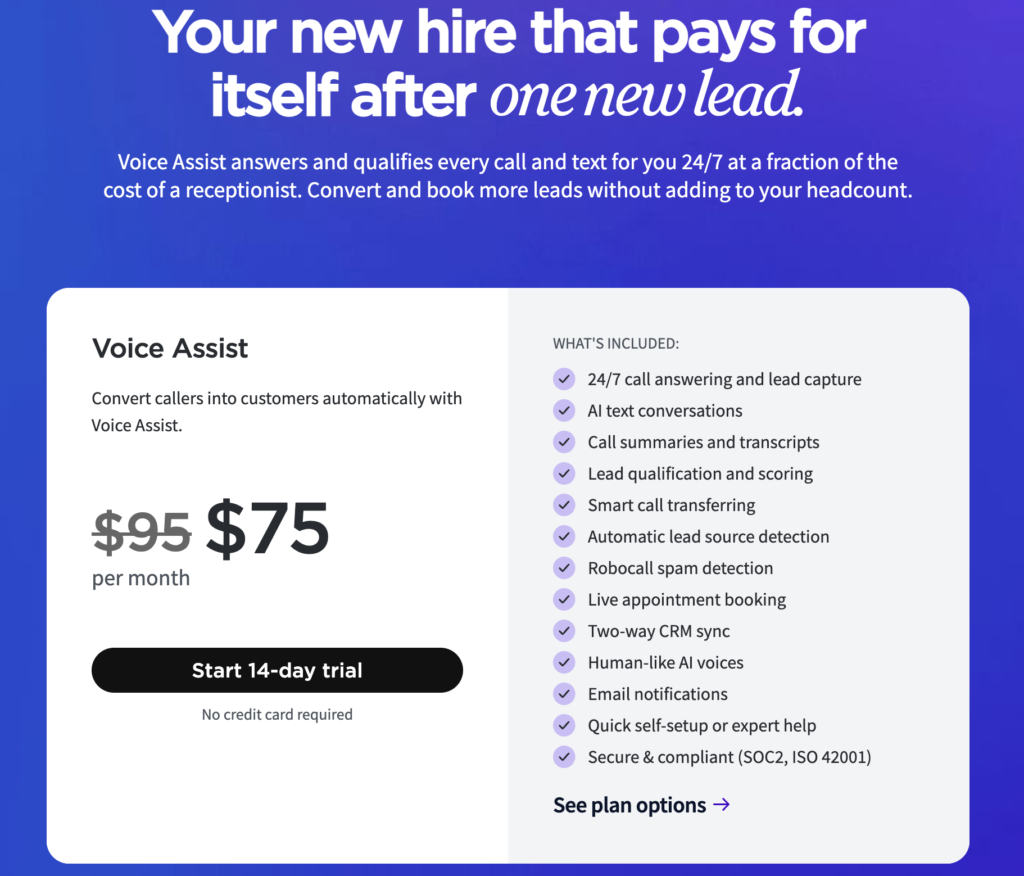
No included call quantity, overage rate, billing term, expiry date, or renewal rate appears
anywhere on the card. Source: voiceassist.callrail.com/pricing, captured 11 August 2026.
Voice Assist as published on two CallRail surfaces
| Price shown | Main page: starts at $95 per month | Product site: $95 struck through, $75 |
| Included calls | 50 calls over 15 seconds | Not stated |
| Overage rate | $1 per additional call | Not stated |
| Offer terms | Not applicable | No expiry, billing term, or renewal rate published |
| Call tracking | Not mentioned on the card | Described as an optional addition |
Both surfaces read on 11 August 2026 in a desktop browser. Neither displayed a publication or update date.
Two figures on two pages do not by themselves prove two prices for the same purchase. One may be a reference price and the other a temporary offer. They may attach to different billing cadences, regions, or acquisition paths. The public pages do not distinguish those possibilities, which is the finding. A buyer cannot resolve them from published information alone.
The click path makes this harder to miss than it sounds. The Voice Assist card on CallRail’s main pricing page carries links out to the product site, so the reader who follows the vendor’s own navigation arrives at the lower figure within one click of the higher one. Which number a buyer takes into a budget spreadsheet depends on where they stopped reading.
Sources: CallRail, pricing page, read 11 August 2026 · CallRail, Voice Assist pricing page, read 11 August 2026
What you can and cannot model
The $1 figure that appears in most coverage of Voice Assist is an overage rate, not the price of a call. It applies after the included allowance is used. Any cost estimate that skips the allowance overstates a small operation’s bill and understates nothing useful.
Working only from the terms CallRail publishes beside the $95 figure, a buyer can build the following.
Published-terms scenario, base $95 plan
| Qualifying calls per month | Modelled monthly total |
|---|---|
| 50 or fewer | $95 |
| 100 | $145 |
| 250 | $295 |
| 500 | $545 |
Projection, not an invoice observation. Assumes the $95 base, 50 included calls, and $1 overage all apply to the buyer’s account. Excludes taxes, telecom and number charges, call tracking charges, and any promotional or renewal adjustment. A qualifying call is one Voice Assist answers that runs longer than 15 seconds.
The same exercise cannot be done for $75. The product site publishes a counting rule, stating that a call registers against usage only when Voice Assist answers it and it runs beyond 15 seconds. Its FAQ also confirms that calls and texts beyond the plan are billed on top of the base fee. What the page does not publish is the included quantity or the overage rate. Without those two numbers, the lower price supports no forecast at all.
That asymmetry is worth naming plainly. The figure a buyer is most likely to quote in a budget is the one CallRail publishes with the least information attached to it.
There is a second reason the table above should be read as a range rather than a forecast. The qualifying call CallRail describes is not the same thing as an inbound call. Under the published rule, a call the agent does not answer never registers, and neither does one that ends inside fifteen seconds. Wrong numbers, robocalls, and immediate hang-ups fall outside the count. A business that takes its current call log volume and reads straight across to a row in that table will overstate its own bill, because a meaningful share of inbound traffic will not qualify. The number a buyer actually needs is answered calls that go past fifteen seconds, and most phone systems do not report that figure directly.
Sources: CallRail, pricing page footnote, read 11 August 2026 · CallRail, Voice Assist billing FAQ, read 11 August 2026
Sources: CallRail, pricing page footnote, read 11 August 2026 · CallRail, Voice Assist pricing FAQ, read 11 August 2026
Page variants this briefing could not resolve
An automated retrieval of CallRail’s pricing page, run on the same date as the desktop reading, returned page content that did not match the rendered view in three respects. Recording this is more useful than picking a winner.
The rendered desktop page carried one comparison table showing local minute overage at $0.06. The retrieved page body contained three comparison tables, one at $0.06 and two at $0.05, with the analysis-minute and transcription-minute rows differing between them. The rendered desktop page carried one Voice Assist footnote referring to 50 calls with no call tracking prerequisite. The retrieved page body contained three footnote variants, two of which name an additional $55 for Lead Tracking, and one of which sets the threshold at 55 calls rather than 50.
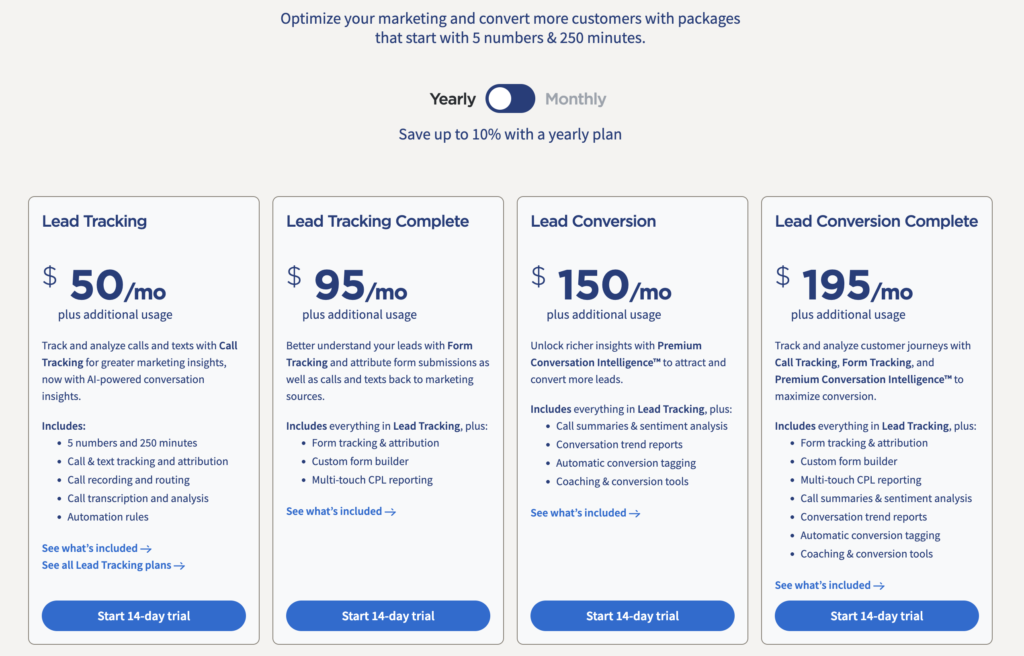
On Monthly, captured 11 August 2026, the same four cards read $55, $105, $165, and $215.
Voice Assist is not priced in this view; its card sits further down the page.
Source: callrail.com/pricing.
Several explanations are available and the public evidence does not select among them. These may be responsive components serving different screen widths. They may be stale content blocks left in the markup. They may be an active experiment. The retrieval may have returned a cached earlier version of the page.
The working draft of this briefing attributed the difference to caching and set the variants aside. That was a conclusion the evidence does not support, and it has been withdrawn. The variants are recorded here as an unresolved conflict.
For a buyer the response is not to average the numbers or to guess which is live. It is to obtain the base price, the included-call threshold, the overage rate, and any call tracking dependency on one written order summary, and to treat that document rather than any page as the record.
Source: CallRail, pricing page, read and retrieved 11 August 2026
The document chronology behind the product
Voice Assist is governed by documents written across twelve months. The dates are published, and reading them in order shows which parts of the record predate the standalone product.
Document dates as published by CallRail
| Date | Document | Relevance |
|---|---|---|
| August 2025 | Supplemental Terms for AI Services | The contract covering CallRail’s AI products. Predates the standalone launch by eleven months. |
| January 2026 | Terms of Use; subprocessor list | Fees, renewal, and the third parties that receive data. |
| 27 February 2026 | ISO/IEC 42001:2023 certificate | Scoped to the AI management system supporting Voice Assist. |
| March 2026 | Description of Services | States that CallRail does not guarantee AI output accuracy. |
| 28 July 2026 | Standalone launch announcement | The commercial change. No call tracking subscription required. |
| 11 August 2026 | Pricing pages, as read | $95 with usage terms on one surface; $75 without usage terms on the other. |
Dates are those printed on each document. Pricing pages displayed no date and are listed by access date.
Three entries in that table carry weight for a procurement reviewer.
The AI Services Terms, dated August 2025, state that they apply to CallRail’s AI-powered services and control over the general Terms of Use where the two conflict. Three provisions bear on a customer-facing voice agent. CallRail shall own all data collected by or processed through the AI Services, with the customer’s own supplied materials carved out. CallRail may acquire those materials by accessing or scraping the customer’s publicly accessible websites, and the clause states the permission holds even where the site’s own terms conflict. And CallRail states that it does not review AI responses for accuracy, bias, or intellectual property clearance, placing responsibility for decisions made on the output with the customer. The document also assigns compliance with applicable recording laws to the customer, which is a matter for buyer-side legal review rather than something this briefing can resolve.
The Terms of Use, dated January 2026, set the conditions under which a displayed price becomes a recurring one. CallRail states there that fees paid are non-refundable, that subscriptions renew automatically on each monthly or yearly anniversary of the first charge, and that a customer who cancels is charged through the end of the current term with no pro-rated refund for unused days. Cancellation is available at any time. What it does not do is stop the current term. For a buyer weighing an annual commitment against a promotional monthly figure, those two clauses interact, and the pricing pages do not mention either.
The subprocessor list, dated January 2026, names the third parties that receive personal data. Three entries name AI voice agent work in their stated purpose: OpenAI’s API for letting callers speak to an agent, and ElevenLabs and Rime for text-to-speech generation. Two more, assembly.ai for speech-to-text and Google Gemini for transcript analysis, describe AI processing without naming the voice agent. Every location entry reads USA. CallRail publishes each vendor’s purpose. It does not publish a feature-level routing map, so the list identifies who is involved without showing what runs where.
The ISO/IEC 42001:2023 certificate was issued to CallRail, LLC by Schellman Compliance, LLC, numbered 1577716-1, valid from 27 February 2026 to 26 February 2029, with one in-scope location in Atlanta. Its scope paragraph limits the certification to the AI management system supporting Voice Assist, with CallRail acting as an AI provider. Voice Assist is expressly named, which is more than many product-page badges can claim. The certificate also carries a printed condition stating that it does not authorize the labelling of products, processes, or services, and it does not address call quality, output accuracy, or availability.
Sources: CallRail, Supplemental Terms for AI Services, August 2025 · CallRail, subprocessor list, January 2026 · Schellman Compliance, LLC, certificate issued 27 February 2026 · CallRail, Description of Services, March 2026
What to obtain in writing before the trial
The trial itself is low friction. CallRail’s product page offers a 14-day trial with no credit card required, which means a buyer can evaluate the agent before any of the pricing questions become financially live.
The questions still need answering before the trial converts. Ask CallRail to confirm the following in one written response or order summary, rather than reading them off separate pages.
The current standalone monthly price, and whether $75 is introductory, channel-specific, or recurring. The renewal price and any promotion end date. The included call threshold, given that the published figures include both 50 and 55. The overage rate that applies to the price being quoted. Whether call tracking is required for the billing path being sold. The countries in which the standalone product can be activated, if you are outside the United States. Whether a healthcare deployment can receive a Business Associate Agreement on a standalone account. And any taxes, number charges, or telecom fees that will appear on the invoice but not on the pricing page.
Two of those deserve a note. On countries, CallRail’s platform pricing FAQ states that CallRail is available in the United States, Canada, the UK and Australia. The Voice Assist FAQ answers the same question more narrowly: Voice Assist is available in the United States as a standalone product. It directs interest from elsewhere to CallRail’s sales team. Whether the same limit applies to Voice Assist bought as a CallRail add-on is not addressed on either page.
Payment mechanics are worth settling in the same message. CallRail’s Voice Assist FAQ states that it accepts major credit cards and processes transactions in US dollars, that payment by check requires a conversation with sales, and that invoicing is typically available to customers spending more than $500 per month on an annual commitment. A business that expects to be invoiced rather than charged to a card is therefore looking at a spending level several times the advertised price, on a term the pricing pages do not describe. For finance teams that cannot pay a recurring card charge, that is a qualifying condition rather than a detail.
On healthcare, CallRail’s healthcare page states that its Healthcare Plans start at $150 per month and that every Healthcare Plan includes a Business Associate Agreement. The Voice Assist site markets to healthcare, dental, and medspa practices. Future Stack Reviews did not locate a published statement covering standalone accounts, which makes this a question for CallRail rather than an assumption a practice should carry into deployment.
Sources: CallRail, Voice Assist pricing FAQ, read 11 August 2026 · CallRail, pricing page FAQ, read 11 August 2026 · CallRail, healthcare page, read 11 August 2026
FAQ
How much does CallRail Voice Assist cost?
CallRail’s main pricing page states that Voice Assist starts at $95 per month, with $1 per call after 50 qualifying calls. Its Voice Assist product site displayed $95 struck through beside $75 per month on 11 August 2026, without publishing usage terms or an expiry date for the lower figure.
Is $75 a promotion?
Neither CallRail page states whether it is. The strikethrough presents $75 as the lower of two figures, but no billing term, expiry date, eligibility condition, or renewal rate is published alongside it. A buyer should request that in writing before budgeting from the number.
Do I need CallRail call tracking to use Voice Assist?
CallRail’s 28 July 2026 announcement states that the standalone product runs on an existing business number without a call tracking subscription, and the product site describes call tracking as an optional addition. Automated retrieval of the pricing page returned footnote variants naming an additional $55 charge, which remains unresolved.
What counts as a billable Voice Assist call?
CallRail’s product FAQ states that a call counts toward usage only when Voice Assist answers it and it runs longer than 15 seconds. Duration beyond that threshold is not separately metered. The $1 figure published on the main pricing page is an overage rate that applies after the included allowance.
Which countries can buy Voice Assist standalone?
CallRail’s Voice Assist FAQ names the United States for the standalone product and directs interest from elsewhere to its sales team. The platform FAQ lists four supported countries for CallRail overall: the United States, Canada, the United Kingdom, and Australia. The add-on case is not addressed.
Can a healthcare practice get a BAA on a standalone account?
CallRail’s healthcare page states that Healthcare Plans start at $150 per month and include a Business Associate Agreement. Future Stack Reviews did not locate a published statement extending that to standalone Voice Assist accounts. Any practice handling protected health information should confirm this with CallRail before deployment.
Does CallRail’s ISO 42001 certificate cover its other AI features?
The certificate scopes the certified AI management system to Voice Assist, with CallRail as an AI provider. It was issued by Schellman Compliance, LLC and runs from 27 February 2026 to 26 February 2029. It does not address call quality, output accuracy, or availability, and it names no other product.
Methodology
This is a Tier C briefing. Tier C means document-first research with no hands-on testing and no claim of use, purchase, ownership, or measurement.
Every CallRail page named here was read by Future Stack Reviews on 11 August 2026 in a desktop browser, or captured as a dated screenshot on that date, or opened as a published PDF. Where a document displays its own last-updated date, that date is given. Where a page displays none, the access date is given instead, and the two are not merged.
Where the rendered page and an automated retrieval of the same URL disagreed, both states are recorded and neither is presented as the live one. An earlier working draft attributed those differences to caching. That attribution was withdrawn because the evidence does not establish a cause.
Phone numbers differ between captures of the same CallRail page. CallRail runs dynamic number insertion on its own website, which is the expected behavior of a call tracking vendor using its own product, and it is not treated here as an inconsistency.
CallRail support-center articles published before the 28 July 2026 announcement were not independently opened for this briefing and are not cited. Where an open question depends on them, it is listed as an open question. No competitor pricing page was opened, so this briefing contains no competitor price comparison.
Statements sourced to CallRail describe CallRail’s stated position. They are not independent verification of product behavior, contractual outcome, or regulatory status. This briefing contains no legal conclusions and no assessment of whether any product or configuration complies with any regulation.
Sources, all accessed 11 August 2026: CallRail pricing page · Voice Assist pricing page · CallRail announcement, 28 July 2026 · Supplemental Terms for AI Services, August 2025 · Terms of Use, January 2026 · Description of Services, March 2026 · Subprocessor list, January 2026 · ISO/IEC 42001:2023 certificate · CallRail healthcare pageVerdict
Budget from $95. That figure is published with the usage terms attached to it, which makes it the only Voice Assist price a buyer can currently model. Treat $75 as an unresolved offer until CallRail states its billing term, included usage, and renewal rate in writing.
None of that is a judgment about the product. This briefing did not test the agent, and a document review cannot tell you whether it handles your callers well. What it can tell you is that CallRail changed how Voice Assist is sold on 28 July 2026, and that its published record has not settled into one description of the new arrangement. The price appears in two states. The included-call threshold appears as both 50 and 55 across page variants. The contract governing the AI carries a date eleven months older than the launch.
The practical position is narrower than either pricing page suggests, and it is workable. Start the trial, which costs nothing and requires no card. Use that fortnight to get one written order summary covering price, renewal, included calls, overage rate, call tracking dependency, and country eligibility. Sign against that document rather than against a page.
Related FSR briefings
Where this pattern shows up elsewhere
Tier B briefings are hands-on tested inside a paid account. Tier C briefings are document-first, with no hands-on testing.
-
Tier B
Hostinger renewal pricing: the term discount does not come back
The renewal question this briefing leaves open, answered inside one paid account: a first-term discount that did not come back.
-
Tier C
Runway Pricing 2026: Credits, Seats, and Where Runway’s Documents Contradict Each Other
One vendor’s own pages disagreeing on price and entitlement, with each difference classified before it is counted as a conflict.
-
Tier C
ElevenLabs Pricing: The Same Plan Buys 1x to 16x More Through the API
One subscription worth a different amount depending on which of the vendor’s own surfaces the work runs through.
-
Tier C
Zendesk AI Pricing in 2026: Two Billing Models, One Unpublished Rate Card
A published price with the rate card behind it held back, which is the position the lower Voice Assist figure sits in.
-
Tier C
OpusClip Credits: Why 3,600 Shared Credits Cost $174 or $348
The same quantity carrying two different prices across one company’s own pricing pages.
Contact Future Stack Reviews
Vendor pages change without notice. If a figure here no longer matches what CallRail publishes, tell us. Corrections are dated and logged rather than edited in silently.
| Report a change | Send the page, the figure, and the date you saw it. |
| Procurement questions | If you are running a vendor review and need a clause or entitlement traced to its source, tell us which one. |
| Vendor right of reply | CallRail is welcome to respond. Corrections supported by a dated official source are published. |
| [email protected] |
Tier C briefing. Document-first research with no hands-on testing. Future Stack Reviews did not open a CallRail account, place a call, or view a checkout screen or invoice for this product. Statements attributed to CallRail describe CallRail’s published position and are not independent verification of product behavior or regulatory status. Cost figures marked as projections are calculated from published terms and are not invoice observations. Nothing here is legal, tax, or compliance advice. This briefing contains no affiliate links, and Future Stack Reviews received no compensation from CallRail or any competitor in connection with it. Published by 合同会社Future Stack, Osaka, Japan. Last updated: 11 August 2026.