Last updated: August 22, 2026
Built from AdCreative.ai’s published documents and public pages, read unauthenticated from Japan on 22 August 2026. No account was created, no subscription purchased, no creative generated, no credit meter observed. Every claim below describes what a named document says. Nothing below is a test result, a legal opinion, or a statement about vendor intent.
AdCreative.ai sells advertising creative generation through monthly credit allowances, operated by ADYOUNEED SAS within the Appier group. This audit compares pre-purchase public claims against the AdCreative.ai Terms of Service for Online Subscribers dated 19 December 2025 , and against the separate Enterprise Terms. It is a document audit, not a product test.
Verdict in one sentence: a self-service buyer can identify the published rules from these documents but cannot model usage cost, renewal exposure, or output rights from them alone.
Discrepancy matrix
| Issue | Public page states | Contract states | Status | Buyer action |
|---|---|---|---|---|
| Credit trigger | FAQ: consumed on download; generation unlimited | Clause 1.3: generating or downloading may consume credits | DIRECT CONFLICT | Ask which events decrement the meter |
| Refund | FAQ: refunds offered within 7 or 30 days if unused | Clause 4.7: no right of withdrawal; refund at sole discretion | STRUCTURAL | Ask whether refund is a policy or a discretion |
| Cancellation cutoff | Refund page: cancel before the cycle ends | Clause 4.2 EN and JP use materially different wording | TEXTUAL DIVERGENCE | Ask for the last cancellation time for your cycle |
| Output ownership | Plan matrix: Complete Asset IP Rights listed under Enterprise only | Enterprise clause 7.1 adds one ownership sentence the Online Terms do not contain | PLAN-SCOPED | Get the output rights for your plan in writing |
| AI training scope | Privacy Policy: anonymized data, consent revocable | Clause 10.1 permits use of account data, insights, and Contents | SCOPE GAP | Ask what revocation stops, per data class |
| Security evidence | Data stated as held on AWS servers in Ireland | No product-specific DPA, subprocessor list, or certification scope located | NOT LOCATED | Request the product-scope security package |
Each row is sourced in the section of the same name. Status labels are Future Stack Reviews classifications, not vendor labels. Retrieved 22 August 2026, unauthenticated, desktop, Japan.
What this audit does not establish
- Runtime behavior. Whether a live account meter decrements on generation is untested here.
- Which text binds you. The contracting party is set by the transaction record, so the applicable entity, language version, and currency are unknown before purchase.
- Legal effect. No clause discussed here is assessed for enforceability, validity, or outcome.
- Vendor intent. Divergent wording is recorded as wording. No motive is inferred.
- Historical pricing. No matched historical artifact is held, and no price change is claimed.
- Customer experience. No user reviews, complaint volumes, or support ratings are cited.
Use this brief for
- Procurement and finance approval of a self-service subscription
- Deciding what to obtain in writing before paying
- Assessing output rights before running generated assets in paid campaigns
- Modeling the limits of what published documents can tell you
Do not use this brief for
- Output quality, speed, or editor usability evaluation
- A buy or avoid recommendation
- A legal opinion on any clause discussed here
- Enterprise contract review, which requires the negotiated order form
At a glance
| Named service provider | ADYOUNEED SAS, RCS Paris 843 804 899, per clause 4.4.3 and the legal notice. |
| Contracting party | Not the same field. The preamble states it is determined by the online transaction record. |
| Law and forum | Follows the contracting party. Clause 12.5 maps four entities to four different laws and forums. |
| Currency | Clause 4.1 states fees display in different currencies by contracted entity or account setting. |
| Documents audited | Online Subscriber Terms 19 December 2025 (EN, JP, ZH), Enterprise Terms, Privacy Policy, Legal Notice 17 September 2025, Refund Information, plan matrix. |
| Credit rollover | None. Clause 4.6 and the refund page both state unused credits do not carry forward. |
| Credit top-up price | Purchase right exists in clause 4.6. No price located in the pages reviewed. |
| Invoices | Account-pulled, not email-pushed. Clause 4.4.2. |
| Liability cap | Clause 8.2.5 caps total liability at the amount paid in the most recent six months. |
| Data location | OFFICIAL CLAIM: AWS servers in Ireland. Not independently verified here. |
Retrieved 22 August 2026. Clause numbers refer to the English Online Subscriber Terms unless stated.
In this audit
Contents
Credits: two different trigger events
A credit is the billing unit. Every plan is sold as a monthly quantity of credits, so the event that consumes one determines cost per accepted asset. Two official sources name different events.
| Public FAQ | A credit is used on download. Generation is unlimited and does not consume credits. |
| Clause 1.3, Online Terms | Credits enable the client to “generate or download” a Project. Either action may consume one or more credits. |
| Runtime meter | Not tested in this audit. |
The Japanese and traditional Chinese editions of clause 1.3 carry the same generate-or-download construction.
The documents alone are insufficient to calculate cost per accepted asset. If generation consumes credits in runtime, discarded generations would affect usage cost; if it does not, they would not. Neither document settles the question, and no account was opened to test it.
Clause 4.6 states that credits unused during the applicable month are not carried forward, and the refund page repeats that credits expire at the end of each billing cycle. Clause 4.6 also grants the right to purchase extra credits for an additional fee. No top-up price was located in the pages reviewed, so a buyer cannot model overage cost from the public record.
Sources: AdCreative.ai, Online Subscriber Terms, 19 December 2025, clauses 1.3 and 4.6 · AdCreative.ai, Japanese Online Subscriber Terms, clause 1.3 · AdCreative.ai, homepage FAQ, 22 August 2026 · AdCreative.ai, Refund Information, 22 August 2026
Refunds: a policy and a discretion
The homepage FAQ says refunds are offered within seven days for monthly plans and thirty days for yearly plans if the platform has not been used. Clause 4.7 uses a different structure. It records that the subscriber has “no right of withdrawal after subscribing,” then provides that AdCreative.ai may, at its “sole discretion,” grant an exceptional refund to a customer who did not use the service and who writes inside the same windows.
The dedicated refund page is closer to the contract than to the FAQ. Its eligibility answer is conditional and lists four disqualifiers: the service was used, the request falls outside the window, the account has been deactivated or deleted, or the request concerns unused or expired credits.
These statements can coexist. A company can operate a refund policy while reserving the decision contractually. The finding is not that one page is false. It is that the FAQ gives a more definite answer than the document a subscriber accepts, and a buyer budgeting for recovery after an unwanted renewal is budgeting against the more definite one.
Clause 3.3 adds a sequence worth planning around: no refund is granted after an account is deactivated or deleted. Clause 4.6 states sums paid remain the property of AdCreative.ai and are non-refundable except where clause 4.7 is satisfied.
Processing time is published twice with different numbers. The homepage FAQ says eligible refunds are typically processed the same day, with bank posting taking one to two weeks. The refund page says approved refunds are issued within two to three weeks. These may describe different stages of the same process, so this is recorded as timeline ambiguity rather than a proven conflict.
Sources: AdCreative.ai, Online Subscriber Terms, clauses 3.3, 4.6 and 4.7 · AdCreative.ai, Refund Information, 22 August 2026 · AdCreative.ai, homepage FAQ, 22 August 2026
Cancellation: three wordings, no verified cutoff
The published cancellation cutoff is not stated consistently.
Monthly cancellation, as published
| Source | Wording | What it settles |
|---|---|---|
| Clause 4.2, English | The cancellation timeframe is “within” seven days before the end date of the monthly cycle. | Grammatically ambiguous. Does not settle a cutoff. |
| Clause 4.2, Japanese | Cancellation must be carried out by seven days before the end date of the monthly period. | States an advance deadline. |
| Refund Information page | Cancel before the end of your monthly cycle. | States a pre-renewal deadline only. |
Annual figures diverge the same way around thirty days. Read 22 August 2026.
The Japanese text states an advance deadline. The refund page states only a pre-renewal deadline. The English sentence is grammatically ambiguous, and this audit does not convert it into a definite seven-day window. Doing so would be interpretation, not document reading.
The defensible finding is textual: three official pages use materially different wording, and none of them establishes the live cutoff for a specific account. Which text applies depends on the transaction record, the contracting entity, and the accepted language version, none of which a prospective buyer can read off the public pages. This audit does not state which language controls, which cutoff would be enforced, or what any tribunal would decide.
For operational planning a buyer can work to the earliest published cutoff and retain the cancellation confirmation. That is risk management, not a conclusion about contractual validity.
Sources: AdCreative.ai, Online Subscriber Terms, clause 4.2 · AdCreative.ai, Japanese Online Subscriber Terms, clause 4.2 · AdCreative.ai, Refund Information, section on avoiding unwanted renewals
Trial access versus paid plan entitlements
The refund page carries the clearest published description of the free trial. It states the trial runs seven days, grants ten credits, and provides unlimited access to every Pro feature the company offers, naming eleven: Product Videos, Custom Templates, Batch Creatives, Compliance Checker AI, Creative Scoring AI, Ad Videos, Storytelling Ads, Connected TV Ads, Blog Videos, Fashion Videoshoots, and Stock Videos. The page states the trial gives “the exact same access as our Pro plan.”
The plan comparison table, captured on the yearly billing view, describes Starter as ten credits a month, one brand, and one user. Nine of the eleven features the refund page names for the trial carry a cross in the Starter column: Custom Templates, Product Videos, Batch Creatives, Compliance Checker AI, Creative Scoring AI, Ad Videos, Storytelling Ads, Blog Videos, and Fashion Videoshoots. The other two, Connected TV Ads and Stock Videos, are not rows in that table.
One qualifier belongs with that reading. The same table marks “All AI Assets Unlocked” with a check for Starter while marking Creative Scoring AI with a cross. The vendor’s own taxonomy therefore treats AI assets and Creative Scoring as separate things, and “All AI Assets Unlocked” is not defined on the page. A buyer should not infer either direction from that phrase alone.
The published gap is still material. The trial’s credit allowance matches Starter’s exactly, while its feature access is described as matching a higher tier. Creative Scoring AI, the performance-prediction feature the company positions as its differentiator, appears on the trial list and carries a cross in the Starter column. Whether a paid Starter account reproduces the trial workflow requires a verified plan-entitlement capture, which this audit does not have.
Sources: AdCreative.ai, Refund Information, “How the Trial Works”, 22 August 2026 · AdCreative.ai, plan comparison table, yearly billing view, 22 August 2026
Output rights: online terms versus enterprise terms
Clause 1.4 of the Online Subscriber Terms defines Content as material the client supplies. Clause 1.6 defines Project as the marketing visuals generated through the service. Clause 6.3 states the client retains rights in submitted Content, which addresses the input rather than the output. Clause 6.1 grants AdCreative.ai an irrevocable, transferable, sublicensable license over that Content to the extent required to provide the services.
Section 7 of the Online Subscriber Terms holds three subsections in each of the three published languages: rights related to the Services, rights to the know-how, and the client’s understanding of the ownership of the Services. Future Stack Reviews read all three subsections in the English, Japanese, and traditional Chinese editions and located no clause granting the client ownership of the generated Project.
The Enterprise Terms are a separate document, and their section 7 is not a rewrite of it. The opening paragraph of clause 7.1 is word for word identical across the two documents, and clauses 7.2 and 7.3 are identical in both. The Enterprise version adds a single sentence to 7.1, and that sentence is the entire difference between the two contracts on this point: Projects generated by the service from client-supplied Content are owned by the client.
That sentence also carries a structural role. Clause 7.3 opens in both documents with the phrase “Unless otherwise expressly provided in these Terms,” then reserves all rights in the Services, and in work derived from their use, to AdCreative.ai. In the Enterprise document, clause 7.1 supplies such an express provision. In the online-subscriber document, Future Stack Reviews located none.
The public plan matrix runs in the same direction, listing Complete Asset IP Rights, Commercially Safe AI Models, Commercially Safe Content, and Global Data Governance Protocols only in the Enterprise column.
That is a plan-document difference, not proof that self-service customers own nothing. Absence of an express grant does not settle copyright, license scope, commercial use, or third-party rights, and the outcome would turn on the applicable law, which section 07 shows is itself entity-dependent. What it changes is the procurement question. A self-service buyer planning paid campaigns should obtain the applicable output license or ownership wording in writing before committing budget.
The iStock component sits separately and is unresolved. Clause 1.7 states the service uses photographs and videos available through iStock, and clause 7.1 excludes iStock material from AdCreative.ai’s own property. The reviewed documents do not supply the downstream license terms a buyer would need to assess territory, duration, permitted media, volume limits, model release status, or whether previously downloaded assets may keep running after cancellation.
Sources: AdCreative.ai, Online Subscriber Terms, clauses 1.4, 1.6, 1.7, 6.1, 6.3 and 7 · AdCreative.ai, Japanese Online Subscriber Terms, section 7 · AdCreative.ai, Traditional Chinese Online Subscriber Terms, section 7 · AdCreative.ai, Terms of Service for Enterprise Customers, section 7 · AdCreative.ai, Enterprise plan matrix, 22 August 2026
Data, training scope, and security evidence
Three official sources describe AI training, and they address different data classes and different model destinations rather than stating incompatible rules.
Training scope, as published
| Source | Data class named | Stated purpose |
|---|---|---|
| Clause 10.1 | Data, insights, Contents from the account, plus connected Google and Meta ad account data | Platform functionality, algorithm refinement, training and improving AI systems |
| Privacy Policy | Anonymized user data, personally identifiable information stripped | Improving and training AI systems |
| Enterprise page | A single brand’s previous campaigns and creative assets | Brand-specific fine-tuning in a dedicated instance, without sharing with global models |
Read 22 August 2026. The Enterprise statement is a plan-specific claim about brand fine-tuning and is not read here as a statement about all account data.
What the public record does not provide is a map. No document reviewed states which data class, on which plan, feeds which model. The Privacy Policy states that consent may be revoked at any time through account settings or by contacting the data protection officer, so a revocation route is published. What that revocation stops, per data class and per connected ad account, is not specified anywhere in the pages reviewed.
Other data facts are stated plainly and should be recorded as vendor statements rather than verified conditions. Data is stated to be held on Amazon Web Services servers in Ireland. Retention is specified as 180 days after access is disabled, five years for billing data, ten years for invoices under the French Commercial Code, and thirteen months for cookies. The paragraph on transfers outside the European Economic Area names the Privacy Shield framework, and a buyer assessing transfer mechanisms should ask the company which mechanism currently applies.
On security artifacts, the finding is deliberately narrow. Within the AdCreative.ai pages listed in the methodology, Future Stack Reviews did not locate a product-specific data processing agreement, a named subprocessor list, or a certification-scope statement covering the self-service product. Material published at the parent-company level was not audited in this scope, and no statement was located mapping any group-level certification to the AdCreative.ai self-service product. Not located for this product is not the same as does not exist, and a procurement reviewer should request the product-scope security package directly.
Sources: AdCreative.ai, Online Subscriber Terms, clause 10.1 · AdCreative.ai, Privacy Policy, AI training, consent, storage and retention · AdCreative.ai, Enterprise, 22 August 2026 · AdCreative.ai, Help Center index, 22 August 2026
Entity, law, currency, and invoices
Two fields that look identical are not. Clause 4.4.3 names ADYOUNEED SAS as the service provider and states it remains so regardless of which payment route processes the transaction. The preamble states something different: the contracting party is determined by the online transaction record. A buyer therefore knows who operates the service but not, before purchase, who the counterparty will be.
That distinction propagates. Clause 12.5 maps four entities to four different arrangements: ADYOUNEED SAS and Appier Pte. Ltd. to Singapore law and the arbitration rules of the Singapore International Arbitration Centre, Appier Japan to Japanese law and the Tokyo District Court, and Appier Inc. to Taiwanese law and the Taipei District Court. Clause 4.1 adds that fees display in different currencies depending on the contracted entity or the currency shown in the account. Law, forum, and currency all follow a field the buyer cannot read in advance.
Payment routing runs on the same structure. Clause 4.4.3 describes three paths: the French Stripe account of ADYOUNEED SAS, the US Stripe system with Woopra Inc. as collection agent for US customers, and the French Stripe account of SARL APPIER UK CO. LTD as collection agent for everyone else.
Invoices are account-pulled rather than email-pushed. Clause 4.4.2 states invoices are generated in the customer’s name and accessible exclusively through the application under the Billing tab inside Settings, that the company does not dispatch invoices or related billing communications by email or any other external method, and that reviewing them is the customer’s sole responsibility. The refund page repeats this and the refund procedure asks the subscriber to download the invoice and attach it. Separately, the homepage trial section states a reminder is sent before the trial ends; that is a different communication about a different event. Future Stack Reviews did not locate a statement in the reviewed pages that a renewal charge on an ongoing subscription is announced in advance by email.
Two documentation details complete the entity record. The legal notice states share capital of 1,432.80 euros while the privacy policy states 1,000.00 euros for the same company and registration number. And clause 11 applies a definition of anti-social forces drawn from Japanese law inside a contract published by a French company.
Sources: AdCreative.ai, Online Subscriber Terms, preamble and clauses 4.1, 4.4.2, 4.4.3, 11 and 12.5 · AdCreative.ai, Legal Notice, last updated 17 September 2025 · AdCreative.ai, Privacy Policy, data controller · AdCreative.ai, Refund Information, contact section
Why a plan name is not a price
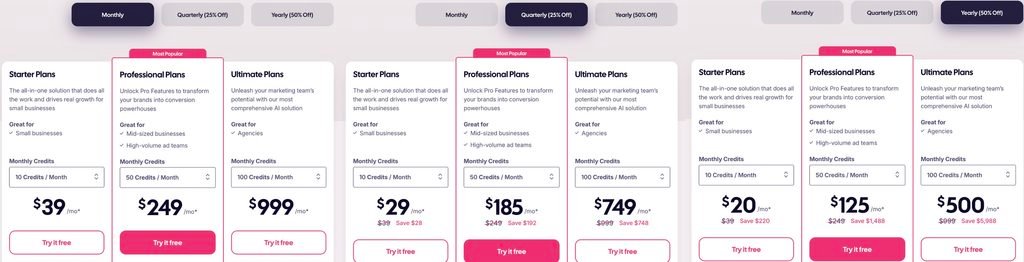
A plan name does not identify a price on this site, because each plan card carries a monthly-credits selector directly above the displayed figure. Changing the selected credit quantity changes the SKU being quoted. Any price a buyer, a competitor, or a review site reports is therefore scoped to a selector state, a billing cycle, and an account locale.
Clause 4.1 reinforces the same point from the contract side, stating that fees display in different currencies depending on the contracted Appier group entity or the currency shown in the account.
The billing toggle offers three cycles: Monthly, Quarterly labeled at 25 percent off, and Yearly labeled at 50 percent off. On the yearly view captured for this audit, the displayed rates were 20 dollars a month for Starter against a 39 dollar reference, 125 for Professional against 249, and 500 for Ultimate against 999. Campaign state at the moment of capture was not recorded, so those figures are reported as a dated observation rather than as list prices.
One arithmetic note. Professional’s stated annual saving of 1,488 dollars matches twelve months of its 124 dollar difference, and Ultimate’s 5,988 matches twelve months of its 499 dollar difference. Starter’s stated saving of 220 dollars does not reconcile with twelve months of its 19 dollar difference, which is 228. This audit records the discrepancy and does not infer a cause.
There is also no standalone pricing page in the site’s own navigation. The Pricing item resolves to an anchor section on another page, captured as an anchor URL on 22 August 2026. The Internet Archive holds two captures of the separate /pricing path, both dated 3 April 2026, and the archived content is AdCreative.ai’s own not-found page. A price published only inside a dynamic selector page raises the evidence required to reconstruct a historical offer, which is an analyst inference rather than a vendor statement.
Sources: AdCreative.ai, pricing section, yearly billing view, 22 August 2026 · AdCreative.ai, Online Subscriber Terms, clause 4.1 · Internet Archive, capture of adcreative.ai/pricing, 3 April 2026
What to obtain in writing before purchase
The public documents identify the risks. They do not close them. Before approving a self-service subscription where credit predictability, renewal control, campaign rights, or connected-account data matter, request written answers to five questions.
Send these to sales or support before paying
- Which events decrement the credit meter: generation, preview, download, retry, failed generation, or re-download of an edited asset?
- What is the last moment at which a cancellation prevents renewal for my billing cycle, and which language version of clause 4.2 applies to my account?
- Is a refund for an unused subscription a policy commitment or a discretionary decision, and which entity decides?
- What ownership or commercial-use rights attach to generated Projects on my specific plan, and what license covers iStock material embedded in them?
- Which Appier group entity will appear on my transaction record, in which currency, and what does revoking training consent stop for each data class?
Keep the written answer alongside the transaction record. It is the only document that ties the published rules to your specific plan, entity, and currency.
FAQ
Does AdCreative.ai charge a credit when you generate a creative, or only when you download it?
The two published answers name different events. The FAQ states credits are consumed only on download and generation is unlimited. Clause 1.3 states credits enable the client to generate or download, and either action may consume credits. Runtime metering was not tested in this audit.
Is the AdCreative.ai refund policy a guarantee?
The terms do not describe it as one. Clause 4.7 records no right of withdrawal after subscribing and reserves any refund to the company’s sole discretion, limited to subscribers who did not use the service and who write within seven days for monthly plans or thirty for annual plans.
When is the last moment to cancel an AdCreative.ai monthly subscription before it renews?
The public record does not settle it. Three official texts use different wording: the Japanese clause 4.2 states an advance deadline, the refund page states a pre-renewal deadline, and the English clause 4.2 is ambiguous. Ask the vendor for the cutoff that applies to your account.
Does AdCreative.ai email invoices?
No. Clause 4.4.2 states invoices are accessible exclusively inside the application under Settings and Billing, that the company does not dispatch invoices or related billing communications by email or other external methods, and that reviewing them is the customer’s sole responsibility.
Do AdCreative.ai subscribers own the ads the platform generates for them?
The two contracts differ by one sentence. Clause 7.1 of the Enterprise Terms states that Projects generated from client-supplied Content are owned by the client. The Online Subscriber Terms carry the same section 7 without that sentence, in all three published languages. That is a document difference, not a legal conclusion.
Which company and which law govern an AdCreative.ai subscription?
ADYOUNEED SAS is the named service provider, but the terms state the contracting party is set by the online transaction record. Clause 12.5 maps four possible entities to Singapore, Japanese, and Taiwanese law with correspondingly different forums, so the answer is account-specific.
Methodology and source scope
Tier C at Future Stack Reviews means document-first research conducted before any hands-on testing. No account was created, no subscription purchased, no creative generated, no credit meter observed, and no measurement taken.
Sources were read in a desktop browser on 22 August 2026 from Japan, unauthenticated. Pages read in full: the homepage including the pricing section and FAQ, the Enterprise page, the Creative Scoring page, the Refund Information page, the Online Subscriber Terms in English, Japanese, and traditional Chinese, the Enterprise Terms, the Privacy Policy, the Cookies Policy, the Legal Notice, the Affiliate Policy, and the Help Center category index. Individual Help Center articles were not opened. Parent-company material was not audited.
The Online Subscriber Terms carry the version date 19 December 2025. The Legal Notice carries 17 September 2025. The Affiliate Policy is effective 1 January 2026. Prices and the plan matrix were read from the rendered page rather than page source, because unrendered markup on this site contains values that do not appear on screen. Campaign state at the moment of price capture was not recorded, which is a limitation of this pass.
Where two official sources disagree, both are recorded and neither is treated as correct. The status labels used here distinguish a direct conflict from a structural difference, a textual divergence, a plan-scoped difference, a scope gap, and a not-located finding. Where a document is silent, the finding is recorded as not located within a stated search scope, never as absence. Statements about clauses describe what the text says, not what it achieves.
Flagged for a future hands-on brief: live credit metering across generate, preview, download, and retry; the paid Starter entitlement gate; the checkout, renewal, and cancellation screens; the iStock downstream license held by Getty Images; product-scope security documentation obtained through sales; and Appier Group filings on the Tokyo Stock Exchange.
Prior Future Stack Reviews coverage of AdCreative.ai pricing has been withdrawn, and this briefing makes no claim about any historical price change. Future Stack Reviews received no payment, no product access, no briefing, and no review copy from AdCreative.ai or Appier in connection with this article. This page carries no affiliate links and Future Stack Reviews receives nothing from an AdCreative.ai subscription.
Verdict
AdCreative.ai’s pre-purchase public documents do not produce one procurement answer on credit metering, refund discretion, cancellation timing, or self-service output rights.
That is a narrower statement than it sounds, and it is deliberately narrow. Different wording across documents does not by itself establish a contradiction, a runtime behavior, a contractual outcome, or an intention. Some of the differences here are direct conflicts, one is a plan-scoped difference between two contracts, one is a documentation gap, and one is an ambiguity in a single English sentence. Sorting them into those categories is most of the work, and collapsing them into a single accusation would be less useful and less true.
What survives sorting is a procurement conclusion rather than a product one. The vendor publishes a substantial documentation set, including a dedicated refund page, terms in three languages, a named data controller, a stated data location, and a specific retention schedule. A buyer can read all of it and still be unable to answer what a credit costs them, when they must cancel, whether a refund is recoverable, and what rights attach to the assets they produce.
The decision rule follows from that. Where those four questions carry real budget or campaign exposure, obtain written answers tied to your plan, entity, and currency before approving the purchase. Where they do not, the published record is adequate. This is an editorial decision rule, not legal advice, and it is not a recommendation to buy or to avoid the product.
Related briefings
Related briefings
Tier B means hands-on tested. Tier C means document-first, before hands-on testing.
Hands-on with a credit meter that did not always agree with the account, and a price list that is not published.
Higgsfield Unlimited Explained: 7 Conditions That Decide Whether a Generation Costs Credits
The conditions that decide whether a generation consumes a credit, read from the published rules.
Metaso AI Search for Buyers Outside China: Access, Payment, Output Rights, and Contract Gaps
Access, payment, output rights, and the contract gaps a buyer outside the vendor’s home market has to close.
Descript Review 2026: Privacy, AI Training, and Where the Documents Disagree
Privacy and AI training terms, and the points where the published documents do not line up.
OpusClip Credits: Why 3,600 Shared Credits Cost $174 or $348
The same credit balance carrying two different prices, and what decides which one you pay.
Runway Pricing 2026: Credits, Seats, and Where Runway’s Documents Contradict Each Other
Credits, seats, and the places where the vendor’s own documents contradict each other.
Contact and corrections
Talk to the desk
Corrections, right of reply, and procurement questions
| Found an error | Send the clause or page and what it should say. Material corrections are dated, numbered, and logged. They are never applied silently. |
| Vendor right of reply | AdCreative.ai and Appier may respond to any finding here. Replies are published in full beside the section they address. |
| Procurement questions | If you are running a vendor review and need the underlying clause references or the source ledger, ask and we will send them. |
| What we cannot do | We do not give legal advice, do not intervene in billing disputes, and do not accept payment to change or remove a finding. |
[email protected] · Published by 合同会社Future Stack, Osaka, Japan.
This is a Tier C document audit built from published pages, not from testing. It is not legal, tax, or financial advice, and it is not a recommendation to buy or avoid any product. Prices, plan contents, and terms change without notice; confirm every figure against the vendor’s current pages before purchasing. Where two official sources disagree, this audit reports both and resolves neither. This page carries no affiliate links.
Last updated: 22 August 2026 · Published by 合同会社Future Stack, Osaka, Japan · Edited by Takashi Fujino · © 2026 合同会社Future Stack