Last updated: August 10, 2026
Metaso AI Search is a Chinese answer engine operated by Shanghai MetaSOTA Technology Inc. Its website and its App Store listings are reachable outside mainland China. That does not establish that a buyer abroad can finish registration, pay with a supported method, or use every output commercially. This document-first review separates those questions. Future Stack Reviews did not create an account, buy credits, run a query, or inspect a generated file.
Verdict in one sentence: Metaso is publicly distributed outside China, but its current public documents do not let a business buyer abroad confirm registration, payment eligibility, commercial output rights, or the terms governing every displayed billing label.
Built only from Metaso’s own published documents, MiniMax’s published model license and license Q&A, and public app storefront pages, read on 9 and 10 August 2026. FSR did not register an account, buy anything, run a query, export a file, or call the API. Nothing here reports product performance, speed, or citation accuracy.
| Buyer question | What a public source establishes | Status | Still unknown |
|---|---|---|---|
| Public distribution | Apple lists the app on the China, United States, Japan, and Macau storefronts, seller shown as Shanghai MetaSOTA Technology Inc. | Page display | Nothing about account-level eligibility |
| Registration | Privacy policy 3.1.1: a nickname and a mobile number for an SMS code. WeChat login also described. | Official claim | Whether a non-China number receives the code |
| Payment | Agreement 3.4.5 gives an Alipay cancellation path; Apple storefronts list in-app purchases. | Official claim | Accepted instruments; whether a foreign purchase completes |
| What is sold | Apple’s China page displayed ten entries labeled as membership, credits, knowledge-base quota, search quota, and one report product. | Page display | Whether each label is separately purchasable at checkout |
| Credit rules | Agreement 3.2 and 3.3 define credits, publish six consumption rates, and set a 12-month expiry on long-term credits. | Official claim | Rules for the other displayed labels |
| Output use | Agreement 2.2 restricts platform content; 7.5 says Metaso does not restrict use of generated content. | Open conflict | The boundary in a mixed answer |
| AI labels | Agreement 6.7 says Metaso adds a visible label and a metadata marker and bars their removal. | Untested | Actual presence across formats |
| Data storage | Privacy policy 8.2: stored in mainland China; no current scenario of provision outside it. 9.3: logs kept at least six months. | Official claim | Whether queries or uploads train models |
| API | An official API page exists, while agreement 6.8 bars programmatic calling of the platform. | Open conflict | API-specific terms, price, rate limits |
| Video model terms | Agreement 2.6 incorporates the MiniMax H3 Community License; MiniMax’s own Q&A treats hosted API access differently. | Open conflict | Which deployment path Metaso uses |
Status key. Page display: what a named page showed on a named date, not a complete inventory. Official claim: what a vendor document states, not independently verified. Open conflict: two sources give different answers and FSR preserves both. Untested: FSR performed no test.
What happened: one product, four gates
Short answer. Most English coverage treats Metaso as one question: is it a good AI search tool. For a buyer outside mainland China it is four separate questions, and a public app listing answers none of them. Distribution, registration, payment, and contract coverage are established by different evidence, and on current public documents they do not all close.
The four gates run in order, and each one can stop a purchase on its own.
Gate 1, registration. Can an account be created with a non-China phone number.
Gate 2, payment. Can a supported payment instrument outside China complete a purchase.
Gate 3, output rights. Can the result be used in client work, published, or redistributed.
Gate 4, contract coverage. Which agreement, which dynamic page, and which third-party license govern that use.
The product itself has moved well past search. On 10 August 2026, Apple’s China storefront page displayed ten separate in-app purchase entries for the app, labeled across membership, credits, knowledge-base quota, search quota, and a single interview analysis report. The public interface offers search intensity settings, slide generation, an audio lesson feature, file upload, and an API entry point, and the site displayed a banner advertising video generation priced by the second.
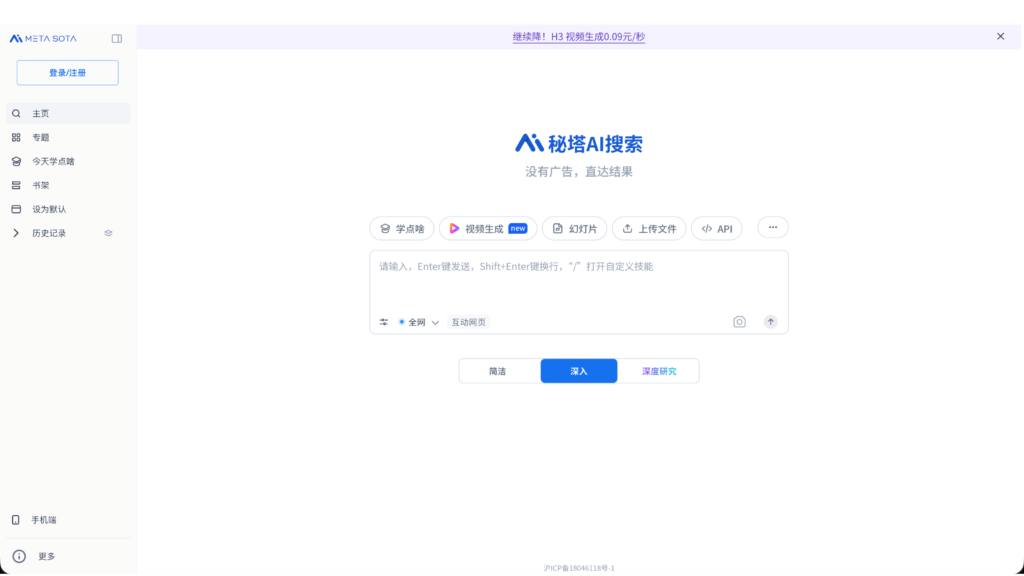
captured from Japan on 9 August 2026. The sign-in and register button at the
top left is where this briefing stops: FSR did not go past it. The button row
shows how far the product has moved beyond search, and the banner across the
top announces a further price cut on H3 video generation, at 0.09 yuan per
second on this date. Every label on the page is in Chinese.
Model disclosure sits on different surfaces rather than in one place. Apple’s listing attributes the product to the company’s own model, MetaLLM. The user agreement’s billing rules price a standard model answer at one credit and a DeepSeek model answer at three. Clause 2.6 of the same agreement names MiniMax H3 for video generation. Those statements describe different product layers and are not inherently contradictory. What matters for a buyer is that model identity appears in the price list and the contract rather than in the product description.
One observation about currency of documentation, stated narrowly. The company’s about page describes the search product as being at a 0.99 stage, while Apple lists app version 2.5.4. FSR did not establish when the about text was last revised.
Sources: Metaso user agreement, read 10 August 2026 · Metaso about page, read 9 August 2026 · Apple App Store, China storefront, read 10 August 2026
Who this affects
Short answer. This briefing matters at the point where Metaso stops being something you read and becomes something you pay for, build on, or hand to a client.
- You need to register or pay from outside mainland China and want to know what is established before you try.
- You plan to put output into a client deliverable, a publication, or a redistributed product.
- You are considering the API and need written terms, a price, and a rate limit before writing code.
- You are in the European Union, the United Kingdom, South Korea, or the United States and the video feature is in scope.
- You have to produce a procurement file: a data processing agreement, a subprocessor list, a status page, or a contracting entity.
Each of those maps to a gate, and each is answered below by a named document rather than by an opinion. The video question is the one most likely to be missed, because it involves a second company’s license that Metaso’s own agreement pulls into the consumer terms.
Sources: Metaso user agreement, read 10 August 2026 · MiniMax H3 Community License Agreement, read 9 August 2026
Who this does not concern
Short answer. If Metaso stays a personal reading tool and never enters a paid or client-facing workflow, the gaps in this briefing do not reach you.
- You read Chinese, already use WeChat, and want a free search tool for your own reading.
- You will not publish, redistribute, or bill anyone for what it produces.
- You will not touch the video feature or the API.
- You need no contract, no invoice, and no data documentation.
None of that is a criticism. A product built for a domestic consumer audience is entitled to be built for one. The gaps appear only when someone outside that audience treats a reachable website as a purchasable business tool.
One caution that applies even to casual use. Agreement clause 7.2 states that Metaso does not warrant the accuracy, completeness, or functionality of generated content, and singles out numbers, times, and factual descriptions as things it does not guarantee to be correct. Clause 7.1 disclaims the accuracy and timeliness of search results as well. If you use the product for research, keep checking the citations yourself.
Sources: Metaso user agreement, clauses 7.1 and 7.2, read 10 August 2026
Gates 1 and 2: registration and payment
Short answer. The public documents describe what registration asks for. They do not establish that a foreign attempt completes. FSR observed the sign-in dialog and stopped before submitting anything.
On 9 August 2026 the sign-in dialog opened on a WeChat QR scan, with phone verification and account password available as secondary choices. The phone form’s country code field accepted a manually typed value of 81. That is the extent of the observation. FSR did not request a verification code, did not complete registration, and cannot say whether a message reaches a Japanese number. The consent checkbox for the agreement and privacy policy was unticked by default.
Privacy policy clause 3.1.1 lists what phone registration collects: an account nickname and a mobile number used to receive a verification code. The same clause describes WeChat login as an alternative and email binding as a route to email and password login.
Additional features invoke separate identity checks rather than reusing the first one.
- Public link sharing requires real-name identity verification (privacy policy 3.1.5).
- Withdrawing earnings from the creator feature requires a name, an identity-card number, a bank card number, and a phone number (agreement 5.2.4). The clause describes no alternative for a user without a Chinese identity card.
- Agreement 1.3 permits immediate suspension or cancellation, with no liability, where Metaso observes abnormal calling patterns or has reasonable grounds to believe the user is not the original registrant.
On payment, the public record is thinner than the sign-up record. Agreement 3.1 says fees and entitlements are published on the order page. Clause 3.4.5 describes cancelling auto-renewal through Alipay and through in-product menus. FSR located no page listing accepted payment instruments, and did not open a checkout screen. Apple’s storefronts offer a separate rail with Apple as merchant of record, but FSR did not open an in-app purchase sheet and cannot confirm what a given account can actually buy.
Where the resulting data sits is stated by the vendor. Privacy policy 8.2 says personal information is stored within the People’s Republic of China and that there is currently no scenario in which it is provided outside that territory. Clause 9.3 says network operation logs are kept for at least six months under the Cybersecurity Law. Clause 3.3 lists nine circumstances in which consent is not required before collection and use. These are vendor statements, not an independent security assessment.
The third-party component picture needs one precise distinction. Clause 3.4 says Metaso does not share the personal information you give it, such as phone number, nickname, and avatar, with third-party service providers. Separately, clause 4.1.2 publishes an SDK directory describing embedded components that collect device information directly, under those providers’ own privacy terms. Both statements can hold at once. The consequence for a buyer is that the data path includes parties whose terms Metaso’s policy expressly does not govern, and no standalone subprocessor page was located in searches of metaso.cn on 9 and 10 August 2026.
One question the documents do not answer at all: no explicit clause on the use of queries or uploaded files for model training was located in the user agreement or the privacy policy as read on 10 August 2026. Clause 3.1.6 covers device and behavioral telemetry used for analysis, which is a different thing.
Sources: Metaso privacy policy, effective 31 October 2025, read 10 August 2026 · Metaso user agreement, read 10 August 2026
Gate 3: what you may reuse, and what you may not
Short answer. The agreement gives different rules to platform content and to generated content, and does not define the boundary between them. Neither “commercial use is prohibited” nor “commercial use is allowed” is a defensible reading of the current text.
Clause 2.2 licenses what it calls platform content for personal citation and reference. The authorization expressly excludes redistribution, forwarding, publication, transfer, commercial or other development, and systematic extraction to build a compilation, database, or catalog. Clause 6.8 separately limits the service, paid or free, to the user’s own personal use, and prohibits resale, rental, and calling the platform’s services or content by crawler or any other programmatic means.
Clause 7.5 addresses a different object. For content a user generates through the service, it says Metaso does not restrict the manner or scope of use, and that the user is responsible for that content and must use it lawfully and reasonably.
An exported answer contains both things: a synthesized response and retrieved third-party material. The agreement does not say where one stops and the other starts. For a client-facing workflow, that classification is the whole question, and the public agreement does not resolve it.
Three obligations sit on top of whichever classification applies.
Clause 2.3 requires a user who uploads, publishes, or distributes generated content to check its truthfulness and accuracy first, and to mark it conspicuously as artificial intelligence generated. Clause 6.7 states that Metaso adds labels to generated content, both a visible label and an implicit marker in file metadata, and prohibits users from removing, altering, or concealing them. China’s measures for labeling artificial intelligence generated and synthetic content took effect on 1 September 2025, alongside a mandatory national standard covering the labeling method.
That is what the agreement and the regulation say. FSR did not export a file, inspect metadata, or confirm how labeling is implemented across text, slides, audio, images, and video. A publisher planning a workflow should test an exported file rather than assume either presence or absence.
Sources: Metaso user agreement, clauses 2.2, 2.3, 6.7, 6.8, 7.5, read 10 August 2026 · Cyberspace Administration of China, labeling measures notice, 14 March 2025 · Cyberspace Administration of China, four-department release, 14 March 2025
Gate 4: billing labels and what the contract maps
Short answer. Apple’s China page displayed several differently named purchase entries. The user agreement explains credits in detail and does not map the other labels. That is a documentation gap, not proof of a hidden second currency.
| Entry | Label group | Price |
|---|---|---|
| Monthly membership | Subscription | ¥39.00 |
| Annual membership | Subscription | ¥228.00 |
| 1,000 credits | Credits | ¥12.80 |
| 10,000 credits | Credits | ¥117.00 |
| Credit entry listed at 199 yuan | Credits | ¥199.00 |
| Knowledge-base quota, 1,000 points | Knowledge-base quota | ¥3.50 |
| Knowledge-base quota, 10,000 points | Knowledge-base quota | ¥34.00 |
| Knowledge-base quota, 100,000 points | Knowledge-base quota | ¥320.00 |
| Search quota, 3,000 | Search quota | ¥39.00 |
| Interview deep analysis report | Single purchase | ¥29.80 |
Entries and prices as displayed on Apple’s China storefront product page on 10 August 2026. Apple’s public listing is a display of entries, not a guarantee of what a particular account can purchase. FSR did not open a purchase sheet or complete a transaction. Displayed entry counts differed by storefront on the same date: China 10, United States 6, Macau 3, Japan 1.
What the agreement does map is credits, and it maps them closely.
Clause 3.2.4 states that long-term credits, however obtained, including by purchase and by gift, expire twelve months after the date they are credited, and that expired credits are not reissued and not converted to cash. Clause 3.2.2 states that daily refresh credits are valid only on the day they appear and are zeroed the next day. Clause 3.8 states that when a balance expires or runs out, the corresponding service stops immediately.
Clause 3.3 publishes rates for six operations. Slide generation costs one credit per page. The audio lesson and slide combination costs one credit per page. A search costs the number of tool calls minus one plus the model answer, where a standard answer is one credit and a DeepSeek answer is three, and the first tool call is free. Long thinking on a topic costs three credits and fast thinking costs one. File upload costs two credits per megabyte, rounded up. For the API, the clause points at the playground page. Every rate above is as published on 10 August 2026.
Clause 3.3.7 then covers anything else in one line: a credit-consuming item that is not listed follows whatever the product page shows at the time. The Apple labels translated as knowledge-base quota and search quota are not credits, and the agreement text does not define them or state how they are consumed or expire.
That is the accurate finding, and it is narrower than it first looks. The agreement also delegates several things to dynamic surfaces by design. Clause 3.1 says fees and entitlements appear on the order page. Clause 3.6 says free allowances are whatever the page displays at the time and may be adjusted by Metaso. Clause 3.5 reserves the right to change prices and billing models with notice on the service page. A buyer should therefore keep dated captures of the order and top-up pages, because the agreement permits later change and the pages carry terms the contract does not restate.
Renewal, refunds, and liability
Clause 3.4.1 authorizes the payment channel to deduct the next period’s fee without verifying a payment password or SMS code, twenty-four hours before expiry. Clause 3.4.4 promises a reminder five days before each cycle and states that fees deducted under an instruction issued before cancellation are, in principle, not refunded. Clause 3.7 makes payment non-transferable and non-refundable except for a duplicate charge caused by Metaso’s own technical problem, or an inability to use a purchased service for more than ten consecutive days or twenty cumulative days, subject to verification. Clause 7.8 caps total liability at the fees paid in the preceding six months.
Sources: Metaso user agreement, clauses 3.1 to 3.8 and 7.8, read 10 August 2026 · Apple App Store, China storefront, read 10 August 2026 · Apple App Store, Japan storefront, read 9 August 2026
The H3 clause: an open conflict, not a regional ban
Short answer. Metaso’s agreement pulls a second company’s model license into the consumer terms. That license and the licensor’s own Q&A, published in the same repository, describe territorial scope differently for hosted access. Metaso does not say which deployment path it uses, so a buyer in the four named regions cannot resolve which terms apply.
Clause 2.6 of Metaso’s user agreement states that the video generation feature is supported by the MiniMax H3 model, that the model is bound by the MiniMax H3 Community License Agreement, and that using the service means the user has read and agrees to be bound by all of that license. It prohibits removing or altering the MiniMax attribution, and links the license.
The two MiniMax documents do not line up on the point that matters.
| Side A: the license text | Acceptance is triggered by use including through hosted services. Output is defined to include results produced through hosted services. The grant applies solely within an Applicable Territory defined as worldwide minus the European Union, the United Kingdom, the Republic of Korea, and the United States. Section V.4 bars use of the works or their outputs outside that territory. Section V.2 requires a hosted-service provider to bind end users to equivalent terms. |
| Side B: MiniMax’s license Q&A | Published in the same repository. It states that the API and the open-weight release follow different approaches, describing the API as globally available with built-in safeguards, and open weights as temporarily limited in certain regions. It attributes the difference to the control MiniMax retains over its own serving infrastructure. |
| What Metaso does not say | Whether its video feature calls MiniMax’s hosted API, runs H3 weights itself, or operates under a separate negotiated agreement. Clause 2.6 incorporates the community license either way. |
| Buyer impact | A user in one of the four named regions cannot determine from public documents which set of terms reaches them, or whether the incorporation in clause 2.6 changes the answer. |
FSR takes no position on which reading prevails, and does not say that any user is in breach of anything. The defensible finding is narrower and, for a procurement file, more useful: the contract stack for one product feature is unresolved on the vendor’s own published materials.
Two further points from the license, stated as text rather than as consequence. Commercial products or services above USD 20 million in yearly revenue require separate prior written authorization. The license is governed by Hong Kong law with exclusive jurisdiction in the Hong Kong courts, while Metaso’s own agreement runs under PRC law with arbitration in Beijing. MiniMax’s Q&A also says organizations in the restricted regions can apply for a formal license and describes the current limitation as temporary.
Three questions to send the vendor before adopting the video feature:
- Does Metaso’s video generation call MiniMax’s hosted API, or run H3 weights on Metaso infrastructure.
- If it calls the hosted API, why does clause 2.6 incorporate the community license into the end-user agreement.
- Does any separate authorization cover Metaso or its users in the four named regions.
Until those are answered, no regional conclusion should be drawn in either direction. Japan is not named in the license’s excluded territories, and that observation alone does not establish that the feature is authorized in Japan.
Sources: MiniMax H3 Community License Agreement, read 9 August 2026 · MiniMax, Q&A About License, read 10 August 2026 · Metaso user agreement, clause 2.6, read 10 August 2026
FAQ
Is Metaso AI Search available outside China?
Partly. The website is reachable and Apple lists the app on the United States, Japan, and Macau storefronts as well as China. Public distribution is established. Whether an individual account can complete registration and payment from abroad is a separate question that FSR did not test.
Can I register with a non-China phone number?
Unresolved. The privacy policy requires a mobile number for an SMS verification code and does not list accepted country codes. FSR observed the form accept a manually typed country code of 81 and stopped there, without requesting a code or completing registration.
Can I pay from Japan, the United States, or Europe?
Unresolved. The agreement says fees appear on the order page and gives an Alipay route for cancelling auto-renewal. Apple’s storefronts list in-app purchases, which would place Apple as merchant of record. FSR located no published list of accepted payment instruments and did not attempt a purchase.
Can I use Metaso output commercially?
Unresolved on the agreement’s own wording. Clause 2.2 restricts platform content to personal citation and reference. Clause 7.5 says Metaso does not restrict how users use generated content. The agreement does not define the boundary in an answer that mixes both, so neither a yes nor a no is defensible.
Where is Metaso data stored?
The privacy policy states that personal information is stored within the People’s Republic of China and that there is currently no scenario in which it is provided outside that territory. It also states that network operation logs are kept for at least six months. These are vendor statements, not an independent assessment.
Does Metaso use my queries or files to train models?
Not stated. No explicit training-use clause was located in the user agreement or the privacy policy as read on 10 August 2026. The policy covers device and behavioral telemetry used for product analysis, which is a different question. A buyer should ask the vendor directly.
Does Metaso have an API, and may a business use it?
An official API page exists and exposes a search endpoint alongside page-reading and question-answering functions. The consumer agreement’s clause 6.8 separately prohibits calling the platform’s services programmatically. FSR located no per-call price, rate limit, or API-specific terms on the rendered public page. Treat this as an open conflict pending API terms.
Does the MiniMax H3 license block users in the United States or the EU?
Unresolved for hosted access. The license text limits the grant to an Applicable Territory that excludes the EU, UK, South Korea, and the US, and extends that to outputs. MiniMax’s own Q&A describes its hosted API as globally available. Metaso does not disclose which path its video feature uses.
How long do Metaso credits last?
Clause 3.2.4 states that long-term credits expire twelve months after the date they are credited, however they were obtained, and that expired credits are not reissued and not converted to cash. Daily refresh credits are valid only on the day they appear and are zeroed the next day.
Are Apple’s in-app purchase lists complete?
No. Apple’s product page shows a set of entries, and displayed counts differed by storefront on the same date: China 10, United States 6, Macau 3, Japan 1. That difference does not establish regional availability. Only an in-app purchase sheet on a real account can answer what is buyable.
Is Metaso connected to Meta AI or Meta Platforms?
No connection is stated in either company’s public materials. Metaso is operated by Shanghai MetaSOTA Technology Inc., which its own about page says was founded in April 2018. FSR did not examine corporate ownership records, so this answer reflects published materials rather than a registry check.
Sources: Metaso user agreement, read 10 August 2026 · Metaso privacy policy, effective 31 October 2025 · Metaso API page, read 9 August 2026 · MiniMax, Q&A About License, read 10 August 2026
Methodology and limits
This is a Tier C briefing. At Future Stack Reviews that means document-first: named primary sources were opened and read, and the product was not used. Tier C is a scope statement, not a quality grade.
Read, and when. Metaso’s user agreement, privacy policy, about page, API page, and default search engine page, on 9 and 10 August 2026. Apple App Store product pages for the app on the China, United States, Japan, and Macau storefronts. The MiniMax H3 Community License Agreement and MiniMax’s Q&A About License, both in the model’s Hugging Face repository. Two Cyberspace Administration of China pages on labeling measures for AI-generated content. Screenshots of the logged-out Metaso interface, including the home screen and the sign-in dialog, were captured in Japan on 9 August 2026 and are held in a private evidence archive.
Not done. No account registered. No verification code requested. No subscription or credit pack bought. No in-app purchase sheet opened. No search, slide, audio lesson, video, or API call run. No file exported or inspected. No logged-in page opened. No vendor response obtained. No test of output quality, speed, reliability, or citation accuracy.
Unresolved. Whether a verification code reaches a non-China number. What a foreign account can actually buy. Logged-in prices on the web membership and top-up pages. Consumption and expiry rules for knowledge-base quota and search quota. API price, rate limits, and API-specific terms. Whether any territorial notice appears before the video feature runs. Whether queries and uploaded files are used for model training. Which deployment path Metaso uses for H3.
On absence. Where this briefing says something was not located, it means it was not found in the documents and pages listed above, searched on the dates given. It does not mean the vendor has never published it.
On quotation. Metaso’s documents are published in Chinese. Every description here is a paraphrase in the writer’s own words, not a translation offered as authoritative text. Anyone relying on a specific clause should read the original.
Sources: Metaso user agreement · Metaso privacy policy, effective 31 October 2025 · Metaso default search engine page · MiniMax H3 Community License Agreement. All read 9 and 10 August 2026.
The buyer decision
The public record supports a limited consumer test. It does not support a procurement conclusion in either direction.
Distribution is established: the app is listed in several non-China storefronts and the site is reachable. Registration, payment, output rights, and contract coverage are not established, and two of them are open conflicts on the vendor’s own documents rather than simple gaps. That combination is unusual and it is the reason this briefing exists.
| Individual researcher | Reasonable to test with non-sensitive material and independent citation checking. |
| Publisher or agency | Hold until the platform-content and generated-content boundary is clarified in writing. |
| Developer | Hold until API-specific terms, pricing, and rate limits are obtained in writing. |
| Enterprise or regulated buyer | Public evidence is insufficient for a standard procurement file. Request documents before further evaluation. |
This is a reading of the public evidence, not a performance judgment. FSR ran no tests.
Recheck any figure above before relying on it. Prices, storefront entries, and third-party model terms in this category change within days.
Sources: Metaso user agreement, read 10 August 2026 · MiniMax, Q&A About License, read 10 August 2026 · Metaso privacy policy, effective 31 October 2025
Need a vendor-ready evidence request?
Future Stack Reviews turns briefings like this one into a structured question pack you can send a vendor: registration and payment eligibility, billing-unit definitions, output rights, data handling, and third-party model terms, each tied to a numbered clause. We also run Tier B extensions that test registration and purchase directly.
We do not provide legal advice and we do not issue compliance approvals.
Found an error, or represent the vendor? Tell us. Corrections are logged with an identifier and published rather than edited in silently.
Future Stack Reviews is an independent publication. This briefing is a document-first structural audit. It is not legal, financial, or compliance advice, and it makes no statement about whether any product or practice is lawful, compliant, safe, or secure. It describes what named documents state on the dates they were read. Product terms, prices, and third-party model licenses in this category change quickly. Verify against current vendor documents before acting. No compensation was received from any company named here.
Published by 合同会社Future Stack, Osaka, Japan. Last updated 10 August 2026. Official documents and storefront pages read 9 and 10 August 2026. Hands-on status: not tested.
Tier B = hands-on tested. Tier C = document-first, no hands-on testing.
The same vendor whose model license Metaso’s clause 2.6 incorporates, audited on its own terms and its own record of moving them.
Another credit meter where the per-generation prices lived only inside the app, tested against receipts rather than the panel.
Kimi K3 for Technical Buyers: Which Route You Take Changes What You Bought
The question Metaso leaves open, answered at another Chinese model vendor: the access route decides which contract you are actually under.
Gemini CLI Was Open Source. The Access Was Not
Open licensing and open access are separate questions, which is the split running straight through the H3 weights and API terms.
GPT-5.6 Sol Has Public Pricing, but No Public Access Path
A published price with no usable access path, the same gap between what is announced and what a buyer can actually reach.
EU AI Act Article 50: The Law, the Code of Practice, and What a Buyer Can Verify
What an AI transparency and labeling duty actually requires a buyer to verify, on the European side of the obligation Metaso passes on.