Last updated: July 29, 2026
Future Stack Reviews has not tested Kimi K3. No account was purchased, no API request was made, no weights were downloaded, and no claim is made about output quality. Every statement below reports what a named document said when FSR opened it, with the date attached. Where two Moonshot documents state different things, both are shown.
Kimi K3 is Moonshot AI’s 2.78-trillion-parameter open-weight model with a 1,048,576-token context window. This briefing does not measure model quality. It answers a narrower question: whether to reach K3 through the official API, Kimi Business, a third-party host, or self-hosted weights, and what each route changes about licensing, content use, throughput, and what a buyer still has to obtain.
The verdict in one line: Kimi K3 is four purchasing decisions wearing one name, and the token price describes only one of them.
Start here
What happened
Moonshot AI released Kimi K3 and published the model weights under a new licence written for K3, not the Modified MIT licence used for Kimi K2. The API lists $3.00 per million input tokens and $15.00 per million output tokens.
Who this is for
Teams choosing how to run a K3 pilot. Anyone redistributing the weights or building a service on them. Procurement and legal reviewers who need the contracting entity, the content-use default, and the documents that sit above them.
Who can skip this
Anyone using the free app for personal work. Anyone who wants a tested quality verdict, which this briefing does not contain. Anyone whose organisation has already ruled out models from this vendor, since none of the detail here will change that.
What the licence allows
Allowed: download, run, modify, fine-tune, redistribute and sell, at no licence cost. Conditional: a defined class of Model-as-a-Service operator must sign a separate agreement first. Required above scale: display “Kimi K3” in the interface.
Holding a Moonshot document we have not seen, or spotted an error? [email protected]
The four routes, side by side
| Route | Content-use default in the public documents | What still has to be obtained |
|---|---|---|
| Official API | OpenPlatform Terms clause 4: content may be used to provide, develop and improve the Services, unless otherwise expressly agreed in writing | A written restriction. The clause describes no self-service switch |
| Kimi Business | Business Supplement clause 5.3: content will not be used to train, optimize or improve the models, unless the customer expressly authorizes it or law requires it | The Order, which prevails over the Supplement, plus the referenced data processing addendum, Usage Policy and product documentation |
| Third-party host | Set by that provider’s own terms, not by Moonshot’s | Whether the provider is a certified inference partner under license clause 4(b), and how faithfully it reproduces the official implementation |
| Self-hosted weights | You control the data path | Infrastructure at the recommended scale, and clause 2 of the license if the group operates a Model-as-a-Service business |
Sources: Moonshot AI, Terms of Service for Kimi OpenPlatform, 27 May 2026 · Moonshot AI, Kimi Business Supplement, effective 1 June 2026 · Moonshot AI, Kimi K3 License. All opened 28 July 2026.
Key facts, as published on 28 July 2026
| Architecture, as published | 2.78T total parameters, 104.2B activated, 93 layers, 896 routed experts with 16 active |
| Context window | 1,048,576 tokens, priced flat across the full window |
| API price | $0.30 cache-hit input · $3.00 cache-miss input · $15.00 output, per million tokens, taxes excluded |
| Weights licence | Kimi K3 License, five conditions. Kimi K2 used the Modified MIT License with one added condition |
| Contracting entity | Moonshot AI Pte. Ltd., Singapore, in the OpenPlatform Terms, the consumer Terms and the Business Supplement |
| Minimum to call the API | A successful top-up of at least $1. There is no free API tier |
| Rate-limit basis | Cumulative top-up, not current balance. Vouchers do not count toward the cumulative total |
| Business plan | $599 per year per seat, with a no-training-by-default clause in the Business Supplement |
| Serving recommendation | Supernode configurations of 64 or more accelerators, as recommended by Moonshot |
| Claim status | All of the above are document claims read by FSR, not FSR measurements |
In this briefing
Contents
Which Kimi you are buying
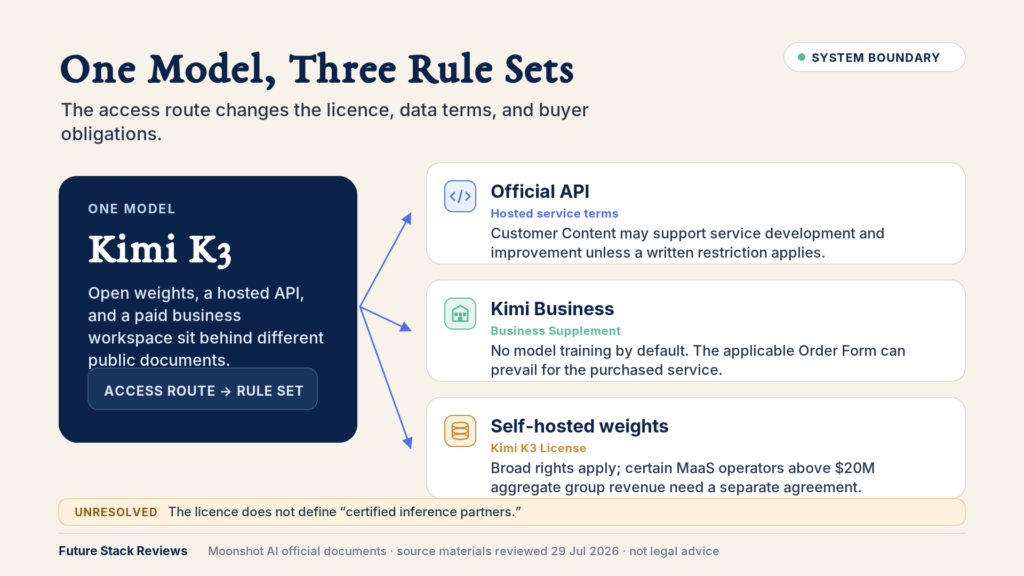
Most coverage of Kimi K3 treats it as one product with one price. Moonshot’s own documents do not. There are four ways to reach the model, each governed by a different instrument, and the differences between them are larger than the differences most buyers spend their evaluation time on.
The official API is the fastest route and the one the benchmarks were run on. It is governed by the Kimi OpenPlatform Terms of Service, last updated 27 May 2026, between the customer and Moonshot AI Pte. Ltd. in Singapore. Access requires a top-up. Throughput is set by how much has been topped up in total.
Kimi Business is a seat-based organization product at $599 per year per seat. It is governed by the general Terms plus a Kimi Business Supplement effective 1 June 2026, and the Supplement carries a content-use position the standard API terms do not.
A third-party host is now a real option, since the weights are published. What governs the relationship is that provider’s contract, not Moonshot’s. Two questions follow the buyer into that route, and both are covered in section 06.
Self-hosting puts the data path entirely inside the buyer’s control. Moonshot recommends serving K3 on supernode configurations of 64 or more accelerators, which sets the entry cost for that route well above a single node.
These are not tiers of the same product. They are different contracts with different defaults, and a decision taken on one route does not carry to another.
Sources: Moonshot AI, Terms of Service for Kimi OpenPlatform, 27 May 2026 · Moonshot AI, Kimi Business Supplement, effective 1 June 2026 · Moonshot AI, Kimi Business · Moonshot AI, Kimi K3: Open Frontier Intelligence. All opened 28 July 2026.
What the license requires at scale
Kimi K2 shipped under a file titled “Modified MIT License”. It is the standard MIT text with one paragraph appended, and that paragraph states that it is the only modification: products above 100 million monthly active users or above $20 million in monthly revenue must display “Kimi K2” in the interface.
Kimi K3 ships under a file titled “Kimi K3 License”. It is not MIT with an addendum. It is a rewritten grant with five numbered conditions, and the K2 attribution rule now appears third in that list.
The grant itself is wide. The license defines the Software to include the model weights, parameters, configuration files, inference and training code and documentation, and permits use, copying, modification, publication, distribution, sublicensing, sale, deployment, fine-tuning and derivative works. The conditions are where a reviewer’s time goes.
Clause 1 carries the attribution notice and adds a sentence MIT does not have: the licensee’s use of the Software must comply with applicable laws and regulations. Compliance with law is written as a condition of the grant rather than as a separate covenant. What that changes about a breach analysis is a question for counsel.
Clause 2 is new. It defines Model as a Service as giving a third party access to inference or fine-tuning in a way that lets that third party exercise meaningful control over inputs, parameters or training data, and it excludes two things: end-user products where model capability sits only inside specific features or harnesses, and the mere relaying of requests to models hosted by others. The trigger then requires two conditions together. The licensee or one of its affiliates must operate a Model-as-a-Service business as defined, and the aggregate revenue of the licensee and its affiliates must exceed twenty million US dollars over any consecutive twelve months. Where both hold, the licensee must enter a separate agreement with Moonshot before using the Software for any commercial purpose.
Two details survive summarizing badly, and most published summaries drop one of them.
The twenty million is measured on the licensee and its affiliates in aggregate, not on the Model-as-a-Service line. And revenue alone does nothing on its own: without a qualifying Model-as-a-Service business somewhere in the group, a company of any size can use K3 commercially under the license as written. Whether a particular endpoint meets the definition is the question a reviewer has to answer first, and the license gives the test rather than the answer.
Clause 4 exempts internal use, defined as use that does not make the Software, its outputs or its underlying capabilities available to third parties, and exempts use accessed through Moonshot AI’s official products or certified inference partners. The license does not define “certified inference partners”. No criteria, process or list appears in the license text.
Clause 5 disclaims warranties on an as-is basis and extends that disclaimer to any output and results from the Software.
What the document does not contain is also checkable. It sets no enumerated prohibited-use categories beyond the requirement to comply with applicable law. It restricts no field of use, contains no copyleft obligation, no restriction on training other models on K3 outputs, no export or sanctions clause, no termination-for-breach provision and no express patent grant. A legal reviewer will want each of those absences on the checklist rather than assumed either way.
Sources: Moonshot AI, Kimi K3 License (opened 28 July 2026) · Moonshot AI, Kimi K2 Modified MIT License (opened 28 July 2026) · Moonshot AI, Kimi K3 model card, section 7
What happens to your content
Moonshot publishes different content-use positions for the API, for Business and for the consumer service. A buyer should fix the route before deciding whether Kimi is suitable for proprietary code, customer records or internal documents.
On the standard API, the OpenPlatform Terms state that Moonshot may use Content to provide, maintain, develop, support and improve the Services. The same clause tells customers who require restrictions on the use of Customer Content for training or improving Moonshot’s models to contact Moonshot to discuss available enterprise arrangements or separate written agreements. It closes by stating that unless otherwise expressly agreed in writing, Customer Content may be used for the foregoing purposes.
That is a document-level default. It is not proof about what happens to any particular prompt, and it is not a legal conclusion about anyone’s rights. The practical consequence is narrow and worth stating plainly: paying for the API does not by itself produce a no-training position, and the route the terms describe for changing that runs through a written agreement rather than a setting.
On Kimi Business, clause 5.3 of the Business Supplement states that Moonshot will not use Customer Content submitted to, generated by or stored through the Business Services to train, optimize or improve its models, unless the customer provides express authorization or such use is required by applicable law. Clause 5.2 grants a license to host, process, transmit, display and otherwise use Customer Content as necessary to provide, maintain, secure, support and improve the Business Services, which is a narrower purpose than model improvement.
That is a contractual position, not a marketing statement, and it materially separates Business from the standard API.
It does not finish the procurement review. The Supplement says it supplements and forms part of an Agreement that can include the Terms of Service, Privacy Policy, Usage Policy, an Order, the online checkout page, product documentation, a data processing addendum and service-specific terms. It also states that where an Order conflicts with the Supplement, the Order prevails for the specific Business Services purchased under it. Clause 16 adds that governing law and forum are as specified in the applicable Order, and where the Order is silent, the forum falls back to the one determined under the general Kimi Terms of Service.
The buyer-facing consequence of those two provisions is straightforward. The published no-training clause is real, and the document that can override it is the one the buyer has not seen yet. A procurement file for this route should contain the Order, the data processing addendum, the Usage Policy and the product documentation the Supplement points to, not just the Supplement.
On the consumer service, the Terms of Service displayed on 28 July 2026 carry an effective date of 21 January 2026, name Moonshot AI Pte. Ltd. registered in Singapore, and state that content may be used to operate, maintain, improve and develop the Services. They then offer a mechanism the API terms do not: users may opt out of allowing their content to be used for model improvement and research purposes by contacting Moonshot at a stated address, and Moonshot states it will honour that choice in accordance with applicable law.
Two contract facts set the ceiling on all three surfaces. The OpenPlatform Terms and the consumer Terms both specify Singapore governing law, arbitration administered by the Singapore International Arbitration Centre with the seat in Singapore, a mandatory sixty-day negotiation period, and a requirement that claims be filed within one year. Liability is capped at twelve months of fees on the API, at the greater of twelve months of fees or one hundred US dollars on the consumer service, and at twelve months of fees for the Business Services giving rise to the claim under the Supplement.
Sources: Moonshot AI, Terms of Service for Kimi OpenPlatform, 27 May 2026, sections 4, 9 and 12 · Moonshot AI, Kimi Business Supplement, effective 1 June 2026, sections 5, 14 and 16 · Moonshot AI, Kimi Terms of Service, effective 21 January 2026, sections 3, 8 and 11 (opened 28 July 2026) · Moonshot AI, Kimi OpenPlatform Privacy Policy, 30 April 2025
The token price is the first line
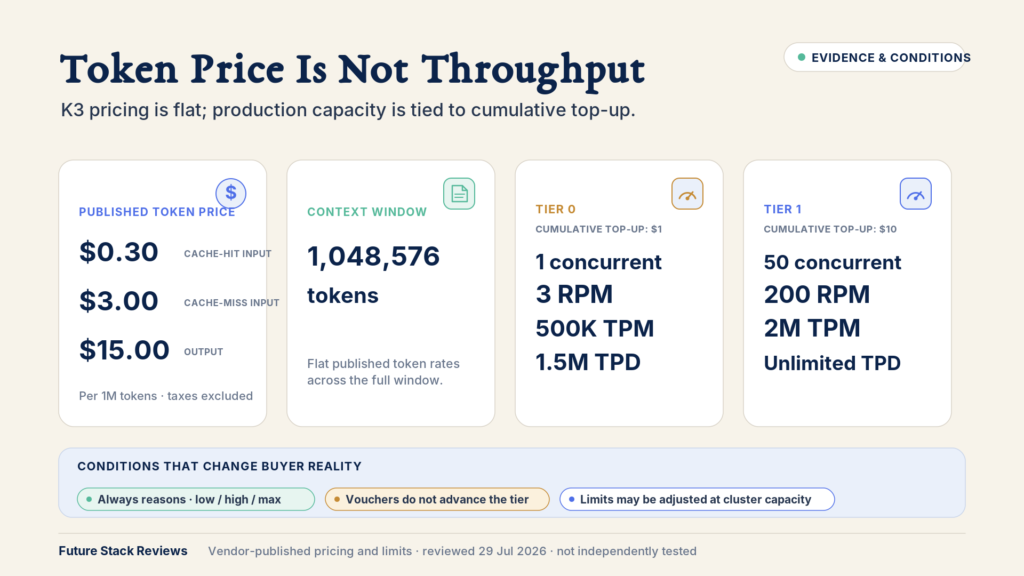
At $3.00 input and $15.00 output per million tokens, K3 carries a familiar sticker. Reading straight from that number to a cost comparison skips several things the platform documentation states.
Between the sticker and the bill
| Entry condition | K3 unlocks after a successful top-up of at least $1. There is no free API tier. |
| Throughput entitlement | Rate limits are set by cumulative top-up, not by current balance or by spend. Tier 0 at $1 allows one concurrent request, 3 requests per minute and 1.5 million tokens per day. Tier 3 requires $100 cumulative, Tier 5 requires $3,000. |
| Voucher exclusion | Vouchers do not count toward the cumulative total. Promotional credit can be spent, but does not raise the tier. |
| Capacity clause | Moonshot states it may temporarily adjust rate limits when cluster load reaches its capacity limit. |
| Reasoning tokens | K3 always reasons, and reasoning tokens bill at the $15.00 output rate. Whether the effort level can be lowered is answered differently by different pages. See section 05. |
| Cache condition | The 90 percent cache discount applies automatically, but a request can only hit the prefix cache when the previous request’s prompt exceeded 256 tokens. |
The tier ladder is keyed to money placed with the vendor rather than to money consumed. A team that needs 200 concurrent requests has to have topped up $100 cumulatively to reach that tier, whether or not it has used anything close to that. Planning throughput therefore means planning prepayment ahead of need.
Three published provisions govern what happens to the balance itself, and they sit in different parts of the terms. Fees are non-refundable except where law requires or Moonshot exercises its discretion, and billing disputes must be raised in writing within thirty days or the charge is deemed accepted. On account cancellation, any remaining balance is permanently deleted, and re-registering with the same entity does not restore it. Among the enforcement measures Moonshot reserves for violations of the agreement, exercisable without prior notice, is freezing and confiscating the recharged amount.
Each of those is ordinary for a prepaid developer platform. Together they are the reason a first top-up should be sized as an amount the team is willing to have tied up rather than as a float.
Sources: Moonshot AI, Flagship Model Kimi K3 Pricing (opened 28 July 2026) · Moonshot AI, Recharge and Rate Limiting (opened 28 July 2026) · Moonshot AI, Kimi K3 Quickstart (opened 28 July 2026) · Moonshot AI, Terms of Service for Kimi OpenPlatform, 27 May 2026, sections 3, 5 and 11
Which version of which document
The single most useful habit for evaluating Kimi K3 is to record which document version a decision was based on. Moonshot publishes a lot, publishes it in several places, and does not always update every place at once.
Reasoning effort. K3 always reasons, and reasoning tokens bill at the output rate, so whether the effort level can be lowered is a cost question. On 28 July 2026, FSR opened four Moonshot documents and found four different statements.
| Document | What it stated when opened |
|---|---|
| K3 API pricing page | reasoning_effort supported, “currently max only” |
| K3 quickstart guide | Supports low, high and max, default max |
| K3 launch blog | Launches at max effort, with low and high effort “to be introduced in subsequent updates” |
| K3 technical report, Appendix F | The chat template reserves low, medium, high and max, of which K3 supports “a subset” |
Each row quotes the named document as read on 28 July 2026. The pricing page was reopened later the same day and still read “currently max only”.
The launch blog describes the state at launch, so its position is expected to age. The pricing page and the quickstart are both current reference documentation and they do not agree. The report is the only source that names a fourth level and the only one that declines to say which are live.
The practical answer for a buyer is not to pick a winner from the documentation. It is to send one request at each documented value against your own account, record the response or the error, and build the cost model from that. Until then the effort lever should sit in the plan as an unknown rather than as a saving.
Benchmark figures. Moonshot published K3’s results in three places, and for several benchmarks the three do not carry the same number.
| Benchmark | Launch blog | Model card | Technical report |
|---|---|---|---|
| Toolathlon-Verified, Kimi K3 | 73.2 | 76.5 | 76.5 |
| GDPval-AA v2 Elo, Kimi K3 | 1668.0 | 1686 | 1686 |
| GDPval-AA v2 Elo, Claude Fable 5 | 1760.0 | 1747 | 1747 |
| Terminal-Bench 2.1, Claude Fable 5 | 84.6 | 88.0 | 88.0 |
| JobBench, Kimi K3 | 52.9 | 54.3 | 54.3 |
| JobBench, GPT-5.6 Sol | 46.5 | 45.4 | 45.4 |
Values as displayed in each artifact on 28 July 2026. On the rows shown, the model card and the technical report agree and the launch blog differs. The blog’s Terminal-Bench row also shows Claude Fable 5 and Claude Opus 4.8 carrying the same value, 84.6.
The differences do not all move in the same direction. On GDPval the later artifacts raise K3 and lower Claude Fable 5. On Terminal-Bench the later artifacts raise Claude Fable 5, which narrows K3’s margin. FSR located no erratum, evaluation-date log or version note reconciling the three.
Moonshot’s evaluation footnotes are more detailed than most vendor benchmark tables. They state which agent harness produced each score, and the harnesses differ between models. They disclose that the SWE-Marathon evaluation ran on an H20-calibrated branch of the official tasks with Docker images, performance gates and reference oracles recalibrated, and that PostTrainBench ran on H20 GPUs where the official setting is H100. They report competitor fallback and refusal counts. On Moonshot’s own PerceptionBench, the published table places GPT-5.6 Sol first and Kimi K3 second, in both the model card and the report. What the footnotes do not do is reconcile the numerical differences between the three artifacts.
For a buyer the operational point is simple. Cite a Moonshot benchmark figure with the artifact and the date attached, because Moonshot has published more than one value for several of them.
Sources: Moonshot AI, Flagship Model Kimi K3 Pricing · Moonshot AI, Kimi K3 Quickstart · Moonshot AI, Kimi K3 launch blog, Full Benchmark Table, Footnotes and Limitations · Moonshot AI, Kimi K3 model card, section 3 · Moonshot AI, Kimi K3 Technical Report, Table 2, section 6.1.3 and Appendix F · Moonshot AI, Introducing PerceptionBench. All opened 28 July 2026.
Self-hosting and third-party hosts
Moonshot has published the weights, the model card and deployment guidance. The model card gives 2.78 trillion total parameters with 104.2 billion activated, 93 layers, 896 routed experts with 16 active and 2 shared per token, a 160K vocabulary and MXFP4 weights with MXFP8 activations under quantisation-aware training.
The deployment guidance sits alongside it. Moonshot recommends supernode configurations of 64 or more accelerators, and gives the reason: at this sparsity, inference efficiency benefits from large high-bandwidth communication domains. That is a vendor recommendation rather than a tested floor, and FSR did not benchmark a smaller deployment. It does mean that for most organizations the near-term value of the open weights is provider choice and continuity rather than in-house serving.
Provider choice comes with a question Moonshot itself has raised. Alongside the Kimi Vendor Verifier project, released with Kimi K2.6, the company describes receiving community reports of benchmark anomalies after the K2 Thinking release, finding that a significant portion came from misused decoding parameters, then observing a stark contrast between third-party and official API results on one evaluation and finding the difference widespread across the infrastructure providers it tested. Its stated conclusion is that the more open the weights and the more diverse the deployment channels, the less controllable the quality becomes.
Those findings are from the K2 generation. Whether the same variance appears on K3 is not established by that document, and FSR has run no host comparison. What carries across is the method: a score measured on the official API is not automatically the score a given host will produce, and the vendor recommends verifying rather than assuming. A buyer selecting a third-party host should treat host identity as part of the evaluation and ask the provider directly whether it is a certified inference partner within the meaning of license clause 4(b), since the license does not publish that list.
Moonshot’s launch post also records three limitations for K3, and they matter for anyone deploying it as an agent. The first is sensitivity to thinking history: K3 was trained in preserved thinking history mode, and if an agent harness fails to pass back the historical thinking content, or if an ongoing session with another model is switched to K3, generation quality may become highly unstable. The second is excessive proactiveness: when K3 meets minor issues or ambiguous intent during execution, it may make unexpected decisions on the user’s behalf, and Moonshot suggests constraining it explicitly in the system prompt or in an AGENTS.md file. The third is a noticeable gap in user experience compared with Claude Fable 5 and GPT-5.6 Sol.
The technical report separately describes cyber-security evaluations. Moonshot reports that frontier models from Anthropic and OpenAI refuse cyber-related tasks, making comparable evaluation infeasible, and excludes them from that suite. It reports that roughly 70 percent of human-reviewed findings were confirmed genuine, including 16 previously unknown vulnerabilities across six projects, and that K3 solved 14 of 36 tasks on an in-house exploit suite against GLM-5.2’s 8. It attributes a joint assessment to the UK AI Security Institute and NIST’s Center for AI Standards and Innovation. Those are vendor statements. FSR did not open the cited assessment and did not reproduce any result.
Read next to the license, this produces a governance question rather than a conclusion. The weights carry no enumerated prohibited-use categories beyond the requirement to comply with applicable law, and the vendor’s own report describes capability in vulnerability discovery and exploit development. The documents do not state what relationship, if any, should hold between those two things. Organizations with an internal AI use policy should decide how that policy treats openly licensed weights before the question arrives attached to a project.
Sources: Moonshot AI, Kimi K3 model card, sections 2, 4 and 5 · Moonshot AI, Kimi K3 launch blog, Architecture and Infrastructure, Availability, Limitations · Moonshot AI, Rebuilding the Chain of Trust: Kimi Vendor Verifier · Moonshot AI, Kimi K3 Technical Report, Table 1 and section 6.2.2 · Moonshot AI, Kimi K3 License, clause 4. All opened 28 July 2026.
What FSR could not obtain
A briefing is only as useful as its account of its own gaps. The following were searched for on Moonshot’s own domains during this review and not located. That is a statement about a search, not proof that a document does not exist, and buyers should request each by name.
- A data processing addendum. The Business Supplement refers to one as a component of the Agreement, so a document appears to exist for that route. FSR did not retrieve it.
- A subprocessor list. Both privacy policies permit sharing with corporate affiliates without naming them or identifying their jurisdictions.
- A security certification, trust centre, status page or uptime commitment.
- A stated data residency option. The OpenPlatform Privacy Policy states that collected information is stored on secure servers located in Singapore, but describes no customer-selectable region.
- A general deprecation policy setting out a notice period, migration window or support commitment. Individual retirements are announced: the kimi-k2 series was discontinued on 25 May 2026, kimi-latest on 28 January 2026, and kimi-thinking-preview on 11 November 2025. A notice on the model list states that following the K3 launch, kimi-k2.5 and the moonshot-v1 series are no longer available to newly registered users, with full sunset on 31 August. Each retirement is published. The rule governing retirements is not.
- A definition or list of “certified inference partners” as used in license clause 4(b).
- The Order, Usage Policy and product documentation that the Business Supplement places above or alongside itself.
Two documentation dates are worth carrying into a vendor review. The OpenPlatform Privacy Policy is dated 30 April 2025 and is incorporated by reference into terms dated 27 May 2026, so the newer instrument imports the older one. The platform changelog, which describes itself as being updated periodically with product and documentation changes, shows a most recent entry dated 7 April 2025.
Sources: Moonshot AI, Kimi OpenPlatform Privacy Policy, 30 April 2025 · Moonshot AI, Platform Changelog (opened 28 July 2026) · Moonshot AI, Model List (opened 28 July 2026) · Moonshot AI, Kimi Business Supplement, introductory provisions
Questions buyers ask
Is Kimi K3 MIT licensed?
No. K3 ships under a bespoke document titled “Kimi K3 License” with five conditions. Kimi K2 shipped under a Modified MIT License with one added condition. Coverage published before the weights release that describes K3 as MIT or Modified MIT was extrapolating from K2.
Can a company use Kimi K3 commercially?
The licence charges no fee and permits commercial use, modification, distribution and sale. Two conditions attach at scale: a defined class of Model-as-a-Service operator above an aggregate revenue threshold must sign a separate agreement first, and products above 100 million monthly users or $20 million monthly revenue must display “Kimi K3”.
Does the $20 million clause apply to total company revenue?
The licence measures the threshold on the aggregate revenue of the licensee and its affiliates over any consecutive twelve months, not on Model-as-a-Service revenue. It only engages where the licensee or an affiliate also operates a Model-as-a-Service business as the licence defines it. Both conditions must hold.
Does the Kimi API use customer content for model improvement?
The OpenPlatform Terms state Moonshot may use Content to develop and improve the Services, and that unless otherwise expressly agreed in writing, Customer Content may be used for those purposes. Customers requiring restrictions are directed to discuss enterprise arrangements or a separate written agreement. No self-service switch is described.
Does Kimi Business train on organisation data?
Clause 5.3 of the Business Supplement states Moonshot will not use Business Customer Content to train, optimise or improve its models, unless the customer expressly authorises it or law requires it. The Supplement also states that an applicable Order prevails over it, so the Order should be read before relying on the clause.
Can Kimi K3 reasoning effort be reduced?
K3 always reasons. Four Moonshot documents state different things about whether the effort level can be set lower, and reasoning tokens bill at the $15.00 output rate. Test each documented value against your own account and build the cost model from the result rather than from the documentation.
Is there a free Kimi API tier?
No. K3 unlocks after a successful top-up of at least $1. Rate limits are then set by cumulative top-up rather than by current balance or spend, and vouchers do not count toward that cumulative total. The consumer app has a free tier; the developer platform does not.
Can Kimi K3 be self-hosted economically?
Moonshot recommends serving K3 on supernode configurations of 64 or more accelerators. That is a vendor recommendation rather than a measured floor, and FSR did not test a smaller deployment. For most teams the practical benefit of the open weights is provider choice rather than in-house serving.
How should a buyer evaluate a third-party K3 host?
Moonshot’s own Vendor Verifier post reports finding widespread differences between third-party and official API results on the K2 generation. Ask the provider whether it is a certified inference partner under licence clause 4(b), and re-run your own evaluation on the host you intend to use.
Methodology and limits
This is a Tier C briefing. FSR did not test Kimi K3, did not hold or purchase a paid plan, did not call the API and did not download the weights. Nothing here is a measurement.
Every statement above describes the content of a document FSR opened directly, or of a document supplied to FSR in full and read in full, on 28 July 2026. Where two Moonshot documents state different things, both are shown and neither is presented as correct. Where a document could not be retrieved, that is stated rather than filled in.
Three limits apply specifically to this briefing.
Documents at this vendor are mutable, and several changed during the research window. The K3 launch top-up rebate page carried both its original event end date of 12 August 2026 and a notice ending the campaign at 08:59:59 PDT on 29 July 2026, citing recent constraints in computing resources. Model availability notices describe a sunset in progress. Legal pages at other vendors have been observed to differ by region and account state, and FSR read these from a single vantage point. Reopen every linked source and check its stated date before relying on a figure here.
Consumer plan availability is a dated observation, not a standing fact. On 28 July 2026 at 15:10 JST, the Kimi membership pricing page displayed five tiers, Adagio at $0, Moderato at $19 per month or $180 per year, Allegretto at $39 or $372, Allegro at $99 or $948 and Vivace at $199 or $1,908, and all four paid tiers displayed a join-waitlist action rather than a purchase action. The same page carried a notice that a new membership system is coming, that existing subscribers are unaffected, that anyone wanting the combined benefits should purchase before the new system starts, and that the new system will sell Kimi and Kimi Code benefits separately, with no start date published. The comparison table marked K3 extra-long chat capacity of up to one million tokens as available on Allegro and Vivace only. Plan display can vary by region, currency and account state, and this was one observation from one vantage point at one moment.
Independent verification was not performed. Benchmark results, cyber-security findings and the joint assessment attributed to the UK AI Security Institute and NIST CAISI are vendor statements reported here as such. FSR reproduced none of them and did not open the cited assessment.
Statements about legal effect, compliance, adequacy or enforceability appear nowhere in this briefing. Questions raised here about jurisdiction, transfer or contract structure belong with the reader’s own counsel.
Primary documents read for this briefing: Kimi K3 License; Kimi K2 Modified MIT License; Kimi K3 model card; Kimi K3 Technical Report; Kimi K3 launch blog; Kimi K3 API pricing; Kimi K3 quickstart; Recharge and Rate Limiting; Model List; Platform Changelog; Kimi K3 Launch Top-Up Rebate; Terms of Service for Kimi OpenPlatform; Kimi OpenPlatform Privacy Policy; Kimi Terms of Service; Kimi Privacy Policy; Kimi Business Supplement; Kimi Business; Kimi membership pricing; Kimi Vendor Verifier; PerceptionBench.
Verdict
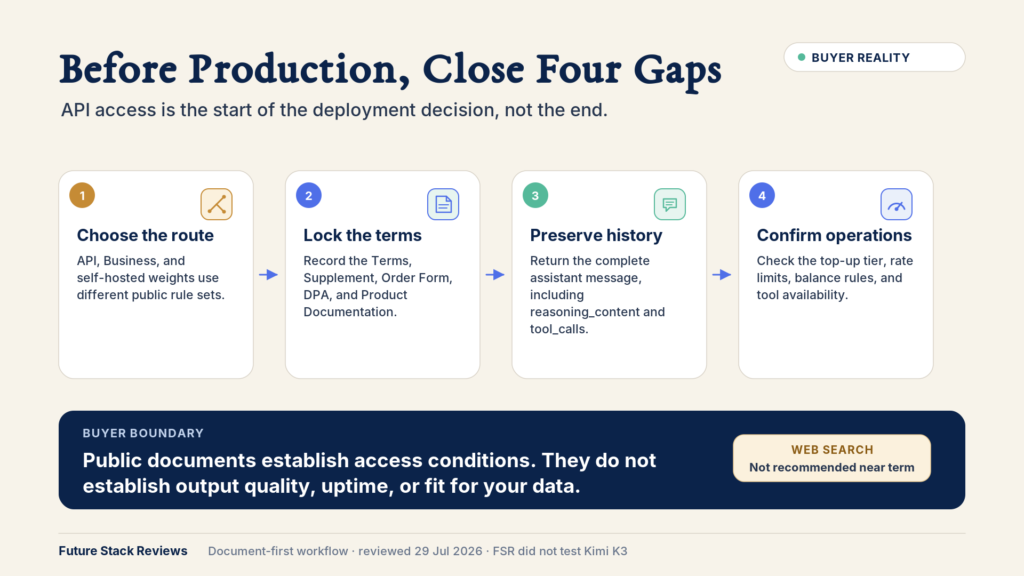
There is no single answer for Kimi K3, because there is no single Kimi K3. The recommendation depends on the route.
Official API. Suitable for evaluation now, with non-sensitive test data. The published content-use default permits use of Customer Content for service development and improvement absent a written agreement, so proprietary code and customer records should wait until a restriction is agreed in writing. Size the first top-up as an amount you are willing to have tied up, and resolve the reasoning-effort question against your own account before building a cost model.
Kimi Business. The stronger published data position, because the no-training default sits in an agreement rather than on a product page. It is not a finished procurement package. Ask for the Order, the data processing addendum, the Usage Policy and the product documentation before the pilot rather than after, and read the Order first, since the Supplement states the Order prevails over it.
Third-party host. Viable, and the reason open weights matter for buyers who will never run 64 accelerators. Treat host identity as part of the evaluation rather than a detail beneath it, ask whether the provider is a certified inference partner within the meaning of the license, and re-run your own tests on the host you intend to use.
Self-hosting. Justified where data-path control, fine-tuning or extreme volume make the infrastructure defensible. The license permits it broadly, and the constraint is the recommended serving configuration rather than the terms.
Across all four, one habit does more than any other. Record the artifact and the date behind every figure you carry into a decision. Moonshot has published more than one value for several of its own benchmarks and more than one answer on at least one live product question, and a buyer who cites a page without a date can be quoting a version the vendor has already moved past.
Related FSR briefings
Tier B = hands-on tested. Tier C = document-first, no hands-on testing.
-
Tier B
Another open-weight release where the licence, not the benchmark, decided who could actually use it.
-
Tier C
Kimi K3, the Distillation Allegation, and the Contract Question a Buyer Can Actually Resolve
The same model, the question this briefing leaves out: what a buyer can settle from documents while the allegation stays open.
-
Tier C
Claude Fable 5 Pricing: Anthropic Tells You the Token Price, Not What Your Plan Includes
The same gap between a published token price and what a plan actually entitles you to, at a different vendor.
-
Tier C
Grok 4.5 at Launch: Choose the Access Path Before the Model
The route-before-model argument applied to a different launch, where the access path decided the outcome.
-
Tier C
Gemini CLI Was Open Source. The Access Was Not
Open licensing and open access are separate questions, as they are for K3’s downloadable weights.