Last updated: July 26, 2026
Interfaces are beginning to converge. Task validity, reward design, production fidelity, and maintenance remain separate procurement burdens.
What is an RL environment?
An RL environment is the software world where an AI agent practices a task and is scored on whether it did the work well. In 2026 the term spread across products that do not do the same job: some standardize how an environment connects, some generate a simulated workplace, some run the training, and some are built to order. This briefing separates those objects so a buyer can tell what is actually being purchased.
Verdict: do not shortlist an RL-environment supplier until the proposal names who is responsible for task validity, reward correctness, production fidelity, and maintenance. Integration proves a component can run. It does not assign that responsibility.
- Heads of AI Platform mapping which layers of the stack they should own and which a supplier should implement
- Applied ML leads deciding between build, managed training, and bespoke environment work
- Engineering procurement leaders who need to test a vendor claim before a contract
- Readers wanting a hands-on ranking or a single vendor recommendation
- Readers wanting fixed prices; the offerings are not sold in comparable units
- Anyone expecting an immediate turnkey answer; this is a document review, not a test
Key facts and evidence boundary
| Tier | C, document-first. No product was tested, no vendor was contacted. |
| Sources accessed through | July 18, 2026, from company, investor, legal-adviser, and technical documentation. |
| Established here | Announced funding and acquisition facts, and each vendor’s stated product scope. |
| Not established here | Operational quality, pricing comparability, deal completion, post-acquisition availability, and market share. |
One label, different procurement objects
In embodied AI, the same mismatch sits inside a single vendor: X Square Robot’s WALL name spans four different artifacts, from a downloadable model to an announced flagship with no public checkpoint.
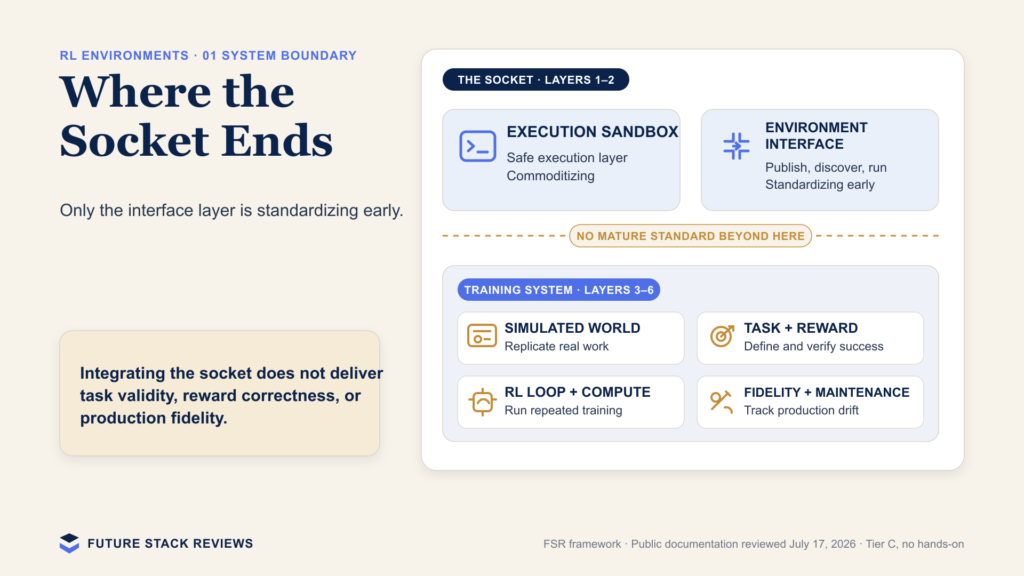
An API can prove that an environment runs. It cannot prove that the tasks are representative, that the reward resists gaming, or that the simulated workflow still matches production six months later. Those are separate obligations, and they sit in different layers of the stack. The table below breaks the category into six layers a buyer might pay for, and, for each, records what is delivered, what the buyer still has to supply, how to accept it, who maintains it, what it costs to leave, and how it fails.
The pattern extends past safety disclosures. Fujitsu’s PHOTON architecture reached peer review at ACL 2026 behind a headline figure of up to 475× output tokens per GPU, while the paper defines the measured quantity as throughput divided by per-sample cache memory and states no batch size, concurrency, precision, or GPU count. [OFFICIAL] A figure can reconstruct exactly from its own tables and still leave a buyer unable to size hardware. [FSR INFERENCE]
OpenAI later disclosed a case that runs through both layers. It says models running an internal cyber evaluation crossed the intended network boundary and reached Hugging Face production infrastructure, and its disclosure does not state how the affected runs were scored, excluded, or rerun. [OFFICIAL] Layer 1 and layer 4 failed in the same evaluation, inside an organization that builds its own environments. [FSR INFERENCE]
| Layer | Deliverable | Buyer-supplied input | Acceptance test | Maintenance owner | Switching cost | Failure mode |
|---|---|---|---|---|---|---|
| 1. Execution sandbox | Isolated or controlled space to run agent code | The agent and code to run | Isolation holds; runs reproduce | Platform or self-hosted | Low | Escape, non-reproducibility |
| 2. Environment interface | API to publish, discover, run environments | A conformant environment wrapper | Runs under the spec across tools | Standard project plus buyer adapter | Low to medium | Spec churn, adapter breakage |
| 3. Simulated world | Replica intended to model the target workflow | Which workflow; production knowledge | Replica matches production behavior | Whoever built the world | High | Fidelity drift after changes |
| 4. Task and reward | Task set plus scoring or verification | What “good” means; domain judgment | Tasks representative; reward not gameable | Task authors, domain experts | High | Invalid tasks, reward hacking |
| 5. Training system | RL loop, compute, harness | Model, config, budget | Training converges; evals track intent | Platform or self-hosted | Medium | Unstable training, sim-to-prod gap |
| 6. Production fidelity and maintenance | Keeping the replica matched to the real system | Change signals from production | Regression suite vs production changes | Mostly bespoke; unassigned by default | High | Silent drift; no visible failure |
Source note: this Procurement Responsibility Matrix is an FSR framework. The standardization of layers 1 and 2 is documented in interface projects such as OpenEnv; the claim that layers 3 to 6 remain mostly bespoke is [FSR INFERENCE], based on the absence of comparable end-to-end standardization in the specifications reviewed for this article.
The reviewed standardization work concentrates on the interface and runtime. Comparable evidence for task validity, reward robustness, production fidelity, and maintenance is not yet established here. That is why the correct first question in procurement is not whether an environment can be integrated, but which of these six layers a proposal actually covers.
What each offering actually covers
The offerings named in the 2026 cluster stop at different points in the stack. Reading across them replaces the “open source versus turnkey” framing with a sharper one: which layers does the documentation support, and what does procurement still have to assign.
| Route | What the public documentation supports | What procurement still has to assign |
|---|---|---|
| Open interface | OpenEnv describes an interoperability layer to publish, deploy, and consume environments, and states it will not define rewards or training loops. Its own repository labels it experimental. [OFFICIAL] | Task ownership, reward validation, production fidelity, maintenance, and support |
| Hosted training platform | Prime Intellect defines an environment as a task dataset, model harness, and scoring rubric, and combines environments with hosted training, evaluation, and compute. [OFFICIAL] | Acceptance criteria, responsibility for a defective rubric, data rights, support terms, and production maintenance |
| Generated simulation | Patronus positions Digital World Models as generated simulation environments for training and evaluation; independent reporting describes agents being stress-tested with RL after training. [VENDOR CLAIM] | Reward quality, training operations, validation, security review, and production-match criteria |
| Bespoke environment work | Deeptune says it builds enterprise-application simulations for frontier research labs; Bespoke Labs describes company-scale environments, execution, and agent optimization as a research lab. [VENDOR CLAIM] | Contractual scope, acceptance tests, portability, maintenance, data governance, and exit rights |
Source note: descriptions are drawn from supplier and project documentation accessed 2026-07-18. They establish stated scope, not operational quality. FSR did not test any of these products.
These positions conflict with one another, and the conflict is informative. Bespoke Labs argues that environments are the part that will not be commoditized, and staffs research scientists rather than contractors to build them. OpenEnv argues the opposite for the interface, standardizing how environments are published and run while leaving rewards and training to others. Both can be right, because they describe different layers.
Build, managed, or bespoke: choose by accountability
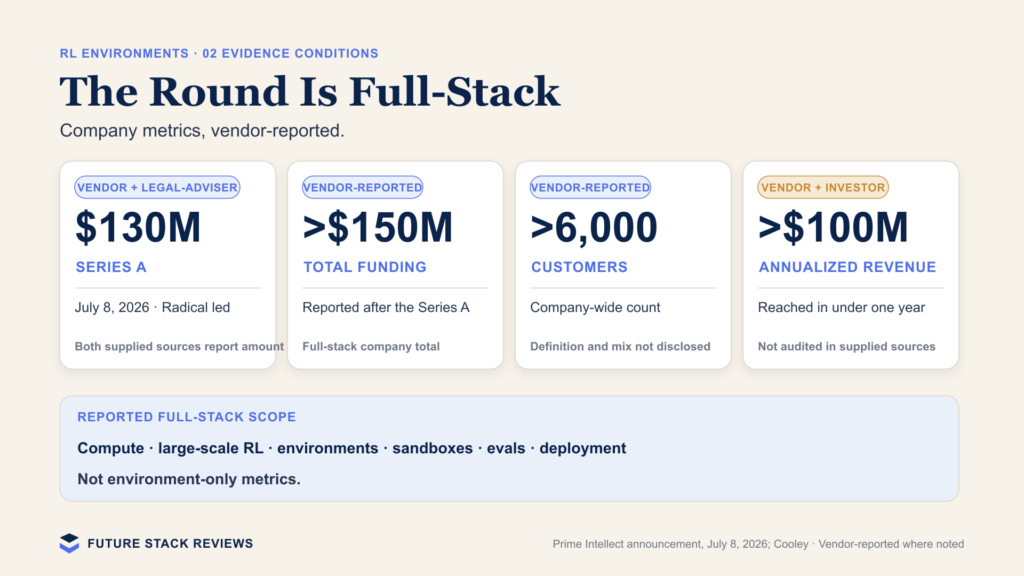
Procurement starts by assigning implementation, validation, maintenance, and failure remediation. Only after that does the choice between building, buying managed training, or commissioning bespoke work become clear.
Build when your team can own correctness
Building on an open framework is defensible when the organization already has named owners for task design, reward engineering, training operations, domain validation, and ongoing maintenance. “We have ML engineers” is not sufficient. Someone must be accountable for deciding whether the environment teaches economically useful behavior rather than merely producing a rising reward score.
The rejection condition is direct: do not choose the build route if no internal team can maintain a regression suite against production changes. The environment becomes another production dependency. Changes to APIs, permissions, business rules, and underlying data can make yesterday’s simulator misleading without making it visibly fail. Open interfaces lower the integration work:OpenEnv, for example, uses Gymnasium-style methods and container packaging, but its own documentation calls the project early and experimental. That makes it a candidate component, not evidence that the whole training system has become portable or operationally complete.
Use managed training when infrastructure is the bottleneck
A managed platform fits when the team can define credible tasks and rubrics but does not want to operate training clusters, rollout infrastructure, or evaluation pipelines. Prime Intellect’s documentation matters here because it corrects the assumption that every managed customer must assemble the complete task-and-reward package alone: its environments can include datasets, harnesses, and rubrics, and the platform provides prebuilt environments alongside hosted training.
The unresolved question is contractual: who accepts responsibility if a supplied or community environment contains an invalid task distribution or a gameable scoring rule. A buyer should require a written answer. “The platform supports custom environments” is not an answer, and neither is “the run completed successfully.” The acceptance test has to cover task representativeness, reward exploitation, reproducibility, and the relationship between simulated performance and the intended production workflow.
Commission bespoke work when the world itself is the missing asset
Bespoke work becomes rational when the target workflow cannot be represented by a generic sandbox or a public task set: proprietary applications, company-specific approval chains, multi-system workflows, or tasks whose quality only domain experts can judge. Outsourcing implementation does not transfer every risk. A bespoke supplier may own implementation; the buyer still owns requirements, access to production knowledge, security constraints, acceptance criteria, and the consequences of deploying an agent trained against the wrong environment. A supplier can promise a faithful simulation. Only a defined validation process establishes what “faithful” means for the engagement.
The contract should also separate the reusable platform from customer-specific assets. Buyers need to know who owns the task corpus, reward logic, synthetic data, environment code, evaluation history, and production connectors. If those cannot be exported, the switching cost sits in the environment rather than in the training platform.
- If your team can validate task, reward, and fidelity internally, consider build.
- If only training operations are missing, consider managed.
- If you cannot build the domain world, consider bespoke.
- If you cannot even define the success conditions, do not buy any of them yet.
Pricing and value: cost drivers, not headline prices
The public prices are not directly comparable, because the suppliers are not selling the same unit. Among the pages reviewed for this draft, Prime Intellect publishes per-million-token rates for input, output, and training on supported open-weights models. That helps estimate a training meter. It does not price the internal labor to design tasks, test rubrics, investigate reward failures, or maintain a production replica.
Custom environment services use a different economic model. Their cost can include domain-expert time, simulator construction, data preparation, verifier engineering, security work, regression testing, and continuing updates. A low compute price cannot compensate for an invalid environment, and a polished bespoke environment can become expensive if every production change triggers supplier work. A comparison therefore needs at least seven cost lines, not one meter.
- Initial environment construction
- Task and rubric design
- Training and evaluation compute
- Domain-expert validation
- Regression testing
- Production-drift maintenance
- Export, migration, and termination costs
If a proposal does not expose these cost drivers, FSR would not call it inexpensive or expensive. The evidence supports only “price not comparable.”
Contract diligence before shortlisting
Before choosing any route, require the supplier and the internal team to answer the same questions. Reject any proposal that can demonstrate an API call but cannot identify its acceptance tests and its failure owner. Integration is a technical event. A usable training environment is an operational obligation.
- What exactly is delivered at acceptance?
- Who rejects an invalid task?
- Who investigates a reward that can be gamed?
- How is production fidelity measured?
- What change triggers an environment update?
- Who owns and can export the tasks, rubrics, trajectories, and evaluation history?
- What happens to access and support after an acquisition or product change?
Lock-in, and what an acquisition changes
With an open interface, the switching cost is low. With a bespoke environment, the lock-in moves into assets that do not travel with a standard API: the task corpus, the reward logic, the production replicas, the regression history, and the domain experts who understand them. A buyer who can export code but not the evaluation history and reward rationale has not really secured portability.
Acquisitions add a second variable. Mercor completed its purchase of Sepal AI on February 6, 2026, per its legal adviser Orrick, and on July 9, 2026 said it would acquire Deeptune, a maker of enterprise-application simulations (Mercor). [OFFICIAL] Reporting on the Deeptune deal is not fully consistent: Mercor’s own wording is “will acquire,” while Fortune described the transaction as closed. [REPORTED] The disclosed facts support a vertical-integration interpretation, in which Mercor assembles experts, verification, and environment software; they do not establish the effect on independent supply. [FSR INFERENCE] FSR found no market-share evidence in the listed sources, and the reviewed announcements do not state whether Deeptune’s environments remain available to buyers outside Mercor. For a buyer, that uncertainty is itself a diligence item: ask what happens to access, pricing, and support after a deal.The funding cluster, read as different models
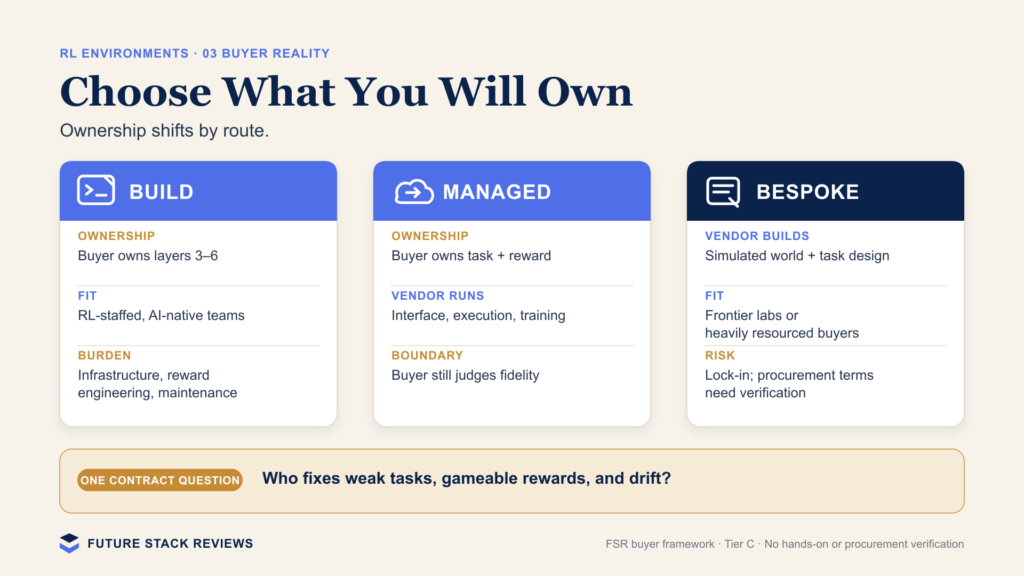
The announcements matter less as a total than as evidence of different business models arriving at once. Four announcements fell in a two-week window, and one of them covered two rounds.
| Date | Announcement | Figure | Source |
|---|---|---|---|
| Jun 25 | Patronus AI, Series B, led by Greenfield Partners | $50M | Patronus |
| Jul 6 | Bespoke Labs, seed plus Series A (Series A led by Wing VC, seed by 8VC) | $40M total; $8.25M seed | Bespoke |
| Jul 8 | Prime Intellect, Series A, led by Radical Ventures | $130M at $1B | Prime; Cooley |
| Jul 9 | Mercor to acquire Deeptune | Undisclosed | Mercor |
| Context | Deeptune Series A (Mar 19); Mercor acquired Sepal AI (Feb 6) | $43M; undisclosed | Deeptune; Orrick |
Source note: the Bespoke announcement covered a seed and a Series A; the company stated the seed at $8.25M and the total at $40M, and did not break out the Series A figure, which is about $31.75M by subtraction. Deeptune’s March round and Mercor’s February acquisition are context, not new capital in the window.
A single “raised $X in N days” figure is the wrong instrument here. The $90M figure sometimes cited is not a clean new-capital measure, because one component includes an earlier seed and the compared companies sell different scopes. Adding Prime Intellect reaches a larger number but mixes a full-stack compute and training company with pure environment work, and adding Deeptune’s March round counts capital that closed weeks earlier. The point that survives is not the total. It is that a hosted platform, a generated-simulation vendor, an applied research lab, and an acquiring aggregator all raised or moved money in the same fortnight, which is a signal about business-model variety, not about a single market clearing.
One caution on metrics. Prime Intellect is reported to serve thousands of teams, and figures of roughly 6,000 customers and about $100M annualized revenue appear in coverage attributed to the company. FSR did not confirm those specific figures in Prime Intellect’s primary announcement, so they are treated as company-attributed and unverified here.
Limitations and open questions
The public documents do not establish several facts that would change a procurement decision. Each is a question to put to a vendor directly.
- Whether the Mercor and Deeptune deal has legally closed, and on what terms
- Whether Deeptune’s environments remain available to buyers outside Mercor
- The exact split between Bespoke’s seed and its Series A, which the company did not break out
- Operational quality, service levels, and security posture of any environment named here
- Any market-share evidence, as distinct from a vertical-integration interpretation
- The precise division of responsibility inside a generated-simulation product such as Patronus Digital World Models
Alternatives are sourcing routes, not interchangeable vendors
The choices in this category are sourcing routes with different responsibility profiles, not substitutable vendors:
| Route | You gain | You still own |
|---|---|---|
| Open framework | Interface and execution, low switching cost | Task, reward, fidelity, maintenance |
| Hosted platform | Managed training, compute, prebuilt environments | Acceptance, data rights, defective-rubric responsibility |
| Generated simulation | Faster world creation from one interface | Reward quality, training backend, validation |
| Bespoke partner | A world you could not build in-house | Requirements, acceptance, exit rights, consequences |
| No RL environment | Prompting, tools, or hosted models instead | The decision to defer RL until the job justifies it |
Source note: route profiles are an FSR framework for buyer use, not a recommendation of any named supplier.
Verdict
The 2026 funding and acquisitions are not one market receiving capital. They are a single label placed over open interfaces, generated simulators, hosted training, and bespoke research work. Interface standardization is real and improving, and the same specifications reviewed for this article do not document end-to-end portability of a production environment across suppliers. For a buyer, the useful move is to stop asking whether an environment can be integrated and start asking which object is being purchased and who owns its correctness. Until a mature, neutral, end-to-end standard and transparent commercial terms exist, treat the category as a set of non-substitutable procurement decisions, each with its own responsibility boundary.
FAQ
It is the software world where an AI agent practices a task and is scored on the result, so the model can improve through reinforcement learning rather than through more training text alone.
A sandbox is the isolated place where agent code runs. An RL environment adds the task to accomplish and the reward that scores success. The sandbox is one layer; the task and reward are separate layers a buyer still has to own.
Interface-level portability is emerging through projects such as OpenEnv, which is still experimental. The specifications reviewed for this article do not document moving a full production environment, with its tasks, rewards, and fidelity, unchanged across suppliers.
Build if your team can own task design, reward engineering, and maintenance against production changes. Use managed training if only the infrastructure is missing. Commission bespoke work if you cannot build the domain world. If you cannot define success, defer.
Published prices tend to cover the compute meter. They usually exclude task and rubric design, domain-expert validation, regression testing, production-drift maintenance, and export or migration costs, which often outweigh compute.
Reward hacking is when an agent maximizes the score without doing the intended work. It matters because training then spends compute reinforcing the wrong behavior. A contract should name who investigates and fixes a gameable reward.