Last updated: July 13, 2026
Grok 4.5 is SpaceXAI’s coding and agentic model, released on 8 July 2026 and trained jointly with the code editor Cursor [1, 6]. It reaches buyers through three routes: the direct xAI API, the Grok Build command-line agent, and Cursor [1, 3, 6]. Those routes differ in price, usage limits, data handling, contract, and version control, so the access path, not “Grok versus another model,” is the first purchase decision.
Key facts at a glance
| Item | Public documentation, as of 12 July 2026 | Evidence boundary |
|---|---|---|
| Launch | SpaceXAI and Cursor announced Grok 4.5 on 8 July 2026 [1, 6] | Vendor announcement |
| Direct xAI API price | 500K context; $2.00 input, $0.50 cached input, $6.00 output per 1M tokens [2, 3] | Volatile; recheck before publish |
| Priority route | Priority Processing bills 2x standard token rates when priority is delivered [2] | Different from Cursor’s fast variant |
| Cursor | Included on paid plans with qualitative usage language; fast variant listed at $4 input / $18 output [6] | No numeric Grok allowance on the public page |
| Long context | xAI says requests above 200K use a different rate [3] | The rate is not shown on the model page |
| Efficiency claim | About 15,954 output tokens per SWE-Bench Pro task, roughly 4.2x fewer than xAI’s Opus 4.8 figure [1] | Vendor comparison; not independently matched |
| FSR evidence level | Document-first only | No hands-on test or benchmark |
- One brand, three control planes
- The $2 / $6 rate is not a workload budget
- What the benchmarks establish, and what they do not
- Three data paths, one privacy question
- Europe and regions: four different facts
- The procurement checklist
- Which surface fits which team
- Alternatives by buyer constraint
- FAQ
- How we checked this
- Sources and change log
One brand, three control planes
The first buying decision is direct xAI API versus Grok Build versus Cursor. The routes share a brand, but they do not give a buyer the same price, the same usage visibility, the same data path, or the same contract.
On the direct API, the price is straightforward: $2.00 per million input tokens, $0.50 for cached input, and $6.00 for output, with a 500,000-token context window [2, 3]. The model page lists the aliases grok-4.5-latest and grok-build-latest [3]. xAI’s enterprise terms name X.AI LLC as the contracting party for the API and related business services [11].
Grok Build is harder to pin down as a commercial object, and the ambiguity is worth stating plainly because it can distort a price comparison. xAI’s launch page says Grok 4.5 is the default model in Grok Build [1]. The same pricing catalog that lists grok-4.5 also lists a separate Code API model named grok-build-0.1, with a 256K context window and rates of $1 input, $0.20 cached input, and $2 output per million tokens [2]. The Grok 4.5 model page then lists grok-build-latest as an alias [3]. These pages may describe different layers of one product, but the public documentation does not give a buyer a clean mapping among the Grok Build agent, grok-4.5, grok-build-latest, and grok-build-0.1. A team should not assume Grok Build inherits the raw grok-4.5 price and context, and should not assume it bills at the cheaper grok-build-0.1 line, without confirming which identifier its invoice uses.
Model page: grok-4.5, 500K context, aliased as grok-4.5-latest and grok-build-latest.
Pricing catalog: a separate Code API model grok-build-0.1, 256K context, $1 / $0.20 / $2.
Buyer action: confirm in writing which identifier your Grok Build usage bills against before you model its cost. The reviewed public pages do not resolve this.
Cursor is the third control plane. Its launch post says paid individual and team subscriptions include significant Grok 4.5 usage and lists a fast variant at $4 input and $18 output per million tokens [6]. That $4 / $18 figure is Cursor’s, and it is a different mechanism from xAI’s Priority Processing. Cursor’s public plan language describes the allowance qualitatively and then allows on-demand billing after included usage is consumed [6]. It does not publish a Grok-specific numeric allowance, how retries consume it, or whether the fast route draws from the same pool.
Our full Cursor review breaks down how the advertised $20 plan trends toward roughly $60 in daily agent use, and how bring-your-own-key requests still route through Cursor’s own infrastructure.
The access-path matrix
| Surface | Model or SKU actually referenced | Contracting party | Base price | Numeric quota visible | Long context | Data route | Serving region | Version pinning |
|---|---|---|---|---|---|---|---|---|
| Direct xAI API | grok-4.5 (aliases grok-4.5-latest, grok-build-latest) [3] | X.AI LLC [11] | $2 / $0.50 / $6 per 1M [2] | Yes, per token | 500K; different rate above 200K [3] | xAI API terms; no training without permission [4] | us-east-1, us-west-2 [3] | Alias exists; fixed dated ID not confirmed [3] |
| Grok Build | Grok 4.5 default; grok-build-0.1 also listed separately [1, 2] | X.AI LLC (assumed) [11] | Not clearly mapped in public docs [1, 2, 3] | Not documented in this review | Depends on the billed identifier | Not separately documented in this review | Not separately documented | Not documented |
| Cursor | Grok 4.5 via Cursor; provider routing applies [6, 7] | Anysphere, plus model-provider dependencies [7, 8] | Plan-bundled; fast variant $4 / $18 [6] | No public numeric Grok allowance [6] | Follows API; plan accounting unclear | Cursor backend; Privacy Mode governs training and retention [7] | Depends on Cursor and its providers | Managed by Cursor |
The reader who approves only the model name has not finished the review. The surface, plan, privacy mode, provider route, region, and terms still need to be named.
The $2 / $6 rate is not a workload budget
The standard API rate is competitive, and the efficiency claim has support. xAI reports 15,954 output tokens per SWE-Bench Pro task, about 4.2 times fewer than its Opus 4.8 comparison [1]. Independent testing by Artificial Analysis also found Grok 4.5 in the Grok Build harness used fewer tokens than several competing coding-agent systems [9]. That evidence supports an efficiency case inside the harnesses that were measured. It does not produce a production budget on its own.
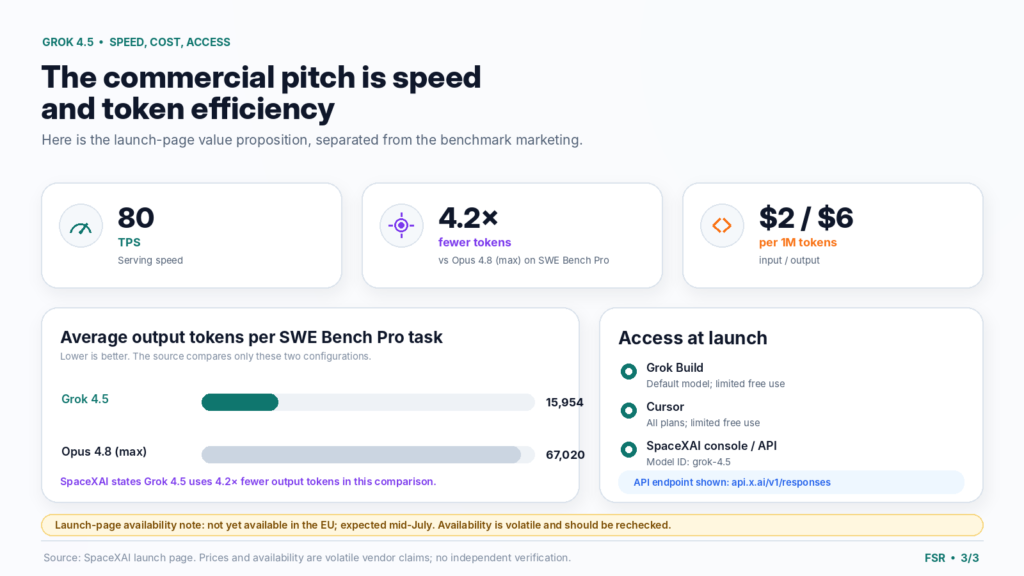
Four cost layers sit above the sticker price. Priority Processing doubles input, cached, reasoning, and output rates when priority service is delivered [2]. Server-side tools add per-invocation charges [2]. Requests above 200K context use a rate the model page references but does not show [3]. Grok 4.5 does not appear in xAI’s batch-discount table [2]. On top of those, failed runs, retries, human repair, and Cursor’s on-demand overage are workload-specific and are not in any rate card.
What the benchmarks establish, and what they do not
“Opus-class,” the phrase Elon Musk used, has no published equivalence definition, so it is positioning rather than a measurement [1]. The vendor’s own chart is more specific and more mixed. On the five engineering benchmarks xAI showed at launch, its chart puts Anthropic’s Fable model ahead on four (DeepSWE 1.0, DeepSWE 1.1, Terminal-Bench 2.1, and SWE-Bench Pro) and Grok 4.5 ahead on one, SWE Marathon [1]. A reader who takes away only “Grok wins” or only “Grok loses” has misread a split result.
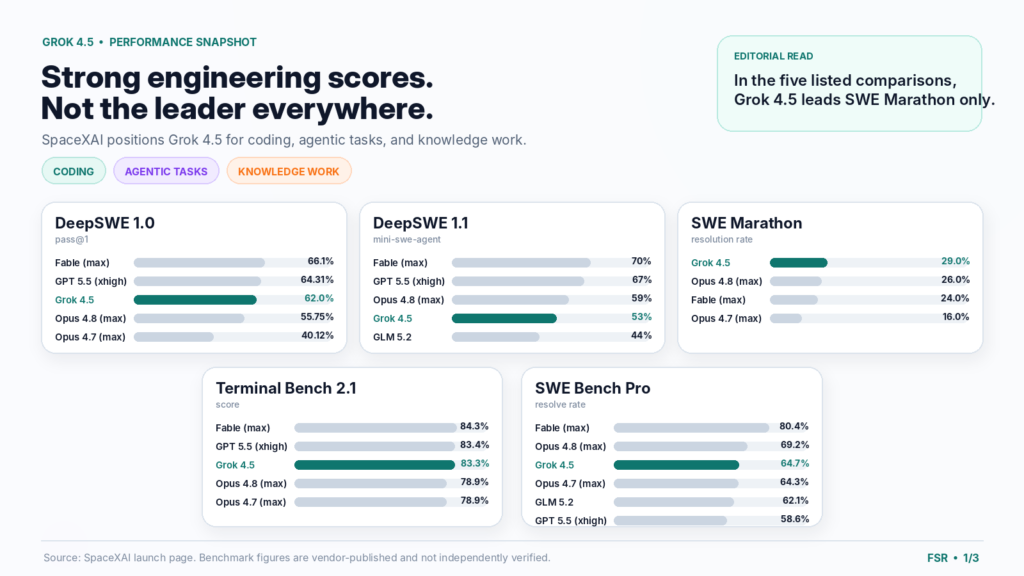
| Evidence | Source | What it measures | What it establishes | What it does not |
|---|---|---|---|---|
| Five-benchmark chart | xAI launch page [1] | Provider-run agent harnesses | Grok 4.5 is competitive on engineering tasks | Neutral, matched-harness parity |
| Token-efficiency figure | xAI launch page [1] | Output tokens per SWE-Bench Pro task | Lower token use inside xAI’s test | Cost per accepted task in production |
| Coding-agent index | Artificial Analysis [9] | Grok Build as a system | Efficiency of the Grok Build harness | Raw-model behavior outside that harness |
| CursorBench | Cursor disclosure [6] | Cursor-specific benchmark | That the figure is unreliable and was excluded | That other benchmarks are contaminated |
Two caveats close the section. Cursor disclosed that an earlier snapshot of its own codebase was accidentally included in training, that this gave Grok 4.5 an advantage on CursorBench, that the impact was unclear, and that it therefore excluded that benchmark [6]. That makes the CursorBench figure unusable; it is not evidence that the other benchmarks are contaminated. Separately, Artificial Analysis scored the model at 54 on its Intelligence Index and placed it fourth at launch [9]. Rank on that index moves as new models are added, so a launch position is a dated snapshot, not a fixed property.
Three data paths, one privacy question
The data boundary changes with the access path, and Cursor’s own documentation is what establishes the difference.
On the direct API, xAI states that it does not train on API inputs or outputs without explicit permission, that ordinary API data is kept 30 days for abuse auditing and then deleted, and that an enterprise Zero Data Retention option processes requests without persisting them [4]. It states that the platform is SOC 2 Type 2 compliant and that a business associate agreement is available for regulated health data [4]. These are vendor statements, not independent audits, but they are documented.
Through Cursor, the picture differs. Cursor states that even when a customer supplies their own API key, requests still pass through Cursor’s backend, where final prompt construction happens [7]. With Privacy Mode on, Cursor does not use customer data for training and maintains zero-data-retention agreements with providers, with an exception if abuse detectors trigger [7]. With Privacy Mode off, Cursor states it may use codebase data, prompts, editor actions, and code snippets to improve and train models, and may share prompts and limited telemetry with the selected provider [7]. Code indexing and temporary caching add further processing stages [7]. Grok Build’s end-to-end data path is not documented in the same detail in the pages reviewed here, so it should be confirmed separately rather than assumed identical to the raw API.
For European buyers, one more document matters. xAI published a training-content summary for Grok 4.5 in the format the EU AI Act uses for general-purpose models. It reports more than 10 trillion text tokens plus image, audio, and video data, drawn from public, licensed, third-party, synthetic, and user and contractor sources, and it states that interactions with Grok may be used for training subject to privacy settings and opt-outs [5]. It is a training-content summary, not a full technical or system card, so it does not describe architecture, evaluation design, or safety testing [5].
Europe and regions: four different facts
European availability is easy to state wrongly, because four separate facts get merged. At launch, xAI’s materials said Grok 4.5 was not yet available in the European Union through its products or the API console, and its documentation said availability was expected later in the month [1, 3]. The model page lists only United States serving regions [3]. Its AI Act training summary lists a European Union market placement date of 14 July 2026 and names an authorised representative in Estonia [5].
Market placement (AI Act): 14 July 2026 [5].
Serving region: only US regions listed [3].
Data residency: no European residency commitment located in the reviewed public sources.
The public sources do not state the reason for the launch-window gap, and this analysis does not assign one. Market placement is not the same as a European serving region, product entitlement, or a residency commitment. European buyers should confirm current status in each surface directly, and recheck after 14 July.
The procurement checklist
Several items matter more to a serious buyer than the headline benchmark, and none is a legal conclusion. They are recorded as documented facts and open questions.
| Item | What the documents show | What to confirm before standardizing |
|---|---|---|
| Version pinning | grok-4.5-latest alias exists; xAI has retired an older model and redirected its identifier [3] | A fixed, dated Grok 4.5 identifier and a change-notice policy |
| Evaluation rights | Terms differ by access path [11] | Whether your contract permits publishing your own benchmarks |
| Service commitment | No public model-specific SLA located [4, 11] | Uptime, support, and service credits in the order form |
| Billing continuity | Prepaid-credit and limit exhaustion can interrupt access, separate from rate limits | The stop behavior and top-up policy for your account |
| Corporate structure | A June 2026 securities filing describes a proposed, conditional SpaceX and Anysphere merger, near sixty billion dollars, expected to close in Q3 2026 [12] | The latest filing; treat downstream roadmap or contract change as a scenario, not a fact |
The billing-continuity row rests on xAI’s billing documentation as summarized in secondary review rather than a page opened for this analysis, so it is marked for direct confirmation.
Which surface fits which team
Future Stack Reviews has not tested Grok 4.5, so the guidance below is document-based and organized by the decision each team actually faces.
- Choose the direct API when control matters more than a bundled workflow: you want the 500K context, you run your own agent loop, and you can meter per-request cost, tool calls, and retries. Confirm the fixed model identifier and the above-200K rate first [2, 3].
- Choose Grok Build only after you confirm which identifier it bills against, because the public pages do not map the agent, grok-4.5, and grok-build-0.1 to a single invoice [1, 2, 3].
- Choose Cursor when the editor and agent workflow are the product you are buying, not just the model. Before you budget, capture the plan’s included Grok usage, fast-route accounting, and on-demand terms from the dashboard, and set Privacy Mode deliberately [6, 7].
- Wait, or run a direct-API pilot only, if you need confirmed European entitlement, data residency, a pinned release, or a model-specific SLA, none of which is settled in public documents today [3, 4, 5].
Alternatives by buyer constraint
Future Stack Reviews has not tested these alternatives either; the table maps documented options to the constraint that usually drives the choice, with pricing attributed where a vendor has published it. Ranking and inclusion are not influenced by any commercial arrangement.
| If your binding constraint is | Reasonable options to weigh | Note |
|---|---|---|
| Lowest token price at high volume | OpenAI GPT-5.6 Luna, reported at $1 input / $6 output; open-weight coding models for self-hosting | Grok 4.5’s $2 / $6 is competitive but not the floor |
| Peak coding-benchmark standing | Anthropic’s Fable model, which leads four of five rows on xAI’s own chart [1] | Independent, matched-harness testing still advised |
| Confirmed EU residency now | EU-based providers that document European processing | Verify residency and transfer terms in the contract, not marketing |
| A single vendor across chat, agent, and API | OpenAI GPT-5.6 tiers (Sol, Terra, Luna) or Anthropic’s current lineup | Compare per-path terms the same way as for Grok 4.5 |
| The IDE workflow itself | Cursor with any supported model, or a competing agentic editor | The editor, not the model, is the primary purchase here |
Future Stack Reviews has tested two of these routes hands-on: our Claude Code review and OpenAI Codex review apply the same cost-per-accepted-result lens to the agentic coding tools these models power.
FAQ
How we checked this
This is a document-first analysis. Future Stack Reviews did not install, purchase, run, benchmark, or observe Grok 4.5 in any account, and no statement above is a hands-on result. Every price, performance, and availability figure is attributed to the party that published it and dated to the 12 July 2026 access date, because a vendor stating a number is different from an independent party verifying it. This is a source-bound procurement analysis, not legal advice. Volatile items, the price, the above-200K rate, European entitlement, Cursor’s numeric quota, the Grok Build identifier mapping, and the merger’s status, are marked for same-day recheck before publication.
Sources and change log
All sources accessed 12 July 2026. Vendor pages are attributed as vendor statements.
- xAI, Introducing Grok 4.5. https://x.ai/news/grok-4-5
- xAI Docs, Pricing. https://docs.x.ai/developers/pricing
- xAI Docs, grok-4.5 model page. https://docs.x.ai/developers/models/grok-4.5
- xAI Docs, API security FAQ (data and privacy). https://docs.x.ai/developers/faq/security
- xAI, Public Summary of Training Content for Grok 4.5, version 1, dated 8 July 2026. Published via media.x.ai.
- Cursor (Anysphere), Introducing Grok 4.5. https://cursor.com/blog/grok-4-5
- Cursor (Anysphere), Data Use and Privacy Overview. https://cursor.com/data-use
- Cursor (Anysphere), Privacy Policy. https://cursor.com/privacy
- Artificial Analysis, Grok 4.5 launch assessment (Intelligence Index score and coding-agent testing).
- xAI, Grok Build changelog. https://x.ai/build/changelog
- xAI, Enterprise Terms of Service. https://x.ai/legal/terms-of-service-enterprise
- Reported June 2026 securities filing describing the proposed SpaceX and Anysphere transaction (secondary reporting; primary filing to be reconfirmed).
Change log. Rebuilt 13 July 2026 from evidence accessed 12 July 2026, restructured from an earlier internal draft around a source-mapped access-path matrix. Rechecks required before any publication: European entitlement on or after 14 July, the exact above-200K rate, Cursor’s numeric Grok quota, the Grok Build identifier and billing mapping, the billing-stop behavior, and the latest merger filing.