Last updated: August 4, 2026
Evidence boundary. Future Stack Reviews bought a HeyGen Creator subscription from Japan on 30 July 2026 and ran paid tests on 1 and 2 August. One account, one region, one billing cycle. Every credit figure below is a value the account’s own billing history displayed. The checkout was completed in Japanese yen at the conversion rate displayed on screen; the final card-settled amount was not independently verified. Ten outputs completed, and nine retained delivered media files were measured for resolution, duration, codec, and audio layout. This briefing reaches no verdict on output quality and compares nothing against another product. Vendor pages are recorded as official claims, not as verification of how any account is billed.
HeyGen credits are the unit the Creator plan meters. The HeyGen Creator plan costs $29 a month and issues 600 of them, deducted when you generate video, translate it, or create assets. We bought the plan, spent 439 of those credits across four generation modes, and examined every billing and account-record surface we located and could access during the test window. This briefing answers one question: can 600 credits be forecast before you spend them, and attributed afterward?
The pool reconciled to the credit. The per-job planning and attribution layer did not.
Best for
- One operator running one generation mode and watching the balance
- Buyers who will reconcile manually against the history screen
- Short avatar presenter work, where our four jobs behaved consistently
- Evaluating the product before committing to a higher tier
Not for
- Forecasting a month across more than one generation mode
- Charging work back to a client, a project, or a cost center
- Two people generating in the same account at the same time
- Automation that needs a cost quote before it submits a job
Key facts
| Plan tested | Creator, monthly |
| Access location | One account accessed from Japan |
| Monthly allocation | 600 credits |
| Current-cycle use | 439 credits |
| Remaining balance | 161 credits |
| Completed paid-cycle outputs | 10 |
| Current-cycle debit rows | 12 |
| History rows with a numeric credit value | 13 |
| History rows visible in total | 14 |
| Generation modes tested | Four |
| Current official Video Agent figures | 20 and 30 credits per minute, depending on the page |
| Delivered files | Nine retained media files re-measured and hash-verified. Ten completed outputs in total; two CSV exports were also hash-verified. No quality verdict, no competitor comparison |
| Billing currency | Japanese yen. Card statement not opened |
Contents
On this briefing
What 439 credits proves, and what it does not
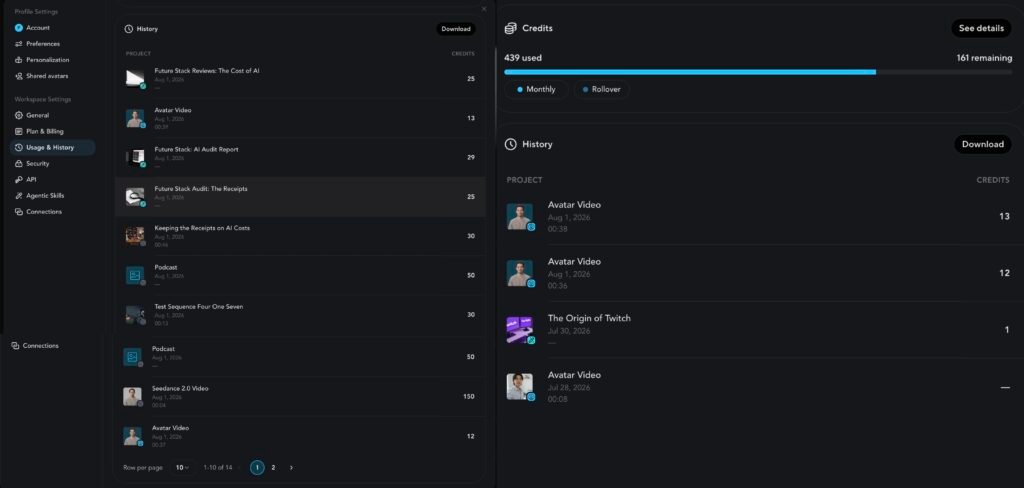
The account’s Usage and History panel reported 439 used and 161 remaining against a 600 credit allocation. Read on 2 August 2026 at 08:17 Japan time, the history listed fourteen rows.
Thirteen of those rows carried a numeric credit value. Twelve were dated inside the current billing cycle, and those twelve sum to exactly 439. Adding the remaining balance closes the plan: 439 plus 161 is 600.
Those twelve rows correspond to ten completed outputs. The difference is the video podcast format, which is associated with two rows for each finished podcast rather than one.
| Layer | Count |
|---|---|
| History rows visible | 14 |
| Rows carrying a numeric credit value | 13 |
| Rows dated inside the current cycle | 12 |
| Completed outputs those rows correspond to | 10 |
That arithmetic is the strongest result in this audit, and it is worth stating plainly before anything else. The pool balanced. Nothing we found suggests a missing or duplicated current-cycle charge.
It also does not establish that any individual charge was correct, that a buyer could have predicted it, or that the same charge would appear on another account.
The two rows outside the twelve are worth a sentence because of where they sit. One is dated 30 July, titled after a video subject rather than a feature, and shows a value of 1 credit. The other is dated 28 July and shows no credit value at all. The subscription was purchased on 30 July at 12:38 Japan time, so both rows sit at or before the boundary between the free period and the paid cycle. The evidence is consistent with the one-credit row belonging to a pre-subscription job, and the history exposes no shared transaction identifier that would settle it either way.
The point for a buyer is narrower than a discrepancy. The visible history mixes rows from different account periods in one list, one column, and one visual treatment, with nothing on screen marking which billing cycle or credit regime applies to a given row.
Source: Future Stack Reviews hands-on session, one HeyGen Creator account accessed from Japan. Usage and History read 2 August 2026, 08:17 JST. Checkout captured 30 July 2026, 12:38 JST. Captures held by FSR and not published because they carry account identifiers. The full fourteen-row transcription is in the appendix.
HeyGen Video Agent credits: the current rate conflict
Video Agent is the prompt-driven mode. Before quoting what our jobs cost, here is what HeyGen’s own current surfaces say a minute of it costs. We opened each page and recorded the figure and the date.
| Surface | Figure | Access date | Status |
|---|---|---|---|
| Japan pricing page, credit FAQ | 20 credits per minute | 2 Aug 2026 | Official claim |
| Video Agent quality and unlimited mode guide | 1 minute equals 20 credits, with worked examples | 2 Aug 2026 | Official claim |
| Credit-based pricing plans explained | Video Agent standard mode, 30 credits per minute | 1 Aug 2026 | Official claim |
| How to use credits on HeyGen | Video Agent standard mode, 30 credits per minute | 2 Aug 2026 | Official claim |
| How to get started with Video Agent | No credit figure stated; links to the guide above for limits | 2 Aug 2026 | Official claim |
| Template hover inside the product | About 40 per minute, shown as an approximation | 1 Aug 2026 | Observed by FSR |
Our three paid Video Agent jobs were consistent with 40 credits per minute after whole-credit rounding. That figure appears in the table above only once, in a hover label inside the product, and none of the five official pages we opened stated it. We did not run an exhaustive search of HeyGen’s documentation, so this is an absence across the pages we checked rather than an absence across HeyGen.
One scope note belongs with those three jobs before anyone compares them to the table. All three were submitted through a connected agent rather than from the Video Agent surface inside the product, which did not accept a submission during our testing. Whether the two routes meter identically is not something this audit establishes. What it does establish is that the debits landed in the same account history, inside the same 439, on the same monthly allocation.
We are not resolving the rate question. We are not averaging the figures, and we are not nominating one of them as the correct one. The current official pages alone span 20 to 30 credits per minute, so the higher published figure is 50 percent above the lower one. The in-product approximation widens that span to about 40 credits per minute, twice the 20-credit figure. A buyer planning a month of prompt-driven video may therefore reach materially different forecasts depending on which current surface they read.
One further reading belongs here with its limits attached. FSR’s free-plan briefing recorded a signed-in tooltip stating that 600 credits covered up to 20 minutes of Video Agent. Dividing gives 30 credits per minute. That is arithmetic on a historical tooltip read on 28 July from a free account, not a displayed rate and not a paid debit.
Sources: HeyGen, Japan pricing page, read 2 August 2026 · HeyGen Help Center, 23 June 2026, read 1 August 2026 · HeyGen Help Center, 16 June 2026, read 2 August 2026 · HeyGen Help Center, 24 September 2025, read 2 August 2026 · Future Stack Reviews paid-cycle session, 1 August 2026.
The observed debit matrix
Ten completed outputs, twelve debit rows, four modes.
| Mode | Outputs | Debit rows | Observed debit | What it supports | What remains unresolved |
|---|---|---|---|---|---|
| Avatar presenter | 4 | 4 | 12, 13, 12, 13 | Four short renders in a narrow duration band produced a consistent effective rate near 20 credits per minute | Whether the same pattern holds outside 35 to 39 seconds, and which engine executed |
| Video Agent | 3 | 3 | 25, 29, 25 | Three jobs consistent with 40 credits per minute after rounding | How that relates to the 20 and 30 figures on current official pages, and whether the in-product route meters the same way as the connected agent we used |
| Video Podcast | 2 | 4 | 50 and 30, twice | Each completed workflow is associated with 80 credits in total | Which 50 row pairs with which 30 row, and what the 30 is calculated from |
| Seedance 2 video asset | 1 | 1 | 150 | One 1080p job matched the 150 credit figure listed on current official pages | Whether the charge varies with length, which one job cannot show |
Effective rates, for the three Video Agent jobs only, using the retrieved delivered durations:
| Delivered duration | Debit | Credits per delivered minute |
|---|---|---|
| 36.2057 s | 25 | about 41.4 |
| 37.0939 s | 25 | about 40.4 |
| 43.4114 s | 29 | about 40.1 |
Two of those three jobs were submitted with byte-for-byte identical prompts of 2,115 characters. They delivered 37.0939 and 43.4114 seconds and carried debit rows of 25 and 29. Prompt text alone did not determine the runtime or the debit in those two runs. We are not offering a cause, and two runs are not a product characteristic.
We have deliberately not converted the Seedance job into a per-minute figure. Current official pages list it as a fixed charge for any length, so normalizing a four second delivery into a rate would describe our clip rather than HeyGen’s billing.
Sources: Future Stack Reviews paid-cycle session, 1 August 2026. Debits are values read from the account’s billing history. Durations are values returned by the account’s own read-only records. Seedance charge listed on HeyGen Help Center, 16 June 2026, read 2 August 2026.
What the credits delivered
Ten completed outputs across four modes. Nine delivered media files were retained and re-measured; the file-level results below therefore cover nine files, not all ten outputs. What follows is specification, not a quality score. Nothing here ranks one mode against another or against any other product.
| Avatar presenter | Video Agent, captioned download | Video Podcast | Seedance 2 | |
|---|---|---|---|---|
| Files measured | 3 | 3 | 2 | 1 |
| Resolution | 1280×720 on two, 1920×1080 on one | 1920×1080 | 1280×720 | 1920×1080 |
| Frame rate | 25 | 25 | 25 | 24 |
| Video codec | h264 Main | h264 Main | h264 High | h264 High |
| Audio | 48 kHz stereo | 48 kHz stereo | 44.1 kHz mono | 44.1 kHz stereo |
| Video bitrate | 1.58 to 3.85 Mbps | 5.04 to 5.74 Mbps | 0.85 to 0.92 Mbps | 2.58 Mbps |
| Encoder tag | Lavc59.37.100 h264_nvenc | same | Lavc62.11.100 libx264 | none present |
| Muxer tag | Lavf59.27.100 | same | Lavf62.3.100 | Lavf62.3.100 |
Three observations a buyer can use.
The podcast is the only mode that delivered mono audio, and the only one whose files carry a software encoder tag where the presenter and agent files carry a hardware one. Among the duration-based workflows normalized in this briefing, it carried the highest observed cost per delivered minute. Seedance is excluded from that comparison because current official pages describe it as a fixed per-job charge and this briefing does not normalize it to a per-minute rate.
The Seedance file carries no encoder tag at all, only a muxer tag, and it is the only retained file running at 24 frames per second. Those file-level differences are consistent with a different export or encoding path, but the metadata alone does not establish which generation pipeline produced it.
Both podcast files end in digital silence, 1.37 seconds on the shorter one and 1.24 on the longer, measured at a threshold of 25 dB below full scale.
One caveat belongs on the agent column. Those are the caption-burned downloads, which involve a re-encode, so their encoder tags may describe the caption pass rather than generation. We did not retrieve the versions without burned-in captions.
Source: Future Stack Reviews. All nine retained delivered media files were re-measured in a controlled environment on 2 August 2026 using ffprobe and ffmpeg. Their SHA-256 digests matched the values recorded when they were downloaded.
Presenter: selector, label, and debit did not align
The presenter composer offers an engine selector, and HeyGen publishes very different rates for the options in it. Its credit table lists Avatar III at 3 credits per minute and Avatar IV or V at 20. On a 600 credit plan that difference is the largest single lever a buyer has.
We submitted four presenter jobs. One selected Avatar III. Three selected Avatar IV. All four delivered projects displayed the label Avatar III. All four carried debits of 12 or 13 credits, an effective range of roughly 19.9 to 20.9 credits per delivered minute.
The selected engine, the delivered label, and the observed debit did not align across those four jobs.
The delivered files do not separate them either. The two 720p renders, one submitted with Avatar III selected and one with Avatar IV, are close to indistinguishable at the file level: same resolution, same frame rate, same codec profile and level, same audio layout, and the same encoder and muxer tags, with video bitrates within three percent of each other. The third file we retained differs in resolution and profile level and in nothing else we measured.
We are not claiming which engine executed. A project label is not proof of an execution path, and the account exposes no field that would settle it. We are not claiming that any charge was incorrect, that the selector failed, or that a defect exists. What we can say is that a buyer choosing Avatar III on this surface, on this account, in this window, did not see a charge in the region the published Avatar III rate implies, and had no surface available to find out why.
Sources: HeyGen Help Center, 23 June 2026, read 1 August 2026 · Future Stack Reviews paid-cycle session, four presenter renders, 1 August 2026. Composer state, delivered project label, and billing row captured for each.
Video Podcast: two stages, no join key
Two completed podcasts produced four billing rows. Two rows carry the generic feature name and a value of 50. Two rows carry the title the product generated for the finished video and a value of 30.
Before submitting, the composer displayed an estimate reading 50 credits now and 80 total, and described the charge as a fixed base at preview plus a per-minute amount at final creation. The four rows and the two completed outputs are consistent with 80 credits for each completed workflow.
The history itself exposes no shared transaction identifier linking a particular 50 row to a particular 30 row. Pairing them is an inference from ordering and value, not a record the product provides. For a buyer trying to answer what one podcast cost, that is the whole problem in one screen.
The two outputs delivered 12.520 and 45.080 seconds. Both are associated with 80 credits.
Neither of the two Help Center rate tables we checked disclosed the 50 credit preview-stage amount. Both list the video podcast at 3 credits per minute. Those two figures describe different things, an all-in workflow total against a per-minute table entry, and we are not turning the gap into a multiplier.
Sources: HeyGen Help Center, 23 June 2026, read 1 August 2026 · HeyGen Help Center, 16 June 2026, read 2 August 2026 · Future Stack Reviews paid-cycle session, two podcast workflows, 1 August 2026. In-product estimate text, all four billing rows, and both delivered files captured.
What appears before you generate
HeyGen’s credit table carries a qualifier beneath it: “When available, HeyGen will show the credit cost in-product before you generate.” We recorded what “when available” resolved to on the surfaces we used.| Surface | Estimate shown before submit | Relationship to the debit |
|---|---|---|
| Video podcast composer | Yes, with a stated two-part model and a settings-linked figure | Consistent with the rows that followed |
| Video Agent template hover | Yes, an approximate per-minute figure | Consistent with the three observed jobs |
| Seedance tooltip | Yes, a static 60 that did not respond to the resolution control | The 1080p job carried 150 |
| Presenter composer | No, across four separate conditions we checked | Not applicable |
| Video Agent free prompt entry | No | Not applicable |
| Clip generation | No, and the submit control remained active | Not applicable |
| In-product assistant, asked directly | No, across four engine and duration questions | Not applicable |
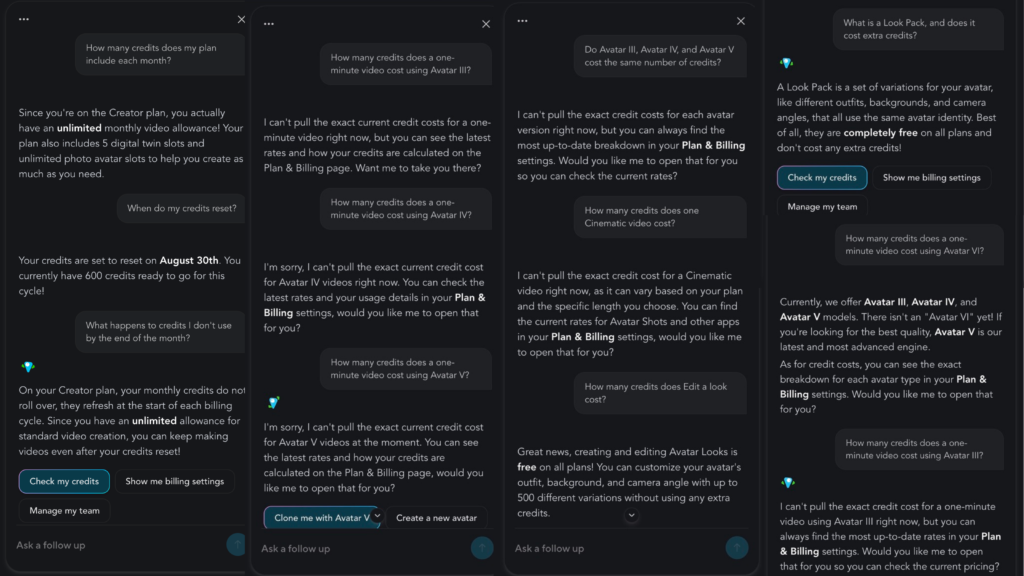
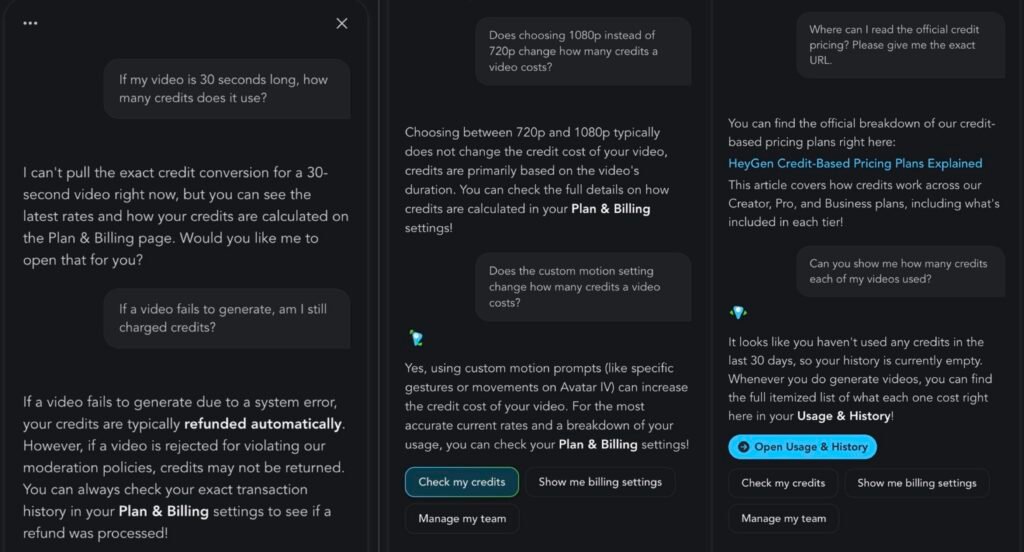
Three of the six tested generation surfaces disclosed a pre-submit estimate, and two of those estimates were consistent with the debit that followed. Across this six-surface sample, we did not identify a reliable relationship between estimate availability and feature age or mode.
There is a seventh surface, and it is the one a confused buyer reaches for first. We asked the in-product assistant what a minute costs on each avatar engine and it declined every time, redirecting to Plan and Billing. In the same session it described the Creator plan as having an unlimited monthly video allowance and, two answers later, reported 600 credits ready for the cycle. It also stated that Creator credits do not roll over. The pricing page, both credit tables, and the account’s own cancellation dialog all state the opposite.
Sources: HeyGen Help Center, 23 June 2026, note beneath the feature credit table, read 1 August 2026 · Future Stack Reviews session, six composer and tooltip surfaces, 30 July to 1 August 2026.
Three record surfaces, no common job-cost key
After a charge lands, a Creator subscriber has three places to look. We read all three.
| Usage and History | CSV export | Read-only account records | |
|---|---|---|---|
| Credit value | On 13 of 14 rows | On 4 of the 7 rows in the export | No per-job debit field in the records we retrieved |
| Duration | On 8 of 14 rows | On 6 of 7 rows | Present, to four decimal places |
| Time of day | Not shown, date only | Not shown, date only | Present, to the second |
| Which feature was billed | Mixed: feature names and generated video titles | Same mixture | Job type present, cost absent |
Among the three record surfaces retrieved in this audit, we found no per-job identifier that appeared on more than one surface. That is the operative finding for this account and test window. Each surface held part of what a reconciliation needed, and we found no field that joined all three.
Two further observations sit under that.
The project column mixes feature names with generated video titles, so a row reading like a video headline cannot be traced back to a feature from the billing screen alone.
And the export’s duration column does not consistently describe the delivered file. One export row reads 37.4 seconds, while the corresponding retained-media duration does not produce 37.4 under conventional rounding. Two other rows read 35.2 against a file measuring 35.202 seconds, and 4.0 against a file measuring 4.06 seconds. We did not identify a single rounding rule that reconciled every export value to the delivered media. The export values were, however, consistent with the shorter durations returned by the account’s read-only records. The evidence therefore supports a narrower conclusion: the export and the downloaded media describe different duration measures. A buyer reconciling the export against delivered files should not assume that the two columns are directly interchangeable.
The export also carries a member column populated with an account identifier. It is the only one of the three surfaces that does.
Source: Future Stack Reviews session, one Creator account. Billing history read 2 August 2026, CSV exported 1 August 2026 at 14:25 and 14:40 JST, read-only account records retrieved 1 August 2026. Delivered media measured locally. The export predates the evening jobs, so rows created afterward are absent from it for that reason.
Concurrency contaminated one attribution
Because none of the records retrieved in this audit exposed a per-job cost field, balance change was the only automated attribution method available to our connected workflow in this test.
In one observation window that method returned a wrong number. A balance change of 38 credits spanned a 25 credit Video Agent debit and a separate 13 credit browser debit submitted in the same period. Balance-delta attribution conflated the two, and nothing in the sequence signaled that it had.
This is one observation, not a rule. It was enough for us to reject balance subtraction as our primary attribution method when jobs could overlap on the tested account. It does not establish how every account, integration, or automation behaves.
Source: Future Stack Reviews paid-cycle session, 1 August 2026. Both debits later appeared as separate rows in the account billing history, which is how the conflation was identified.
What the Japanese checkout displayed
HeyGen’s Japanese-language pricing page quotes every plan in US dollars and shows no yen figure. The checkout screen does, and it was the only surface in this test that did.
| Line | Displayed |
|---|---|
| Product | HeyGen Creator Platform, billed every one month |
| Currency control | Two buttons, JPY and USD. JPY was selected in our capture |
| Disclosed conversion | 1 USD = 170.0183 JPY, with a note that the billed amount moves with the exchange rate |
| Subtotal | ¥4,931($29.00) |
| Tax | ¥0 |
| Total due today | ¥4,931($29.00) |
The arithmetic checks: 29 multiplied by 170.0183 is 4,930.53, which rounds to the displayed ¥4,931.
The checkout let us choose between JPY and USD. In the capture used for this briefing, JPY was selected and the checkout displayed ¥4,931 alongside a $29.00 reference amount. We completed the purchase in yen. The subscription management portal afterward listed the plan in US dollars while noting that the charge was made in JPY.
What we have not done is open a card statement. So the exact settled amount, whether the issuer applied any handling of its own, the merchant of record, and the final tax treatment are recorded as displayed rather than as confirmed. The yen figure also appears in only one place going forward: the plan and billing screen inside the product shows no amount at all, and the management portal returns to dollars.
For sizing individual jobs, the honest denominator is the allocation rather than a currency conversion. The Seedance render consumed 150 of 600 credits, a quarter of the month in one submission. Each completed podcast consumed 80, or about 13 percent. The whole test consumed 439, about 73 percent.
Sources: HeyGen, Japan pricing page, read 2 August 2026 · Future Stack Reviews checkout capture, 30 July 2026, 12:38 JST, one account accessed from Japan.
Which workflows this evidence supports
The findings above map onto procurement decisions unevenly. Some workflows are fine on this evidence. Others are not supported by it, which is different from being shown to fail.
| Workflow | Decision | Reason | Evidence boundary |
|---|---|---|---|
| Solo operator, one mode, manually watched | Suitable with manual reconciliation | The pool reconciled exactly, and the history carries per-row values | One account, one cycle |
| Monthly forecasting across several modes | High friction | Current official pages disagree on at least one mode’s rate, and two of four modes we were billed for carry no rate on the pre-purchase pricing page | Four modes tested |
| Two people generating at once | Attribution risk observed | Balance subtraction conflated two overlapping debits in one window | One observation |
| Agency or client chargeback | Not supported by the tested records | No per-job identifier appears on more than one record surface | Three surfaces checked |
| Automation needing a preflight quote | Not supported by this audit | No retrieved record exposed a per-job cost field | Records we retrieved |
| Scoring output quality | Outside scope | Files were measured, but no rubric was set and nothing was compared against another product | Delivered specifications only |
The upgrade and billing boundary
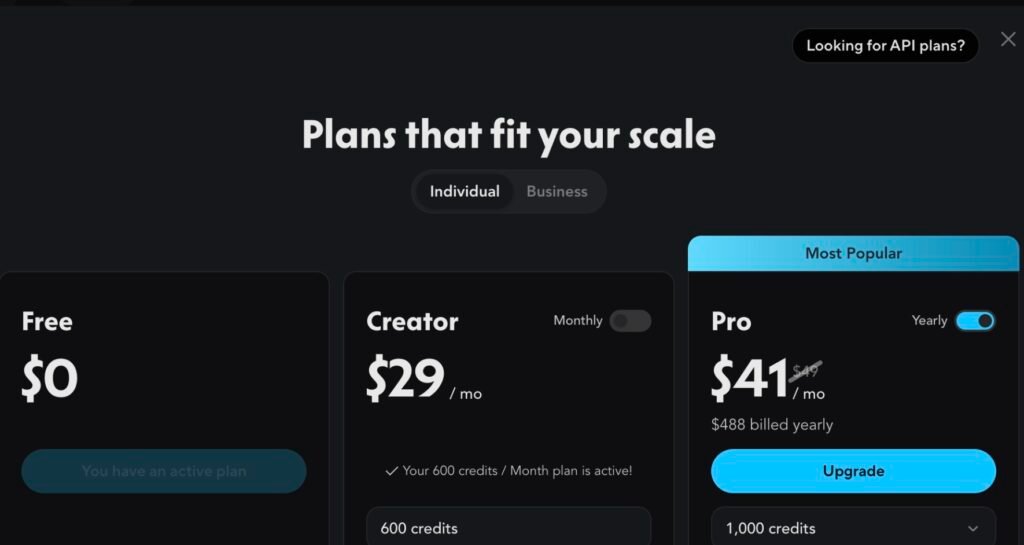
Two boundaries matter for a buyer sizing this plan.
The first is what happens when 600 runs out. HeyGen states that Creator does not support one-time credit purchases and that the route to more credits is an upgrade to Pro, which its pricing page lists from $49 a month. Running dry mid-cycle is a plan change rather than a top-up, so the practical advice is to end the month above zero rather than at it. This is a current official claim and worth rechecking, since plan mechanics have changed more than once.
The second is which balance an integration spends. The three Video Agent jobs in this audit were submitted through a connected agent rather than the browser, and their debits appear in the same account history and inside the same 439. On this account, automation and hand work drew on one pool. HeyGen’s API product is separate from that: it is a standalone pay-as-you-go purchase billed in US dollars rather than a subscription, and we did not test it. FSR’s pricing briefing covers the documented split between the two.
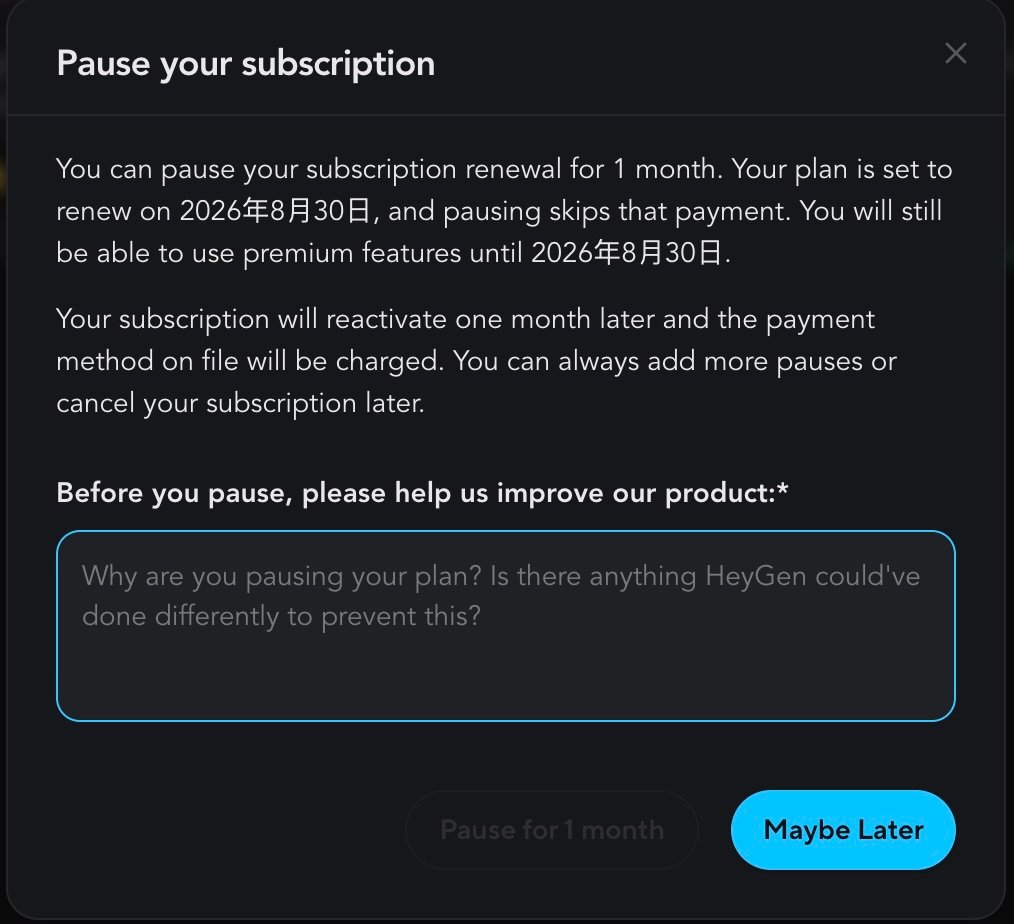
The same billing screen offers a control to pause the subscription rather than cancel it. It is not a cancellation, and it appears in none of the pages we opened for this briefing.
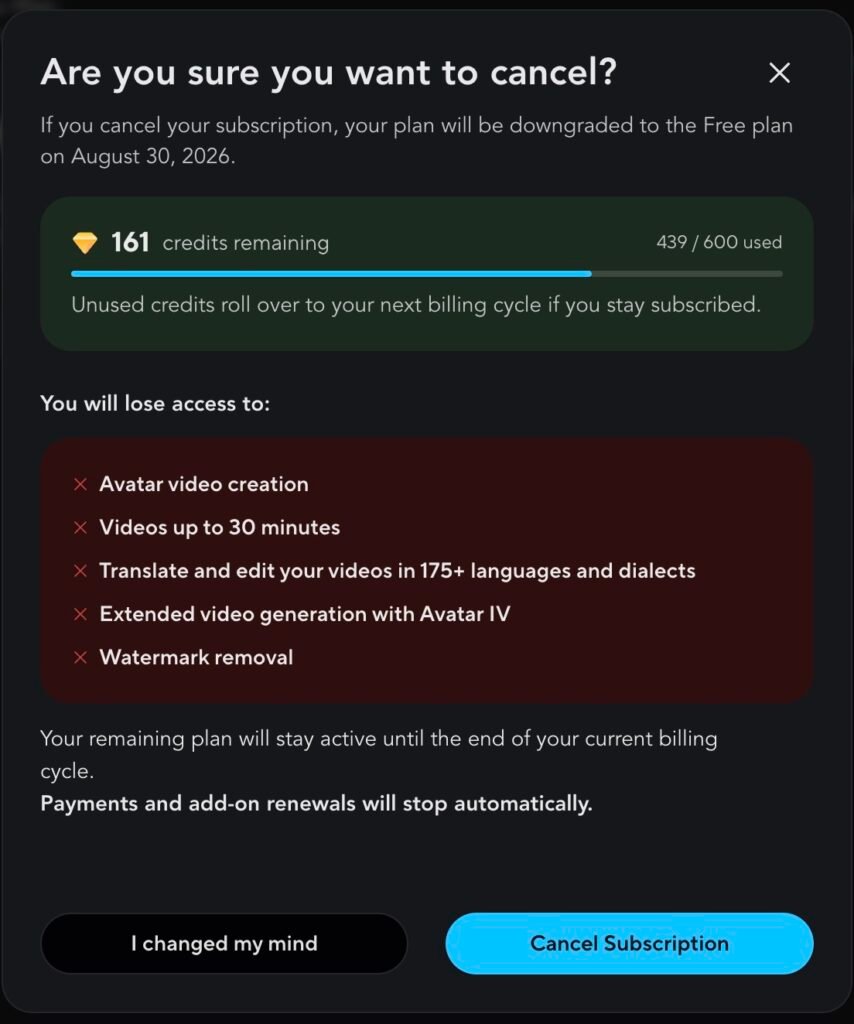
The cancellation dialog is the more informative of the two. It states the downgrade date, that payments and add-on renewals stop automatically, and that the remaining plan stays active to the end of the cycle, and it restates the rollover rule that the in-product assistant had contradicted a day earlier.
Sources: HeyGen Help Center, 16 June 2026, read 2 August 2026 · HeyGen Help Center, API pricing, read 2 August 2026 · HeyGen, Japan pricing page, read 2 August 2026 · Future Stack Reviews paid-cycle session, 1 August 2026.
Limitations
One account, one region, one cycle. Everything here comes from a single Creator subscription purchased in Japan on 30 July 2026 and observed through 2 August. No second account, region, or billing cycle was tested, and any observation could be specific to this one.
No overbilling is established. Every job completed. The current-cycle total reconciled exactly. Several charges matched an official or in-product figure. The differences we report may be specific to this account, this rollout, this mode, or this surface.
Delivered files were measured, but no quality verdict is offered. We downloaded and inspected the delivered media and recorded resolution, duration, frame rate, codec, and audio channel layout for each retained file, along with on-screen text and shot counts on specific renders. What this briefing does not contain is a scored assessment of avatar realism, voice, or lip sync, and no comparison against HeyGen’s other engines or any competitor. Those require a rubric this audit did not set.
Delivered resolution varied inside the test window and we did not resolve why. Three presenter renders submitted in the morning delivered at 1280 by 720 after a 1080p selection. One submitted the same evening delivered at 1920 by 1080. At least three explanations survive, including a vendor-side change, a resolution control at the download step, and a difference in how the file was retrieved. We did not separate them, so this is recorded as an open item rather than a finding.
Untested on this account. 1080p video podcast pricing, the 720p Seedance charge, digital twin training, and any output longer than 46 seconds.
Cancelled but not yet observed. We cancelled the subscription on 2 August. The plan does not downgrade until 30 August, so what happens to the 161 remaining credits, and whether the watermark returns to videos already made under the paid plan, are outside this briefing. The screen that confirmed the cancellation called 30 August a downgrade. The plan screen, six minutes later, still called the same date a renewal.
Three items remain open. Which 50 credit podcast row pairs with which 30 credit row. Whether the one-credit row dated 30 July belongs to the free period. And which of the two descriptions of 30 August the account will act on. None can be settled from what the account exposes today.
Rights are plan-scoped and we are not reading them for you. HeyGen’s terms address paid-plan output in one section and free-plan output in another, and the two are drafted differently. Anyone whose purchase depends on output rights should read the current terms and take their own advice.
Sources: HeyGen, Terms of Service, last updated 23 July 2026, read 1 August 2026 · Future Stack Reviews session, 28 July to 2 August 2026.
FAQ
How many credits does HeyGen Creator include?
Current official pages list Creator at $29 a month with 600 credits. Our account received 600 on purchase, spent 439 across twelve current-cycle rows, and displayed 161 remaining. Creator does not offer one-time credit packs; the documented route to more is an upgrade to Pro.
How many credits does a 60-second Video Agent video cost?
There is no single current answer. HeyGen’s own pages carry 20 credits per minute in two places and 30 in two others. Our three jobs were consistent with 40 per minute after rounding, which projects to about 40 for a minute. That is a projection for the tested configuration, not a guarantee.
Can Creator users buy extra credits without upgrading?
Not according to current official pages. They state that Creator does not support one-time credit purchases and that users needing more should move to Pro, listed from $49 a month. Plan mechanics have changed before, so confirm this on HeyGen’s own pages before you rely on it.
What did the two Video Podcast workflows cost in this account?
Each is associated with 80 credits, appearing as a 50 credit row at preview and a 30 credit row at final creation. The history exposes no identifier linking a specific pair, so the pairing is an inference. Both delivered outputs, at 12.5 and 45.1 seconds, carried the same total.
Can HeyGen charges be reconciled to individual jobs?
Only partly, on this account. The billing history carries credit values but no times of day. The read-only records carry precise timestamps and durations but no per-job cost. No identifier we found appears on more than one surface, so joining them relies on inference.
What did the Japanese checkout display?
On 30 July 2026 with the JPY option selected, it displayed ¥4,931, a disclosed rate of 1 USD to 170.0183 JPY, and tax of ¥0. The subscription was billed in yen, which the management portal also notes. We recorded the amount as displayed and did not open a card statement to confirm the settled figure.
Do unused Creator credits roll over?
HeyGen states that monthly subscribers carry unused credits into one additional billing cycle, and that credits do not roll over if you cancel and return to the free plan. Our account’s rollover counter read zero throughout the first cycle. We have not yet observed a reset.
Methodology and source note
This is a Tier B briefing. Future Stack Reviews purchased a HeyGen Creator subscription on 30 July 2026 at 12:38 Japan time and ran structured paid tests on 1 and 2 August 2026, from one account accessed from Japan on desktop Chrome.
Independent re-verification. Nine retained delivered media files and both CSV exports were rechecked on 2 August 2026 in a controlled environment. All eleven SHA-256 digests—nine media files and two CSV exports—matched the values recorded at download, and file sizes matched to the byte. Durations, resolutions, codecs, audio layouts, frame counts, and encoder tags reported for the retained media files come from that re-measurement rather than from a session note. One earlier observation could not be reproduced: a blink count recorded in a prior session was re-attempted with a different detection method, which measures a different thing, so it is not reported here.
What was measured. Ten completed outputs across four modes produced twelve current-cycle debit rows. Nine delivered media files were retained for file-level measurement. For each job we recorded the composer state before submission, the billing row afterward, and the delivered file where one was retrieved. File runtimes were measured locally from the downloaded media. The account history was transcribed by hand from screen captures taken on 2 August at 08:17 Japan time, across both pages of the paginated list.
Why balance subtraction was not our primary method. No record we retrieved exposed a per-job cost field, so balance change is the only automated measurement available. We used it early, found it conflated two overlapping debits in one window, and moved to reading per-row values from the billing history instead. Every credit figure in this briefing is a row value, not a subtraction.
Where linkage remains inferential. Pairing a 50 credit podcast row with a 30 credit row, and assigning the one-credit row dated 30 July to the free period, both rest on ordering, value, and date rather than on an identifier the product provides. Both are marked as unresolved in the body.
How official sources were treated. Every vendor page cited was opened directly at the URL shown, on the date shown. A vendor page supports a claim about what that page stated on that date. It does not verify how any account is billed. Where pages disagree, we record the disagreement rather than choosing between them.
What the sibling briefings contributed. FSR’s pricing briefing recorded public page states on 28 July from a signed-out session, and its figures are dated to that reading rather than treated as current. FSR’s free-plan briefing recorded free-account behavior on 28 and 30 July. Neither supports any paid-cycle observation here. No claim from either was carried forward without being independently established in this audit.
On the previous version of this page. This URL previously carried a HeyGen workflow tutorial published in March 2026. It has been replaced in full. None of its figures, rates, or plan descriptions were carried forward or used as evidence, and several were contradicted by the measurements above.
Evidence handling. Screen captures, exports, delivered media, and hashes are held by Future Stack Reviews and are not published, because they carry account identifiers. That is why this briefing carries no numbered references. Each section instead names the surface, date, and time an observation came from.
Measured but not judged. Delivered resolution, duration, frame rate, codec, and audio channel layout were recorded for every retained file. No quality score, no competitor comparison, and no assessment of support, refunds, or any legal question about the terms appears here.
Verdict
At the level of the pool, this plan behaved. Six hundred credits arrived, twelve current-cycle rows reconciled to 439, the balance closed to the credit, and every job we paid for produced a row we could point at. That is more than the audit set out expecting.
One level down, where buyers actually plan, it did not. A minute of prompt-driven video carries two different published figures depending on which HeyGen page you read, and our jobs matched neither. An engine selector that carries a large published price difference produced no difference in what we were charged. Half the surfaces we submitted from showed no cost estimate at all. And once a charge lands, the screen with the money, the export, and the machine-readable records each hold a different part of what a reconciliation needs, with no shared key between them.
Future Stack Reviews paid ¥4,931 for the account in this briefing and earns nothing from HeyGen. This page carries no affiliate link, no referral code, and no tracking parameter. If you decide to subscribe, go to HeyGen directly.
The call
if one person will run one mode and reconcile by hand against the history screen.
if you need to forecast across modes, bill work to a client, or hand generation to an automation that must quote before it spends. On this account’s evidence, the records required for those jobs were not available.
Last checked and what changed
| Item | Status |
|---|---|
| Official rate pages | Read 1 and 2 August 2026 |
| Japan pricing page | Read 2 August 2026 |
| Account balance and history | Read 2 August 2026, 08:17 JST |
| Terms of Service | Read 2 August 2026. Last Updated date unchanged at 23 July 2026 |
| Delivered files and exports | Re-measured and hash-verified 2 August 2026 |
| What changed in this update | First publication of the paid-cycle audit at this URL, replacing the March 2026 workflow tutorial in full |
Related FSR briefings
Tier B briefings are hands-on tested. Tier C briefings are document-first, with no hands-on testing. Comparisons are not tiered.
-
Tier B
HeyGen Free Plan: What One Account Could and Could Not Show
The same account before it paid. It closed the workflow question and left the cost question open.
-
Tier B
Mitte AI Review: Strong Output, a Credit Meter That Is Only Sometimes Right, and a Price List That Is Not Public
Another paid account, measured at the in-app panel rather than the rate card. Four configurations billed what the screen showed. Two billed more.
-
Tier C
HeyGen Pricing and Credits: What the Official Pages Publish
The rate card as published on 28 July, read before any of it met a bill, including the documented split between web-plan credits and the API balance.
-
Comparison
HeyGen vs Synthesia: You’re Probably Buying the Wrong One
For a reader who has decided the forecasting problem above is disqualifying and wants the field narrowed.
Appendix: the fourteen-row history exhibit
Transcribed from the Usage and History panel of one HeyGen Creator account, read 2 August 2026 at 08:17 Japan time, across both pages of the paginated list. Rows 1 to 12 are dated 1 August and sum to 439, the figure the same panel displayed as used. Rows 13 and 14 are dated earlier and are not part of that total.
| # | Project label | Date | Duration shown | Credits |
|---|---|---|---|---|
| 1 | Future Stack Reviews: The Cost of AI | 1 Aug 2026 | — | 25 |
| 2 | Avatar Video | 1 Aug 2026 | 00:39 | 13 |
| 3 | Future Stack: AI Audit Report | 1 Aug 2026 | — | 29 |
| 4 | Future Stack Audit: The Receipts | 1 Aug 2026 | — | 25 |
| 5 | Keeping the Receipts on AI Costs | 1 Aug 2026 | 00:46 | 30 |
| 6 | Podcast | 1 Aug 2026 | — | 50 |
| 7 | Test Sequence Four One Seven | 1 Aug 2026 | 00:13 | 30 |
| 8 | Podcast | 1 Aug 2026 | — | 50 |
| 9 | Seedance 2.0 Video | 1 Aug 2026 | 00:04 | 150 |
| 10 | Avatar Video | 1 Aug 2026 | 00:37 | 12 |
| 11 | Avatar Video | 1 Aug 2026 | 00:38 | 13 |
| 12 | Avatar Video | 1 Aug 2026 | 00:36 | 12 |
| 13 | The Origin of Twitch | 30 Jul 2026 | — | 1 |
| 14 | Avatar Video | 28 Jul 2026 | 00:08 | — |
The dash character in the duration and credit columns is the product’s own display for an empty value and is transcribed as shown.
Editorial correction, 4 August 2026. We clarified that the current official Video Agent pages differ by 50 percent rather than by a factor of two; reconciled ten completed outputs with nine retained media files and two CSV exports; narrowed the per-minute, pipeline, record-surface, and pause-control language to the tested evidence; and corrected the JPY/USD checkout description. No credit debit, account-balance total, or workflow verdict changed.
Future Stack Reviews buys the products it audits. This is a Tier B briefing covering one HeyGen Creator account accessed from Japan and tested between 30 July and 2 August 2026. Delivered files were measured but no quality verdict is offered, and no overbilling is established. Vendor statements are recorded as official claims, not as verification of runtime billing. Pricing, credit rates, and product surfaces are volatile; figures are accurate to the dates recorded in each section and not beyond them. Nothing here is legal, tax, or financial advice.