Last updated: May 9, 2026
Tier A review · 4 months on Claude · 6 months on ChatGPT
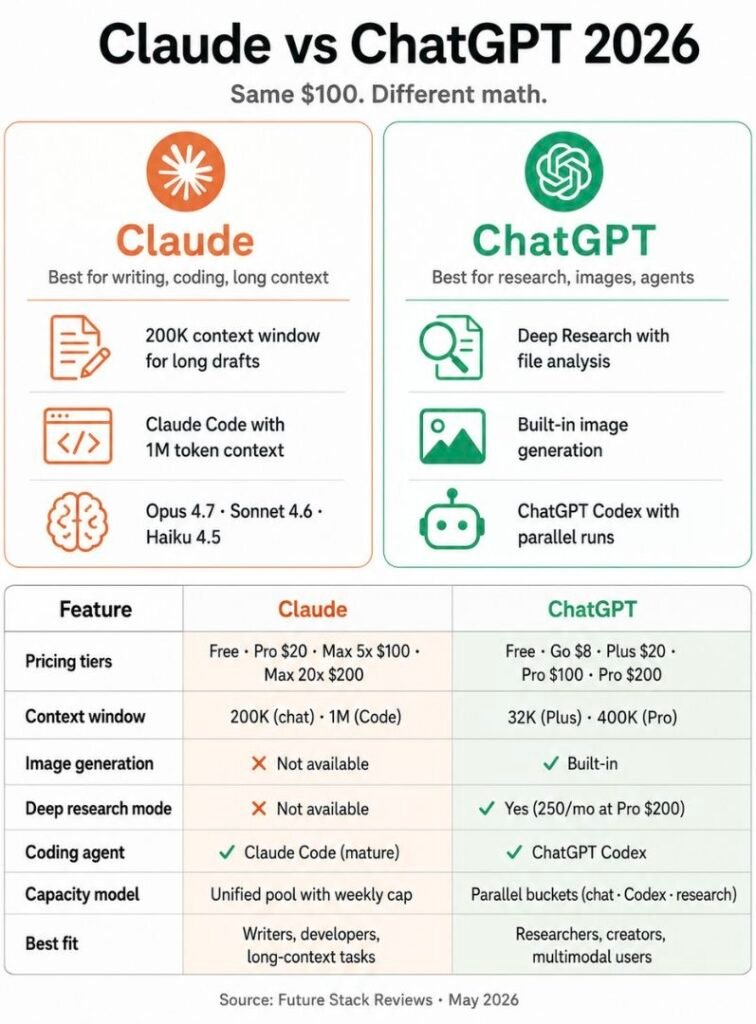
Claude is Anthropic’s frontier AI assistant emphasizing long-context reasoning and developer tooling. ChatGPT is OpenAI’s frontier AI platform emphasizing multimodal generation and orchestration breadth. As of May 2026, both ship subscriptions that mirror at the $20, $100, and $200 tiers, with ChatGPT additionally offering a Go tier at $8 below Plus. The math underneath those identical $20-and-above prices diverges sharply at the $100 tier and above.
I paid $100 to Anthropic. I paid $100 to OpenAI. The Anthropic plan held at 91% weekly cap with breathing room (tested across April and early May 2026, before Anthropic’s May 6 limit increase). The OpenAI plan burned through 5x usage in 24 hours on May 1, forcing me onto the $200 tier the next day. One of those plans was named “Pro.” The other was named “Max.” The naming told the truth that the pricing pages did not.
This review reads the convergence at face value, then peels back what the same dollar buys on each side. It uses four months of operational Claude data, six months of operational ChatGPT data, and Phase 1 research across six independent sources covering vendor pricing pages, peer-reviewed evidence, X-side power-user testimony, regulatory filings, and competitive industry structure.
Briefing Summary, May 2026
The question worth asking: When two AI vendors land within five days of each other on identical $100 / $200 / 5x / 20x pricing structures, what is the same dollar actually buying?
What this review found across six evidence layers:
- Anthropic and OpenAI shipped pricing structures that mirror at the $20, $100, and $200 tiers in April 2026 (ChatGPT also offers a Go tier at $8 with no Claude equivalent). Session-level usage math at the $100 tier diverges by roughly an order of magnitude depending on workload type.
- ChatGPT Pro $100 burns through 5x Codex limits in 18 hours of agentic engineering work (per a publicly archived X observation in May 2026). My own $100 ChatGPT plan burned through in 24 hours doing Deep Research and PDF construction with zero Codex use.
- Claude Max 5x ran at 91% weekly cap with 5-hour ceiling hits 3-4 times per week across April and early May 2026. Same dollar, different shape.
- Anthropic’s April 4 ban on third-party agent harnesses produced reports of 10x-50x cost increases for displaced flat-rate users. OpenAI’s Pro $100 launched five days later, priced exactly at Claude Max 5x.
- On May 6, 2026, Anthropic doubled Claude Code’s 5-hour rate limits for Pro, Max, Team, and Enterprise plans, and removed peak-hour reduction on Claude Code for Pro and Max. The metering shift was not unilateral or final.
- Sora’s web/app interface was discontinued April 26, 2026. Microsoft and OpenAI restructured their license April 27, 2026, ending exclusivity. Both events received almost no public reaction. Both matter more than the launch posts.
- OpenAI documents Pro $200 as the highest-usage option, but it no longer appears in the default public pricing display. Display ambiguity, not discontinuation, is what changed.
- Peer-reviewed academic literature in our queried set does not yet contain a head-to-head Claude Opus 4.7 vs GPT-5.5 benchmark comparison. Vendor numbers from both sides remain self-published.
The short recommendation: If your work is long-context coding, sustained writing, or repository-scale agentic engineering, Claude Max 5x is the better $100. If your work is multi-modal research, Deep Research, image generation, and tooled data analysis, ChatGPT Pro $100 is the better $100, but its value depends entirely on which quota bucket your workflow drains first.
The rest of this review walks through what makes those identical-price plans into different products.
Methodology · how this review was tested and sourced
TL;DR · Three lines for the impatient
Claude wins long writing, long-context coding, and sustained reasoning. ChatGPT wins multi-modal, agentic breadth, and Deep Research with files.
At $100, both plans run out faster than the marketing implies. If you’re a power user, plan to test before committing to $200.
The reason both vendors landed on identical pricing in April 2026 is parallel defensive pricing pressure against open-weight competitors like DeepSeek, not coordination.
Quick Start · 30-second decision
If you write for a living, default to Claude Pro at $20. The 200K context window earns its rent the first time you paste a 40-page draft into a single chat.
If you do mixed knowledge work that touches images, files, voice, and Deep Research, default to ChatGPT Plus at $20. The breadth solves the daily-utility problem better than Claude does at this tier.
If you hit caps three or more times a week, escalate. Not to $200 yet. Try $100 first, on whichever side dominates your workflow. If you cap that within a week, the $200 tier is your real seat.
If you cap $100 within a day, read section six.
Full Comparison · 4 tiers, 6 layers
Comparison tables in this category usually optimize for completeness. This one optimizes for the lines that move actual purchase decisions. Six layers, four tiers, no padding.
Layer 1: Pricing and access (vendor-documented, May 9, 2026)
| Free | $20 tier | $100 tier | $200 tier | |
|---|---|---|---|---|
| Claude | Limited | Pro $20 ($17 annual) | Max 5x | Max 20x |
| ChatGPT | Limited | Plus $20 | Pro $100 | Pro $200 |
Both Pro $200 and Max 20x remain available to subscribers as of May 9, 2026. OpenAI’s help documentation continues to identify Pro $200 as the highest-usage option. The change is in display, not in availability. New users browsing OpenAI’s default pricing page see Pro $100 emphasized; Pro $200 has been moved out of that primary display surface. Section ten unpacks the implications.
Layer 2: Underlying models
Claude Pro and Max all run the same model family. Opus 4.7 (released April 16, 2026), Sonnet 4.6, Haiku 4.5. Max tiers are pure usage multipliers, not capability gates.
ChatGPT splits differently. Plus gets GPT-5.5 Instant and Thinking. Pro $100 and Pro $200 both unlock GPT-5.5 Pro, the research-grade reasoning model. The catch: GPT-5.5 Pro mode disables Apps, Memory, Canvas, and image generation. The most capable reasoning model is also the most stripped of tools. ChatGPT itself confirms this when asked about its own architecture.
Layer 3: Usage limits (what actually runs out)
OpenAI publishes specific message counts. Anthropic publishes relative multipliers and exposes session/weekly progress bars. The transparency gap is itself a product difference.
| Plus / Pro $20 | Pro $100 / Max 5x | Pro $200 / Max 20x | |
|---|---|---|---|
| ChatGPT GPT-5.5 (3h window) | 160 messages | 5x Plus | 20x Plus |
| ChatGPT Codex (5h window) | 15-80 local | 80-400 local (10x promo through May 31) | 300-1,600 local (25x 5h promo through May 31) |
| ChatGPT Deep Research | Standard | Higher allowance | 250 runs/month |
| ChatGPT Agent (monthly) | 40 messages | 400 messages | 400 messages |
| Claude (per session) | 5x Free | 5x Pro | 20x Pro |
| Claude weekly cap | Yes | Yes | Yes |
| Claude Code 5h limit | Standard | Doubled May 6, 2026 | Doubled May 6, 2026 |
On May 6, 2026, Anthropic doubled Claude Code’s 5-hour rate limits across Pro, Max, Team, and Enterprise plans, and removed peak-hour limit reduction for Claude Code on Pro and Max. The capacity baseline for Claude Code shifted upward three days before this review’s last verification date. Tests reported in section seven preceded that increase.
Claude’s usage shares a single pool across claude.ai, Claude Code, and Claude Desktop. Heavy Code use eats the same window as writing. ChatGPT separates Codex limits from chat limits, so Codex burnout doesn’t kill your normal GPT-5.5 quota.
Layer 4: Context window
Claude paid chat: 200K tokens across all paid tiers. Claude Code: 1M tokens with Sonnet 4.6 and Opus 4.7 under stated conditions. ChatGPT Plus: 32K Instant, 256K Thinking. ChatGPT Pro: 128K Instant, 400K Thinking.
For a 5,000-word draft with 50 pages of research attached, Claude wins the chat-side fight outright. For Codex working repository-scale on long-running tasks, the 1M Code context is decisive.
Layer 5: Modality
ChatGPT generates images natively. Claude does not. Claude makes HTML and SVG diagrams, which is a different product.
Sora was discontinued for web and app on April 26, 2026 per OpenAI. The Sora API follows on September 24, 2026. ChatGPT no longer has a current first-party video advantage. The launch coverage that frames ChatGPT as the multi-modal champion is six months out of date.
Voice mode exists on both. ChatGPT’s polish on desktop and mobile is materially ahead.
Layer 6: Agentic and tool ecosystem
Claude Code is the strongest single-product story in the AI assistant market right now. Anthropic reports it as a core driver of revenue, and partner momentum (Cursor, Vercel, Factory, GitHub Copilot) reflects it.
ChatGPT Codex is more powerful in raw quota terms at the $100 tier and above, with parallel cloud agents, code reviews, and IDE integration. Sam Altman publicly endorsed using both: “use codex or claude code, whatever works best for you” (May 1, 2026, 23,055 likes on X). The OpenAI CEO killed single-tool loyalty as a marketing line. Section nine unpacks what that signal actually means.
The 24-Hour Burn · two receipts
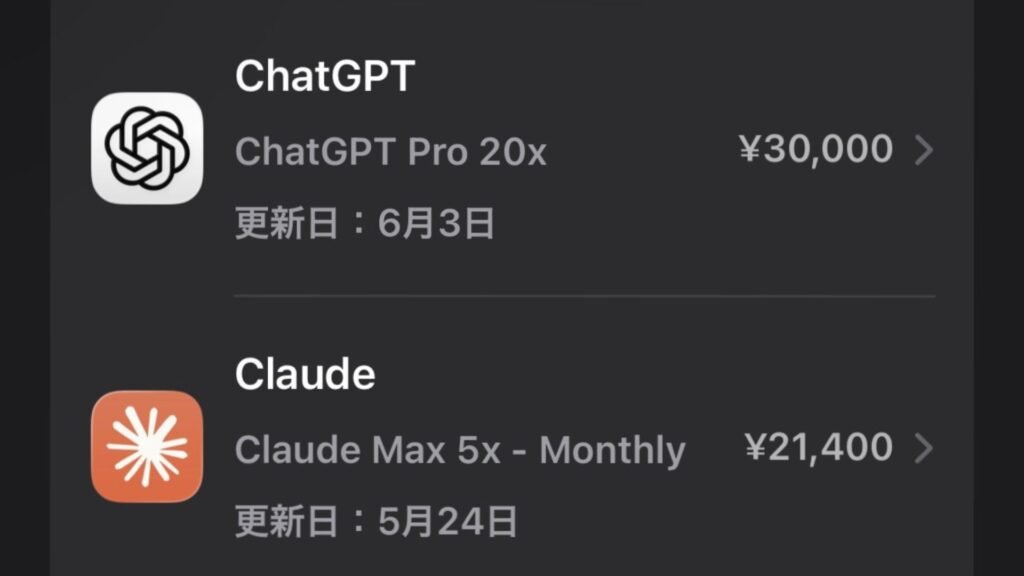
I have a ChatGPT Pro 20x subscription on iOS. ¥30,000 per month, App Store billing, renewal date June 3. The screen looks like every other subscription edit screen. The number it represents took 24 hours to find.
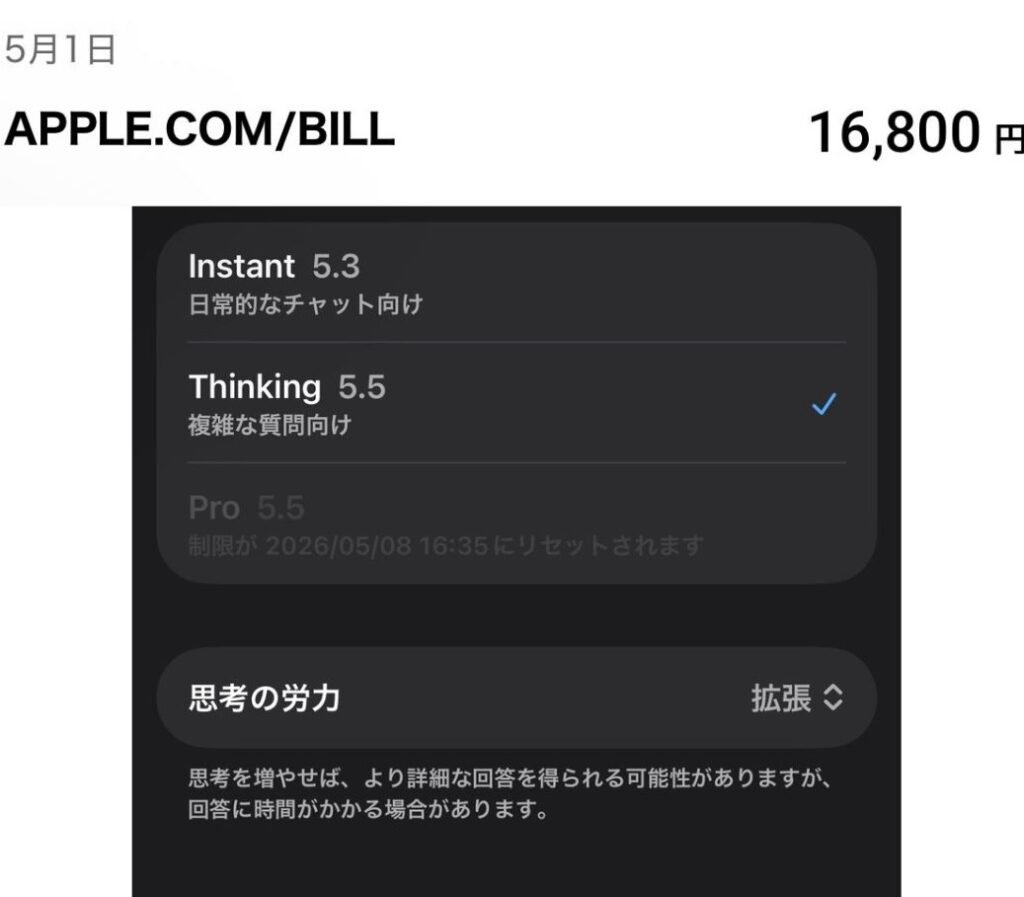
Receipt one is mine. Tested workflow logged on May 1, 2026: Pro $100 upgrade activated mid-morning after months on ChatGPT Plus, then approximately 14 hours of mixed Deep Research queries (multi-source synthesis on competitive landscape) plus PDF construction with embedded research extracts (multi-page output, repeated reasoning calls), plus back-and-forth with GPT-5.5 Pro on the final synthesis. Zero Codex. Zero image generation. Zero Sora (which was already gone by then).
By the end of that calendar day, the dashboard showed 100% of my 5x weekly window consumed. Recovery was a full week. I upgraded to Pro $200 the next morning because waiting was not an option. Subscription dashboard screenshot archived for verification.
Receipt two is from the public record. A widely-shared X observation in May 2026, archived for verification, reported: “Fun fact, you can run through 60% of a weekly ChatGPT Pro codex rate limit by using goal mode with GPT 5.5 xhigh fast in ~18 hours. And frankly, that’s pretty generous.” Different user. Different workload. Different feature set. Same envelope.
Two paths into the same wall. I burned the cap on Deep Research and PDF synthesis. He burned it on Codex agentic work. The marketing copy for Pro $100 implies “5x Plus” of headroom across whatever you do. The plan in practice splits into orthogonal token-burn pools, and any single pool can be exhausted in a day if your work density is real.
Side note: my Claude Max 5x subscription, running concurrently across the same April-early-May window, peaked at 91% on the weekly meter. The 5-hour rolling cap hit 100% three or four times a week. That observation is what the next section is about.
Same Price, Different Math · the Capacity Asymmetry
Frame this through a lens FSR has used before. The Trust Asymmetry analysis from the Opus 4.7 review traced the geometry of how truth was distributed unevenly across Anthropic’s release documents. Documents closer to the marketing surface carried less of it. Documents buried in System Card footnotes carried more.
The same geometry applies to pricing. Call this Capacity Asymmetry. The Trust Asymmetry was about the distance between what marketing says and what documentation admits. The Capacity Asymmetry is about the distance between what the price tag implies and what your actual workload consumes.
At the $100 tier, both vendors say “5x.” The 5x means different things on different days. Claude Max 5x gives you 5x your Pro session limits across an integrated chat-and-code pool, with weekly caps as a backstop. ChatGPT Pro $100 gives you 5x Plus on GPT-5.5 messages, plus a separate 5x (currently 10x through May 31) on Codex, plus a separate Deep Research counter, plus a separate 400 monthly Agent messages. The ChatGPT side is more transparent on the math and more granular on the buckets. It is also more capable of creating dead ends, because each bucket has its own zero point.
A user doing Codex-heavy refactors hits the Codex wall first. A user doing Deep Research hits the research counter. A user doing GPT-5.5 Pro reasoning on long files burns through token-time on the reasoning ceiling. None of these failure modes show up in casual benchmark coverage, because casual benchmark coverage is talking to Group 1 (the next section explains).
The Capacity Asymmetry is not a bug or a scandal. It is a structural feature of how each company chose to architect compute envelopes. Anthropic optimized for sustained sessions with weekly hard ceilings. OpenAI optimized for transparent quota math with multiple parallel exhaustion points. If your workload fits one envelope shape, you win. If it fits the other, you pay $100 and watch the bucket drain.
Most reviewers writing about “Claude vs ChatGPT” never test the failure modes because they never use either tool hard enough to hit them.
Flat-Rate Under Pressure · April, then May 6
A four-week window in April 2026 contains every signal needed to read where the market was heading. A May 6 update suggests the trajectory is not as one-way as April implied.
April 4: Anthropic enforced its third-party agent ban. Tools like OpenClaw, which had been using Claude Pro and Max subscription tokens to run autonomous agentic loops at flat-rate prices, were cut off. Displaced flat-rate users faced pay-as-you-go Extra Usage rates instead. Public reports cited cost increases ranging from 10x to 50x for the same workload depending on usage pattern, though the upper end of that range comes from secondary press summaries rather than archived primary data. A widely-shared X demonstration in late April showed Claude Code refusing or surcharging any repository containing the string “OpenClaw” in a JSON blob. Anthropic was not just banning a tool. They were refusing to talk to text that mentioned it.
April 9: OpenAI launched ChatGPT Pro $100. Five days after the Anthropic ban. Priced exactly at Claude Max 5x. With a 5x Codex multiplier (10x through May 31, 2026, as a launch promotion). The targeting was so precise it stopped being subtle.
April 16: Anthropic shipped Claude Opus 4.7. The benchmark gains were measured in single-digit points. The launch coverage focused on partner testimonials. The evidence layer beneath the launch was thinner than the marketing surface implied.
April 26: OpenAI discontinued Sora’s web and app interface. The Sora API follows on September 24. User reaction was, in Grok’s phrasing, “near-zero ripple.” OpenAI absorbed a feature deletion with almost no churn. Section ten has a hypothesis about why.
April 27: Microsoft and OpenAI amended their partnership. Microsoft’s IP license is now non-exclusive. The revenue share is gone. OpenAI can serve its products on any cloud through 2032. Multi-cloud freedom 18 days after Pro $100 launch reads as IPO preparation more than it reads as product strategy.
May 6: Anthropic doubled Claude Code’s 5-hour rate limits for Pro, Max, Team, and Enterprise subscribers. Peak-hour limit reduction on Claude Code was removed for Pro and Max. The capacity squeeze that defined April was, on the Claude side, partially walked back five weeks later.
The framing that almost holds these events together comes from a small X post on April 5, 2026: “the all-you-can-eat agent era is ending. Metered AI is starting.” The framing was directionally correct but probably too absolute. Both vendors moved in April to constrain flat-rate autonomous compute. Anthropic’s May 6 walk-back suggests the constraints went further than user economics could absorb. The era is not ended so much as it is being repriced in real time.
What changed permanently in this window: the implicit promise that flat-rate AI subscriptions could absorb autonomous agentic compute is no longer reliable. Anthropic broke first because their margins broke first. OpenAI followed by introducing a price floor disguised as a new tier. The $100 plans are no longer a generous middle ground. They are the new minimum for serious work. Whether they are also a stable ceiling depends on what compute economics look like in Q3.
Two Groups Speaking Past Each Other · the Karpathy spine
Andrej Karpathy posted on April 9, 2026, the day OpenAI launched Pro $100. The thread reached 20,651 likes and is the cleanest available framing for why “Claude vs ChatGPT” coverage feels disjointed depending on who is writing it.
The argument: there is a growing gap between people who experience AI as a casual chat tool and people who experience it as autonomous agentic infrastructure. Same product names. Different products in practice. The two groups are speaking past each other.
Independent benchmark data suggests a similar split, even where the exact frontier-version comparison Karpathy implies is not yet in peer review. The 2025 benchmarking on the Japanese national medical exam put Gemini 2.5 Pro at 97.2%, GPT-5 at 96.3%, Claude Opus 4.1 at 96.1%, and Grok-4 at 95.6%. A 0.7% spread across four frontier models above the 95% reliability threshold. For Group 1 (short queries, simple tasks, casual chat), the model choice barely registers as a real decision.
The same year, the MCP-Universe benchmark on multi-tool agentic tasks put GPT-5 at 43.72% and Claude-4.0-Sonnet at 29.44%. A 14-point gap. NoLiMa, a long-context evaluation, showed GPT-4o falling from 99.3% to 69.7% accuracy as context expanded to 32K tokens. For Group 2 (long context, agentic, multi-tool), the gap between models is large, and the gap between vendors translates into hours of saved or wasted work.
What Karpathy did not name, but what May 2026 chatter suggests, is a Group 3. The cost-sensitive developers who already migrated. An X user post in early May captured the Group 3 sentiment directly: “between codex and deepseek I don’t see a reason to keep my claude subscription. deepseek v4 pro with opencode as the harness is great at like 1% of the cost of claude.” Section twelve returns to whether the underlying cost claim survives careful examination.
If a coverage piece does not name which Group it is writing for, the recommendations it produces will be wrong for two of the three.
The Pro $200 That OpenAI Stopped Showing
Open ChatGPT’s pricing page today. Free, Go, Plus, Pro at $100, Business, Enterprise. Pro $200 is not in that primary display. New users navigating the upgrade flow see Pro $100 as the highest individual tier on offer.
Pro $200 still exists. OpenAI’s help center continues to identify it as the highest-usage individual option, and existing subscribers retain their plans. I am paying for it. The renewal is on June 3 at ¥30,000 (the iOS App Store price, which works out to roughly $200 USD with no Apple-tax markup, a quiet detail most US-side reviews would not notice). The plan was not killed. It was de-emphasized.
The reaction on X to this display change was, in Grok’s word, “minor confusion.” A handful of users posted some version of “wait, did Pro $200 go away?” There was no outrage thread. There was no Reddit megathread. There was no journalist op-ed. The tier most aggressively priced for power users vanished from default visibility, and almost nobody noticed.
That non-reaction is the more interesting story. Three readings of it are defensible:
- The market test succeeded. Pro $100 absorbed the demand that would have flowed to Pro $200. Users who would have paid more were satisfied paying less. From OpenAI’s revenue engineering perspective, this is a victory.
- The audience for $200 is too small to make noise. Heavy Codex users, long-running agentic developers, and parallel-workflow operators are a tiny share of total ChatGPT users. They saw the change, shrugged, and kept working. They were never the ones writing about pricing changes.
- Display de-emphasis precedes other changes. Existing subscribers retain access for now. The plan still exists in OpenAI’s documentation. Whether it remains the default upgrade path for new heavy users in three months is a different question than whether it exists today.
The specific reading matters less than the pattern. Anthropic publishes Max 5x and Max 20x side-by-side on a public pricing page. OpenAI documents Pro $100 and Pro $200 in help, but only surfaces Pro $100 in the default acquisition flow. Same pricing structure, opposite display strategy. One company is proud of its top tier. The other is treating its top tier as a subdued upgrade for customers who can identify the bottleneck themselves. A reader asking “which AI assistant should I buy” has been getting price comparisons that miss this dimension entirely.
The Verification Void · what 14 papers don’t yet say
For this review, FSR queried Consensus across a curated set of 14 peer-reviewed papers covering Claude and GPT-family models from 2025 and early 2026. The brief was simple. Find independent academic comparisons of Claude Opus 4.7 versus GPT-5.5 on canonical benchmarks. SWE-bench Verified, HumanEval, MMLU, GPQA Diamond, MATH, HellaSwag.
No papers in that set returned a head-to-head canonical comparison between those two specific frontier variants.
The peer-reviewed literature in our set contains comparisons of Claude 3.5/3.7/4.0 against GPT-4o and GPT-5. It contains long-context evaluations across both families. It contains medical reasoning, calculus problem-solving, and graph coloring hallucination studies. What it does not yet contain in this curated set is a peer-reviewed, vendor-independent evaluation of the exact frontier variants both companies are currently selling. Opus 4.7 launched April 16. GPT-5.5 launched April 23. Five weeks later, the academic verification layer for that specific head-to-head was empty in our search.
This means most of what you have read about how Opus 4.7 compares to GPT-5.5 on coding, reasoning, or knowledge benchmarks comes from one of three sources. The vendors themselves. Vendor partner testimonials (which are also vendor-controlled). Independent reviewers running unstandardized prompts on small samples. Each of these has value. None substitutes for peer review.
OpenAI’s published numbers (GPT-5.5 at 82.7% on Terminal-Bench 2.0, 78.7% on OSWorld-Verified, 84.9% on GDPval, GPT-5.5 Pro at 39.6% on FrontierMath Tier 4) are the work of OpenAI. Anthropic’s claim that Opus 4.7 leads on SWE-Bench Pro is the work of Anthropic. Neither claim is wrong on its face. Both claims are unverified by anyone outside the company that benefits from them, in the academic record we have access to.
The structural fact is that AI capability marketing currently runs months ahead of academic evaluation cycles. Buyers signing $10M annual enterprise contracts are doing so on internal benchmarks. This is not unique to either Anthropic or OpenAI. It is the current state of the industry, and a serious blind spot most comparison reviews never name.
The Hidden Third Option · DeepSeek and Mistral
Most “Claude vs ChatGPT” articles assume the universe of choices is two. The 2026 universe is at least four, and the third and fourth options are eating market share neither vendor wants to talk about. The exact size of those bites, however, is harder to confirm than X-side enthusiasm implies.
DeepSeek-V4 ships at meaningfully lower per-token pricing than GPT-5.5 or Opus 4.7 on third-party hosted endpoints, and the model is open-weight under permissive licensing. Vendor-side reporting and developer testimony cite both significant capability and steep cost compression versus closed frontier models. The exact “97% of GPT-5.5 performance for 86% less” figure that circulates on X power-user threads has not been independently benchmarked against the latest GPT-5.5 and Opus 4.7 variants in the academic record we surveyed, and per-token pricing depends on which provider hosts the model. The directional claim (significantly cheaper, with workload-dependent capability gap) is well-supported. The exact numerical claim should be treated as practitioner shorthand rather than verified ratio. For developers running heavy autonomous loops, the cost compression is real enough to drive migration. The capability tradeoff is real enough to require workload testing.
Mistral Le Chat Pro is structurally a different product, optimized for European data sovereignty and EU AI Act alignment. Hosted on EU infrastructure (France/Sweden), with enterprise-grade DPA and Standard Contractual Clauses available. Important correction to widely-circulated claims: Mistral’s official documentation states that Free, Pro, Student, and Team tier input/output data are used for training by default unless the user explicitly opts out. Enterprise plans are treated differently. The “zero-log on Pro” framing some EU coverage uses overstates what the consumer Pro plan actually offers without configuration. For European enterprises, Le Chat Pro’s procurement advantage is real. The privacy story requires reading the documentation rather than the marketing.
If you’re building a multi-tool AI stack that mixes Claude, ChatGPT, and an alternative model for cost or compliance reasons, the question of where each tool earns its slot becomes operational, not theoretical. The orchestration layer that routes tasks across these models is where the real workflow advantage lives in 2026, and it’s a workflow split most stack-building reviews miss. The Genspark Workspace 4.0 vs ChatGPT Pro Deep Research comparison is one specific entry point into that question, with the $24.99 versus $200 math turning out sharper than either side’s marketing claims.
EU Buyers · what US reviews miss
Three things US-side comparison coverage routinely gets wrong about the EU buying landscape, and that any European reading this should treat as binding.
claude.ai and Claude Desktop do not offer native EU data residency. EU residency for Claude is available only via AWS Bedrock (Frankfurt, Paris, Stockholm) or Google Vertex AI’s European regions. The consumer-tier Claude products process data through US infrastructure. ChatGPT Enterprise and Edu, by contrast, ship EU residency at no extra cost. ChatGPT API users can enable regional endpoints for a 10% surcharge.
Training data defaults differ by tier and by vendor in ways that are easy to misread. OpenAI consumer-tier data may be used for training depending on user settings. Anthropic states that its consumer Claude chats and coding sessions may be used for training when users explicitly choose to allow it, when content goes through safety review, or under similar specific conditions. Both vendors disable training by default on Enterprise and API tiers via contractual DPAs. Microsoft 365 Copilot’s Claude integration is explicitly excluded from Microsoft’s EU Data Boundary as of January 2026, which matters for Microsoft enterprise stacks running on Claude.
The EU AI Act’s GPAI obligations (Article 53) became applicable on August 2, 2025, with enforcement powers active from August 2, 2026. Penalties scale to €15M or 3% of global turnover for non-compliance. Whether either vendor’s published documentation fully meets the Commission’s training-summary template is a question this review flags but does not adjudicate. For deeper EU regulatory analysis, the Opus 4.7 review’s European Footnote section tracks Schrems II residency risk, the EU Cyber Resilience Act’s June 2026 timeline, and Germany’s BSI commentary in more detail. For risk-averse EU enterprises, Mistral Enterprise (with its specific contractual data-handling guarantees) remains a serious procurement option, with the caveat that Mistral’s Pro tier requires explicit training opt-out and is not zero-log by default.
Who Should and Shouldn’t Use Each
Not for:
If your daily workflow is two prompts a day asking simple questions, none of this matters. Free tiers handle that. Stop reading and close this tab.
If you want a single tool that handles every workload at every tier without tradeoffs, neither product exists in 2026. The marketing implies it. The architecture refuses it. Sam Altman publicly endorsed using both. That endorsement was accurate.
If you are paying $200 a month for ChatGPT Pro because you upgraded last year and have not checked recently, audit your weekly usage. If you are not regularly hitting the Pro $100 ceiling, the $200 tier is over-spec.
FAQ
Q: Is Claude Pro at $20 better than ChatGPT Plus at $20?
For long-form writing and code, yes. For multi-modal work, image generation, voice, and Deep Research, no. The two products optimize for different daily workflows at the same price point. If you draft documents over 3,000 words regularly, default to Claude Pro. If your work touches files, images, or research synthesis daily, default to ChatGPT Plus.
Q: Why did ChatGPT Pro $100 burn through in 24 hours?
Pro $100 splits its 5x usage across multiple parallel buckets: GPT-5.5 messages, Codex tasks (with a temporary 10x promo through May 31, 2026), Deep Research runs, and Agent messages. Heavy use of any single bucket exhausts that bucket while leaving others untouched. Deep Research with PDF synthesis is one of the fastest ways to drain the research counter. Codex agentic loops are another. The marketing framing of “5x Plus” implies a single shared pool. The architecture is more granular than that.
Q: Does ChatGPT Pro $200 still exist?
Yes. OpenAI’s documentation continues to identify Pro $200 as the highest-usage individual tier, and existing subscribers retain access. What changed is that Pro $200 was removed from the default public pricing display after the April 9, 2026 Pro $100 launch. The plan exists. New users navigating to the pricing page see Pro $100 as the visible ceiling. Display de-emphasis, not discontinuation.
Q: Should I just use both?
Sam Altman publicly recommended exactly this on May 1, 2026: “use codex or claude code, whatever works best for you.” The post reached 23,055 likes. The OpenAI CEO killed single-tool loyalty as a marketing line. For power users, the answer is increasingly yes. Route long-context writing and Claude Code work to Anthropic. Route Deep Research, image generation, and multi-modal tasks to OpenAI. Budget two subscriptions, total around $200, and stop apologizing for it.
Q: What about DeepSeek-V4 or Mistral?
DeepSeek-V4 offers significant per-token cost compression versus GPT-5.5 and Opus 4.7 on third-party hosted endpoints, with a workload-dependent capability gap. Test against your specific use case before assuming the popular “97%/86%” shorthand applies to your workload. Mistral Le Chat Pro is structurally aligned for European data sovereignty, but Pro tier (and Free, Student, Team) require explicit training opt-out; Enterprise is the procurement-grade tier for regulated work. The “Claude vs ChatGPT” framing assumes those two are the only choices. They are not, and the next 18 months will make that clearer.
FSR Verdict
FSR VERDICT
The April 2026 pricing collision between Anthropic and OpenAI looks like symmetry from the outside. Same four tiers, same $100 and $200 price points, same 5x and 20x usage multipliers. Read inside the math and the symmetry breaks. Different envelopes, different burn shapes, different bets on what AI infrastructure looks like in 2027. The May 6 Anthropic limit increase suggests neither side has settled on a final answer.
If you are a Claude Pro or Plus user at $20: stay there until you regularly hit caps three or more times a week. The $20 tier on either side handles most knowledge work. Upgrade pressure should come from your work density, not from FOMO.
If you are escalating to $100: pick by workload, not by hype. Long-context writing and code go to Claude Max 5x. Deep Research, image generation, and multi-modal tooling go to ChatGPT Pro $100. Test for a week before deciding whether $200 is justified. Some workloads cap $100 inside a day; others hold at 60% indefinitely.
If you are at $200 on either side: audit your usage monthly. If you sit comfortably below 60% of the weekly cap, the tier is over-spec for your workload. If you hit the cap and stop working, the spend is justified, but understand you are now in the smallest fraction of users either company is optimizing for.
If you are an EU enterprise buyer: ChatGPT Enterprise with EU residency is the lowest-friction path on the US-vendor side. Mistral Enterprise is the lowest-friction path on the EU-vendor side. Avoid Claude consumer tiers for personal data without Bedrock or Vertex AI routing. Avoid Mistral Pro for procurement-grade compliance work; the training-default makes Enterprise the right tier for that lane.
If you are watching the industry rather than buying: the more interesting story is not which model wins. It is whether the $100 tier becomes the new floor for serious AI work, whether DeepSeek and the open-weight ecosystem force another round of pricing pressure by Q4 2026, and whether Anthropic and OpenAI’s compute economics survive the migration from flat-rate to metered without losing the developer base they spent the last two years acquiring. Anthropic’s May 6 walk-back suggests the answer to that last question is still being negotiated in real time.
The flat-rate era for autonomous agentic compute is under pressure. April was the inflection point. May 6 was the partial walk-back. What replaces flat-rate has not been fully priced yet.
That part of the story has not been written, and most of the people writing comparison reviews about Claude and ChatGPT have not noticed.
About this review
Tier: Tier A · 4 months operational use of Claude, 6 months operational use of ChatGPT.
Pricing verified on May 9, 2026 against official Claude (claude.com/pricing) and ChatGPT (openai.com/chatgpt/pricing) sources. Pro $200 access verified via direct subscription dashboard. Anthropic’s May 6, 2026 Claude Code rate-limit increase reflected throughout.
Affiliate disclosure: No active affiliate program participation for either Claude or ChatGPT at the time of publication. This review was not commercially compensated by either vendor.