
Every “Synthesia alternatives” article on the internet does the same thing. They line up eight tools, paste the pricing page, slap a star rating on each one, and call it a comparison. Half the tools on those lists aren’t even in the same category as Synthesia. Pictory doesn’t have avatars. InVideo AI is a generative video engine built for cinematic content. Comparing them to Synthesia is like reviewing a bicycle as a car alternative because both have wheels.
This article works differently. Instead of ranking tools you don’t need, it starts with why you’re looking for an alternative — and recommends one tool per reason.
TL;DR — WHAT YOU SHOULD ACTUALLY USE INSTEAD
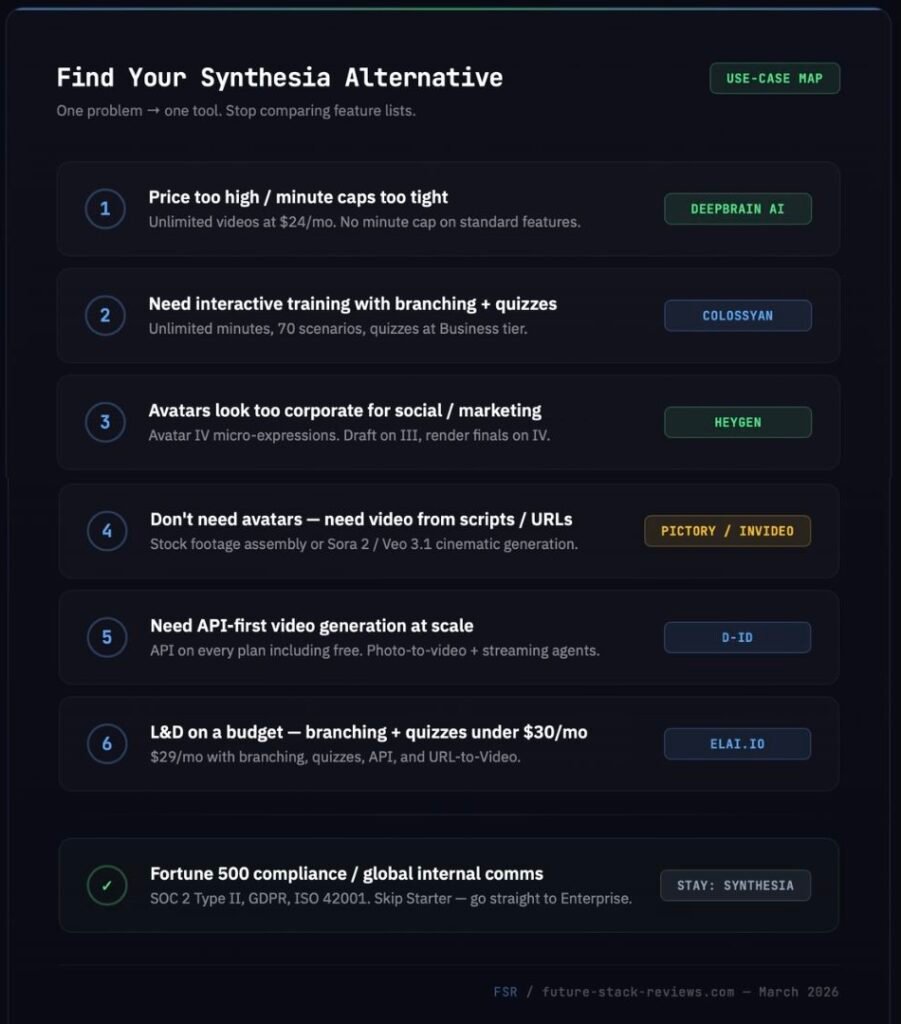
Your problem is Synthesia’s price or minute caps → D-ID Pro ($29/month) gives you 15 minutes, commercial license, API access, and voice cloning. If you just need to test ideas, D-ID’s free Trial includes API access — no other avatar tool does that at $0. For the absolute lowest entry price with commercial use, DeepBrain AI Personal ($24/month) offers unlimited video generation.
You need interactive training videos with branching and quizzes → Colossyan Business ($88/month) gives you unlimited avatar video minutes plus scenario branching and basic quizzes. Synthesia locks interactive quizzes behind Enterprise. Colossyan locks them too, but gives you branching and single-select quizzes at the Business tier. If your budget is tighter, Elai.io Creator ($29/month) includes branching and single-select quizzes with API access.
You want natural-looking avatars for marketing and social content → HeyGen Creator ($29/month). The Avatar IV model produces the most expressive, casual-feeling output in the market right now. Just know that Avatar IV burns premium credits — standard avatars are unlimited, the impressive stuff is metered. ([Read the full HeyGen Review here.] | [HeyGen vs Synthesia deep-dive])
You want to turn blogs, scripts, or URLs into video — no avatar needed → Pictory Starter ($25/month annual) gives you 200 video minutes from stock footage. InVideo AI Plus ($25/month annual) gives you access to Sora 2 Pro, Veo 3.1, and Kling 3.0 for cinematic AI-generated footage. Neither is a Synthesia replacement. They’re a different category, and recognizing that will save you months of frustration.
You need API-first video generation at scale → D-ID offers API access on every plan including the free Trial. Elai.io includes public API from Creator ($29/month). HeyGen’s API starts at Business tier ($149/month+). Pick based on your volume and quality requirements.
You want maximum output volume for the money → DeepBrain AI Personal ($24/month) — unlimited videos up to 30 minutes each, 1080p, 120 minutes of AI dubbing with lip-sync per month, and access to Sora 2 and Veo 3.1 generative models. No other tool at this price point matches the raw output capacity.
You’re a Fortune 500 running global compliance training → Stay with Synthesia. Skip Starter, skip Creator, go straight to Enterprise. (Here’s why.)
Now here’s the breakdown.
WHY EVERY “TOP 10” LIST IS FAILING YOU
Search “Synthesia alternatives” right now and open the first five results. You’ll notice three problems that every single one shares.
They compare tools from completely different categories as if they’re interchangeable. Pictory converts blog posts and scripts into stock footage videos with AI voiceover. It has no AI avatars, no lip-sync presenters, no digital twins. Listing it alongside Synthesia as an “alternative” is misleading at best. InVideo AI is a generative video engine — it plugs into Sora 2, Veo 3.1, and Kling 3.0 to produce cinematic footage from text prompts. Powerful, but it’s not an avatar platform. It’s a different product solving a different problem.
The second problem is vanity metrics. These articles treat “number of avatars”and “number of languages” as meaningful comparison points. Synthesia lists 140+ languages. HeyGen claims 175+. DeepBrain AI says 150+. These numbers tell you almost nothing about what you’ll actually experience. Synthesia’s AI dubbing on Starter and Creator plans doesn’t include lip-sync — it’s audio-only dubbing deducted from your usage cap. The lip-sync translation that makes Synthesia attractive for multinational companies is Enterprise-only — and even at that tier, it’s a paid add-on on top of custom pricing. HeyGen includes lip-sync translation on all paid plans, but it consumes premium credits that aren’t unlimited. The headline language count is marketing. Implementation details are where you win or lose money.
The Real Reason You’re Here
People don’t type “Synthesia alternatives” because they want a list of eight similar-looking tools. They type it because something specific about Synthesia isn’t working for them. Maybe the 10-minute monthly cap on Starter ran out after two training videos. Maybe the content moderation system auto-rejected a healthcare script. Maybe they need SCORM export but can’t justify an Enterprise sales conversation for a five-person L&D team. Each of those problems has a different answer, and no ranking of one through ten addresses any of them.
This article is organized around those problems. Find yours, get one recommendation, move on.
YOUR PRICE COMPLAINT IS VALID — HERE’S WHERE THE MATH ACTUALLY WORKS
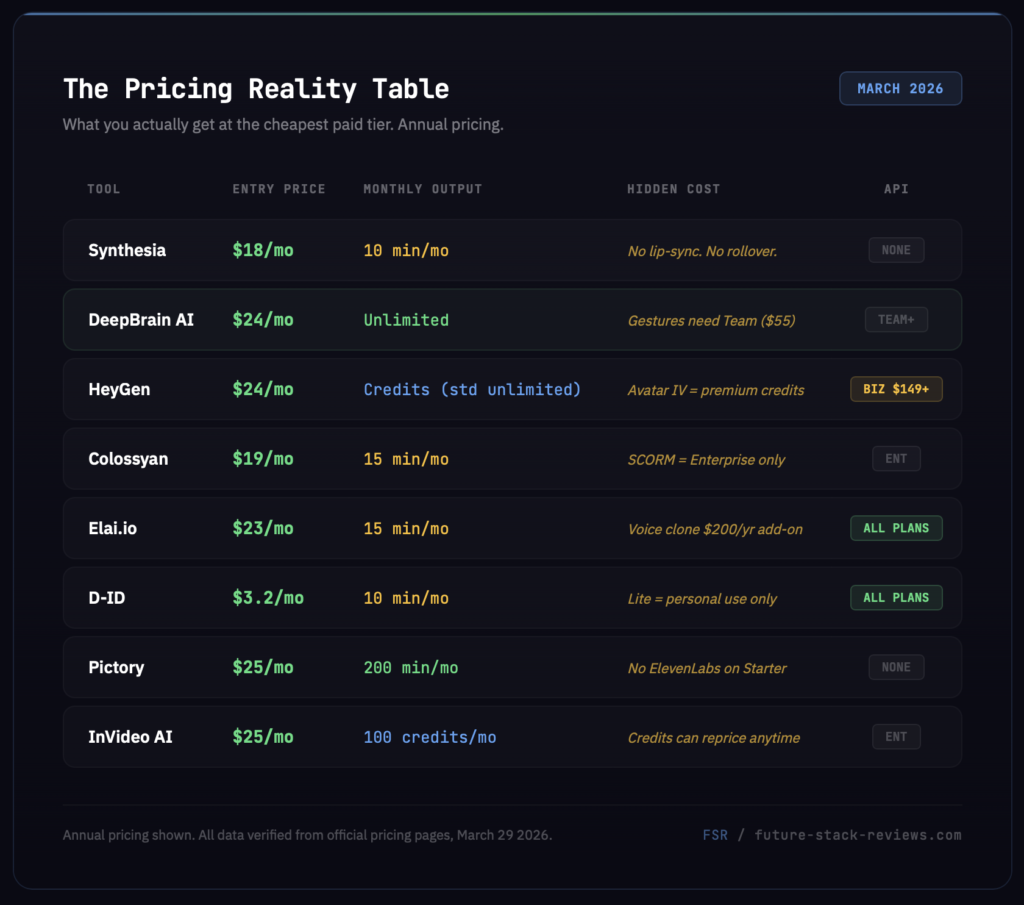
Synthesia Starter costs $18/month on an annual plan. That gets you 120 minutes per year — 10 per month, no rollover. A typical two-minute training video takes three to four rounds of iteration. Script tweaks, avatar repositioning, pacing adjustments. Each regeneration burns minutes from the same cap. In practice, Starter supports roughly three to five finished videos per month before you’re locked out.
Creator jumps to $64/month annual for 360 minutes per year. That’s 30 per month, still no rollover, and you’re now paying $768/year for what amounts to 15 polished videos monthly if you iterate normally.
If the math doesn’t work for you, two alternatives change the equation.
D-ID — More Capability Per Dollar
D-ID Pro at $29/month gives you 15 minutes per month for videos, agents, translation, and API — all from one allocation. The commercial use license kicks in at Pro (Lite at $5.90 is personal use only — a detail most review sites skip). You get 3 personal avatars, 1 voice clone, premium voices, and API access. D-ID’s approach is different from Synthesia’s studio-trained avatars. You’re animating photos rather than using pre-built presenters, which means the ceiling on realism is lower but the flexibility is higher. If your use case doesn’t require broadcast-polish avatars, D-ID gives you more capability per dollar than any other paid plan in this category.
One thing D-ID doesn’t do well: translation. Video Translate is capped at 5 minutes per video across all plans below Enterprise, with 30+ output languages versus Synthesia’s 140+. If multilingual content is your primary need, D-ID is the wrong alternative.
DeepBrain AI — The Volume Play
DeepBrain AI Personal at $24/month is the value outlier that most comparison articles haven’t caught up to. It offers unlimited AI video generation — not minute-capped, not credit-gated on standard features. Videos up to 30 minutes each. Export in 1080p. 120 minutes of AI dubbing with lip-sync per month. 100+ stock avatars, 3 custom avatars, voice cloning included. Access to generative models including Sora 2 and Veo 3.1 via 720 credits per year. And a free plan exists — 3 videos per month at 720p with commercial use rights, which no other avatar tool offers at the free tier.
The trade-offs are real. DeepBrain’s avatar quality, particularly voice realism, doesn’t match Synthesia or HeyGen on their best models. Multi-avatar scenes and gesture control require the Team plan ($55/seat/month). One-Click Translation is Team-tier and above. And the platform’s interface, while functional, isn’t as polished as Synthesia’s editor. But if your primary frustration with Synthesia is running out of minutes before running out of things to say, DeepBrain removes that bottleneck entirely.
YOU NEED TRAINING VIDEOS THAT ACTUALLY TRAIN — NOT JUST TALK
Synthesia is the default choice for corporate L&D teams, and for good reason. SOC 2 Type II. GDPR compliance. ISO 42001. The governance stack is built for Fortune 500 IT security reviews. But the features that make training videos effective — branching scenarios, embedded quizzes, interactive decision paths — are distributed unevenly across Synthesia’s tiers in ways that catch L&D teams off guard.
Synthesia now offers Interactive CTA and Branching on Creator ($64/month annual). That’s a relatively recent addition that puts basic interactivity within reach without an Enterprise contract. But Interactive Quizzes remain Enterprise-only. Brand Kits are Enterprise-only. SCORM export is Enterprise-only. If your training workflow requires learners to answer questions inside the video and you need to package the result for your LMS, you’re calling Synthesia’s sales team regardless.
Colossyan — The Middle Ground
Colossyan Business at $88/month occupies the space between Synthesia Creator and Synthesia Enterprise. You get unlimited video minutes on standard models, 170+ avatars, access to 70 avatar scenarios, and 4 interactive videos per month. Branching, buttons, and hotspots are available. Text-based quizzes with single-select and multi-select options are included at Business. The per-unit cost for interactive training content is significantly lower than reaching Synthesia Enterprise.
The limitations matter. Colossyan’s avatar quality is visibly a step below both Synthesia and HeyGen — G2 reviews consistently note that output looks more obviously AI-generated. The language count is 75+ versus Synthesia’s 140+. SCORM export is Enterprise-only at Colossyan too, which means SMB teams who need LMS packaging still face a sales conversation. And the free plan isn’t permanent — it’s a 14-day Enterprise trial with 5 minutes of generation, not an ongoing free tier.
Elai.io — L&D on a Budget
If your budget doesn’t stretch to $88/month, Elai.io Creator at $29/month is worth examining. It includes branching, buttons, hotspots, and single-select text-based quizzes on the lowest paid tier. Public API access is included. URL-to-Video conversion lets you paste a product page or blog and generate a video from the content automatically. 80+ avatars, 300+ standard voices, and the platform is now powered by Panopto — a dedicated enterprise video hosting company — which signals a serious push into L&D infrastructure.
Elai’s minutes are tight at 15 per month with no rollover. Custom avatars cost $199/year as a selfie avatar add-on, and voice cloning is another $200/year. The total cost for a team that needs customization inflates quickly beyond the $29 sticker. But for a small L&D team that needs branching and quizzes at the lowest possible entry point without committing to an enterprise contract, Elai currently has no direct competitor at this price.
YOUR AVATARS LOOK LIKE NEWS ANCHORS AND YOUR AUDIENCE CAN TELL
This is the quality complaint. Synthesia’s Expressive Avatars produce flawless lip-sync and consistent lighting. The output feels like a professional broadcast segment. But the body language is largely static — controlled, corporate, deliberate. For internal compliance training where authority matters, that’s a feature. For TikTok ads, Instagram Reels, or LinkedIn video posts where casual energy drives engagement, it’s a problem.
The most common version of this complaint on X and Reddit isn’t that Synthesia looks bad. It’s that Synthesia looks fake in contexts where authenticity matters. Users describe avatars as feeling too polished for social feeds, too rigid for marketing content, too much like a news anchor reading a teleprompter.
HeyGen Creator at $29/month is the established answer here, and the reasons are well-documented. Avatar IV uses full-body motion capture integrated with generative AI. The avatar reads script context and triggers hand gestures, weight shifts, micro-expressions, and natural movement dynamically. The result feels like a creator talking to camera rather than a presenter delivering a segment.
HeyGen — The Credit Discipline
What most reviews don’t explain clearly is the credit structure. HeyGen Creator gives you access to all premium features — Avatar IV, lip-sync video translation, the latest Video Agent model, AI-generated avatars and looks, advanced AI image and video models — but all of those consume premium credits. The standard avatar generation (Avatar III and older) doesn’t have a monthly minute cap. The premium features that HeyGen actually markets as headline capabilities run on a metered credit system.
HeyGen doesn’t publish the exact credit-per-minute conversion rate on their pricing page. The Pro plan ($99/month) gives you 10× premium usage over Creator. Business ($149/month + $20/seat) gives you 5× over base. But what “base” actually means in minutes of Avatar IV output isn’t documented publicly.
If you’re producing marketing content at volume, the practical workflow is: draft and iterate on Avatar III (unlimited), then render final versions on Avatar IV (credit-limited) only after the script, pacing, and framing are locked. That credit discipline makes Creator viable for serious social media production. Without it, you’ll burn through premium allocation in the first week.
If you want to test this workflow before committing, HeyGen’s free plan includes a digital twin and three videos per month — enough to validate the approach.
For the full credit structure analysis and the zero-waste workflow that keeps Avatar IV costs under control, read the complete HeyGen Review.For a detailed feature-by-feature comparison between HeyGen and Synthesia, [the HeyGen vs Synthesia deep-dive covers everything].
YOU DON’T ACTUALLY NEED AN AVATAR — YOU NEED VIDEO
This section exists because roughly half the tools that appear in “Synthesia alternatives” lists aren’t avatar platforms. They’re video creation tools that serve entirely different production workflows. If you’re searching for Synthesia alternatives and what you actually want is to turn a blog post into a YouTube video, or generate cinematic B-roll from a text prompt, you’re in the wrong product category. Recognizing that now saves you from subscribing to an avatar tool, struggling with talking-head limitations for three months, and then switching to the tool you should have started with.
Pictory — Stock Footage Assembly
Pictory Starter at $25/month (annual) converts scripts, blogs, and long-form content into videos using stock footage from Getty Images and Storyblocks. No AI avatar. No digital presenter. You get 200 video minutes per month — twenty times Synthesia Starter’s allocation — because stock footage assembly is computationally cheaper than avatar rendering. Pictory is built for content marketers and YouTube creators who need volume. The Pictory 2.0 update added AI credit-based avatar generation as a new feature, but the platform’s strength remains content repurposing, not presenter-led video.
The weaknesses are specific. Maximum resolution is 1080p across all tiers — no 4K. API access is unavailable on any public plan. ElevenLabs AI voices, which are noticeably higher quality than Pictory’s standard voices, aren’t included on Starter — you need Professional at $35/month. The standard AI voiceover has drawn consistent complaints about sounding robotic.
InVideo AI — Generative Cinematic
InVideo AI Plus at $25/month (annual) takes a different approach. It’s a generative video platform that gives you access to over 200 AI models including Veo 3.1, Sora 2 Pro, Kling 3.0, and Nano Banana Pro. The invideo v4 agent can generate up to 30 minutes of video from a single text prompt. This isn’t a talking-head tool — it produces cinematic, dynamic footage that can include AI avatars (4 on Plus, 16 on Max) alongside stock footage, AI-generated scenes, and visual effects.
The credit system matters here too. Plus gives you 100 credits per month. Credits don’t roll over. InVideo’s FAQ explicitly states they can update credit costs at any time without prior notice. The platform is based in India and has raised venture funding independently. Some third-party sources have reported ByteDance involvement, but this is not confirmed on InVideo’s official site — enterprise buyers with strict data governance requirements should verify the ownership structure directly before committing. The Trustpilot score of 1.2/5 is driven almost entirely by billing and cancellation complaints rather than product quality — G2 sits at 4.5/5 from over 1,600 reviews — but the billing friction is real and worth noting.
For content creators and marketers who want video that doesn’t look like a talking head reading a script, these two tools serve that need better than any avatar platform will. Just don’t call them Synthesia alternatives. They’re Synthesia exits.
YOU NEED API-FIRST VIDEO AT SCALE
If you’re building automated video pipelines — personalized sales outreach triggered from CRM data, onboarding videos generated per new employee, product demo videos assembled from URLs — the API isn’t a nice-to-have. It’s the product. And this is where the tier-gating across platforms creates real budgeting problems.
Synthesia’s API is unavailable on Starter. Creator offers read-only API access with up to 360 minutes per year deducted from the plan’s usage limits. Full write API access — the kind that lets you programmatically generate videos — requires Enterprise and a custom sales conversation.
D-ID stands alone in this category for one reason: API access on every tier, including the free Trial. That means a developer can prototype an avatar video integration, test the streaming API, validate the output quality, and build a proof of concept without spending anything. The Lite plan ($5.90/month) and Pro plan ($29/month) maintain API access with increasing minute allocations and avatar counts. For lightweight, high-volume integrations — think personalized outreach at scale or kiosk-style interactive avatars — D-ID’s API-first architecture is purpose-built.
Elai.io and HeyGen — The Other Options
Elai.io offers public API from Creator ($29/month) onward, with no tier restriction on the API itself. The minute cap (15/month on Creator, 50/month on Team) limits volume, but for teams that need API integration without an enterprise contract, Elai is one of only two public options below $100/month.
HeyGen launched its Video Agent API in February 2026, but API access starts at the Business tier ($149/month + $20/seat). For teams already investing in HeyGen for marketing video, the API extends that investment into programmatic generation. For API-first buyers evaluating from scratch, the entry price is significantly higher than D-ID or Elai.
YOU JUST WANT MORE MINUTES AND FEWER RESTRICTIONS
Some users searching for Synthesia alternatives aren’t dissatisfied with the product. They’re dissatisfied with the allocation. Ten minutes a month on Starter. Thirty on Creator. Every regeneration, every script revision, every pacing adjustment counts against the cap. Minutes that don’t roll over.
DeepBrain AI Personal ($24/month) eliminates this problem at its root. Unlimited AI video generation. Not credit-gated on standard features. Not minute-capped per month. Videos up to 30 minutes each. The allocation model is fundamentally different from Synthesia’s: instead of buying minutes you’ll burn through during iteration, you get unlimited renders and only face constraints on per-video length and premium feature access.
The generative credit system (720/year on Personal) applies to advanced models like Sora 2, Veo 3.1, and Kling — not to standard avatar video generation. AI dubbing with lip-sync runs separately at 120 minutes per month on Personal, 240 on Team. Multi-language translation starts at Team ($55/seat/month).
DeepBrain’s stock avatar library numbers 100+ on Personal with 2,000+ AI-generated avatars available across all tiers. Custom avatars: 3 on Personal, 5 on Team, unlimited on Enterprise. The platform includes 7,000+ templates and tools like URL-to-Video, Script-to-Video, and Docs-to-Video on all paid plans. Commercial use rights are included even on the Free plan.
The caveats aren’t trivial. Interactive Videos require Team ($55/seat/month). Interactive Quizzes and SCORM export are both Enterprise-only. Avatar gesture control and multi-avatar scenes require Team. The per-seat pricing on Team ($55/seat) adds up fast for larger groups. And while DeepBrain’s avatar quality has improved significantly, voice realism still trails Synthesia and HeyGen on certain models and languages — particularly English, where the bar set by competitors is highest.
But if your core problem is that Synthesia charges you for the privilege of iterating on your own content, DeepBrain removes that friction entirely.
WHEN SYNTHESIA IS THE RIGHT CHOICE — DON’T SWITCH
Not every search for alternatives should end with switching. Synthesia raised $200 million in January 2026 at a $4 billion valuation, led by Google Ventures and NVIDIA. It crossed $146 million ARR by September 2025, with over 80% of the Fortune 100 as customers. The platform’s October 2025 Synthesia 3.0 update introduced Express-2 avatars with full body movement, Video Agents for two-way real-time conversations, an AI Playground integrating Sora 2 and Veo 3.1 directly into the editor, and personal avatar creation from a single photograph. The pace of feature development is accelerating, not slowing down.
If you’re a large enterprise running global internal communications and compliance training, Synthesia is built specifically for you. The security stack — SOC 2 Type II, GDPR, ISO 42001 — passes Fortune 500 IT reviews. The content moderation system, frustrating as it can be for smaller teams in regulated industries, exists because enterprise buyers demand it. SAML SSO, SCIM user provisioning, brand kits, dedicated customer success management, priority content moderation, and unlimited minutes are all Enterprise-tier features designed for organizations that need predictability, governance, and zero reputational risk from their AI video platform.
Why the Lower Tiers Won’t Satisfy You
The Starter and Creator plans serve as functional entry points for evaluating Synthesia’s editor, avatar quality, and workflow. They’re not built for sustained production. If your organization’s use case maps to corporate training, compliance, or multilingual internal communication at scale, skip the lower tiers entirely. Go straight to the Enterprise sales conversation. The per-minute economics of Starter and Creator will frustrate you into upgrading within a quarter anyway.
Synthesia’s competitive position is strongest where creative freedom is the lowest priority. IYou don’t want wild custom avatars. You don’t need casual body language. What you need is a reliable, governance-approved video production line that outputs consistent, professional, multilingual training content across dozens of markets — Synthesia remains the category leader, and switching to save money on a $18/month plan would be the wrong optimization.
WHEN TO SKIP AVATAR TOOLS ENTIRELY
Avatar platforms solve one specific problem: putting an AI-generated human presenter in front of a camera. If your video doesn’t need a presenter, you don’t need an avatar tool. Using Synthesia, HeyGen, or any alternative to produce marketing B-roll, product demos, or YouTube content is like using a screwdriver to hammer nails. You’ll get something done, but it won’t be good, and you’ll wonder why it took so long.
What to Use Instead
For cinematic B-roll and dynamic AI-generated scenes, Runway Gen-3, Sora, and Kling are the tools reshaping what’s possible. Reddit’s AI communities are increasingly noting that dedicated avatar platforms are being squeezed by general-purpose video generation models that can produce footage making talking-head avatars look dated.
Podcast editing, documentary-style content, and screen recordings with AI polish are where Descript and CapCut are purpose-built and significantly more capable than any avatar platform’s built-in editor.
For short-form social video assembled from stock footage, the Pictory and InVideo AI options described above serve that need at a fraction of the cost and cognitive overhead.
Not every video problem is an avatar problem. And the most expensive mistake in this category isn’t picking the wrong avatar tool — it’s picking an avatar tool when you didn’t need one.
THE VERDICT — FIND YOUR PROBLEM, GET YOUR ANSWER
Stop comparing feature lists. Start with the reason you’re here.
“Synthesia costs too much for what I get” → DeepBrain AI Personal ($24/month) for unlimited generation. D-ID Pro ($29/month) for API access and photo-to-video flexibility.
“I need interactive training content without an Enterprise contract” → Colossyan Business ($88/month) for unlimited minutes and scenario building. Elai.io Creator ($29/month) for branching and quizzes at the lowest entry point.
“My avatars look too corporate for social media” → HeyGen Creator ($29/month). Use Avatar III for drafts, Avatar IV for finals.
“I don’t need an avatar — I need video” → Pictory ($25/month) for stock footage assembly. InVideo AI ($25/month) for generative cinematic content.
“I need API-first video generation” → D-ID (API on every plan, including free). Elai.io ($29/month with public API).
“I want the most minutes for my money” → DeepBrain AI Personal ($24/month). Unlimited videos. Not close.
“I’m Fortune 500 and need governance” → Stay with Synthesia Enterprise. Nothing else passes the same security reviews.
The right tool isn’t the one with the most features. It’s the one that matches the specific problem you’re solving today.
Pricing and features verified via official platform pages as of March 29, 2026. Screenshots were captured from live pricing dashboards. This article will be updated if any platform changes its pricing structure.
