Last updated: October 7, 2026
Evidence record: Starter Guide · Tier C — Document-based Research
Built from Leonardo.Ai’s public pricing page, Terms of Service (Terms), policies, Help Center (Help) and blog, plus a Canva Help page. For this guide, Future Stack Reviews (FSR) did not sign in to Leonardo.Ai, generate an image or buy a plan.
Starter Guide is the format; Tier is depth of evidence, not a rating.
- Read
- Last read October 7, 2026Asia/Tokyo
- Plan figures
- Web prices as displayed signed out, in Japan: a “$” sign, no currency code, marked “ex. tax.” Checkout wasn’t opened.
- Links
- No affiliate or referral codes in this page’s links.
Leonardo.Ai, which its Privacy Policy calls “a Canva brand,” is an AI platform for generating, editing and upscaling images and for making video. This guide is for anyone weighing it for a first work image, and covers still images on the Free plan and the paid individual (Solo) plans.
Verdict
Decide by the image, not the tool. Highlighted: Use the Free plan only for an image that can stay public and that no one needs to own or hold exclusively. Pay when the job needs something only a paid plan gives, keep a tool you have confirmed meets your requirements, and wait if the pages cited here leave open something you depend on.
FSR’s judgment, not a test result. Sources: Leonardo.Ai Privacy Policy, section 3 · Terms, clause 8.7 · Help Center FAQ
Best for, not for, and when to wait
Best for · Not for · Wait
Best for
If both apply
A first test on the Free plan
- Highlighted: the subject can be public and stay public
- no one needs to own the image or hold it exclusively
Not for
If any applies
- Free-plan work on anything that can’t be public, or that you or a client must own or keep exclusive
- Any plan: work that uses inputs you lack rights to, or impersonates or falsely portrays a real person
- Any plan: work that needs a guarantee of a unique or non-infringing image; the Terms give neither, subject to consumer law
Wait
If this applies
- Before paying, you need to know how outside model providers handle your inputs, or whether Private Mode (the paid private-generation setting) starts ON: neither is stated in the pages cited
FSR’s judgment, not a test result.
Sources: Leonardo.Ai Privacy Policy, section 3 · Terms, clauses 5.2(h)(iii), 7.2, 8.2, 8.7 and 8.9 · Pricing, FAQ · Help Center, visibility settings
At a glance
Key facts · checked October 7, 2026
- Free plan
- $0, with 150 tokens a day: usage credits, not images.
- Visibility and deletion
- Free-plan content is “publicly available by default”: other users can view it, and it can show up in search results.
- Red note: Private generation (Private Mode) and deleting generated images need a paid plan, Help says.
- Ownership
- Under the Terms, as between you and Leonardo: Free-plan output is Leonardo’s; content you create on a paid plan is yours, on conditions.
- Commercial use on Free: section 05.
- Lowest-priced paid Solo plan
- Essential: $12 a month billed monthly, or $10 a month as shown under “Pay Yearly,” both “ex. tax.”
- Help says there is currently no free trial of consumer plans.
Sources by row. Free plan: Leonardo.Ai Pricing · Visibility and deletion: Privacy Policy, section 3; Help Center FAQ · Ownership: Terms, clauses 8.3 and 8.7 · Paid plan: Pricing; Help Center FAQ
01 Before you sign up: four questions
Ask these four questions about Leonardo.Ai and about the tool you use now, and add what the job needs: accurate text, dimensions and file format. Quoted rules are Leonardo’s; the conclusions are FSR’s.
- Can the image be public? The Privacy Policy says everything you generate on the Free plan is “publicly available by default”: other users can view it, and it can show up in search results. If the image can’t be public, Free is out. An invented mug for your own blog passes this test; a client’s unreleased product doesn’t.
- Whose material, and which people, are in it? Under the Terms you warrant that you have the rights and permissions Leonardo needs to use what you submit. The Terms prohibit generating “impersonations of any real person” and content that portrays a person falsely in a misleading or defamatory way. Leave out inputs you lack rights to.
- Must you be able to delete it, own it or keep it exclusive, for yourself or a client? If any answer is yes, Free doesn’t fit: Help says deleting generated images requires a paid plan, and under the Terms, as between you and Leonardo, Free-plan output is Leonardo’s. Paying doesn’t guarantee a unique image either (section 05).
- Which email will you sign up with? Signing up with an address tied to an employer or other organization means you warrant that you have “the authority to bind” it to the Terms, and its admin may come to control the account and its content. Use a work address only if you have that authority.
Sources by question. 1: Leonardo.Ai Privacy Policy, section 3; Help Center FAQ · 2: Terms, clauses 5.2(h)(iii) and 8.2 · 3: Help Center FAQ; Terms, clauses 8.7 and 8.9 · 4: Terms, clauses 3.2 to 3.4
02 Free: 150 tokens a day, and what goes public
The Free plan costs $0 and includes 150 tokens a day, Leonardo’s usage credits; unused free tokens “do not carry over to the next day.” Highlighted: A token is not an image. Cost depends on the model and settings, and Help says you will see it before you generate, generally on the button. One example from Help: Nano Banana (Google’s Gemini 2.5 Flash Image), a model free users can use, currently costs 40 tokens an image. FSR’s arithmetic: 150 ÷ 40 = 3.75, so three such images a day with 30 tokens left, if nothing else uses tokens. Go by the cost shown, not this example.Sources: Leonardo.Ai Pricing · Help Center: Tokens FAQ, Nano Banana
Everything you generate on Free is public. Help says deleting generated images requires a paid plan, and deleting may not remove every copy, because the Privacy Policy says copies may remain “in cached and archived pages” or where other users copied or saved them. The policy also says Leonardo may analyze your content to train its models, and that content generated privately on a paid plan won’t be used for that.
Help’s example has a user copying another public image’s prompt, and Help extends Leonardo’s rights in public images to “text prompts and images you input into the services” without saying whether an uploaded image is itself shown. Put nothing in a prompt or an upload on Free that you couldn’t publish.
The advice is FSR’s. Sources: Leonardo.Ai Help Center: Commercial Usage, Private & Public Images
03 A first test on Free, if you want one
FSR hasn’t run this test. Leonardo’s blog and Help describe the path: sign up with single sign-on or email, type a prompt (Leonardo picks a model, which you can change), check the cost shown, generate, and download the image from your Library. Use an invented, unbranded subject, and treat each result as public the moment it is generated. Check the downloaded file’s format, dimensions and any watermark against the job: the pages cited don’t state a standard image download’s format or whether still images carry a watermark. Stop if the cost surprises you, a content filter blocks the prompt, or the result misses the job. The test shows nothing about private generation, paid features, ownership or exclusivity.
Sources: Leonardo.Ai blog, “Getting Started With Leonardo.Ai” · Help Center: generating images, Tokens FAQ, FAQ · Privacy Policy, section 3
04 Paying: prices, Private Mode and no free trial
The pricing page shows three paid Solo plans on monthly billing: Essential at $12 a month, Premium at $30 and Ultimate at $60, each marked “ex. tax.” Under “Pay Yearly” the cards show $10, $24 and $48 a month and no yearly total. Prices carry a “$” sign and no currency code, and FSR didn’t open checkout, so the amount charged is unconfirmed. A paid plan adds, among other things, Private Mode, deletion of generated images (Help doesn’t name the plan), ownership under the Terms (section 05), and 8,500, 25,000 or 60,000 tokens a month by plan; unused tokens go to a Rollover Bank that holds up to three months’ worth.
Sources: Leonardo.Ai Pricing · Help Center: FAQ, Tokens FAQ · Terms, clause 8.3
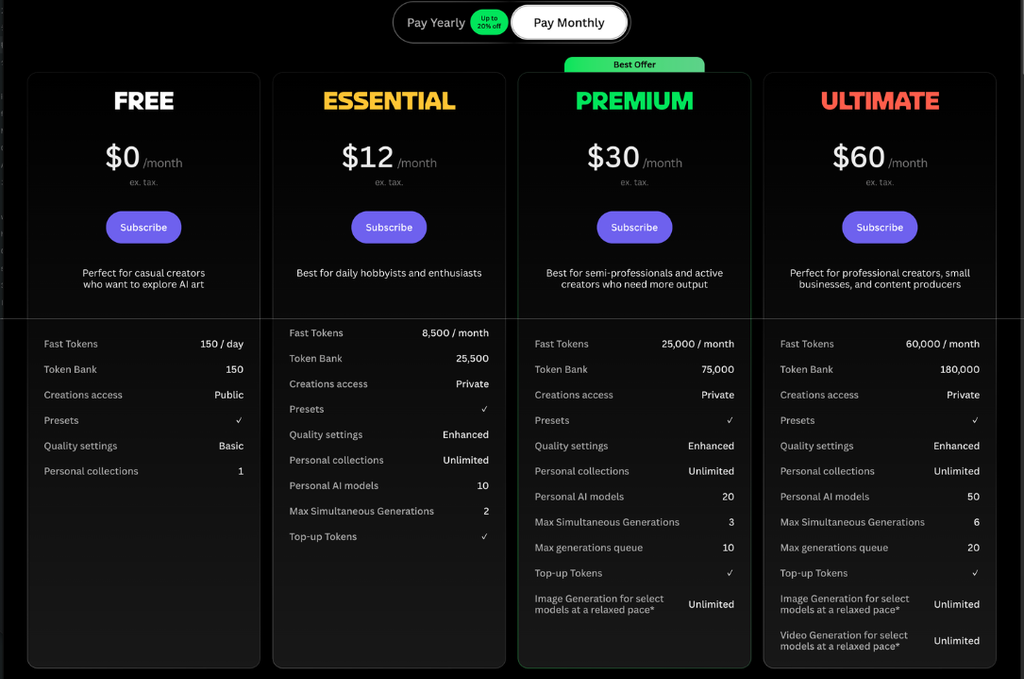
The advice is FSR’s. Sources: Leonardo.Ai Pricing · Help Center: FAQ, Commercial Usage, visibility settings
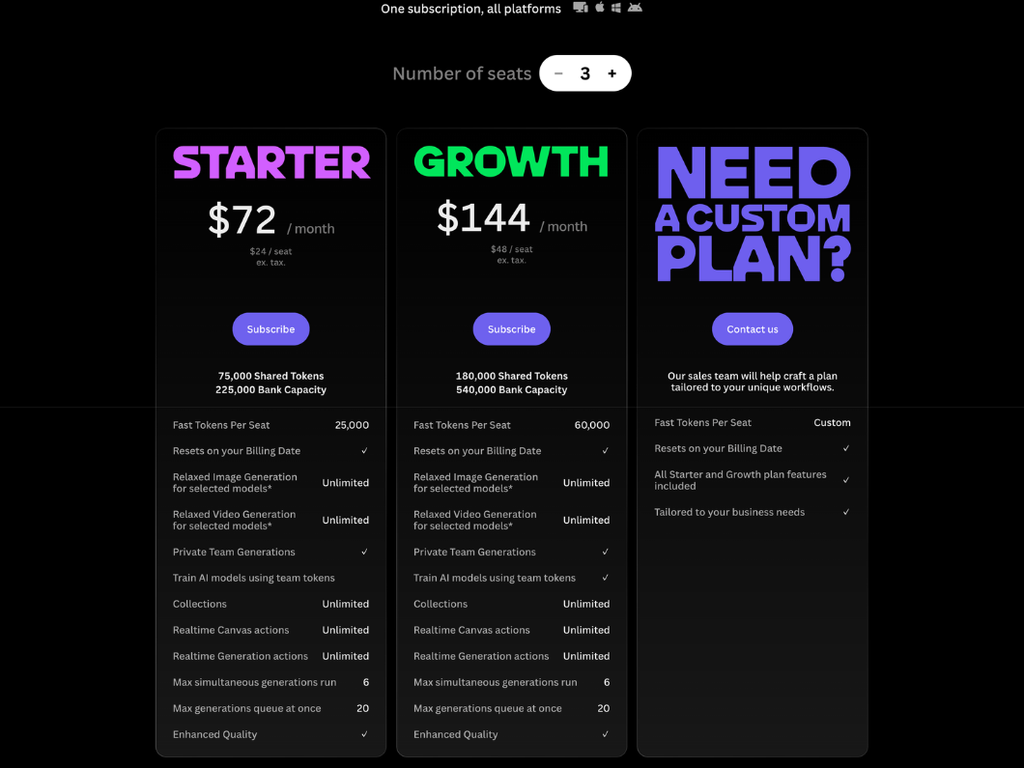
The last two sentences are FSR’s inference. Sources: Leonardo.Ai Help Center FAQ · Terms, clause 4.7 · Refund Policy · Pricing
05 Who owns the image, and commercial use
Under the Terms, as between you and Leonardo, rights in content you create on a paid subscription “will vest in you,” subject to your compliance with the Terms and to what the law permits; rights in Free-plan output “will vest in us,” meaning Leonardo. That allocates rights between the two of you; it doesn’t say whether an AI-generated image is protected by copyright where you live. The Terms add that outputs “may not be unique” and, subject to consumer law, come with no warranty that they infringe no one’s rights.
Can you use a Free-plan image commercially? Leonardo’s pricing FAQ, Help Center and a November 2025 blog post say yes, with caveats: the FAQ describes “a non-exclusive, royalty-free licence,” and the blog says “another person could use that same design” because the images are public. FSR found no clause in the full Terms that expressly grants or prohibits commercial use of Free-plan output, and doesn’t resolve the difference. If commercial use of Free-plan output, exclusivity or transferring ownership matters to the job, read the Terms themselves or get legal advice.
Sources: Leonardo.Ai Pricing, FAQ · Help Center, Commercial Usage · blog post on commercial use, November 2025 · Terms
Content that is public on a paid plan gives Leonardo a license the Terms call “irrevocable” and “perpetual,” covering AI training and “any commercial purpose”; one Help article instead ties it to “the duration that they are set to public.”
06 Canceling, and Canva Business
Help says a canceled plan stays active until the next renewal date, then changes to Free, and that any unused tokens expire at that point. Its Token Rollover article says Rollover Bank tokens “will be cancelled” if you cancel. Back on Free, Help says, the rights in what you generated privately while paying don’t change. Not stated in the pages cited: whether those images stay private, whether a paid plan’s delete and visibility tools reach images you made on Free, or whether upgrading changes who owns them.
Sources: Leonardo.Ai Help Center: canceling a subscription, Token Rollover, FAQ
If you use Leonardo.Ai through Canva Business. Canva’s Help says the Leonardo Essential access included with Canva Business ends on October 11, 2026 (23:59 UTC) for subscribers who signed up before September 9, 2026 (23:59 UTC). It also says subscriptions started on or after September 1 don’t include that access, which leaves sign-ups from September 1 to 9 unclear. Canva says images you have already created “remain yours and will be unaffected,” and that you can still use Leonardo’s Free plan, where FSR found no Canva exception to the public-by-default rule.
FSR read Canva’s page on October 7, 2026, before that end date. Sources: Canva Help Center, “Leonardo.Ai entitlement updates in Canva Business” · Leonardo.Ai Privacy Policy, section 3
07 FAQ
Is Leonardo.Ai free?
There is a Free plan: $0, with 150 tokens a day. What you generate on it is public by default, and Help says deleting generated images requires a paid plan (section 02).
Leonardo.Ai Pricing · Privacy Policy, section 3 · Help Center FAQ
Are my images private if I pay?
That depends on the Private Mode toggle, not on paying. Images generated with it ON are private, and Help says a paid user can mark a public image private later. Not stated in the pages cited: which way the toggle starts, or whether these controls reach images made on Free (sections 04 and 06).
Leonardo.Ai Help Center: FAQ, visibility settings
Can I use Free-plan images commercially?
Leonardo’s pricing FAQ says yes, under a non-exclusive license. Under the Terms, as between you and Leonardo, Free-plan output is Leonardo’s, and FSR found no clause that expressly grants or prohibits commercial use. The images are also public (section 05).
Leonardo.Ai Pricing, FAQ · Terms · Privacy Policy, section 3
Does Leonardo.Ai train on my images?
Its Privacy Policy says it may analyze your content to train its models, and that content generated privately on a paid plan won’t be used for that. How outside model providers use inputs isn’t stated in the pages cited (sections 02 and 04).
08 Methodology and limits
Starter Guide, Tier C. FSR did not use Leonardo.Ai for this guide (no sign-in, no image, no plan), so nothing here measures image quality, speed or cost.
FSR’s AI assistants, including Anthropic’s Claude and an OpenAI assistant, retrieved the pages cited on October 6 and 7, 2026 (Asia/Tokyo), signed out, and helped research and draft this guide; agreement between AI tools is not independent verification. Figures are as displayed on October 7 on a device in Japan. A person at FSR also opened ten of the 16 source pages in a browser, and the text and screenshots returned matched what the assistants had retrieved. That checks the reading, not the product. “Not stated” and “found no” cover only the pages cited, not everything Leonardo publishes. Dates here are FSR’s reading dates. Leonardo’s Terms and Privacy Policy are dated January 19, 2026; the pricing page and Refund Policy show no date.
Sources: Leonardo.Ai Terms of Service · Privacy Policy · Refund Policy · Pricing. See also: FSR Methodology · FSR Disclosure
09 Verdict
Highlighted: Decide by the image, not the tool.| Route | Choose it if | Then |
|---|---|---|
| Test on Free | The subject can be public and stay public, and no one needs to own the image or hold it exclusively | Read section 05 before any commercial use |
| Pay for a Solo plan | The job needs something only a paid plan gives: private generation, deletion, ownership under the Terms, more tokens or another paid feature | If privacy matters, check that Private Mode is ON before your first paid generation, and don’t count on a refund for a change of mind |
| Keep your current tool | You have confirmed it meets the job’s needs: accurate text, dimensions, privacy, file format and rights | Nothing more: FSR tested no tool for this guide, so it can’t say Leonardo.Ai would do better or worse |
| Wait or skip | You need something the pages cited don’t state and you can’t check first (how outside providers handle inputs, the Private Mode default), or a guarantee the Terms don’t give (a unique or non-infringing image) | This row overrides the others |
FSR’s judgment, not a test result. Sources: Leonardo.Ai Privacy Policy, section 3 · Help Center FAQ · Terms, clauses 7.2, 8.3, 8.7 and 8.9 · Refund Policy · Pricing, FAQ
This verdict could change if Leonardo changed the free allowance or the public-by-default rule, added a Terms clause granting free users commercial rights, or documented the Private Mode default or outside providers’ handling of inputs.
Where you would start
- Paid plans
- Leonardo.Ai pricing page (opens in a new tab), read with section 04.
Official Leonardo.Ai links, with no affiliate or referral code.
10 Corrections and contact
Corrections and contact
- When
- A price, rule or term here is out of date, or Leonardo documents something listed here as not stated.
- Send
- The public source URL, the passage it affects and its date, if shown.
- Do not send
- Passwords, account details, invoices, or anything personal or confidential.
Verified errors are fixed or clearly updated, not quietly removed.
Ask whether it fits you
Each button copies the briefing below and opens that assistant in a new tab; paste it there. Leave out client material, account details and anything confidential. If nothing is copied, open “What gets copied” and copy it yourself.
- ChatGPT Copy & open · OpenAI (opens in a new tab)
- Claude Copy & open · Anthropic (opens in a new tab)
- Gemini Copy & open · Google (opens in a new tab)
- Perplexity Copy & open · Perplexity (opens in a new tab)
- Copilot Copy & open · Microsoft (opens in a new tab)
- Kimi Copy & open · Moonshot AI (opens in a new tab)
What gets copied
FSR BRIEFING PACKET: What Is Leonardo.Ai? What the Free Plan Makes Public, and When to Pay or Skip It
Publisher: Future Stack Reviews (FSR). Article: https://future-stack-reviews.com/what-is-leonardo-ai/
Format: Starter Guide. Evidence depth: Tier C, from Leonardo.Ai's public pricing page, Terms of Service, policies, Help Center and blog, plus a Canva Help page. For this guide FSR did not sign in to Leonardo.Ai, generate an image or buy a plan.
Last read: October 7, 2026 (Asia/Tokyo); figures as displayed that day, signed out, on a device in Japan.
FSR used AI assistants, including Anthropic's Claude and an OpenAI assistant, to retrieve the pages and to research and draft the article.

WHAT IT IS
An AI platform for generating, editing and upscaling images and for making video. Its Privacy Policy calls the company "a Canva brand." The article covers still images on the Free plan and the paid individual (Solo) plans.

FREE PLAN
- $0, with 150 tokens a day. Tokens are usage credits, not images: cost depends on the model and settings, and unused free tokens don't carry over to the next day.
- Help says you will see the token cost before you generate, generally on the button.
- Leonardo's blog and Help describe the path: sign up with single sign-on or email, type a prompt (Leonardo picks a model, which you can change), check the cost shown, generate, and download the image from your Library. FSR has not run it.
- One example from Help: Nano Banana (Google's Gemini 2.5 Flash Image), a model free users can use, currently costs 40 tokens an image. FSR's arithmetic: 150 / 40 = 3.75, so three such images a day with 30 tokens left, if nothing else uses tokens. Go by the cost shown, not this example.
- The Privacy Policy says Free-plan content is "publicly available by default": other users can view it, and it can show up in search results.
- Help says deleting generated images requires a paid plan. Deleting may not remove every copy: the Privacy Policy says copies may remain in cached and archived pages or where other users saved them.
- The Privacy Policy says Leonardo may analyze content to train its models, and that content generated privately on a paid plan won't be used for that.
- Help's example has a user copying another public image's prompt, and Help extends Leonardo's rights in public images to the prompts and images you input. FSR's advice: put nothing in a prompt or an upload on Free that you couldn't publish.

PAID SOLO PLANS
- Monthly billing: Essential $12, Premium $30, Ultimate $60 a month, each marked "ex. tax." Under "Pay Yearly" the cards show $10, $24 and $48 a month and no yearly total. A dollar sign, no currency code. FSR did not open checkout, so the amount charged is unconfirmed.
- A paid plan adds, among other things, Private Mode, deletion of generated images (Help doesn't name the plan), ownership under the Terms, and 8,500, 25,000 or 60,000 tokens a month by plan; unused tokens go to a Rollover Bank that holds up to three months' worth.
- On a paid plan, the Private Mode toggle, not the payment, decides whether an image is public. The plan cards show "Creations access" as "Private" on paid plans, but Help's steps are to subscribe, then turn the toggle ON, and generations made with it OFF are public. Help says a paid user can mark a public image private later.
- Help says there is currently no free trial of consumer plans and suggests buying a plan to try it, then canceling. Canceling is not a refund: plans renew automatically, a cancellation takes effect when the period ends, and the Refund Policy, which lists faults and non-delivery of tokens among its grounds, says Leonardo can refuse a refund for a change of mind.
- FSR's inference: expect to pay for one billing period of the plan that includes what you need before you know whether it fits; on monthly billing that starts at $12 before tax for Essential, as displayed.

OWNERSHIP AND COMMERCIAL USE
- Under the Terms, as between you and Leonardo, content you create on a paid plan is yours, subject to complying with the Terms and to what the law permits; Free-plan output is Leonardo's. That allocates rights between you and Leonardo; it doesn't say whether copyright protects an AI-generated image where you live. Outputs may not be unique, and, subject to consumer law, there is no warranty that they infringe no one's rights.
- Commercial use on Free: Leonardo's pricing FAQ, Help Center and a November 2025 blog post say yes, with caveats; the FAQ describes a non-exclusive license, and the blog says another person could use the same design because the images are public. FSR found no clause in the full Terms that expressly grants or prohibits commercial use of Free-plan output, and doesn't resolve the difference.
- Content that is public on a paid plan gives Leonardo a license the Terms call irrevocable and perpetual, covering AI training and any commercial purpose; one Help article instead ties it to the time the images are set to public.
- Any plan: you warrant that you have the rights and permissions Leonardo needs to use what you submit; impersonating a real person, or portraying a person falsely in a misleading or defamatory way, is prohibited. A sign-up address tied to an employer or other organization means you warrant authority to bind it, and its admin may come to control the account.

CANCELING, AND CANVA BUSINESS
- Help says a canceled plan stays active until the next renewal date, then changes to Free, with any unused tokens expiring then. Rollover Bank tokens are canceled if you cancel.
- Back on Free, Help says the rights in what you generated privately while paying don't change.
- Canva Business: Canva's Help says the included Leonardo Essential access ends on October 11, 2026 (23:59 UTC) for subscribers who signed up before September 9, 2026 (23:59 UTC), and that subscriptions started on or after September 1 don't include it, which leaves sign-ups from September 1 to 9 unclear. Canva says images already created remain yours and are unaffected, and that the Free plan stays available; FSR found no Canva exception to its public-by-default rule.

NOT STATED IN THE PAGES THE ARTICLE CITES
- Whether Private Mode starts ON or OFF.
- How outside model providers keep or use your inputs (the pricing FAQ says some models run on outside providers' servers).
- Whether an image you upload on Free is itself shown (Help doesn't say).
- A standard image download's file format, and whether still images carry a watermark.
- Whether privately made images stay private once you are back on Free, whether a paid plan's delete and visibility tools reach images made on Free, and whether upgrading changes who owns them.

FSR VERDICT
Decide by the image, not the tool.
- Test on Free: the subject can be public and stay public, and no one needs to own the image or hold it exclusively. Read the commercial-use point above before any commercial use; a test shows nothing about private generation, paid features, ownership or exclusivity.
- Pay for a Solo plan: the job needs something only a paid plan gives (private generation, deletion, ownership under the Terms, more tokens or another paid feature). If privacy matters, check that Private Mode is ON before your first paid generation, and don't count on a refund for a change of mind.
- Keep your current tool: you have confirmed it meets the job's needs (accurate text, dimensions, privacy, file format and rights). FSR tested no tool for this guide, so it can't say Leonardo.Ai would do better or worse.
- Wait or skip: you need something the pages cited don't state and you can't check first (how outside providers handle inputs, the Private Mode default), or a guarantee the Terms don't give (a unique or non-infringing image). This overrides the other routes.

MAIN SOURCES (the article cites more)
- Pricing: https://leonardo.ai/pricing
- Terms of Service: https://leonardo.ai/terms-of-service
- Privacy Policy: https://leonardo.ai/privacy-policy
- Refund Policy: https://leonardo.ai/refund-policy
- Help Center FAQ: https://intercom.help/leonardo-ai/en/articles/7051613-frequently-asked-questions
- Canva Help: https://www.canva.com/help/leonardo-entitlement-update/

LIMITS
Prices, plans and terms change; verify on the official pages before you act. FSR used no Leonardo.Ai plan for this guide, so nothing here measures image quality, speed or cost, or shows what a particular account can do. Nothing here is legal advice. Where this packet and the live pages disagree, the live pages win.

Help me decide whether to use Leonardo.Ai for one work image. Open the article linked above if you can; if you can't, say so and work from this briefing. Ask what the image is for, whether it can be public, whose material or which people appear in it, whether I must be able to delete it, whether I or a client must own it or keep it exclusive, which email I would sign up with, what file format and dimensions I need, and which tool I use now. Do not ask me to paste client material, account details or confidential data.
Your assistant’s reply is its own answer, not FSR’s. Check it against the article and the Leonardo.Ai pages it cites.