
Most “my tech stack” articles stop at the recommendation. They rarely show what the author is still figuring out, what they overpay for, or which tools sit idle after the first month. This is a full operational and financial audit of every paid subscription behind Future Stack Reviews. Including the ones I haven’t mastered yet.
22 active paid subscriptions. 11 in daily or weekly production. 11 more in active skill development — paid for, not yet fully deployed. Two tools dropped in the past year.
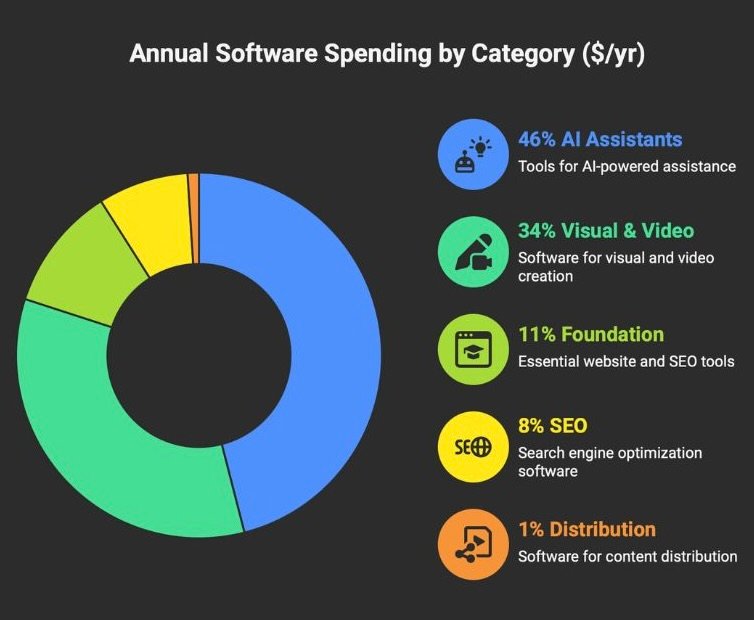
Total estimated annual software spend: over ¥700,000 (~$4,900 USD).
The six AI assistants I use most frequently generate zero affiliate revenue. Not one has a public affiliate program open to content creators.
Ground Rules
Before the breakdown, three things this article does that most stack articles don’t.
Every tool gets a verdict. Not “I love it” or “highly recommended.” Each tool is classified into one of five tiers: Essential (the operation stops without it), Useful (clear productivity gain), Luxury (nice to have, survivable without), Experimental (testing a hypothesis), or Probably Unnecessary (still paying, still questioning why).
“I use it” and “you should buy it” are separate statements. I subscribe to 22 tools. I would recommend maybe 8 of them to someone building a content site from scratch today. The gap between those two numbers is the most important thing in this article.
Affiliate status is disclosed per tool. Not in a footer. Not in fine print. Right next to the verdict, every time. Some tools here have affiliate programs. Some don’t. The ones I depend on most pay me nothing.
One more thing: this article will be re-audited. Tools that don’t earn their keep get cut. What you’re reading is the April 2026 snapshot, not a permanent endorsement.
The Full Stack
| Tool | Category | Status | Verdict | Cost | Affiliate |
|---|---|---|---|---|---|
| Claude Max | AI | Production | Essential | $100/mo | No |
| Perplexity Pro | AI | Production | Essential | ¥30,000/yr | No |
| Gemini Pro | AI | Production | Useful | ¥2,900/mo | No |
| ChatGPT Plus | AI | Production | Useful | ¥3,000/mo | No |
| Grok (xAI) | AI | Production | Useful | ¥4,661/mo | No |
| Le Chat Pro | AI | Production | Experimental | $143.90/yr | No |
| Hostinger | Hosting | Production | Essential | ¥6,948/yr (Y1) | Yes |
| Ahrefs | SEO | Production | Essential | ¥4,906/mo | No |
| Canva | Design | Production | Useful | ¥1,180/mo | Yes |
| Leonardo AI | Image Gen | Production | Useful | $30/mo | No* |
| Napkin AI Pro | Visualization | Production | Useful | ¥43,551/yr | Yes |
| AIOSEO | WordPress | Development | Useful | ¥28,800/yr (Y1) | Yes |
| Surfer SEO | SEO | Development | Experimental | Via PartnerStack | Yes |
| OpenArt | Image Gen | Development | Experimental | $174/yr (Y1) | Yes |
| Runway AI | Video Gen | Development | Luxury | ¥30,000/yr (Y1) | Yes |
| Luma AI | Video Gen | Development | Experimental | $29.99/mo | Yes |
| CapCut | Video Edit | Development | Useful | ¥2,180/mo | Yes |
| Vrew | Video Edit | Development | Experimental | ¥23,600/yr | No |
| GetResponse | Development | Useful | TBD | Yes | |
| WPForms | WordPress | Development | Useful | $199/yr | Yes |
| Akismet | WordPress | Development | Useful | ¥19,693/yr | Yes |
| Behance Pro | Portfolio | Development | Luxury | ¥11,378/yr | Via Adobe |
Production = actively used in the content creation workflow that produces published articles. Development = subscribed and available, but not yet integrated into daily operations.
Look at the Affiliate column. Nine of twenty-two tools have no affiliate program or no confirmed program. My four most essential tools are Claude, Perplexity, Ahrefs, and Hostinger. Two of those four generate zero commission under any circumstance. Ahrefs permanently shut down its affiliate program in 2015 and has publicly confirmed it will never bring it back.
When I call Ahrefs essential, that recommendation is worth exactly $0 to me.
The Foundation
Hostinger | Essential | In Production | Affiliate: Yes (40–60%)
Every page on this site loads through Hostinger’s LiteSpeed servers. The migration from a previous host cut page load times roughly in half. Premium plan pricing starts at $2.99/month on a 48-month term, which is aggressive introductory pricing. Renewal rates are considerably higher. Check those numbers before signing a multi-year commitment.
The control panel has a learning curve if you’re coming from cPanel. Took me about two weeks to feel oriented. That’s a real friction cost that most Hostinger reviews skip over.
Hostinger has an affiliate program paying 40–60% on initial sales. I’m disclosing that here, next to the tool, not in a footnote. The site runs on Hostinger regardless. Verify that with any DNS lookup tool.
The WordPress Ecosystem
The infrastructure layer running under the hood: Astra theme, Spectra blocks, LiteSpeed Cache, WP Mail SMTP with Gmail OAuth integration. None of this is exciting. All of it is functional.
AIOSEO, WPForms, and Akismet are installed and paid for on annual plans. All three sit in the Development column because I haven’t explored their full capabilities. AIOSEO handles meta titles and descriptions, but the advanced schema markup and sitemap configuration remain untouched. WPForms powers the contact page. Akismet filters spam. Functional, not optimized.
I’m paying for features I’m not using yet. In a stack article built to impress, you’d never see that sentence. But this isn’t that kind of article.
The AI Council: 6 Assistants, Zero Affiliate Revenue
This is the section where most readers will split into two camps: “that’s a serious research methodology” or “that’s subscription hoarding.” Both readings are fair. Let me explain the operating logic, and you can decide which camp you land in.
I stopped searching for one AI tool that handles everything. That search burns more time than running purpose-built tools in parallel. Each of these six has a defined, non-overlapping role.
Primary — Daily Use
Claude Max | Essential
The strategic center of the entire operation. Article architecture, long-form editorial collaboration, research synthesis, quality control. Everything flows through Claude at some point. The Max plan runs $100/month, making it my single most expensive subscription by a wide margin.
That cost is justified by extended context windows and reasoning depth that shorter-context models can’t match when you’re building 4,000-word research articles. For someone writing social posts or short-form content, Pro or even the free tier covers it.
Perplexity Pro | Essential
The factual baseline. When different AI tools return conflicting data on pricing, feature specs, or company claims, Perplexity’s cited sources break the tie. Every factual claim in every review published on this site gets cross-referenced through Perplexity before publication.
The workflow is narrow and specific: I write targeted research prompts, Perplexity returns source-verified answers, and those answers become the factual skeleton each article is built on. It’s not a writing tool. It’s a verification engine.
Secondary — Weekly Use
Gemini Pro | Useful
Competitive analysis and article structure design. When I need to reverse-engineer how the top-ranking pages for a keyword are organized—what angles they cover, what gaps they leave, how the information hierarchy works—Gemini handles that structural analysis.
A limitation worth noting: competitive data from Gemini sometimes reads as inflated. I cross-reference structural findings against what I can verify manually before building an article architecture on top of them.
ChatGPT Plus | Useful
The adversarial layer. After a draft reaches a state I’d consider publishable, ChatGPT’s job is to dismantle it. Surface weak arguments, flag missing counterpoints, find the logical gaps that the writer can’t see because the writer has been staring at the same document for six hours. I don’t use ChatGPT to produce content. I use it to stress-test content that already exists.
Grok | Useful
Social sentiment extraction from X. When I review a tool, I need to know what real users are complaining about, what they praise unprompted, and what debates are happening in threads that never surface in official marketing copy. Grok pulls those conversations. The data is rough. Engagement numbers from social platforms are directional signals, not measurements you’d put in a spreadsheet. But directional is enough when the alternative is guessing.
Specialist — Defined Role, Still Proving Its Seat
Le Chat Pro (Mistral) | Experimental
Coding assistance, data analysis, and an alternative analytical lens. This is the most recent addition to the council, and its permanent role is still forming.
Where I am with it right now: strong performance on technical tasks, notably leaner ecosystem than Claude or ChatGPT, and a favorable cost ratio at $143.90/year. But I haven’t isolated the specific workflow where Le Chat becomes the irreplaceable choice over the five other AI tools on this list. It holds its seat for now. Whether it earns a permanent one is a question for the next audit.
The Math That Matters
Six AI subscriptions. Daily to weekly use across all of them. Combined annual cost: approximately ¥400,000 (~$2,650 USD).
Affiliate revenue generated by these six tools: zero. Claude has an enterprise-only referral program closed to publishers. OpenAI, Google, xAI, Anthropic, Mistral, and Perplexity offer no public affiliate programs for content creators. When I tell you Claude is essential to this operation, there is no financial mechanism connecting that statement to my revenue.
This inverts the economics of a typical stack article. Most authors spotlight the tools that pay them commissions. My most critical tools pay nothing.
The Discovery Engine
Ahrefs | Essential | In Production | Affiliate: No (Permanently Closed)
The highest-value research tool on this list. Keyword difficulty scoring, search volume data, competitor backlink profiles, content gap analysis. My entire editorial calendar is built on data pulled from Ahrefs.
At approximately ¥4,906/month for the Starter tier, it’s a significant line item for a growing site. I tested operating without dedicated SEO tooling for three months early in this site’s life. Content strategy quality dropped noticeably.
Ahrefs closed its affiliate program in 2015. The company has published a blog post confirming it will never relaunch one. Every positive statement about Ahrefs in this article, and in every other article on this site, carries zero financial upside.
Surfer SEO | Experimental | Development | Affiliate: Yes (PartnerStack, 15–25% Recurring)
Subscribed through PartnerStack. Not yet woven into daily workflow. The NLP-driven content optimization scoring adds a layer of on-page analysis that manual keyword placement misses, and the data looks promising.
Why it’s still in development: my current publishing cadence hasn’t created enough pressure to justify adding another tool to the production pipeline. As article output scales, Surfer’s value proposition becomes more concrete.
Surfer SEO has an active affiliate program. I’m telling you that in the same breath as telling you I haven’t fully deployed it. Draw your own conclusions about which statement matters more.
The Visual Stack
Eight subscriptions across image generation, video production, data visualization, and design. This is the category with the most overlap and the most legitimate questions about redundancy. Let me address those directly.
In Production
Leonardo AI | Useful | No Affiliate Program*
Leonardo AI runs a Creator Program (LCP) for artists and filmmakers, but it’s a partnership—not an affiliate program. Applications are currently on hold with a waitlist.
Primary tool for featured article images. The Phoenix model with Cinematic preset produces consistent, controllable output. I run Prompt Enhance off and Quality mode on for nearly every generation.
I never subscribed to Midjourney. Leonardo’s daily free credits during testing and its granular control parameters made it the better operational fit from the start. Social sentiment data from X confirms this isn’t an unusual trajectory—Leonardo is increasingly positioned as the practical working alternative to Midjourney’s more artistic, less controllable output.
Canva | Useful | Affiliate: Yes (Impact)
Social media graphics and rapid brand assets. This is not my primary design tool. Most FSR visual elements are built as HTML files and captured via browser screenshot for pixel-level control. Canva fills the gap when speed matters more than precision.
At ¥1,180/month, the cost-to-utility ratio is reasonable. Professional designers will outgrow it. For a solo content operation needing consistent visual output at speed, it holds up.
Napkin AI Pro | Useful | Affiliate: Yes (25% lifetime recurring, direct)
Converts text descriptions into visual diagrams and data graphics. When I need a concept translated into a presentable visual explanation, Napkin generates a usable starting point faster than building from scratch. User sentiment across social platforms is consistent: what used to be a multi-hour design detour compresses into minutes.
In Development
OpenArt | Experimental | Affiliate: Yes (20% Recurring)
Alternative image generation platform. Subscribed to benchmark against Leonardo AI in controlled comparisons. The evaluation is ongoing and hasn’t produced a definitive conclusion yet.
Runway AI | Luxury | Affiliate: Yes (Direct Program)
AI video generation. Annual plan at ¥30,000/year. The underlying technology is impressive. The bottleneck isn’t Runway’s capability. The bottleneck is my ability to integrate video content into a primarily written review operation.
This subscription represents a bet on a future content format, not a current production need. That’s the transparent assessment.
Luma AI Dream Machine | Experimental | Affiliate: Yes (PartnerStack)
Second AI video generation tool, billed monthly at ~$30. Two video generation subscriptions while producing near-zero video content is the clearest example of “expensive homework” on this entire list.
I maintain both because the technology is evolving at a pace where today’s experimental subscription could become next quarter’s production tool. Or it might get cut in the next audit. I don’t know yet, and pretending otherwise would be dishonest.
CapCut | Useful | Affiliate: Yes (Impact, 20–35% Recurring)
Video editing. In the Development column because my video output hasn’t ramped to a level that demands dedicated editing software. When it does, CapCut is the likely editing backbone. Feature density at ¥2,180/month competes well against higher-priced alternatives.
Vrew | Experimental | No Affiliate Program
AI-assisted video editing with automatic captioning and subtitle generation. Built by a Korean company, Voyagerx. Near-zero brand recognition in the English-language creator space.
Why it’s on this list: the AI-driven caption and editing automation could compress video post-production dramatically. If that thesis holds, Vrew becomes a competitive advantage specifically because almost no Western creators have adopted it yet. That’s the bet. Whether it pays off depends on my video output actually materializing.
The Distribution Layer
GetResponse | Useful | Development | Affiliate: Yes (33% Lifetime Recurring)
Email marketing platform. Subscribed, infrastructure configured, not yet deployed for active newsletter distribution. The automation features—segmented welcome sequences, behavioral triggers, audience tagging—drove the selection over alternatives.
Why it remains dormant: content production has consumed all available bandwidth. The email system is built and waiting. Activation follows once publishing cadence stabilizes.
GetResponse offers one of the strongest affiliate structures in this entire stack: 33% lifetime recurring commissions with a 120-day cookie window. I’m providing that disclosure in the same paragraph where I admit I haven’t sent a single campaign through the platform yet.
Behance Pro | Luxury | Development | Affiliate: Via Adobe
Portfolio and creative showcase platform. Annual subscription at ¥11,378/year. In development as a potential visual portfolio for FSR’s design output. The integration with Adobe’s ecosystem is the primary rationale.
PartnerStack + FirstPromoter | Infrastructure
Not content tools. These are affiliate program management platforms that aggregate and track commissions. PartnerStack handles programs from GetResponse, Surfer SEO, and others. FirstPromoter manages one specific program. No subscription cost for joining either platform.
The Graveyard
Two tools didn’t survive.
Mootion AI Pro — Cut
Character animation and generation. The technology functions as advertised, but the use case didn’t exist in my workflow. Content operations at FSR have no recurring demand for character-based visual assets. The subscription was a capability in search of a problem. Terminated after the initial billing cycle.
DeepSeek — Cut
AI assistant with competitive technical performance. The decision to drop it had nothing to do with output quality. Data sovereignty concerns—the potential for information processed through the platform to be stored or routed through jurisdictions with materially different data governance frameworks—created a risk incompatible with operating a site that handles competitive intelligence and software evaluation data.
This was the hardest cut on the list. Not because of capability. DeepSeek performs at a level that competes with any tool in the AI section above. But trust infrastructure outweighs feature comparison when your operational model depends on information integrity. I made the security call and moved on.
Who Needs What
If you’ve read this far, you might be mapping my stack onto your own plans. Let me redirect that impulse.
Twenty-two subscriptions behind a site with forty-two published articles is not a model of efficiency. It’s the specific cost structure of building capability and content in parallel—learning tools while using them to produce reviews. That’s my situation. It’s not a template to copy.
Here’s what I’d tell someone at each budget level.
Under $50/month
Hostinger for hosting. Free tiers of Claude and Perplexity for AI-assisted research and writing. Google Analytics 4 and Search Console for data. WordPress with the free Astra theme for publishing. This produces a functional, professional-grade site. A large number of successful content operations never exceed this tier.
$50–150/month
Add one paid AI subscription. Claude Pro at $20/month would be my pick based on output quality per dollar. Consider Canva Pro for visual consistency if you’re producing social media content alongside articles. When your published library passes 30 articles and organic strategy becomes a priority, Ahrefs Starter at $29/month starts paying for itself in editorial precision.
$150–300/month
Multiple AI tools with defined, non-overlapping roles. Ahrefs as a core research platform. An email marketing tool like GetResponse. One image generation subscription. At this level, “stack” starts meaning something—tools aren’t isolated purchases, they form a connected production pipeline where each one’s output feeds the next.
$300+/month — Where I Sit
Twenty-two subscriptions, eleven in production, eleven in development. Experimental video tools, redundancy-by-design in the AI layer, capability investments that haven’t paid off yet. This spending level is rational only if testing and evaluating tools is part of your core operation. For most content creators, it’s excess.
I spend over ¥60,000 monthly on software. I am not recommending you match that number. I’m showing you the real figure so you can plan your own budget against verified data instead of the sanitized cost tables most stack articles publish.
This audit covers April 2026. The next one happens in six months. Some of these tools won’t survive it.
Disclosure: Affiliate program status is identified per tool throughout this article. Of twenty-two tools listed, nine have no affiliate program or no confirmed public program. Verdict classifications are independent of affiliate status. My four highest-rated tools include two (Claude and Ahrefs) that generate zero affiliate commission under any program structure.
