
Mureka is an AI music generator that turns text prompts, lyrics, or hummed melodies into full songs with vocals, instruments, and arrangement. It costs $7.17 a month on the Pro plan and $21.59 on Premier. Most review sites treat those as “budget” and “premium” options. They’re not. They’re two completely different products wearing the same name.
Mureka’s Pro plan ($7.17/mo) gives you MP3 downloads and commercial rights. That’s it. No stems, no MIDI export, no voice cloning, no Melody Idea, no Studio access. Every feature that separates Mureka from Suno is locked behind the Premier tier ($21.59/mo). If you just want finished songs with commercial rights, Suno Pro at $10/mo produces more polished output. If you need stems, MIDI, and DAW-ready production tools, Mureka Premier is the only AI music platform that delivers them at this price point. Buy the right tier or don’t buy at all.
What Is Mureka AI?
Mureka is built by Skywork AI, a subsidiary of Kunlun Tech (昆仑万维), a publicly traded Chinese tech conglomerate listed on the Shenzhen Stock Exchange (ticker 300418.SZ). The platform launched in 2024 and had attracted roughly 10 million users by the end of 2025. The legal entity behind it is SKYWORK AI PTE. LTD., registered in Singapore, and the terms of service are governed by Singapore law.
The name comes from “Music + Eureka.” The pitch is simple: describe the kind of song you want, and the AI composes it. Unlike most competitors that generate audio token by token, Mureka uses what it calls MusiCoT (Music Chain-of-Thought) technology. The system plans the song structure first, mapping out verses, choruses, bridges, and transitions before filling in the actual audio. Think of it as the difference between writing a novel one sentence at a time and outlining the whole story before drafting.
This architectural choice has a measurable effect. Mureka’s outputs tend to have tighter rhythmic grids and more predictable song structures than Suno, which sometimes drifts in tempo or generates structurally chaotic arrangements. On Artificial Analysis‘ music leaderboard, Mureka V8 scored above Suno V5 for both vocals and instrumentals. That benchmark result matters, but it doesn’t tell the full story. We’ll get to why.
The current model lineup includes V9 (the latest and most expressive), V8, O2, and V7.6 on paid plans, with v7.5 reserved for the free tier. Mureka also offers a text-to-speech engine, a music marketplace where users sell AI-generated tracks, and a developer API at platform.mureka.ai.
The Pricing Trap Most Reviews Miss
This is where most Mureka AI review articles fail their readers. They list the plans, describe the features, and move on. They don’t explain what happens when you pick the wrong one.
Mureka has three tiers. Here’s what each one actually includes:
Free ($0): Four songs per day. The v7.5 model only. No downloads, no commercial rights, no stems, no editing tools. Outputs generated on this tier belong to Mureka, not to you. Their terms state that free-tier content grants the user only a license for non-commercial internal use. If you create something good on the free plan and want to use it commercially, you’ll need to regenerate it on a paid tier.
Pro ($7.17/mo annual, $9/mo monthly): 5,000 Gold credits per month, roughly 500 songs. Access to V9, V8, O2, and V7.6 models. MP3 downloads, commercial use rights, reference track uploads, remix functionality, region editing, song extension, text-to-speech, cover art generation, video download, and priority queue with up to 10 concurrent generations.
Premier ($21.59/mo annual, $27/mo monthly): Everything in Pro plus stem separation (up to 12 stems), Mureka Studio access, WAV downloads, stems and MIDI export, voice cloning, Melody Idea (turn humming into a full song), and professional voice cloning. 20,000 Gold per month, roughly 2,000 songs.
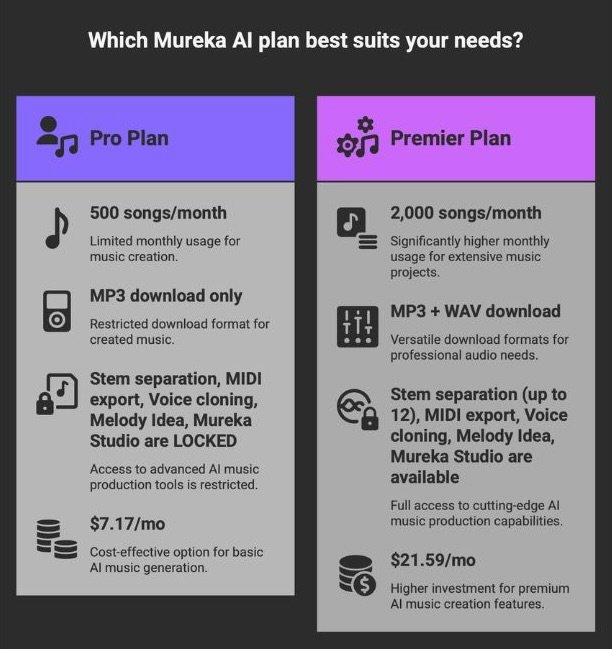
The Pro plan strips out every feature that makes Mureka worth choosing over Suno. No stems. No MIDI. No WAV. No voice cloning. No Melody Idea. No Studio. You get MP3 files with commercial rights, which Suno also offers at $10/mo with arguably more polished audio output. If you’re buying Mureka for what makes it different, the Pro plan doesn’t contain it.
The math is uncomfortable. Pro costs $86 per year. Premier costs $259 per year. That’s a $173 gap. For that difference, you get stems, MIDI, WAV, voice cloning, and Studio. If any of those matter to your workflow, Premier pays for itself quickly. A single session of stem separation from a dedicated tool like Lalal.ai can cost more than a month of Premier.
But if none of those features matter and you just want to generate songs and download them, Suno’s Pro plan at $10/mo gives you 500 songs with commercial rights, stems on some plans, and audio that consistently sounds more polished out of the box. The decision is binary: need DAW production tools, go Premier. Don’t need them, go Suno.
What Mureka Actually Does Well
The MusiCoT architecture pays off most visibly in rhythmic consistency. When you need a track that maintains a steady tempo throughout, Mureka delivers more reliably than Suno. This matters less for a pop single and more for content creators who need loops that cut cleanly in a video editor. Suno’s tempo drifts and structural surprises make its outputs harder to work with in post-production. For background music, podcast beds, and game prototyping, that structural predictability is worth more than raw audio polish.
Where the platform surprises is melody handling. The Melody Idea feature (Premier only) lets you hum or upload a short snippet, and the AI builds a complete arrangement around it. Other platforms interpret your input as a suggestion. Mureka treats it as a constraint. If you write a specific topline hook on a piano and need backing that doesn’t fight your melody, this is the only AI music tool that consistently respects your creative intent rather than overriding it.
Upload a reference track, and Mureka generates something in a similar style. Beat-making YouTubers have built tutorial content around this feature because it actually works. The reference engine captures genre and vibe with reasonable accuracy, though it won’t reproduce the exact arrangement of your source material. That gap is both a creative limitation and a legal safety net.
Stem separation rounds out the production toolkit. Premier users can split tracks into up to 12 individual stems, isolating vocals, drums, bass, and individual instruments without leaving the platform. It’s not a replacement for iZotope RX at the precision level, but for quick DAW integration where you want to tweak individual elements before mixing, it saves a step that no other AI music generator at this price offers.
Where Mureka Falls Short
Benchmark scores and real-world output quality don’t always align.
The most persistent criticism from producers is vocal integration. MusicRadar’s hands-on review noted that Mureka’s vocals feel somewhat detached from the backing track. The notes are right, but the vocal doesn’t sit in the mix the way a well-produced record should. Suno v5 and ElevenLabs Music both achieve more natural vocal embedding. This gap is narrowing with each model update, but as of V9, it remains audible on direct comparison.
Raw audio from Mureka also tends to need external EQ and mastering. Producers describe an “AI sheen” that separates the output from release-ready quality. Udio set the bar for near-radio-ready output before its UMG settlement restricted its operations. Mureka’s mixes are clean, but recognizably synthetic to trained ears. For creators who plan to import stems into a DAW and process them anyway, this matters less. For anyone expecting to download and publish directly, the polish gap is real.
Then there’s the consistency problem. Users on X and Trustpilot report Mureka generating the wrong genre, ignoring instrumental-only requests, or producing noticeably weaker tracks after the first few generations in a session. When Mureka delivers, the output is competitive with anything on the market. But the hit rate across a batch of 20 or 30 generations is lower than what you’d get from Suno, and that unpredictability erodes trust in a paid workflow.
Mureka vs Suno vs Udio: The 2026 Reality
The AI music landscape shifted violently in late 2025. In October, Universal Music Group settled its copyright lawsuit against Udio, creating a licensed partnership for commercial music generation. Warner Music Group struck a similar deal with Suno in November. Publishers like Kobalt and Merlin signed with Udio and ElevenLabs in early 2026.
The wild west era is over. The new competitive moat is major label licensing, and Mureka doesn’t have it.
A U.S. lawsuit was filed against Kunlun/Skywork over Mureka in December 2025. The complaint alleges that Mureka does not publicly disclose the specific recordings, catalogs, or datasets used to train its models. This is an active lawsuit, not an adjudicated finding. But combined with the industry’s shift toward licensed AI music platforms, it makes Mureka’s long-term legal position less certain than Suno’s or Udio’s.
Here’s how the three stack up in practice:
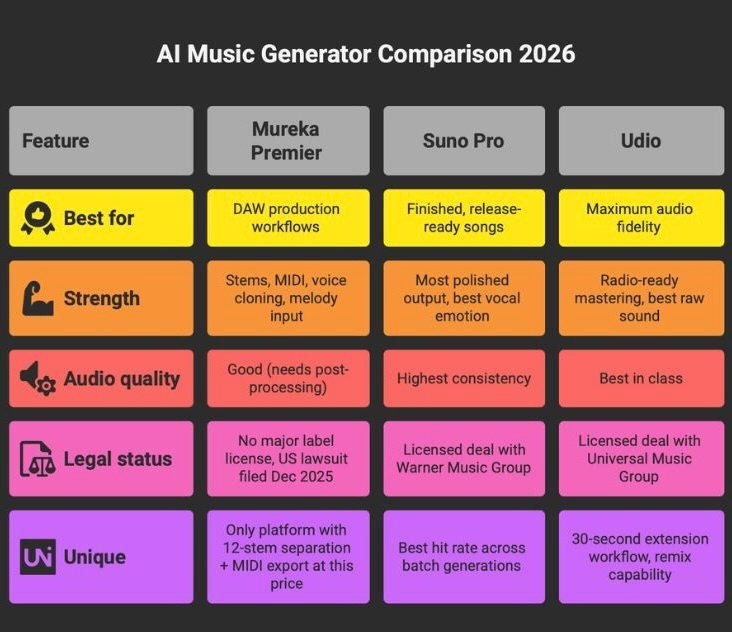
Suno is the default for most creators. V5 produces the most consistently polished finished tracks, especially for vocal-forward genres. The free tier is limited but functional, and licensing deals with WMG give it legal cover that smaller platforms lack. It falls short on production tools: no MIDI export, no voice cloning, and tempo drifts that make post-production editing unpredictable.
Udio delivers the highest audio fidelity among all AI music generators but now operates under a licensed, “opt-in” model after its UMG settlement. You get best-in-class raw audio quality and a 30-second extension workflow that lets you build tracks incrementally. The tradeoff is restricted download functionality and a free plan that barely functions.
Mureka occupies a different niche entirely. It’s the only platform offering stems (up to 12), MIDI export, voice cloning, and melody-first composition at the Premier price point. Less polished raw output and more legal uncertainty are the costs. But if your workflow involves importing AI-generated material into a DAW and building on it, no other platform gives you as much to work with.
If you’re a songwriter who works in a DAW and needs stems to build on, Mureka Premier is the most capable option. If you want finished, release-ready songs with minimal post-production, Suno is better. If audio fidelity matters above all else and you can work within licensing constraints, Udio is unmatched.
Who Should Buy Mureka (and Who Shouldn’t)
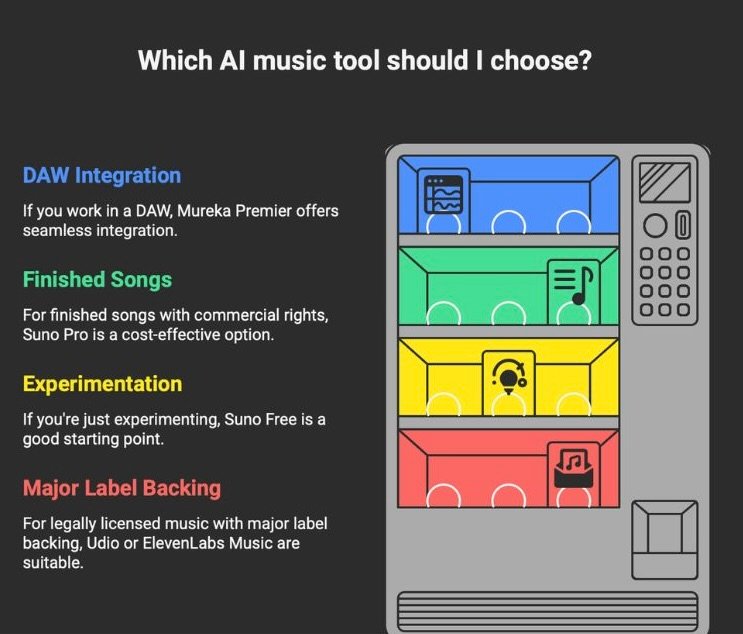
Mureka Premier makes sense for a narrow but underserved group: indie game developers prototyping adaptive soundtracks who need stems and MIDI files they can manipulate in a DAW. Songwriters who write topline melodies first and want AI to build arrangements around their input without overriding it. Podcast producers who need custom intros with individual element control. (If you need a dedicated podcast editor, see our Descript Review.) Content creators who want to isolate drums or bass from a generated track and remix them into something new.
If that’s not your workflow, you’re probably better served elsewhere. For polished, ready-to-publish songs without touching a DAW, Suno delivers more consistent quality. For hobbyists experimenting with AI music, Suno’s free tier is more generous. For legally licensed AI music backed by major label agreements, Udio and ElevenLabs Music carry less risk.
If you only need royalty-free background music without vocals, Soundful is a cheaper alternative — see our Soundful review.
And the Pro plan at $7.17/mo? Skip it. This bears repeating because the price tag makes it tempting. But it’s a stripped version of the platform that removes every feature justifying Mureka over competitors. MP3 files with commercial rights is all you get, and Suno offers the same thing with more polished output at a comparable price. Either commit to Premier or go somewhere else entirely.
Red Flags You Should Know About
Three issues deserve full transparency.
The billing experience is the biggest concern. Multiple users across Google Play, the App Store, and Trustpilot report difficulty canceling subscriptions. Complaints describe a broken cancellation page, support response times exceeding five days, additional forms required before cancellation is processed, and continued charges after cancellation requests. Mureka markets its plans with “cancel anytime” language, and the terms state cancellation is possible through app stores or Stripe at least 24 hours before renewal. The gap between that messaging and reported user experience is consistent with dark-pattern-style retention friction. Mureka’s Trustpilot score sits at 1.4 stars from 129 reviews as of early 2026, while its Google Play rating is 4.7 from 49,000 reviews. That disparity is striking, and it suggests the billing experience may differ sharply from the product experience.
Before subscribing, confirm your cancellation path. If paying through iOS, cancel via Settings → Subscriptions. If through Google Play, cancel via Subscriptions in the Play Store app. If paying via Stripe on the web, locate the cancellation option in your Mureka account settings before your renewal date. Do not rely on customer support email for time-sensitive cancellations.
Privacy is the second issue to weigh. Mureka’s policy permits cross-border data transfers to jurisdictions where its affiliates operate. Kunlun Tech is headquartered in China, so transfers beyond Singapore cannot be ruled out from the policy text alone. The terms also state that content transmitted to Mureka is treated as non-confidential and non-proprietary. Casual users won’t notice this. Professional creators uploading unreleased vocals, client stems, or proprietary material should factor it into their decision.
The third concern is legal. Mureka’s marketing references analysis of “millions of songs,” but the company has not publicly disclosed the specific recordings or datasets used to train its models. Suno and Udio faced major label lawsuits in 2024 over similar issues, but both have since secured licensing deals that partially resolve their legal exposure. Mureka has not announced comparable agreements, and a U.S. lawsuit filed in December 2025 specifically raises the training data question.
None of these red flags make Mureka unusable. They make it a product that requires informed purchasing. Subscribe through an app store for easier cancellation. Avoid uploading proprietary material you can’t afford to lose. Understand the legal landscape before building a commercial catalog on AI-generated music from any platform.
The Verdict
Mureka is the most capable AI music production toolkit available at the Premier tier. Stems, MIDI, voice cloning, melody input, and Studio access make it the right choice for creators who work inside a DAW. But the Pro plan is a trap that removes everything making Mureka worth choosing, and the platform carries real concerns around cancellation UX, data privacy, and legal uncertainty that Suno and Udio have begun to address through licensing deals. Buy Premier with annual billing for the best per-dollar value. Skip Pro entirely.
