
ElevenLabs is the best AI voice generator you can buy in 2026. The problem isn’t the product — it’s that most people buy the wrong plan, waste credits on retakes, and never learn the workflow that makes this tool pay for itself. Every other review site will tell you the voices sound amazing. We’ll tell you exactly how to buy it, how to use it, and how to avoid the mistakes that turn a powerful tool into an expensive disappointment.
TL;DR — For Busy People
ElevenLabs produces the most natural AI voices available anywhere — and it’s not close. But most buyers pick the Starter plan ($5/mo), hit its walls within a week, and either upgrade frustrated or quit thinking the product failed them. It didn’t. They just started wrong. The right move: test on Free, then go straight to Creator ($22/mo, $11 your first month). That unlocks Professional Voice Cloning, high-quality audio, and the ability to buy more credits when you need them. And before you generate anything — finish your script first. Every retake burns credits. The workflow below can cut your bill in half.
→ Skip to: The Correct Way to Buy ElevenLabs
What ElevenLabs Actually Does
ElevenLabs started in 2022 when two Polish engineers — Mati Staniszewski (ex-Palantir, ex-BCG) and Piotr Dąbkowski (Oxford/Cambridge, published at NeurIPS) — decided that AI-generated speech sounded terrible and they could fix it. They were right.
The company has raised $781 million across five funding rounds, with a $500M Series D in February 2026 valuing the company at $11 billion. Annual revenue passed $330 million by end of 2025, with a target to double that in 2026. Over 75% of Fortune 500 companies have employees using the platform. Partnerships include Square, MasterClass, BCG, NVIDIA, and Duolingo. An IPO is planned for 2028–2029.
The product covers text-to-speech, voice cloning, speech-to-text, AI dubbing across 70+ languages, sound effects, music generation, conversational voice agents, and a speech-to-speech voice changer. The flagship Eleven v3 model went generally available in February 2026 with inline emotion tags — type [whispers] or [excited] in your script and the voice responds naturally.
The product is exceptional. The question is whether you’re buying it the right way.
Why the Voice Quality Justifies the Price
Let’s start with what you’re paying for, because it matters.
Eleven v3 supports 70+ languages with inline emotion control. Tag sections of your script with [excited], [whispers], [sighs], [shouting], or [laughs] and the model responds with natural inflection. Multi-speaker dialogue mode accepts JSON input with different speakers and produces a realistic conversation. The emotional range is roughly 5x wider than the previous generation.
In streaming TTS benchmarks, ElevenLabs Flash v2.5 scored the highest audio naturalness rating (Elo score) among all tested platforms. Users consistently describe the output as closer to human speech than any competitor — breathing patterns, emotional inflection, natural pauses all land in ways that other platforms can’t match yet.
Real-world impact: creators using ElevenLabs for audiobooks, faceless YouTube channels, and podcast production report content creation speeds 10x faster than hiring voice talent. The multilingual dubbing is a particular standout — creators have produced podcasts in languages they don’t speak while preserving their own voice’s emotional characteristics. Hindi and Tamil dubbing gets strong reviews from non-English creators.
This is the tool’s core value and why it commands premium pricing. But premium pricing demands a smart buying strategy.
The Pricing Structure (And Where Most Buyers Go Wrong)
ElevenLabs splits its products into three billing categories: ElevenCreative (the main platform), ElevenAgents (conversational AI), and ElevenAPI (developer access). Most people only look at the first one.
ElevenCreative Plans
| Plan | Price/mo | Credits | TTS Minutes (Multilingual) | TTS Minutes (Flash) |
|---|---|---|---|---|
| Free | $0 | 10,000 | ~10 min | ~20 min |
| Starter | $5 | 30,000 | ~30 min | ~60 min |
| Creator | $22 ($11 first month) | 100,000 | ~100 min | ~200 min |
| Pro | $99 | 500,000 | ~500 min | ~1,000 min |
| Scale | $330 | 2,000,000 | ~2,000 min | ~4,000 min |
| Business | $1,320 | 11,000,000 | ~11,000 min | ~22,000 min |
| Enterprise | Custom | Custom | Custom | Custom |
Annual billing saves about 17% — roughly two months free.
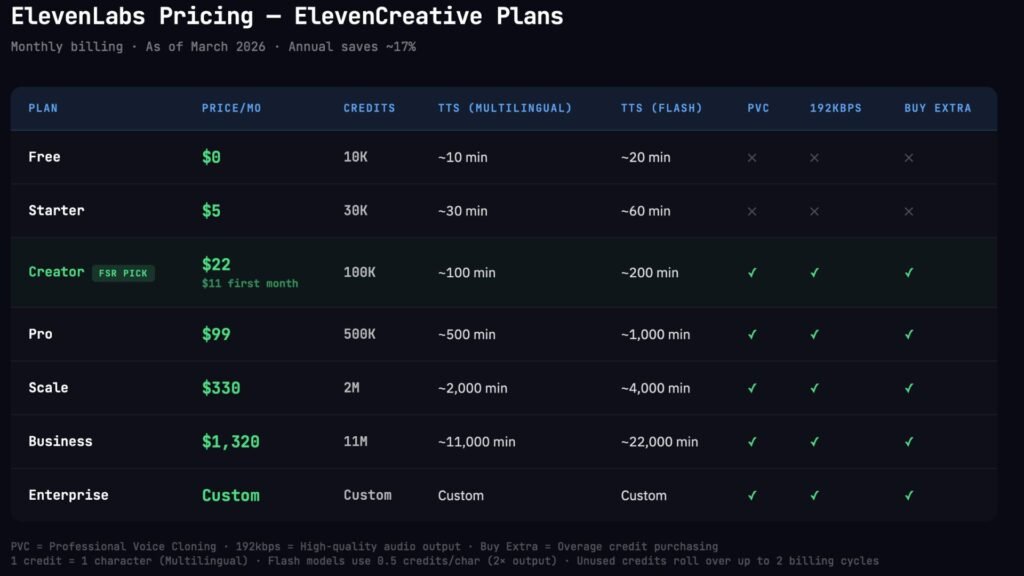
Credit math: 1 credit = 1 character with Multilingual v2. Flash models consume 0.5 credits per character, effectively doubling your output. Unused credits roll over for up to two billing cycles on paid plans.
Why Starter ($5) Is the Wrong Starting Point
This is where most buyers make their first mistake. Starter gives you a commercial license and basic Instant Voice Cloning — which sounds like a reasonable entry point for $5. But three critical features are locked out:
Professional Voice Cloning is Creator-only. Instant cloning uses ~1 minute of audio and gives you a rough approximation. Professional cloning uses 30+ minutes and produces near-perfect voice replication. If you’re building a brand voice, PVC is the feature that makes ElevenLabs worth paying for, and it requires Creator ($22) minimum.
192kbps audio is Creator-only. Starter caps you at 128kbps. The difference is audible in headphones and it matters for published content — podcasts, YouTube, audiobooks.
You can’t buy more credits on Starter. When your 30,000 credits run out, you wait until next month. On Creator and above, you can purchase additional credits. Starter users just hit a wall.
The result: Starter gives you enough to fall in love with the quality but not enough to do professional work. Most users who start on Starter either upgrade within a week or leave thinking ElevenLabs is too limited. It’s not. They just started on the wrong tier.
Overage Costs to Know About
On Creator and above, overage rates kick in when you exceed your monthly credits:
| Feature | Creator | Pro | Scale | Business |
|---|---|---|---|---|
| TTS Multilingual (per 1K chars) | $0.30 | $0.24 | $0.18 | $0.12 |
| TTS Flash (per 1K chars) | $0.15 | $0.12 | $0.09 | $0.06 |
| Dubbing (per min) | $0.60 | — | — | $0.24 |
| STT via API (per hour) | $0.40 | — | — | $0.22 |
| STT via UI (per hour) | $4.50 | — | — | $3.00 |
One thing to watch: Speech-to-Text via the web UI costs over 10x more than via the API for the same work. If you’re doing volume STT, use the API.
For Developers: API Billing Is Separate
This catches people off guard. ElevenLabs maintains a separate API pricing system from the UI plans. If you’re building a product that makes API calls, your ElevenCreative subscription credits and your API usage may be billed independently. Confirm your billing setup before shipping anything to production.
The Credit Mistake That Doubles Your Bill (And How to Fix It)
This is what separates informed ElevenLabs users from everyone else.
Credits are consumed every time you hit “Generate” — not when you export the final audio. Every generation attempt costs the same, whether you keep the result or not.
That matters because voice generation is iterative. You generate, listen, realize the emphasis is wrong, adjust, generate again. Pacing feels off — generate again. Different voice — generate again. Across user forums, the pattern is consistent: actual credit consumption runs 3–5x higher than what the minute-count math would predict, because people don’t account for iteration.
This is not a flaw in ElevenLabs. It’s how the tool works, and it’s why your workflow matters as much as your plan choice.
The fix that cuts your bill in half:
- Write your complete script in a separate editor (Google Docs, Notion, anything)
- Polish every comma and period — punctuation controls pacing, line breaks create pauses
- Read it aloud yourself to catch awkward phrasing before spending credits
- Use Flash models (0.5 credits/char) for test generations and iteration
- Switch to Multilingual only for your final generation
- Only then export
Users who adopt this workflow report 50–70% lower credit consumption compared to those who write and generate simultaneously inside ElevenLabs. It’s the single highest-ROI habit you can build with this tool.
Voice Cloning: The Feature That Justifies the Price
ElevenLabs offers two tiers, and the gap between them is bigger than you’d expect.
Instant Voice Cloning (IVC) — Available from Starter ($5). Upload ~1 minute of audio, get a clone in seconds. Good for prototyping. Not good enough for published content where listeners know the original voice.
Professional Voice Cloning (PVC) — Available from Creator ($22). Upload 30+ minutes of studio-quality audio, wait 2–6 hours, and get a clone that captures timbre, emotional nuance, and expressive patterns at near-perfect fidelity. Creator gets 1 PVC slot; Business gets 3.
Two things to know about PVC: it will clone background noise and artifacts along with your voice (studio-quality source recording is non-negotiable), and PVC is not yet fully optimized for the newest Eleven v3 model as of the February 2026 GA launch. ElevenLabs has flagged PVC+v3 optimization as “coming soon.” For now, use Multilingual v2 for your best PVC results.
Voice Verification Requirements
Following several high-profile misuse incidents (including a January 2024 case where AI-generated audio was used in voter suppression robocalls, resulting in a $6 million FCC fine), ElevenLabs now requires identity verification for voice cloning. Users must attest they own or have consent for the target voice. Executive or third-party voice clones require live microphone verification.
This adds friction to the cloning workflow, and some users find it excessive. But given the legal landscape around AI-generated voice content in 2026, a platform that takes verification seriously is one that’s less likely to face regulatory shutdowns. For professional users building long-term workflows, that stability matters.
The Models: Which One to Use When
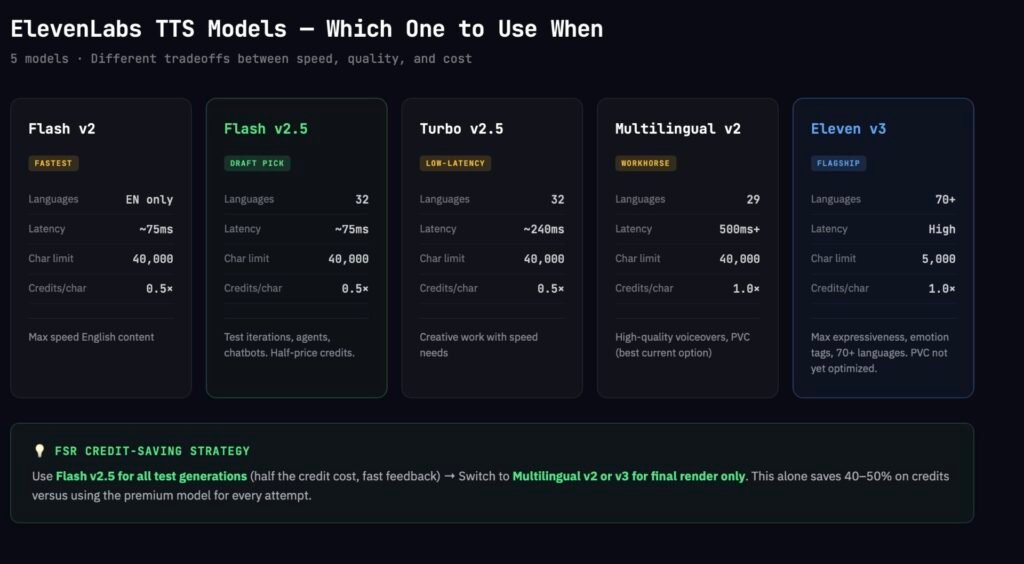
ElevenLabs has five TTS models. Picking the wrong one wastes credits and time.
| Model | Languages | Latency | Best For |
|---|---|---|---|
| Flash v2 | English only | ~75ms inference | Maximum speed, English content |
| Flash v2.5 | 32 languages | ~75ms inference | Real-time agents, chatbots, draft iterations |
| Turbo v2.5 | 32 languages | ~240ms TTFB | Low-latency creative work |
| Multilingual v2 | 29 languages | ~500ms+ TTFB | High-quality voiceovers, PVC (current best) |
| Eleven v3 | 70+ languages | Not optimized for real-time | Maximum expressiveness, emotion tags |
The smart play: use Flash v2.5 for all your test generations (half the credit cost, fast feedback loops), then switch to Multilingual v2 or v3 for your final render. This alone can save 40–50% on credits versus using the premium model for every attempt.
Note on v3: it’s the most expressive model but has a 5,000-character-per-request limit (vs. 40,000 for Flash/Turbo), which means longer scripts require more calls. And the marketed “75ms latency” is inference-only from US servers — real-world latency from Asia runs 400–600ms. Design your UX accordingly if you’re building real-time applications.
Things to Know Before You Buy
No review should hide the rough edges. These are facts, not dealbreakers — but you should know them going in.
Non-English quality varies. Default and AI-generated voices carry some English phonetic bias. ElevenLabs acknowledges this and recommends creating native-language Instant Voice Clones for best results in non-English languages. Multilingual dubbing (especially Hindi, Tamil, and major European languages) works well, but edge-case languages and accent preservation remain inconsistent.
Content moderation can be aggressive. ElevenLabs prohibits deepfakes, unauthorized impersonation, hate speech, and voter suppression content. In practice, the moderation system sometimes flags legitimate content — there was a documented case of an ALS patient in the UK being temporarily blocked for using mild colloquialisms that the system misidentified as inappropriate. The account was restored, but it highlights that automated moderation on a voice platform is still imperfect.
Voice data retention policy. ElevenLabs retains voice data for up to 3 years after your last platform interaction. Uploaded voice samples may be used for model improvement and safety research. There’s no automated self-service deletion workflow — erasure requires a manual request. Enterprise contracts can negotiate custom terms. HIPAA compliance requires the Enterprise tier with a BAA. If you’re uploading client voices or sensitive recordings, review the privacy policy first and consider Enterprise terms.
Concurrency limits. Free tier allows 4 concurrent Flash requests and 2 for other models. This scales to 30/15 on Scale and Business. Voice agents, TTS, and STT each draw from separate concurrency pools — hitting one cap blocks that feature even if others have headroom. Enterprise tier is required for meaningfully high-scale production.
None of these are reasons not to buy ElevenLabs. They’re reasons to buy it with your eyes open.
Who ElevenLabs Is Built For
YouTube/TikTok creators (faceless channels, narration): Creator plan ($22/mo). PVC lets you build a consistent channel voice. Budget for iteration — your real credit usage will exceed the simple math.Pairing with AI video? See our HeyGen review and InVideo AI review.
Developers building voice products: Pro ($99/mo) for 44.1kHz PCM output and higher concurrency. Confirm your API billing setup is aligned with your UI plan. Test concurrency limits early — the platform rejects sessions at the ceiling with no queue.
Podcast and audiobook producers: Pro ($99/mo). The volume, audio quality, and overage flexibility you need. Use ElevenLabs for generation and a DAW for final polish if you need millisecond-level control.
Enterprise/team deployments: Scale ($330/mo) minimum for workspace seats. Enterprise tier for HIPAA, SSO, custom SLAs, and elevated concurrency.
Who should consider alternatives instead: If you’re a developer comfortable with Python/Docker who generates at very high volume (100K+ daily API calls), self-hosted open-source tools like Kokoro TTS or F5-TTS can dramatically reduce per-unit costs.For a broader comparison of AI video and voice platforms, see our breakdown of 8 Synthesia alternatives. The quality gap has narrowed, though ElevenLabs still leads on expressiveness and multilingual consistency. For everyone else — especially content creators who value time-to-output — ElevenLabs remains the right tool at the right price, as long as you buy the right plan.
The Correct Way to Buy ElevenLabs
Here’s the decision tree:
Step 1: Start on Free. Generate a few clips, test different voices, confirm the quality fits your use case. Don’t pay yet.
Step 2: Skip Starter. Go to Creator ($22/mo). Use the first-month 50% discount ($11) to validate at full capability — PVC, 192kbps, overage purchasing. Starter’s limitations make it a frustrating middle ground that misrepresents what the product can actually do.
Step 3: Build the workflow before you start generating.
- Finish your script in an external editor
- Polish punctuation (it controls pacing)
- Read aloud to catch issues before spending credits
- Iterate with Flash models (half-price credits)
- Final render on Multilingual v2 (or v3 for emotion tags)
Step 4: Go annual after 1–2 months. 17% savings, no reason not to once you’ve validated your usage pattern.
Step 5: Watch for v3 PVC optimization. If you bought Creator for Professional Voice Cloning, stick with Multilingual v2 for PVC work until ElevenLabs ships the v3 optimization update.
Bottom Line
ElevenLabs is the best AI voice platform available in 2026 — and it’s the one that rewards smart buyers the most. The v3 model produces speech closer to human than anything else commercially available, across more languages than any competitor. The company is well-funded ($11B valuation, $781M raised, IPO on the horizon), actively improving, and deeply embedded in enterprise workflows from Square to BCG.
The mistake most people make isn’t choosing ElevenLabs. It’s choosing the wrong plan, skipping the workflow discipline, and burning through credits on avoidable retakes. Start on Free. Jump to Creator. Build your script before you generate. Use Flash for drafts, Multilingual for finals.
That’s how you get the most out of the best voice AI on the market.
ElevenLabs pricing and features verified against elevenlabs.io as of March 30, 2026. This review will be updated if pricing changes are announced.
