Last updated: August 23, 2026
AI avatar video platforms turn a typed script into video of a synthetic presenter. In 2026 their plans no longer share a common unit. One minute may draw from a flat allowance, a shared credit pool priced differently per mode, or several linked meters at once. This document-first briefing compares eight options by what their own pricing pages establish, what they leave to a sales conversation, and which unanswered question matters most for each. No product was tested.
Verdict in one sentence. Pick by the meter that governs the costliest part of your workflow, then treat every question the pricing page leaves open as a line item for the order form rather than a detail to settle after the first invoice.
The finding that carries this page. On HeyGen’s Creator plan, a full month of credits spent on the newer avatar engines buys exactly one maximum-length video. The allocation, the rate, and the maximum length are all on the same page.
Evidence boundary. This is a Tier C, document-first briefing. No authenticated observation of any product named here is admitted, and no account action or product test was performed. FSR opened eight vendors’ pricing surfaces, two D-ID contract documents, two vendor security pages, and European Commission material on 23 August 2026, and recorded what they displayed. Vendor statements are official claims, not independent verification of how any account is billed.
- You are converting a credit allocation into a planning figure before signing an annual plan
- Your cost driver is re-rendering after review
- You need LMS packaging and want to know which plans publish it
- You are running lip-synced localization at volume
- You are writing a procurement memo and need the open items named
- You want to know whether the avatars look convincing
- You want generation speed, failure rate, or support quality
- You want confirmation that a SCORM package runs in your LMS
- You want what a signed-in account actually shows or charges
- You want a single buy recommendation
| Review depth | Tier C, document-first |
|---|---|
| Hands-on evidence | None admitted. No account action or product test was performed |
| Direct substitutes covered | 6 |
| Adjacent routes covered | 2, in their own section and not ranked against the six |
| Observation | Japan, logged out, 23 August 2026, 13:55 to 16:43 JST |
| Metering models found | Four: shared credits, minutes split by engine, video count with side meters, prepaid per-second wallet |
| Out of scope | Signed-in screens, checkout, output quality, speed, reliability, support, LMS interoperability |
| Affiliate links | None |
| Question | What can a buyer calculate from the pages these vendors put in front of them? |
| Answer | A per-mode planning ceiling, yes. A monthly bill, no. And on two vendors, not even the ceiling without opening a second page. |
What FSR opened
Two evidence classes appear in this briefing, and the difference between them decides how much weight each figure carries.
Captured in a browser, from Japan, signed out, with the address bar and the system clock in frame on 23 August 2026: HeyGen’s pricing page, including its plan cards, its feature comparison grid, and the pricing FAQ that publishes credit rates. Synthesia’s pricing page. D-ID’s Studio pricing page. AI Studios’ pricing page. Elai’s pricing page. Colossyan, Vidnoz and Creatify were also opened in a browser and are shown below,
though those three captures do not carry the address bar and clock in frame.
Read as page text on the same date, without a browser capture: Colossyan’s pricing and security pages, Vidnoz’s pricing page, D-ID’s API pricing page, D-ID’s End User Agreement and Products Terms of Use, Synthesia’s trust center, Creatify’s pricing page, and European Commission material on the AI Act.
Where a figure comes from the first class, this briefing says the page displayed it. Where it comes from the second, this briefing says FSR read it. Material FSR did not open at all sits in section twelve and supports nothing above it.
Sources: HeyGen pricing page, observed 23 August 2026 · Synthesia pricing page, observed 23 August 2026 · D-ID Studio pricing page, observed 23 August 2026 · AI Studios pricing page, observed 23 August 2026 · Elai pricing page, observed 23 August 2026
A minute is not one unit
A plan price is useful only when a buyer can map it to a defined amount of work. Across these eight products the mapping breaks in four different ways, and the word “minute” carries four different economic meanings.
| Shared credit pool | Synthesia, HeyGen, Vidnoz. One balance funds generation, dubbing, translation, and asset creation at a different rate for each. |
|---|---|
| Minutes split by engine | Colossyan meters its NEO and NEO2 engines as separate monthly allowances. Elai meters rendering minutes. |
| Video count with side meters | AI Studios places no cap on the number of videos, then meters duration, dubbing minutes, generative credits, and priority processing separately. |
| Prepaid per-second wallet | HeyGen’s developer documentation prices API generation per second against a prepaid balance rather than plan credits. |
The unit worth comparing is therefore not the generated minute. It is the cost per approved, distributable minute after revisions, translation, and entitlement gates. No pricing card publishes that number, and nothing in this briefing produces it either. What the next four sections do is show where the published figures and the usable ones diverge.
Sources: Colossyan pricing page, read 23 August 2026 · AI Studios pricing page, observed 23 August 2026 · HeyGen developer documentation, read 23 August 2026 · Vidnoz pricing page, read 23 August 2026
HeyGen: a month of credits, one video
Three numbers on HeyGen’s pricing page, all captured in a browser on the same day, meet at an uncomfortable place.
The Creator plan card publishes 600 credits per month at $29. The feature comparison grid sets that plan’s longest single video at 30 minutes. The pricing FAQ lists Avatar IV and Avatar V at 20 credits per minute.
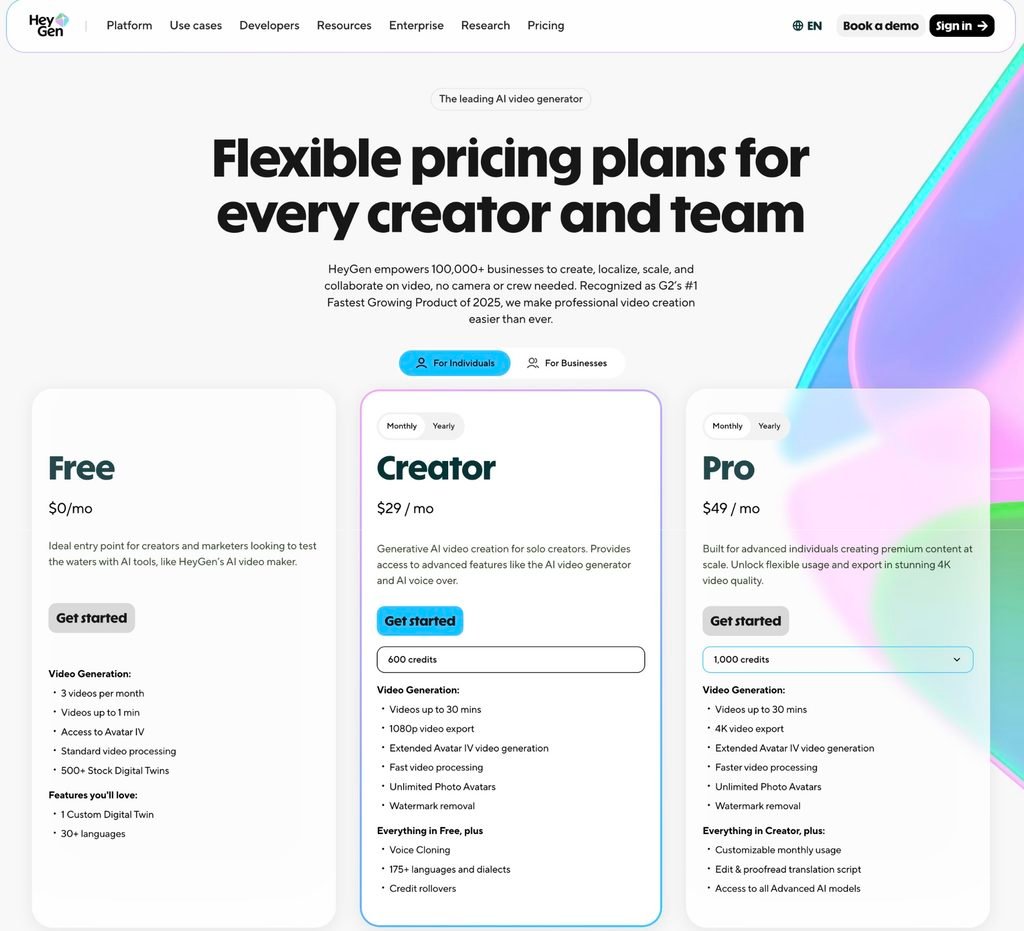
| Workflow, as listed in the pricing FAQ | Credits per minute | Minutes if the whole month goes to it |
|---|---|---|
| Avatar III | 3 | 200 |
| Audio dubbing, no lip sync | 2 | 300 |
| Full video translation, with lip sync | 5 | 120 |
| Avatar IV or Avatar V | 20 | 30 |
| Video Agent | 20 | 30 |
Allocation and rates displayed on HeyGen’s pricing page to this observer on 23 August 2026. The division is ours. Each figure assumes an entire month funds one workflow, which no real schedule does, and establishes nothing about rounding, retries, failed jobs, or output a buyer would accept.
The Avatar IV row equals the plan’s maximum video length. A Creator subscriber working only in the newer engines has a monthly allocation of exactly one maximum-length video, before a single revision.
The spread between the top row and that one is the other thing to carry away. Moving from Avatar III to Avatar IV multiplies credit consumption by roughly seven for the same running time, and the same page markets Avatar IV access on every tier including Free. A buyer who assumes the newer engine and budgets at the older engine’s rate is out by that factor.
Two other rules from the same FAQ set the edges of the cycle. Creator and Pro subscribers who run out move to a higher plan or tier; only Business can buy a one-off credit pack or enable automatic reload. Unused monthly credits carry into the following month, annual credits accumulate until the annual renewal date, and credits do not carry over after cancellation.
There is a second meter FSR has documented separately. HeyGen’s API pricing page states that the authentication method decides which balance is charged: OAuth-based MCP usage draws on the web plan’s premium credits, while API-key usage for Skills and the direct API draws on a separate API dashboard balance. The page publishes no conversion between the two, so the cheaper route for a given workload cannot be read off it. That finding is set out in full in FSR’s HeyGen pricing briefing.
Sources: HeyGen pricing page, plan cards, feature grid and pricing FAQ, observed 23 August 2026 · FSR, HeyGen Pricing and Credits, 28 July 2026
Synthesia: what the word “or” is carrying
Synthesia’s annual plan cards, as displayed, publish a credit balance and a usage line for each tier. Starter reads 14,500 credits per year, usable for up to 120 minutes of video or AI Dubbing per year. Creator reads 44,000 credits per year, usable for up to 360 minutes of video or AI Dubbing per year.
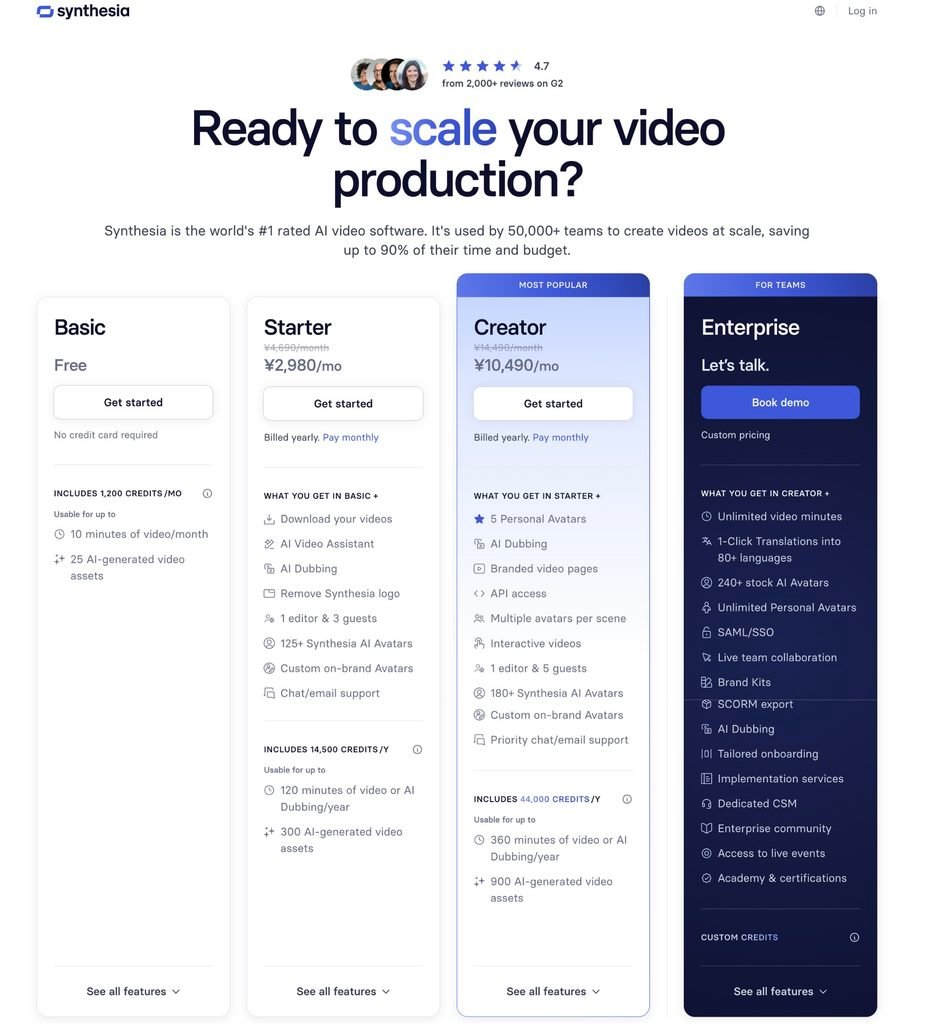
The load-bearing word is or. It is one shared allowance offered as alternatives, not two separate budgets. A team that dubs is spending the same balance it would have spent generating.
How far that balance goes depends on the mode, and the rates are published on a second surface. Synthesia’s knowledge base, which FSR read as page text rather than capturing in a browser, states that each second of video uses two credits, making one minute of standard video 120 credits. The same article lists AI Dubbing with lip sync at 240 credits per minute, dubbing without lip sync at 120, Bulk Personalization at 90, and API usage at 75.
| Plan | Balance on the card | Usage line on the card | Lip-synced minutes the balance funds |
|---|---|---|---|
| Starter, annual | 14,500 credits | Up to 120 minutes of video or AI Dubbing | 60.42 |
| Creator, annual | 44,000 credits | Up to 360 minutes of video or AI Dubbing | 183.33 |
Balances and usage lines displayed on Synthesia’s pricing page to this observer on 23 August 2026. The 240-credit lip-sync rate was read from Synthesia’s knowledge base, which FSR did not capture in a browser. The division is ours, and describes a planning ceiling rather than any account’s deductions.
Lip-synced dubbing spends the balance at twice the standard rate, so the annual allowance funds roughly half the minute figure printed beside it. Synthesia does not conceal the rate. The comparison grid carries a note that Lip Sync uses double credits when enabled, and the knowledge base publishes the number. Neither surface states the lip-synced minute figure next to the allowance, and lip-synced localization is a common reason for buying in this category at all.
Two operational rules from the same knowledge base compound this. Unused credits reset at the start of the billing period with no accumulation, and self-serve accounts have no mid-cycle top-up. A team approaching its limit either upgrades or waits, and upgrading resets the balance to the new plan’s allocation rather than carrying the remainder forward.
The plan cards also place the feature gates. The Creator card lists API access, multiple avatars per scene, and interactive videos. The Enterprise card lists SAML and SSO, brand kits, one-click translation into 80 or more languages, and SCORM export. Both were displayed on the page.
Sources: Synthesia pricing page, annual view, observed 23 August 2026 · Synthesia Knowledge Base, self-serve credits, read 23 August 2026
SCORM access is not LMS compatibility
For teams delivering through a learning management system, SCORM is a material entitlement gate. A line on a pricing page does not establish that the exported package will run in a specific LMS.
| Product | Lowest plan listing it | Package detail on the page | Evidence class |
|---|---|---|---|
| Colossyan | Professional, $59/mo billed yearly | Five exports per month, streaming. Enterprise adds unlimited streaming plus self-contained. | Page text |
| Vidnoz | Starter, $19.99/mo billed yearly | None. Listed as a plan bullet only. | Page text |
| Synthesia | Enterprise, quote only | None. Listed on the Enterprise card. | Browser capture |
| Elai | Enterprise, quote only | None. The grid also places Panopto Integration on Enterprise. | Browser capture |
| AI Studios | Enterprise, quote only | None. Listed under Exclusive to Enterprise with SAML SSO and Interactive Quizzes. | Browser capture |
| HeyGen | Not established | A Learning and Development section listing SCORM Export exists in the feature grid. FSR captured the individual-plan tab and did not resolve which tier carries it. | Unresolved |
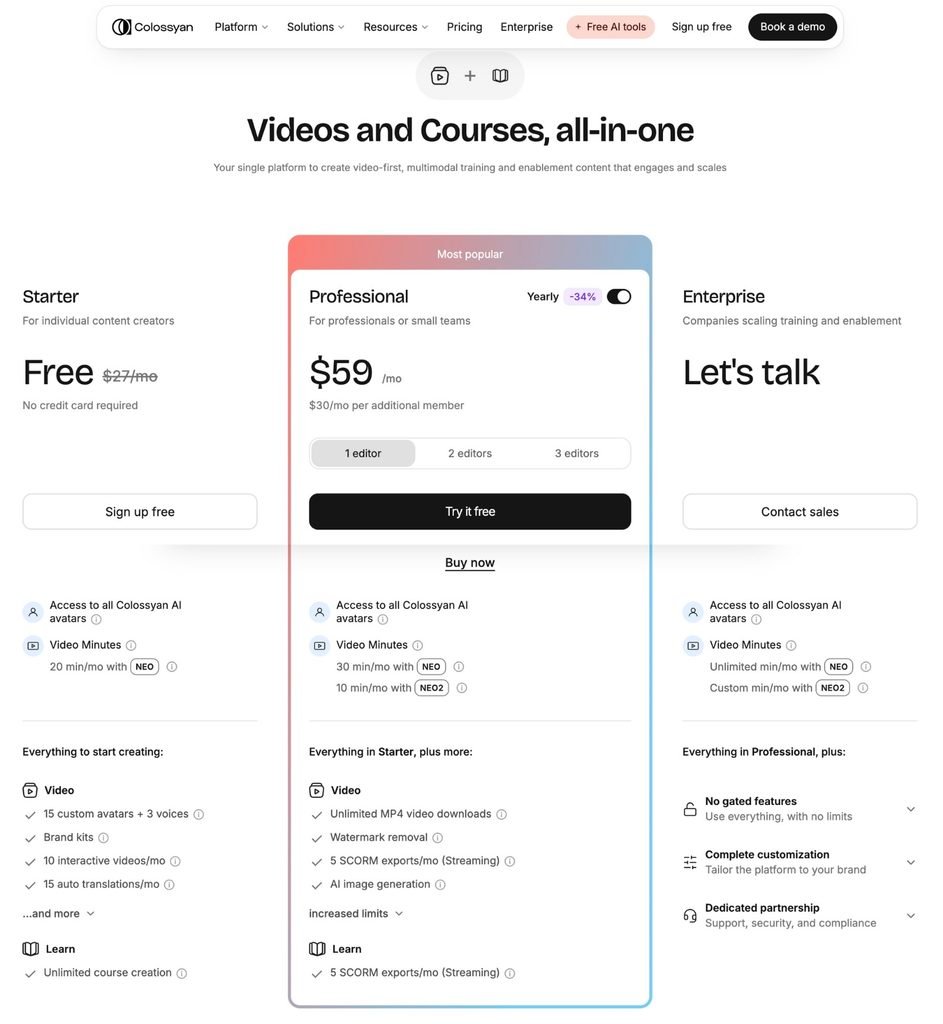
The pattern is not that SCORM ranges from twenty dollars to a sales call. A quote-only plan is a procurement state, not a price, and the implementations are not proven equivalent. The pattern is that one named capability sits on a self-serve plan at Colossyan and behind Enterprise at Synthesia, Elai, and AI Studios, while only Colossyan states what kind of package it produces.
Elai deserves a specific note. It has been owned by Panopto, an enterprise video platform, since October 2024, and that relationship is a common reason it reaches L&D shortlists. On the page as displayed, both SCORM Export and Panopto Integration sit above the $125 Team plan.
Before treating any plan as an LMS solution, ask for SCORM 1.2, SCORM 2004, or both; streaming or self-contained packaging; completion and pass-fail behavior; quiz result reporting; translated package handling; package update behavior after the source video changes; xAPI or cmi5 support; and a sample package you can load into your own LMS.
Sources: Colossyan pricing page, read 23 August 2026 · Vidnoz pricing page, read 23 August 2026 · Synthesia pricing page, observed 23 August 2026 · Elai pricing page, observed 23 August 2026 · AI Studios pricing page, observed 23 August 2026 · Panopto newsroom, 23 October 2024
Where upgrading does not lower the unit rate
A larger plan usually lowers the price per unit. On two of these pricing pages the average included-unit rate rises with the tier, and both vendors print the figure themselves.
Elai’s cards show Creator at $29 per month for 15 minutes with a printed rate of $1.93 per minute, and Team at $125 per month for 50 minutes with a printed rate of $2.50 per minute. Vidnoz’s cards on the annual view show Starter at $19.99 per month for 450 credits with a printed rate of $0.04 per credit, and Business at $56.99 per month for 900 credits with a printed rate of $0.06 per credit.
The monthly view prints $26.99 and $0.06 for Starter and $74.99 and $0.08 for Business, so the inversion holds on both billing cadences.
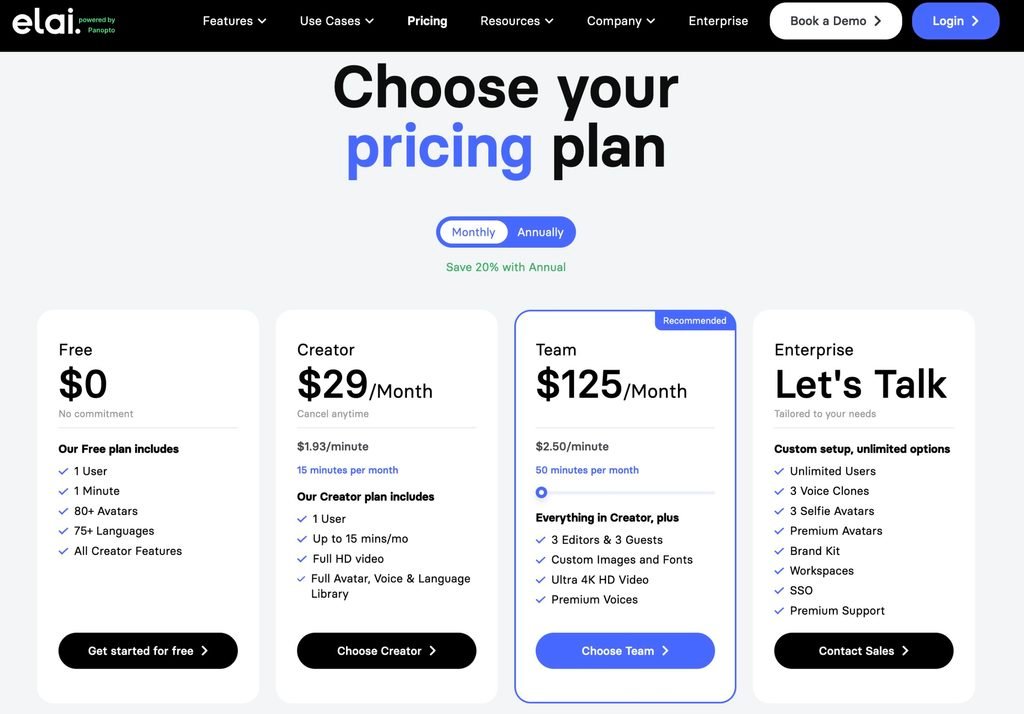
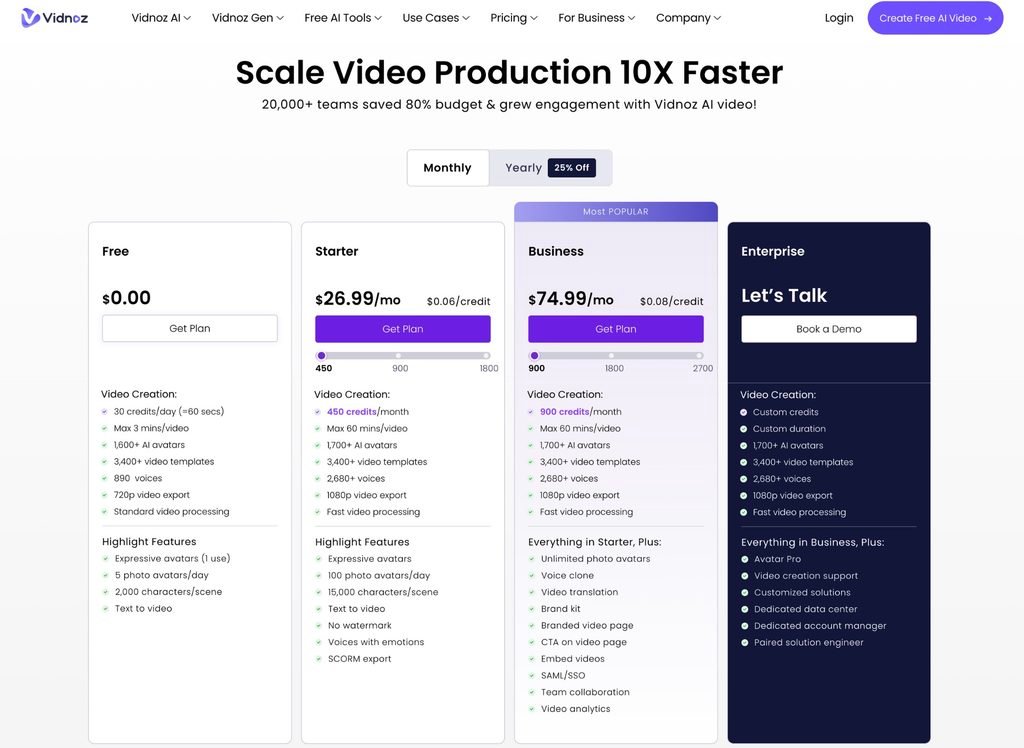
The measure is the average price of an included unit, and that is the whole claim. It differs from the marginal price of an extra unit: Elai separately sells top-up minutes at $2 each, below the Team card’s included rate. The higher tiers also bundle capabilities a minute does not measure, including additional editors and guests, 4K output, premium voices, brand kits, voice cloning, translation, SSO, and analytics.
Upgrading can still be the right move at either vendor. What it is not, on these two pages, is a volume discount.
Sources: Elai pricing page, observed 23 August 2026 · Vidnoz pricing page, annual view, read 23 August 2026
The six direct substitutes
Each of these generates a synthetic presenter from text, publishes a price, offers commercial use on some published plan, and showed 2026 activity. The matrix is the comparison. The notes after it cover only what a table cannot hold.
| Product | Entry paid plan | Meter | Rollover | Re-render rule as published | Commercial use from |
|---|---|---|---|---|---|
| HeyGen | Creator $29/mo, 600 credits | Shared credits, 2 to 20 per minute by workflow | Yes. Monthly carries one cycle, annual accumulates to renewal, none after cancellation | Not stated on the pages opened | Not stated as a labeled gate |
| Colossyan | Professional $59/mo yearly, 30 NEO + 10 NEO2 min/mo | Minutes, metered separately per engine | No | Deleting a generated video does not return minutes | Not stated as a labeled gate |
| Vidnoz | Starter $19.99/mo yearly, 450 credits/mo | Credits. 0.5 per second standard, 2 per second Expressive and Product Avatar | Not stated on the page read | Not stated on the page read | Free tier carries a watermark; Starter removes it |
| Elai | Creator $29/mo, 15 min/mo | Rendering minutes | Not stated on the page opened | Every Render click consumes minutes again; deleting does not restore them | Not stated as a labeled gate |
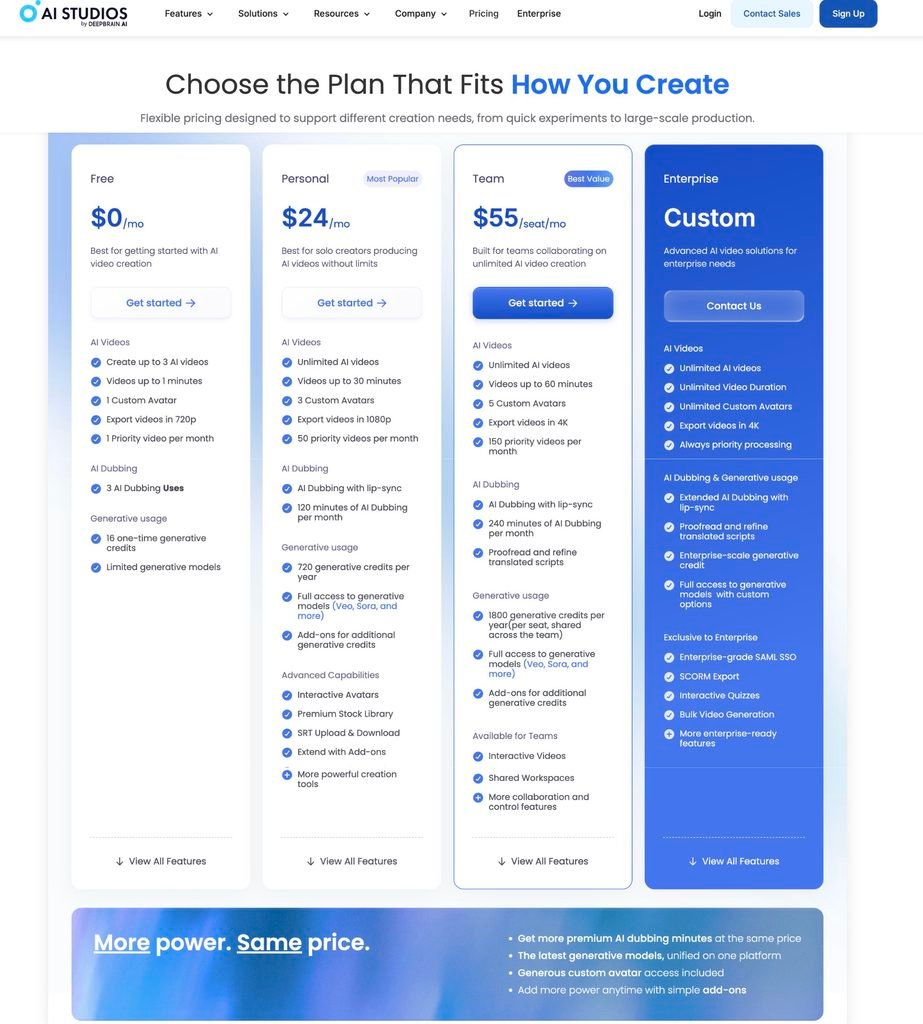
| AI Studios | Personal $24/mo on the annual view | Video count uncapped; duration, dubbing, generative credits and priority queue each metered | No. Dubbing minutes reset monthly even on annual plans | Not stated on the page opened | Commercial Use Rights appears as a grid row |
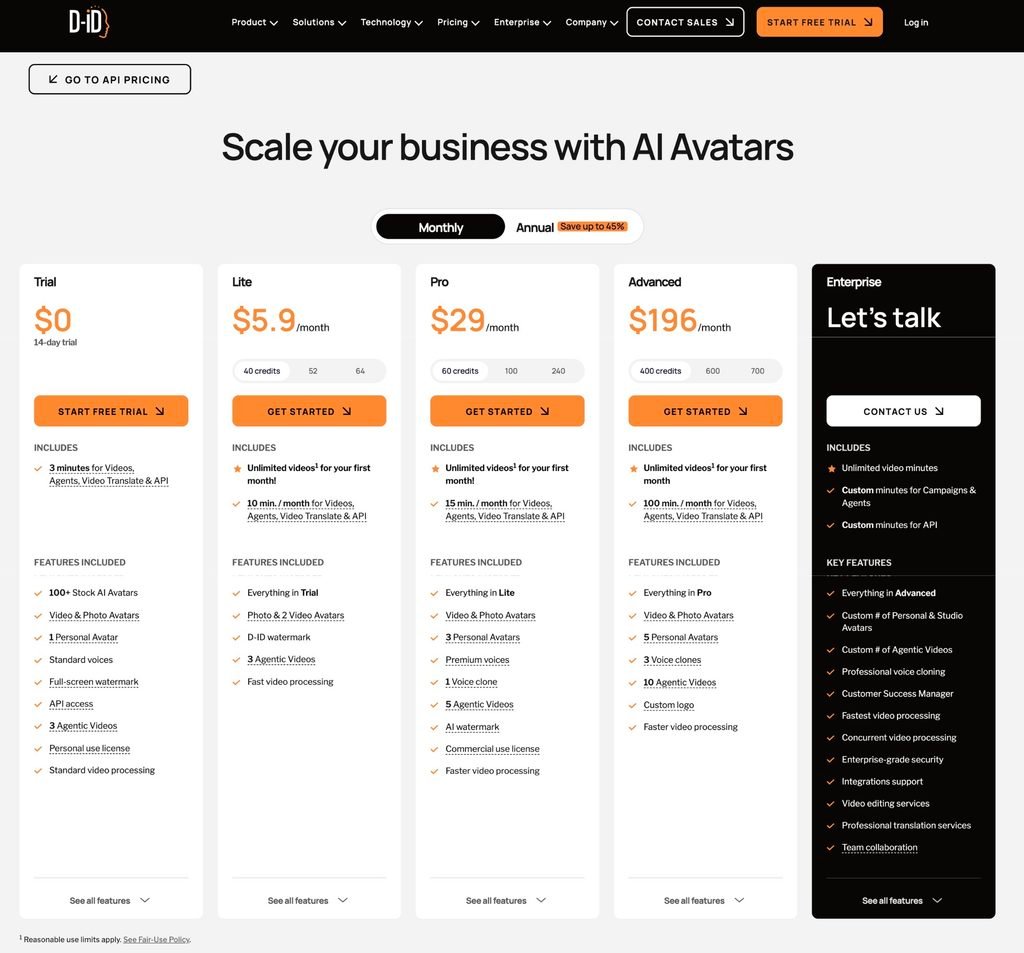
| D-ID | Studio Lite $4.70/mo yearly, 10 min/mo | Minutes, rounded up to the nearest 15 seconds. API draws the same balance | No. Minutes do not accumulate and unused minutes become void | Not stated on the pages opened | Studio Pro $16/mo. Lite is personal use only |
Every cell read from a vendor page on 23 August 2026. “Not stated on the page” means the field was absent from the surfaces FSR opened, not that the behavior does not exist.
HeyGen has the closest published feature mapping to Synthesia among these six. Its individual tiers run Free, Creator at $29 with 600 credits, and Pro from $49 with 1,000 credits scaling to 100,000 at $4,300. Business is listed at $149 per month plus $20 per additional seat with 1,500 credits. Check an in-product estimate before an annual commitment, for the reason set out in section three.
Colossyan publishes more operational detail on public pages than the others here: named SCORM package types, a 99.9 percent uptime commitment with a recovery time and recovery point objective of one hour, AWS regions in the EU and US, and a statement that its AI vendors are contractually prohibited from training on Colossyan input. On the EU AI Act it says its practices follow the transparency and risk management principles of the regulation, which stops short of asserting compliance. Capacity is the constraint. NEO2 is capped at 10 minutes per month on Professional, and an extra 600 NEO2 minutes costs $1,500 per year.
Vidnoz lists SCORM on its entry paid plan, which no other vendor here does. Its credit rates are printed: 0.5 credits per second for standard generation and 2 per second for Expressive Avatar. At the second rate, Starter’s 450 monthly credits fund 3.75 minutes of Expressive Avatar output, while the comparison grid lists up to 15 minutes of it. FSR could not reconcile those two figures from the page, and the page also references daily bonus credits whose value FSR did not establish. Confirm both in an account before relying on the Expressive Avatar allowance.
Elai converts scripts, URLs, PowerPoint files, and PDFs into avatar video with interactive playback. Beyond the sticker, price the add-ons: a studio avatar is $500 per year, a selfie avatar $199, and voice cloning $200, with one selfie avatar and one voice clone included on an annual Team subscription. Its FAQ states that minutes are consumed on every Render click including re-renders of the same video, and that deleting projects does not restore them. Top-up minutes are $2 each. Its terms state that data for cancelled users is stored for one year from the cancellation date.
AI Studios is the only product here that does not cap video count, and its FAQ qualifies that directly: unlimited means no limit on the number of videos, while length, dubbing usage, and generative credit consumption remain subject to plan limits. Two meters are linked. Dubbing usage beyond the included minutes is deducted from generative credits. Priority processing is itself rationed at 1, 50, and 150 videos per month across the tiers, which prices queue position rather than capability.
D-ID separates Studio and API into two priced ladders, which makes its developer route easier to identify than a single blended plan. On the Studio annual view, Pro is $16 per month with 15 minutes and Advanced $108 with 100. On the API annual view, Build is $14.40, Launch $35, and Scale $138.60. Commercial use starts at Studio Pro and at API Launch. Studio Pro still carries what the grid calls an AI watermark; a custom logo appears at Advanced. Team collaboration, SAML or SSO, and enterprise-grade security are Enterprise only, so the $108 Advanced plan remains a single-user product.
Sources: HeyGen pricing page, observed 23 August 2026 · Colossyan pricing page, read 23 August 2026 · Colossyan security page, read 23 August 2026 · Vidnoz pricing page, read 23 August 2026 · Elai pricing page, observed 23 August 2026 · AI Studios pricing page, observed 23 August 2026 · D-ID Studio pricing page, observed 23 August 2026 · D-ID API pricing page, read 23 August 2026
Two adjacent routes
These two answer a different question and are not ranked against the six. Direct avatar substitutes and adjacent video routes should not share one list, which is how buyers subscribe to the wrong category.
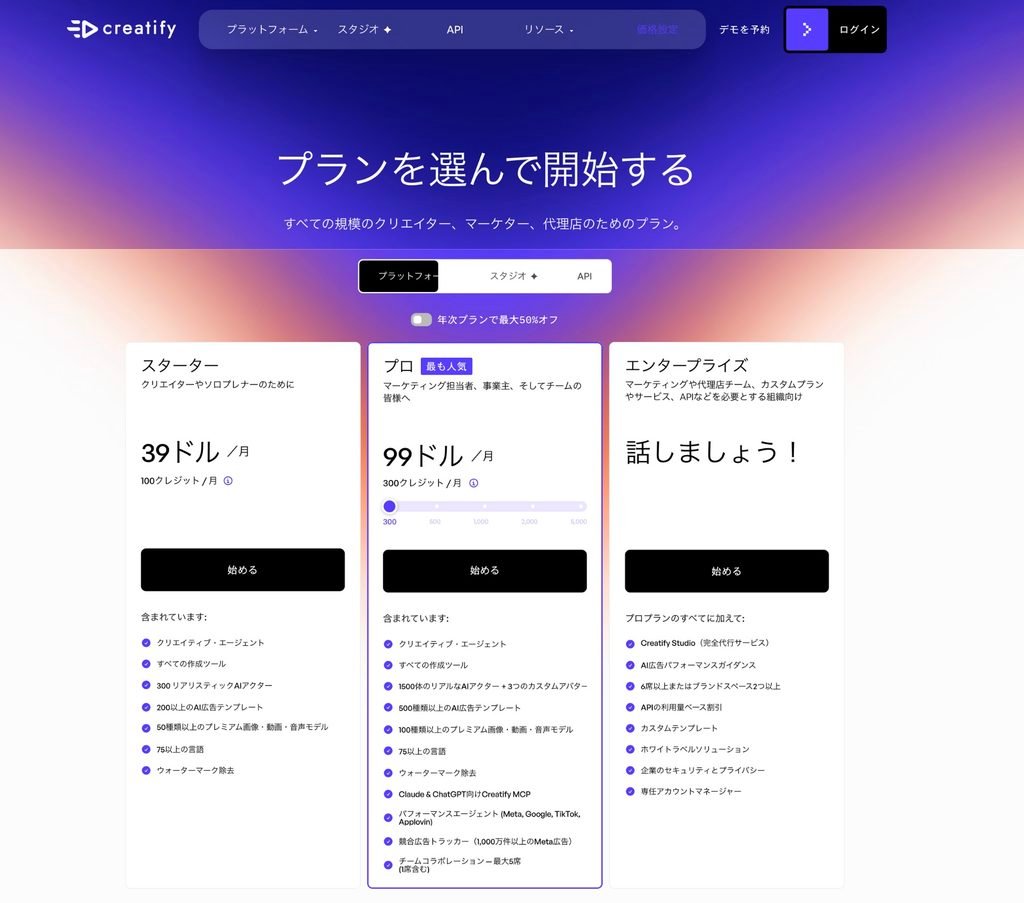
Ad creative rather than training. Creatify ingests a product URL and generates ad variants with avatars. Its published plans are Starter at $39 per month with 100 credits including watermark removal, and Pro at $99 per month with 300 credits and three custom avatars. There is no SCORM export, because the product is not aimed at LMS delivery. Several FAQ answers on that page did not render for FSR, including credit consumption, rollover, revision counting, and refund policy. This is the thinnest evidence base on this page.
Self-hosted rather than SaaS. Procurement teams in regulated environments ask a question no pricing page in this category answers: can the work be done without sending an employee’s face and voice to a vendor’s servers. Self-hostable avatar synthesis projects exist and are worth an engineering evaluation where data residency is a hard requirement. FSR is not naming or recommending one here. Repository identity, license terms, commercial-use boundaries, and maintenance status were not audited during this rebuild, and each of those changes the answer. Those four checks come before any comparison with the SaaS options above.
Sources: Creatify pricing page, read 23 August 2026
What the contracts add that the cards do not
D-ID publishes both of its agreements as complete public text, which is not true of every vendor here, so it serves as the worked example. Everything below is specific to D-ID. Use it as the shape of the questions to put to every vendor on a shortlist.
Two documents govern different relationships. The Products Terms of Use, last updated July 2024, applies on acceptance when using D-ID’s applications or calling its API. The End User Agreement, last updated September 2024, forms part of an accompanying Order Form. Each term below is attributed to its document, because that difference decides which applies to a given account.
| Term | What the document states | Document |
|---|---|---|
| Output availability | Each created Animation is stored on servers available to the user for 24 to 48 hours, then automatically deleted. Downloading within that window is the user’s responsibility. | End User Agreement |
| Deletion on termination | Data uploaded to the Software is deleted within 14 days of the effective termination date. | Products Terms of Use |
| Cancellation notice | To avoid billing for the next period, cancel 15 days before the end of the billing period. Unused credits expire at period end. | Products Terms of Use |
| Synthetic marking | All Animations contain a synthetic mark. Removing, hiding, or minimizing it requires prior written approval. Replacing the logo with an alternate watermark is described as available to Enterprise customers on request. | Products Terms of Use |
| Named third parties | Stripe is named for payments and ElevenLabs for text to speech and voice cloning. The same clause states that some third-party sources may use user submissions and animations to maintain, develop, or improve their services. | Products Terms of Use |
| License over inputs | Users retain ownership of submissions and outputs. Separately, submitting content grants a worldwide, irrevocable, royalty-free, perpetual, transferable license to use, reproduce, distribute, and prepare derivative works, with moral rights waived where law permits. This is a license grant, not a transfer of ownership. | Products Terms of Use |
| Consent obligation | Obtaining all necessary consents, rights, and licenses for supplied images, text, audio, and video rests with the user. | Both |
| Content restrictions | The prohibited list includes material providing medical advice, and material the user would not wish to potentially become public or that is otherwise sensitive, with internal know-how given as the example. | Products Terms of Use |
| Indemnity direction | Under the Products Terms of Use the user indemnifies D-ID. The Order Form agreement additionally has D-ID indemnify the user against third-party claims that its own software infringes intellectual property. | Differs by document |
| Uptime | Unless separately agreed in writing, no commitment of uptime or availability is made. | Both |
| Governing law | Delaware for users residing in the United States; Israel with exclusive jurisdiction in Tel Aviv for users residing elsewhere. A separate clause requires any cause of action to commence within one year. | Both |
The availability window carries the most weight and needs the most care. It appears in the Order Form agreement rather than the self-serve terms, so it may not govern every account. A buyer reading only the pricing page would take away something different: that page’s FAQ discusses free-user data being deleted after six months of inactivity with email notice. Three retention statements exist across three D-ID documents, covering different objects under different agreements. If a workflow assumes a generated video stays retrievable in the platform, confirm which document applies before relying on it.
The third-party clause is the one for a security reviewer, because it sets up a contrast between two vendors covered here. D-ID’s terms state that some third-party sources may use submissions and animations to improve their services. Colossyan’s security page states that its AI vendors are contractually prohibited from training on Colossyan input. Opposite positions, each in the vendor’s own primary document, neither hidden and neither commonly compared.
None of this criticizes D-ID’s drafting, which is more transparent than most here precisely because the full text is public. It criticizes buying from a pricing card.
Sources: D-ID Products Terms of Use, last updated July 2024, read 23 August 2026 · D-ID End User Agreement, last updated September 2024, read 23 August 2026 · D-ID Studio pricing FAQ, observed 23 August 2026 · Colossyan security page, read 23 August 2026
EU AI Act Article 50, stated narrowly
Article 50 does not impose a disclosure duty on every AI-generated training video. That is the sentence worth carrying away, and it is the one most often stated wrongly.
The transparency obligations in Article 50 of Regulation (EU) 2024/1689 began to apply on 2 August 2026. The European Commission adopted final guidelines on 20 July 2026, and a voluntary Code of Practice on Transparency of AI-Generated Content sits alongside them. Enforcement runs through national market surveillance authorities.
Duties split between providers and deployers. Provider duties include marking synthetic output in a machine-readable format so it can be detected. Deployer duties include disclosing content that constitutes a deep fake, and labeling AI-generated text published to inform the public on matters of public interest where it has not had human editorial review. Commission material notes a transitional arrangement for the marking obligation running to 2 December 2026 for generative systems placed on the market before 2 August 2026, and that content generated before 2 August 2026 does not require retroactive labeling.
The deployer disclosure duty attaches to content meeting the regulation’s deep fake definition, not to all AI-generated video. Whether a corporate module narrated by a stock synthetic presenter meets that definition, and whether a digital likeness of a named employee reaches it more readily, are separate questions with potentially different answers. This briefing records that the question is open. Counsel closes it, against actual output.
What the vendors state about themselves is short. Synthesia’s site footer carries a statement that its content is generated using artificial intelligence and labeled in accordance with EU AI Act Article 50 requirements, the only Article 50 self-reference FSR found on any of these vendors’ pages. D-ID’s terms state that all Animations contain a synthetic mark that cannot be removed without written approval, a marking practice described in contract rather than a regulatory claim. Colossyan’s security page states that its AI practices follow the transparency and risk management principles of the EU AI Act, wording that stops short of asserting compliance.
Three questions for any vendor on a shortlist, none of which the public pages answered for most of them: does the platform embed machine-readable provenance metadata into exported files, and in what format; is that marking preserved after re-encoding or editing outside the platform; and is the vendor a signatory to the Code of Practice.
Sources: European Commission, Guidelines on transparency obligations, read 23 August 2026 · European Commission, Quick facts on transparency rules, read 23 August 2026 · European Commission, Code of Practice on Transparency of AI-generated Content, read 23 August 2026 · European Commission, Article 50 FAQ, read 23 August 2026
When Synthesia remains defensible
Nothing here argues for switching. Two constraints point the other way.
For buyers with a formal security review, document availability may outweigh a lower self-serve price. Synthesia’s trust center states that the company is SOC 2 Type II compliant and certified within ISO/IEC 27001:2022, ISO/IEC 27701:2019, and ISO/IEC 42001:2023, and lists GDPR and UK Cyber Essentials alongside them. The resource list includes a SOC 2 Type II report dated 28 July 2026, 2026 penetration test reports, a Data Protection Impact Assessment, an AI Impact Assessment, and completed CAIQ, SIG Lite, and HECVAT questionnaires. ISO 27701 covers privacy information management, and HECVAT is a higher-education procurement assessment. Both shorten a vendor review.
The second constraint is scale. The Enterprise card is where unlimited video minutes, one-click translation into 80 or more languages, 240 or more stock avatars, unlimited personal avatars, SAML and SSO, live team collaboration, brand kits, and SCORM export sit together. If most of that list is required, the self-serve tiers are an evaluation environment, and the arithmetic in section four is a reason to reach Enterprise sooner rather than a reason to leave.
One item to confirm at checkout. Synthesia serves region-specific currency pages. The Japanese page displayed Starter at ¥4,690 per month reduced to ¥2,980 on annual billing, and Creator at ¥14,490 reduced to ¥10,490, with a banner advertising a 36 percent saving where the US dollar page advertises 38. Tax treatment and the effective rate against a local currency are questions for the checkout screen, which FSR did not reach.
Sources: Synthesia Trust Center, read 23 August 2026 · Synthesia pricing page, Japanese edition, observed 23 August 2026
Claims FSR has not verified
Everything in this section is unverified. These items come from a compiled research file, not from a page FSR opened in a browser. They are recorded because they bear on the sections above and because a reader deserves to know they exist. None is evidence, and none supports a claim anywhere else in this briefing.
A second HeyGen rate card. The research file describes a HeyGen help center article publishing per-minute rates that differ from the pricing page across every overlapping category, splitting the avatar engines into photo and video variants, listing Avatar V separately, and giving Video Agent two modes. If that article says what the file reports, a buyer sizing a plan from the pricing page and a buyer sizing one from the help center would reach materially different figures. FSR did not capture that article in a browser during this rebuild, and the conflict is therefore recorded as an open question rather than a documented contradiction. It is the most consequential item on this list.
Synthesia’s re-generation charge. The file notes that the pricing page FAQ says only new video seconds count when an existing video is edited, while the credit knowledge base says credits are recalculated based on the updated duration. Those may describe different edit cases. Neither surface defines the boundary, and FSR ran no account test. A revision-heavy workflow cannot be costed from these two descriptions.
Older unlimited plan products. The file describes HeyGen plans carrying the word Unlimited withdrawn from new sale in 2026 with existing subscribers permitted to keep them, and Colossyan plan names no longer on its current pricing page. No such plan appears on the pages FSR opened, which is consistent with withdrawal but confirms neither the date nor the retention rule.
Custom avatar entitlements at HeyGen. The pricing grid FSR captured shows one custom digital twin on Free and one or more on Creator and Pro. The research file reports different figures from a help center article. Those do not agree, and FSR opened only one of them.
Everything else. Terms of service for vendors other than D-ID, privacy and biometric notices, data processing addenda, subprocessor lists, refund and cancellation help articles, and affiliate programs were not opened during this rebuild. Any statement about them belongs in a separate briefing with its own evidence.
No source citation is given for this section. FSR did not open these sources, and citing them would imply otherwise.
What to verify before paying
These are checks a buyer should run. FSR did not perform them.
- Which avatar engine will the work actually use, and which rate applies to it?
- Does the intended monthly volume fit the allocation at that rate, with room for revisions?
- If the workflow mixes generation and translation, do both draw on the same allocation?
- What does a second render of the same video cost after a script edit?
- Does a failed or rejected generation consume the allocation, and will the vendor confirm that in writing?
- Which plan carries SCORM, and which package version and completion behavior does it produce?
- Will a sample package load and report correctly in your own LMS?
- What happens on the plan when the allocation runs out mid-cycle?
- Which billing cadence suits the production pattern, given how rollover differs between them?
- What is the charge in local currency at checkout, including tax and merchant of record?
- Which agreement governs the account, and what does it say about retention, consent, and indemnity?
Questions four and five are the ones to send the vendor in writing. Neither is answered on the pages a buyer reads before purchase, and both change a monthly figure after the card has been charged rather than before.
What this briefing does not establish
This Tier C briefing does not establish avatar realism, lip-sync quality, voice quality, generation speed, failure rate, support quality, actual credit deductions, refund behavior, cancellation behavior, SCORM interoperability, accessibility conformance, or comparative output quality between any two products named.
Most of those require separate authenticated evidence. Output claims require controlled generations. Billing, refund, cancellation, and support claims require separately logged workflows. LMS claims require a test in a real LMS. None of that evidence is admitted here.
Nor does it establish what a buyer outside Japan sees. Every browser observation was made from one country, in one signed-out session, on one date.
FAQ
What is the closest direct Synthesia alternative?
HeyGen has the closest published feature mapping among the six direct substitutes here. Its individual plans run Free, Creator at $29 with 600 credits, and Pro from $49 with 1,000. Business is listed at $149 per month plus $20 per additional seat with 1,500 credits.
How many minutes does a month of HeyGen Creator credits buy?
There is no single figure. At the pricing page’s published rates, 600 credits cover 200 minutes on Avatar III or 30 on Avatar IV and V. Thirty minutes is also that plan’s maximum single video length, so a month spent only on the newer engines is one video.
Which self-serve plan publishes SCORM export?
Among the pages FSR opened, Colossyan Professional at $59 per month billed yearly, with five streaming exports monthly. Vidnoz lists SCORM on Starter at $19.99 on a page FSR read as text. Synthesia, Elai, and AI Studios place it on quote-only Enterprise plans.
How many minutes does Synthesia Starter actually buy?
The annual card publishes 14,500 credits and up to 120 minutes of video or AI Dubbing per year. At the knowledge base’s rate of 240 credits per minute for lip-synced dubbing, that balance funds 60.42 minutes. Standard video at 120 credits per minute reaches the stated cap.
Do Synthesia credits roll over?
According to its knowledge base, no. Credits reset at the start of the billing period with no accumulation. Self-serve accounts also cannot top up mid-cycle, and unused credits from a previous plan do not carry over on upgrade because the balance resets to the new allocation.
Does D-ID’s Lite plan allow commercial use?
No. The Studio comparison grid lists a personal use license on Trial and Lite, with commercial use starting at Pro. D-ID’s Products Terms of Use state the same, adding that Lite subscribers may use the software and animations for non-commercial use only. Pro still carries what the grid calls an AI watermark.
How long does a generated video stay available?
It depends on the vendor and on which agreement governs the account. D-ID’s End User Agreement states that each created Animation is available for 24 to 48 hours before automatic deletion. Elai states that data for cancelled users is stored for one year. Most vendors here say nothing about it on a pricing page.
Does the EU AI Act require labeling every AI training video?
No. Article 50 has applied since 2 August 2026 and assigns marking duties to providers and disclosure duties to deployers, but the deployer disclosure duty attaches to content constituting a deep fake as the regulation defines it, not to all AI-generated video. Take the question to counsel with your actual output.
Methodology
This is a Tier C, document-first briefing. No authenticated observation of any product named here is admitted as evidence, and no account action or product test was performed.
What was captured in a browser. Five pricing pages, viewed from Japan in a signed-out session on 23 August 2026 between 13:55 and 16:43 Japan Standard Time: HeyGen, Synthesia, D-ID Studio, AI Studios, and Elai. Each was captured as a screenshot with the browser address bar and the system clock in frame. The HeyGen capture covers the plan cards, the individual-plan feature grid, and the pricing FAQ that publishes credit rates.
What was read as page text. Colossyan’s pricing and security pages, Vidnoz’s pricing page, D-ID’s API pricing page, D-ID’s End User Agreement and Products Terms of Use, Synthesia’s trust center, Synthesia’s self-serve credits knowledge base article, Creatify’s pricing page, and four European Commission pages on Article 50.
What was not opened. Help center articles other than the Synthesia credits article, terms of service for vendors other than D-ID, privacy and biometric notices, data processing addenda, subprocessor lists, status pages, product update posts, and affiliate programs. Statements attributed to those surfaces appear only in section twelve, and none supports a claim elsewhere.
How statements are treated. A statement that a named page displayed a given figure to this observer on this date is a page-state observation. What that figure means for a live account is the vendor’s stated position, not independent verification of billing behavior. Where FSR divides published figures, the inputs are shown and the result is described as a planning ceiling.
Contradictions preserved. Where two of a vendor’s own documents appear to disagree, both are recorded and the conflict is left open. No invoice, credit ledger, or in-product quotation exists here that would let FSR pick a winner.
Corrections made before publication. Two claims were removed from earlier drafts. A draft named Colossyan Professional as the lowest published SCORM entry; Vidnoz lists it lower, and section five was corrected. A draft also stated that publishing AI training video to EU staff creates a labeling duty no vendor marking discharges. That was wrong: deployer is defined in Article 3 rather than Article 50, the disclosure duty attaches to deep fakes rather than to all AI-generated video, and guidance that machine-readable marking alone is insufficient does not establish that no vendor-supplied disclosure can satisfy the duty. Neither claim was published. These were pre-publication corrections, not public retractions.
On the previous version of this article. The article published at this address on 29 March 2026 was used only as an audit target. Its product, price, performance, and sentiment claims were not admitted as evidence or carried forward.
Scope of observation. One country, one signed-out session, one date. Nothing here describes what a buyer in another market sees, and nothing describes what appears after signing in.
Affiliate disclosure. This is a Tier C briefing. FSR does not place affiliate links in Tier C briefings. This page carries none and FSR receives nothing from any subscription named here.
Volatility. Prices, plans, allocations, and feature availability in this category are volatile. The evidence requires a current recheck before purchase.
Verdict
These vendors publish enough for a buyer to calculate a planning ceiling and not enough to forecast a bill.
The clearest case is HeyGen’s Creator plan, where the allocation, the rate, and the maximum video length are on one page and meet at exactly one video per month on the newer engines. The next clearest is Synthesia’s annual allowance, where a single shared balance is offered as either generation or dubbing and the lip-synced rate halves what it funds. Neither vendor hides a number. Both leave the buyer to do the division.
Around that arithmetic sit the things the pages do not settle: what a failed job costs, what a second render costs after an edit, whether a SCORM package will load in a particular LMS, and which agreement governs a given account. Those are the items worth a dated written answer from a vendor before the first invoice rather than after.
Choose by the meter that governs the costliest part of the workflow. For a revision-heavy team that is the re-render rule. For a localization team it is the lip-synced rate. For an L&D team it is which plan carries SCORM and in what format. For a procurement reviewer it is which of the two contracts applies. The lowest monthly price answers none of those.
This briefing does not establish which of these products is worth buying. It establishes what the pages a buyer reads before deciding will and will not tell them.
Contact and corrections
Need these terms checked against your own procurement requirements?
Send the URL, a screenshot, and the date you saw it. Confirmed errors are corrected with a numbered note and the original wording quoted. We do not make silent edits.
If a figure here misrepresents your product, send the primary page that shows otherwise and we will correct it.
Tier B means Future Stack Reviews tested the product hands-on. Tier C means the briefing was built from primary documents without hands-on testing.
Future Stack Reviews publishes structural audits of AI and SaaS products for technical buyers. This is a Tier C document-first briefing: no authenticated observation of any product named here is admitted as evidence, and no account action or product test was performed. Vendor statements are recorded as official claims, not independent verification of runtime behavior. No affiliate links appear on this page and FSR receives nothing from any subscription named here.