Last updated: August 21, 2026
Tier B · Hands-on plus primary sources
Future Stack Reviews created an account, signed in, took a course assessment, and was issued a completion badge on this platform on 21 August 2026. The badge shown below is ours. Firsthand observations are marked where they appear.
Not tested: administrator consoles, Team or Enterprise deployment, LMS export, accessibility, badge behaviour over time, the Skilljar sign-in route, and every course except the one named in the Methodology. One account, one region, one session.
Claude Academy is Anthropic’s free learning site at academy.claude.com, announced on 20 August 2026. Anyone can browse it, and a Claude account saves progress and unlocks course completion badges. Those badges are not Claude Certifications. Anthropic runs a separate, paid, proctored certification programme through Pearson, and the two produce different objects with different rules.
Use Claude Academy for the teaching, which is good. Do not present its badge as a certification, because Anthropic publishes a full rulebook for one and, as far as we could find, none for the other.
Best for
- Individuals who want a structured, vendor-authored route into Claude products
- Teams building an internal enablement curriculum who need a spine to work from
- Educators and nonprofit staff who need a free 4D framework syllabus they can teach
- Developers preparing for the Claude Certification exams, which use this material as prep
Not for
- Anyone who needs a credential with a published validity period and pass standard
- Hiring or procurement reviewers treating the badge as tested capability
- Learning teams that require SCORM or xAPI export into an existing LMS
- Organizations that need documented administrator reporting before rollout
At a glance
| Announced | 20 August 2026, on the Claude blog |
| Price | Free. No payment method was requested at any point in our session |
| Account | Browsing without an account is offered. Quizzes and badges require signing in through a consent screen |
| Catalog | 22 courses, 119 tutorials, 148 use cases, 289 total, per the site’s own catalog file generated 20 August 2026 |
| What the badge shows | Course title, holder name, issue date, Claude Academy mark, and an Add to LinkedIn control |
| Badge rulebook | No published pass mark, retake policy, validity period, or verification statement located. See section 03 for the search scope |
| Claude Certification | Separate programme. 99 to 175 US dollars, proctored by Pearson, Credly-issued, valid 12 months, Claude Partner Network members only |
| Tested | 21 August 2026, from Japan, one personal account, no administrator console |
Contents
What Claude Academy is
Anthropic published Claude Academy on 20 August 2026. The launch post points readers to academy.claude.com and to a Learn more entry in the Claude profile menu, and describes three things a learner gets: recommendations based on interests and completed learning, tracking for course completion and badges, and an installable skill that surfaces Academy material inside a Claude conversation.
The site publishes its own catalog as a JSON file. Generated on 20 August 2026, it counts 22 courses, 119 tutorials, and 148 use cases, for 289 items. Courses run from a 45-minute introduction to subagents up to a 67-lesson course on the Claude API. The AI Fluency track, built on the 4D framework of delegation, description, discernment, and diligence, is the part that teaches judgement rather than button positions, and it is the part most worth a non-technical reader’s time.
One thing to settle immediately, because the search results do not: three different Anthropic properties carry the word academy, and a fourth site with the identical name is not Anthropic’s at all. Section 08 separates them.
Sources: Anthropic, 20 August 2026 · Claude Academy catalog file, generated 20 August 2026 · Claude Academy, accessed 21 August 2026
Two things called a badge
Anthropic issues two credentials that both arrive as a digital badge, and the difference between them is the single most useful thing to understand before you put either on a profile.
Observed by FSR · 21 August 2026
We signed in with a Claude account, completed the assessment for AI Fluency: Framework & Foundations, and were issued a badge. It carries the heading Course Completion Badge, the course title, the line Presented to followed by the holder’s name, the Claude Academy mark, and an issue date. Three controls sit beneath it: Add to LinkedIn, View the course, and View your learning. A notification email arrived from an Anthropic address in the same minute, saying the badge was ready to view and share.
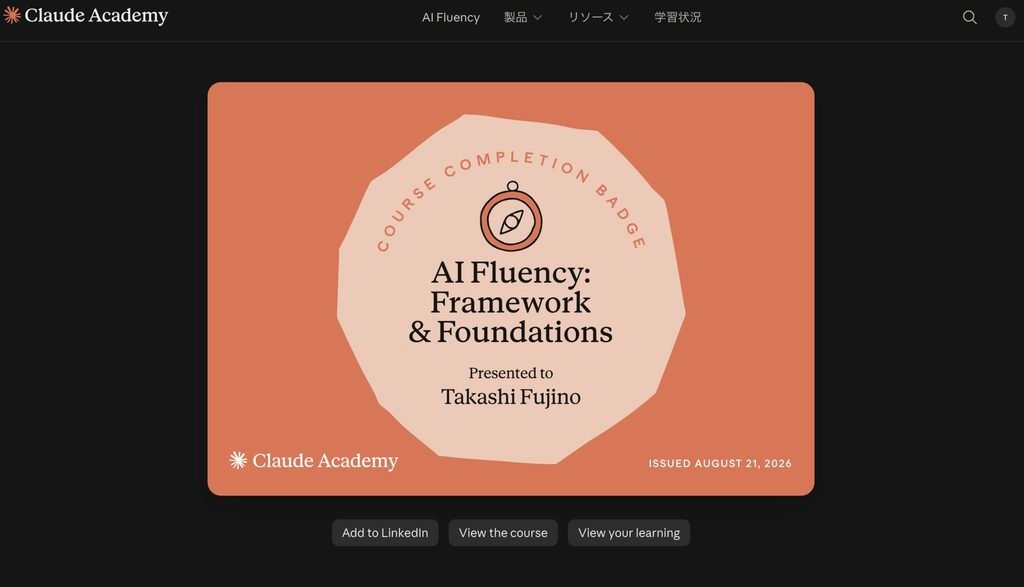
Now put that next to the other one. Anthropic’s certification programme, expanded on 23 July 2026, states that “Certification represents validated capability, rather than course attendance.” Everything about it is published in detail.
| Question | Academy completion badge | Claude Certification |
|---|---|---|
| Who can take it | Anyone with a Claude account | Claude Partner Network members, registering with a company email |
| Cost | Free | 99, 125, 125, and 175 US dollars for the four exams |
| Supervised | Not described as supervised on any page we opened | Proctored, delivered by Pearson |
| Identity checked | Not described on any page we opened | Candidates validate identity before the exam begins |
| Pass standard | No published pass mark located | Published in downloadable official exam guides per credential |
| Retake rules | No published policy located | Waits of 14, 30, then 90 days, up to four attempts per rolling 12 months |
| Validity | No published validity period located | 12 months from the date earned, with free on-time renewal |
| Issued through | Claude Academy itself | Credly by Pearson, accepted by email invitation |
| If you change employer | No published transfer policy located | Transfers. Anthropic advises adding a personal email to Credly |
| Counts toward anything | Nothing published | Certified practitioner counts feed Claude Partner Network tier standing |
The right column is a rulebook. The left column is a product that works. That is the honest shape of it, and it is not a criticism of the Academy so much as a warning about the word badge, which is now doing two jobs at once inside one vendor.
Anthropic reports more than 36,000 people certified across more than 1,300 organizations since March 2026, and more than 400,000 people trained through the Partner Academy this year. Those are vendor-reported figures, dated to 23 July 2026, and they describe the certification track rather than the public one.
Sources: Firsthand observation by Future Stack Reviews, 21 August 2026 · Anthropic, 23 July 2026 · Anthropic Partner Academy, accessed 21 August 2026 · Pearson VUE, accessed 21 August 2026 · Claude Academy, accessed 21 August 2026
Looking for the badge rulebook
The certification programme publishes a fee, a delivery partner, an identity check, an exam guide, a retake schedule, a validity period, and a renewal route. We went looking for the equivalent on the Academy side and did not find it. That claim needs a boundary around it, so here is the boundary.
What we opened, and did not find a badge specification on
The Academy home, all-resources, courses, tutorials, use-cases, sign-in, webinars, and AI Fluency collection pages. Individual course pages including Claude 101, AI Fluency: Framework & Foundations, AI Fluency for students, AI Fluency for Builders, and the two courses that list no quiz. The published catalog file. The Claude 101 quiz and badge pages while signed in. The 20 August launch post. The Anthropic Help Center category index. Anthropic’s privacy policy and published subprocessor list. Both Skilljar sites, including the Partner Academy certification FAQ and policies pages.
What we did not do: open every individual Help Center article inside the Team and Enterprise and Privacy and legal collections, and open every page reachable from the signed-in Academy interface. If Anthropic has published a badge specification somewhere in that space, this section is the one that changes, and we would rather change it than leave it wrong.
On the pages we did open, the badge is described operationally rather than contractually. The AI Fluency for Builders page tells learners to complete the final course quiz to earn your completion badge. The AI Fluency for students page describes taking a final assessment and earning one. That tells a learner what to do. It does not tell an employer what the resulting object means.
The practical consequence is narrow and worth stating precisely. An Academy badge is an authentic record that Anthropic issued something under a name, a course, and a date. It is better evidence than a screenshot. It is not, on anything we could find, accompanied by the published rules that would let a third party say what standard was met to obtain it. Treat it as evidence of structured learning, and ask for something else when the question is capability.
Sources: Firsthand observation by Future Stack Reviews, 21 August 2026 · Claude Academy, accessed 21 August 2026 · Claude Academy, accessed 21 August 2026 · Anthropic Help Center, accessed 21 August 2026
Free course, plan-bound practice
Claude 101 lists its prerequisites plainly: a Claude account on any plan including Free, and no prior experience with AI assistants. Nothing in the enrolment path asks for payment, and nothing did in our session.
The same block adds a line most launch write-ups skipped. Two topics, Cowork and Enterprise Search, require a paid or Team/Enterprise plan to try hands-on. Open those lessons and the note is there. The skills lesson tells readers on the wrong plan to skip the hands-on steps. The Enterprise Search lesson tells Free, Pro, and Max learners they can skip it.
This is disclosed and the skip path is offered rather than hidden, so it is not a trap. It is still a planning problem. A Free-plan learner and an Enterprise learner can finish the same course having practiced different amounts of it, and both end up holding the same badge. If you are standardising training across a department, decide up front whether completion means passing the same quiz or performing the same work.
The pattern repeats higher up the catalog. Building with the Claude API, Claude with Amazon Bedrock, and Claude with Google Cloud’s Vertex AI are free to read. Reproducing their examples requires the corresponding platform account, and those platforms bill separately. The tuition is zero. The environment is not.
Sources: Claude Academy, accessed 21 August 2026 · Claude Academy, accessed 21 August 2026 · Claude Academy, accessed 21 August 2026 · Claude Academy, accessed 21 August 2026
Choose the account before you start
Claude Academy does not create a separate learning identity. It attaches learning to a Claude account, and the sign-in page offers three ways in: a Claude account, a Skilljar route for people who do not have one, and browsing without an account at all.
Observed by FSR · 21 August 2026
The Claude account route hands off to a consent screen on claude.ai, where an application named Academy requests connection to the Claude chat account. The authorization ties Academy records to whichever Claude account and organization is active at that moment.
The screen lists two purposes. The first is access to Anthropic profile information. The second, in the Japanese interface we were served, names organization enrolment and completion reports. It does not settle the direction: it could mean the application may read organization reports, or that your records are surfaced to an organization. We did not capture the English-language screen, and we are not going to fix a scope boundary from a translation.
For an individual this is a one-time decision with a long tail. Sign in with a personal Claude account and the learning history belongs to you. Sign in with a company-managed account and it belongs to an account you may not keep. We found no published statement about transferring an Academy learning record between accounts, and no equivalent to the advice Anthropic gives certification holders, which is to attach a personal email to Credly so the credential survives a job change.
The other door leads somewhere different again. The legacy Skilljar course site was still live on the same day, still branded Anthropic Academy in its own navigation, and still carrying a data panel the new site does not repeat. It states that you don’t need an Anthropic account to access this learning content, that Skilljar tracks progress within that platform while the Anthropic account governs Anthropic services, and it names a specific address for deleting learning activity. Anthropic’s published subprocessor list showed 20 entries on 21 August 2026 and Skilljar does not appear on it, though that page does not state whether Claude Academy falls inside its scope, so its silence settles nothing.
Sources: Firsthand observation by Future Stack Reviews, 21 August 2026 · Claude Academy, accessed 21 August 2026 · Anthropic Courses, accessed 21 August 2026 · Anthropic Partner Academy, accessed 21 August 2026 · Anthropic Trust Center, accessed 21 August 2026
The catalog is a dated build
The all-resources page shows a single total. Behind it sits a published JSON catalog that explains what the number is. The file declares a generation timestamp of 20 August 2026 at 17:54 UTC, a staleAfter value of 19 September 2026, and a content commit hash. Its counts are 22 courses, 119 tutorials, 148 use cases, 289 total.
So the number is a snapshot with a declared shelf life of roughly 30 days, and it covers exactly three content types. Webinars are not among them. The Japanese listing of the same page showed a higher total on the same day, 355, and its list did include webinar entries reaching back to November 2025, with the webinar detail pages living on anthropic.com. Quote the number with its date and its surface, or do not quote it.
Localization drift, for readers outside English
A Japanese path exists at /ja and the interface is translated, but parts of the course copy are not. On the Japanese Claude 101 page the learning objectives remained in English. The drift reaches the data as well: one use case names Claude Opus 5 in the English catalog and Claude Opus 4.7 on the Japanese listing of the same item, while several other English entries still name Claude Opus 4.6. Useful teaching, three model vintages, one catalog.
Sources: Claude Academy catalog file, generated 20 August 2026 · Claude Academy, accessed 21 August 2026 · Claude Academy, accessed 21 August 2026 · Claude Academy, accessed 21 August 2026
The index will not tell you what a course awards
The course index lists 22 courses. Thirteen show a Completion badge label on their card. Nine do not. Two of those nine list no quiz either, so the absence is consistent. The remaining seven are the audience editions of AI Fluency, and six of the seven do list a quiz.
Open one and the picture changes. The AI Fluency for students page shows the badge in its header line and carries a section describing the final assessment and the award. The index card and the course page disagree about the same course, which means the index cannot answer the question a learner is asking it. Check the course page.
The seven affected editions are the ones written for students, educators, pK-12 educators and their trainers, nonprofits, small businesses, and builders. A missing metadata label is a minor defect. It is a slightly less minor defect on the cards aimed at the readers most likely to want a record and least likely to have anyone checking behind them.
Sources: Claude Academy, accessed 21 August 2026 · Claude Academy, accessed 21 August 2026 · Claude Academy, accessed 21 August 2026
Four things called an academy
| Property | Run by | Who gets in | What you earn |
|---|---|---|---|
| academy.claude.com | Anthropic | Anyone | Course completion badge |
| anthropic.skilljar.com | Anthropic, on Skilljar | Anyone, no Anthropic account required | Certificate of completion |
| anthropic-partners.skilljar.com | Anthropic, on Skilljar | Claude Partner Network members, company email | Partner badges and four paid proctored certifications |
| claude-academy.com | Not Anthropic | Anyone | XP, in-platform badges, leaderboard |
The fourth entry deserves a fair note. claude-academy.com states its position in its meta description, its FAQ, and its footer: it is an independent learning platform, “not affiliated with, endorsed by, or sponsored by Anthropic”. The confusion risk comes from two products sharing one name, not from that site’s conduct. Check the domain before you sign up, and check it again before you cite a course count, because the two catalogs are different sizes.
Sources: Claude Academy, accessed 21 August 2026 · Anthropic Courses, accessed 21 August 2026 · Anthropic Partner Academy, accessed 21 August 2026 · Claude Academy (independent), accessed 21 August 2026
FAQ
Is Claude Academy free?
Yes. We created an account, took a course assessment, and received a badge without being asked for a payment method. Some exercises inside otherwise free courses require a paid Claude plan or a separate cloud account to perform, and the lessons say where.
Is a Claude Academy badge the same as a Claude Certification?
No. The badge is free and earned by passing a course quiz. Claude Certification is a paid, proctored, identity-checked exam delivered by Pearson, issued through Credly, valid 12 months, and open only to Claude Partner Network members. Anthropic describes it as validated capability rather than course attendance.
What does the completion badge show?
The badge we received carries the heading Course Completion Badge, the course title, the holder’s name, the Claude Academy mark, and an issue date, with Add to LinkedIn, View the course, and View your learning controls beneath it. It is shown in section 02.
Does the badge expire, and can I retake the quiz?
We found no published validity period, pass mark, or retake policy for Academy badges on the pages listed in section 03. Claude Certification publishes all three: 12-month validity, a pass standard in each exam guide, and retake waits of 14, 30, then 90 days.
Should I use a personal or a work Claude account?
Personal, if you want the learning history to survive a job change. Academy attaches records to the Claude account and organization active at authorization, and we found no published route for moving that history to another account. Anthropic gives the opposite advice for certifications, where a personal email keeps the credential portable.
Can my employer see my course progress?
Not established. The consent screen shown when connecting a Claude account names organization enrolment and completion reports among its two purposes, but no page we opened states what an administrator actually sees. Confirm with Anthropic before deploying Academy as company training.
Does every course award a badge?
The index showed a badge label on 13 of 22 cards, but at least one course without the label displays a badge on its own page, so the index is not reliable here. Two courses list no quiz at all, which is consistent with no award. Check the course page.
What happens to certificates I earned on the old Anthropic Academy?
We found no statement on any Anthropic surface we opened. The legacy Skilljar site was still live and still issuing certificates of completion on 21 August 2026. Ask Anthropic support before assuming your existing record carries over.
Is Claude Academy the same as claude-academy.com?
No. Anthropic’s site is academy.claude.com. The similarly named claude-academy.com is an independent commercial platform that states on its own pages that it is not affiliated with, endorsed by, or sponsored by Anthropic. Course counts quoted online often belong to one and get attributed to the other.
Where should I start?
Non-technical readers: Claude 101 at 2.5 hours, then AI Fluency: Framework & Foundations at 4 hours. Developers already using Claude daily: Claude Code in Action or Introduction to Model Context Protocol. The courses are not sequenced as prerequisites, so start where the gap is.
Sources: Firsthand observation by Future Stack Reviews, 21 August 2026 · Claude Academy, accessed 21 August 2026 · Anthropic, 23 July 2026 · Anthropic Partner Academy, accessed 21 August 2026 · Anthropic Courses, accessed 21 August 2026 · Claude Academy (independent), accessed 21 August 2026
Methodology
What we did
On 21 August 2026 we opened Claude Academy from Japan in Chrome on macOS, signed in through the Claude account route, worked through AI Fluency: Framework & Foundations, sat its assessment, and received a completion badge.
Alongside that session we read the pages listed in section 03, in both English and Japanese where both exist, plus the Anthropic Partner Academy certification FAQ and Pearson VUE’s Anthropic page for the certification comparison. Every count is either quoted from a page that displayed it or counted by us from an enumerated list, and the article says which. No number is estimated.
What we did not do
One account, one region, one session, one course. We did not operate an administrator console, deploy to a team, test the Skilljar sign-in route, test the LinkedIn export, test badge behaviour over time, or complete any other course. We did not open every individual Help Center article, or every page reachable from the signed-in Academy interface. Nothing here is a general result about courses we did not take.
A dated observation worth preserving. The 20 August launch post links a Claude Academy skill at a GitHub path ending in claude-academy-guide. On 21 August that path returned a 404. The repository shows a commit dated 18 August renaming the folder to academy-guide, which is where the skill was found. That is a publication synchronisation gap, not a product defect, and it stops being reproducible the moment the link is fixed.
Redactions. The badge identifier in the badge URL and the account email on the consent screen are masked. The holder name is published deliberately, because a name-bearing artifact is the point of that section.
Corrections made before publication. An earlier internal draft of this briefing carried a stronger claim, that the Academy badge had no verification surface at all. That went further than the evidence supported, because we had searched a limited set of pages and had promoted an absence into an architecture. It was cut. Section 03 now states only what we looked at and what we did not find on it. We are recording this because a publication that audits other people’s claims should show its own corrections.
Disclosure. Future Stack Reviews uses Anthropic products in its own production workflow, including for drafting and research assistance. That is a conflict of interest and is disclosed rather than managed away. Research was cross-checked across several independent AI systems, and every claim here traces to a page a human opened. Claims that survived only in a machine-generated summary were dropped.
Volatility. This platform is one day old. Counts, labels, index metadata, and links will change. Every figure carries the date it was seen. Treat a dated figure as a record, not a current state.
Sources: Firsthand observation by Future Stack Reviews, 21 August 2026 · Anthropic, 20 August 2026 · Anthropic skills repository, accessed 21 August 2026 · Anthropic Trust Center, accessed 21 August 2026
Verdict
If you are learning on your own: use it, and use a personal Claude account. The AI Fluency track is the strongest thing here, and the badge is a reasonable record of having done the work. Start with Claude 101 and the Framework & Foundations course.
If you run enablement for a team: use it as the curriculum, not as the competency system. Standardise which plan learners hold before you assign a course, because the same badge can sit on top of very different amounts of practice. Decide who owns the learning record before anyone signs in. Get administrator reporting, retention, and export answered in writing first, because none of it was published on the pages we opened.
If you are hiring or reviewing a vendor: read the badge as evidence that someone took a course seriously enough to pass its quiz. That is worth something. It is not a Claude Certification, which is the object with a fee, a proctor, an identity check, an exam guide, a pass standard, and a twelve-month clock on it. When the question is capability, ask for that one, or ask for work.
The teaching is good and free, which is rare enough to say plainly. The credential around it is young and, so far as we could find, unspecified. Those two facts are not in conflict. They just answer different questions, and most of the confusion around this launch comes from people asking the second question and reading the first answer.
Sources: Firsthand observation by Future Stack Reviews, 21 August 2026 · Anthropic, 23 July 2026 · Claude Academy, accessed 21 August 2026 · Anthropic Partner Academy, accessed 21 August 2026
Correct us, or bring us a document
Several statements here record that we could not find something, not that it does not exist. Section 03 says exactly where we looked. If you hold a page, a support reply, or an administrator screen that answers one of them, we will update the briefing and log the correction with its date. Vendor corrections are published on the same terms as reader corrections.
Write to [email protected].
Related briefings
Tier B briefings pair primary-source research with hands-on testing. Tier C briefings are document-first and say so.
Meta AI Has Three Privacy Routes. They Do Not Do the Same Job
Three routes into one product that do not do the same job. Read it after the sign-in section if that screen bothered you.
Cloudflare’s Free-Plan AI Crawler Labels Come From a Spoofable Header
A label that names something is not evidence of it. The course index here has the same problem.
Claude Code Plans and Billing: What Actually Controls a Session
Which plan you hold decides what a Claude session can actually do. The companion to the plan-bound practice section.
Best AI Coding Assistant 2026: 10 Tools, 60 Questions, 15 Answers
Sixty buyer questions, ten products, fifteen answers. The same accounting this briefing uses on one product.
Hermes Agent and Nous Portal: What the MIT License Does Not Cover
What a license does not cover, bounded the way this briefing bounds what a page does not say.
Cursor Pricing in 2026: Plans, Usage Limits, and What the Public Pages Do Not Quantify
Published plans, unpublished quantities. The same gap, on a product you probably already pay for.
Future Stack Reviews is an independent publication. This is a Tier B briefing: primary-source research plus a single hands-on session on 21 August 2026 with one account in one region. All observations are dated. Future Stack Reviews uses Anthropic products in its own workflow; see Methodology. This page contains no paid placements and no sponsored links. Nothing here is legal, procurement, or compliance advice.