
Search “CallRail alternatives” and you get two things: competitor blogs ranking themselves #1, and G2 lists stuffed with VoIP platforms that have nothing to do with marketing attribution. Not a single independent review in the top 10. We tested five actual alternatives and matched each one to the business type it fits. If your situation isn’t here, you probably don’t need to switch.
This is the companion piece to our [CallRail Review]. Read that first if you haven’t decided whether CallRail is the problem.
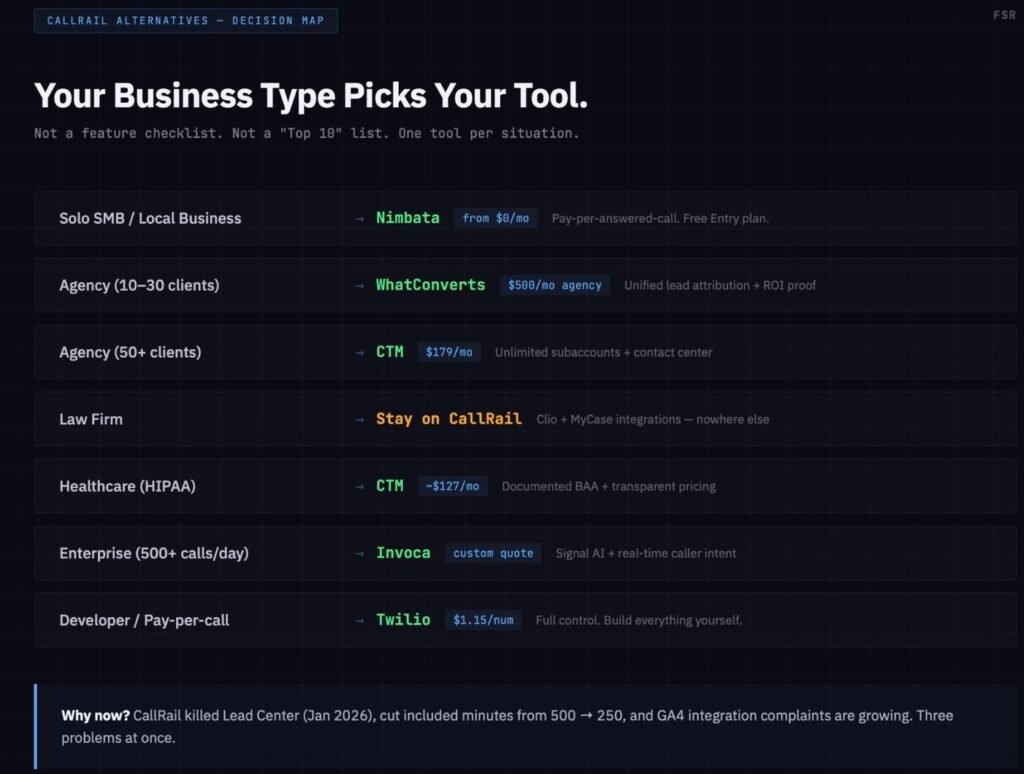
Your business type determines your tool. Not a feature checklist.
Solo SMB on a budget → Nimbata (from $39/mo, pay-per-answered-call)
Agency with 10–30 clients → WhatConverts ($500/mo agency plan, unified lead attribution)
Agency at 50+ clients → CallTrackingMetrics ($179/mo, unlimited subaccounts)
Law firm → Stay on CallRail (Clio + MyCase integrations exist nowhere else)
Healthcare / HIPAA required → CallTrackingMetrics (documented BAA, $179/mo)
Enterprise 500+ calls/day → Invoca (Signal AI, custom quote)
Developer / pay-per-call operator → Twilio ($1.15/number, build everything yourself)
Three Things Happening to CallRail Right Now
People don’t randomly start searching for alternatives. Something changes. In CallRail’s case, three things changed at once.
Lead Center is dead. CallRail officially sunset their VoIP softphone product on January 27, 2026. If you were using Lead Center for inbound/outbound calling, queue management, or call transfers, that functionality no longer exists inside CallRail. Their recommendation is to migrate to RingCentral through a partnership deal. That’s fine if you want RingCentral. It’s not fine if you picked CallRail specifically to keep everything in one platform.
Pricing got tighter. The base Call Tracking plan includes 250 local minutes. It used to be 500. Users on X have been vocal about this, calling it a margin grab. The $45/month starting price sounds accessible until you realize 250 minutes covers maybe 125 two-minute calls. A busy plumber blows through that in a week.
GA4 integration complaints are growing. Multiple users report limited reporting and friction with Google Analytics 4. For agencies that need to prove campaign ROI through GA4, this is a real operational pain point.
None of this means CallRail is bad. It means CallRail is changing. If the changes don’t affect your workflow, stay put. Switching call tracking platforms mid-campaign is expensive and disruptive. Only move if you have a concrete reason.
When to Stay on CallRail
This section exists because no competitor blog will ever write it.
You’re a law firm. CallRail has published native integrations with Clio Manage, Clio Grow, and MyCase. Among the five alternatives in this article, none of them offer comparable legal CRM connectivity. If your intake workflow depends on these integrations, switching means rebuilding that pipeline from scratch through Zapier or custom API work. The cost of that rebuild will dwarf any subscription savings.
You’re deeply integrated. If CallRail is wired into your Google Ads, HubSpot, Salesforce, and custom dashboards, the migration cost isn’t the new subscription fee. It’s the 2-4 weeks of reconfiguration, the broken attribution data during transition, and the team retraining. Unless you’re saving $200+/month, the math doesn’t work.
Your clients expect the CallRail name. Some agency clients specifically request CallRail because their previous agency used it, or because their marketing consultant recommended it. Switching to a tool your client has never heard of introduces friction that no feature advantage can offset.
The Five Alternatives (Matched to Your Situation)
We’re not ranking these 1 through 5. Each one wins in exactly one scenario. Find your scenario.
WhatConverts — For Agencies That Need to Prove ROI
WhatConverts is not a call tracker that happens to do forms. It’s a lead attribution platform that tracks calls, forms, live chat, and ecommerce transactions in one dashboard. The core pitch: every lead gets traced back to its source, assigned a value, and reported to the client with actual revenue attached. That’s a different product category from CallRail’s “which campaign rang the phone” approach.
For an agency managing 10-30 clients, the question isn’t “can WhatConverts track calls?” It’s “can I prove to my client that their $5,000 ad spend produced $38,000 in qualified leads?” WhatConverts was built to answer that question. CallRail was built to answer a simpler one.
Agency pricing starts at $500/month for the Plus Agency plan with unlimited accounts and $120 in included usage credit. The Elite Agency plan at $1,250/month adds customer journey mapping and multi-click attribution. White labeling and branded client portals are available on agency tiers.
Individual plans start at $30/month for basic call tracking, which undercuts CallRail’s $45 floor. But the real value unlocks at the Pro tier ($100/month), where you get HIPAA compliance, call flows, scheduled reports, and API access.
WhatConverts has a 4.9/5 rating on G2 across ~286 reviews, and a 4.9/5 on Capterra. On X, it gets more organic, unprompted recommendations from local SEO and PPC professionals than any other CallRail alternative. Multiple agency owners describe it as “way better than CallRail” without being asked.
The catch: WhatConverts doesn’t publish its full per-minute and per-number overage rates on the public pricing page. You’ll need to check their in-account pricing calculator or contact sales to get exact costs for your call volume. That’s annoying but not disqualifying.
G2 Rating: 4.9/5 (~286 reviews) · Capterra: 4.9/5 (~51 reviews) · Founded: 2014, Charlotte NC · Bootstrapped · Free trial: 14 days, no credit card
[→ Try WhatConverts Free for 14 Days]
Nimbata — For Solo Businesses That Don’t Need $50/Month Minimums
Nimbata has a free Entry plan. Read that again. Free. It includes online and offline call tracking, pre-built reports, and spam filtering. No credit card. No time limit. Just free.
The Pro plan at $39/month adds call recordings, call flows, Google Analytics integration, and email notifications. The critical difference from CallRail: Nimbata charges per answered call, not per minute. If your average call is 8 minutes, CallRail bills you for 8 minutes. Nimbata bills you for 1 answered call. For businesses with longer average call durations, this pricing model is materially cheaper.
We modeled a solo local business scenario: 5 tracking numbers, 200 calls per month. CallRail came in at $50/month. Nimbata Pro came in around $67/month. CallRail actually wins this specific scenario on raw price. But Nimbata’s free Entry plan means you can start tracking calls today, with zero financial commitment, and upgrade only when your volume justifies it. CallRail has no equivalent on-ramp.
International coverage is strong. Numbers in 70+ countries and 4,300+ cities. Transcription supports 100+ languages, which is a significant advantage over CallRail’s English-focused AI. If you run campaigns in multiple languages or geographies, this matters.
Nimbata’s public HIPAA documentation is thinner than CallRail’s or CTM’s. If you’re in healthcare and HIPAA compliance is non-negotiable, verify directly with Nimbata before committing. We couldn’t find a publicly accessible BAA comparable to what CTM publishes.
G2 Rating: 4.7/5 (26 reviews) · Capterra: 4.7/5 (27 reviews) · Founded: 2013, Boston MA · Free trial: 14 days (or just use the free plan)
[→ Start Nimbata Free — No Credit Card]
CallTrackingMetrics (CTM) — For Scale Operations and Healthcare
CTM occupies a different lane. It’s not competing with CallRail on simplicity. It’s competing on operational depth. Smart Dialer, advanced IVR routing, live agent coaching, AskAI (ChatGPT-powered call analysis), and the ability to function as a lightweight contact center platform.
For agencies at 50+ clients, CTM’s Marketing Pro plan ($179/month) offers unlimited subaccounts, white-label custom domains, and deep API access. That’s the plan where the per-client economics start to beat CallRail’s model, because you’re not paying per-account. You’re paying for infrastructure.
For healthcare, CTM has publicly documented HIPAA compliance with a formal BAA request process. Transcription pricing is published at $0.02/minute. We modeled a healthcare scenario (15 numbers, 300 calls/month, HIPAA required, transcription needed) and CTM came in around $127/month. CallRail’s healthcare plans start at $150/month. That’s not a dramatic savings, but the transparency of CTM’s pricing structure means fewer billing surprises.
The downside is real: the learning curve is steep. If you just want to stick a tracking number on a Google Ad and see which calls it generates, CTM is overkill. The interface reflects its depth. Teams that don’t need call center features will find unnecessary complexity.
G2 Rating: 4.5/5 (760 reviews) · Capterra: 4.6/5 (~150 reviews) · Founded: 2011, Maryland · ~$26-32M ARR · 100,000+ users · Numbers in 70+ countries
Invoca — For Enterprise Operations That Outgrew CallRail
Invoca is a different class of product. $204 million in funding. Unicorn valuation. Clients include ADT, AutoNation, and Mayo Clinic. In May 2025, they acquired Symbl.ai to add agentic AI and multi-modal conversation intelligence.
You don’t switch from CallRail to Invoca because of a pricing complaint. You switch because your operation crossed from marketing attribution into call operations. When you need Signal AI analyzing 100% of conversations, PreSense predicting caller intent in real-time, automated QA across multiple locations, and compliance analytics at scale, you’ve outgrown the CallRail category entirely.
No public pricing. Annual or multi-year contracts. The Pro plan includes 6,000 tracking numbers. Enterprise includes 12,000. Elite includes 18,000. If those numbers seem absurdly high, you’re not the target customer.
The trigger for needing Invoca isn’t a specific call volume. It’s when your problems shift from “which ad drove this call” to “how do we score, route, coach, and ensure compliance across thousands of daily conversations.” That’s a fundamentally different operating model.
G2 Rating: 4.5/5 (962 reviews) · Founded: 2008, Santa Barbara CA · $204M raised · 2,000+ enterprise customers
Twilio — For Developers Who Build, Not Buy
Twilio is not a call tracking tool. It’s a communications API. Including it in a “CallRail alternatives” list is technically misleading, but we’re including it because technical operators keep asking about it, and the cost economics are real.
A US local number costs $1.15/month. Inbound calls cost $0.0085/minute. Call recording costs $0.0025/minute. At scale, these numbers are dramatically cheaper than any packaged solution. One technical operator on X described CallRail as “basically Twilio but more expensive with better UI.” That’s reductive but not wrong.
The problem is everything you don’t get. No dashboard. No dynamic number insertion. No Google Ads integration. No attribution. No reporting. No CRM sync. You build all of it yourself, or you hire someone to build it. Development time to replicate CallRail’s core functionality: 2-3 months minimum for a capable developer.
The rule is binary. If you have developer resources and want maximum control at minimum telecom cost, Twilio is the floor. If you don’t have a developer, Twilio doesn’t exist as an option.
Public company (NYSE: TWLO) · 300,000+ businesses on platform · Numbers in 100+ countries · Free trial: 30 days with $15 credit
The Real Cost Comparison
Every alternatives article shows the starting price. Nobody shows the actual bill. We modeled three scenarios with real math.
Scenario 1: Solo local business (5 numbers, 200 calls/month) CallRail: $50 · Nimbata Pro: ~$67 · CTM Marketing Lite: ~$97 · WhatConverts: $30 + usage (exact total requires in-account calculator) · Invoca: quote only
CallRail wins on raw price for this low-volume scenario. But Nimbata’s free Entry plan lets you start at $0 and upgrade only when volume demands it. That on-ramp doesn’t exist anywhere else.
Scenario 2: Agency with 15 clients (150 numbers, 1,000 calls/month) Nimbata Agency: ~$474 · CallRail: ~$523 · WhatConverts Agency Plus: ~$550 · CTM Marketing Pro: ~$584 · Invoca: quote only
Nimbata is cheapest on paper. But WhatConverts is the editorial recommendation here because the value isn’t in the subscription cost. It’s in the reporting infrastructure that lets you retain clients by proving their ROI. A $76/month premium that prevents a single client churn pays for itself indefinitely.
Scenario 3: Healthcare practice (15 numbers, 300 calls/month, HIPAA + transcription) CTM: ~$127 · CallRail Healthcare: $150+ · WhatConverts Pro: ~$100 + usage (exact total not public) · Nimbata: HIPAA documentation insufficient for recommendation · Invoca: quote only
CTM wins healthcare because it combines the lowest auditable price with the most transparent HIPAA posture. WhatConverts Pro at $100/month might be cheaper but its full usage pricing isn’t publicly verifiable.
These costs assume US local numbers and don’t include taxes. Per-minute and per-number rates vary by country and plan tier. We recommend running your specific scenario through each vendor’s pricing page or contacting sales before committing. Numbers marked as approximate (~) are calculated from publicly available rate cards; numbers marked as “not public” could not be verified from the vendor’s website.
What Breaks When You Switch
Number porting works. Every tool on this list supports it. The typical timeline is 2-4 weeks for US numbers, 4-6 weeks for international. That part is boring and predictable.
What actually hurts is everything around the number. Dynamic number insertion scripts need to be replaced. Call flow configurations need to be rebuilt from scratch. CRM integrations need to be remapped. Historical attribution data doesn’t migrate. AI tags, call summaries, and lead scores stay behind in the old platform.
For a solo SMB, expect a few days of setup plus the carrier port window. For an agency with multiple clients, budget 1-3 weeks of configuration and QA before the ports complete. For enterprise or contact center migrations, the number port is the smallest workstream. Routing, analytics, compliance logic, and integration rebuilds are the real project.
Run both platforms in parallel during transition. Don’t hard-cut. The overlap subscription cost is trivial compared to losing attribution data during a gap.
The Comparison Table
| Tool | Real Starting Price | Best For | Worst For | HIPAA | Agency Features |
|---|---|---|---|---|---|
| CallRail | $45/mo (250 min included) | Legal firms, integrated teams | Micro-SMBs needing 1-2 numbers | Yes ($150/mo+) | Standard |
| WhatConverts | $30/mo (individual) · $500/mo (agency) | Agencies proving multi-channel ROI | Teams wanting call-only tracking | Yes (Pro $100/mo+) | Elite (white-label + client portal) |
| Nimbata | $0 (Entry) · $39/mo (Pro) | Solo SMBs, budget operators | Healthcare (HIPAA docs limited) | Verify directly | Agency plan at $149/mo |
| CTM | $79/mo (Lite) · $179/mo (Pro) | Scale agencies, healthcare, sales floors | Simple marketing attribution seekers | Yes (Pro, documented BAA) | Unlimited subaccounts on Pro+ |
| Invoca | Custom quote (enterprise only) | 500+ calls/day, contact centers | Anyone under $10K/mo ad spend | Yes (contact sales) | Enterprise only |
| Twilio | $1.15/number + $0.0085/min | Developers, pay-per-call operators | Anyone without a developer | Must build custom | DIY (you build it) |
Verdict
The call tracking market wants you to believe this is a feature comparison. It’s not. It’s an operating model decision.
If you’re an agency that needs to prove lead-to-revenue attribution across calls, forms, and chat, WhatConverts is the tool that was built for your problem. If you’re a solo operator who needs call tracking without a $50/month floor, Nimbatagives you a free starting point that no other platform matches. If you’re scaling past 50 clients or need HIPAA compliance with transparent pricing, CTM is the operational backbone. If you’ve outgrown marketing attribution entirely and need enterprise conversation intelligence, Invoca is the only serious option. If you’re a developer who wants raw telecom at the lowest cost, Twilio is the foundation.
And if you’re a law firm with Clio or MyCase in your stack, close this tab. CallRail is your answer and nobody else comes close on legal CRM integration.
Pick the one that matches your operation. Not the one with the best feature list.
