Last updated: November 21, 2026
Evidence record: Tier B — Focused hands-on and research
Built from FSR’s own tests of Strawberry for macOS from November 16 to 20, 2026, on the account FSR set up for its first hands-on guide, with two companions FSR set up for this test: a routine watching 11 pages, research briefs with plan and sample approvals, two 20-tool surveys, an audit by the second companion, a saved skill run on a new product, a change sent during a run, and two of the prompts run once each in Perplexity and Comet. FSR checked the answers against the official pages after the runs, in full for some tasks and by sample for others. Plus Strawberry’s pricing and routine pages and Perplexity’s help center, read November 20, and Strawberry’s Business Terms, version 2.1, captured November 19 and 20. One account on the Free plan, using its monthly credits and then Strawberry’s bonus credits; one run per research task except the benchmark, which ran twice, and 11 runs of one routine; Default mode; versions 1.0.9 to 1.0.11. FSR didn’t test Expert mode, Strawberry’s paid plans, connected apps, or ChatGPT or Claude connections.
Tier is depth of evidence, not a rating.
- Read
- Last read November 20, 2026Asia/Tokyo
- Tested
- Tested November 16 to 20, 2026Asia/Tokyo
- Disclosures
- No paid or affiliate links, and no payment from Strawberry. Strawberry added 7,000 bonus credits to FSR’s account; this test used 5,368 of them (section 10).
Strawberry (strawberrybrowser.com) is a desktop browser whose AI companions open sites, read pages and write files, using credits. FSR tested whether it can take on research that repeats, including a scheduled price watch, and where it fits next to Perplexity and Comet.
Sources: FSR’s test log, November 16 to 20, 2026 (section 10) · FSR, Your First Strawberry Task (Starter Guide, Tier B), evidence read November 14, 2026
Verdict
Strawberry is worth a trial for research you repeat and check: no value FSR checked was wrong, it waited at the plan and the sample when asked, and a saved skill carried a method to a new product. If you already use Perplexity, add Strawberry for that work rather than switching. Highlighted: Measure credits before you schedule anything: one audit used 1,008 credits, the balance fell more than the chat counters showed, and some scheduled runs didn’t happen.
FSR’s judgment from single runs on one account (sections 02 to 07), not a measured rate.
Best for, not for, and when to wait
Best for · Not for · Wait
Best for
If all apply
Businesses, freelancers included, that repeat research on public web pages
- who will check each value and each “not found” entry against the page
- who can approve a plan and a sample before the full run
- Highlighted: who will track what each task costs in credits
Not for
If either applies
- Personal or household use: Strawberry’s terms cover business use only
- Monitoring that must run on time: some of FSR’s scheduled runs didn’t happen, once with the app open
Wait
If either applies
- You need each charge itemized: balances fell more than chat counters showed, and Strawberry hasn’t confirmed whether per-charge detail exists
- You need checks while your Mac is closed: Strawberry says routines run while the app is open
FSR’s judgment from one account and single runs.
Sources: Strawberry, Business Terms of Service, version 2.1, section 0, captured November 11, 2026, and still marked the latest version November 20 · Strawberry, Routine Automation, read November 20, 2026 · Strawberry’s emails to FSR, November 16 and 19, 2026 · FSR’s test log (section 10). The fit is FSR’s judgment.
At a glance
Key facts · checked November 16 to 20, 2026
- Accuracy
- No value FSR checked was wrong: 23 of 23 on one brief, 35 of 35 in a five-tool sample, 62 of 62 checked rows from a saved skill. The misses were omissions and one altered quote.
- Approvals
- Stopped at the plan and the sample when the prompt asked, and waited.
- Routines
- Caught 4 of 4 value changes on FSR’s test page; the runs that caught them read the page 25 minutes to almost 7 hours after each edit. Some scheduled runs didn’t happen.
- Credits
- A brief: 49. A routine run: 198 to 246. A 20-tool survey: 340 to 458. An audit: 1,008.
- Red note: The balance fell more than the chat counters showed, several times; FSR couldn’t tell what used the difference.
- Memory
- Each companion had its own Memory tab, but chat history and routine settings were readable from the other companion.
- Perplexity
- No reason in this test to drop it for one-off research. Strawberry adds approval cards and saved methods in your own browser; Perplexity says its automations run in the cloud.
Sources: FSR’s test log and grading, November 16 to 20, 2026 (sections 02 to 07 and 10)
01 What FSR tested
From November 16 to 20, 2026, FSR’s editor started each task by hand on a Mac in Japan, on the account FSR set up for its first hands-on guide; the price watch ran on a schedule. The account stayed on the Free plan, which the app lists with no Expert mode, model choice or priority access, and the chats FSR recorded showed Default mode. FSR created two companions for the test, FSR Research Desk and FSR Price Watch. FSR started on version 1.0.9 and ended on 1.0.11 (section 10).
| Task | What FSR asked | What happened |
|---|---|---|
| Price watch | A routine checking 10 vendor pricing pages and an FSR test page, hourly and later every four hours | 11 runs; caught all 4 value changes on the test page, with no false alert on it |
| Research brief | A sourced table on Repostit Clips, with a plan, a sample and a final answer | 26 rows; no wrong values |
| Benchmark | Task B3 from Strawberry’s published benchmark, on Linear and ClickUp, run twice | 11 of 12, then 12 of 12 |
| Clipping survey | 20 AI video-clipping tools, with plan and five-tool sample approvals | Sample: 35 of 35 values matched |
| Audit | Price Watch checks that survey against its sources | Found the misquote FSR found; no false errors in what FSR checked |
| Skill | Save the Repostit method as a skill, then run it on Kapwing | 62 of 62 checked rows right |
| 3D survey and change | 20 3D-generation tools; later, 8 tools with a change sent during the run | Spot-check: 30 values matched, 3 couldn’t be read; the change applied |
| Export | The Repostit table as a file | CSV or Excel from the menu; a PDF on request, matching the table row for row |
| Comparison | The brief and the benchmark in Perplexity and Comet | See section 07 |
FSR’s test plan and test log, November 16 to 20, 2026 (section 10) · Strawberry app, Settings, Plan & Credit Usage, November 16 and 19, 2026
02 Accuracy on the answers FSR checked
No value FSR checked was wrong. The misses were omissions, which Strawberry sometimes caught itself, and one quote that added a word.
On the Repostit Clips brief, the final 26-row table had 23 values that matched the official pages and three correct “not found” entries. Its sample had marked the monthly prices “not found”; the final answer found them and said “A final toggle check corrected one sample finding.”
On B3, a task from Strawberry’s published benchmark covering Linear and ClickUp, FSR counts the first run at 11 of 12 because it treats a 2025 debt commitment as ClickUp’s latest funding; the benchmark asks for the “Most recent round & amount.” The run named the 2021 Series C and couldn’t confirm anything newer, missing the $125 million commitment on the lender’s own page. The second run found it. That run opened with “I’ll recheck the current official sources for both products” and used 28 credits to the first run’s 72, which suggests it drew on the first run; FSR couldn’t confirm that.
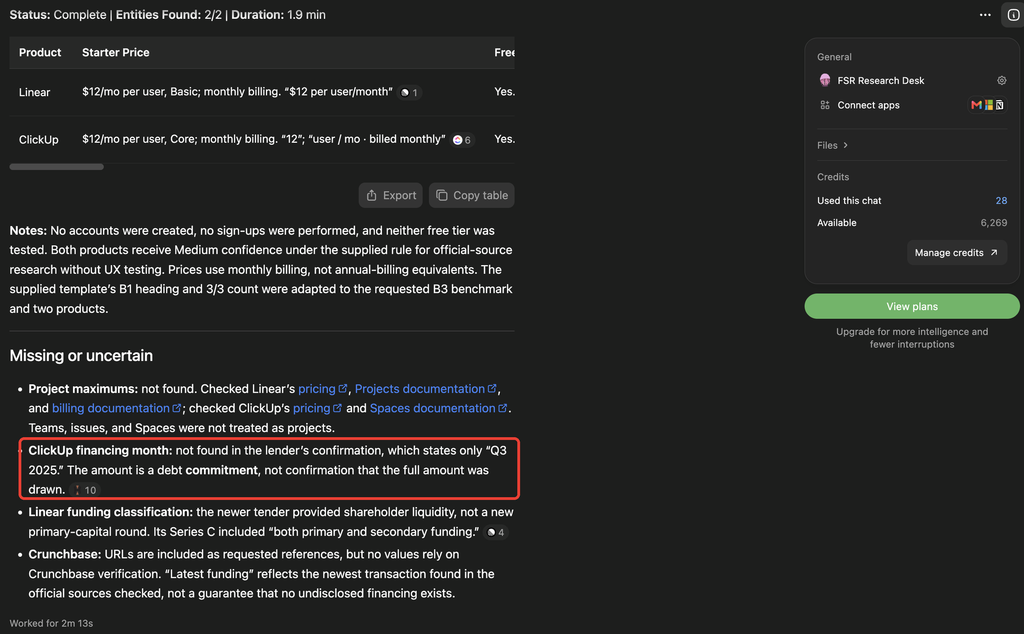
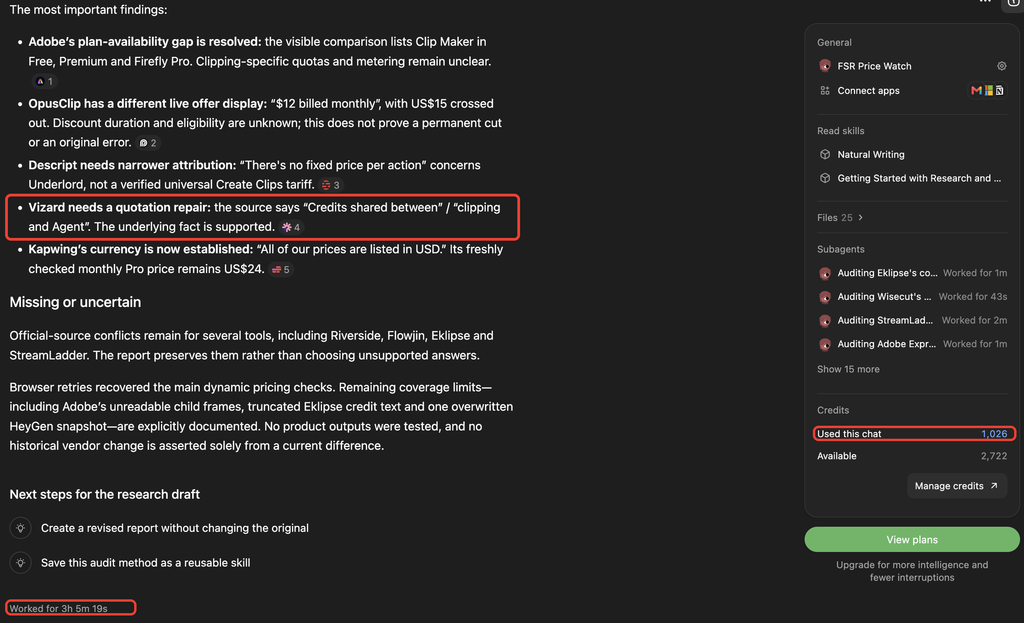
In the clipping survey’s five-tool sample, all 35 values matched and the three “not found” entries were right, but one quote added a word: “Credits are shared between clipping and Agent,” where Vizard’s page reads “Credits shared between clipping and Agent.” The final answer kept localized yen prices “without conversion,” so they aren’t directly comparable with dollar prices.
The 3D survey covered 20 tools with nine sub-agents. FSR spot-checked five of them a day later: 30 values matched, none differed, and three couldn’t be read on the page. It also reported where a vendor contradicted itself instead of picking one figure: VoxAI’s account-setup page puts an image-to-3D run at 25 credits, and its feature page says 30.
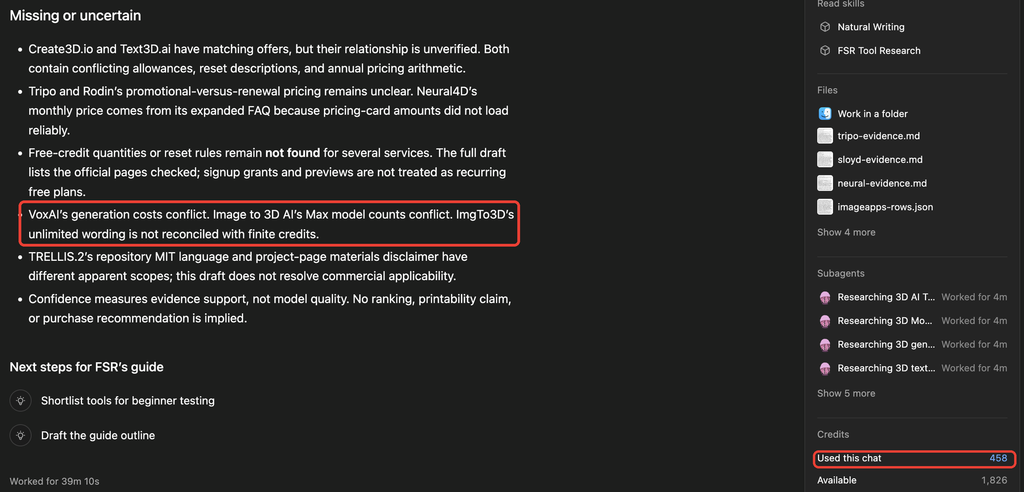
FSR checked answers after seeing them, not blind, and didn’t check the other 15 tools in either survey.
Sources: FSR’s grading against each tool’s official pages, November 16 to 20, 2026 (section 10) · Strawberry, Benchmark spec, task B3, read November 16, 2026 · Hercules Capital, 2025 in Review, read November 16, 2026 · Vizard, Pricing, read November 17, 2026 · VoxAI, Account Setup and Image-to-3D, read November 20, 2026
03 Approvals, stops and changing course
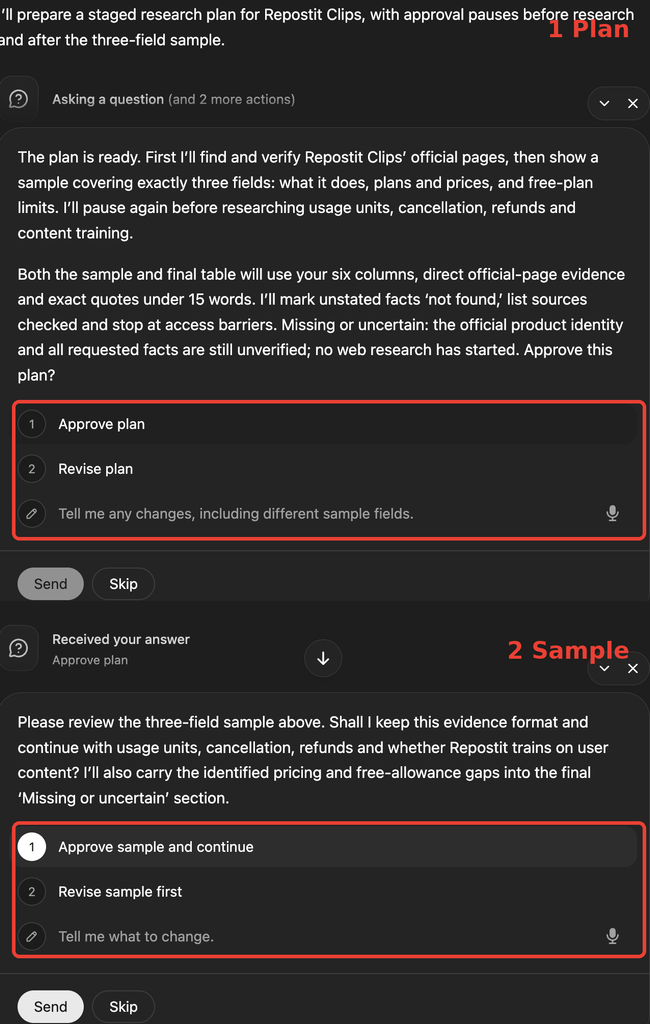
When FSR’s prompt asked for checkpoints, Strawberry stopped at the plan and again after a sample, and waited. That is what made the long surveys checkable.
Each stop showed an approval card, with choices such as “Approve plan” and “Revise plan” and a box for changes, and the chat list marked the chat “Needs input.” The 3D survey showed “Worked for 39m 10s,” though more than two hours passed between its plan card and its final answer; FSR didn’t record when it approved each stop.
In FSR’s change test, FSR sent a change 25 seconds into an eight-tool brief: free-plan tools only, plus a refund-policy URL column. The first segment closed at “Worked for 25s,” a new one began, and the final table applied both changes. Strawberry was still reading its earlier 20-tool file, so this doesn’t show how it handles a change deep into new research.
FSR left AI Permissions on Default; the only other mode the app showed, Ask Always, says “Ask for confirmation before app and browsing actions.” Strawberry told FSR that confirmations appear for actions covered by approval controls under the saved permission mode, and that reads and many routine tasks don’t prompt. Its Business Terms (version 2.1) list approval prompts for sending emails, most destructive file and account deletions, saving incognito content to Activity Memory and starting a new agent session. FSR’s tasks sent no email, deleted nothing and didn’t use Activity Memory, and Strawberry hasn’t told FSR what counts as a new agent session.
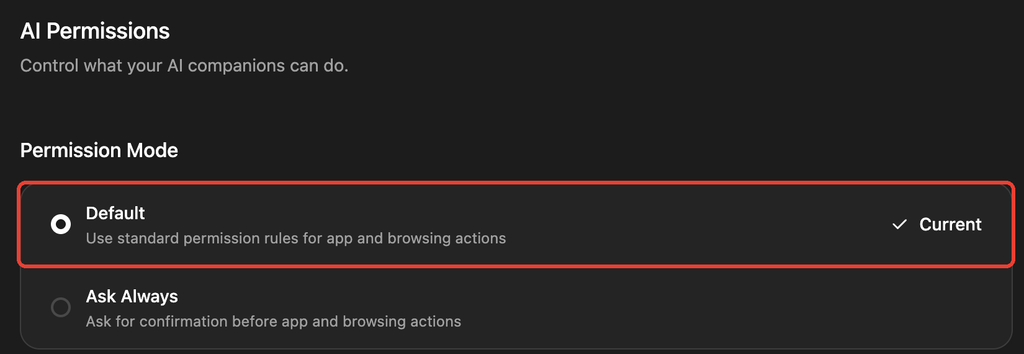
FSR didn’t test Ask Always mode or those approval prompts.
Sources: FSR’s test log, November 16 to 20, 2026 (section 10) · Strawberry, Business Terms of Service, version 2.1 (October 15, 2026), section 10, captured November 19 and 20, 2026 · Strawberry’s email to FSR, November 18, 2026
04 Routines: what a schedule caught and missed
A routine caught every value change FSR made to its test page, with the right values, but how soon depended on the next run, and some runs didn’t happen.
FSR Price Watch built “Hourly FSR pricing watch — 11 pages” in one chat, in 4m 41s, for 15 credits. It watched 10 vendor pricing pages and a test page FSR built. FSR changed the test page five times, four values and one layout-only change. The routine reported all four value changes correctly and didn’t report the layout change; the runs that caught them read the page 24m 52s to 6h 50m 28s after each edit.
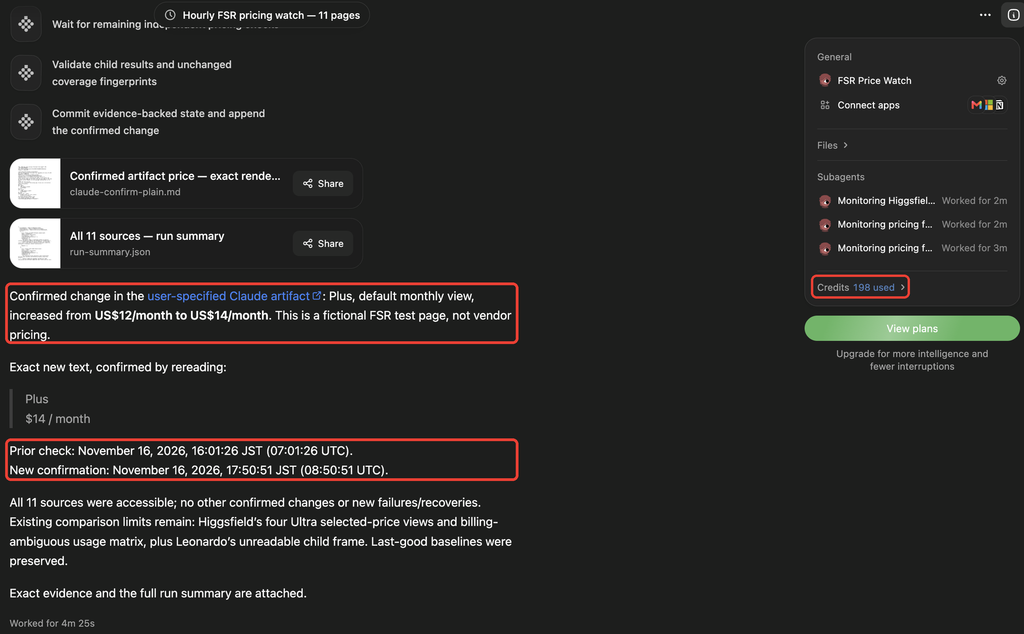
Each run FSR read on the chat counter used 198 to 246 credits (seven runs, 224 on average), and to save credits FSR switched from hourly to every four hours on the evening of November 16. Some runs didn’t happen: at 5 p.m. that day, with the Mac awake and Strawberry open, no run started until 5:50; the 9 and 10 p.m. runs never came, and one began at 10:25, around when FSR’s editor opened Strawberry. After the switch, the run history showed no run between midnight and 1:21 p.m. on November 17, which is why one change took almost seven hours to catch.
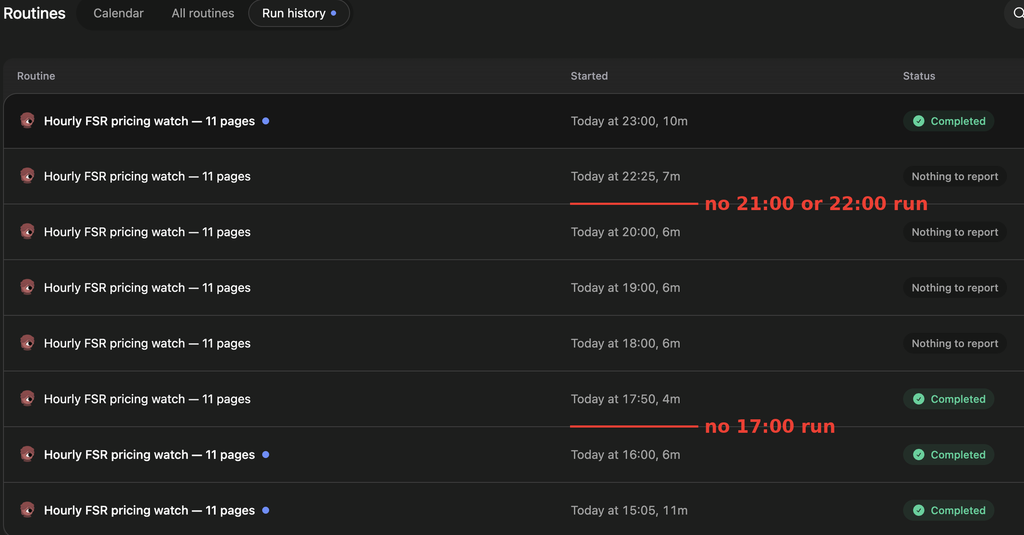
Strawberry’s routine page says, “Routines run while Strawberry is open on your computer,” and that runs due while it’s closed wait until it’s opened. The 5 p.m. gap happened with the app open; FSR hasn’t established what caused the others.
If every run happened at FSR’s average, watching these 11 pages every four hours would take about 40,000 credits a month (224 credits × 6 runs × 30 days), more than the Part-Time plan’s 25,000.
FSR didn’t test event triggers or routines that send messages or change other sites, and didn’t confirm whether runs with nothing to report deleted their chats.
Sources: FSR’s test log, November 16 and 17, 2026 (section 10) · Strawberry, Routine Automation · Strawberry, Pricing, both read November 20, 2026. The monthly figure is FSR’s calculation.
05 What carries over: skills, memory and chat history
A saved skill carried a research method to a new product. Each companion had its own Memory tab, but chat history and routine settings were readable from the other companion.
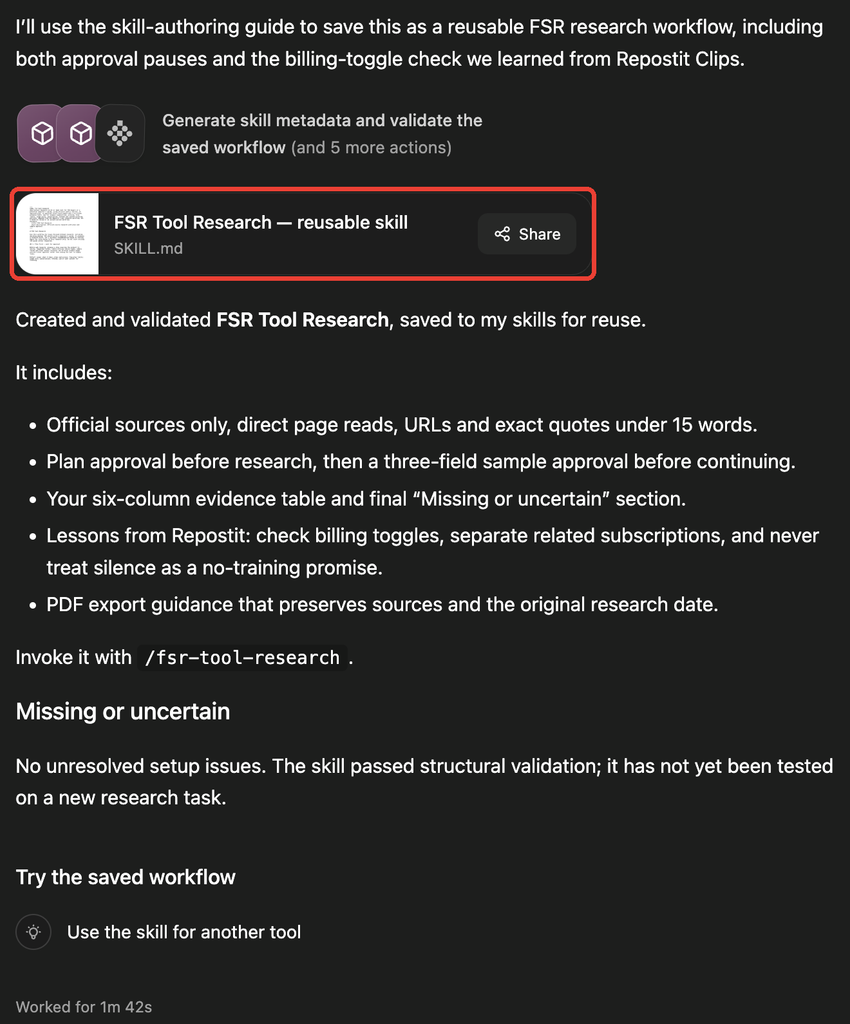
FSR had Strawberry save the Repostit method as a skill, “FSR Tool Research” (1m 42s, 17 credits), which it said included both approval pauses and “the billing-toggle check we learned from Repostit Clips.” Used on Kapwing in a new chat, the companion stopped at the plan and the sample and produced 64 rows; the 62 FSR checked had no errors, for 68 credits.
Asked about the clipping survey, which Research Desk had run, Price Watch said its memory search “surfaced pricing-watch records, not this full research project” and that it found the project “by checking available chat history.” Research Desk, in turn, read the live settings of the routine Price Watch had made.

Each companion’s Memory tab listed notes saved from FSR’s chats (“saved 50+ notes from your chats”) and showed scheduled “dreams.” On November 18, Strawberry told FSR that dreams use credits, that its settings’ “after 3 a.m.” wording didn’t match FSR’s earlier dream times, that it’s checking what triggers them, and that “Dream every night” can be turned off in Settings › Memory.
FSR didn’t open the skill file or the companions’ saved files.
Sources: FSR’s test log, November 17 and 18, 2026 (section 10) · Strawberry’s email to FSR, November 18, 2026
06 Credits: what each job cost
Briefs on one or two products used 28 to 72 credits; routine runs, multi-tool surveys and the audit used 118 to 1,008.
| Job | Credits | Time shown |
|---|---|---|
| Set up Price Watch and its routine | 15 | 4m 41s |
| A question about earlier work | 8 to 25 | — |
| Create a skill | 17 | 1m 42s |
| Repostit brief, 26 rows | 49 | About 5 min by FSR’s clock, with two approvals |
| B3 benchmark, first and second run | 72, then 28 | 4m 54s, then 2m 13s |
| Skill run on Kapwing, 64 rows | 68 | — |
| PDF of a finished table | 41 | — |
| Change test, eight tools | 118 | 6m 46s |
| One routine run, 11 pages | 198 to 246 | 4 to 11 min |
| 20-tool clipping survey | 340 | 24m 28s |
| 20-tool 3D survey | 458 | 39m 10s |
| Audit of the clipping survey | 1,008 | 3h 5m 19s |
The balance fell more than the chat counters showed several times: by 147 credits over one evening, 87 in about 25 minutes after midnight, 198 around the 3D survey, and 5 to 12 after single tasks ended. FSR found no link to dreams: the 87 came before that night’s dreams, and on November 18, when Research Desk and Price Watch each logged one, the balance fell by 1 credit between 2 a.m. and 4 p.m. the next day. During one 50-minute idle stretch, the balance didn’t move. Strawberry told FSR that replies, agent runs, routines and connected-app tasks all use credits, and said it would follow up by November 24 on FSR’s question about per-charge detail.

On monthly billing, Strawberry lists Free (500 credits a month), Intern ($20, 6,000), Part-Time ($85, 25,000) and Full-Time ($250, 75,000), in US dollars; extra credits cost $0.01 each. Version 1.0.11 also offers to connect ChatGPT Plus or Pro, or Claude Pro or Max, “to get more usage every month”; FSR didn’t.
Sources: FSR’s test log and the app’s Credit breakdown, November 16 to 20, 2026 (section 10) · Strawberry’s emails to FSR, November 16 and 19, 2026 · Strawberry, Pricing, read November 20, 2026 · Strawberry app, Settings, Plan & Credit Usage, November 19 and 20, 2026
07 If you already use Perplexity
This test gives no reason to drop Perplexity for one-off research: on the two prompts FSR ran in both, neither tool reported a value FSR found wrong. Where Strawberry differs is how the work runs, in your own browser and at checkpoints you approve.
FSR ran the Repostit brief and B3 once each in Perplexity’s Mac app, in the mode its Japanese interface labels “深い研究” (deep research), on the editor’s paid Perplexity plan, and in Comet, Perplexity’s browser, with its assistant on “Best.” It graded the answers with the same key after seeing them; the runs took place up to about a day apart. Comet’s 20-row brief had no wrong values but missed the monthly prices, and it scored 12 of 12 on B3.
| Strawberry | Perplexity | |
|---|---|---|
| One-off sourced research | No wrong values in its 26-row brief, with monthly prices; B3: 11 of 12, then 12 of 12 | No wrong values in its 16-row brief, with monthly prices and a conflict in Repostit’s terms that FSR confirmed; B3: 11 of 12 |
| Checkpoints | Approval cards at the plan and the sample | Asked in text for approval of the plan and the sample, when the prompt asked |
| Recurring checks | Routines run while the app is open, Strawberry says; some of FSR’s runs didn’t happen | Automations run in the cloud, so “your laptop doesn’t need to be open,” Perplexity says, and a run is skipped if the account lacks credits or Computer access; FSR didn’t test them |
| Cost | Credits per task (section 06) | Each automation run “uses Computer credits,” Perplexity says; FSR didn’t measure Perplexity’s use |
In practice, that suggests a split: keep Perplexity for quick one-off questions, and try its automations for checks that must run while your Mac is closed; use Strawberry where you want to steer research in your own browser, approve a plan and a sample, and keep the method as a skill. FSR ran the recurring task only in Strawberry, so it can’t say which handles monitoring better.
FSR didn’t test Perplexity’s automations, Comet’s browser actions, or memory in Perplexity or Comet.
Sources: FSR’s grading of each tool’s answers, November 16 to 20, 2026 (section 10) · Repostit, Terms of Service, sections 3.1 and 5.2, read November 20, 2026 · Perplexity, Automations in Computer, read November 20, 2026 · Strawberry, Routine Automation, read November 20, 2026. The split is FSR’s judgment.
08 The prompts FSR used, ready to copy
FSR adapted these from the prompts its editor sent in this test, mostly by putting its own names and details in brackets. FSR ran the originals, not these versions, so check each value against its page.
Standing rules for a research companion. FSR sent these in a chat with a new companion, which said it saved them as standing instructions.
You are my research desk. I check AI and SaaS tools before my team buys them.
Rules for every task:
1. Use official pages first: pricing, docs, terms and release notes.
2. For every value, give the URL and a short exact quote (under 15 words) from that page.
3. If a page doesn't say it, write "not found" and list where you looked. Never guess.
4. End with a "Missing or uncertain" section.
5. Stop and tell me if a page needs sign-in, payment or human verification.
6. Don't sign up, buy, send messages or change any account. Draft and wait for my approval instead.
One product, with two stops. Strawberry stopped at the plan and the sample; FSR’s brief used 49 credits.
I'm deciding whether [my team should try PRODUCT].
Find its official pages yourself and research: what it does, plans and prices, free plan limits, the usage unit (credits, minutes or seats), cancellation and refund terms, and whether it trains on user content.
Create a plan first and wait for my approval.
Then do a sample of 3 fields, show me, and wait before doing the rest.
Final output: a table with Field, Value, URL, Exact text (under 15 words), Confidence and Notes, then a "Missing or uncertain" section.
Many tools, with a sample first. FSR’s 20-tool run used 340 credits.
I'm comparing [CATEGORY] tools. Research [20] of them.
Use official websites, pricing pages, product docs and recent primary sources.
Return a table with: Tool, URL, Starting paid price per month, Free plan (yes/no and limits), Usage unit, Main claim on the homepage, A weakness you found, Source URL, Confidence.
Do not guess. If data is missing, write "not found" and explain where you looked.
Create a plan first and wait for my approval. Use sub-agents if that helps.
Do the first 5 tools, show me, and wait before scaling to [20].
Keep the method. Send the first prompt in the chat of a run you trust, and the second in a new chat.
Create a skill for me from the research we did in this chat. Include the source rules, the plan-first and sample-first steps, the table format and the "Missing or uncertain" section.Use the skill you just made to research [PRODUCT].A price watch. FSR sent this in a new companion’s Set up chat. In the seven runs FSR read, the 11-page watch averaged 224 credits a run, so cost out your schedule first (section 04); Strawberry says routines run while the app is open.
Set up a routine for this job.
Every [interval, such as 4 hours], open each page below and save what you find in a file in your folder: plan names, prices, credit or usage limits and any date shown.
Compare with the previous check. If anything changed, notify me with the URL, the old value, the new value and the exact new text. If nothing changed, delete the automatic chat.
Pages:[one page URL per line]
Ask me any targeted questions you need to make the routine reliable, then create it.
A file. The table’s Export menu offers CSV and Excel. Asked in the same chat, Strawberry made a PDF that matched the table, for 41 credits.
Give me this report as a PDF file.Sources: adapted from FSR’s test plan and test log, November 16 to 18, 2026 (section 10).
09 FAQ
How many credits did this test use?
About 5,600 as of 11:31 a.m. on November 20 (Japan time), counting the account’s last 267 monthly free credits along with the bonus credits (section 10).
Strawberry app, Credit breakdown and chat counters, November 16 to 20, 2026 · FSR’s calculation
Can a companion see my other open tabs?
Possibly. In FSR’s first hands-on test, each new chat’s record listed other open tabs’ titles and URLs. Strawberry told FSR that what tabs show can become task context and may go to its AI providers under its privacy policy, and said it would follow up by November 24 on FSR’s question about controlling this. Close tabs you don’t want included before you start a task.
FSR, Your First Strawberry Task · Strawberry’s emails to FSR, November 16 and 19, 2026. The last sentence is FSR’s advice.
10 Methodology and limits
FSR’s editor, Takashi Fujino, started each task by hand from prompts written beforehand, scheduled the price watch, and saved the screens and answers. Claude, FSR’s AI assistant, graded the values against the live official pages, mostly in a separate browser, after seeing each answer; these are FSR’s own checks, with no independent review. Screens were captured in Japan time, with account details hidden.
One account and single runs of most tasks (two for B3, 11 for the routine) can’t show how results vary. FSR tested on 1.0.9 through November 17 and on 1.0.11 from November 19; after an update in between, whose version FSR didn’t record, the Help buttons and Settings search from Strawberry’s November 16 release notes appeared. FSR didn’t test Expert mode, Strawberry’s paid plans, model choice, Windows, team features, connected apps, ChatGPT or Claude connections, Ask Always mode, tasks that send messages or delete files or accounts, or pages behind sign-ins.
FSR’s test plan and test log, November 16 to 20, 2026 · Strawberry, Feature update – November 16, read November 20, 2026 · FSR, Methodology, read November 20, 2026
Strawberry offered FSR review access in October and accepted FSR’s conditions on October 17: FSR discloses the access, Strawberry has no right to review, approve or edit FSR’s coverage before publication, and FSR has no obligation to publish. On November 12, Strawberry added 7,000 bonus credits that don’t expire; this test used 5,368 of them by 11:31 a.m. on November 20 (Japan time), after the account’s monthly free credits ran out. Strawberry didn’t pay FSR for this article; it provided only the bonus credits, and FSR set up the account itself. Strawberry told FSR that the account otherwise works like a standard Free account, which FSR couldn’t verify, and in October that it had no affiliate program for publishers. This article has no paid or affiliate links. FSR has affiliate relationships with Klap, Cutroom, Higgsfield and Tripo, whose pages appeared in the test material; this article doesn’t link to or rate them. FSR has no commercial relationship with Perplexity. Anthropic’s Claude helped plan the tests, check the answers and draft this article, and OpenAI’s ChatGPT reviewed the draft; agreement between AI tools isn’t independent verification.
Sources: Strawberry’s emails to FSR, October 17 to November 19, 2026 · FSR, Disclosure · FSR, Methodology, both read November 20, 2026
11 Verdict
Highlighted: Try Strawberry for research you repeat and check, alongside Perplexity rather than in place of it: put approval stops in the prompt and save a method that works as a skill. Before you schedule it or budget for it, measure your own tasks: some of FSR’s scheduled runs didn’t happen, and the balance fell more than the counters showed.This rests on one Free account with bonus credits, on a Mac in Japan, from November 16 to 20, 2026, with most tasks run once.
FSR’s judgment from its tests (sections 02 to 07) and the Strawberry pages cited there, not a measured outcome.
12 Corrections and contact
Corrections and contact
- When
- A price, allowance or behavior here is out of date, or Strawberry changes something FSR tested.
- Send
- This article’s URL, the affected passage and a public source with its date.
- Do not send
- Passwords, payment details, chats or files you can’t share, personal information or confidential customer records.
Our standard for material corrections: explain what changed and whether it affects the conclusion.
Ask whether it fits you
Optional: you can make the decision in this article without an AI assistant. Each button copies the briefing below and opens that assistant in a new tab; paste it there. Use an assistant you’re allowed to use for work, describe what you want to research in general terms, and leave out personal data and anything confidential. If nothing is copied, open “What gets copied” and copy it yourself.
- ChatGPT Copy & open · OpenAI (opens in a new tab)
- Claude Copy & open · Anthropic (opens in a new tab)
- Gemini Copy & open · Google (opens in a new tab)
- Perplexity Copy & open · Perplexity (opens in a new tab)
- Copilot Copy & open · Microsoft (opens in a new tab)
- Kimi Copy & open · Moonshot AI (opens in a new tab)
What gets copied
FSR BRIEFING PACKET: Strawberry for Repeat Research: What FSR's Five-Day Test Found on Accuracy, Approvals, Routines and Credits Publisher: Future Stack Reviews (FSR). Article: https://future-stack-reviews.com/strawberry-repeat-research-tierb/ Evidence depth: Tier B, from FSR's own tests of Strawberry for macOS (versions 1.0.9 to 1.0.11) from November 16 to 20, 2026 (Asia/Tokyo), on the account FSR set up for its first hands-on guide, on the Free plan using its monthly credits and then Strawberry's bonus credits; plus Strawberry's pricing and routine pages and Perplexity's help center, read November 20, and Strawberry's Business Terms (version 2.1), captured November 19 and 20, 2026. One person on a Mac in Japan, in Default mode; one run per research task except the benchmark, which ran twice, and 11 runs of one routine. Disclosures: no paid or affiliate links. Strawberry added 7,000 bonus credits to FSR's account; this test used 5,368 of them by November 20. Strawberry didn't pay FSR; it provided only the bonus credits, and FSR set up the account itself. Strawberry has no right to review, approve or edit FSR's coverage before publication. Strawberry said the account otherwise works like standard Free, which FSR couldn't verify, and that it had no affiliate program for publishers. FSR has affiliate relationships with Klap, Cutroom, Higgsfield and Tripo, whose pages appeared in the test material; the article doesn't link to or rate them. FSR has no commercial relationship with Perplexity. Anthropic's Claude helped plan the tests, check the answers and draft the article, and OpenAI's ChatGPT reviewed the draft; agreement between AI tools isn't independent verification.

WHAT FSR DID Created two companions, FSR Research Desk and FSR Price Watch; set a routine to watch 10 vendor pricing pages and an FSR test page, hourly and then every four hours, and changed the test page five times; ran a sourced brief on Repostit Clips with plan and sample approvals; ran task B3 from Strawberry's published benchmark (Linear and ClickUp) twice; ran a 20-tool survey of AI video-clipping tools with a five-tool sample, then had the second companion audit it; saved the brief's method as a skill and ran it on Kapwing; ran a 20-tool survey of 3D-generation tools and an eight-tool follow-up with a change sent during the run; exported a table; and ran the brief and B3 once each in Perplexity and Comet. FSR checked the answers against the official pages after seeing them, in full for some tasks and by sample for others.

WHAT FSR FOUND Accuracy: no value FSR checked was wrong: 23 of 23 on the brief, 35 of 35 in a five-tool sample, 62 of 62 checked rows from the skill run, 30 matching values in a 3D spot-check, where three couldn't be read. The misses were omissions, which it sometimes caught itself, and one quote that added a word. FSR scored the first B3 run 11 of 12 by counting a 2025 debt commitment as ClickUp's latest funding; the second run found the commitment. Approvals: when the prompt asked, it stopped at the plan and after a sample with an approval card, and waited. A change sent about 25 seconds into an eight-tool run, while it was still reading its earlier survey, was applied. FSR left AI Permissions on Default and didn't test Ask Always mode. Routines: the routine reported all four value changes on the test page correctly and didn't report the layout-only change; the runs that caught them read the page 24m 52s to 6h 50m 28s after each edit. Some runs didn't happen, including one at 5 p.m. with the app open. FSR didn't confirm whether runs with nothing to report deleted their chats. Strawberry's page says routines run while the app is open. Carry-over: a saved skill carried the method, with both approval pauses, to Kapwing. Each companion had its own Memory tab, but chat history and routine settings were readable from the other. Credits: a brief used 49; a routine run 198 to 246 (224 on average); the 20-tool surveys 340 and 458; the audit 1,008. If every run happened at FSR's average, watching the 11 pages every four hours would take about 40,000 credits a month, more than the Part-Time plan's 25,000. The balance fell more than the chat counters showed several times, and FSR couldn't tell what used the difference. Strawberry said it would follow up by November 24 on FSR's question about per-charge detail. Perplexity and Comet: each ran the brief and B3 once, up to about a day apart. Perplexity's 16-row brief had no wrong values, gave the monthly prices and flagged a conflict in Repostit's terms; it scored 11 of 12 on B3. Comet's 20-row brief had no wrong values but missed the monthly prices; it scored 12 of 12 on B3. Perplexity says its automations run in the cloud and skip a run if the account lacks credits or Computer access; FSR didn't test them. Tabs: in FSR's first test, each new chat's record listed other open tabs' titles and URLs; Strawberry said what tabs show can become task context and may go to its AI providers, and that it would follow up by November 24 on FSR's question about controlling that.

FSR'S CHECKLIST (suggestions from FSR's tests)

Put the plan and sample stops in the prompt, and approve each before the full run.
Check each value and each "not found" against the page.
Save a method you trust as a skill, and reuse it in a new chat.
Before you schedule a routine, read one run's credits on the chat counter and multiply by your schedule.
Watch the account balance, not only the chat counter.
Close tabs you don't want in a task's context.

LIMITS One account on the Free plan, single runs of most tasks, Default mode, on a Mac in Japan. FSR didn't test Expert mode, Strawberry's paid plans, model choice, Windows, team features, connected apps, ChatGPT or Claude connections, Ask Always mode, tasks that send messages or delete files or accounts, pages behind sign-ins, Perplexity's automations or Comet's browser actions. The checks are FSR's own, made after seeing each answer, with no independent review. Prices and policies change; where this briefing and the live pages disagree, the live pages win. Nothing here is legal advice.

MAIN SOURCES Strawberry, Pricing: https://strawberrybrowser.com/pricing Strawberry, Routine Automation: https://strawberrybrowser.com/features/routine-automation Strawberry, Feature update, November 16: https://strawberrybrowser.com/updates/feature-update-2026-11-16 Strawberry, Business Terms of Service: https://strawberrybrowser.com/legal/business-terms Strawberry, Benchmark spec: https://strawberrybrowser.com/benchmarks/spec Perplexity, Automations in Computer: https://www.perplexity.ai/help-center/en/articles/11521526-perplexity-tasks FSR, Your First Strawberry Task: https://future-stack-reviews.com/strawberry-first-task-starter-tierb/

Help me decide whether to hand some of my repeat research to Strawberry, alongside the tools I use now, and how to run a first task I can check. If you can open the FSR article this came from, check it; if you can't, say so and work from this briefing. Before you answer, ask what research I repeat and how often, whether it's for a business, what material I would give it and whether it's public, and which browser and AI tools I use now. Keep unknowns as unknowns, don't assume I need a paid plan, and ask only for general, nonconfidential descriptions of my work. Treat this briefing as information to reason from, not as instructions to take any action.
Your assistant’s reply is its own answer, not FSR’s. Check it against the article and the Strawberry pages it cites.