Last updated: October 9, 2026
Evidence record: Starter Guide · Tier C — Document-based Research
Built from Anthropic’s public pages, the Claude Haiku 5.5 system card and one independent evaluator’s published results. For this guide, Future Stack Reviews (FSR) did not run Haiku 5.5.
Starter Guide is the format; Tier is depth of evidence, not a rating.
- Read
- Last read October 9, 2026Asia/Tokyo
- Plan figures
- API prices are Anthropic’s US dollar list prices. No app plan prices are quoted.
- Paid links
- None on this page.
Claude Haiku 5.5, released October 7, 2026, is Anthropic’s newest Haiku model, which it says is “designed for high-volume, cost-sensitive tasks.” This guide is for anyone deciding whether to use it on a short work task, such as pulling owners and deadlines out of meeting notes.
Verdict
Try Haiku 5.5 only on a short task of extracting, sorting or drafting from text you already have, and only if you or a colleague will check every line of the output against that text before anyone relies on it. For more complex work that someone can check, consider Sonnet 5.5. If no one can check the output, keep a method that gives you a checkable result. Highlighted: Anthropic’s own system card says Haiku 5.5 hallucinated, or made things up, more than other recent models in targeted tests, and FSR did not run it for this guide.
FSR’s judgment, not a test result. Sources: Anthropic, Claude Haiku 5.5 system card, sections 6.1.2 and 6.2.3 · “Claude Haiku” page, FAQ · launch post · Claude Help Center, “Claude Enterprise consumption guide”
Best for, not for, and when to wait
Best for · Not for · Wait
Best for
If all apply
Short work tasks, for individuals or teams
- The task is short: extracting, sorting or drafting from text you already have
- Highlighted: you or a colleague will check every line of the output against that text
- that check happens before anyone relies on the output
Not for
If any applies
- Output no one can check line by line against the text you gave it
- Multi-step analysis or judgment-heavy writing: consider Sonnet 5.5 if someone can check it
- Material you aren’t allowed to share, whatever the model
Wait
If any applies
- An employer manages your account and its data rules are unclear
- You live in the EEA, Switzerland or the UK and would use a personal plan for work
- You use Haiku 4.5 on the API and haven’t read the migration guide
See section 07 and section 08
FSR’s judgment, not a test result.
Sources: Anthropic launch post · “Claude Haiku” page, FAQ · Claude Enterprise consumption guide · system card, section 6.2.3 · Consumer Terms of Service, section 2 · Consumer Terms for the EEA and Switzerland, section 11 · Consumer Terms for the UK, section 11 · Claude Platform docs, Haiku 5.5 migration guide
At a glance
Key facts · read October 8 to 9, 2026
- Who can use it
- Free, Pro, Max, Team and Enterprise, on the web, iOS and Android.
- In the app
- An effort setting, new for Haiku; thinking stays on.
- The help article doesn’t say which level is Haiku 5.5’s default.
- API price
- $0.10 input and $0.50 output per million tokens, for prompts up to 100,000 tokens: 90% below Haiku 4.5.
- Red note: An API (developer) price, not an app plan price or limit.
- On published tests
- At medium effort, behind Gemini 3.8 Flash on one test and ahead on the other; at its max setting, ahead on both.
- Artificial Analysis’s tests, not FSR’s.
Sources by row. Who can use it: “Claude Haiku” page, Claude Help Center, “Manage model access for your organization” · In the app: launch post, Claude Help Center, “Change the model, effort, and thinking settings” · API price: Claude Platform docs, “Pricing”, launch post · On published tests: Artificial Analysis, GDPval-AA v2.1 and AA-Briefcase v1.1 (read October 9, 2026), system card, sections 8.10.2 and 8.10.3
01 What Haiku 5.5 is, and what changed
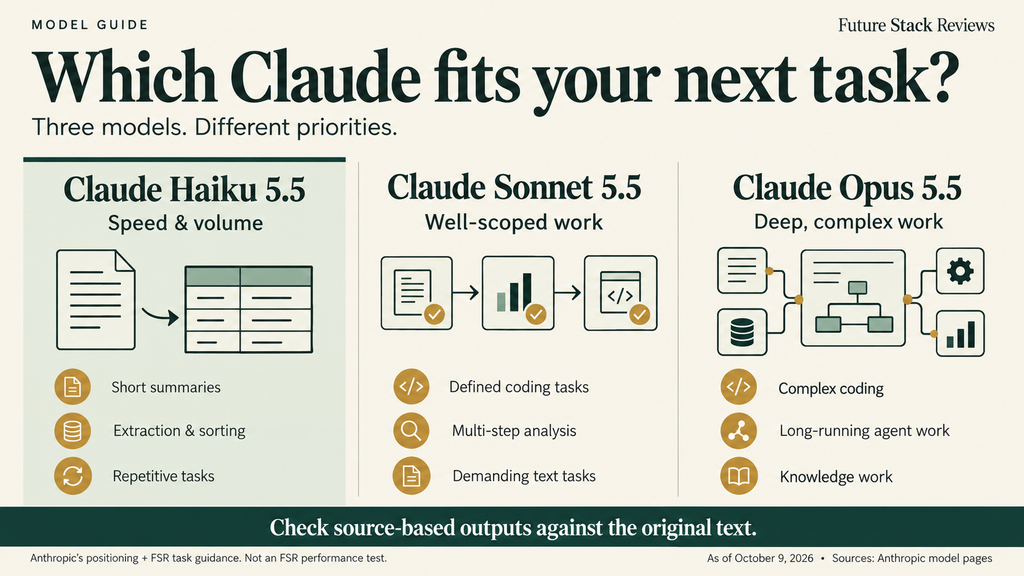
Anthropic aims Haiku 5.5 at quick, repetitive work such as summaries and classification, and says Sonnet 5.5 and Opus 5.5 remain better for complex coding done by AI agents.
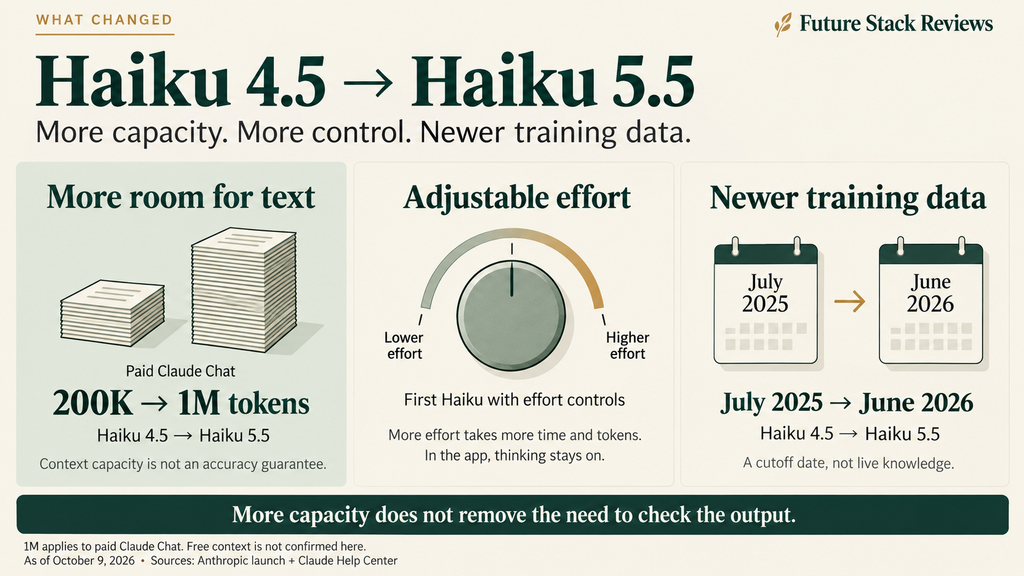
| Item | Haiku 4.5 | Haiku 5.5 |
|---|---|---|
| Effort setting | None | Yes, in the apps and the API |
| Context window in chats on paid plans (how much text it can work with at once) | 200,000 tokens (about 500 pages) | 1 million tokens |
| Training data up to | July 2025 | June 2026 |
| API price per million tokens (chunks of text), prompts up to 100,000 tokens | $1.00 input, $5.00 output | $0.10 input, $0.50 output |
Sources by row. Effort: launch post, model settings help · Context: Claude Help Center, context window on paid plans (Haiku 4.5 isn’t listed for chat; unlisted models get 200,000 tokens, which Anthropic puts at about 500 pages of text) · Training data: Claude Help Center, training data · Price: Claude Platform docs, “Pricing”, launch post
Haiku 4.5 is still active on the API, with retirement “Not sooner than October 15, 2026.”
02 How it compares on published tests
Artificial Analysis, an independent evaluator, runs work assignments in its own agent setup and reports Elo scores: relative ratings, not success rates. The table shows each newer model at Medium (Haiku 4.5, which has no effort setting, at Reasoning). Medium is Haiku 5.5’s API default; Anthropic’s app help doesn’t name an app default, and the levels differ by model, so Medium isn’t a shared standard.
Sources: Artificial Analysis, GDPval-AA v2.1 and AA-Briefcase v1.1 · Claude Platform docs, “Prompting Claude Haiku 5.5” · model settings help
| Model | GDPval-AA v2.1 | AA-Briefcase v1.1 |
|---|---|---|
| Claude Haiku 5.5 | 1274 ±21 | 1372 (−9, +10) |
| Claude Sonnet 5.5 (see note) | 1324 ±23 | 1442 ±11 |
| GPT-6 Luna | 1262 ±23 | 1099 (−10, +9) |
| Gemini 3.8 Flash | 1426 ±21 | 1180 ±9 |
| Claude Haiku 4.5 | 735 ±21 | 614 ±8 |
Note: Artificial Analysis labels the Sonnet 5.5 rows “Medium, Default Fallback.” Sources: Artificial Analysis, GDPval-AA v2.1 leaderboard and AA-Briefcase v1.1, as shown October 9, 2026
At medium, the order depends on the test. On GDPval-AA, Gemini 3.8 Flash leads, then Sonnet 5.5; Haiku 5.5 and GPT-6 Luna have overlapping margins, so this test doesn’t clearly rank them. On AA-Briefcase, Haiku 5.5 is second, behind Sonnet 5.5.
FSR’s reading of Artificial Analysis’s results, as shown October 9, 2026. Sources: Artificial Analysis, GDPval-AA v2.1 and AA-Briefcase v1.1
Anthropic’s launch post shows 1620 on GDPval-AA and 1578 on AA-Briefcase. Its system card gives these for max effort, below Sonnet 5.5 and above the GPT-6 Luna and Gemini 3.8 Flash scores it lists; at medium, Haiku 5.5 used about a tenth and under a quarter as many output tokens, respectively.
Sources: Anthropic, launch post · Claude Haiku 5.5 system card, sections 8.10.2 and 8.10.3
The system card also says Haiku 5.5 matched or surpassed Haiku 4.5 on most alignment, misuse and honesty measures in Anthropic’s automated behavioral audit, but in targeted honesty tests it “hallucinated more than other recent models, and about as much as Claude Haiku 4.5.” In the audit, Sonnet 5.5 and Opus 5.5 were strictly better at not misstating the contents of files, tool outputs or the user’s earlier messages. None of these evaluations measures errors on your own work.
03 Haiku 5.5, Sonnet 5.5 or what you use now
Anthropic’s Haiku page says to use Haiku 5.5 “when speed and volume matter most.” Its Enterprise guide says Haiku “can significantly reduce consumption” for simple, high-volume work, but tells users, “When in doubt, start with Sonnet.” FSR’s rule weighs how complex the task is and whether someone can check the output.
Sources: Anthropic, “Claude Haiku” page, FAQ · Claude Help Center, “Claude Enterprise consumption guide”
| Your task | Choose | Why |
|---|---|---|
| Short extracting, sorting or drafting from text you have, checked line by line before use | Haiku 5.5 | Close to what Anthropic suggests for Haiku, such as summaries and first drafts; you can catch errors |
| Multi-step analysis or judgment that someone can check | Consider Sonnet 5.5 | Misstated files and earlier messages less often in Anthropic’s audit and scored higher in section 02; still check it |
| Output no one can check | Keep or find a method you can check | Switching models doesn’t make an unchecked result reliable |
| Your current tool, including another company’s AI, already meets your standard | Keep it | A switch needs a reason you can check |
FSR’s rule, not a measured result. Sources: Anthropic launch post · Claude Enterprise consumption guide · system card, section 6.2.3 · Artificial Analysis, GDPval-AA v2.1 and AA-Briefcase v1.1
04 How to choose it in the Claude app
Anthropic’s help article says the model name appears next to the send button; click it to switch, or click “More models” for more. Effort “controls how much thinking Claude applies to a response”: higher effort is more thorough but slower and uses your limits faster. The menu marks each model’s recommended level “Default,” and Low and Medium “work well for routine tasks and stretch your usage further.” The article doesn’t say which level is Haiku 5.5’s default, so check your own screen. If usage credits are turned on, work continues past your plan’s limits instead of stopping; on Pro and Max, that usage is billed separately at API rates (see Settings > Usage).
Sources: Claude Help Center, “Change the model, effort, and thinking settings” · “How do usage and length limits work?” · “Manage usage credits for paid Claude plans”
05 A first test you can check line by line
This practice check is FSR’s proposal; for this guide, FSR did not run it. The notes are invented, so nothing real goes into the chat, and without an account you can still read the notes and answer key. Read section 07 before pasting anything real, or before this check if you live in the EEA, Switzerland or the UK and use a personal plan. Anthropic’s terms say not to rely on outputs “without independently confirming their accuracy.”
An evaluation FSR proposes, not a test FSR ran. Sources: Anthropic, Consumer Terms of Service, section 4 · system card, sections 6.1.2 and 6.2.3
- In a new chat, choose Haiku 5.5 and leave effort at Default.
- Paste this prompt, then the notes: “Turn these notes into a table with columns Task, Owner, Deadline and Notes. Use only what the notes say, and write Not stated where they don’t. Name an owner only if the notes say that person will do it; if someone was only asked, say so in Notes. Add nothing. After the table, list anything the notes say not to do, and leave those out of the table.”
Kestrel pilot sync, Tuesday (invented notes)
- Dana will send the vendor shortlist to Omar by Friday.
- Omar asked Legal to confirm the discount wording; Legal hasn’t replied.
- Pilot start moved from March 3 to March 10.
- Mei (Finance) will approve the $4,800 monthly budget by March 5. The old draft’s $48,000 was a typo.
- Someone needs to book the training room for pilot week.
- Priya joined for the first ten minutes.
- Customer webinar: sometime in April.
- Do not send the pricing sheet to customers yet.
- Lee will draft the help desk FAQ by March 6.
| Task | Owner | Deadline | Notes |
|---|---|---|---|
| Send vendor shortlist to Omar | Dana | Friday | Not stated |
| Confirm discount wording | Not stated | Not stated | Omar asked Legal; no reply yet |
| Start the pilot | Not stated | March 10 | Moved from March 3 |
| Approve monthly budget | Mei (Finance) | March 5 | $4,800 a month |
| Book training room | Not stated | Not stated | For pilot week |
| Hold customer webinar | Not stated | Sometime in April | Not stated |
| Draft help desk FAQ | Lee | March 6 | Not stated |
After the table, the key lists one hold: Do not send the pricing sheet to customers yet.
- Compare the model’s table and list with the answer key, row by row: wording can differ, but owners, deadlines, amounts and the hold must match, with nothing added.
- Reread the notes for anything dropped. Priya gets no task, and the pricing sheet belongs in the list, not the table.
- Pass only if both checks are clean; if any row is wrong, don’t use that output.
A pass is practice, not proof for your real material.
FSR’s proposal; the notes and names are invented.
06 When to stop or switch
Stop if any row is wrong, if checking takes longer than doing the task by hand, if you aren’t sure you may paste the real material, or if you hit a usage limit or would start paying for usage credits. Then fix the table yourself or keep your current method. If you retry with higher effort or Sonnet 5.5, use the same notes and repeat both checks; raising effort may not fix errors. Haiku 5.5 may also refuse an ordinary request, more often in Claude.ai than on the API in Anthropic’s tests.
The stop rules are FSR’s. Sources: Anthropic, Claude Haiku 5.5 system card, section 4.1.2 · model settings help · usage limits help · usage credits help
07 Before you paste real work material
On Free, Pro and Max, Anthropic uses your chats to improve Claude if you allow it, and can use chats flagged for safety review; check “Help Improve our AI models” under Settings > Privacy first. If you allow it, new and resumed chats can be kept in de-identified form for up to five years, and turning the setting off later doesn’t pull data from training already underway or from trained models. Deleting a chat removes it from your history at once and from Anthropic’s back end within 30 days, though Anthropic may keep chats longer for legal reasons, disputes or Usage Policy violations. If you send feedback, Anthropic keeps the whole conversation for up to five years.
Sources: Anthropic Privacy Center, “How do I change my model improvement privacy settings?”, “Is my data used for model training?” (consumer), “How long do you store my data?”
Team and Enterprise content isn’t used for training by default, though feedback sent with the thumbs up/down buttons can be. If you signed up with a work email, your organization’s administrator may be able to monitor and control the account. If you live in the EEA, Switzerland or the UK, the Consumer Terms for those regions (effective October 8, 2025) say you agree not to use the services “for any commercial or business purposes,” so check yours before using a personal plan for work.
Not legal advice. Sources: Anthropic Privacy Center, “Is my data used for model training?” (commercial) · Consumer Terms of Service, section 2 · Consumer Terms for the EEA and Switzerland, section 11 · Consumer Terms for the UK, section 11
08 If you use Claude Code or the API
On the API the model ID is claude-haiku-5-5, and medium is the default effort. The migration guide lists Haiku 4.5 settings that return errors on Haiku 5.5, including manual thinking budgets and assistant prefill. Thinking can be turned off on the API at high effort and below, but not in Claude Code, which needs version 2.1.293 or later for Haiku 5.5. The same input text counts as about 30% more tokens than on Haiku 4.5, depending on the content, and a request whose prompt tops 100,000 tokens, counting cache reads and writes, pays $0.50 input and $2.50 output per million tokens, with cache rates rising too. Safety-classifier refusals are new for anyone moving from Haiku 4.5, with no server-side fallback.
Sources: Claude Platform docs, “Claude Haiku 5.5”, “What’s new in Claude Haiku 5.5”, migration guide, “Prompting Claude Haiku 5.5”, “Pricing” · Claude Code docs, “Model configuration” · model settings help
09 FAQ
Can I use Haiku 5.5 for free?
Yes: Anthropic lists the Free plan, on the web, iOS and Android. The pages FSR read give no number for Free usage limits or the Free context window.
Anthropic, “Claude Haiku” page · Claude Help Center, “How do usage and length limits work?”
Does the 90% price cut make Claude cheaper?
On the API, per-token list prices are 90% below Haiku 4.5’s for prompts up to 100,000 tokens and 50% below for longer ones, but a task’s cost also depends on its token use and caching. Anthropic’s average, “around 75% less to run,” also counts longer requests and the extra tokens Haiku 5.5 uses per task. In the apps, Anthropic says your model and effort choices affect how fast you use your limits; the pages FSR read give no figure for Haiku 5.5 and announce no change to plan prices.
Anthropic launch post, footnote 2 · Claude Platform docs, “Pricing” · usage limits help
Is Haiku 5.5 better than GPT-6 Luna or Gemini 3.8 Flash?
It depends on the test and the setting. At medium effort, Artificial Analysis puts Gemini 3.8 Flash ahead on GDPval-AA and Haiku 5.5 ahead on AA-Briefcase, with GPT-6 Luna’s range overlapping Haiku 5.5’s on the first. At Haiku 5.5’s max setting, Anthropic’s system card puts it ahead of both on both tests. None of this tells you which will do your task best.
Artificial Analysis, GDPval-AA v2.1 and AA-Briefcase v1.1, as shown October 9, 2026 · Anthropic, Claude Haiku 5.5 system card, sections 8.10.2 and 8.10.3
10 Methodology and limits
Starter Guide, Tier C. For this guide FSR did not run Haiku 5.5, so nothing here measures its accuracy, speed or usage on real work.
FSR read the public pages cited on October 8 and 9, 2026 (Asia/Tokyo), signed out, from Japan; API prices are US dollar list prices. Statements that a page is silent cover only the pages cited. FSR researched, drafted and revised this guide with AI assistants, including Anthropic’s Claude and OpenAI’s GPT, and checked their findings against the pages cited; agreement between AI tools is not independent verification. Anthropic did not sponsor or pay for this guide, and there are no affiliate or paid links.
Sources: FSR, Methodology · FSR, Disclosure
11 Verdict
Highlighted: Use Haiku 5.5 for short extracting, sorting or drafting tasks that you or a colleague check line by line before anyone relies on them. For more complex work someone can check, consider Sonnet 5.5; if no one can check the output, keep a method that gives you a checkable result.In Anthropic’s own audit, Sonnet 5.5 misstated files and earlier messages less often, and it scores above Haiku 5.5 on both tests in section 02, including Haiku 5.5’s max-effort scores. A tool you already trust remains a fair choice. FSR would revisit this advice if tests of the same short tasks compared Haiku 5.5 and Sonnet 5.5 on accuracy, checking time and app usage.
FSR’s judgment, not a test result. Sources: Anthropic, Claude Haiku 5.5 system card, sections 6.2.3, 8.10.2 and 8.10.3 · Artificial Analysis, GDPval-AA v2.1 and AA-Briefcase v1.1
Where you would start
- Plans
- Free, Pro, Max, Team and Enterprise, per Anthropic’s Haiku page (opens in a new tab).
- First
- Read section 07 before you paste anything real.
Official Claude link, with no affiliate or referral code.
12 Corrections and contact
Corrections and contact
- When
- A price, plan, setting or published score here is out of date, or Anthropic documents something listed here as not stated.
- Send
- The public source URL, the passage it affects and its date, if shown.
- Do not send
- Passwords, account details, invoices, or anything personal or confidential.
Verified errors are fixed or clearly updated, not quietly removed.
Ask whether it fits you
Each button copies the briefing below and opens that assistant in a new tab; paste it there. Leave out client material, account details and anything confidential. If nothing is copied, open “What gets copied” and copy it yourself.
- ChatGPT Copy & open · OpenAI (opens in a new tab)
- Claude Copy & open · Anthropic (opens in a new tab)
- Gemini Copy & open · Google (opens in a new tab)
- Perplexity Copy & open · Perplexity (opens in a new tab)
- Copilot Copy & open · Microsoft (opens in a new tab)
- Kimi Copy & open · Moonshot AI (opens in a new tab)
What gets copied
FSR BRIEFING PACKET: Claude Haiku 5.5: What Changed, How It Compares, and When to Consider Sonnet 5.5
Publisher: Future Stack Reviews (FSR). Article: https://future-stack-reviews.com/claude-haiku-5-5-starter-tierc/
Format: Starter Guide. Evidence depth: Tier C, from Anthropic's public pages, the Claude Haiku 5.5 system card and Artificial Analysis's published results. For this guide FSR did not run Haiku 5.5.
Evidence read: October 8 to 9, 2026 (Asia/Tokyo), signed out, from Japan.
FSR used AI assistants, including Anthropic's Claude and OpenAI's GPT, to research, draft and revise the article. Anthropic did not sponsor or pay for it, and it has no affiliate or paid links.

WHAT IT IS
- Anthropic's newest Haiku model, released October 7, 2026, which Anthropic says is designed for high-volume, cost-sensitive tasks. Anthropic says Sonnet 5.5 and Opus 5.5 remain better choices for complex agentic coding.
- Anthropic lists it for Free, Pro, Max, Team and Enterprise on Claude.ai, iOS and Android.
- It is the first Haiku with an effort setting. Effort controls how much thinking Claude applies to a response; higher effort is more thorough but slower and uses limits faster. In the apps, thinking can't be turned off. The effort menu marks each model's recommended level "Default"; Anthropic's help article doesn't say which level that is for Haiku 5.5.
- Changes from Haiku 4.5: context in chats on paid plans is 1 million tokens (Haiku 4.5: 200,000), and training data runs to June 2026 (Haiku 4.5: July 2025).
- Haiku 4.5 is still active on the API, with retirement "Not sooner than October 15, 2026." The pages the article cites don't say whether it stays in the app's model menu.

PRICE
- API: $0.10 input and $0.50 output per million tokens for prompts up to 100,000 tokens (Haiku 4.5: $1.00 and $5.00), which is 90% lower per token; a request whose prompt tops 100,000 tokens, counting cache reads and writes, pays $0.50 and $2.50, with cache rates rising too. The same input text counts as about 30% more tokens than on Haiku 4.5, depending on the content. Anthropic says it costs around 75% less to run on average, a figure that also counts longer requests and the extra tokens Haiku 5.5 uses per task; what a task costs depends on its token use and caching.
- These are API prices. In the apps, Anthropic says the model and effort level you choose affect how fast you use your limits, but the pages the article cites give no figure for Haiku 5.5 and announce no change to plan prices. Anthropic says Low and Medium effort stretch usage further, and its guide for Enterprise admins says Haiku can significantly reduce consumption for simple, high-volume work. If usage credits are turned on, work continues past a plan's limits instead of stopping; on Pro and Max, that usage is billed separately at API rates.

PUBLISHED TEST RESULTS (not FSR tests)
- Artificial Analysis, Elo at the Medium setting (Haiku 4.5: Reasoning), as shown October 9, 2026. Elo scores are relative ratings, not success rates. Medium is Haiku 5.5's default on the API; Anthropic's app help doesn't name an app default, and the levels differ by model, so Medium isn't a shared standard.
 GDPval-AA v2.1: Haiku 5.5 1274 (±21), Sonnet 5.5 1324 (±23), GPT-6 Luna 1262 (±23), Gemini 3.8 Flash 1426 (±21).
 AA-Briefcase v1.1: Haiku 5.5 1372 (−9, +10), Sonnet 5.5 1442 (±11), GPT-6 Luna 1099 (−10, +9), Gemini 3.8 Flash 1180 (±9).
 Haiku 4.5, rows labeled Reasoning: 735 and 614. Artificial Analysis labels the Sonnet 5.5 rows "Medium, Default Fallback."
- Among these five models, the order changes with the test. On GDPval-AA, Haiku 5.5 and GPT-6 Luna have overlapping margins, so that test doesn't clearly rank them. Both tests run in Artificial Analysis's own agent setup, not the Claude app.
- At max effort, Anthropic's system card (sections 8.10.2 and 8.10.3) gives Haiku 5.5 1620 on GDPval-AA and 1578 on AA-Briefcase, the figures in its launch post: behind Sonnet 5.5 (1840, 1824) and ahead of GPT-6 Luna (1437, 1336) and Gemini 3.8 Flash (1435, 1203); the card doesn't state those three models' settings. At medium, Haiku 5.5 used about a tenth (GDPval-AA) and under a quarter (AA-Briefcase) of the output tokens it used at max. The card says Artificial Analysis ran these evaluations.
- The system card also says Haiku 5.5 matched or surpassed Haiku 4.5 on most alignment, misuse and honesty measures in Anthropic's automated behavioral audit, but in targeted honesty tests hallucinated more than other recent models, about as much as Haiku 4.5. In the audit, Sonnet 5.5 and Opus 5.5 were strictly better at not misstating the contents of files, tool outputs or the user's earlier messages. None of these evaluations measures errors on a reader's own work.

FSR'S RULE (judgment, not a test result)
- Short extracting, sorting or drafting from text you have, which you or a colleague will check line by line before anyone relies on it: start with Haiku 5.5.
- Multi-step analysis or judgment that someone can check: consider Sonnet 5.5, and still check it.
- Output no one can check: keep or find a method you can check; switching models doesn't make an unchecked result reliable.
- Your current tool, including another company's AI, already meets your standard: keep it.

FIRST TEST (proposed by FSR, not run)
- Use invented meeting notes and ask for a table of Task, Owner, Deadline and Notes, using only what the notes say, "Not stated" where they don't, and an owner only where the notes say that person will do it, followed by a separate list (not table rows) of anything the notes say not to do. Compare the table and list with FSR's answer key row by row (owners, deadlines, amounts and the one hold must match; nothing added), then reread the notes for anything dropped. Pass only if both checks are clean. A pass is practice, not proof.
- Stop if any row is wrong, checking takes longer than doing the task by hand, you aren't sure you may paste the real material, or you hit a usage limit or would start paying for usage credits. Then fix the table yourself or keep your current method. A retry with higher effort or Sonnet 5.5 uses the same notes and both checks; raising effort may not fix errors. Switching models doesn't settle whether you may paste the material or whether anyone can check the output.

BEFORE REAL MATERIAL
- Free, Pro and Max: Anthropic uses chats to improve Claude if you allow it, and can use chats flagged for safety review; check "Help Improve our AI models" under Settings > Privacy. If you allow it, new and resumed chats can be kept in de-identified form for up to five years, and turning the setting off later doesn't pull data from training already underway or from trained models. Deleting a chat removes it from your history at once and from Anthropic's back end within 30 days, but Anthropic may keep chats longer when the law requires it, to resolve disputes, or to act on Usage Policy violations. If you send feedback, Anthropic keeps the whole conversation for up to five years. Team and Enterprise content isn't used for training by default, though feedback sent with the thumbs up/down buttons can be.
- If you signed up with a work email, your organization's administrator may be able to monitor and control the account. If you live in the EEA, Switzerland or the UK, the Consumer Terms for those regions (effective October 8, 2025) say you agree not to use the services "for any commercial or business purposes"; check the terms that apply before using a personal plan for work.

MAIN SOURCES (the article cites more)
- Launch post: https://www.anthropic.com/claude-haiku-5-5
- Claude Haiku page: https://www.anthropic.com/claude/haiku
- System card: https://www.anthropic.com/claude-haiku-5-5-system-card
- Model, effort and thinking settings: https://support.claude.com/en/articles/8664678-change-the-model-effort-and-thinking-settings
- API pricing: https://platform.claude.com/docs/en/about-claude/pricing
- Usage limits and usage credits: https://support.claude.com/en/articles/11647753-how-do-usage-and-length-limits-work
- Usage credits on Pro and Max: https://support.claude.com/en/articles/12429409-manage-usage-credits-for-paid-claude-plans
- Consumer Terms for the EEA and Switzerland: https://www.anthropic.com/legal/archive/cbf30172-78ac-43b7-8161-bd230de7cec9
- Consumer Terms for the UK: https://www.anthropic.com/legal/archive/6dceedc8-d8c6-4dd8-a0db-2b95b560ca23
- Artificial Analysis, GDPval-AA v2.1: https://artificialanalysis.ai/evaluations/gdpval-aa
- Artificial Analysis, AA-Briefcase v1.1: https://artificialanalysis.ai/evaluations/aa-briefcase

LIMITS
Prices, plans and published scores change; verify on the official pages before you act. FSR did not run Haiku 5.5 for this guide, so nothing here measures its accuracy, speed or usage on your work, or shows what a particular account can access. Nothing here is legal advice. Where this packet and the live pages disagree, the live pages win.

Help me decide whether to use Claude Haiku 5.5 for one short work task. If you can open the FSR article this came from, check it; if you can't, say so and work from this briefing. Ask what the task is, whether I or a colleague can check every line of the output against the original text before anyone relies on it, which Claude plan and app I use and where I'm based, whether an employer manages my account, and which tool I use now. Do not ask me to paste client material, account details or confidential data.
Your assistant’s reply is its own answer, not FSR’s. Check it against the article and the Anthropic pages it cites.