Last updated: August 24, 2026
Instantly.ai and lemlist are cold outreach platforms, operated by Foo Monk, LLC in Wyoming and LEMPIRE SAS in Paris. Their current published documents conflict on two limits that decide the price. Instantly advertises unlimited email accounts while its August 2026 Terms cap Connected Accounts at 100 per workspace. lemlist says its Email plan is billed by volume rather than per seat, then says in a later article that only users with an active paid seat can send. This briefing compares documents. It does not test either product.
Verdict in one sentence: do not calculate total cost from either plan card until the vendor confirms in writing how many people can send, how many accounts one subscription covers, what consumes a credit, and who owns any domain bought inside the product.
Commercial disclosure: FSR is enrolled in Instantly’s referral program and is not enrolled in lemlist’s affiliate program. This page carries no affiliate link to either vendor, because Tier C briefings never do. The same audit questions were applied to both companies. The disclosure sits here rather than in a footnote so it can be weighed before the findings.
FSR did not open an account, purchase a plan, connect a mailbox, or send an email for this briefing. Nothing here assesses product performance.
Two vendors, five published conflicts that change the cost
Both vendors restructured their plans during 2026, and in both cases the supporting documents did not all move together. Instantly’s pricing page and help center say email accounts are unlimited; its Terms, updated more recently than either, set a ceiling of 100 per workspace, and its billing help center lists multiple workspaces as a common cause of unexpected charges. lemlist’s plan guide says the Email plan is not billed per seat; its seats guide says only users with an active paid seat can send. Neither set of documents lets a buyer calculate team cost without asking.
- Teams where more than one person will send campaigns
- Agencies planning a separate workspace per client
- Operators running more than 100 sending mailboxes
- Procurement reviewers pricing a contract, not a plan card
- Anyone needing a deliverability or reply-rate benchmark
- Anyone wanting a feature checklist or a single winner
- Anyone comparing campaign builders, reporting, or support
- Existing customers looking for their own grandfathered price
Published list prices at each volume tier, published credit rates, and what each contract and help center states about account ceilings, workspace billing, infrastructure ownership, and refunds.
Whether a second sender adds a charge, whether the account ceiling is enforced, what a live checkout bills, and whether either product performs. Those need a written answer or an account.
The conflicts, in one table
| Buyer question | Vendor | One published answer | Another published answer | Status |
|---|---|---|---|---|
| Does a second person who sends cost extra? | lemlist | Plan guide, 30 June 2026: the Email plan is volume-based, cost scales with team sending, not per seat, with unlimited users | Seats guide, 22 July 2026: a seat is one user able to send, and only users with an active paid seat can send outreach | Open conflict |
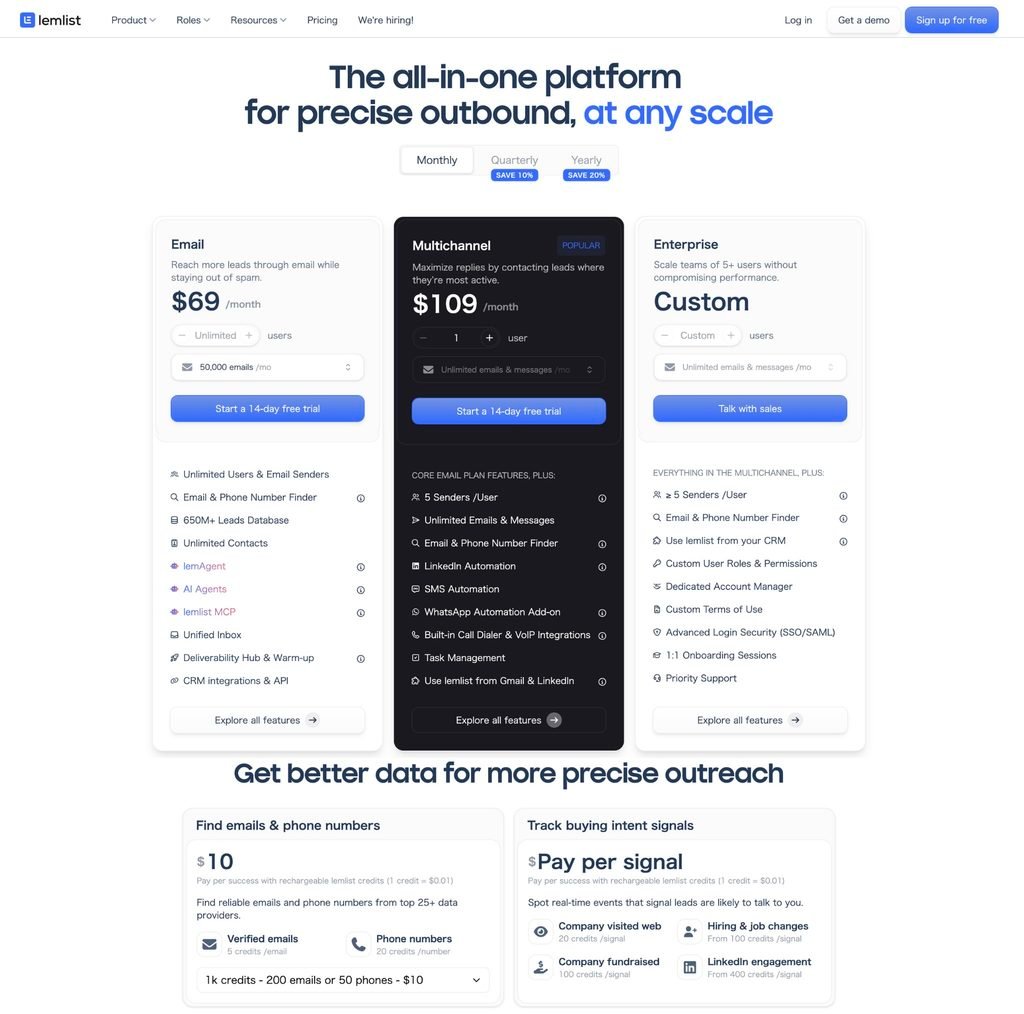
| Is the Email plan priced per user or per workspace? | lemlist | Plan card: “Unlimited users”, priced per month | Comparison table on the same page: “Email From $55 /user /mo” | Open conflict |
| How many sending accounts does one subscription cover? | Instantly | Pricing page and help center: unlimited email accounts | Terms of Service 2.2, updated 12 August 2026: a maximum of 100 Connected Accounts per workspace | Open conflict |
| How large is the lead database? | lemlist | Pricing page: 650M+ | AI-facing page: 600M+ · Help center plan guide: 450M+ | Three figures |
| Do I own a domain bought inside the product? | Instantly | Help center and agent-facing pricing page sell domains at $15 a year | Terms 4.6(g): no ownership, no right to transfer, port, or take control | Marketing against contract |
| Do I own a domain bought inside the product? | lemlist | Pricing page lists in-app domain purchase as included | Not addressed in the source set FSR reviewed | Source gap |
Each row reports what a document states. None of them establishes live checkout behavior, technical enforcement, or the terms of a negotiated order form. Sources appear in the sections below.
Contents
Is the lemlist Email plan seat-free?
lemlist’s pricing page shows the Email plan at $69 a month with a user selector reading “Unlimited”, a 50,000-email monthly cap, and “Unlimited Users and Email Senders” listed as an included feature.
The Help Center article on choosing a plan, dated 30 June 2026, agrees. It states that the Email plan is volume-based, that cost scales with how many emails the team sends per month rather than per seat, and that users and sending addresses are unlimited.
A second Help Center article, dated 22 July 2026, describes the product differently. It states that a seat is one user with the ability to send campaigns, that customers can invite unlimited users but only those with an active paid seat can send outreach, and that one seat equals one user equals one sender. It puts the Email plan inside that model by name, capping free guest seats at five on Email and Multichannel and describing them as an alternative to occupying a paid seat.
The tension also appears inside the June article. Its troubleshooting section states that the Email plan supports unlimited users, then adds that each person should have their own user seat, without saying whether such a seat is paid.
lemlist’s own pricing page lists, among its suggested questions, “Is the Email plan priced per user or per workspace?” The vendor is anticipating the question. Its documents do not yet answer it in one voice.
The question to send: on the Email plan, is the listed monthly price the entire platform fee for twenty people who each send campaigns, or does each sending user require a paid seat on top?
Sources: lemlist, pricing page, read 24 August 2026 · lemlist Help Center, how to choose a plan, 30 June 2026 · lemlist Help Center, understand seats in lemlist, 22 July 2026
Unlimited accounts and the second workspace
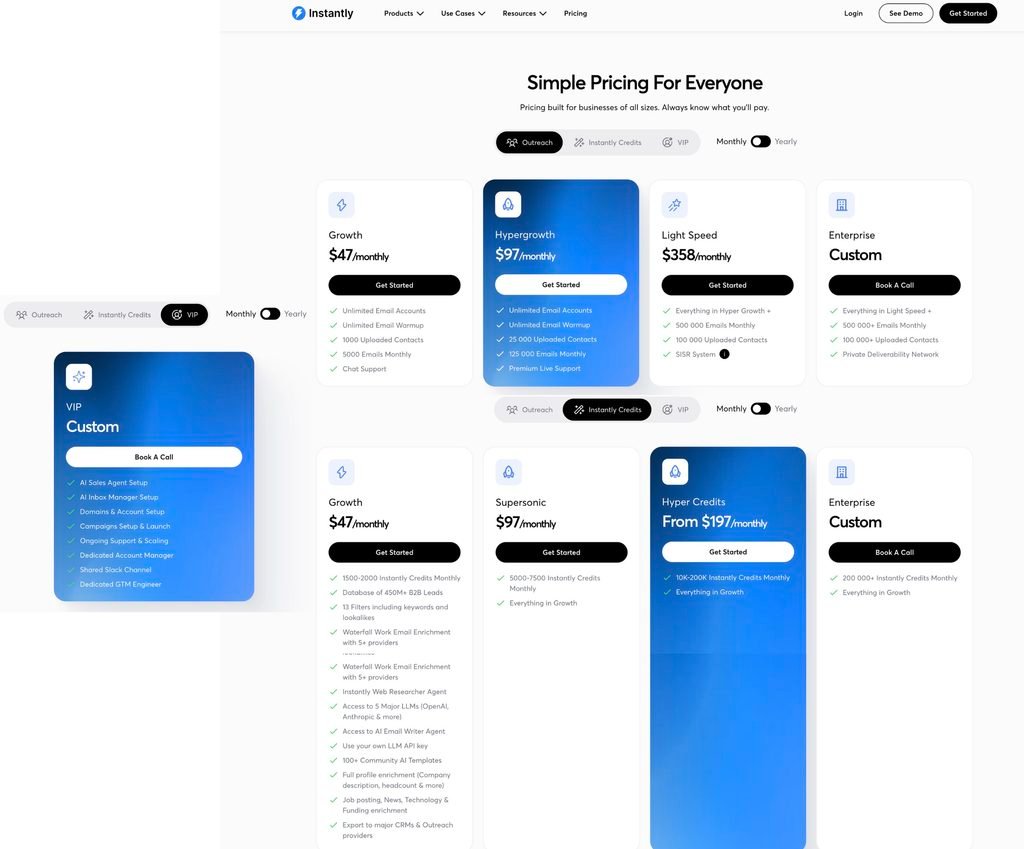
Instantly says email accounts are unlimited on three separate surfaces. The pricing page lists “Unlimited Email Accounts” on Growth, Hypergrowth, and Light Speed. The Help Center plans overview, dated 17 July 2026, describes the Email Outreach product as connecting and warming up unlimited email accounts. The billing and usage overview, dated 13 July 2026, repeats the same phrase.
Its Terms of Service, updated 12 August 2026, state at section 2.2 that Instantly currently offers a maximum of one hundred Connected Accounts per workspace, and that the subscriber agrees not to exceed that limit. The Terms are the most recently updated of those four documents.
The route past 100 is a second workspace, and that has a published price. Instantly’s Help Center states that each workspace requires its own subscription, that three workspaces mean three separate subscriptions to manage, and that an active Email Outreach plan is required to create a workspace at all. Its billing help article lists multiple workspaces as one of the common causes of charges customers do not recognize, alongside the note that active plans in different workspaces are billed separately.
FSR did not test what happens at the hundred-and-first account and cannot say whether “Email Account” and “Connected Account” are the same unit or whether support grants exceptions. The cost consequence stands on the documents alone. An operator planning 240 sending mailboxes cannot model that from the word unlimited, because the documented route past the ceiling is another subscription.
Sources: Instantly.ai, pricing page, read 24 August 2026 · Instantly.ai, Terms of Service section 2.2, updated 12 August 2026 · Instantly Help Center, manage workspaces and team members, 9 July 2026 · Instantly Help Center, understanding your billing and charges, 23 July 2026 · Instantly Help Center, plans overview, 17 July 2026
The $358 and $359 comparison
At the published 500,000-email tier the two monthly base prices are one dollar apart. Instantly Light Speed lists at $358. lemlist Email lists at $359.
| Emails per month | Vendor and plan | Monthly list price |
|---|---|---|
| 5,000 | Instantly Growth | $47 |
| 50,000 | lemlist Email | $69 |
| 100,000 | lemlist Email | $89 |
| 125,000 | Instantly Hypergrowth | $97 |
| 200,000 | lemlist Email | $159 |
| 500,000 | Instantly Light Speed | $358 |
| 500,000 | lemlist Email | $359 |
| 1,000,000 | lemlist Email | $659 |
Monthly billing, new-customer list prices as displayed on 24 August 2026, excluding tax. Regional pricing, currency, and logged-in state were not verified.
The base prices are comparable. The included units are not.
Instantly’s contact allowance is a standing ceiling rather than a monthly reset. Its Help Center states that the uploaded contact limit is fixed across all campaigns and not per month, so Light Speed’s 100,000 contacts is a total the account holds, not a monthly refill. Prospect data and AI actions are sold through a separate Instantly Credits subscription, and a Credits plan without an Email Outreach plan is limited to uploading 250 leads.
lemlist Email lists unlimited contacts, prices enrichment separately per successful action, and carries the unresolved sender-seat question above. lemlist also states that campaigns pause automatically when the team reaches its monthly email cap.
Treat the ladder as a base-price comparison and price the rest as separate lines.
Sources: Instantly.ai, pricing page, read 24 August 2026 · Instantly Help Center, plans overview, 17 July 2026 · lemlist Help Center, how to choose a plan, 30 June 2026 · lemlist, pricing page, read 24 August 2026
Name the action before you price the credit
Both platforms meter data and AI in credits. The word covers different billing events, so compare actions rather than credit balances.
lemlist fixes one credit at $0.01 on every plan. A verified work email costs five credits and a phone number costs twenty, and its pricing FAQ states credits are charged only when an action succeeds.
Instantly does not fix the credit price. It varies with which Credits subscription you hold.
| Instantly Credits tier | Monthly price | Credits included | Price per credit |
|---|---|---|---|
| Nano | $9 | 150 | $0.060 |
| Growth Credits | $47 | 1,500 | $0.031 |
| Supersonic | $97 | 5,000 | $0.019 |
| Hyper Credits | from $197 | 10,000 | $0.020 |
| Credits add-on | $425 | 50,000 | $0.0085 |
Price per credit is calculated by FSR from published prices and the lowest published credit count for each tier, which is the least favourable reading for the buyer. Neither figure is quoted by the vendor. The $425 entry is an add-on rather than a standalone plan: Instantly documents it as available for Hyper Credits and above. Nano appears in Instantly’s help center and its agent-facing pricing page but not on the pricing page itself. Instantly also documents that unused credits expire two months after purchase on monthly plans and one year on annual plans.
Two consequences follow. The same lookup costs roughly seven times more on the smallest tier than on the largest add-on, and the cheapest per-credit rate is reachable only by buying a qualifying subscription first. Instantly also publishes the work-email enrichment rate as approximately 1.5 credits per row, so the buyer multiplies an approximate quantity by a price that moves with the plan.
The billing trigger differs by action rather than by vendor. Instantly’s published rate card charges the AI Sales Agent five credits per lead generated and the AI Reply Agent five credits per reply generated, on generation rather than on approval or send. Price enrichment, AI generation, and intent signals as separate lines.
Sources: Instantly.ai, Instantly Credits tab, read 24 August 2026 · Instantly.ai, agent-facing pricing page and AI credit rate table, read 24 August 2026 · Instantly Help Center, plans overview, 17 July 2026 · Instantly Help Center, billing and usage overview, 13 July 2026 · lemlist, pricing page credits panel and FAQ, read 24 August 2026
Provisioned domains: title and access
Instantly sells sending infrastructure inside the product. Its help center and its agent-facing pricing page both list a domain at $15 a year, a done-for-you Airmail account at $4 a month, a done-for-you Google account at $5, and a pre-warmed Google account at $10. The billing help article adds that these renew on the fifteenth of each month and are billed separately from the main subscriptions.
Its Terms section 4.6(g) is headed “No Sale or Transfer of Ownership”. It states that Instantly registers, owns, controls, and operates that infrastructure under its own name and billing, that notwithstanding any reference to the purchase of accounts or domains the subscriber acquires no ownership and no right to transfer, port, migrate, or take control of it, and that on termination Instantly may disable, reclaim, repurpose, or retire it.
Legal title and daily access are separate questions, and the help center answers the second one differently. It documents downloading login credentials for done-for-you and pre-warmed Google accounts and managing domain forwarding. It also states that these subscriptions provide only domains and email accounts, and that without an Email Outreach plan the accounts pause automatically after the trial period. A buyer can therefore operate the mailboxes while holding no transferable title to them.
lemlist’s pricing comparison lists in-app domain purchase and in-app emails purchase as included capabilities. FSR reviewed lemlist’s pricing page, its Help Center plan and seats articles, and its data processing addendum page, and did not locate a statement addressing ownership or portability of infrastructure bought that way. That is a gap in the reviewed set, not a finding about lemlist.
Sources: Instantly.ai, Terms of Service section 4.6(g), updated 12 August 2026 · Instantly Help Center, plans overview, 17 July 2026 · Instantly Help Center, understanding your billing and charges, 23 July 2026 · Instantly.ai, agent-facing pricing page, read 24 August 2026 · lemlist, pricing page comparison table, read 24 August 2026
Three numbers for one database
lemlist publishes three different sizes for its lead database. The pricing page states 650M+. The page it publishes for AI assistants states 600M+. The Help Center plan guide states 450M+ when describing what the Multichannel Expert plan includes.
That third surface is worth naming, because lemlist links it in the site footer as structured data for LLMs and it carries one-click links to five AI assistants, each pre-filled with a prompt instructing the assistant to use that page as its source. FSR did not test what any assistant returns and draws no conclusion about intent. The narrow point is that a vendor-maintained page aimed at machines is one more surface capable of disagreeing with the pricing page, and it is the surface an assistant is being pointed at.
Instantly is consistent on the equivalent figure. Its pricing page, its help center, and its agent-facing pricing page all state 450M+.
Sources: lemlist, pricing page, read 24 August 2026 · lemlist, information page for AI and LLMs, read 24 August 2026 · lemlist Help Center, how to choose a plan, 30 June 2026 · Instantly.ai, pricing page, read 24 August 2026
Switching plans and leaving
The published exit terms deserve reading before the pricing.
lemlist states that the Email and Multichannel Expert plans cannot be used in the same team and cannot be switched directly, describing the button as greyed out. The documented options are creating a separate team and manually moving contacts, companies, and unsubscribed lists, or contacting support to escalate to Finance. Either way a fresh thirty-day billing cycle starts immediately. Downgrading an Email tier takes effect at the end of the period with no pro-rata refund, and existing Email Pro customers remain on their previous pricing.
Instantly states in its Terms that all fees paid are non-refundable and non-cancellable, covering subscription plans, credits, and add-on services, and that a subscriber may not re-subscribe to the same paid monthly plan within twenty-one days on the same account.
The manual movement of an unsubscribed list is the item to price. It is the one asset an outbound team cannot afford to reconstruct.
Sources: lemlist Help Center, how to choose a plan, 30 June 2026 · Instantly.ai, Terms of Service sections 5.1 and 5.3, updated 12 August 2026
What this audit did not establish
- Whether the lemlist Email plan charges for additional sending users, and which of its two Help Center articles governs a new signup today
- Whether Instantly’s 100-account ceiling applies to every account type, and what happens at the limit
- What a live checkout charges in any country, currency, or tax treatment
- Whether Instantly’s annual billing view and feature comparison table state the same email allowance as its monthly plan cards
- Whether lemlist’s Terms of Service have been updated to match its current plan pages
- What either vendor’s published agreements permit for secondary use of customer data, which needs a separate review of both agreements against both privacy policies
- Whether suppression and unsubscribe lists can be exported through either API, since neither developer documentation set addresses export mechanics
- Any deliverability, inbox placement, reply rate, campaign builder, reporting, or support quality for either product
Each of those needs an account, a checkout, or a written vendor answer. This briefing had none of them.
Sources: Instantly.ai developer documentation, read 24 August 2026 · lemlist developer documentation, read 24 August 2026
FAQ
Should I choose Instantly or lemlist?
This briefing does not name a winner, because the published documents do not settle the cost. Instantly’s account ceiling and lemlist’s sender-seat rule both change the price, and both are currently stated two ways. Get those two answers in writing first, then compare.
Is the lemlist Email plan really free of sender-seat charges?
The published documents conflict. lemlist’s plan guide of 30 June 2026 says the Email plan is billed by team sending volume rather than per seat, with unlimited users. Its seats guide of 22 July 2026 says only users with an active paid seat can send outreach, and names the Email plan when describing free guest seats. Ask before buying.
Can Instantly connect more than 100 email accounts?
Its pricing page and help center say accounts are unlimited. Its Terms, updated 12 August 2026, state a maximum of 100 Connected Accounts per workspace. Its help center states each workspace requires its own subscription, so the documented route past 100 involves a second subscription. FSR did not test enforcement.
Are the $358 and $359 plans economically equivalent?
No. They are advertised monthly base prices at the same email volume. Instantly sells its lead database and AI actions as a separate Credits subscription, and its uploaded contact limit is a fixed ceiling rather than a monthly reset. lemlist prices enrichment per successful action and its sender-seat treatment is unresolved. Neither figure includes sending infrastructure.
Do Instantly credits expire, and does the cheapest rate apply to everyone?
Instantly documents that unused credits expire two months after purchase on monthly plans and one year on annual plans. The price of a credit also varies by tier, from $0.060 on the smallest plan to $0.0085 on the 50,000-credit add-on, and that add-on is documented as available for Hyper Credits and above rather than as a standalone purchase.
Do I own a domain bought through Instantly?
Its Terms section 4.6(g) states the subscriber acquires no ownership and no right to transfer, port, or take control of Instantly-provisioned infrastructure, regardless of any reference to purchase. Its help center separately documents downloading mailbox credentials and managing forwarding, so operational access and legal title are not the same thing here.
Can lemlist Email and Multichannel Expert run in the same team?
lemlist states they cannot, and that switching directly is not available. The documented options are creating a separate team and manually migrating contacts, companies, and unsubscribed lists, or asking support to escalate to Finance. A fresh thirty-day billing cycle starts either way.
Which documents should procurement request before signing?
The terms of service, the data processing agreement, and a written answer on sending seats, workspace and account ceilings, credit-consuming actions, and infrastructure ownership. Ask which document governs if the plan page and the contract disagree, because on the items above they currently do.