Last updated: July 28, 2026
Evidence boundary. This is a Tier C, document-first review. No authenticated HeyGen observation is admitted, and no account action or product test was performed during this rebuild. FSR opened two public HeyGen pages from Japan on 28 July 2026 and recorded what they displayed. Vendor statements on those pages are official claims, not independent verification of how any account is billed.
HeyGen sells browser-based generation of avatar video, video translation and prompt-driven video projects. Its paid web plans issue a monthly balance of credits, and its pricing page publishes a per-minute credit rate for each of those workflows.
This review does not assess the video. It records what HeyGen’s Japan-facing pricing and API pricing pages published on 28 July 2026, works out what a buyer can and cannot calculate from them, and separates that from material FSR has not opened.
One finding stands out. The same generation capability is billed to two different balances depending on which authentication method an integration uses. HeyGen states this on its own API pricing page.
Read this if
- You need to convert a monthly credit allocation into a usable planning figure
- You are integrating HeyGen and choosing between MCP, Skills and the direct API
- You are buying from outside the United States and need to know what the page quotes
- You are writing a procurement memo and need the open items named
Skip this if
- You want to know whether the avatars look convincing
- You want a buy or do-not-buy recommendation
- You want generation speed, failure rate or support quality
- You want what a signed-in account actually shows or charges
At a glance
| Review depth | Tier C, document-first |
| Hands-on evidence | None admitted. No account action or product test was performed during this rebuild. |
| Pages opened by FSR | Two: the Japan-facing pricing page and the Japan-facing API pricing page |
| Observation | Japan, logged out, Japanese language, 28 July 2026, 02:16 to 02:17 JST |
| Out of scope | Signed-in screens, checkout, legacy plan cohorts, help-centre articles, Terms, output quality, speed, reliability, support |
| Question | What can a buyer calculate from the pages HeyGen puts in front of them? |
| Answer | A per-feature planning ceiling, yes. A monthly bill, no. |
What FSR opened
Two pages, both public, both viewed from Japan without signing in, both captured with the browser address bar and the system clock in frame.
The first is HeyGen’s Japan-facing pricing page. The second is its Japan-facing API pricing page. Everything in sections 2 through 7 comes from one of those two.
Nothing else was opened. FSR did not read HeyGen’s help centre, its terms, its legacy plan guidance or its product update posts during this rebuild. Claims from those surfaces sit in a separate research record, and section 8 lists the ones that matter without treating any of them as established.
This split is the point of a Tier C briefing. A reader should be able to tell which statements FSR checked and which it did not, without reading the methodology to find out.
Sources: HeyGen, Japan pricing page, observed 28 July 2026 · HeyGen, Japan API pricing page, observed 28 July 2026
What the pricing page publishes
The page presents four self-serve tiers and one sales-contact tier. Each paid tier carries a monthly credit allocation, and a pricing FAQ further down the page lists what those credits buy.
Plans as displayed, Japan, 28 July 2026
| Plan | Monthly price | Credits | Longest single video |
|---|---|---|---|
| Free | $0 | None listed. 3 videos per month | 1 minute |
| Creator | $29, or $24 billed annually | 600 | 30 minutes |
| Pro | From $49, up to $4,300 | 1,000 to 100,000 | 30 minutes |
| Business | $149, plus $20 per extra seat | 1,500 | 60 minutes |
| Enterprise | Contact sales | Not published | No stated maximum |
Prices as displayed on the Japanese-language page, in US dollars. The Pro ladder is published as its two endpoints only; intermediate tiers are not listed on this page.
The pricing FAQ then gives per-minute rates. These are the numbers a buyer needs, and they are the only place on the page where the credit currency is converted into anything concrete.
Published credit rates
| Workflow | Credits per minute |
|---|---|
| Avatar III | 3 |
| Avatar IV and Avatar V | 20 |
| Audio dubbing, no lip sync | 2 |
| Full video translation with lip sync | 5 |
| Video Agent | 20 |
Divide an allocation by a rate and a planning ceiling appears. That ceiling assumes the entire month goes to one workflow, which no real production schedule does, and it establishes nothing about actual deductions, rounding, retries or output a buyer would accept. Used with those limits in mind, it is still the most useful number the page yields.
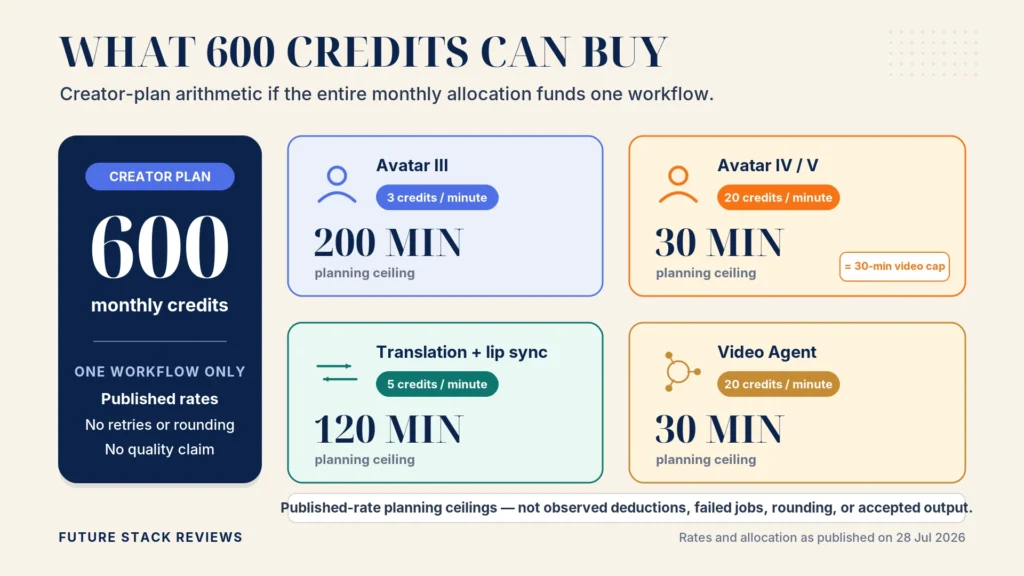
Minutes per month, whole allocation on one workflow
| Workflow | Creator, 600 | Pro entry, 1,000 | Business, 1,500 |
|---|---|---|---|
| Avatar III | 200 min | 333 min | 500 min |
| Avatar IV or V | 30 min | 50 min | 75 min |
| Audio dubbing | 300 min | 500 min | 750 min |
| Translation with lip sync | 120 min | 200 min | 300 min |
| Video Agent | 30 min | 50 min | 75 min |
Arithmetic on the published allocation and the published rate. Not a capacity claim, not a measurement, and not verified against any bill.
The Creator row deserves a second look. The page sets that plan’s longest single video at 30 minutes, and the same page’s rates put a full month of Avatar IV or V at 30 minutes. A Creator subscriber who works exclusively in the newer avatar engines has a monthly allocation equal to one maximum-length video.
The spread across the top two rows is the other thing worth carrying away. Moving from Avatar III to Avatar IV multiplies credit consumption by a factor of roughly seven for the same running time, and the pricing page markets Avatar IV access on every tier including Free. A buyer who assumes the newer engine and budgets with the older engine’s rate will be out by that factor.
Source: HeyGen, Japan pricing page, observed 28 July 2026
Two balances, one capability
HeyGen’s API pricing page carries a section on authentication. It names three integration routes, and it states plainly that the route chosen determines both how a developer authenticates and how the usage is billed.
Authentication decides the balance
| Method | Used for | Deducted from |
|---|---|---|
| OAuth 2.0 | MCP integrations. No API key. Requires an active web plan with premium credits | The web plan’s premium credit balance |
| API key | Skills and Direct API. Key issued from the dashboard settings | The API dashboard balance, separate from web plan credits |
Both routes reach avatar generation. The page’s pay-as-you-go card lists video generation on the Avatar III and Avatar IV engines, video translation, text-to-speech and Video Agent, and it lists MCP server access and Skills integration alongside them. The capability is common. The meter is not.
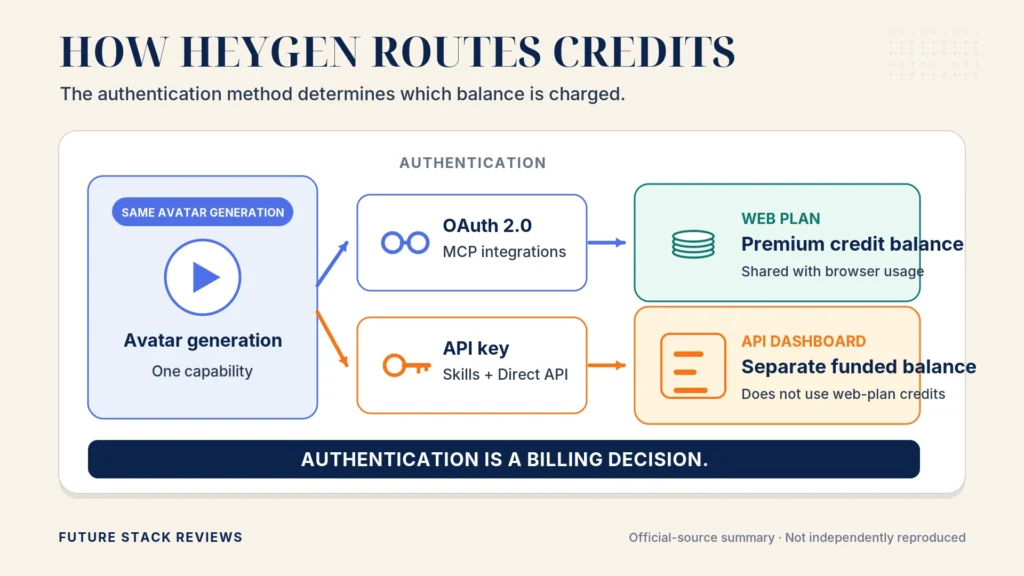
For a team building an integration, this converts a technical decision into a commercial one. Choosing MCP draws down the subscription that also funds the browser product, so automation and human production compete for the same monthly pool. Choosing an API key opens a second, separately funded balance that starts from $5 and leaves the subscription untouched. The same volume of work lands on different lines of the same company’s invoice depending on how the request was signed.
HeyGen documents both rules. It publishes them in adjacent cards on one page, in the plainest language on the site. What the page does not publish is a conversion between the two, and neither balance is expressed in the other’s units. A team cannot read this page and work out which route costs less for a given workload.
This is the structural finding of the review. Not a contradiction, not an error, and not hidden. Two meters for one capability, selected by an implementation detail, with no published exchange rate between them.
Source: HeyGen, Japan API pricing page, observed 28 July 2026
Video Agent: one rate, no mode
The pricing FAQ lists Video Agent at 20 credits per minute. It gives one figure and attaches no mode, tier or engine qualifier to it, while the entries above it in the same list separate Avatar III from Avatar IV and V, and separate lip-synced translation from audio-only dubbing.
That asymmetry is worth noticing rather than explaining. Every other rate on the page is qualified by which engine or which variant the buyer selects. Video Agent is not.
A buyer budgeting a prompt-driven video project therefore has one number and no way to tell from this page whether it applies to every configuration of the feature. Whether Video Agent has variants that meter differently is a question this page does not raise and does not answer.
Section 8 records what the wider research file suggests on that point. It is not established, and it does not change what the pricing page publishes.
Source: HeyGen, Japan pricing page, observed 28 July 2026
Running out, and rolling over
Two of the page’s FAQ answers govern what happens at the edges of a billing cycle, and both draw a line between tiers.
Exhaustion. The page states that Creator and Pro users who need more credits upgrade to a higher plan or tier. Business users have a second option: buy a one-off credit pack, or enable automatic reload. The smaller two self-serve tiers are not offered a top-up on this page.
The consequence for a Creator subscriber is a step, not a slope. Running out mid-month means moving to a plan that starts at $49 rather than adding a small amount of headroom at $29. The Pro ladder that receives them is published on this page as two endpoints, $49 for 1,000 credits and $4,300 for 100,000, with the tiers in between left unstated. A buyer cannot see from this page what the next step up from Pro entry costs.
Rollover. Unused credits on a monthly plan carry into the following month. On an annual plan they accumulate until the annual renewal date. The page also states that after cancellation credits do not carry over, and that credits from a prior cycle expire when a subscription is not active.
Annual billing therefore buys a longer runway as well as a lower monthly rate. A team whose production is seasonal, with quiet months and heavy ones, is treated differently by the two cadences, and the page says so.
Cancellation. Paid features and remaining credits stay available until the current billing cycle ends, after which the account moves to the Free plan and unused credits do not carry over. Downgrades and cancellations take effect at the end of the cycle. Upgrades take effect immediately, with proration and credits added on the spot.
Source: HeyGen, Japan pricing page, observed 28 July 2026
Dollar prices on a Japanese page
The pricing page renders in Japanese, at a Japanese-language URL path, and quotes every price in US dollars. The Business card reads $149 per month with $20 per additional seat. Creator reads $29. There is no yen figure anywhere on the page.
For a buyer paying with a Japanese card, three things follow that the page does not address. The dollar figure is not the amount that will be debited, because a conversion happens somewhere between the page and the statement. The page does not say whether Japanese consumption tax is added at checkout or already included. And it does not state which merchant of record processes the transaction.
None of that is unusual for a US software vendor selling internationally. It is still a gap between what the page shows and what the buyer pays, and it sits on a page localised into their language, which is where a buyer would reasonably expect the local currency to appear.
The same limit applies to this review. FSR did not reach a checkout screen, so the amount a Japanese buyer is actually charged is outside what this briefing can report.
Source: HeyGen, Japan pricing page, observed 28 July 2026
What these pages do not answer
Seven inputs affect a monthly bill and are not resolved by the two pages FSR opened.
Not answered by the observed pages
- Whether a failed or errored generation consumes credits
- How partial minutes round, and whether a 30-second clip bills as half a minute or a full one
- Whether generation and translation bill additively on the same clip
- How the Free tier’s trial access to premium engines is metered, given that no Free credit allocation is published
- What a credit is worth in cash, which any comparison between the web plan and the API balance would require
- Which of the Pro ladder’s intermediate tiers exist, and at what prices
- The checkout total for a Japanese buyer, including conversion, tax and merchant
This list describes the two pages FSR opened. It is not a claim that HeyGen publishes no answer anywhere. No exhaustive search of HeyGen’s documentation was performed during this rebuild, so these items are unresolved rather than documented as absent, and a buyer should treat them as questions to ask rather than as gaps to complain about.
The first two carry the most weight, because both concern behaviour that only becomes visible after money has been committed. A buyer evaluating the platform before purchase cannot observe either.
Sources: HeyGen, Japan pricing page, observed 28 July 2026 · HeyGen, Japan API pricing page, observed 28 July 2026
Claims FSR has not verified
Everything in this section is unverified. These items come from a compiled research file, not from a page FSR opened. They are recorded because they bear on the sections above and because a reader deserves to know they exist. None of them is evidence, and none is used anywhere else in this review.
A product update said to exempt some features from credits. The research file describes a HeyGen update dated 9 July 2026 placing Avatar III, audio dubbing and a Video Agent mode called Essential in a list of features that do not consume premium credits for paid users. FSR did not open that post. If it says what the file reports, it sits alongside a pricing page that was still publishing per-minute rates for two of those three workflows nineteen days later. That would be a question about which surface a buyer should follow, and it is the single most consequential item on this list.
Video Agent modes. The file describes named modes with separate rates, including Standard at 30 credits per minute and Seedance at 90, sourced to help-centre articles FSR did not open. The pricing page publishes one unqualified figure of 20. Whether these describe the same thing is unresolved.
Older Unlimited plans. The file describes plan products carrying the word Unlimited that were withdrawn from new sale in May 2026, with existing subscribers permitted to keep them. No such plan appears on the pricing page FSR observed, which is consistent with withdrawal but does not confirm the date, the retention rule or the cohort.
Custom avatar entitlements. The pricing page’s comparison grid shows one custom digital twin on Free and one or more on Creator and Pro, with Business at five. The research file reports a help-centre figure of five for Creator and Pro. Those do not agree, and FSR checked only one of them.
Everything else. Terms of service, privacy and biometric notices, the data processing addendum, security documentation, refund and cancellation help articles, and the affiliate programme were not opened during this rebuild. Any statement about them belongs to a separate briefing with its own evidence.
No source citation is given for this section. FSR did not open these sources, and citing them would imply otherwise.
What to verify before paying
These are checks a buyer should run. FSR did not perform them.
- Which avatar engine will the work actually use, and which rate applies to it?
- Does the intended monthly volume fit the allocation at that rate, with room for revisions?
- If the workflow mixes generation and translation, do both draw on the same allocation?
- Will the account be integrated, and if so through MCP or through an API key?
- Which balance does that integration route draw from, and is it funded separately?
- What is the charge in local currency at checkout, including tax and merchant?
- What happens on the plan when the allocation runs out mid-cycle?
- Which billing cadence suits the production pattern, given how rollover differs between them?
- Do failed or rejected generations consume credits, and does the vendor confirm that in writing?
Question nine is the one to send the vendor. It is not answered on the pages a buyer reads before purchase, and it is the item most likely to change a monthly figure after the card has been charged.
What this review does not establish
This Tier C review does not establish avatar realism, lip-sync quality, voice quality, generation speed, failure rate, support quality, actual credit deductions, refunds, cancellation behaviour or competitor performance.
Most of those require separate authenticated evidence. Output claims require controlled generations. Billing, refund, cancellation and support claims require separately logged workflows. None of that evidence is admitted here.
Nor does it establish what a buyer outside Japan sees. Every observation in sections 2 through 7 was made from one country, in one language, on one date, without signing in.
FAQ
What do HeyGen credits cost per minute?
The Japan pricing page observed on 28 July 2026 listed Avatar III at 3 credits per minute, Avatar IV and V at 20, audio dubbing without lip sync at 2, full translation with lip sync at 5, and Video Agent at 20. These are HeyGen’s published figures, not measurements of any account’s billing.
How many minutes does a month of credits buy?
There is no single figure. Creator’s 600 credits cover 200 minutes at the Avatar III rate or 30 at the Avatar IV rate. Dividing a published allocation by a published rate gives a planning ceiling for one workflow only, and establishes nothing about rounding, retries, failed jobs or usable output.
Does HeyGen’s API use the same credits as the web plan?
It depends on the authentication method. HeyGen’s API pricing page states that OAuth-based MCP usage is deducted from the web plan’s premium credit balance, while API-key usage for Skills and Direct API is deducted from a separate API dashboard balance. The page publishes no conversion between the two.
Can Creator or Pro buy extra credits without upgrading?
Not according to the observed pricing page. It states that Creator and Pro users move to a higher plan or tier for more credits, while Business users can buy one-off credit packs or enable automatic reload. Running out on the smaller tiers means a plan change rather than a top-up.
Do HeyGen credits roll over?
The observed page states that unused monthly-plan credits carry into the following month, and that annual-plan credits accumulate until the annual renewal date. It also states that credits do not carry over after cancellation, and that prior-cycle credits expire when a subscription is not active.
What does Video Agent cost per minute?
The observed pricing page lists one figure, 20 credits per minute, with no mode or engine qualifier attached. Every other rate in the same list is qualified by variant. Whether Video Agent has variants that meter differently is not addressed on that page.
Is HeyGen actually unlimited?
The pricing page FSR observed offers no unlimited generation plan. It attaches the word to specific entitlements such as photo avatars and voice cloning on paid tiers, while video generation itself carries per-minute credit rates on every listed plan. Claims about older Unlimited plan products are unverified here.
Does a Japanese buyer pay in yen?
Not according to the page. HeyGen’s Japanese-language pricing page quotes every plan in US dollars and shows no yen figure. It does not state whether Japanese consumption tax is added at checkout or which merchant processes the payment. FSR did not reach a checkout screen.
Methodology
This is a Tier C, document-first review. No authenticated HeyGen observation is admitted as evidence, and no account action or product test was performed during this rebuild.
What was opened. Two public HeyGen pages, viewed from Japan in a signed-out browser on 28 July 2026 between 02:16 and 02:17 Japan Standard Time: the Japanese-language pricing page and the Japanese-language API pricing page. Both were captured as screenshots with the browser address bar and the system clock in frame, and the pricing page’s text was extracted in full. The pricing page was reached through a link carrying advertising tracking parameters; its canonical path is recorded in the source list below.
What was not opened. HeyGen’s help centre, terms of service, privacy and biometric notices, data processing addendum, security documentation, product update posts, legacy plan guidance, status page and creator programme were not read during this rebuild. Statements attributed to those surfaces appear only in the section marked as unverified, and none of them supports a claim elsewhere in this review.
How statements are treated. A statement that a named page displayed a given figure to this observer on this date is a page-state observation. What that figure means for a live account is HeyGen’s stated position, not an independent verification of billing behaviour. The distinction is preserved throughout.
Scope of the observation. One country, one language, one date, one signed-out session. Nothing here describes what a buyer in another market sees, and nothing describes what appears after signing in.
On the previous version of this article. The earlier FSR article was used only as an audit target. Its product, price, performance and sentiment claims were not admitted as evidence or carried forward into this review.
Volatility. Prices, plans, allocations and feature availability are volatile. The evidence requires an authorised current recheck before publication or purchase.
Sources opened for this review
- HeyGen pricing, Japanese language edition. No page date displayed. Observed 28 July 2026, 02:16 JST, from Japan, signed out.
- HeyGen API pricing, Japanese language edition. No page date displayed. Observed 28 July 2026, 02:16 to 02:17 JST, from Japan, signed out.
No other HeyGen source was opened during this rebuild. Two sources is the complete list, and it is short by design.
Verdict
HeyGen publishes enough for a buyer to calculate a planning ceiling and not enough to forecast a bill.
The rates are there, clearly set out, and the arithmetic works. What the pages leave open is everything that happens around the edges of that arithmetic: what a failed job costs, how partial minutes round, what the Free tier’s premium access actually meters against, and what a buyer outside the United States is charged once conversion and tax are applied.
The integration decision is the sharper one. A team that reaches HeyGen through MCP spends its subscription credits. A team that reaches the same capability through an API key spends a separately funded balance. Neither page converts one into the other, so the cheaper route for a given workload cannot be determined from what is published.
For a buyer working in Avatar III at modest volume, none of this is likely to matter much. For a buyer standardising on the newer engines, building an integration, or planning localisation at scale, the open items are worth a dated written answer from the vendor before the first invoice rather than after.
This review does not establish whether HeyGen is worth buying. It establishes what the pages a buyer reads before deciding will and will not tell them.
Sources: HeyGen, Japan pricing page, observed 28 July 2026 · HeyGen, Japan API pricing page, observed 28 July 2026
Future Stack Reviews publishes structural audits of AI and SaaS products for technical buyers. This is a Tier C document-first review: no authenticated HeyGen observation is admitted as evidence, and no account action or product test was performed during this rebuild. Vendor statements are recorded as official claims, not independent verification of runtime behaviour. Pricing, plans and terms are volatile and the evidence was frozen as of 28 July 2026.