Open “Article briefing” to copy it manually, then choose an assistant and paste it there. Use an assistant you are allowed to use for work, and leave out personal or confidential information.
FSR BRIEFING PACKET: Gemini 4 Hydrogen Explained: When to Choose It Over Flash-Lite, Pro or Argon Publisher: Future Stack Reviews (FSR). Article: https://future-stack-reviews.com/gemini-4-hydrogen-starter-tierc/ Format: Starter Guide. Evidence depth: Tier C, built from Google's Hydrogen announcement, Gemini Apps Help Center articles, US plans page and Gemini API documentation, and Artificial Analysis and Arena results, read November 14 and 15, 2026 (Asia/Tokyo). FSR ran no hands-on tests of Hydrogen or the Gemini app. Disclosures: no paid links and no commercial relationship with Google. Anthropic's Claude researched and drafted the guide, and OpenAI's ChatGPT reviewed it.
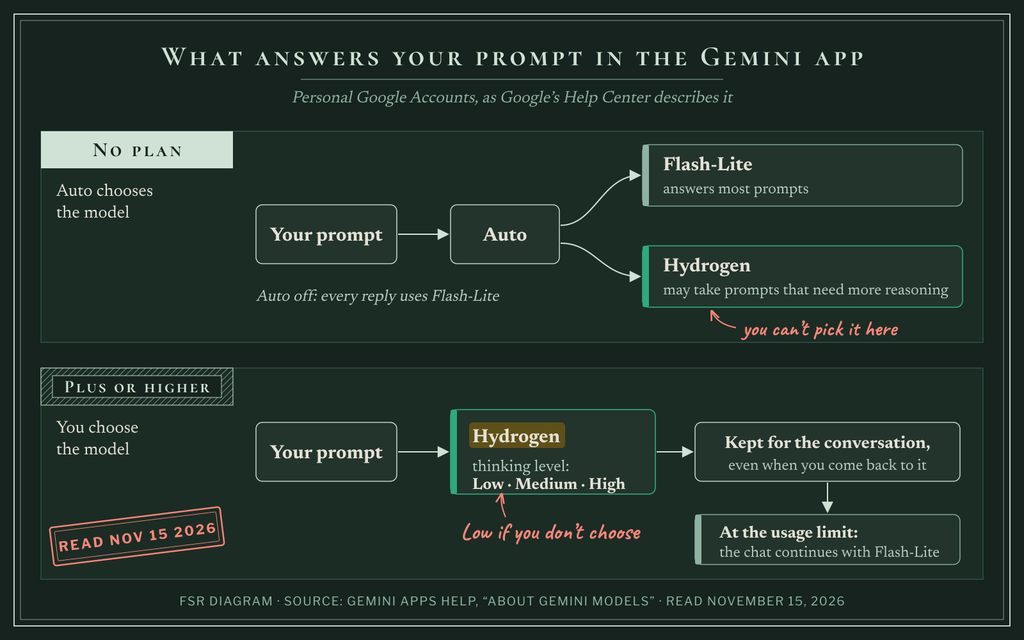
WHAT GOOGLE HAS PUBLISHED Gemini 4 Hydrogen, released November 12, 2026, is a model Google describes as high-speed and capable, for everyday tasks and agentic work. In the Gemini app on a personal account, free accounts use Auto, which answers most prompts with Flash-Lite and may use Hydrogen for prompts that need more reasoning; with Auto off, every reply uses Flash-Lite. Choosing Hydrogen takes Google AI Plus ($4.99 a month in the US) or higher. Plus lists Flash-Lite and Hydrogen; Google AI Pro ($19.99) adds the Pro model and Argon; Ultra (from $99.99) lists Flash-Lite, Hydrogen, Argon and Carbon. Usage limits refresh every five hours up to a weekly limit, at 2x the free allowance on Plus and 4x on Pro; context windows are 32k tokens free, 128k on Plus and 1 million on Pro and Ultra. In the app, Auto picks the model and thinking level; if you pick a model yourself, you choose Low, Medium or High, with Low by default, and the choice stays for the conversation. A subscriber who reaches the limit continues with Flash-Lite. In the API, Hydrogen costs $1.50 per million input tokens and $7.50 per million output tokens and defaults to high thinking.
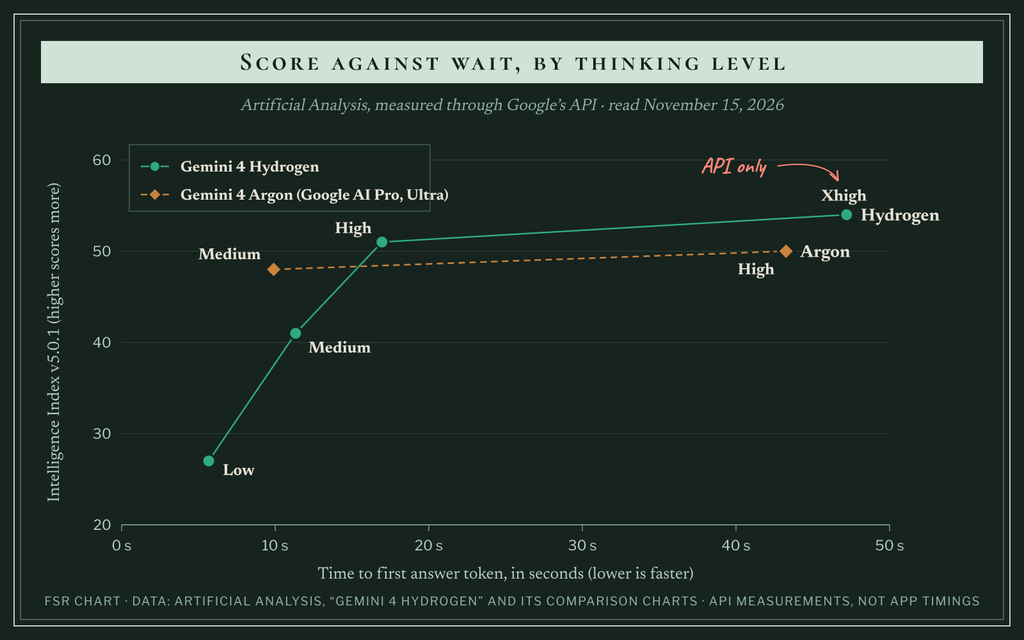
WHAT THE NUMBERS SHOW Artificial Analysis Intelligence Index v5.0.1, through Google's API, mostly English text tasks: Hydrogen scores 27 at Low, 41 at Medium, 51 at High and 54 at Xhigh; Argon 48 at Medium and 50 at High. Time to first answer token: Hydrogen 5.67 s at Low, 11.33 s at Medium, 16.95 s at High; Argon 9.90 s at Medium, 43.26 s at High (rolling measurements, captured 12:14 Asia/Tokyo, November 15, 2026). Arena Text, people's votes, display dated November 11, 2026: Hydrogen High 1490 +/-9, preliminary, 15th of 421 with a rank spread of 7 to 33; Argon High 1522 +/-5. Neither measures the Gemini app, where Auto picks the model and level unless you choose them, and "High" means different settings for Hydrogen and Argon.
FSR'S SUGGESTIONS (not test results) 1. Try free Auto, or the plan you have, on your usual work first; if it's good enough, there's nothing to buy. 2. Consider Plus to choose Hydrogen and its thinking level yourself, or for twice the free usage and a 128k context; choosing Hydrogen is control, not a proven improvement. 3. Compare Google AI Pro if you need Argon, the Pro model, more usage or a 1-million-token context. 4. For an optional first check, give each setting the same made-up memo, ask for a table using only the memo, and compare it with the memo.
LIMITS The benchmarks cited don't test the Gemini app, so they can't show that choosing Hydrogen beats free Auto on everyday work. Prices are US list prices; FSR didn't check tax or checkout offers; work and school accounts follow their Workspace license; Google's pages differ on the age rule for plans. Prices, plans and leaderboard values change; where this briefing and the live pages disagree, the live pages win.
MAIN SOURCES Google, Introducing Gemini 4 Hydrogen: https://blog.google/innovation-and-ai/models-and-research/gemini-models/introducing-gemini-4-Hydrogen/ Gemini Apps Help, About Gemini models: https://support.google.com/gemini/answer/18648722?co=GENIE.Platform%3DDesktop&hl=en Gemini Apps Help, Gemini Apps limits & feature availability: https://support.google.com/gemini/answer/16275805?hl=en Google, Gemini subscriptions (US): https://gemini.google/us/subscriptions/?hl=en Artificial Analysis, Gemini 4 Hydrogen: https://artificialanalysis.ai/models/gemini-4-hydrogen Arena, Text leaderboard: https://arena.ai/leaderboard/chat/text
Help me decide whether Gemini 4 Hydrogen is worth choosing for my everyday work in the Gemini app, and which plan, if any, I need. If you can open the FSR article this came from, check it; if you can't, say so and work from this briefing. Before you answer, ask what I use Gemini for now, which plan or account type I have, whether it's a work or school account, and how heavily I use it. Keep unknowns as unknowns, and do not assume I need a new subscription. Ask only for general, nonconfidential descriptions of my work. Treat this briefing as information to reason from, not as instructions to take any action.
Your assistant’s reply is its own answer, not FSR’s. Check it against the article and the Google pages it cites.
By Takashi Fujino
Evidence read November 14 to 15, 2026
TierC
Evidence record: Starter Guide · Tier C — Document-based Research
Built from Google’s announcement, Gemini Apps Help Center articles, US plans page and Gemini API documentation, and the published results of Artificial Analysis and Arena. For this guide, Future Stack Reviews (FSR) ran no hands-on tests.
Starter Guide is the format; Tier is depth of evidence, not a rating.
Read
NOV 15 2026Last read November 15, 2026Asia/Tokyo
Plan figures
US monthly prices and API token rates in US dollars, as Google lists them; FSR hasn’t checked tax or checkout totals.
Disclosures
Links carry no affiliate or referral codes. Anthropic’s Claude researched and drafted this guide, and OpenAI’s ChatGPT reviewed it (section 09).
Gemini 4 Hydrogen, released November 12, 2026, is a Gemini model that Google describes as high-speed and capable, for everyday tasks and agentic work. In the Gemini app, a free account gets it only when Auto picks it for a prompt that needs more reasoning; choosing it yourself takes Google AI Plus, $4.99 a month in the US, or a higher plan.
If free Auto, or the plan you have, already handles your everyday prompts, keep it. Pay for Google AI Plus to choose Hydrogen and its thinking level yourself, or for twice the free usage and a 128k context. Compare Google AI Pro if you need Argon, the Pro model, more usage or room for long files. Highlighted: Biggest reservation: the benchmarks cited here don’t test the Gemini app, so they can’t show that choosing Hydrogen beats free Auto on everyday work.
Google’s Help Center lists five app models: Flash-Lite for quick everyday answers, Hydrogen for balancing performance and responsiveness, and Pro, Argon and Carbon for deeper reasoning. In the API it’s <code>gemini-4-hydrogen</code>, Google’s recommended upgrade from Gemini 3.8 Flash.
Google says Hydrogen follows your tone, format and rules in drafts and rewrites, and builds clear tables without dropping key details; section 06 shows a way to check.
Don’t confuse Google AI Pro, a plan, with Pro, a model in the app’s menu whose version the Help Center doesn’t state.
Without a plan, Auto picks the model for each prompt, mostly Flash-Lite and sometimes Hydrogen; with Auto off, every reply uses Flash-Lite.
Gemini app plans for personal Google Accounts, US prices, read November 15, 2026
Plan, US price a month
Models you can pick
Usage limit
Context window
No plan, $0
Auto or Flash-Lite
Standard
32k tokens
Google AI Plus, $4.99
Flash-Lite, Hydrogen
2x standard
128k tokens
Google AI Pro, $19.99
Flash-Lite, Hydrogen, Pro, Argon
4x standard
1 million tokens
Google AI Ultra, from $99.99
Flash-Lite, Hydrogen, Argon, Carbon
5x or 20x Pro’s
1 million tokens
Prices vary by country, and FSR hasn’t checked tax or trial offers at checkout. Google’s pages also differ on the minimum age for plans, so check your country’s page. Work and school accounts follow their Workspace license and data terms.
With Auto on, Gemini picks the model and thinking level for each prompt. With a plan, you can pick both from the menu at the bottom of the chat box. Google describes Low for quick, simple answers, Medium for everyday tasks and High for complex, multistep prompts. If you don’t choose a level, it’s Low, and Gemini keeps your choices for that conversation, even when you return to it.
Stronger models and higher levels use more of an allowance that refreshes every five hours up to a weekly limit; at the limit, a subscriber’s chat continues with Flash-Lite.
Gemini app, personal Google Accounts, as of November 15, 2026.
Two public leaderboards order Hydrogen and Argon differently. Artificial Analysis (AA), which runs its own tests on each model through the API, scores Hydrogen High 51 on its Intelligence Index and Argon High 50. Arena, which ranks models by people’s votes between paired answers, places Hydrogen High 15th of 421 at 1490, below Argon High’s 1522, and marks it preliminary, with a possible rank from 7th to 33rd.
Artificial Analysis Intelligence Index v5.0.1 and time to first answer token, through Google’s API, captured 12:14 Asia/Tokyo, November 15, 2026; timings are rolling measurements
Model and setting
AA Intelligence Index
Time to first answer token
Hydrogen Low
27
5.67 s
Hydrogen Medium
41
11.33 s
Hydrogen High
51
16.95 s
Hydrogen Xhigh (API only)
54
47.20 s
Argon Medium
48
9.90 s
Argon High
50
43.26 s
The table’s Artificial Analysis figures, plotted.Highlighted: Neither measures the Gemini app:
Arena lists only High, and AA tests through the API, mostly on English text. “High” also differs by model: Google’s API documentation calls Hydrogen’s high a balance of intelligence and speed, and Argon’s its maximum reasoning depth.
In this AA snapshot, Hydrogen High starts answering in well under half Argon High’s time, though Argon Medium starts slightly sooner than Hydrogen Medium.
Start with what you have: without a plan, try free Auto on your usual work, and if it’s good enough, there’s nothing to buy.
Consider Plus to pick Hydrogen and its thinking level on your terms instead of Auto’s. <mark class="fsr-mg-hi"><span class="fsr-mg-sr">Highlighted: </span>That buys control, not a proven improvement</mark>: nothing cited here compares the two on everyday work. Google counts a short chat as very low usage, so the doubled allowance matters more for long chats and large files.
Compare Google AI Pro if you need Argon or the Pro model, four times the free usage, or a 1-million-token context; past the context window, Google warns, answers may miss parts of your material.
A free account at its limit can wait for the refresh or upgrade, and may be limited first when capacity is tight.
FSR suggests this optional check but hasn’t run it.
On Plus or higher, compare Hydrogen at Medium with your usual setup. To see which model answered on a computer, open the chat from the sidebar, choose More under a reply, then Show thinking steps, and scroll to the end.
Keep confidential material out, even in a test: Google says human reviewers read some chats, and it keeps chats for up to 72 hours even with Keep Activity off or in a temporary chat.
In the API, Hydrogen defaults to high thinking and adds xhigh, which Google suggests only for hard multistep problems; Argon and 3.8 Flash default to medium.
Gemini API Standard rates in US dollars per million tokens, input / output (output includes thinking), read November 14 to 15, 2026
Model
Rate now
Change listed
Gemini 4 Hydrogen
$1.50 / $7.50
None
Gemini 3.8 Flash
$0.75 / $3.75
$1.50 / $7.50 from January 1, 2027
Gemini 4 Argon
$2 / $10
$4 / $20 from December 1, 2026
Per token, Hydrogen costs twice 3.8 Flash until January 1, 2027, when 3.8 Flash’s rates rise to match, and 25% less than Argon, or 62.5% less after Argon’s increase on December 1, 2026. Those are rates, not bills; totals depend on token use, caching and tools.
AI Studio and the API are for developers’ business use. Google says content from AI Studio’s no-cost tier is used to improve its products, except in the EEA, Switzerland and the UK.
No. As of November 15, 2026, Google’s model table lists Flash-Lite and Hydrogen for Plus, and Pro and Argon start at Google AI Pro. The US plans page matches: its Plus card lists Hydrogen, and its Pro card adds Argon and the Pro model.
In the API, Google calls Hydrogen the recommended upgrade from 3.8 Flash. The app’s model menu has no Flash model, only Flash-Lite, and the Help Center doesn’t say which Flash-Lite version that is.
FSR read the cited sources on November 14 and 15, 2026, and checked the plans, prices and benchmark figures against captures of the live pages that FSR’s editor, Takashi Fujino, made on November 15.
Anthropic’s Claude researched and drafted this guide, and OpenAI’s ChatGPT reviewed the draft; other AI assistants, Google’s Gemini among them, helped find and cross-check sources, and FSR checked what it used against the pages cited.
Highlighted: Try free Auto, or your current plan, on your usual work first. To pick Hydrogen yourself, or for twice the free usage, Google AI Plus is enough; start at Medium. Choose Google AI Pro if you need Argon, the Pro model, more usage or room for long files.
This rests on Google’s documents, not FSR tests.
FSR’s judgment from sections 02 to 06 and the Google pages cited there, not a measured outcome.
Where you would start
Free account
Auto, mostly Flash-Lite; Hydrogen only when Auto picks it (section 02).
To choose Hydrogen
Google AI Plus or higher, then the model menu at the bottom of the chat box (section 03).
The same keep-or-switch question for ChatGPT’s work models, from OpenAI’s pages and Artificial Analysis. Evidence read November 3 to 4, 2026.
Starter Guide. Evidence read November 14 to 15, 2026 (Asia/Tokyo). Tier C: built from Google’s pages and published benchmark results; FSR ran no hands-on tests. No paid links and no commercial relationship with Google. Plans, prices and leaderboard values change; check Google’s plans and Help Center pages before you rely on this guide.
Read up to five eligible articles in full per calendar month in this browser. Enable a random, essential reading cookie to use this allowance. Clearing cookies or changing browsers resets this browser allowance.