
CallRail is the default call tracking tool for agencies and local businesses across the US. It has 225,000+ customers, a 4.5/5 on G2, and starts at $45/month. That last number is technically accurate and practically meaningless, because the actual invoice for a working setup looks nothing like the pricing page.
TL;DR // BRIEFING SUMMARY
CallRail is not an AI platform. It is a call tracking and marketing attribution tool — and a very good one. The base product ($45/mo) does exactly what it promises: tie phone calls back to ad campaigns. The problem is the pricing ladder. AI features like transcription, sentiment analysis, and call summaries are locked behind $90–$195/mo tiers, and overage fees on minutes and phone numbers push real invoices well beyond the sticker price.
Buy it if: You run an agency, law firm, or home services business where phone calls = revenue, and you need to prove which ads are working.
Skip it if: You’re a SaaS company, e-commerce brand, or any business that converts online. CallRail can’t track what it can’t hear.
The correct move: Start with the $45 Call Tracking plan. Run it for 30 days. Look at your actual call volume. Only upgrade to Conversation Intelligence if you’re processing 200+ calls/month and can’t manually review them.
What CallRail Actually Is (And What It Isn’t)
CallRail is a call tracking and lead attribution platform, founded in 2011 in Atlanta by Andy Powell and Kevin Mann. Both are Georgia Tech grads. The origin story is oddly specific: Powell ran an online directory of BMW repair shops and needed a way to prove that his website was actually generating phone calls. That frustration became a company that now serves 225,000+ businesses.
The core product connects tracking phone numbers to marketing channels. You assign numbers to Google Ads, Facebook, billboards, yard signs, whatever you’re running, and CallRail shows you which channel generated each call. It records calls, transcribes them on higher plans, and pushes that data into your CRM, Google Analytics, or ad platform.
CallRail’s recent marketing pushes “AI-powered lead intelligence” hard. There are AI features: call summaries, sentiment analysis, keyword spotting, automated lead scoring. But all of these live in the $90–$195/month tiers. The base product is a data pipeline that connects offline voice interactions to digital ad clicks, and it does this well. It’s been doing this for 14 years. The AI is a layer on top, not the foundation.
One thing worth knowing upfront: CallRail is not a phone system. The company shut down its VoIP product (Lead Center) on January 27, 2026, confirmed on their own support page. So if you need a business phone line alongside call tracking, you’ll be pairing CallRail with something like RingCentral or OpenPhone. CallRail handles the tracking and analytics. The actual phone infrastructure lives somewhere else now.
Company stats for context: $132M raised from Sageview Capital and Leaders Fund, $100M ARR hit in 2024, PhoneWagon acquired in May 2021. Mature company, stable product, not going anywhere.
The CallRail Pricing Reality
This is where every other review fails you. They screenshot the pricing table from callrail.com and move on. That tells you nothing about what you’ll actually pay.
Two Plan Lines Running at the Same Time
CallRail currently sells two parallel pricing structures. A legacy “Call Tracking” family and a newer “Lead Engagement” family. Both are live on the pricing page right now, and nobody else reviewing this product is explaining the distinction.
// CALL TRACKING LINE (LEGACY)
| Plan | Price | Numbers | Minutes | Transcription |
|---|---|---|---|---|
| Call Tracking | $45/mo | 5 local | 250 local | ❌ |
| CT + Conversation Intelligence | $90/mo | 5 local | 250 local | 7,500 min |
| CT + Form Tracking | $90/mo | 5 local | 250 local | ❌ |
| CT Complete | $175/mo | 5 local | 250 local | 10,000 min |
// LEAD ENGAGEMENT LINE (NEWER)
| Plan | Price | Numbers | Minutes | Transcription | Analysis Min |
|---|---|---|---|---|---|
| Lead Tracking | $50/mo | 5 local | 250 local | 250 min | ❌ |
| Lead Tracking Complete | $95/mo | 5 local | 250 local | 250 min | ❌ |
| Lead Conversion | $150/mo | 5 local | 250 local | 10,000 min | 2,500 min |
| Lead Conversion Complete | $195/mo | 5 local | 250 local | 10,000 min | 2,500 min |
Source: callrail.com/pricing, April 2026. Every plan includes 5 local numbers and 250 local minutes. Annual billing saves ~10% but is non-refundable.
The Overage Fees Nobody Mentions
Every plan includes just 5 local numbers and 250 local minutes. After that, the meter starts running.
Additional local numbers cost $3/number/month. Toll-free numbers run $5. Extra local minutes are $0.05 each, toll-free minutes $0.08. SMS adds $0.03/message, and form submissions beyond your plan’s cap cost $0.02 each.
The detail that trips people up: calls are rounded up to the nearest minute. If a call lasts 1 minute and 3 seconds, you’re billed for 2 minutes. Across hundreds of calls per month, that rounding adds up faster than you’d expect.
What You’ll Actually Pay: Three Real Scenarios
Forget the pricing page. Here’s what your invoice actually looks like.
// REAL COST SCENARIOS
| Scenario | Advertised | Real Monthly Cost | Gap |
|---|---|---|---|
| Solo plumber 5 numbers, 200 calls/mo, avg 2 min/call | $45/mo | $52–63 | +$7–18 |
| Agency, 20 clients 10 numbers each, 500 total calls/mo | $45/mo | $1,200+ | +$1,155 |
| Healthcare practice HIPAA required, 15 numbers, 300 calls/mo | $45/mo | $197–213 | +$152–168 |
Agency calculation: 20 accounts × $45 base + 100 extra numbers × $3. Healthcare: $150/mo HIPAA floor + 10 extra numbers + minute overages. Per-minute overage assumes average 2–3 minute billed call duration.
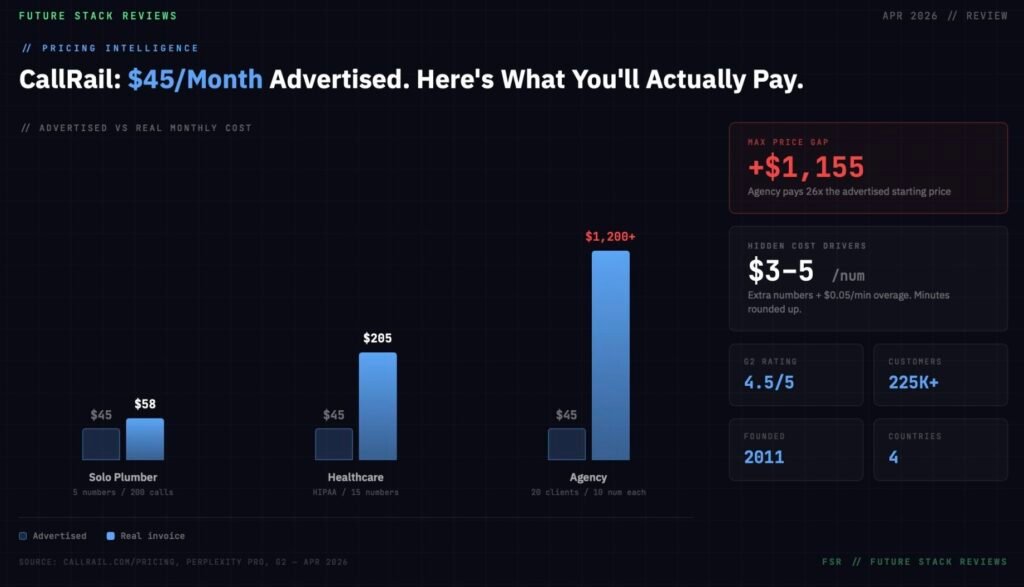
The solo local business scenario is manageable. $52–63/month for reliable call attribution is a fair deal. That’s roughly the cost of two bad leads from an untracked ad campaign.
The agency math is where things break. CallRail charges per account, and each client needs their own. Twenty clients on the base tier with 10 numbers each runs $1,200/month before adding a single AI feature. Agencies with 30 or 40 clients can do the multiplication themselves.
Healthcare is its own problem. The advertised $45/month doesn’t exist in HIPAA-compliant form. Healthcare plans floor at $150/month with a mandatory Business Associate Agreement. Standard plans cannot legally handle protected health information. On top of that, if you need downstream HIPAA-safe marketing data workflows, the Freshpaint integration (healthcare plans only) is a separate vendor cost that CallRail’s pricing page doesn’t mention.
One more thing about billing: annual plans save roughly 10%, but they’re non-refundable. You cannot switch back to monthly or cancel early once you commit. If you’re evaluating CallRail for the first time, pay monthly until you’re certain it fits.
Who Should Buy CallRail
CallRail’s own signup form lists 16 industry options. That dropdown tells you more about their ideal customer than their marketing page does. The list includes: Advertising and Marketing, Automotive, Business Services, Education, Financial Services, Healthcare, Home Services, Legal, Manufacturing, Real Estate, Real Estate Investor, Retail, Software and Technology, Travel and Hospitality, and Other.
Two things stand out. Real Estate and Real Estate Investor are separate categories, which tells you how deep that vertical runs for CallRail. And Home Services, Legal, and Healthcare each get dedicated entries. These are all phone-first industries where a missed call is a lost job, a lost case, or a lost patient.
Home services (HVAC, plumbing, roofing, electrical) is CallRail’s clearest sweet spot. You’re running Google Ads, maybe Local Services Ads, maybe a yard-sign campaign or two. You need to know which of those made the phone ring, and right now you probably don’t. CallRail’s own data says 30% of calls to service businesses go unanswered. If you’re spending $3,000+/month on ads and can’t tell which campaigns are generating real calls versus tire-kickers, the $45 base plan pays for itself inside a month.
Law firms are a different use case. Intake is the whole game for PI, family, criminal defense, and mass tort practices. A missed call from a car accident victim at 11pm is a case worth tens of thousands that just walked to your competitor. CallRail’s call recording and transcription (on the $90 tier) make intake auditable. The firm can review what the receptionist said, what questions got asked, and whether the lead was properly qualified. For practices buying expensive PPC leads at $100–300 per click, knowing which keywords generated actual signed clients isn’t optional.
Marketing agencies get the most visible value from CallRail’s Account Center, white-label reporting, and per-client dashboards. The tool exists to help you prove ROI to clients, and it’s good at that. The catch is scale economics. Run the math on your client count before committing. Fifteen clients at $45 base plus number overages is already $800+/month. If your primary need is proving to clients which channels generated leads rather than deep call analysis and recording, take a hard look at WhatConverts first. It starts at $30/month and was built for exactly that reporting use case.
Healthcare and real estate both work on CallRail, with caveats. Healthcare requires the $150/mo Healthcare Plan with BAA, period. Standard plans are non-compliant and not worth the risk. Real estate works well for brokerages and investors with mixed online/offline lead gen (ads, signs, portal listings), but if all your leads come through a single portal and get managed entirely inside a CRM, the tracking layer adds cost without much insight.
Who Should Not Buy CallRail
⚠ WRONG FIT ALERT
CallRail tracks phone calls. If your business converts through self-serve checkout, trial signups, in-app purchases, or online forms without phone follow-up — CallRail is the wrong tool. Don’t buy a call tracker for a business that doesn’t get calls.
SaaS companies should look elsewhere entirely. Your conversion funnel is product-led: trials, activations, upgrades, churn. The tools that matter are Mixpanel, Amplitude, or PostHog. The one exception is B2B SaaS that closes enterprise deals through phone demos and sales calls. In that narrow case, CallRail can work as a supplement, but it’s never the primary analytics platform.
E-commerce brands have attribution solved by other tools. Triple Whale, Northbeam, or your ad platform’s built-in conversion tracking already handle the “which ad drove this purchase” question. Unless you’re running a catalog business or selling high-ticket custom products that require phone consultation before purchase, CallRail adds a line item to your P&L without adding insight to your funnel.
Anyone outside the US, Canada, UK, or Australia should know that CallRail only officially supports these four countries. We tested this directly: registering from Japan immediately flagged the account as “pending” with a manual review requirement. The product works for those four markets. If yours isn’t one of them, look at alternatives with broader international coverage.
And if you’re a solopreneur getting fewer than 50 calls a month from a single ad channel, just ask callers how they found you. It’s free and it works fine at low volume. CallRail’s value appears when manual tracking becomes impossible, which usually happens around 100+ calls per month across three or more marketing sources.
The AI Features: Expensive or Worth It?
CallRail markets around AI more aggressively every quarter. Whether that marketing matches reality depends entirely on your call volume.
Call Transcription comes at the $90/mo tier and is the most broadly useful AI feature in the platform. Every call gets automatically transcribed with keyword highlighting and searchable text. An agency managing 10+ clients and hundreds of calls per month saves real hours of manual review here. But a solo contractor getting 30 calls a week doesn’t need automatic transcription. Listening to a 2-minute recording is faster than reading the transcript, and call recording is available on the base plan.
Call Summaries and Sentiment Analysis require the $175/mo+ Complete tiers. These condense long conversations into quick-read summaries and tag whether the caller sounded positive, negative, or neutral. The use case is clear: high-volume call centers doing quality assurance across dozens of reps. For a business where the owner answers most calls personally, spending an extra $85/month to get a summary of conversations you already had doesn’t make financial sense.
Voice Assist is CallRail’s newest bet. It’s an AI agent that answers calls, qualifies leads, and captures information after hours. Pricing is $95/month on top of your base plan, so you’re starting around $140 before overages. The concept solves a real problem. The execution is still catching up. Early user reports on X and Reddit describe unnatural voice quality and a tendency to repeat questions when the conversation goes off-script. For after-hours lead capture, a dedicated answering service or even a well-configured voicemail-to-text setup might deliver more reliable results until Voice Assist has a few more update cycles behind it.
Automated Lead Scoring and Conversion Tagging live on the $150+/mo Lead Conversion plans. The system auto-classifies calls as qualified or not based on conversation content. This is where CallRail’s AI adds something you can’t easily replicate manually, but only if you’re drowning in call volume. Businesses under 500 calls per month can tag leads manually in the CallRail dashboard. It takes maybe 10 minutes a day.
// INTEL: THE AI UPGRADE RULE
Only upgrade to an AI tier if you can answer “yes” to both: (1) Do you process 200+ calls per month? (2) Is manually reviewing calls costing you more than $45/month in labor time? If either answer is no, the base $45 plan does the job.
CallRail vs. The Field
CallRail isn’t the only call tracking option, and depending on what you actually need, it might not be the best one.
CallTrackingMetrics (CTM) is the closest head-to-head competitor. It starts at $79/month, which is $34 more than CallRail’s base. But CTM doubles as a business phone system with softphone, outbound dialing, live team dashboards, and contact-center routing. If your sales team lives on the phone and you want attribution plus a full comms platform in one tool, CTM is worth the higher entry price. CallRail’s advantage over CTM is simplicity. If all you need is marketing attribution and don’t want to manage a phone system, CallRail is the leaner option.
WhatConverts starts at $30/month and targets a specific niche: agencies and PPC teams that need to show clients proof of which channels generated leads. It’s not trying to be a call-center tool or an AI analytics engine. It’s a reporting machine. A lot of agencies that outgrow CallRail’s per-account pricing model (or never needed deep call analysis in the first place) end up here. Worth evaluating before committing to CallRail if client-facing lead reports are your primary need.
Invoca doesn’t publish pricing and operates on a sales-led model aimed at enterprises. If you’re reading individual SaaS reviews to decide whether call tracking is worth trying, Invoca is probably a tier above your current scale. It’s built for brands with multi-location operations, large contact centers, and phone revenue in the millions.
Nimbata starts at $39/month and offers a free tier, which CallRail doesn’t. The real differentiator is billing model: Nimbata charges per answered call instead of per minute. For businesses with long phone conversations (legal consultations, healthcare intake calls, real estate walkthroughs that run 15-20 minutes), Nimbata’s model can save serious money compared to CallRail’s per-minute overages with rounding.
For a full side-by-side breakdown, we’re publishing a dedicated comparison: [CallRail Alternatives]
Final Verdict: The Correct Way to Buy CallRail
// FSR VERDICT
Rating: 7.5/10
CallRail is a mature, reliable call tracking platform that does its core job well. The attribution engine is proven across 225,000+ businesses and 14 years of operation. The integrations with Google Ads, HubSpot, and Salesforce are tight. G2 users rate it 4.5/5 across 1,600+ reviews, and that reputation was built on the tracking product, not the AI upsells.
Where it loses points: pricing complexity with two parallel plan lines that confuse new buyers, AI features locked behind expensive tiers, per-account billing that punishes agencies at scale, and a VoIP product that got discontinued in January 2026. The gap between the “$45/month” headline and the real invoice is wider than it should be for a product this established.
CallRail is not the cheapest call tracking option. And for agencies at scale, the per-account model makes it one of the most expensive. But for US-based agencies and local service businesses that need Google Ads call attribution with proven CRM integrations, it remains the default — as long as you buy the right tier and resist the AI upsell until your call volume actually demands it.
Here’s how to buy it without overspending.
Start with the 14-day free trial. No credit card, no commitment. Use those two weeks to verify that CallRail connects properly to your CRM, Google Ads, and whatever else you’re running. If the integrations don’t work, nothing else matters, and you’ll know before paying anything.
After the trial ends, pick the $45/month Call Tracking plan. Not Lead Tracking, not Conversation Intelligence. The base. Five numbers and 250 minutes is enough for most businesses to get a real picture of what their call volume looks like inside the platform.
Run it for a full billing cycle and check the invoice. How many minutes did you actually use? Did you need more than 5 numbers? What did the overages look like? This is the data you need before making any upgrade decision.
If you’re consistently blowing past 250 minutes and your team is spending real time manually reviewing call recordings, the $90 Conversation Intelligence tier is a justifiable upgrade. If you’re not, stay on the base. The AI features are useful at scale. At low volume, they’re a tax on curiosity.
And don’t sign an annual plan until you’ve been on monthly billing for at least 90 days. The 10% discount is real but the commitment is non-refundable. Three months of data tells you whether CallRail is a permanent tool or a temporary experiment.
